Unmanned Aerial Vehicle ((UAV))
UAV Presented By: Alexander Mohamed Osman Riyad Ahmed El-laithy Ruyyan Ahmed El-laithy Peter Raouf Zaki
Introduction What are UVs ? What are UAVs ? Types of UAVs Fixed wing UAV Helicopter UAV Quadroter UAV
Quadrotor Advantage Over Fixed-Wing Vehicle Less design complexity. Minimal space for take-off and landing. A VTOL vehicle.
Quadrotor Advantage Over Helicopter Quadrotors do not require mechanical linkages.  T he use of four rotors allows each individual rotor to have a smaller diameter than the equivalent helicopter rotor .
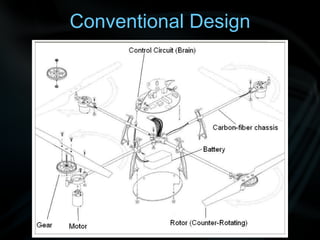
Conventional Design
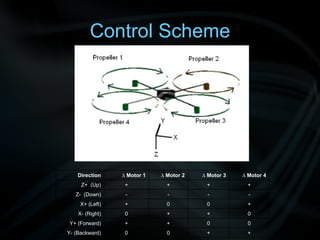
Control Scheme Direction ∆  Motor 1 ∆  Motor 2 ∆  Motor 3 ∆  Motor 4 Z+  (Up) + + + + Z-  (Down) - - - - X+ (Left) + 0 0 + X- (Right) 0 + + 0 Y+ (Forward) + + 0 0 Y- (Backward) 0 0 + +
Materials used in building the Prototypes  Balsa wood planks Super glue
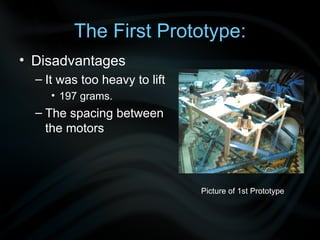
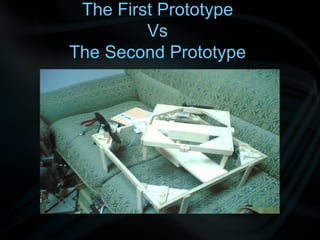
The First  Prototype: Disadvantages  It was too heavy to lift 197 grams. The spacing between the motors  Picture of 1st Prototype
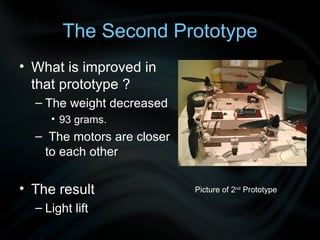
The Second  Prototype What is improved in that prototype ? The weight decreased  93 grams. The motors are closer to each other The result  Light lift  Picture of 2 nd  Prototype
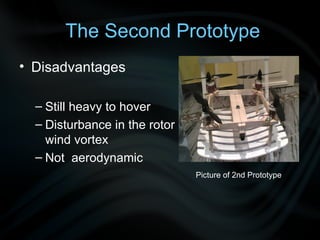
The Second  Prototype Disadvantages Still heavy to hover  Disturbance in the rotor wind vortex Not  aerodynamic  Picture of 2nd Prototype
The First Prototype  Vs  The Second Prototype
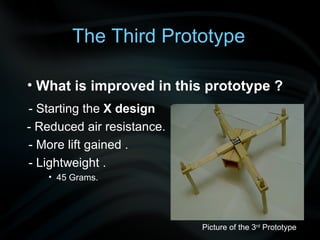
- Starting the  X design  - Reduced air resistance. - More lift gained . - Lightweight . 45 Grams.  Picture of the 3 rd  Prototype What is improved in this prototype ? The Third Prototype
Problems with the new design: Too fragile.  The reduced air resistance was still not enough. What can be done ? The Third Prototype
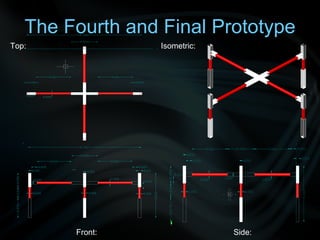
The Fourth and Final Prototype Isometric: Top: Front: Side:
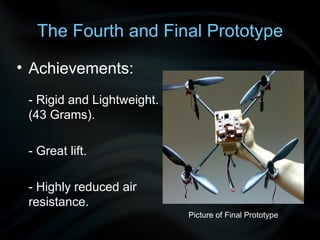
The Fourth and Final Prototype Achievements:   - Rigid and Lightweight. (43 Grams).  - Great lift. - Highly reduced air resistance. Picture of Final Prototype
Specifications: -Total Weight (with all components)  = 990 Grams    (0.99 Kg) - Acceleration at Full Power = 4.061m/s 2 - Vertical Force at Full Power = 4.021N   (Assuming Differential Torque = 0) - Lateral thrust beyond Hover Thrust = 0.4141g - Power – to – Weight Ratio  = 1.5 : 1  The Fourth and Final Prototype
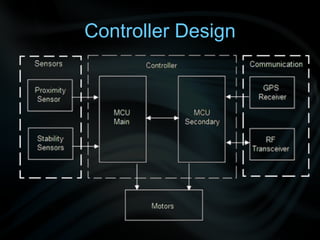
Controller Design Design Objectives Stability Obstacle Avoidance Determining Position Communication
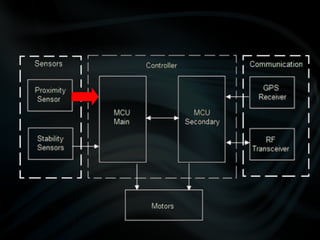
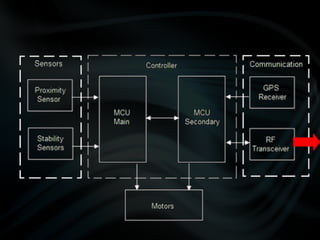
Controller Design To achieve these objectives we need IMU (Inertial Measurement Unit) 5 Ultrasonic Sensors GPS Receiver RF Transceiver
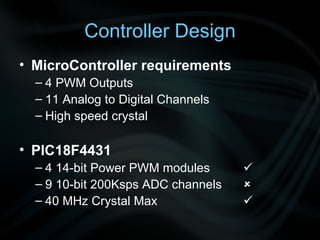
Controller Design MicroController requirements 4 PWM Outputs 11 Analog to Digital Channels High speed crystal PIC18F4431 4 14-bit Power PWM modules  9 10-bit 200Ksps ADC channels  40 MHz Crystal Max 
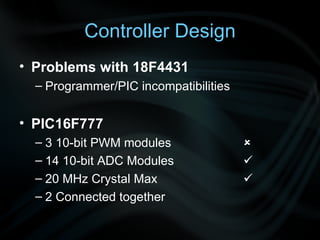
Controller Design Problems with 18F4431 Programmer/PIC incompatibilities PIC16F777 3 10-bit PWM modules    14 10-bit ADC Modules  20 MHz Crystal Max  2 Connected together
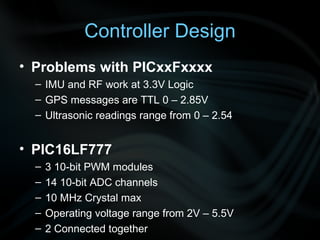
Controller Design Problems with PICxxFxxxx IMU and RF work at 3.3V Logic GPS messages are TTL 0 – 2.85V Ultrasonic readings range from 0 – 2.54 PIC16LF777 3 10-bit PWM modules 14 10-bit ADC channels 10 MHz Crystal max Operating voltage range from 2V – 5.5V 2 Connected together
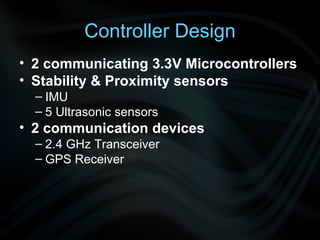
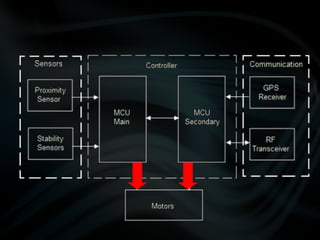
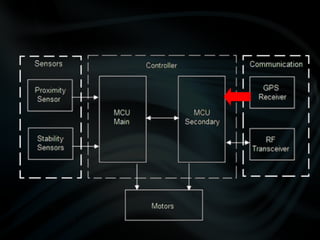
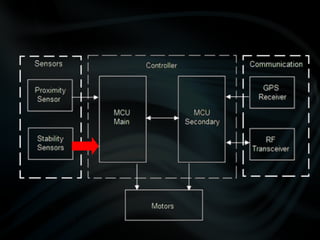
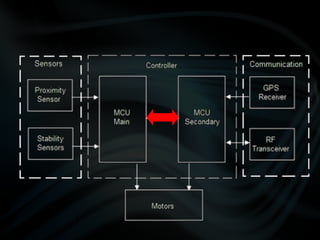
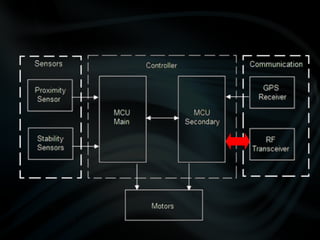
Controller Design 2 communicating 3.3V Microcontrollers Stability & Proximity sensors IMU 5 Ultrasonic sensors 2 communication devices 2.4 GHz Transceiver GPS Receiver
Controller Design
Controller Implementation Small & compact design Easily modified Modify subparts only Protect components from repetitive exposure to welding temperatures Sub boards Interface PCBs (Printed Circuit Boards)
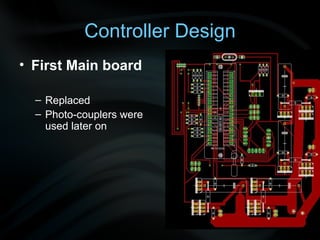
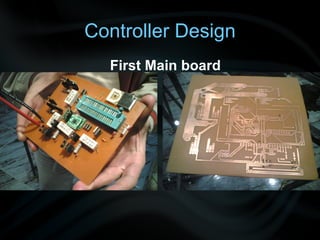
Controller Design First Main board Replaced Photo-couplers were used later on
Controller Design First Main board
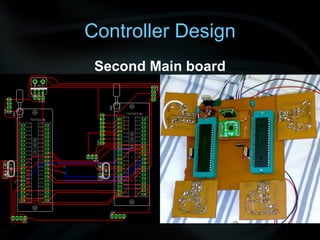
Controller Design Second Main board Photo-couplers were implemented Sub-boards implemented Interface boards Smaller design
Controller Design Second Main board
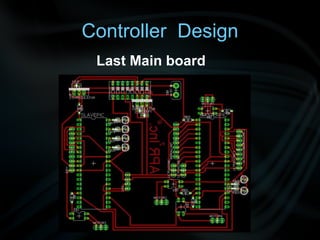
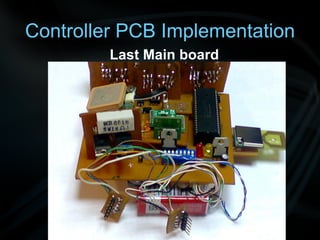
Controller Design Last Main Board Photo-couplers Interface boards Sub-boards 90 ° Interface connections Even smaller design ICSP (In Circuit Serial Programming) wires were added onto the circuit later on LEDs for easier debugging without the need for expensive hardware such as ICDs (In Circuit Debuggers)
Controller  Design Last Main board
Controller PCB Implementation Last Main board
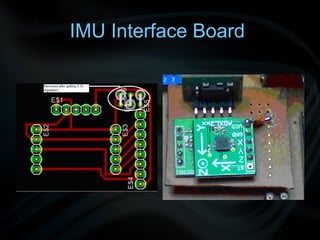
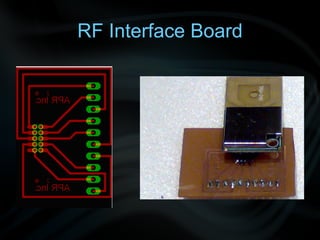
Interface Boards Easier error correction. Reduction of surface area.
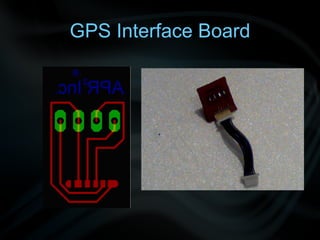
GPS Interface Board
IMU Interface Board
RF Interface Board
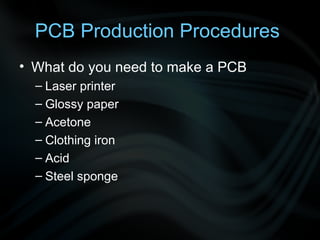
PCB Production Procedures  What do you need to make a PCB Laser printer Glossy paper Acetone Clothing iron Acid Steel sponge
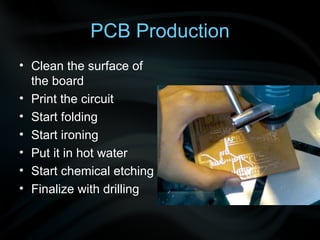
PCB Production Clean the surface of the board Print the circuit Start folding Start ironing Put it in hot water Start chemical etching Finalize with drilling
 
Analog-To-Digital Converter ADCs: - Importance of Data Acquisition in our UAV. - V ref  set on 3 Volts. - Ultrasonic sensors. - Gyrometer. - Accelerometer.
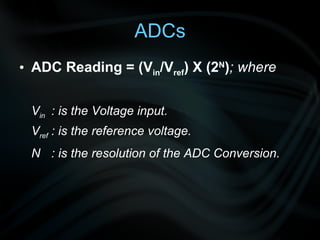
ADC Reading = (V in /V ref ) X (2 N ) ; where V in : is the Voltage input. V ref : is the reference voltage. N  : is the resolution of the ADC Conversion.   ADCs
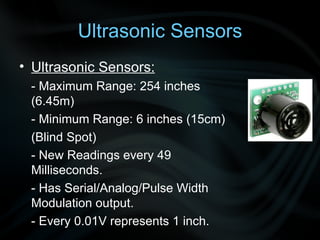
Ultrasonic Sensors Ultrasonic Sensors: - Maximum Range: 254 inches (6.45m) - Minimum Range: 6 inches (15cm) (Blind Spot) - New Readings every 49 Milliseconds. - Has Serial/Analog/Pulse Width Modulation output. - Every 0.01V represents 1 inch.
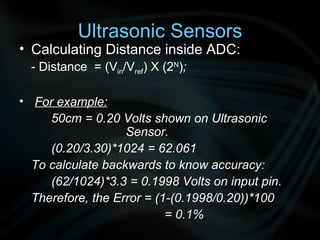
Calculating Distance inside ADC: - Distance  = (V in /V ref ) X (2 N ) ; For example: 50cm = 0.20 Volts shown on Ultrasonic    Sensor. (0.20/3.30)*1024 = 62.061 To calculate backwards to know accuracy: (62/1024)*3.3 = 0.1998 Volts on input pin. Therefore, the Error = (1-(0.1998/0.20))*100   = 0.1% Ultrasonic Sensors
 
PWM Pulse Width Modulation: - Processing after Data Acquisition for scenarios. - Implementing the data acquired as output on  Motors. - Frequency for Motor Output (750Hz).
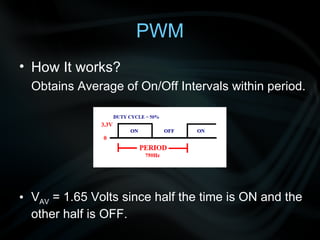
PWM How It works? Obtains Average of On/Off Intervals within period. V AV  = 1.65 Volts since half the time is ON and the other half is OFF.
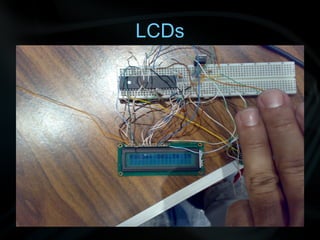
Testing Sensors A great way to test the sensors is using an LCD.  Tangible. Used to test all sensor outputs after processing: - Ultrasonic. - Accelerometer. -  Gyrometer. - GPS Receiver. - RF Transceiver units.
LCDs
 
GPS Applications GPS has become a widely used aid to navigation worldwide . A useful tool for  Map making. Land surveying.  Scientific uses.
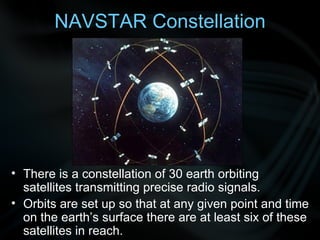
NAVSTAR Constellation There is a constellation of 30 earth orbiting satellites transmitting precise radio signals.  Orbits are set up so that at any given point and time on the earth’s surface there are at least six of these satellites in reach.
GPS Messages Almanac contains orbital data Ephemeris contains the satellites precise orbit.
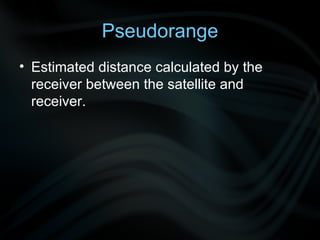
Pseudorange Estimated distance calculated by the receiver between the satellite and receiver.
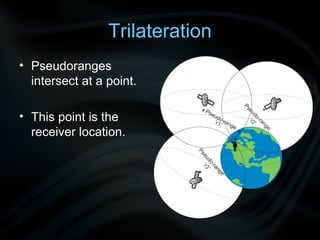
Trilateration Pseudoranges intersect at a point . This point is the receiver location.
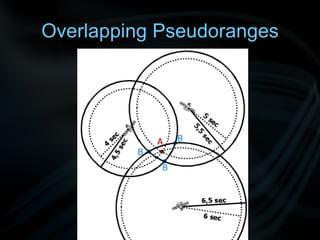
Overlapping Pseudoranges
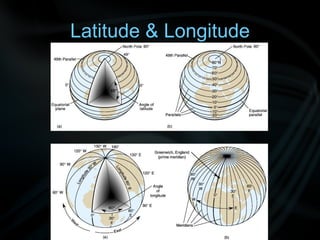
Latitude & Longitude
NMEA Protocol NMEA preferred to SiRF.  Simply works with input and output messages.
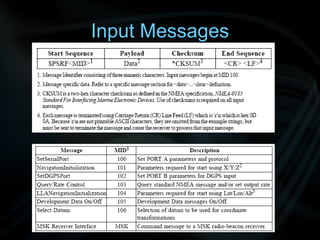
Input Messages
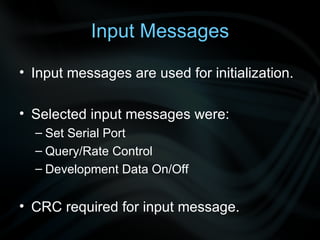
Input messages are used for initialization. Selected input messages were: Set Serial Port Query/Rate Control Development Data On/Off CRC required for input message.  Input Messages
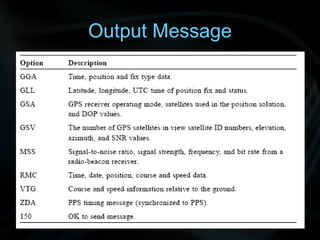
Output Message
Message of choice was RMC, it contained all we needed which was: Latitude & Longitude Course Heading Velocity Output Message
USART The GPS communicates with the PIC through USART. Communicates at 4800 bps Asynchronous
Validating Message When the message is validated: The latitude, longitude and heading are ready to be extracted to the Main PIC. RF function is called to transmit data, to the simulator.
 
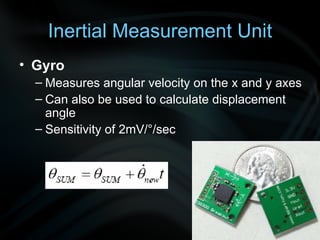
Inertial Measurement Unit Gyro Measures angular velocity on the x and y axes Can also be used to calculate displacement angle Sensitivity of 2mV/ °/sec
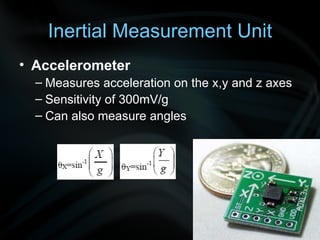
Inertial Measurement Unit Accelerometer Measures acceleration on the x,y and z axes Sensitivity of 300mV/ g Can also measure angles
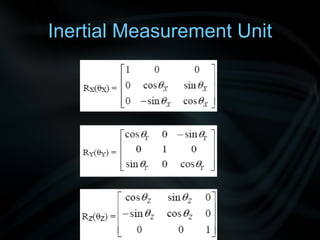
Inertial Measurement Unit IMU Gyrometer & Accelerometer Transform acceleration readings onto the 3 original axes. Velocity & Displacement can be calculated from accelerometer readings on 3 main axes.
Inertial Measurement Unit
 
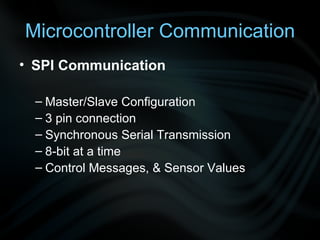
Microcontroller Communication SPI Communication Master/Slave Configuration 3 pin connection Synchronous Serial Transmission 8-bit at a time Control Messages, & Sensor Values
 
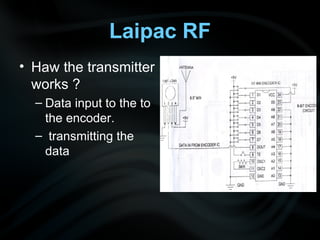
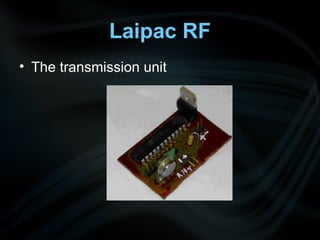
Laipac RF Haw the transmitter works ? Data input to the to the encoder. transmitting the data
Laipac RF The transmission unit
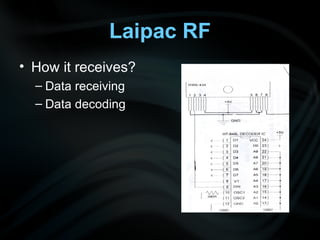
Laipac RF How it receives? Data receiving Data decoding
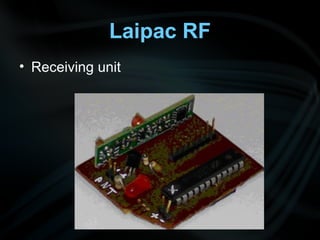
Laipac RF Receiving unit
Laipac RF Conclusion after testing  Too slow. Big size . Very small payload. Very short range.  Need an external antenna.
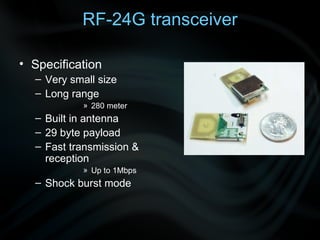
RF-24G transceiver Specification  Very small size  Long range 280 meter Built in antenna 29 byte payload  Fast transmission & reception Up to 1Mbps  Shock burst mode
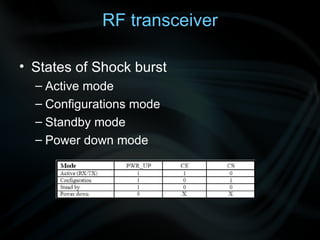
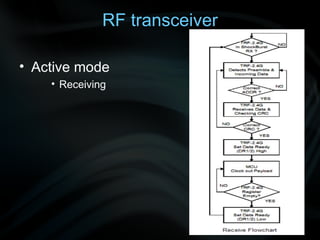
RF transceiver States of Shock burst Active mode Configurations mode Standby mode Power down mode
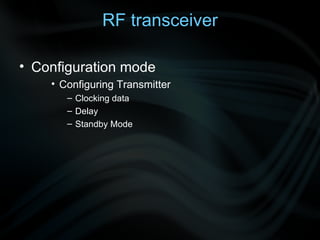
RF transceiver Configuration mode  Configuring Transmitter  Clocking data Delay  Standby Mode
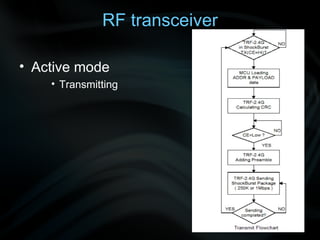
RF transceiver Active mode Transmitting
RF transceiver Active mode Receiving
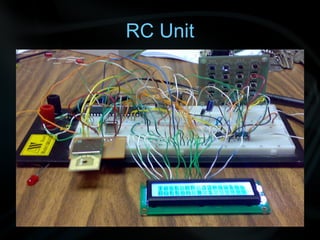
RC Unit
 
Data Acquisition What is Data Acquisition? Why?
Data Presentation What is Data Presentation? Why?
Problems Serial Port Signed Byte Graph Origin Converting Longitude and Latitude to Pixels
Solutions Javax.comm -CommPortIdentifier -Streams -SerialEvent -Converting any data to String then to Bytes Convert to short add 256 if negative -( ( (Height - 90 ) / Range ) * Actual ) + Separation ((width /|(difference between top left longitude and bottom right longitude)|)*|(acquired longitude-top left longitude)|)
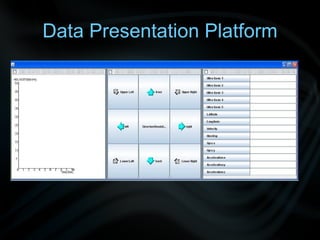
Data Presentation Platform
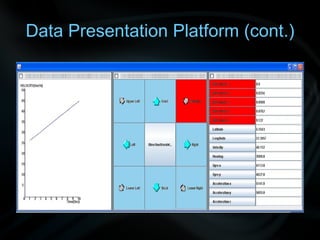
Data Presentation Platform (cont.)
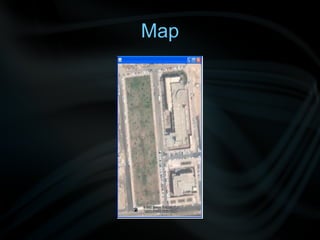
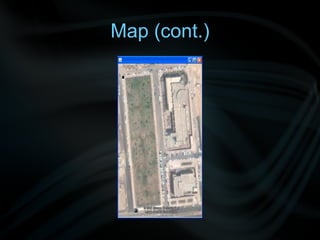
Map
Map (cont.)
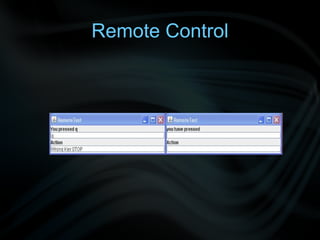
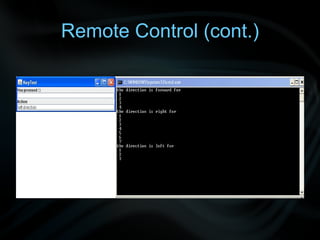
Remote Control
Remote Control (cont.)
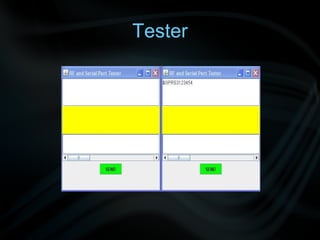
Tester
Object detection
Introduction What is an object ? What is object detection ? How to make it ? What is image processing ?
Challenges & solutions Acquisition problems Developing imaging application in a flexible environment Why not use c/c++ ?  Time consuming , handling Used language, Why ?
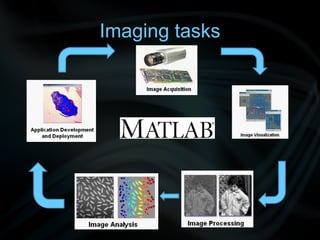
Imaging tasks
Imaging circumstances Type of the acquistion The properties of the target object? The environment The objective
Challenges Colored image Variance in lighting Uninformed background The target is colored The target’s shape is not defined
Our program Acquisition phase Visualization phase Estimate the degree of the color Processing phase Applying Median filter
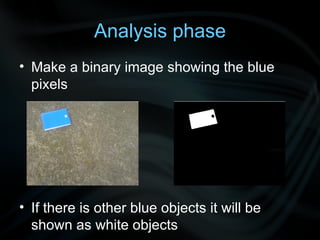
Analysis phase Make a binary image showing the blue pixels If there is other blue objects it will be shown as white objects
Pixel connectivity The use of the labeling function  [label,num]=bwlabel(y,4); stats=regionprops(label,'Area','BoundingBox','PixelList'); What are the importance of those functions
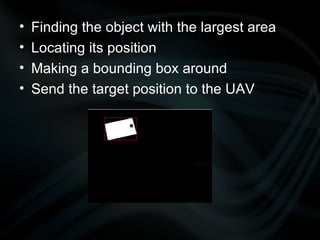
Finding the object with the largest area Locating its position Making a bounding box around Send the target position to the UAV
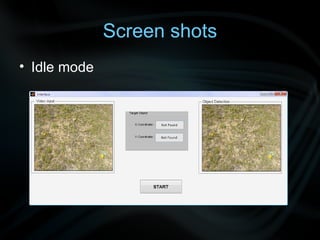
Screen shots Idle mode
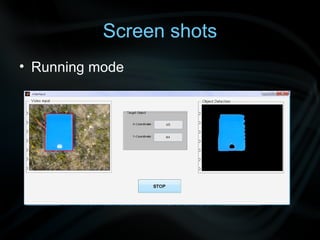
Screen shots Running mode
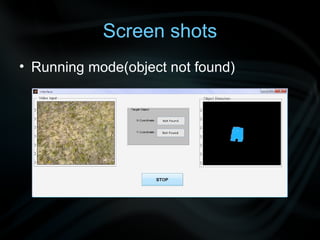
Screen shots Running mode(object not found)
FUTURE IMPLEMENTATIONS Gyrometer & Accelerometer drift correction Ultrasonic sensors attached to servos. High powered brushless motors. A long range high resolution camera. Magnetometer Chassis redesign
CONCLUSION Local market restrictions inhibited time. Bottom down programming was the best approach. Data presentation helps in detecting errors faster and avoiding problems. Placing UAV on a map helps discovering its location. Tester helps in testing the response of the RF and the pic programs
UAV Presentation

  • 1.
  • 2.
    UAV Presented By:Alexander Mohamed Osman Riyad Ahmed El-laithy Ruyyan Ahmed El-laithy Peter Raouf Zaki
  • 3.
    Introduction What areUVs ? What are UAVs ? Types of UAVs Fixed wing UAV Helicopter UAV Quadroter UAV
  • 4.
    Quadrotor Advantage OverFixed-Wing Vehicle Less design complexity. Minimal space for take-off and landing. A VTOL vehicle.
  • 5.
    Quadrotor Advantage OverHelicopter Quadrotors do not require mechanical linkages. T he use of four rotors allows each individual rotor to have a smaller diameter than the equivalent helicopter rotor .
  • 6.
  • 7.
    Control Scheme Direction∆ Motor 1 ∆ Motor 2 ∆ Motor 3 ∆ Motor 4 Z+ (Up) + + + + Z- (Down) - - - - X+ (Left) + 0 0 + X- (Right) 0 + + 0 Y+ (Forward) + + 0 0 Y- (Backward) 0 0 + +
  • 8.
    Materials used inbuilding the Prototypes Balsa wood planks Super glue
  • 9.
    The First Prototype: Disadvantages It was too heavy to lift 197 grams. The spacing between the motors Picture of 1st Prototype
  • 10.
    The Second Prototype What is improved in that prototype ? The weight decreased 93 grams. The motors are closer to each other The result Light lift Picture of 2 nd Prototype
  • 11.
    The Second Prototype Disadvantages Still heavy to hover Disturbance in the rotor wind vortex Not aerodynamic Picture of 2nd Prototype
  • 12.
    The First Prototype Vs The Second Prototype
  • 13.
    - Starting the X design - Reduced air resistance. - More lift gained . - Lightweight . 45 Grams. Picture of the 3 rd Prototype What is improved in this prototype ? The Third Prototype
  • 14.
    Problems with thenew design: Too fragile. The reduced air resistance was still not enough. What can be done ? The Third Prototype
  • 15.
    The Fourth andFinal Prototype Isometric: Top: Front: Side:
  • 16.
    The Fourth andFinal Prototype Achievements: - Rigid and Lightweight. (43 Grams). - Great lift. - Highly reduced air resistance. Picture of Final Prototype
  • 17.
    Specifications: -Total Weight(with all components) = 990 Grams (0.99 Kg) - Acceleration at Full Power = 4.061m/s 2 - Vertical Force at Full Power = 4.021N (Assuming Differential Torque = 0) - Lateral thrust beyond Hover Thrust = 0.4141g - Power – to – Weight Ratio = 1.5 : 1 The Fourth and Final Prototype
  • 18.
    Controller Design DesignObjectives Stability Obstacle Avoidance Determining Position Communication
  • 19.
    Controller Design Toachieve these objectives we need IMU (Inertial Measurement Unit) 5 Ultrasonic Sensors GPS Receiver RF Transceiver
  • 20.
    Controller Design MicroControllerrequirements 4 PWM Outputs 11 Analog to Digital Channels High speed crystal PIC18F4431 4 14-bit Power PWM modules  9 10-bit 200Ksps ADC channels  40 MHz Crystal Max 
  • 21.
    Controller Design Problemswith 18F4431 Programmer/PIC incompatibilities PIC16F777 3 10-bit PWM modules  14 10-bit ADC Modules  20 MHz Crystal Max  2 Connected together
  • 22.
    Controller Design Problemswith PICxxFxxxx IMU and RF work at 3.3V Logic GPS messages are TTL 0 – 2.85V Ultrasonic readings range from 0 – 2.54 PIC16LF777 3 10-bit PWM modules 14 10-bit ADC channels 10 MHz Crystal max Operating voltage range from 2V – 5.5V 2 Connected together
  • 23.
    Controller Design 2communicating 3.3V Microcontrollers Stability & Proximity sensors IMU 5 Ultrasonic sensors 2 communication devices 2.4 GHz Transceiver GPS Receiver
  • 24.
  • 25.
    Controller Implementation Small& compact design Easily modified Modify subparts only Protect components from repetitive exposure to welding temperatures Sub boards Interface PCBs (Printed Circuit Boards)
  • 26.
    Controller Design FirstMain board Replaced Photo-couplers were used later on
  • 27.
  • 28.
    Controller Design SecondMain board Photo-couplers were implemented Sub-boards implemented Interface boards Smaller design
  • 29.
  • 30.
    Controller Design LastMain Board Photo-couplers Interface boards Sub-boards 90 ° Interface connections Even smaller design ICSP (In Circuit Serial Programming) wires were added onto the circuit later on LEDs for easier debugging without the need for expensive hardware such as ICDs (In Circuit Debuggers)
  • 31.
    Controller DesignLast Main board
  • 32.
  • 33.
    Interface Boards Easiererror correction. Reduction of surface area.
  • 34.
  • 35.
  • 36.
  • 37.
    PCB Production Procedures What do you need to make a PCB Laser printer Glossy paper Acetone Clothing iron Acid Steel sponge
  • 38.
    PCB Production Cleanthe surface of the board Print the circuit Start folding Start ironing Put it in hot water Start chemical etching Finalize with drilling
  • 39.
  • 40.
    Analog-To-Digital Converter ADCs:- Importance of Data Acquisition in our UAV. - V ref set on 3 Volts. - Ultrasonic sensors. - Gyrometer. - Accelerometer.
  • 41.
    ADC Reading =(V in /V ref ) X (2 N ) ; where V in : is the Voltage input. V ref : is the reference voltage. N : is the resolution of the ADC Conversion. ADCs
  • 42.
    Ultrasonic Sensors UltrasonicSensors: - Maximum Range: 254 inches (6.45m) - Minimum Range: 6 inches (15cm) (Blind Spot) - New Readings every 49 Milliseconds. - Has Serial/Analog/Pulse Width Modulation output. - Every 0.01V represents 1 inch.
  • 43.
    Calculating Distance insideADC: - Distance = (V in /V ref ) X (2 N ) ; For example: 50cm = 0.20 Volts shown on Ultrasonic Sensor. (0.20/3.30)*1024 = 62.061 To calculate backwards to know accuracy: (62/1024)*3.3 = 0.1998 Volts on input pin. Therefore, the Error = (1-(0.1998/0.20))*100 = 0.1% Ultrasonic Sensors
  • 44.
  • 45.
    PWM Pulse WidthModulation: - Processing after Data Acquisition for scenarios. - Implementing the data acquired as output on Motors. - Frequency for Motor Output (750Hz).
  • 46.
    PWM How Itworks? Obtains Average of On/Off Intervals within period. V AV = 1.65 Volts since half the time is ON and the other half is OFF.
  • 47.
    Testing Sensors Agreat way to test the sensors is using an LCD. Tangible. Used to test all sensor outputs after processing: - Ultrasonic. - Accelerometer. - Gyrometer. - GPS Receiver. - RF Transceiver units.
  • 48.
  • 49.
  • 50.
    GPS Applications GPShas become a widely used aid to navigation worldwide . A useful tool for Map making. Land surveying. Scientific uses.
  • 51.
    NAVSTAR Constellation Thereis a constellation of 30 earth orbiting satellites transmitting precise radio signals. Orbits are set up so that at any given point and time on the earth’s surface there are at least six of these satellites in reach.
  • 52.
    GPS Messages Almanaccontains orbital data Ephemeris contains the satellites precise orbit.
  • 53.
    Pseudorange Estimated distancecalculated by the receiver between the satellite and receiver.
  • 54.
    Trilateration Pseudoranges intersectat a point . This point is the receiver location.

  • 55.
  • 56.
  • 57.
    NMEA Protocol NMEApreferred to SiRF. Simply works with input and output messages.
  • 58.
  • 59.
    Input messages areused for initialization. Selected input messages were: Set Serial Port Query/Rate Control Development Data On/Off CRC required for input message. Input Messages
  • 60.
  • 61.
    Message of choicewas RMC, it contained all we needed which was: Latitude & Longitude Course Heading Velocity Output Message
  • 62.
    USART The GPScommunicates with the PIC through USART. Communicates at 4800 bps Asynchronous
  • 63.
    Validating Message Whenthe message is validated: The latitude, longitude and heading are ready to be extracted to the Main PIC. RF function is called to transmit data, to the simulator.
  • 64.
  • 65.
    Inertial Measurement UnitGyro Measures angular velocity on the x and y axes Can also be used to calculate displacement angle Sensitivity of 2mV/ °/sec
  • 66.
    Inertial Measurement UnitAccelerometer Measures acceleration on the x,y and z axes Sensitivity of 300mV/ g Can also measure angles
  • 67.
    Inertial Measurement UnitIMU Gyrometer & Accelerometer Transform acceleration readings onto the 3 original axes. Velocity & Displacement can be calculated from accelerometer readings on 3 main axes.
  • 68.
  • 69.
  • 70.
    Microcontroller Communication SPICommunication Master/Slave Configuration 3 pin connection Synchronous Serial Transmission 8-bit at a time Control Messages, & Sensor Values
  • 71.
  • 72.
    Laipac RF Hawthe transmitter works ? Data input to the to the encoder. transmitting the data
  • 73.
    Laipac RF Thetransmission unit
  • 74.
    Laipac RF Howit receives? Data receiving Data decoding
  • 75.
  • 76.
    Laipac RF Conclusionafter testing Too slow. Big size . Very small payload. Very short range. Need an external antenna.
  • 77.
    RF-24G transceiver Specification Very small size Long range 280 meter Built in antenna 29 byte payload Fast transmission & reception Up to 1Mbps Shock burst mode
  • 78.
    RF transceiver Statesof Shock burst Active mode Configurations mode Standby mode Power down mode
  • 79.
    RF transceiver Configurationmode Configuring Transmitter Clocking data Delay Standby Mode
  • 80.
    RF transceiver Activemode Transmitting
  • 81.
    RF transceiver Activemode Receiving
  • 82.
  • 83.
  • 84.
    Data Acquisition Whatis Data Acquisition? Why?
  • 85.
    Data Presentation Whatis Data Presentation? Why?
  • 86.
    Problems Serial PortSigned Byte Graph Origin Converting Longitude and Latitude to Pixels
  • 87.
    Solutions Javax.comm -CommPortIdentifier-Streams -SerialEvent -Converting any data to String then to Bytes Convert to short add 256 if negative -( ( (Height - 90 ) / Range ) * Actual ) + Separation ((width /|(difference between top left longitude and bottom right longitude)|)*|(acquired longitude-top left longitude)|)
  • 88.
  • 89.
  • 90.
  • 91.
  • 92.
  • 93.
  • 94.
  • 95.
  • 96.
    Introduction What isan object ? What is object detection ? How to make it ? What is image processing ?
  • 97.
    Challenges & solutionsAcquisition problems Developing imaging application in a flexible environment Why not use c/c++ ? Time consuming , handling Used language, Why ?
  • 98.
  • 99.
    Imaging circumstances Typeof the acquistion The properties of the target object? The environment The objective
  • 100.
    Challenges Colored imageVariance in lighting Uninformed background The target is colored The target’s shape is not defined
  • 101.
    Our program Acquisitionphase Visualization phase Estimate the degree of the color Processing phase Applying Median filter
  • 102.
    Analysis phase Makea binary image showing the blue pixels If there is other blue objects it will be shown as white objects
  • 103.
    Pixel connectivity Theuse of the labeling function [label,num]=bwlabel(y,4); stats=regionprops(label,'Area','BoundingBox','PixelList'); What are the importance of those functions
  • 104.
    Finding the objectwith the largest area Locating its position Making a bounding box around Send the target position to the UAV
  • 105.
  • 106.
  • 107.
    Screen shots Runningmode(object not found)
  • 108.
    FUTURE IMPLEMENTATIONS Gyrometer& Accelerometer drift correction Ultrasonic sensors attached to servos. High powered brushless motors. A long range high resolution camera. Magnetometer Chassis redesign
  • 109.
    CONCLUSION Local marketrestrictions inhibited time. Bottom down programming was the best approach. Data presentation helps in detecting errors faster and avoiding problems. Placing UAV on a map helps discovering its location. Tester helps in testing the response of the RF and the pic programs