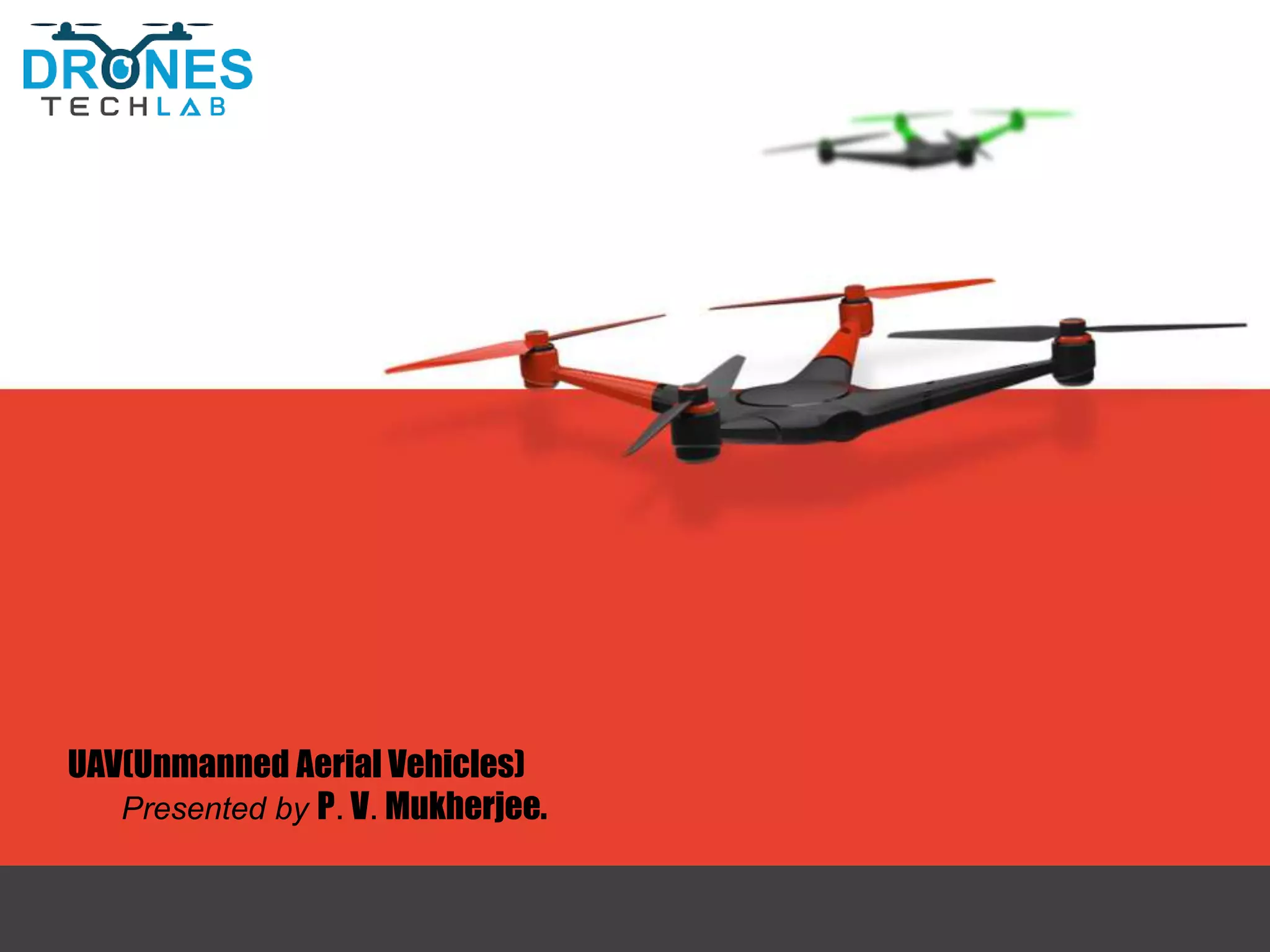
UAV(Unmanned Aerial Vehicles)
Presented by P. V. Mukherjee.
What is an UAV?
 An unmanned aerial vehicle (UAV), commonly known as drone,
is an aircraft without a human pilot aboard. UAVs are a component
of an unmanned aircraft system (UAS); which include a UAV, a grou
nd-based controller, and a system of communications between the
two.
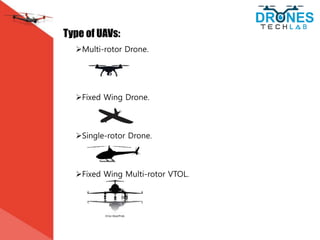
Type of UAVs:
Multi-rotor Drone.
Fixed Wing Drone.
Single-rotor Drone.
Fixed Wing Multi-rotor VTOL.
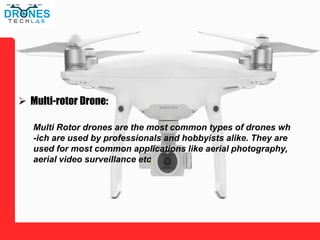
 Multi-rotor Drone:
Multi Rotor drones are the most common types of drones wh
-ich are used by professionals and hobbyists alike. They are
used for most common applications like aerial photography,
aerial video surveillance etc.
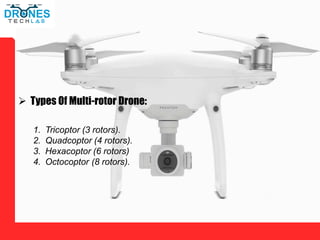
 Types Of Multi-rotor Drone:
1. Tricoptor (3 rotors).
2. Quadcoptor (4 rotors).
3. Hexacoptor (6 rotors)
4. Octocoptor (8 rotors).
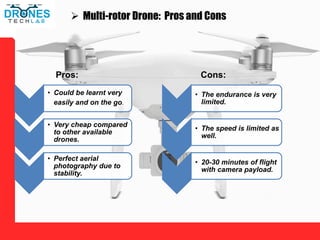
 Multi-rotor Drone: Pros and Cons
• Could be learnt very
easily and on the go.
• Very cheap compared
to other available
drones.
• Perfect aerial
photography due to
stability.
• The endurance is very
limited.
• The speed is limited as
well.
• 20-30 minutes of flight
with camera payload.
Pros: Cons:
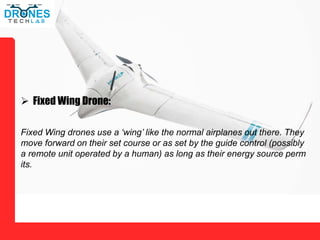
 Fixed Wing Drone:
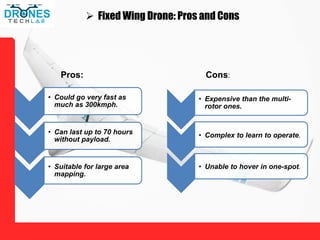
Fixed Wing drones use a ‘wing’ like the normal airplanes out there. They
move forward on their set course or as set by the guide control (possibly
a remote unit operated by a human) as long as their energy source perm
its.
 Fixed Wing Drone: Pros and Cons
• Could go very fast as
much as 300kmph.
• Can last up to 70 hours
without payload.
• Suitable for large area
mapping.
Pros:
• Expensive than the multi-
rotor ones.
• Complex to learn to operate.
• Unable to hover in one-spot.
Cons:
 Single rotor Drone:
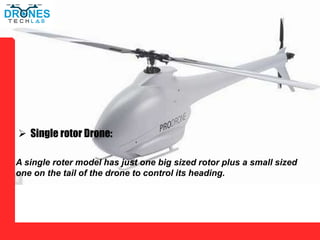
A single roter model has just one big sized rotor plus a small sized
one on the tail of the drone to control its heading.
 Single rotor Drone: Pros and Cons
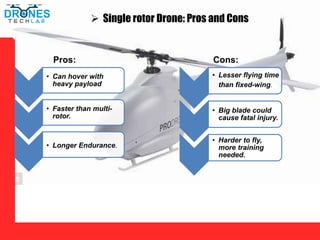
• Can hover with
heavy payload
• Faster than multi-
rotor.
• Longer Endurance.
• Lesser flying time
than fixed-wing.
• Big blade could
cause fatal injury.
• Harder to fly,
more training
needed.
Pros: Cons:
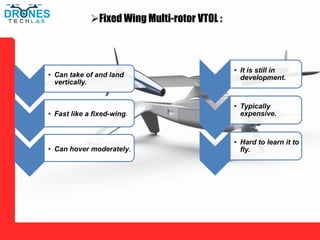
Fixed Wing Multi-rotor VTOL :
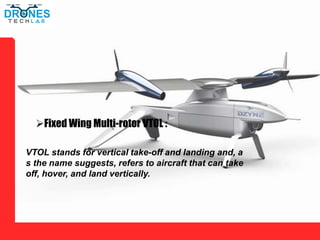
VTOL stands for vertical take-off and landing and, a
s the name suggests, refers to aircraft that can take
off, hover, and land vertically.
Fixed Wing Multi-rotor VTOL :
• Can take of and land
vertically.
• Fast like a fixed-wing.
• Can hover moderately.
• It is still in
development.
• Typically
expensive.
• Hard to learn it to
fly.
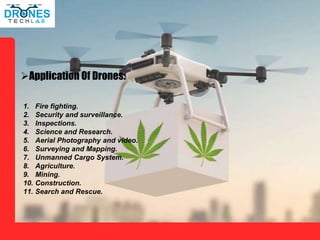
Application Of Drones:
1. Fire fighting.
2. Security and surveillance.
3. Inspections.
4. Science and Research.
5. Aerial Photography and video.
6. Surveying and Mapping.
7. Unmanned Cargo System.
8. Agriculture.
9. Mining.
10. Construction.
11. Search and Rescue.
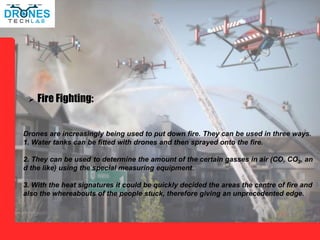
Drones are increasingly being used to put down fire. They can be used in three ways.
1. Water tanks can be fitted with drones and then sprayed onto the fire.
2. They can be used to determine the amount of the certain gasses in air (CO, CO2, an
d the like) using the special measuring equipment..
3. With the heat signatures it could be quickly decided the areas the centre of fire and
also the whereabouts of the people stuck, therefore giving an unprecedented edge.
 Fire Fighting:
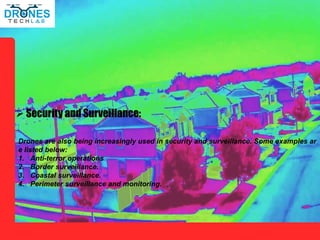
 Security and Surveillance:
Drones are also being increasingly used in security and surveillance. Some examples ar
e listed below:
1. Anti-terror operations
2. Border surveillance.
3. Coastal surveillance.
4. Perimeter surveillance and monitoring.
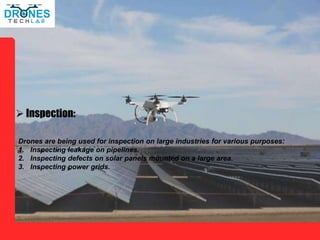
 Inspection:
Drones are being used for inspection on large industries for various purposes:
1. Inspecting leakage on pipelines.
2. Inspecting defects on solar panels mounted on a large area.
3. Inspecting power grids.
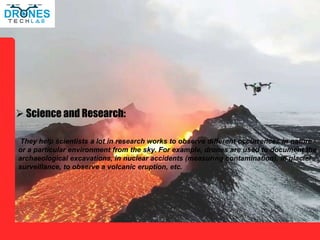
 Science and Research:
They help scientists a lot in research works to observe different occurrences in nature
or a particular environment from the sky. For example, drones are used to document the
archaeological excavations, in nuclear accidents (measuring contamination), in glacier
surveillance, to observe a volcanic eruption, etc.

UAV Types and Applications

  • 1.
  • 2.
    What is anUAV?  An unmanned aerial vehicle (UAV), commonly known as drone, is an aircraft without a human pilot aboard. UAVs are a component of an unmanned aircraft system (UAS); which include a UAV, a grou nd-based controller, and a system of communications between the two.
  • 3.
    Type of UAVs: Multi-rotorDrone. Fixed Wing Drone. Single-rotor Drone. Fixed Wing Multi-rotor VTOL.
  • 4.
     Multi-rotor Drone: MultiRotor drones are the most common types of drones wh -ich are used by professionals and hobbyists alike. They are used for most common applications like aerial photography, aerial video surveillance etc.
  • 5.
     Types OfMulti-rotor Drone: 1. Tricoptor (3 rotors). 2. Quadcoptor (4 rotors). 3. Hexacoptor (6 rotors) 4. Octocoptor (8 rotors).
  • 6.
     Multi-rotor Drone:Pros and Cons • Could be learnt very easily and on the go. • Very cheap compared to other available drones. • Perfect aerial photography due to stability. • The endurance is very limited. • The speed is limited as well. • 20-30 minutes of flight with camera payload. Pros: Cons:
  • 7.
     Fixed WingDrone: Fixed Wing drones use a ‘wing’ like the normal airplanes out there. They move forward on their set course or as set by the guide control (possibly a remote unit operated by a human) as long as their energy source perm its.
  • 8.
     Fixed WingDrone: Pros and Cons • Could go very fast as much as 300kmph. • Can last up to 70 hours without payload. • Suitable for large area mapping. Pros: • Expensive than the multi- rotor ones. • Complex to learn to operate. • Unable to hover in one-spot. Cons:
  • 9.
     Single rotorDrone: A single roter model has just one big sized rotor plus a small sized one on the tail of the drone to control its heading.
  • 10.
     Single rotorDrone: Pros and Cons • Can hover with heavy payload • Faster than multi- rotor. • Longer Endurance. • Lesser flying time than fixed-wing. • Big blade could cause fatal injury. • Harder to fly, more training needed. Pros: Cons:
  • 11.
    Fixed Wing Multi-rotorVTOL : VTOL stands for vertical take-off and landing and, a s the name suggests, refers to aircraft that can take off, hover, and land vertically.
  • 12.
    Fixed Wing Multi-rotorVTOL : • Can take of and land vertically. • Fast like a fixed-wing. • Can hover moderately. • It is still in development. • Typically expensive. • Hard to learn it to fly.
  • 13.
    Application Of Drones: 1.Fire fighting. 2. Security and surveillance. 3. Inspections. 4. Science and Research. 5. Aerial Photography and video. 6. Surveying and Mapping. 7. Unmanned Cargo System. 8. Agriculture. 9. Mining. 10. Construction. 11. Search and Rescue.
  • 14.
    Drones are increasinglybeing used to put down fire. They can be used in three ways. 1. Water tanks can be fitted with drones and then sprayed onto the fire. 2. They can be used to determine the amount of the certain gasses in air (CO, CO2, an d the like) using the special measuring equipment.. 3. With the heat signatures it could be quickly decided the areas the centre of fire and also the whereabouts of the people stuck, therefore giving an unprecedented edge.  Fire Fighting:
  • 15.
     Security andSurveillance: Drones are also being increasingly used in security and surveillance. Some examples ar e listed below: 1. Anti-terror operations 2. Border surveillance. 3. Coastal surveillance. 4. Perimeter surveillance and monitoring.
  • 16.
     Inspection: Drones arebeing used for inspection on large industries for various purposes: 1. Inspecting leakage on pipelines. 2. Inspecting defects on solar panels mounted on a large area. 3. Inspecting power grids.
  • 17.
     Science andResearch: They help scientists a lot in research works to observe different occurrences in nature or a particular environment from the sky. For example, drones are used to document the archaeological excavations, in nuclear accidents (measuring contamination), in glacier surveillance, to observe a volcanic eruption, etc.