
Design Study
Methodology
for Health
Industry 5.0
Dr Mithileysh Sathiyanarayanan
Founder | CEO | Scientist
What is Health Industry 5.0?
2
Let’s quickly understand
 Industrial Revolution
 Health Industry Revolution
Industrial Revolution
3
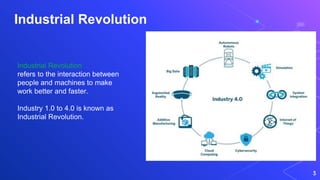
Industrial Revolution
refers to the interaction between
people and machines to make
work better and faster.
Industry 1.0 to 4.0 is known as
Industrial Revolution.
4
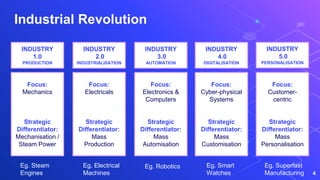
Focus:
Mechanics
Strategic
Differentiator:
Mechanisation /
Steam Power
Focus:
Electricals
Strategic
Differentiator:
Mass
Production
Focus:
Electronics &
Computers
Strategic
Differentiator:
Mass
Automisation
Focus:
Cyber-physical
Systems
Strategic
Differentiator:
Mass
Customisation
INDUSTRY
1.0
PRODUCTION
INDUSTRY
2.0
INDUSTRIALISATION
INDUSTRY
3.0
AUTOMATION
INDUSTRY
4.0
DIGITALISATION
Industrial Revolution
Eg. Steam
Engines
Eg. Electrical
Machines
Eg. Robotics Eg. Smart
Watches
Focus:
Customer-
centric
Strategic
Differentiator:
Mass
Personalisation
INDUSTRY
5.0
PERSONALISATION
Eg. Superfast
Manufacturing
5
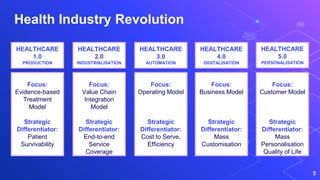
Focus:
Evidence-based
Treatment
Model
Strategic
Differentiator:
Patient
Survivability
Focus:
Value Chain
Integration
Model
Strategic
Differentiator:
End-to-end
Service
Coverage
Focus:
Operating Model
Strategic
Differentiator:
Cost to Serve,
Efficiency
Focus:
Business Model
Strategic
Differentiator:
Mass
Customisation
Focus:
Customer Model
Strategic
Differentiator:
Mass
Personalisation
Quality of Life
HEALTHCARE
1.0
PRODUCTION
HEALTHCARE
2.0
INDUSTRIALISATION
HEALTHCARE
3.0
AUTOMATION
HEALTHCARE
4.0
DIGITALISATION
HEALTHCARE
5.0
PERSONALISATION
Health Industry Revolution
What is Health Industry 5.0?
Also, called as
 Healthcare 5.0
 Health & Industry 5.0
6
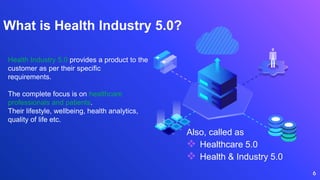
Health Industry 5.0 provides a product to the
customer as per their specific
requirements.
The complete focus is on healthcare
professionals and patients.
Their lifestyle, wellbeing, health analytics,
quality of life etc.
7
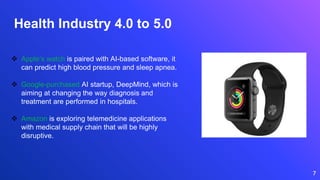
 Apple’s watch is paired with AI-based software, it
can predict high blood pressure and sleep apnea.
 Google-purchased AI startup, DeepMind, which is
aiming at changing the way diagnosis and
treatment are performed in hospitals.
 Amazon is exploring telemedicine applications
with medical supply chain that will be highly
disruptive.
Health Industry 4.0 to 5.0
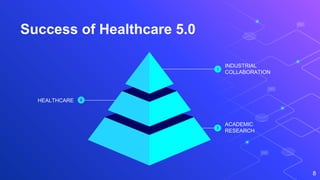
Success of Healthcare 5.0
8
ACADEMIC
RESEARCH
3
HEALTHCARE 2
INDUSTRIAL
COLLABORATION
1
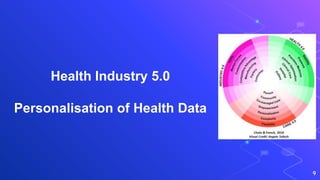
Health Industry 5.0
Personalisation of Health Data
9
Research
Question
To what extent visualisations
can support patients/users in
finding relevant and/or
interesting information in their
own personal health data?
Overall Aim
The aim of the research is to
design and develop interactive
visualisation platform that can
be personalised to explore and
find relevant/interesting
information in a personal health
record.
Objectives
O1: Understand the healthcare
domain & review literature.
O2: Design & develop interactive
visualisations
O3: Validation of visual methods
O4: Iterative refinement of the
developed prototype.
Design
Study
Methodology
14
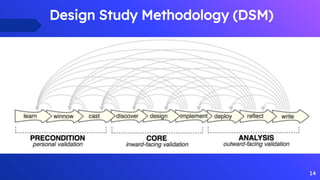
Design Study Methodology (DSM)
Real-world Problem
Real Users
Real Data
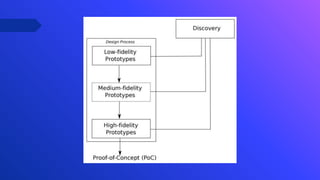
DSM – Precondition Phase
(Phase 1)
16
STAGE 1 : LEARNING
STAGE 2 : WINNOWING
STAGE 3 : CASTING
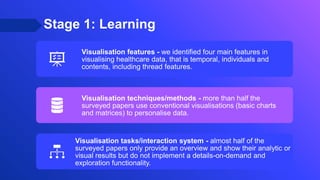
Stage 1: Learning
Visualisation features - we identified four main features in
visualising healthcare data, that is temporal, individuals and
contents, including thread features.
Visualisation techniques/methods - more than half the
surveyed papers use conventional visualisations (basic charts
and matrices) to personalise data.
Visualisation tasks/interaction system - almost half of the
surveyed papers only provide an overview and show their analytic or
visual results but do not implement a details-on-demand and
exploration functionality.
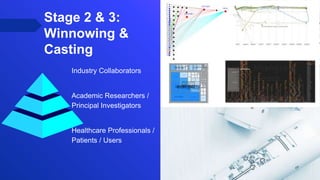
Stage 2 & 3:
Winnowing &
Casting
Industry Collaborators
Academic Researchers /
Principal Investigators
Healthcare Professionals /
Patients / Users
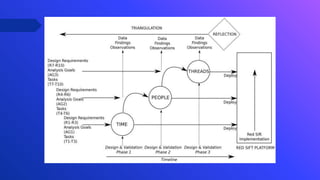
DSM – Condition Phase
(Phase 2)
19
STAGE 4 : DISCOVERING
STAGE 5 : DESIGNING
STAGE 6 : IMPLEMENTING
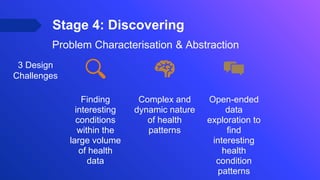
Problem Characterisation & Abstraction
Finding
interesting
conditions
within the
large volume
of health
data
Complex and
dynamic nature
of health
patterns
Open-ended
data
exploration to
find
interesting
health
condition
patterns
Stage 4: Discovering
3 Design
Challenges
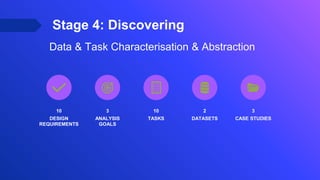
Data & Task Characterisation & Abstraction
10
DESIGN
REQUIREMENTS
3
ANALYSIS
GOALS
10
TASKS
2
DATASETS
3
CASE STUDIES
Stage 4: Discovering
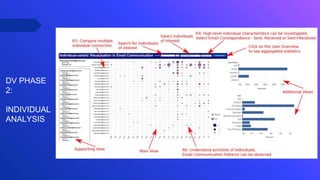
Stage 5 & 6:
Designing & Implementing
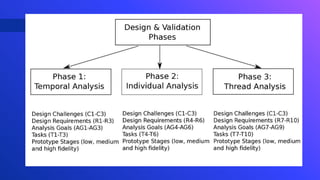
DV PHASE 1:
TEMPORAL
ANALYSIS
DV PHASE
2:
INDIVIDUAL
ANALYSIS
DV PHASE 3:
THREAD
ANALYSIS
DSM – Post-condition Phase
(Phase 3)
29
STAGE 7 : DEPLOYING
STAGE 8 : REFLECTING
STAGE 9 : WRITING
30
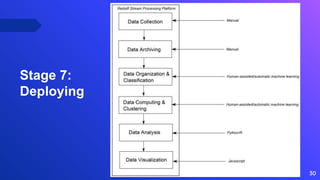
Stage 7:
Deploying
⬡ Iterative user-centered design approach gave us a good base to
capture user requirements (from the experts) which helped us achieve
Objective 1 (O1).
⬡ Iterative user-centered design approach gave us a good platform to
design interactive visualisation solutions with the experts which helped
us achieve Objective 2 (O2).
⬡ Iterative user-centered design approach also gave us a good space to
validate our solutions with the experts which helped us achieve
Objective 3 (O3).
Stage 8: Reflecting
F1: An iterative user-centered design approach helped in understanding
E- discovery domain and the investigation needs:
F2. Multi-faceted exploration and multi-granular analysis helped in
discovering interestingness:
F3: Interactive visualisation assisted active learning helped in classifying
communications:
Findings
L1. Domain-specific requirements in depth should be focussed.
L2. Conventional visualisations and novel visualisations should be
carefully analysed.
L3. Evaluation with non-experts should be considered.
Learnings
P1. Focus on domain-specific requirements.
P2. Consider iterative user-centric design throughout design-cycle.
P3. Generate system-based features for pattern characterisation.
P4. Build pattern-oriented interactive visualisations for discovering
interestingness.
P5. Leverage multi-facetedness and multi-granularity for exploration and
discovery.
P6. Important to represent evolution of healthcare data.
P7. Evaluate the system with both experts and non-experts.
Principles
⬡ Characterised the domain, problems and tasks for Healthcare 5.0.
⬡ Identified knowledge gap and provided overview of the existing techniques.
⬡ Designed and Developed interactive visualisation solutions.
⬡ Validated the solutions
⬡ Deployed Solutions in the Collaborator’s Platform (Google Suite).
⬡ Lesson Learnings & Principles
⬡ Presented papers at various venues India, USA, UK & Germany
⬡ Filing a Patent in the USA.
Stage 9: Writing / Contributions
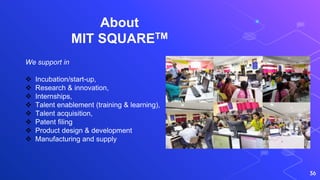
About
MIT SQUARETM
36
We support in
 Incubation/start-up,
 Research & innovation,
 Internships,
 Talent enablement (training & learning),
 Talent acquisition,
 Patent filing
 Product design & development
 Manufacturing and supply
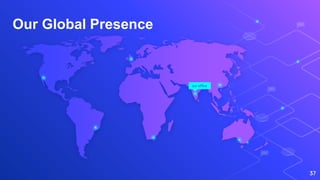
Our Global Presence
our office
37
Disruptive
Technologies
 Internet of Things (IoT) and
Embedded Systems
 Artificial Intelligence
 Ambient Intelligence
 Blockchain
 Cybersecurity
 Robotics
 Patent Filing
 Entrepreneurship
38
Other Offerings
⬡ Value Added Certifications/Courses (VACs);
⬡ Continuous Professional Development (CPD);
⬡ Faculty Development Programs (FDPs);
⬡ Student Development Programs (SDPs);
⬡ Faculty Exchange Programs (FEPs);
⬡ Student Exchange Programs (SEPs);
⬡ Social Outreach Programs (SORs) / Corporate Social Responsibility (CSR);
39
Specific to Talent Management
⬡ Joint / Integrated Courses
⬡ Student Exchange Program
⬡ Research Fellowship
⬡ Joint PhD Program
⬡ Internships
40
Thanks!
Any questions?
You can find me at:
mithileysh@mitsquare.com

Healthcare 5.0

  • 1.
    Design Study Methodology for Health Industry5.0 Dr Mithileysh Sathiyanarayanan Founder | CEO | Scientist
  • 2.
    What is HealthIndustry 5.0? 2 Let’s quickly understand  Industrial Revolution  Health Industry Revolution
  • 3.
    Industrial Revolution 3 Industrial Revolution refersto the interaction between people and machines to make work better and faster. Industry 1.0 to 4.0 is known as Industrial Revolution.
  • 4.
    4 Focus: Mechanics Strategic Differentiator: Mechanisation / Steam Power Focus: Electricals Strategic Differentiator: Mass Production Focus: Electronics& Computers Strategic Differentiator: Mass Automisation Focus: Cyber-physical Systems Strategic Differentiator: Mass Customisation INDUSTRY 1.0 PRODUCTION INDUSTRY 2.0 INDUSTRIALISATION INDUSTRY 3.0 AUTOMATION INDUSTRY 4.0 DIGITALISATION Industrial Revolution Eg. Steam Engines Eg. Electrical Machines Eg. Robotics Eg. Smart Watches Focus: Customer- centric Strategic Differentiator: Mass Personalisation INDUSTRY 5.0 PERSONALISATION Eg. Superfast Manufacturing
  • 5.
    5 Focus: Evidence-based Treatment Model Strategic Differentiator: Patient Survivability Focus: Value Chain Integration Model Strategic Differentiator: End-to-end Service Coverage Focus: Operating Model Strategic Differentiator: Costto Serve, Efficiency Focus: Business Model Strategic Differentiator: Mass Customisation Focus: Customer Model Strategic Differentiator: Mass Personalisation Quality of Life HEALTHCARE 1.0 PRODUCTION HEALTHCARE 2.0 INDUSTRIALISATION HEALTHCARE 3.0 AUTOMATION HEALTHCARE 4.0 DIGITALISATION HEALTHCARE 5.0 PERSONALISATION Health Industry Revolution
  • 6.
    What is HealthIndustry 5.0? Also, called as  Healthcare 5.0  Health & Industry 5.0 6 Health Industry 5.0 provides a product to the customer as per their specific requirements. The complete focus is on healthcare professionals and patients. Their lifestyle, wellbeing, health analytics, quality of life etc.
  • 7.
    7  Apple’s watchis paired with AI-based software, it can predict high blood pressure and sleep apnea.  Google-purchased AI startup, DeepMind, which is aiming at changing the way diagnosis and treatment are performed in hospitals.  Amazon is exploring telemedicine applications with medical supply chain that will be highly disruptive. Health Industry 4.0 to 5.0
  • 8.
    Success of Healthcare5.0 8 ACADEMIC RESEARCH 3 HEALTHCARE 2 INDUSTRIAL COLLABORATION 1
  • 9.
  • 10.
    Research Question To what extentvisualisations can support patients/users in finding relevant and/or interesting information in their own personal health data?
  • 11.
    Overall Aim The aimof the research is to design and develop interactive visualisation platform that can be personalised to explore and find relevant/interesting information in a personal health record.
  • 12.
    Objectives O1: Understand thehealthcare domain & review literature. O2: Design & develop interactive visualisations O3: Validation of visual methods O4: Iterative refinement of the developed prototype.
  • 13.
  • 14.
  • 15.
    Design Study Methodology(DSM) Real-world Problem Real Users Real Data
  • 16.
    DSM – PreconditionPhase (Phase 1) 16 STAGE 1 : LEARNING STAGE 2 : WINNOWING STAGE 3 : CASTING
  • 17.
    Stage 1: Learning Visualisationfeatures - we identified four main features in visualising healthcare data, that is temporal, individuals and contents, including thread features. Visualisation techniques/methods - more than half the surveyed papers use conventional visualisations (basic charts and matrices) to personalise data. Visualisation tasks/interaction system - almost half of the surveyed papers only provide an overview and show their analytic or visual results but do not implement a details-on-demand and exploration functionality.
  • 18.
    Stage 2 &3: Winnowing & Casting Industry Collaborators Academic Researchers / Principal Investigators Healthcare Professionals / Patients / Users
  • 19.
    DSM – ConditionPhase (Phase 2) 19 STAGE 4 : DISCOVERING STAGE 5 : DESIGNING STAGE 6 : IMPLEMENTING
  • 20.
    Problem Characterisation &Abstraction Finding interesting conditions within the large volume of health data Complex and dynamic nature of health patterns Open-ended data exploration to find interesting health condition patterns Stage 4: Discovering 3 Design Challenges
  • 21.
    Data & TaskCharacterisation & Abstraction 10 DESIGN REQUIREMENTS 3 ANALYSIS GOALS 10 TASKS 2 DATASETS 3 CASE STUDIES Stage 4: Discovering
  • 22.
    Stage 5 &6: Designing & Implementing
  • 26.
  • 27.
  • 28.
  • 29.
    DSM – Post-conditionPhase (Phase 3) 29 STAGE 7 : DEPLOYING STAGE 8 : REFLECTING STAGE 9 : WRITING
  • 30.
  • 31.
    ⬡ Iterative user-centereddesign approach gave us a good base to capture user requirements (from the experts) which helped us achieve Objective 1 (O1). ⬡ Iterative user-centered design approach gave us a good platform to design interactive visualisation solutions with the experts which helped us achieve Objective 2 (O2). ⬡ Iterative user-centered design approach also gave us a good space to validate our solutions with the experts which helped us achieve Objective 3 (O3). Stage 8: Reflecting
  • 32.
    F1: An iterativeuser-centered design approach helped in understanding E- discovery domain and the investigation needs: F2. Multi-faceted exploration and multi-granular analysis helped in discovering interestingness: F3: Interactive visualisation assisted active learning helped in classifying communications: Findings
  • 33.
    L1. Domain-specific requirementsin depth should be focussed. L2. Conventional visualisations and novel visualisations should be carefully analysed. L3. Evaluation with non-experts should be considered. Learnings
  • 34.
    P1. Focus ondomain-specific requirements. P2. Consider iterative user-centric design throughout design-cycle. P3. Generate system-based features for pattern characterisation. P4. Build pattern-oriented interactive visualisations for discovering interestingness. P5. Leverage multi-facetedness and multi-granularity for exploration and discovery. P6. Important to represent evolution of healthcare data. P7. Evaluate the system with both experts and non-experts. Principles
  • 35.
    ⬡ Characterised thedomain, problems and tasks for Healthcare 5.0. ⬡ Identified knowledge gap and provided overview of the existing techniques. ⬡ Designed and Developed interactive visualisation solutions. ⬡ Validated the solutions ⬡ Deployed Solutions in the Collaborator’s Platform (Google Suite). ⬡ Lesson Learnings & Principles ⬡ Presented papers at various venues India, USA, UK & Germany ⬡ Filing a Patent in the USA. Stage 9: Writing / Contributions
  • 36.
    About MIT SQUARETM 36 We supportin  Incubation/start-up,  Research & innovation,  Internships,  Talent enablement (training & learning),  Talent acquisition,  Patent filing  Product design & development  Manufacturing and supply
  • 37.
  • 38.
    Disruptive Technologies  Internet ofThings (IoT) and Embedded Systems  Artificial Intelligence  Ambient Intelligence  Blockchain  Cybersecurity  Robotics  Patent Filing  Entrepreneurship 38
  • 39.
    Other Offerings ⬡ ValueAdded Certifications/Courses (VACs); ⬡ Continuous Professional Development (CPD); ⬡ Faculty Development Programs (FDPs); ⬡ Student Development Programs (SDPs); ⬡ Faculty Exchange Programs (FEPs); ⬡ Student Exchange Programs (SEPs); ⬡ Social Outreach Programs (SORs) / Corporate Social Responsibility (CSR); 39 Specific to Talent Management ⬡ Joint / Integrated Courses ⬡ Student Exchange Program ⬡ Research Fellowship ⬡ Joint PhD Program ⬡ Internships
  • 40.
    40 Thanks! Any questions? You canfind me at: mithileysh@mitsquare.com

Editor's Notes

  • #6 Health Industry 4.0 is known as the fourth industrial healthcare revolution which enables “mass customization”. Health Industry 5.0 is known as the fifth industrial healthcare revolution which enables “mass personalisation”.