Importance of Publication
Dr Mithileysh Sathiyanarayanan
Research & Innovation
MIT Square, London
www.mitsquare.com
Objectives
• To understand the importance of publication and its challenges
• To increase the visibility and accessibility of published papers
• To increase the chance of getting publications cited
• To disseminate the publication by using “Research Tools” effectively
• To increase the chance of research collaboration
Agenda
1. Why publication is important?
2. How to plan research and publish?
3. How to write a paper?
4. Can a sample paper help?
5. What editors and publishers want?
6. What are the publication ethics?
7. What are the challenges in publishing articles?
8. What is research impact used for?
9. What are the research tools?
10.What is the success formula?
1. Why publication is important?
Why Publication is Important?
• Convey something important
• Share your work
• Change practice
• Promote thoughts or stimulate debate
• Propose guidelines, principles and suggestions
• Educate
• Help academies and industries implement in real-
time
• Get into high impact journal
• Recognition
• Build your portfolio
• Advance your career
• Credibility with colleagues
• Royalties, Incentives & Remuneration
• Joint Proposals & Funding
• Collaboration
2. How to Plan Research & Publish?
Steps in Starting a Research
• Turn your ideas into a research question
• Review the literature
• Identify methodology and methods
• Enlist co-authors, statistician, supervisor
• Agree who will do what
• Design the study and develop your methods
• Think about the ethics of your study design
• Write your research proposal
• Apply for funding and ethics approval
What is a Research Question?
• The researcher asks a very specific question and tests a
specific hypothesis. Broad questions are usually broken into
smaller, testable hypotheses or questions.
• Often called an objective or aim, though calling it a question
tends to help with focusing the hypothesis and thinking
about how to find an answer.
What Makes a Poor Research Question?
A question that matters to nobody, even you
Hoping one emerges from routine clinical data/records
• the records will be biased and confounded
• they’ll lack information you need to answer your question reliably, because
they were collected for another reason
Fishing expedition/data dredging – gathering new data and hoping a question
will emerge
How to Focus Your Question
• Brief literature search for previous evidence
• Discuss with colleagues
• Narrow down the question – time, place, group
• What answer do you expect to find?
Turning a research question into a proposal
• From who I am collecting information from?
• What kinds of information do I need?
• How much information will I need?
• How will I use the information?
• How will I minimise chance/bias/confounding?
• How will I collect the information ethically?
Minimizing Bias and Confounding
Chance - measurements are nearly always subject to random variation. Minimise error
by ensuring adequate sample size and using statistical analysis of the play of chance.
Bias - caused by systematic variation/error in selecting participants, measuring
outcomes, analysing data – take extra care.
Confounding - factors that affect the interpretation of outcomes. For Ex: people who
carry matches are more likely to develop lung cancer, but smoking is the confounding
factor – so measure likely confounders too.
Study Designs
3. How to Write a Paper
Paper Writing Philosophy
A paper contains
• A report on (new findings) and/or solutions.
• Purpose is to convince the reader that the findings/solutions are
- important
- and better (than the existing solutions)
• Level of rigour when writing is higher
• Expected to support statements with references
• Contextualise what is known about the subject and any gaps in the evidence
• How does your manuscript adds to the body of knowledge
A quality paper must have the following
• What is your research all about?
• Why are you want to conduct this kind of
a research?
• What problems/challenges you want to
solve/reduce?
• Why is it important?
• What have you achieved?
• How you achieved it?
• Why you obtained such results? (analysis)
• How much better is it?
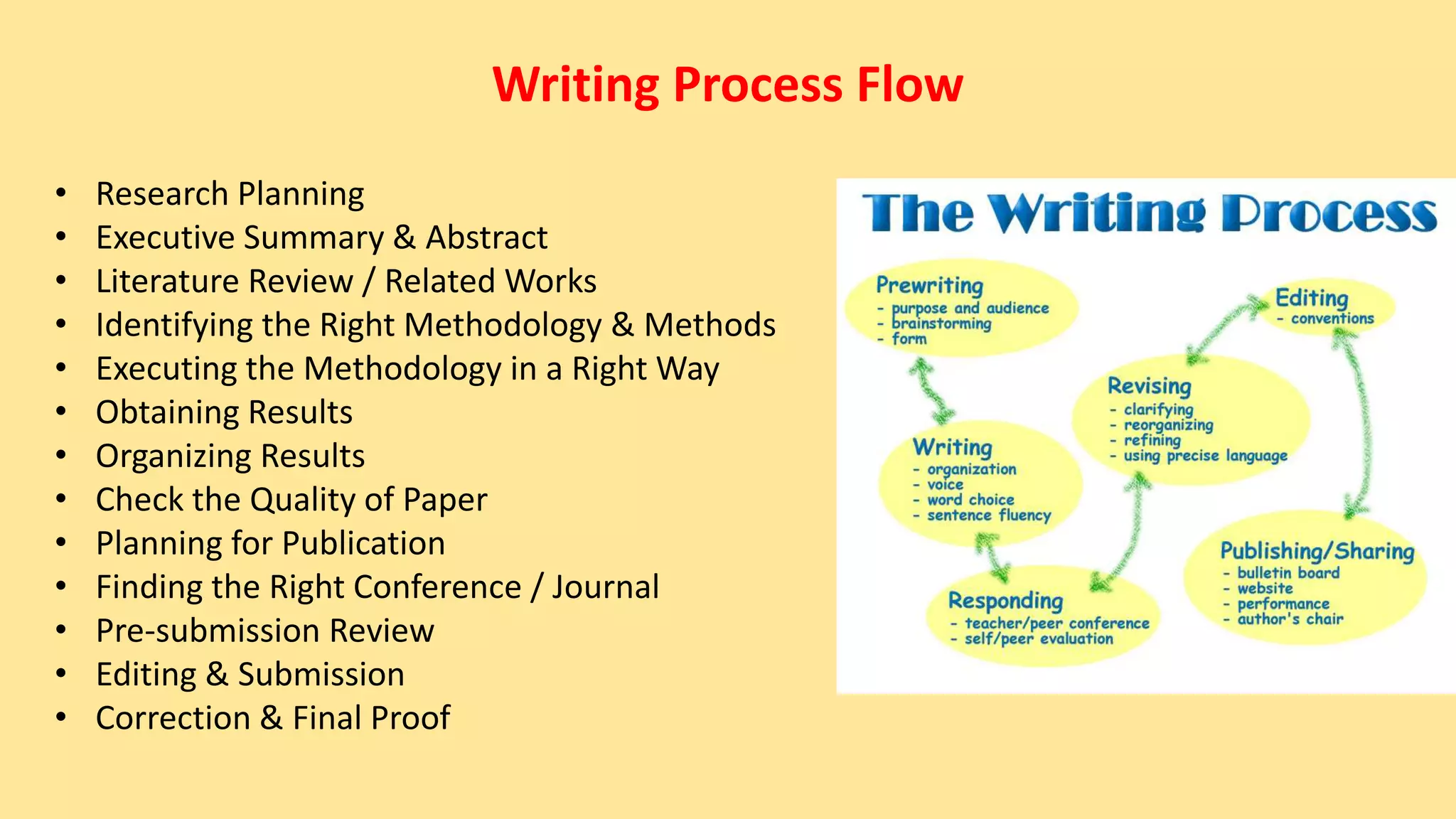
Writing Process Flow
• Research Planning
• Executive Summary & Abstract
• Literature Review / Related Works
• Identifying the Right Methodology & Methods
• Executing the Methodology in a Right Way
• Obtaining Results
• Organizing Results
• Check the Quality of Paper
• Planning for Publication
• Finding the Right Conference / Journal
• Pre-submission Review
• Editing & Submission
• Correction & Final Proof
4. Sample Paper Writing
Introduction
• Considered E-discovery and Digital Forensics as an application domain.
• Multi-faceted (time, individuals, connections and context)
• Many legal companies use manual investigation to find key information
(Lawton et al., UK home office, 2014).
• The complete investigation process is complex / cumbersome, expensive,
time-consuming and tedious to find interesting/relevant information.
• E-discovery experts need a tool that can help in discovering interesting
information and finding interesting relationships between them.
• Can visualization empower investigators? Can visualization be in the
investigation loop?
• Using visualizations to investigate emails from multiple perspectives are
under-explored and under-investigated.
Current Problems Proposed Model
20
Research Question
To what extent visualisations can support analysts in finding relevant
and/or discovering interesting information in a corpus of E-mail within
an organization supporting in the E-discovery Investigation?
Aim of the Research
The aim of the research is to design and develop interactive visual
solutions to explore and find / discover relevant / interesting information
in a corpus of E-mail communications from an investigation perspective
to support organizations specializing in Digital Forensics and E-discovery.
O1: Understand the E-discovery domain & review
literature.
O2: Design & develop interactive visualisations
O3: Validation of visual methods
O4: Iterative refinement of the developed
prototype.
Objectives
23
Contributions
• Characterised the domain, problems and tasks for E-discovery.
• Identified knowledge gap and provided overview of the existing
techniques.
• Designed and Developed interactive visualisation solutions.
• Validated the solutions
• Deployed Solutions in the Collaborator’s Platform (Google Suite).
• Lesson Learnings & Principles
• Presented papers at various venues India, USA, UK & Germany
(includes VIS & domain-related ones).
• Filed a Patent in the USA.
Literature Review – Key Findings
Visualization Features - Identified four main features in visualising
email communication, that is temporal, individuals and contents,
including thread features.
Visualization Techniques / Methods - More than half the surveyed
papers use conventional visualisations (basic charts and matrices) to
investigate data.
Visualization Tasks / Interaction System - Almost half of the surveyed
papers only provide an overview and show their analytic or visual
results but do not implement a details-on-demand and exploration
functionality.
Finding interesting subsets
within the large volume of
data
Complex and dynamic nature of
communication patterns
Open-ended data
exploration to find
interesting communication
patterns
Problem Characterization & Abstraction
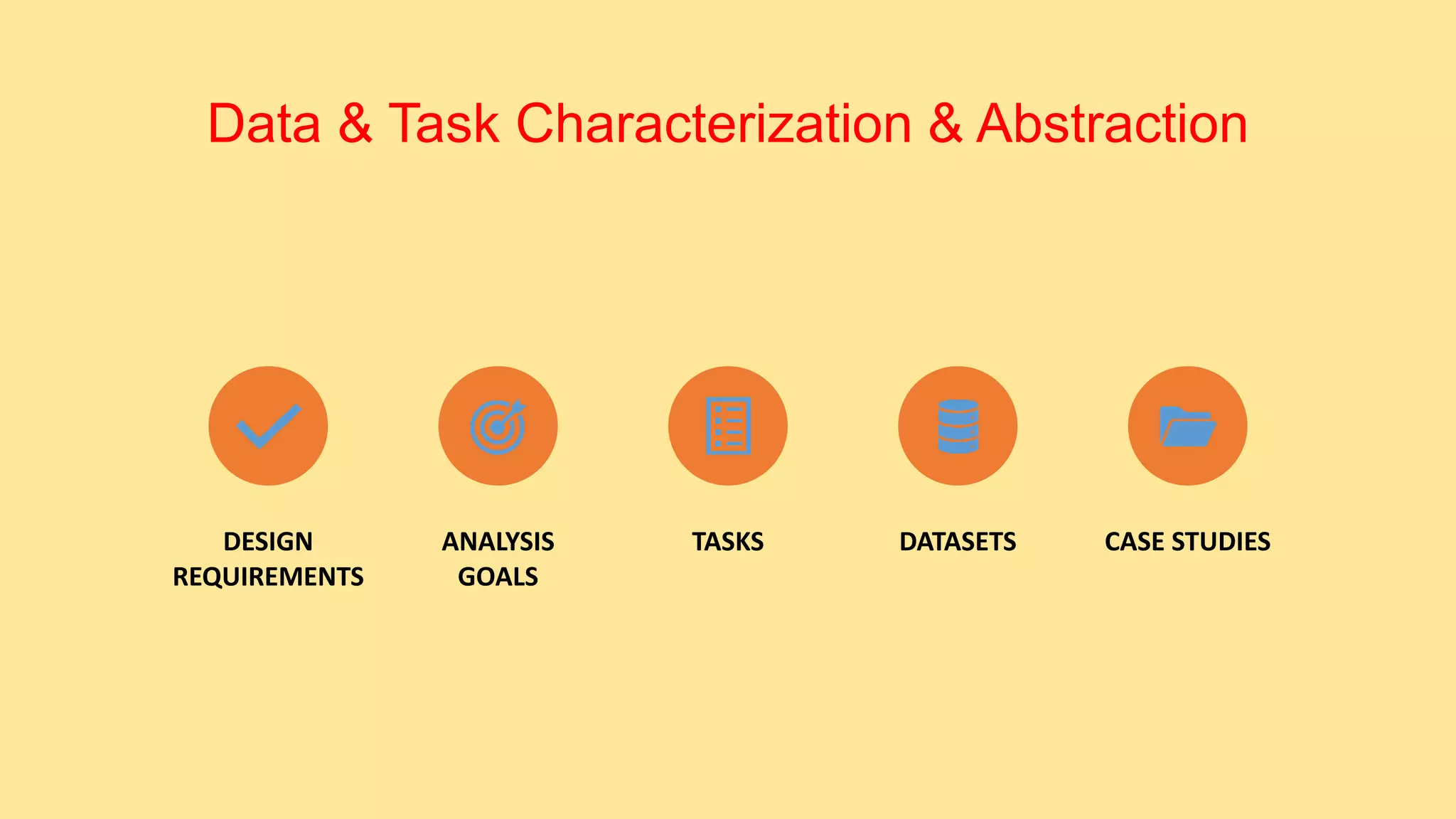
DESIGN
REQUIREMENTS
ANALYSIS
GOALS
TASKS DATASETS CASE STUDIES
Data & Task Characterization & Abstraction
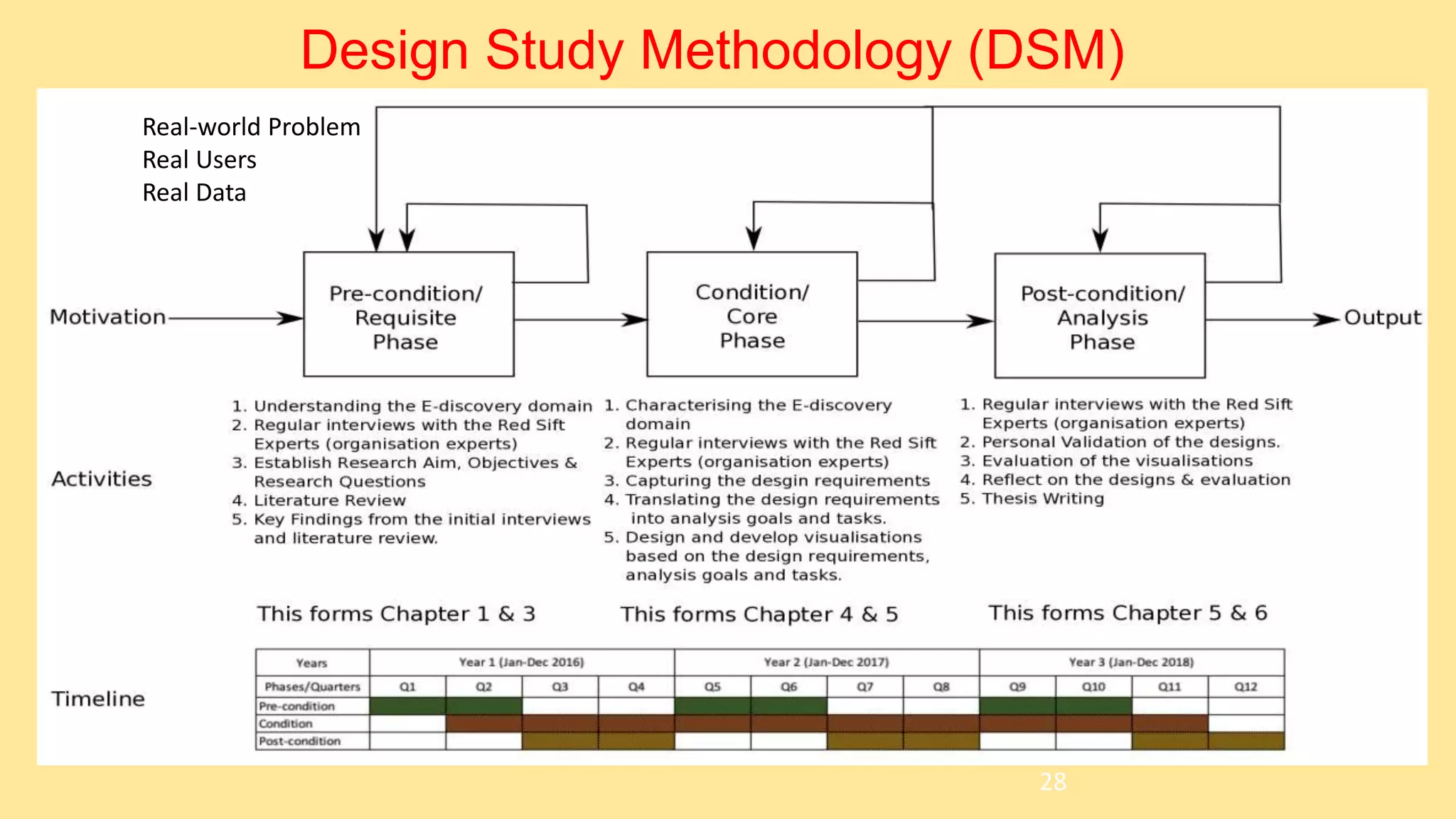
Real-world Problem
Real Users
Real Data
28
Design Study Methodology (DSM)
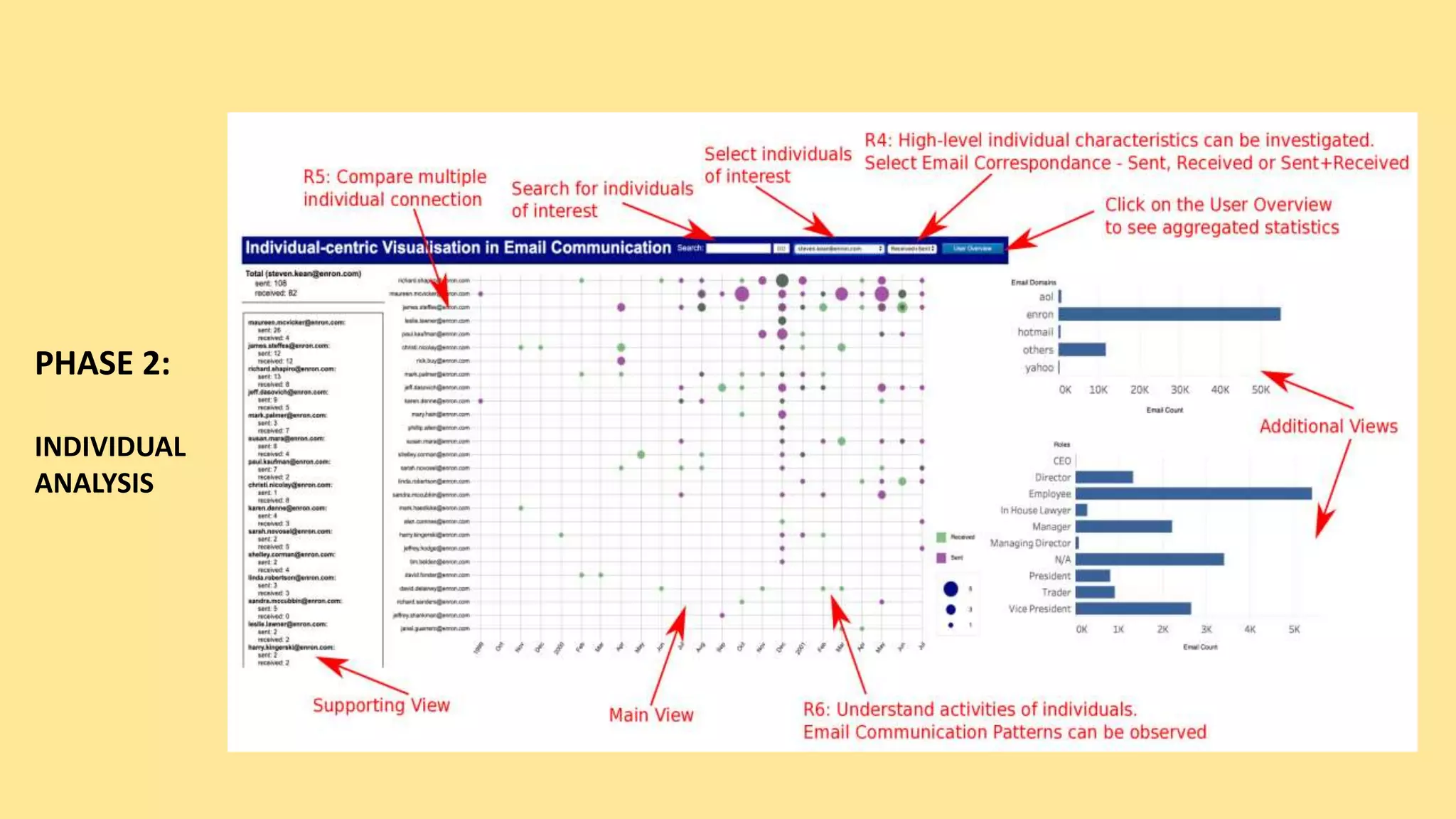
PHASE 1:
TEMPORAL ANALYSIS
Validated the solution with the
experts
PHASE 2:
INDIVIDUAL
ANALYSIS
PHASE 3:
THREAD
ANALYSIS
Iterative user-centric design approach gave us a good base to capture user
requirements (from the experts) which helped us achieve Objective 1 (O1).
Iterative user-centric design approach gave us a good platform to design interactive
visualisation solutions with the experts which helped us achieve Objective 2 (O2).
Iterative user-centric design approach also gave us a good space to validate our
solutions with the experts which helped us achieve Objective 3 (O3).
Revisiting Objectives
F1: An iterative user-centric design approach helped in
understanding E-discovery domain and the investigation needs.
F2. Multi-faceted exploration and multi-granular analysis
helped in discovering interestingness.
F3: Interactive visualisation assisted active learning helped in
classifying communications.
Findings
L1. Domain-specific requirements in depth should be focused.
L2. Conventional visualisations and novel visualisations should
be carefully analysed.
L3. Evaluation with non-experts should be considered.
Learnings
P1. Focus on domain-specific requirements.
P2. Consider iterative user-centric design throughout design-cycle.
P3. Generate system-based features for pattern characterization.
P4. Build pattern-oriented interactive visualisations for discovering
interestingness.
P5. Leverage multi-faceted and multi-granularity for exploration and
discovery.
P6. Important to represent evolution of communication.
P7. Evaluate the system with both experts and non-experts.
Principles
5. What editors and publishers want?
What is Peer Review?
‘Peer review is the process by which reports of, or
proposals for, research are scrutinised by other
researchers’. (Committee of Publisher Ethics, 2011)
What is the Purpose of Peer
Review?
• To ensure that only the best quality
manuscripts are published.
• To provide constructive feedback on
how a manuscript can be further
developed.
6. What are the publication ethics?
Ethical Issues – the Wider Aspects
•What information will you give participants before seeking their
consent?
•How much will the study deviate from current normal (accepted,
local) clinical practice?
•What full burden will be imposed on participants?
•What risks will participants/others be exposed to?
•What benefit might participants or others receive?
•How might society/future patients benefit in time?
•Might publication reveal patients’ identities?
Authorship and Contributorship
• These denote credit and accountability
• Many authors on papers have done little
• People’s names are left off papers
• Authors do not know the authorship criteria
• Contributorship statement more inclusive
Authorship
Authorship credit should be based only on substantial contribution to:
 Conception and design, or data analysis and interpretation
 Drafting the article or revising it critically for important intellectual content
 Final approval of the version to be published
 All these conditions must be met.
 Participation solely in the acquisition of funding or the collection of data does
not justify authorship.
 All authors included on a paper must fulfil the criteria
 No one who fulfils the criteria should be excluded
Contributorship
 Contributors (not all necessarily authors) who took part in planning, conducting, and
reporting the work.
 Guarantors (one or more) who accept full responsibility for the work and/or the
conduct of the study, had access to the data, and controlled the decision to publish.
 Researchers must decide among themselves the precise nature of each contribution.
7. What are the challenges in publishing
articles?
Challenges in Publishing Articles
• Choosing the Suitable Conference and Journal
• Publication Type: Open Access Journal versus Traditional Journal?
• Language and Style
• Plagiarism and Similarities
• Publication Time (rapid publication)
• Publication Cost
• Complexity of Peer Review System
• Copyright issues
• Following Author Guidelines
• Research Impact
8. What is research impact used for?
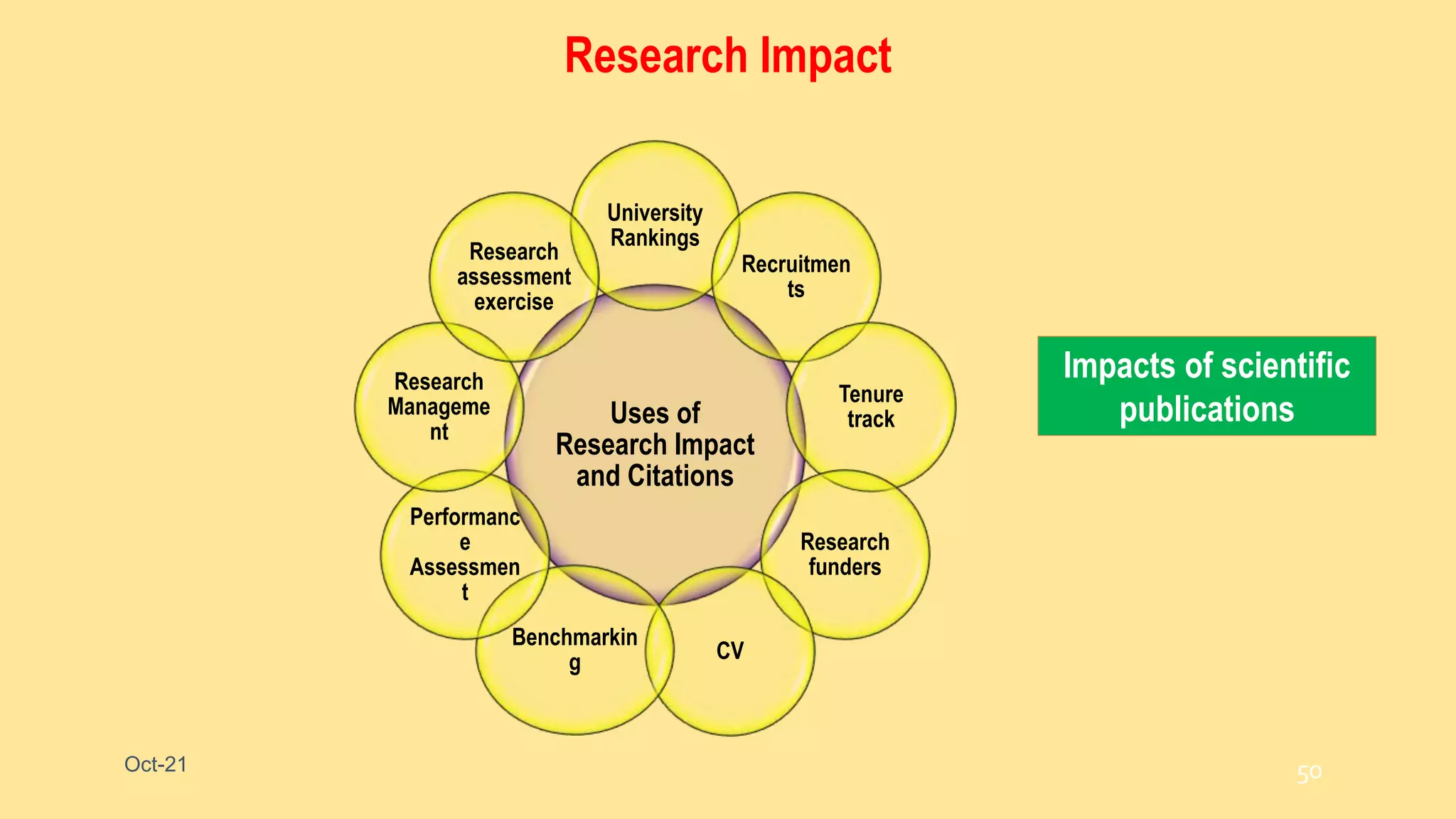
Research Impact
Uses of
Research Impact
and Citations
University
Rankings
Recruitmen
ts
Tenure
track
Research
funders
CV
Benchmarkin
g
Performanc
e
Assessmen
t
Research
Manageme
nt
Research
assessment
exercise
Impacts of scientific
publications
Oct-21 50
Publications are an essential part of scientific communication (with industry and
community) and important products of research. Hence, the following method of
analysis is needed:
 Determining the productivity and quality of a unit's research output.
 In addition to it's impact and visibility.
Citation analysis can be used to compare a unit's research in comparison to the
international level in each field of knowledge.
How is your research being evaluated?
What can be measured?
• Publications per year, per author
• Publication type - articles, conference papers,
dissertations and monographs
• Collaboration between researchers, groups,
organizations etc.
• Who is citing whom, what, when
How Research has Impact
Research Impact
What impact can be measured?
• Individual, group, institution, subject area, geographic region (bibliometrics)
• individual article level (altmetrics)
Bibliometrics
• Uses – to examine scientific publication activity, the most cited
publications and the linkages between citing articles
• It can be used to study the impact of a publication, an author or an
institution based on the number of times works and/or authors have
been cited by others
• Bibliometric indicators, like Journal Impact Factor and h-index, are used
to measure research impact and publication activity
• Three best known citation analysis databases are Web of Science (WoS),
Scopus and Google Scholar (GS)
Refer to: https://ukm.pure.elsevier.com/
Altmetrics (or article level time metrics) measure research visibility in social media and other
online platforms.
How much an article is viewed, downloaded, recommended or discussed on the net? Altmetrics
try to answer who is saying what about research.
Measurable ”items” for example:
– mentions (e.g. blog posts, comments, tweets, Wikipedia)
– use (e.g. downloads, views, saves, bookmarks)
– recommendations (e.g. likes, shares, reviews)
– citation counts
Figures are collected from extensive, open services, including e.g. Open Access journals, citation
databases, social media and researcher visibility services like ORCID, KUDOS, ResearcherID,
Google Scholar, AcademiaEdu and Mendeley.
Altmetrics
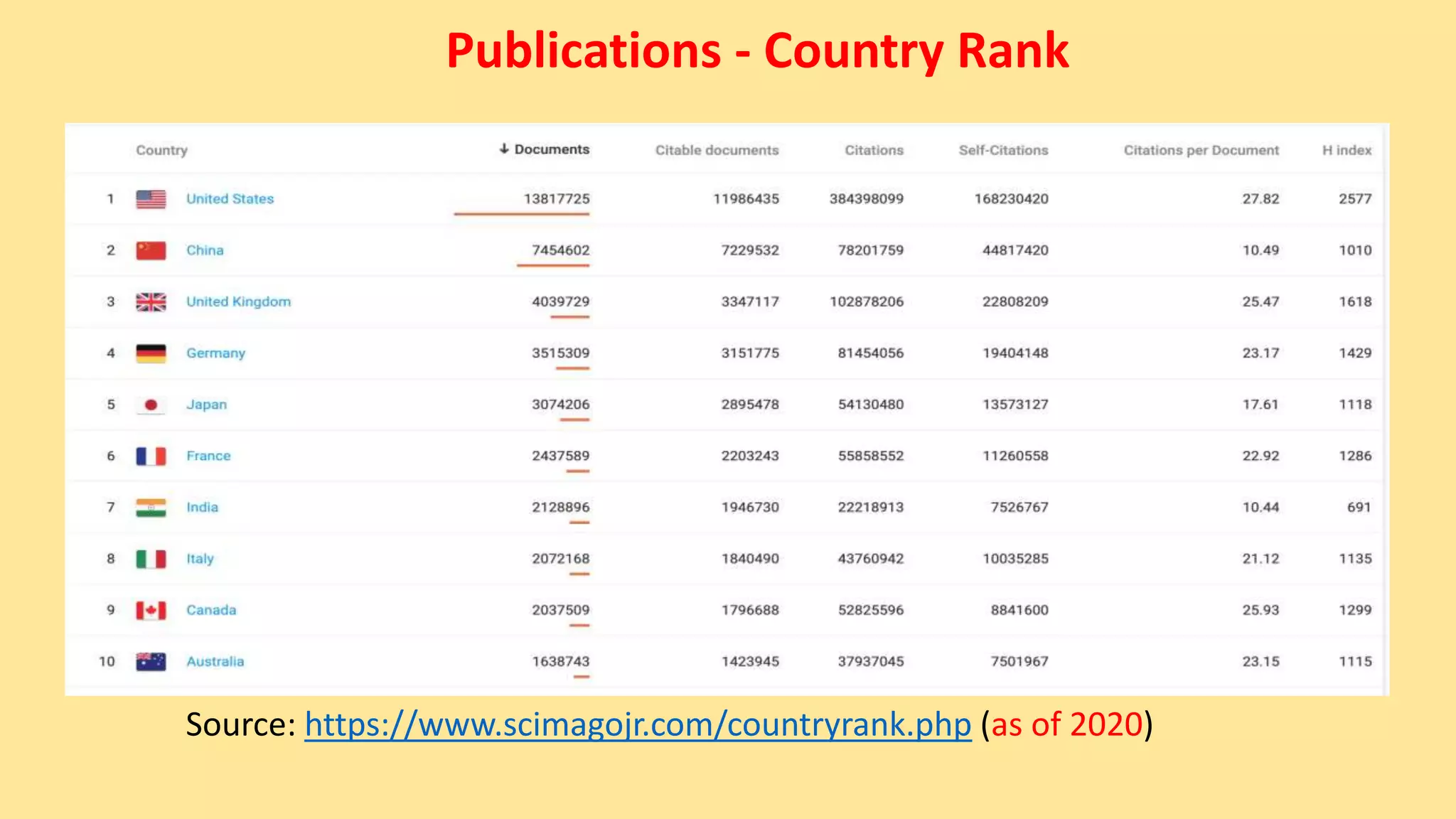
Publications - Country Rank
Source: https://www.scimagojr.com/countryrank.php (as of 2020)
9. What are the research tools?
• Scopus
• Web of Science
• PubMed
• ERIC
• IEEE Xplore
• ScienceDirect
• Directory of Open Access Journals
(DOAJ)
• JSTOR
• Ulrichweb
• Science Citation Index (SCI)
• arXiv
• Google Scholar
• Microsoft
Academic
• AcademiaEdu
• BASE
• CORE
• Science.gov
• Semantic
Scholar
• Baidu Scholar
• RefSeek
Research Tools
Research Database, Search Engines & Indexing Sites
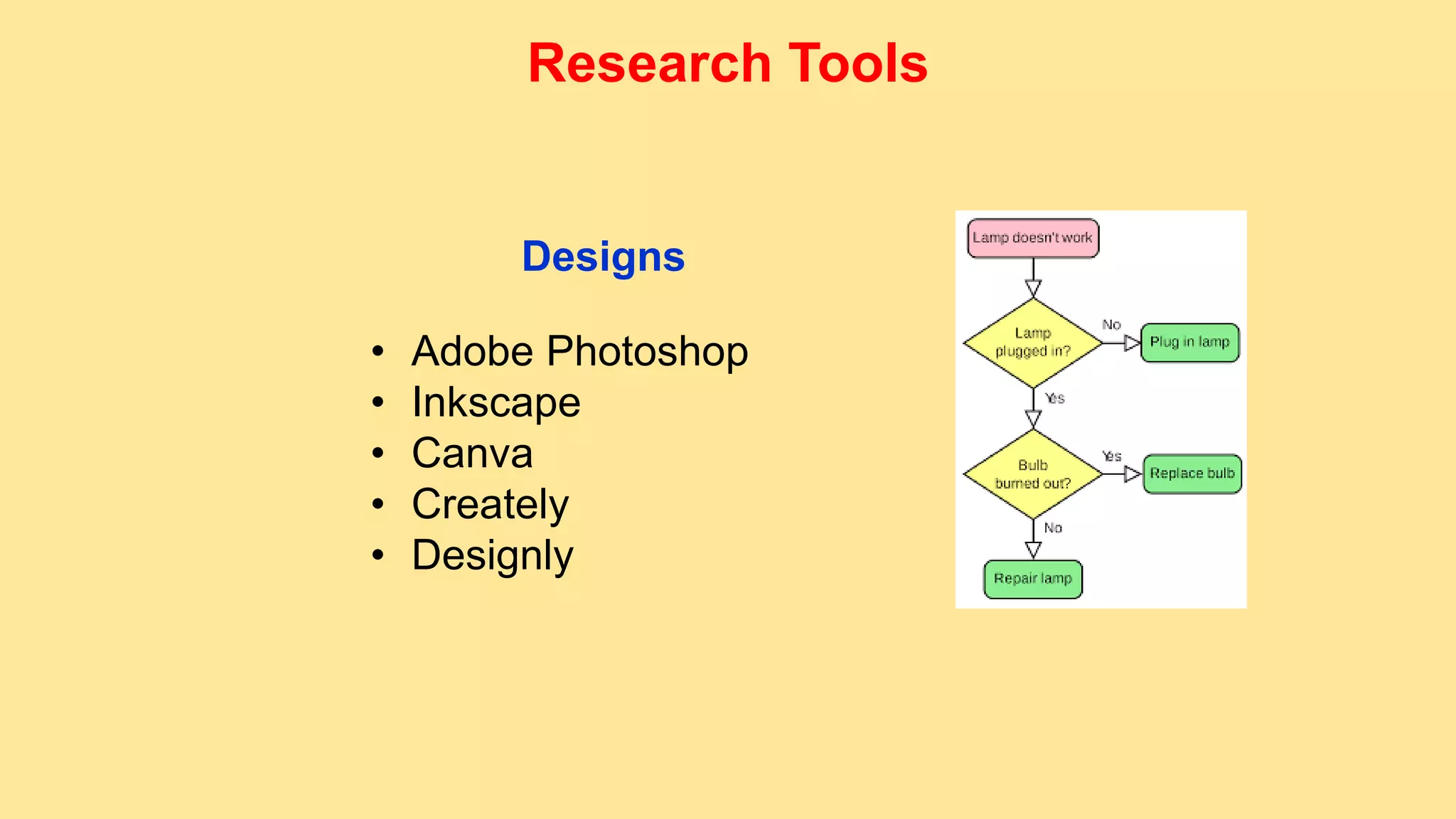
Designs
• Adobe Photoshop
• Inkscape
• Canva
• Creately
• Designly
Research Tools
Grammar Checker
• Hemingway
• Grammarly
• Grammar Check
• Ginger
• Zoho
Other Research Tools
• Dictionary
• Thesaurus
• Translator
Research Tools
Plagiarism Checker
• Turnitin
• iThenticate
• Small SEO Tools - Plagiarism
Checker
• Grammarly
• Quetext
• Duplichecker
Research Tools
Research Datasets
• Google Dataset Search
• Kaggle
• SagePub
• Mendeley
• Github
• Data.Gov
• Datahub.io
• UCI Machine Learning Repository
• Earth Data
• CERN Open Data Portal
• Global Health Observatory Data Repository
• FBI Crime Data Explorer
• Stanford Large Network Dataset Collection
Research Tools
Text Editors
• Microsoft Word
• Google Doc
• OpenOffice
• LaTex
Research Tools
Articles / Citations Management
Tools
• Mendeley
• Zotero
• BibTex
• EndNote
Managing Read, Organize, and
Annotate PDFs
• Mendeley
• ReadCube Papers
• GoodReader
• Foxit PDF Reader
Research Tools
Collaboration Tools - Store and Organize Files
Create documents, spreadsheets and more to share with a group.
Capture, organize, and share notes from anywhere. Share notes with
friends and colleagues.
• Google Drive
• Microsoft 360
• Dropbox
• Evernote
Research Tools
Collaborative Writing Tools
• Google Documents
• Microsoft Documents
• Dropbox Paper
• Overleaf
• Authorea
• PubPub
Collaborative Discussion Tools
• Google Meet & Chat
• Skype
• Slack
In addition, use
• Google Tasks
• Google Keep
• Google Calendar
Research Tools
Research Portfolio
• Google Scholar
• Microsoft
Academic
• ResearchGate
• AcademiaEdu
• LiveDNA
• Slideshare
• Scopus
• Orcid
Research Tools
Conference Alerts & Notifications
• Conference Alerts
• All Conference Alert
• World Conference Alerts
• EDAS
• EasyChair
• Resurchify
Research Tools
My Success Formula
• LaTex
• Inkscape & Canva
• Google Scholar
• Google Workspace
• Mendeley
• BibTex
• Small SEO Tools - Plagiarism
Checker
• Grammarly
• EDAS & EasyChair
What we learnt?
• How important it is to publish articles and what are its challenges?
• How to increase the visibility and accessibility of published papers?
• How to increase the chance of getting publications cited?
• How to disseminate the publication by using “Research Tools” effectively?
• How to increase the chance of research collaboration?
Importance of Publications

Importance of Publications

  • 1.
    Importance of Publication DrMithileysh Sathiyanarayanan Research & Innovation MIT Square, London www.mitsquare.com
  • 2.
    Objectives • To understandthe importance of publication and its challenges • To increase the visibility and accessibility of published papers • To increase the chance of getting publications cited • To disseminate the publication by using “Research Tools” effectively • To increase the chance of research collaboration
  • 3.
    Agenda 1. Why publicationis important? 2. How to plan research and publish? 3. How to write a paper? 4. Can a sample paper help? 5. What editors and publishers want? 6. What are the publication ethics? 7. What are the challenges in publishing articles? 8. What is research impact used for? 9. What are the research tools? 10.What is the success formula?
  • 4.
    1. Why publicationis important?
  • 5.
    Why Publication isImportant? • Convey something important • Share your work • Change practice • Promote thoughts or stimulate debate • Propose guidelines, principles and suggestions • Educate • Help academies and industries implement in real- time • Get into high impact journal • Recognition • Build your portfolio • Advance your career • Credibility with colleagues • Royalties, Incentives & Remuneration • Joint Proposals & Funding • Collaboration
  • 6.
    2. How toPlan Research & Publish?
  • 7.
    Steps in Startinga Research • Turn your ideas into a research question • Review the literature • Identify methodology and methods • Enlist co-authors, statistician, supervisor • Agree who will do what • Design the study and develop your methods • Think about the ethics of your study design • Write your research proposal • Apply for funding and ethics approval
  • 8.
    What is aResearch Question? • The researcher asks a very specific question and tests a specific hypothesis. Broad questions are usually broken into smaller, testable hypotheses or questions. • Often called an objective or aim, though calling it a question tends to help with focusing the hypothesis and thinking about how to find an answer.
  • 9.
    What Makes aPoor Research Question? A question that matters to nobody, even you Hoping one emerges from routine clinical data/records • the records will be biased and confounded • they’ll lack information you need to answer your question reliably, because they were collected for another reason Fishing expedition/data dredging – gathering new data and hoping a question will emerge
  • 10.
    How to FocusYour Question • Brief literature search for previous evidence • Discuss with colleagues • Narrow down the question – time, place, group • What answer do you expect to find?
  • 11.
    Turning a researchquestion into a proposal • From who I am collecting information from? • What kinds of information do I need? • How much information will I need? • How will I use the information? • How will I minimise chance/bias/confounding? • How will I collect the information ethically?
  • 12.
    Minimizing Bias andConfounding Chance - measurements are nearly always subject to random variation. Minimise error by ensuring adequate sample size and using statistical analysis of the play of chance. Bias - caused by systematic variation/error in selecting participants, measuring outcomes, analysing data – take extra care. Confounding - factors that affect the interpretation of outcomes. For Ex: people who carry matches are more likely to develop lung cancer, but smoking is the confounding factor – so measure likely confounders too.
  • 13.
  • 14.
    3. How toWrite a Paper
  • 15.
    Paper Writing Philosophy Apaper contains • A report on (new findings) and/or solutions. • Purpose is to convince the reader that the findings/solutions are - important - and better (than the existing solutions) • Level of rigour when writing is higher • Expected to support statements with references • Contextualise what is known about the subject and any gaps in the evidence • How does your manuscript adds to the body of knowledge
  • 16.
    A quality papermust have the following • What is your research all about? • Why are you want to conduct this kind of a research? • What problems/challenges you want to solve/reduce? • Why is it important? • What have you achieved? • How you achieved it? • Why you obtained such results? (analysis) • How much better is it?
  • 17.
    Writing Process Flow •Research Planning • Executive Summary & Abstract • Literature Review / Related Works • Identifying the Right Methodology & Methods • Executing the Methodology in a Right Way • Obtaining Results • Organizing Results • Check the Quality of Paper • Planning for Publication • Finding the Right Conference / Journal • Pre-submission Review • Editing & Submission • Correction & Final Proof
  • 18.
  • 19.
    Introduction • Considered E-discoveryand Digital Forensics as an application domain. • Multi-faceted (time, individuals, connections and context) • Many legal companies use manual investigation to find key information (Lawton et al., UK home office, 2014). • The complete investigation process is complex / cumbersome, expensive, time-consuming and tedious to find interesting/relevant information. • E-discovery experts need a tool that can help in discovering interesting information and finding interesting relationships between them. • Can visualization empower investigators? Can visualization be in the investigation loop? • Using visualizations to investigate emails from multiple perspectives are under-explored and under-investigated.
  • 20.
  • 21.
    Research Question To whatextent visualisations can support analysts in finding relevant and/or discovering interesting information in a corpus of E-mail within an organization supporting in the E-discovery Investigation?
  • 22.
    Aim of theResearch The aim of the research is to design and develop interactive visual solutions to explore and find / discover relevant / interesting information in a corpus of E-mail communications from an investigation perspective to support organizations specializing in Digital Forensics and E-discovery.
  • 23.
    O1: Understand theE-discovery domain & review literature. O2: Design & develop interactive visualisations O3: Validation of visual methods O4: Iterative refinement of the developed prototype. Objectives 23
  • 24.
    Contributions • Characterised thedomain, problems and tasks for E-discovery. • Identified knowledge gap and provided overview of the existing techniques. • Designed and Developed interactive visualisation solutions. • Validated the solutions • Deployed Solutions in the Collaborator’s Platform (Google Suite). • Lesson Learnings & Principles • Presented papers at various venues India, USA, UK & Germany (includes VIS & domain-related ones). • Filed a Patent in the USA.
  • 25.
    Literature Review –Key Findings Visualization Features - Identified four main features in visualising email communication, that is temporal, individuals and contents, including thread features. Visualization Techniques / Methods - More than half the surveyed papers use conventional visualisations (basic charts and matrices) to investigate data. Visualization Tasks / Interaction System - Almost half of the surveyed papers only provide an overview and show their analytic or visual results but do not implement a details-on-demand and exploration functionality.
  • 26.
    Finding interesting subsets withinthe large volume of data Complex and dynamic nature of communication patterns Open-ended data exploration to find interesting communication patterns Problem Characterization & Abstraction
  • 27.
    DESIGN REQUIREMENTS ANALYSIS GOALS TASKS DATASETS CASESTUDIES Data & Task Characterization & Abstraction
  • 28.
    Real-world Problem Real Users RealData 28 Design Study Methodology (DSM)
  • 32.
    PHASE 1: TEMPORAL ANALYSIS Validatedthe solution with the experts
  • 33.
  • 34.
  • 35.
    Iterative user-centric designapproach gave us a good base to capture user requirements (from the experts) which helped us achieve Objective 1 (O1). Iterative user-centric design approach gave us a good platform to design interactive visualisation solutions with the experts which helped us achieve Objective 2 (O2). Iterative user-centric design approach also gave us a good space to validate our solutions with the experts which helped us achieve Objective 3 (O3). Revisiting Objectives
  • 36.
    F1: An iterativeuser-centric design approach helped in understanding E-discovery domain and the investigation needs. F2. Multi-faceted exploration and multi-granular analysis helped in discovering interestingness. F3: Interactive visualisation assisted active learning helped in classifying communications. Findings
  • 37.
    L1. Domain-specific requirementsin depth should be focused. L2. Conventional visualisations and novel visualisations should be carefully analysed. L3. Evaluation with non-experts should be considered. Learnings
  • 38.
    P1. Focus ondomain-specific requirements. P2. Consider iterative user-centric design throughout design-cycle. P3. Generate system-based features for pattern characterization. P4. Build pattern-oriented interactive visualisations for discovering interestingness. P5. Leverage multi-faceted and multi-granularity for exploration and discovery. P6. Important to represent evolution of communication. P7. Evaluate the system with both experts and non-experts. Principles
  • 39.
    5. What editorsand publishers want?
  • 40.
    What is PeerReview? ‘Peer review is the process by which reports of, or proposals for, research are scrutinised by other researchers’. (Committee of Publisher Ethics, 2011)
  • 41.
    What is thePurpose of Peer Review? • To ensure that only the best quality manuscripts are published. • To provide constructive feedback on how a manuscript can be further developed.
  • 42.
    6. What arethe publication ethics?
  • 43.
    Ethical Issues –the Wider Aspects •What information will you give participants before seeking their consent? •How much will the study deviate from current normal (accepted, local) clinical practice? •What full burden will be imposed on participants? •What risks will participants/others be exposed to? •What benefit might participants or others receive? •How might society/future patients benefit in time? •Might publication reveal patients’ identities?
  • 44.
    Authorship and Contributorship •These denote credit and accountability • Many authors on papers have done little • People’s names are left off papers • Authors do not know the authorship criteria • Contributorship statement more inclusive
  • 45.
    Authorship Authorship credit shouldbe based only on substantial contribution to:  Conception and design, or data analysis and interpretation  Drafting the article or revising it critically for important intellectual content  Final approval of the version to be published  All these conditions must be met.  Participation solely in the acquisition of funding or the collection of data does not justify authorship.  All authors included on a paper must fulfil the criteria  No one who fulfils the criteria should be excluded
  • 46.
    Contributorship  Contributors (notall necessarily authors) who took part in planning, conducting, and reporting the work.  Guarantors (one or more) who accept full responsibility for the work and/or the conduct of the study, had access to the data, and controlled the decision to publish.  Researchers must decide among themselves the precise nature of each contribution.
  • 47.
    7. What arethe challenges in publishing articles?
  • 48.
    Challenges in PublishingArticles • Choosing the Suitable Conference and Journal • Publication Type: Open Access Journal versus Traditional Journal? • Language and Style • Plagiarism and Similarities • Publication Time (rapid publication) • Publication Cost • Complexity of Peer Review System • Copyright issues • Following Author Guidelines • Research Impact
  • 49.
    8. What isresearch impact used for?
  • 50.
    Research Impact Uses of ResearchImpact and Citations University Rankings Recruitmen ts Tenure track Research funders CV Benchmarkin g Performanc e Assessmen t Research Manageme nt Research assessment exercise Impacts of scientific publications Oct-21 50
  • 51.
    Publications are anessential part of scientific communication (with industry and community) and important products of research. Hence, the following method of analysis is needed:  Determining the productivity and quality of a unit's research output.  In addition to it's impact and visibility. Citation analysis can be used to compare a unit's research in comparison to the international level in each field of knowledge. How is your research being evaluated?
  • 52.
    What can bemeasured? • Publications per year, per author • Publication type - articles, conference papers, dissertations and monographs • Collaboration between researchers, groups, organizations etc. • Who is citing whom, what, when How Research has Impact
  • 53.
    Research Impact What impactcan be measured? • Individual, group, institution, subject area, geographic region (bibliometrics) • individual article level (altmetrics)
  • 54.
    Bibliometrics • Uses –to examine scientific publication activity, the most cited publications and the linkages between citing articles • It can be used to study the impact of a publication, an author or an institution based on the number of times works and/or authors have been cited by others • Bibliometric indicators, like Journal Impact Factor and h-index, are used to measure research impact and publication activity • Three best known citation analysis databases are Web of Science (WoS), Scopus and Google Scholar (GS) Refer to: https://ukm.pure.elsevier.com/
  • 55.
    Altmetrics (or articlelevel time metrics) measure research visibility in social media and other online platforms. How much an article is viewed, downloaded, recommended or discussed on the net? Altmetrics try to answer who is saying what about research. Measurable ”items” for example: – mentions (e.g. blog posts, comments, tweets, Wikipedia) – use (e.g. downloads, views, saves, bookmarks) – recommendations (e.g. likes, shares, reviews) – citation counts Figures are collected from extensive, open services, including e.g. Open Access journals, citation databases, social media and researcher visibility services like ORCID, KUDOS, ResearcherID, Google Scholar, AcademiaEdu and Mendeley. Altmetrics
  • 56.
    Publications - CountryRank Source: https://www.scimagojr.com/countryrank.php (as of 2020)
  • 57.
    9. What arethe research tools?
  • 58.
    • Scopus • Webof Science • PubMed • ERIC • IEEE Xplore • ScienceDirect • Directory of Open Access Journals (DOAJ) • JSTOR • Ulrichweb • Science Citation Index (SCI) • arXiv • Google Scholar • Microsoft Academic • AcademiaEdu • BASE • CORE • Science.gov • Semantic Scholar • Baidu Scholar • RefSeek Research Tools Research Database, Search Engines & Indexing Sites
  • 59.
    Designs • Adobe Photoshop •Inkscape • Canva • Creately • Designly Research Tools
  • 60.
    Grammar Checker • Hemingway •Grammarly • Grammar Check • Ginger • Zoho Other Research Tools • Dictionary • Thesaurus • Translator Research Tools
  • 61.
    Plagiarism Checker • Turnitin •iThenticate • Small SEO Tools - Plagiarism Checker • Grammarly • Quetext • Duplichecker Research Tools
  • 62.
    Research Datasets • GoogleDataset Search • Kaggle • SagePub • Mendeley • Github • Data.Gov • Datahub.io • UCI Machine Learning Repository • Earth Data • CERN Open Data Portal • Global Health Observatory Data Repository • FBI Crime Data Explorer • Stanford Large Network Dataset Collection Research Tools
  • 63.
    Text Editors • MicrosoftWord • Google Doc • OpenOffice • LaTex Research Tools
  • 64.
    Articles / CitationsManagement Tools • Mendeley • Zotero • BibTex • EndNote Managing Read, Organize, and Annotate PDFs • Mendeley • ReadCube Papers • GoodReader • Foxit PDF Reader Research Tools
  • 65.
    Collaboration Tools -Store and Organize Files Create documents, spreadsheets and more to share with a group. Capture, organize, and share notes from anywhere. Share notes with friends and colleagues. • Google Drive • Microsoft 360 • Dropbox • Evernote Research Tools
  • 66.
    Collaborative Writing Tools •Google Documents • Microsoft Documents • Dropbox Paper • Overleaf • Authorea • PubPub Collaborative Discussion Tools • Google Meet & Chat • Skype • Slack In addition, use • Google Tasks • Google Keep • Google Calendar Research Tools
  • 67.
    Research Portfolio • GoogleScholar • Microsoft Academic • ResearchGate • AcademiaEdu • LiveDNA • Slideshare • Scopus • Orcid Research Tools
  • 68.
    Conference Alerts &Notifications • Conference Alerts • All Conference Alert • World Conference Alerts • EDAS • EasyChair • Resurchify Research Tools
  • 69.
    My Success Formula •LaTex • Inkscape & Canva • Google Scholar • Google Workspace • Mendeley • BibTex • Small SEO Tools - Plagiarism Checker • Grammarly • EDAS & EasyChair
  • 70.
    What we learnt? •How important it is to publish articles and what are its challenges? • How to increase the visibility and accessibility of published papers? • How to increase the chance of getting publications cited? • How to disseminate the publication by using “Research Tools” effectively? • How to increase the chance of research collaboration?