The document discusses disruptive technologies and how businesses can use them to create new markets and value networks. It provides examples of in-memory computing, crowd sourcing workforces, digital engagement, wearables, social activation, DevOps, and cloud orchestration as disruptive technologies. It also summarizes Clayton Christensen's disruptive technology theory, which separates new technologies into sustaining or disruptive categories. Disruptive technologies lack refinement initially but can eventually displace existing technologies. Examples given include personal computers displacing typewriters and changing communication, and smartphones replacing devices like cameras and GPS units.
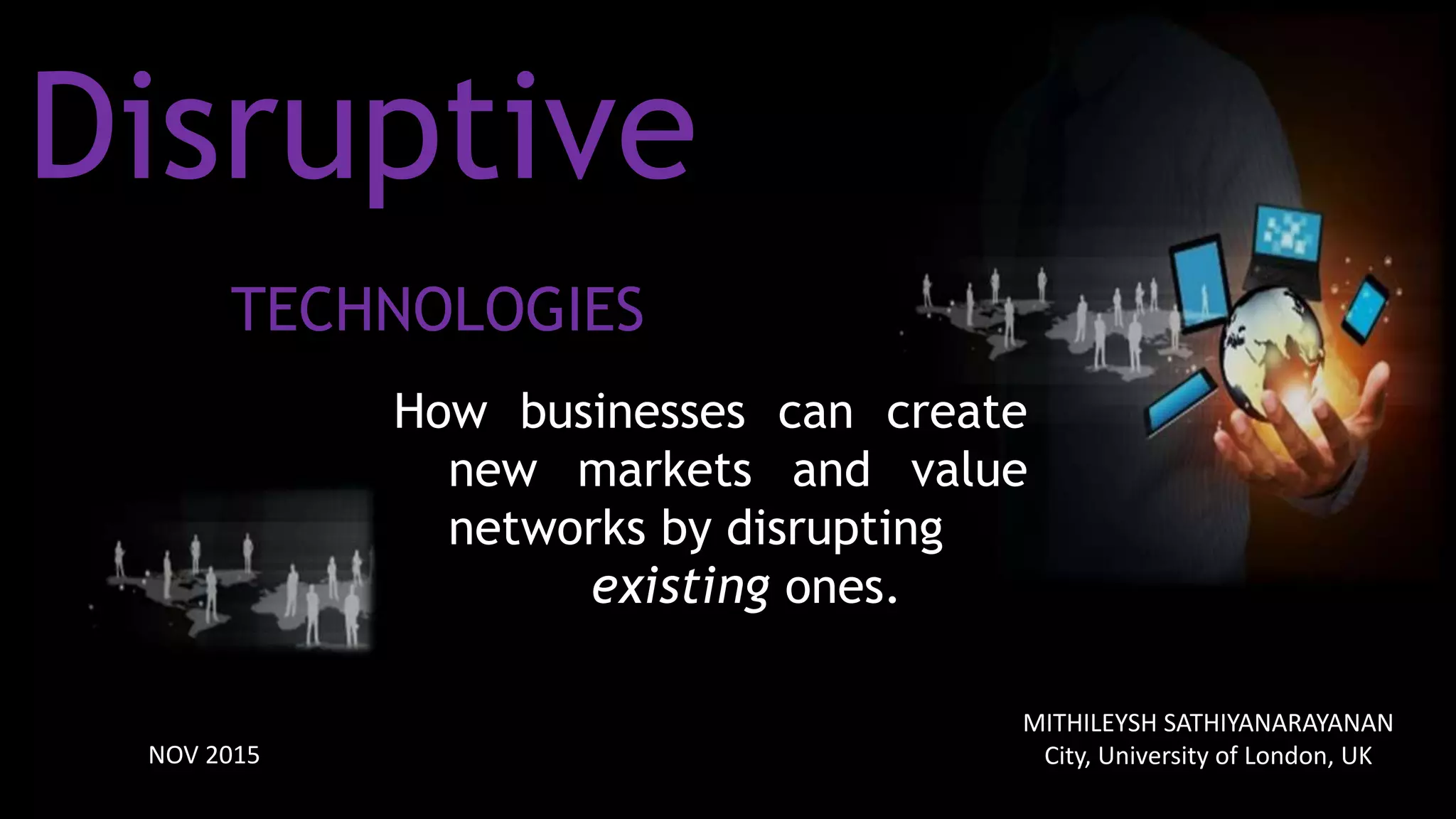
Disruptive
TECHNOLOGIES
How businesses cancreate
new markets and value
networks by disrupting
existing ones.
NOV 2015
MITHILEYSH SATHIYANARAYANAN
City, University of London, UK
2.
IN-MEMORY
COMPUTING
The processing and
utilizationof data
stored in RAM instead
of on disk drives.
The potential of in-memory allows
businesses to make information available
within milliseconds, when their customers
are combing through large sets of data.
3.
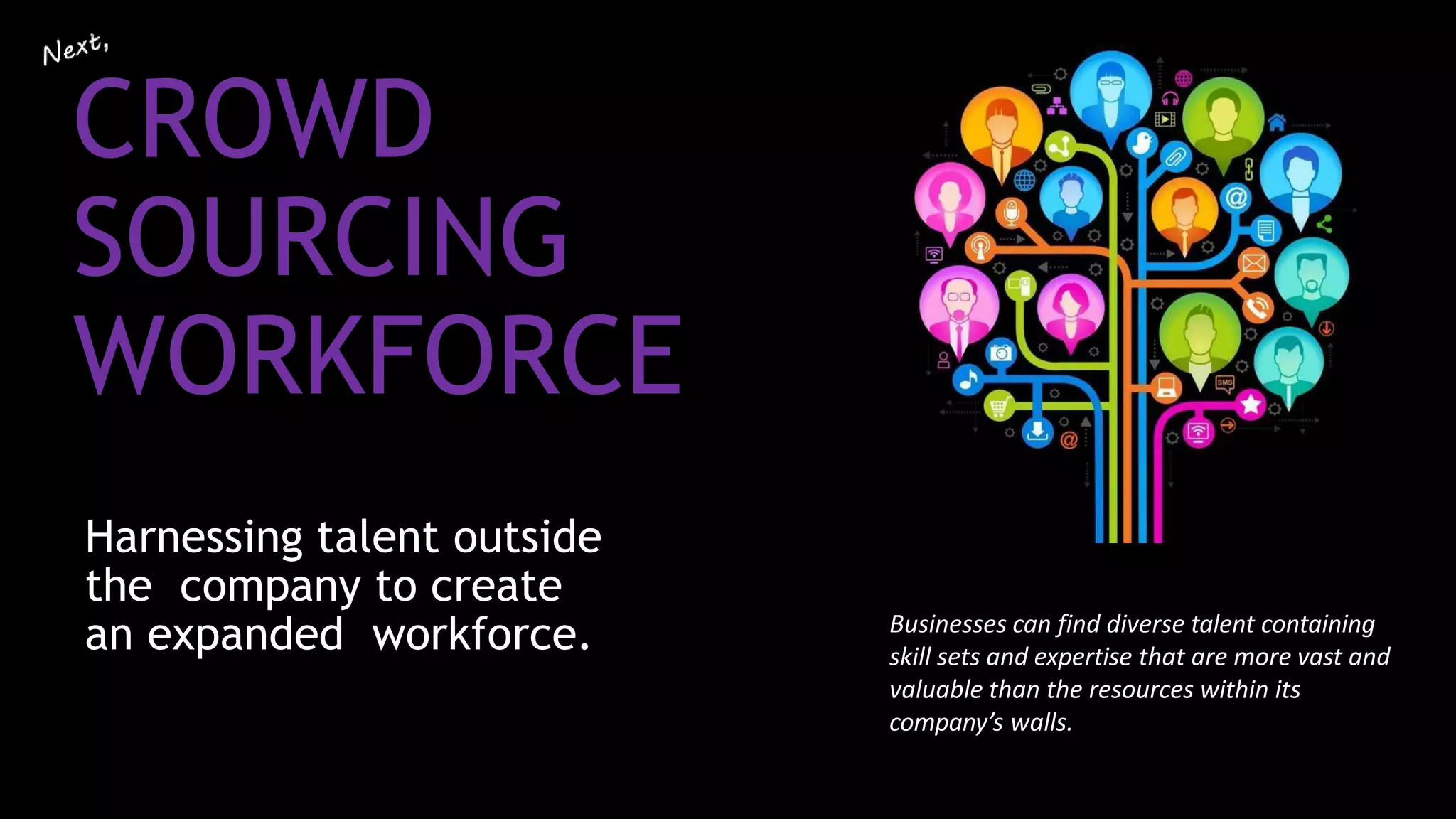
CROWD
SOURCING
WORKFORCE
Harnessing talent outside
thecompany to create
an expanded workforce. Businesses can find diverse talent containing
skill sets and expertise that are more vast and
valuable than the resources within its
company’s walls.
4.
DIGITAL
ENGAGEMENT
The use ofdigital
tools and techniques
to find and mobilize
customers around a
product or service.
Businesses that don’t think beyond the traditional;
will miss the opportunity to lead their customers on
desirable journeys, experiences and outcomes.
The act oftransforming
your social media followers
to brand evangelists.
With satisfied customers endorsing your brand via
social media and word-of-mouth, businesses are likely
to draw in new customers!
SOCIAL
ACTIVATION
7.
DEVOPS
A software development
methodthat uses agile
principles across the
software delivery
lifecycle. Companies that can create an 'all hands on deck'
approach and disrupt the developer versus the
sysadmin battleground will transform their
development and operations into a cross-disciplinary
approach to maximizing reliability in all areas.
DISTRUPTIVE
TECHNOLOGY
THEORY
A disruptive technologyis one that displaces (SHIFTS OR
TRANSFERS) an established technology and shakes up the
industry or a ground-breaking product that creates a
completely new industry
10.
Harvard Business Schoolprofessor Clayton M.
Christensen coined the term disruptive technology.
In his 1997 best-selling book, "The Innovator's
Dilemma,"
▶ Christensen separates new technology into two
categories: sustaining and disruptive.
▶ Sustaining technology relies on incremental improvements
to an already established technology.
▶ Disruptive technology lacks refinement, often has
performance problems because it is new, appeals to a
limited audience and may not yet have a proven practical
application. (Such was the case with Alexander Graham
Bell's "electrical speech machine," which we now call the
telephone.)
11.
Here are afew examples of disruptive
technologies
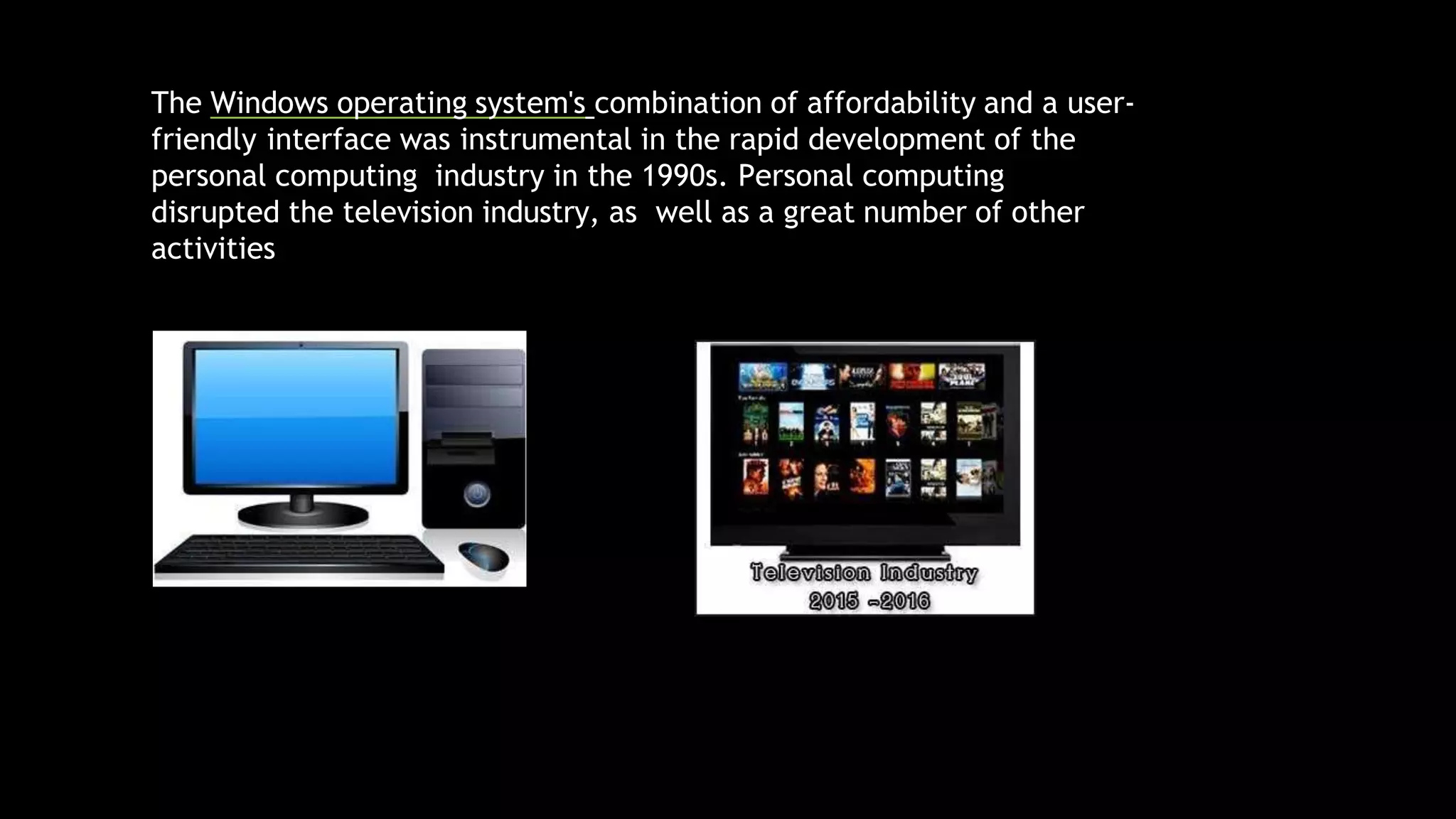
▶ The personal computer (PC) displaced the typewriter and forever changed the way we
work and communicate.
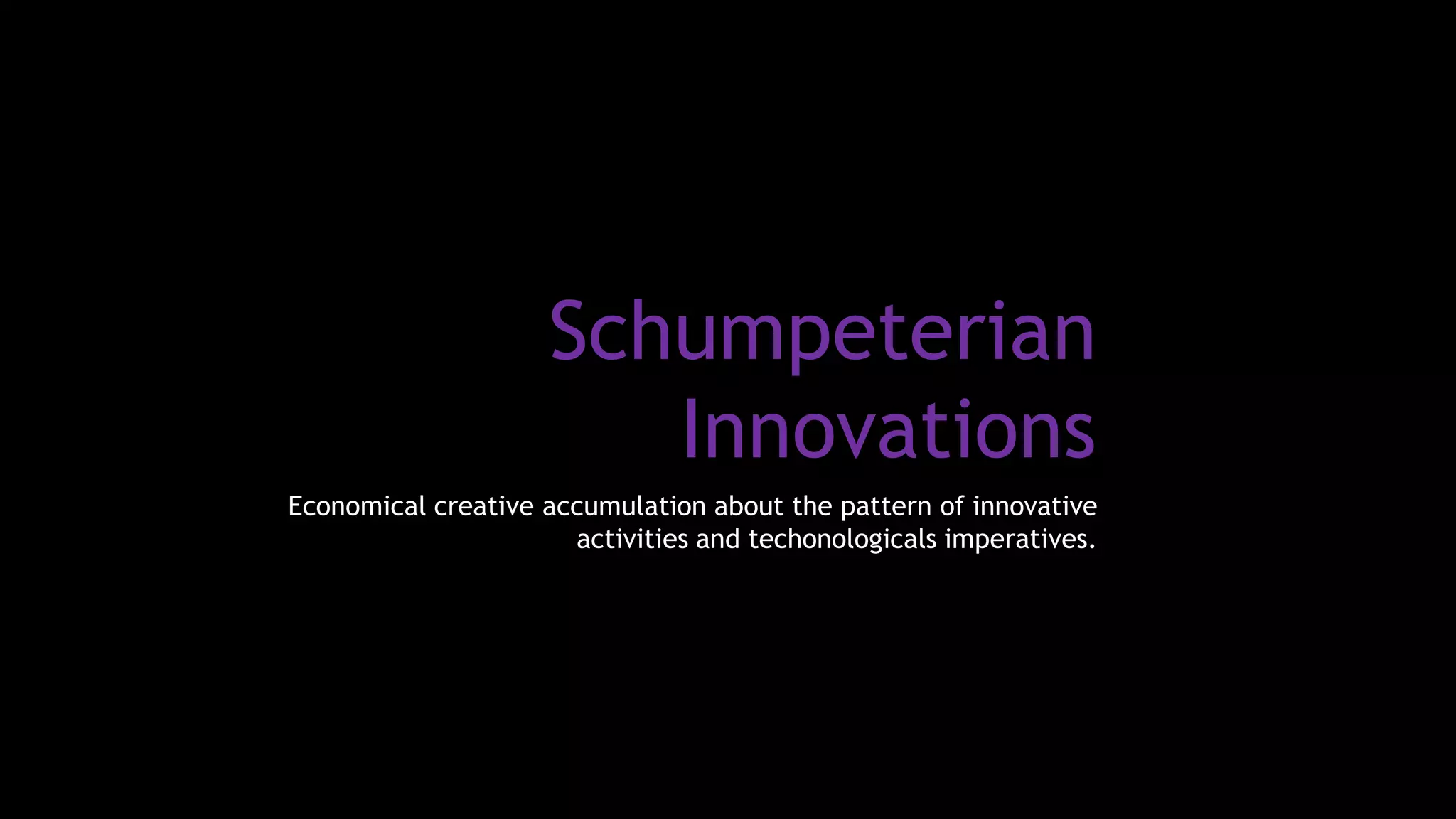
▶ The Windows operating system's combination of affordability and a user-friendly interface
was instrumental in the rapid development of the personal computing industry in the
1990s. Personal computing disrupted the television industry, as well as a great number of
other activities.
▶ Email transformed the way we communicating, largely displacing letter-writing and
disrupting the postal and greeting card industries.
▶ Cell phones made it possible for people to call us anywhere and disrupted the telecom
industry.
12.
CONTD….
▶ The laptopcomputer and mobile computing made a mobile workforce possible and made it
possible for people to connect to corporate networks and collaborate from anywhere. In
many organizations, laptops replaced desktops.
▶ Smartphones largely replaced cell phones and PDAs and, because of the available apps,
also disrupted: pocket cameras, MP3 players, calculators and GPS devices, among many
other possibilities. For some mobile users, smartphones often replace laptops. Others
prefer a tablet.
▶ Cloud computing has been a hugely disruptive technology in the business world,
displacing many resources that would conventionally have been located in-house or
provided as a traditionally hosted service.
▶ Social networking has had a major impact on the way we communicate and --
especially for personal use -- has disrupted telephone, email, instant messaging and
event planning.
13.
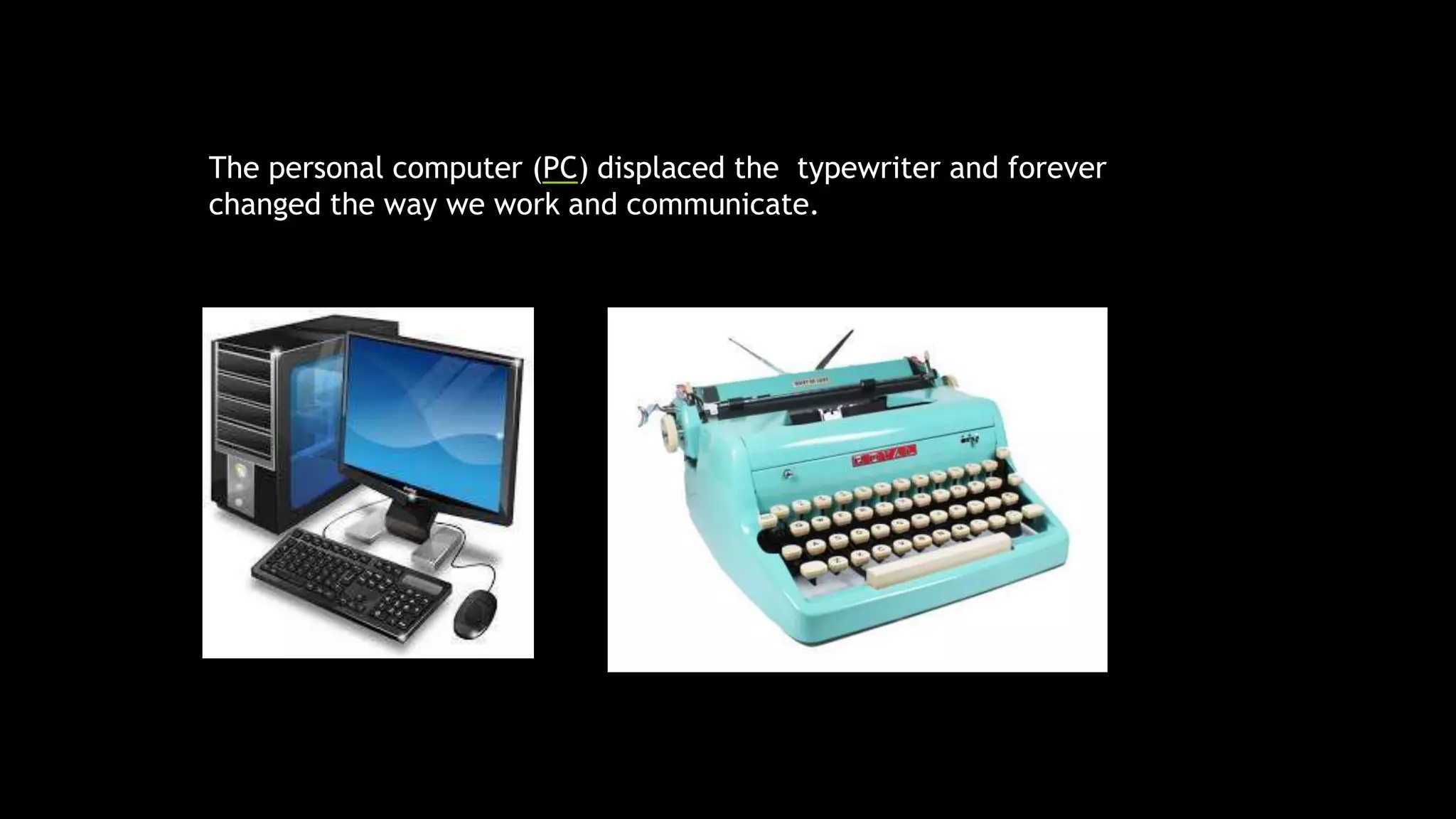
The personal computer(PC) displaced the typewriter and forever
changed the way we work and communicate.
14.
The Windows operatingsystem's combination of affordability and a user-
friendly interface was instrumental in the rapid development of the
personal computing industry in the 1990s. Personal computing
disrupted the television industry, as well as a great number of other
activities
15.
Email transformed theway we communicating, largely displacing
letter-writing and disrupting the postal and greeting card industries.
16.
Cell phones madeit possible for people to call us anywhere and
disrupted the telecom industry.
17.
Innovation Creation Theory
▶It helps to managing and update knowledge
▶ It is considered as the adaptation to new learning.
▶ It is at the centre of Leonard’s (1998) “wellsprings of knowledge” investigation.
▶ He argues that technology developers must devise.
▶ It maintains a system of knowledge creation.
▶ In order to build knowledge assets
▶ It helps to understand them to a great level of complexity.
▶ While her argument is:
future can’t be foreseen,
companies survive on their ability.
It is adapted when necessary,
based on the thoughtful application of knowledge assets.
18.
The World's 10Most Innovative Companies, And How They Do It
▶ In conducting our latest Global Innovation 1000 study, we surveyed more than 450 innovation executives (senior
managers and R&D professionals) at more than 400 different companies around the globe.
▶ The chart below shows how the top 10 most innovative– Apple , Google , 3M ,
GE, Toyota , Microsoft , P&G , IBM , Samsung and Intel –are spending.
Example:
▶ T
ake Apple as an example.
▶ It leads our list of the 10 most innovative.
▶ T
oday Apple epitomizes a capabilities-driven
innovation strategy
20.
Innovation Theory isvery important in an organization because it leads to the progress
of the organization. Moreover, it works where the organizations are user friendly to the
use of the innovations. The chart shows the use of innovation in different departments
of an organization.
In order tomake this engine work, Schumpeter considered innovations
to be the propelling element underlying all economic categories.
According to his theory,
technological innovations appear at rare and irregular intervals in
every industry, and they command a decisive cost or quality
advantage and strike not only at the margin of profits and outputs
but they destroy old ways of doing things and replace them with
new ones.
23.
These innovations occur,when knowledge and information act
upon knowledge and information, and in this constellation,
technology is the tool to make it all work in a
faster mode of creative destruction.
24.
Schumpeterian innovations byother firms destroy the core
competences of leading established firms and hence their sustainable
competitive advantage.
This is what Schumpeter calls “creative destruction”. According to
Schumpeter (1942, p.84; cited in Baaij et al. 2004, p.519),
technological innovations have a destroying and a building
power, which is a critical element for a flexible, modern economy and
society.
THEORY
▶ The theoryof disruptive technologies has been widely studied as part
of innovation theory. Incorporating research in product and process
innovation as well as in techno-economic analysis of technology
markets, disruptive technologies have gained a considerable amount
of interest in technology organizations.
27.
What is technology
disruption?
▶Clayton Christensen, author and creator of disruption theory
defines a disruptive innovation as: “a product or service
designed for a new set of customers”. (Christensen, C. Key
Concepts, 2015).
▶ Technology disruption is the advent of a new or existing technology
that is used and/or created in such a way that it renders the
incumbent obsolete, over years or decades.