BUSINESS INTELLIGENCE (BI)
Dr Mithileysh Sathiyanarayanan
MIT Square, London
City, University of London
Web: www.mitsquare.com
Email: mithileysh@mitsquare.com
RAJ SQUARE CHARITY FOUNDATION
www.rajsquare.com
RAJ CORONA WARRIORS
Thanks to the Volunteers from Tamilnadu.
AGENDA
3
What is Business
Intelligence (BI)?
BI Evolution and Trend
BI Users & Application
Areas
BI Tools
BI Career
4
1. WHAT IS BUSINESS
INTELLIGENCE (BI)?
 Business Intelligence (BI) is about using the right
data to get the right information, to the right
decision makers, at the right time.
 BI is an enterprise-wide platform that supports
reporting, analysis and decision making.
– BI as an information system
– BI as a data analytic processor
– BI as a decision management
BUSINESS INTELLIGENCE (BI)
 fact-based decision making.
 “single version of the truth”.
 useful, actionable insight from stored data.
 effective business decisions can be made.
 allows the act of using historical data to gain new
information.
 quick decisions can be made.
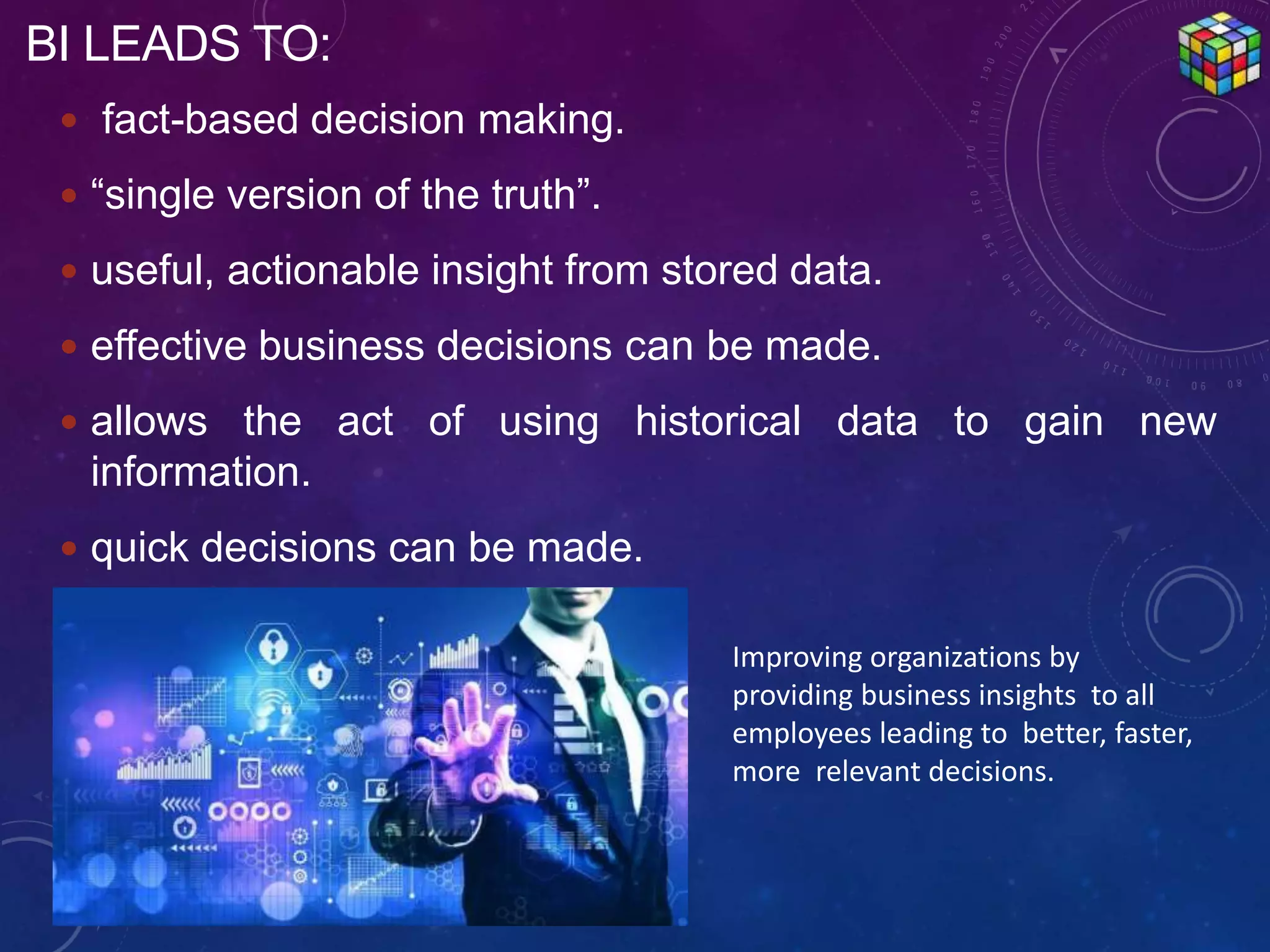
BI LEADS TO:
Improving organizations by
providing business insights to all
employees leading to better, faster,
more relevant decisions.
HOW CAN WE DEFINE BI?
7
Business Intelligence is a set of
methods, processes,
frameworks, architectures,
applications, and technologies
that gather and transform raw
data into meaningful and useful
information used to enable more
effective strategic, tactical, and
operational insights and decision-
making (to drive business
performance).
 Techniques include:
 statistical analysis
 visualisations
 visual analytics
 ad-hoc queries
 reporting
 dashboards
BI TECHNIQUES
• Traditionally BI has been also understood as Decision Support System
(DSS) – data directly contributes to decision without intensive and advanced
analytical techniques.
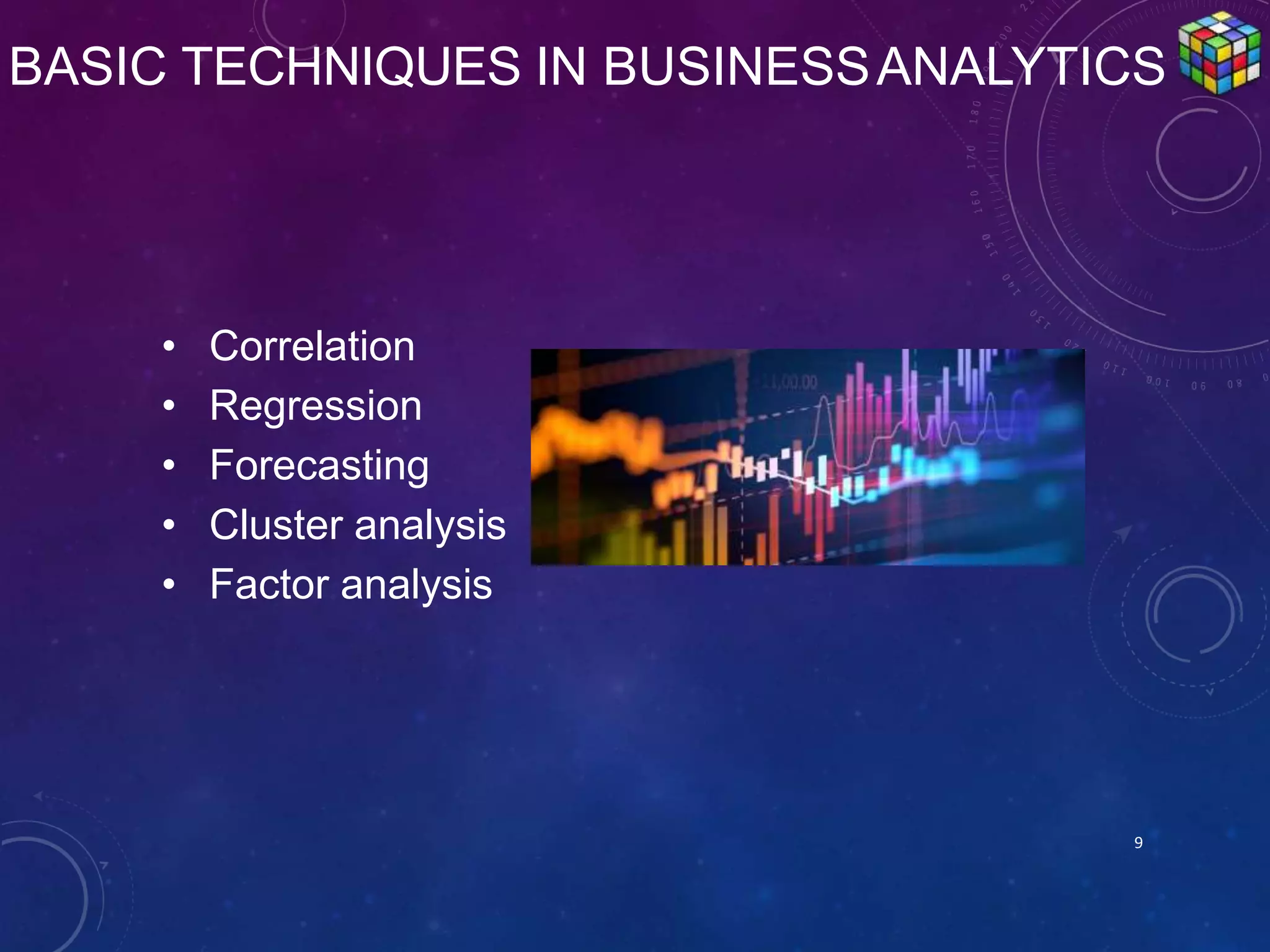
BASIC TECHNIQUES IN BUSINESSANALYTICS
9
• Correlation
• Regression
• Forecasting
• Cluster analysis
• Factor analysis
TYPES OF INFORMATION PROCESSING
10
Transactional Processing
• Focus on individual data item
processing: data insertion,
modification, deletion, and
transmission
Analytical Processing
• Focus on reporting, analysis,
transformation, and decision
support
“DIK" TO ACHIEVE BUSINESS SUCCESS
• Data: raw value elements or facts
• Information: the result of collecting and organizing data that
provides context and meaning
• Knowledge: the concept of understanding information that
provides insight to information, thus useful and actionable
11
Analytical
Processing
Transactional
Processing
BI: A GENERALPROCESS
12
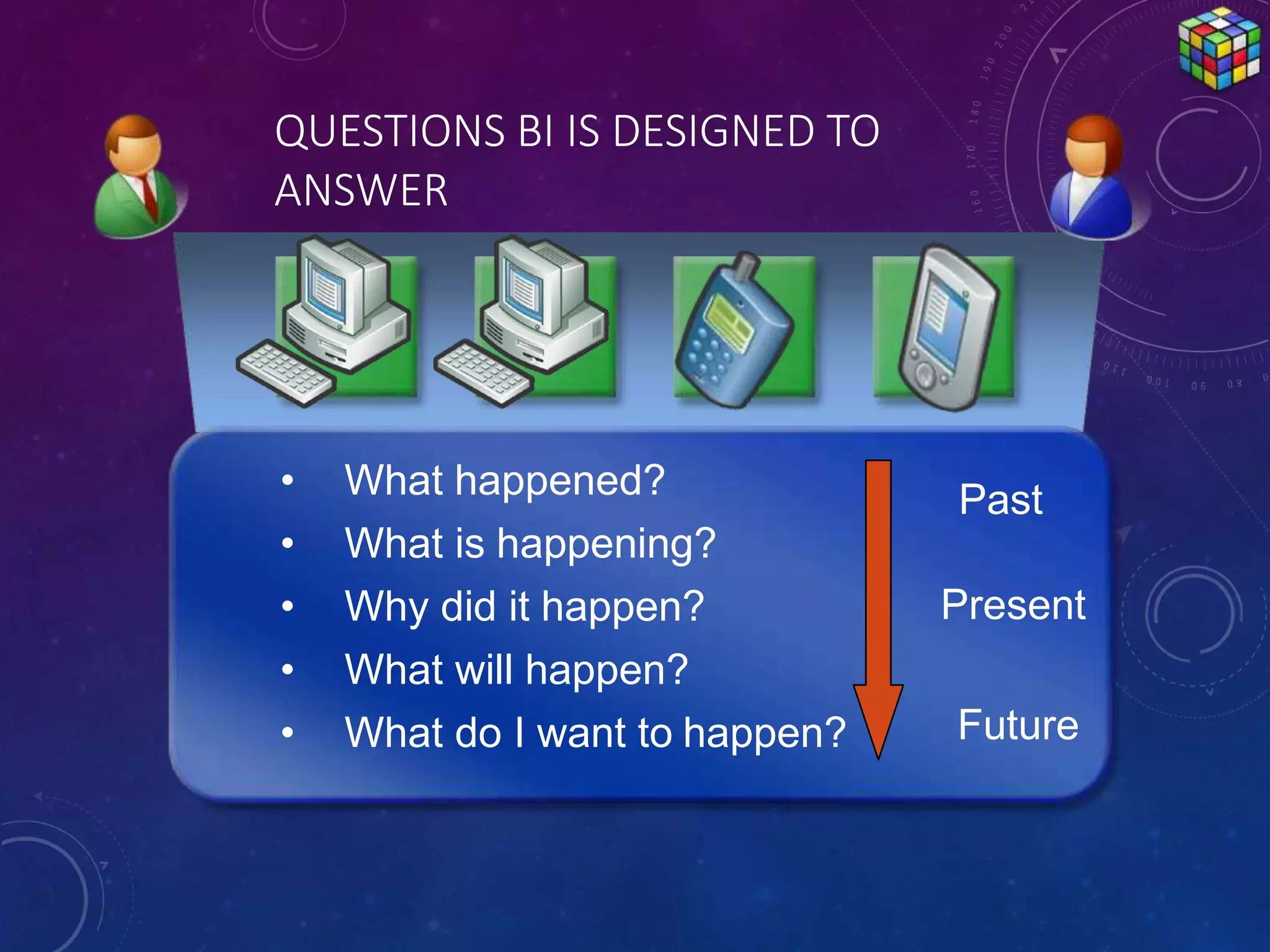
QUESTIONS BI IS DESIGNED TO
ANSWER
• What happened?
• What is happening?
• Why did it happen?
• What will happen?
• What do I want to happen?
Past
Present
Future
A
LEVELS OF ANALYTICALPROCESSING
14Advanced Analytics and Business Intelligence
https://www.youtube.com/watch?v=oNNk9-tmsZY
DATA PRESENTATIONS
29
REPORTS DASHBOARD VISUAL
ANALYTIC TOOL
SCORECARD
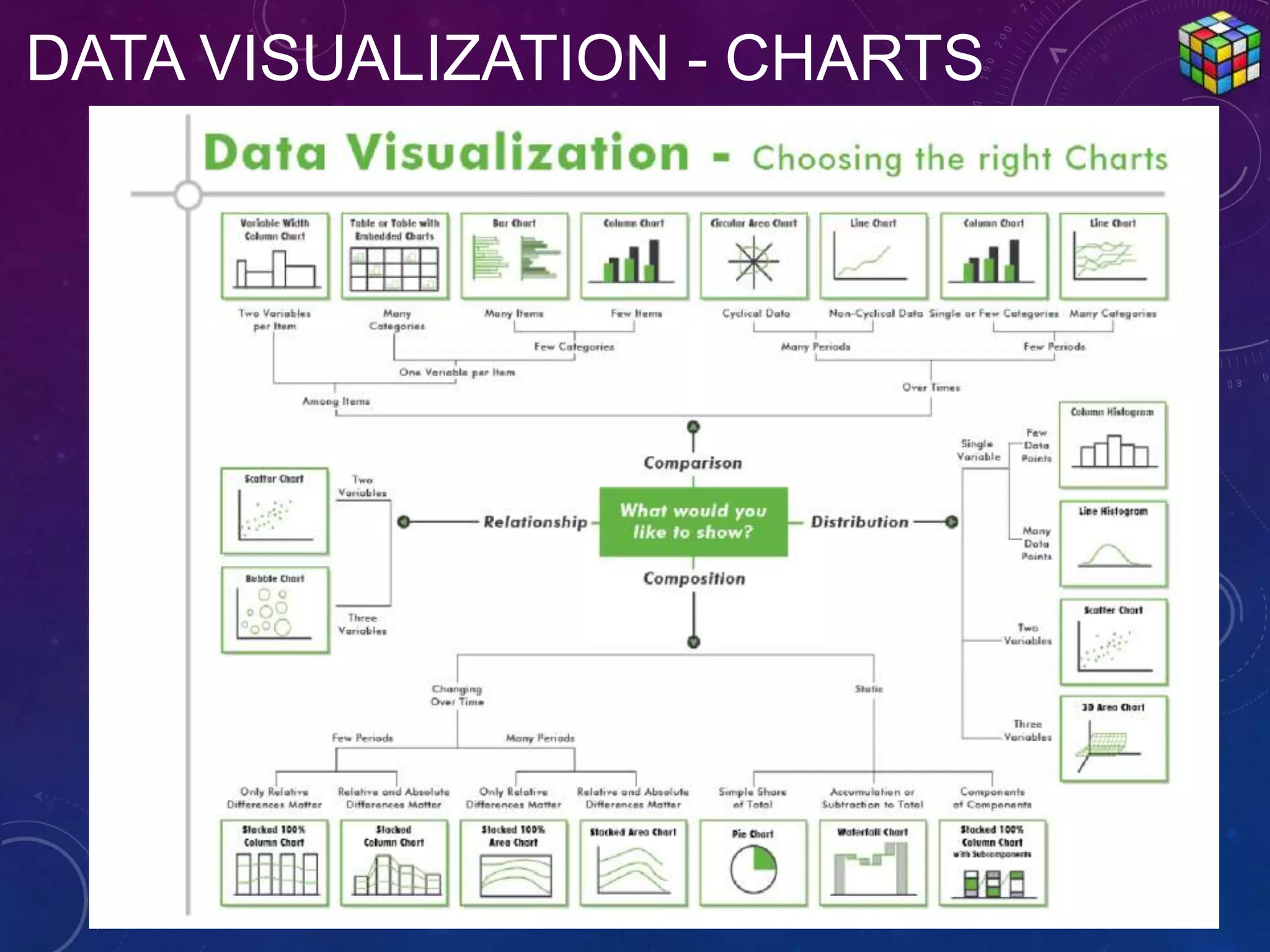
DATA VISUALIZATION - CHARTS
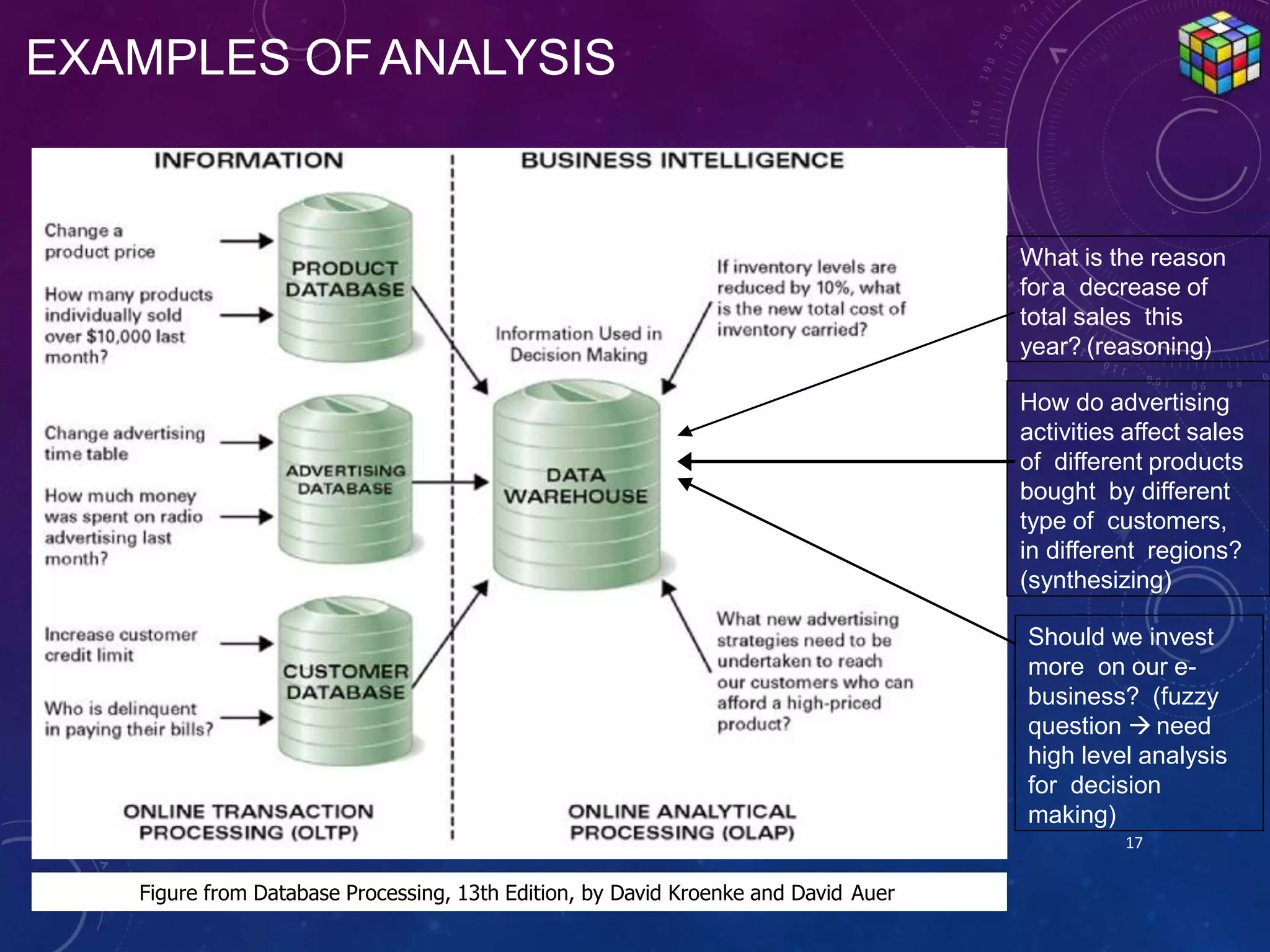
EXAMPLES OFANALYSIS
17
Should we invest
more on our e-
business? (fuzzy
question  need
high level analysis
for decision
making)
How do advertising
activities affect sales
of different products
bought by different
type of customers,
in different regions?
(synthesizing)
Figure from Database Processing, 13th Edition, by David Kroenke and David Auer
What is the reason
fora decrease of
total sales this
year? (reasoning)
18
2. BI EVOLUTION &
TREND
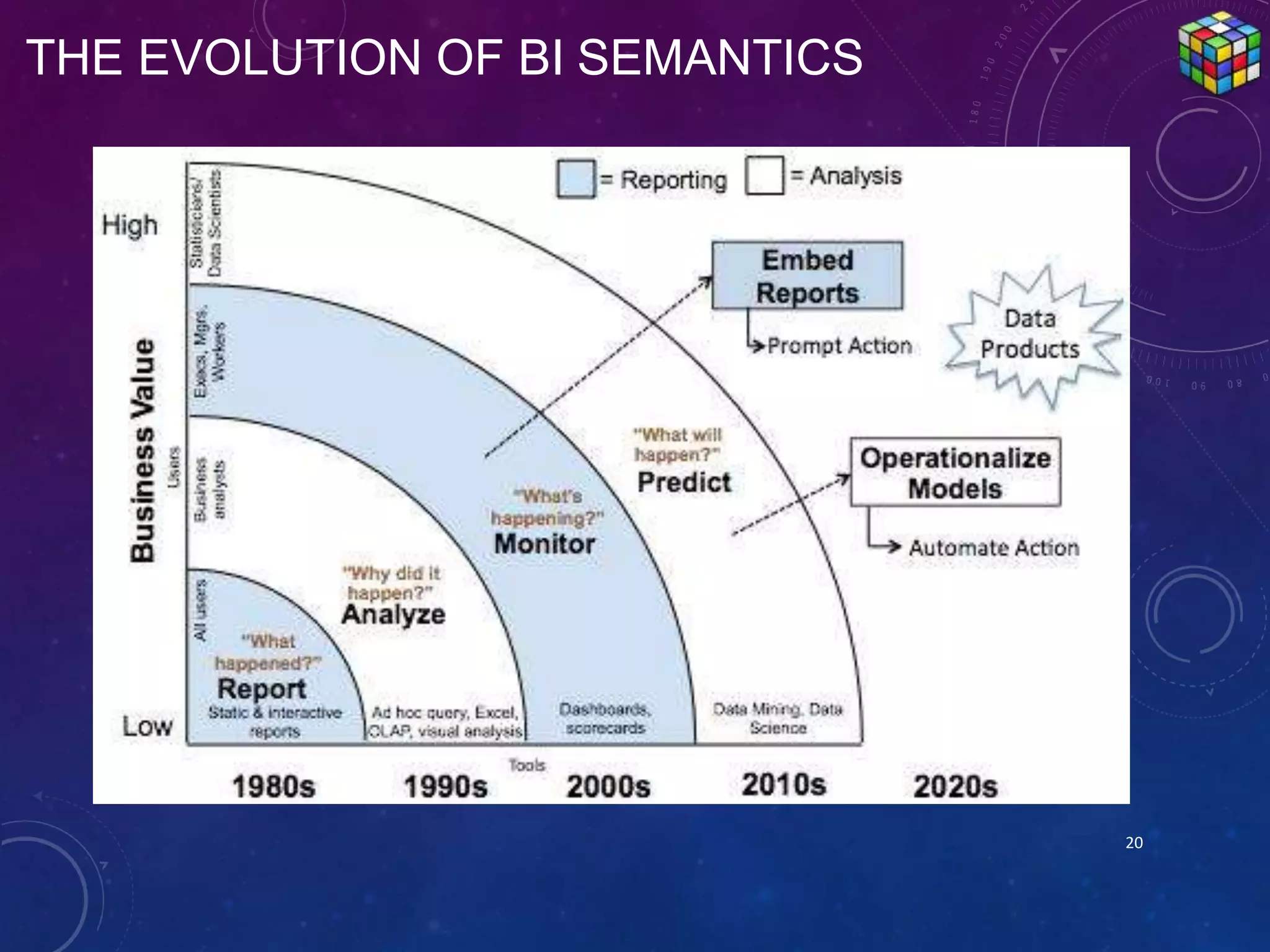
THE EVOLUTION OF BI SEMANTICS
19http://www.b-eye-network.com/blogs/eckerson/archives/2011/02/whats_in_a_word.php
Analytics can be viewed
as the evolved or
improved BI
2020
THE EVOLUTION OF BI SEMANTICS
20
8
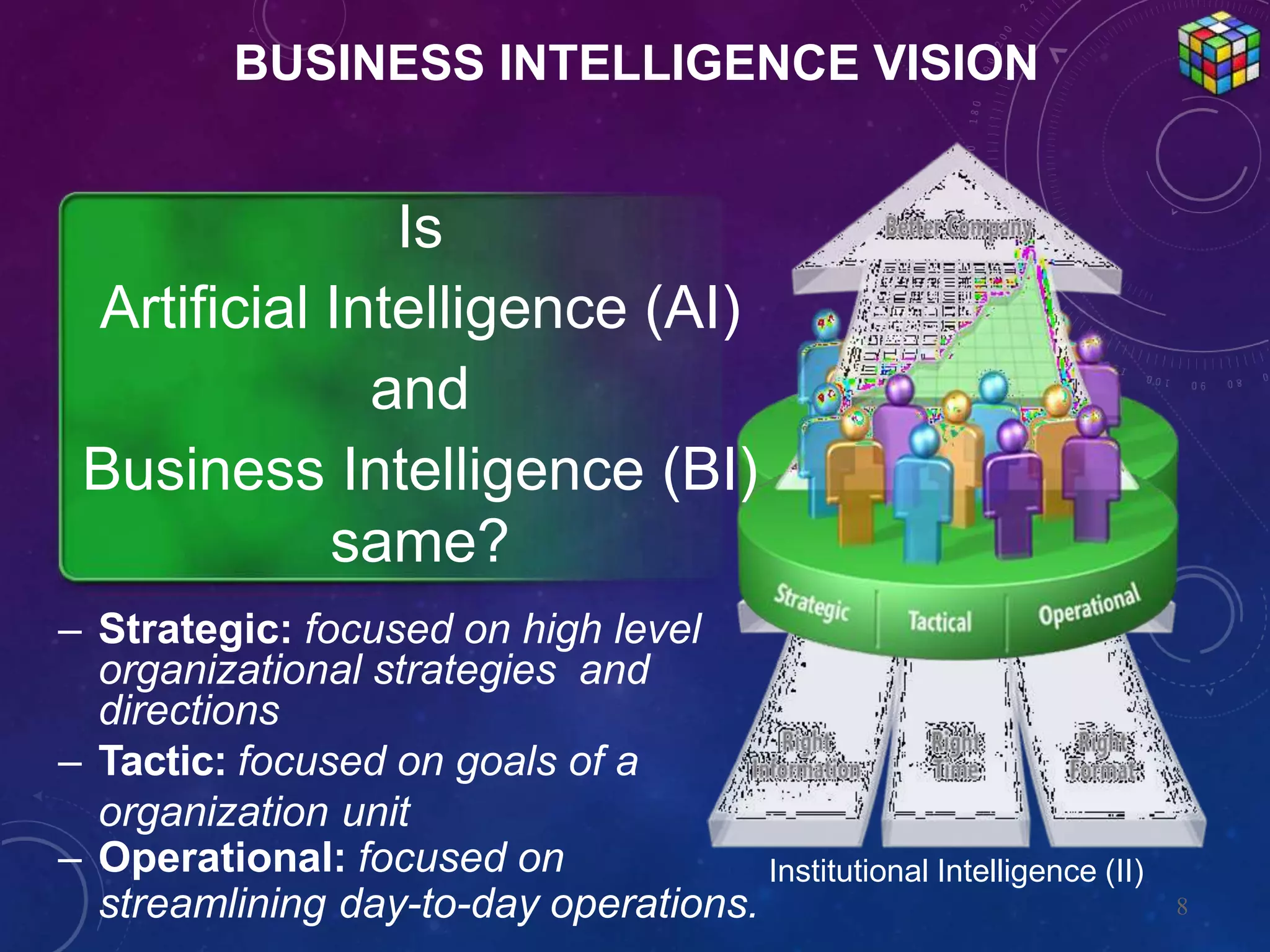
BUSINESS INTELLIGENCE VISION
Is
Artificial Intelligence (AI)
and
Business Intelligence (BI)
same?
– Strategic: focused on high level
organizational strategies and
directions
– Tactic: focused on goals of a
organization unit
– Operational: focused on
streamlining day-to-day operations.
Institutional Intelligence (II)
24
3. BI USERS &
APPLICATION AREAS
BUSINESS INTELLIGENCE USERS
Executives Casual Users
Functional Users Super/Power Users
BI USERS HAVE DIFFERENT NEEDS
26
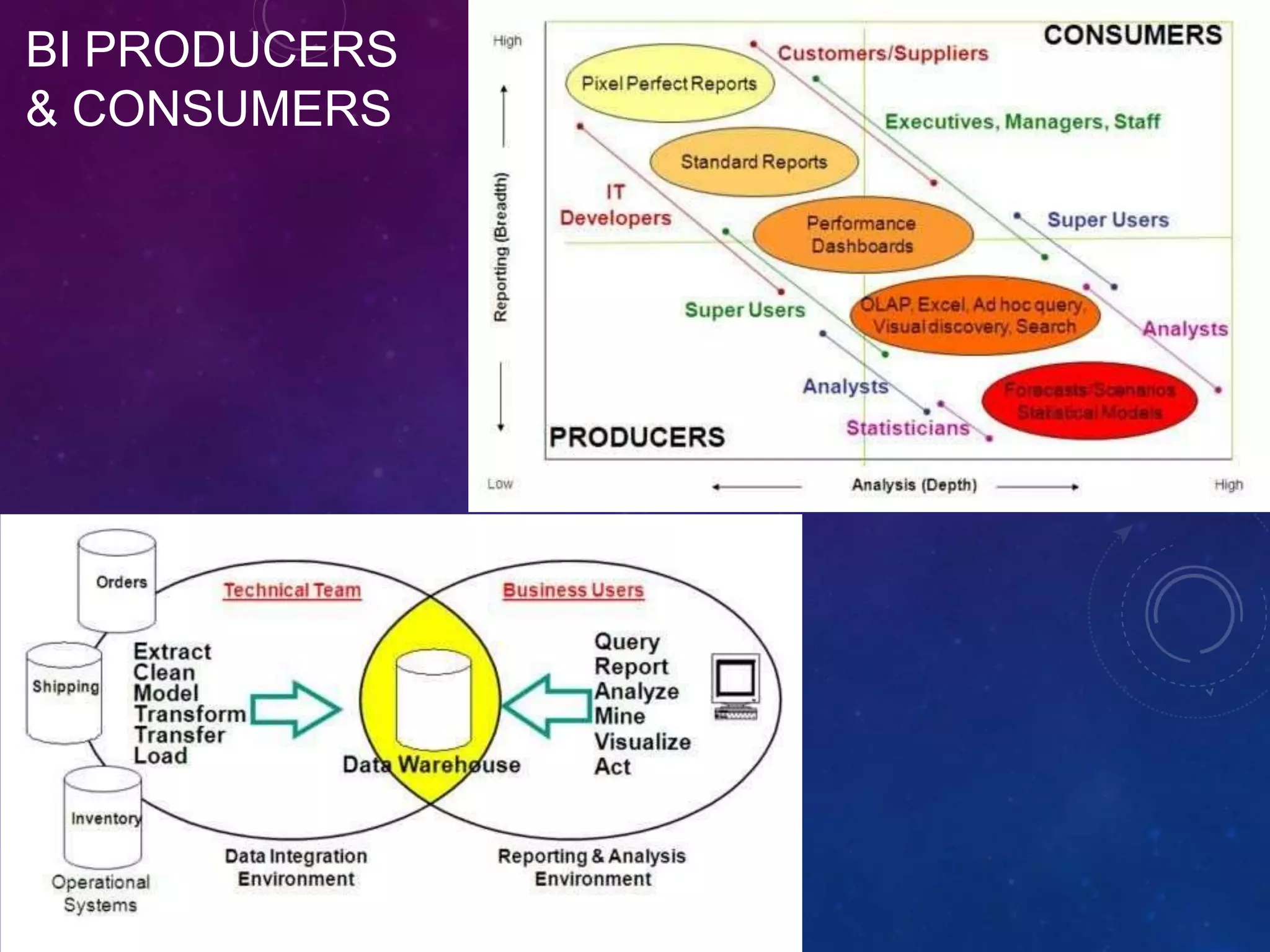
BI PRODUCERS
& CONSUMERS
32 Technical vs. Business users
QUESTIONS BI IS DESIGNED TOANSWER
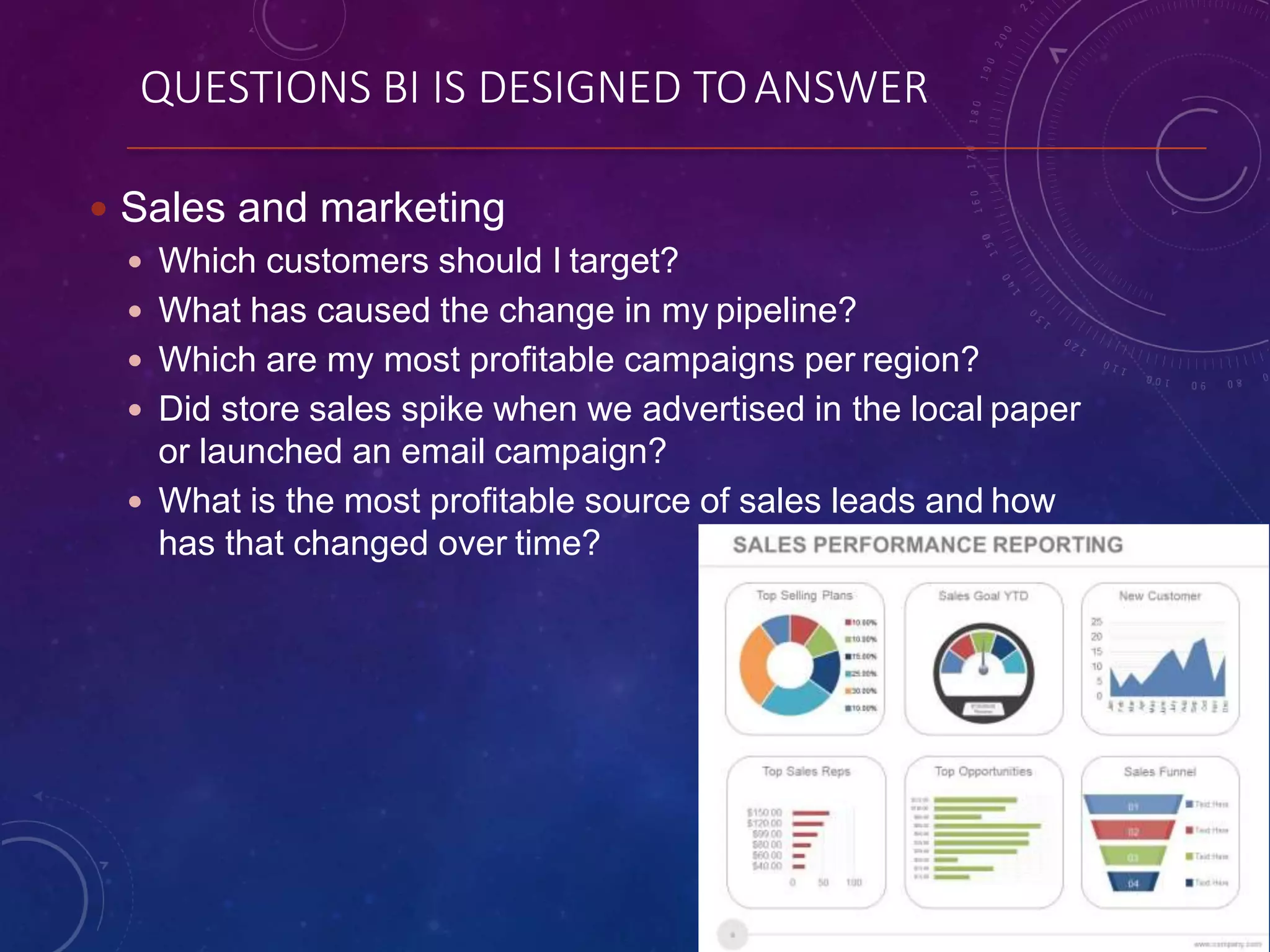
 Sales and marketing
 Which customers should I target?
 What has caused the change in my pipeline?
 Which are my most profitable campaigns per region?
 Did store sales spike when we advertised in the local paper
or launched an email campaign?
 What is the most profitable source of sales leads and how
has that changed over time?
QUESTIONS BI IS DESIGNED TOANSWER
 Operational
 Which vendors are best at
delivering on time and on
budget?
 Financial
 What is the expected annual
profit/loss based on current
marketing and sales
forecasts?
 Overall business performance
 What are the most important
risk factors impacting the
company’s ability to meet
annual profit goals?
BI APPLICATIONAREAS
30
• BI can be applied in all “businesses” (industries,
functional areas, or domains) to drive “business”
performance in both private and public sector
– Private
• Retail, manufacture, real-estate, financial, sports, media,
entertainment, publication, etc.
– Public (non-profit)
• Education, government, healthcare, association, etc.
SAMPLE BIAPPLICATIONS
31
• Marketing and sales
• Financial management
• Human resource/capital
• Project and program management
• Power and energy management
• Business management
• IT management
• Supply chain & logistics
• Healthcare management
• Insurance
• City planning
• Education
• Internet and web
• Sports and games analytics
32
4. BI TOOLS
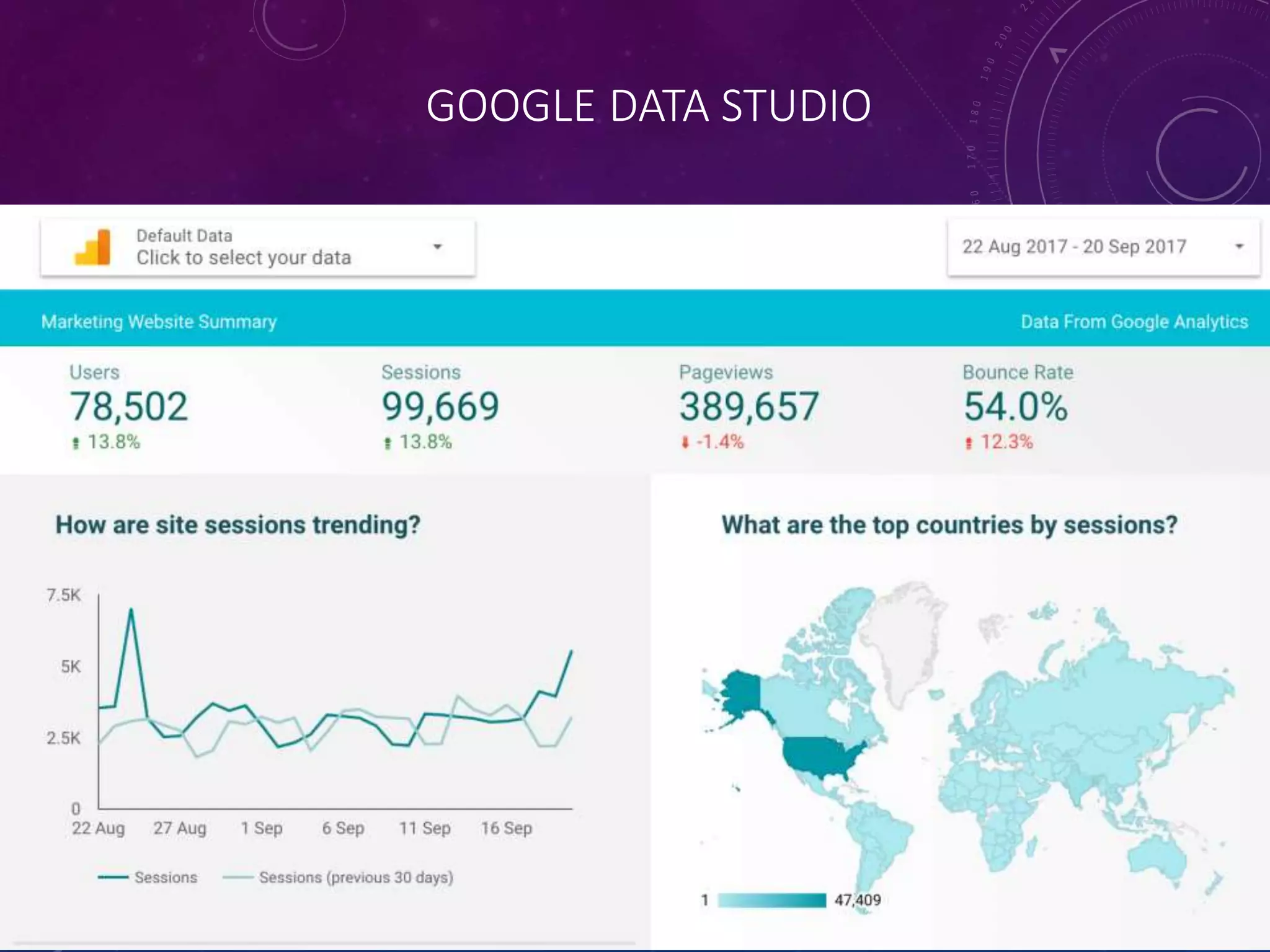
GOOGLE DATA STUDIO
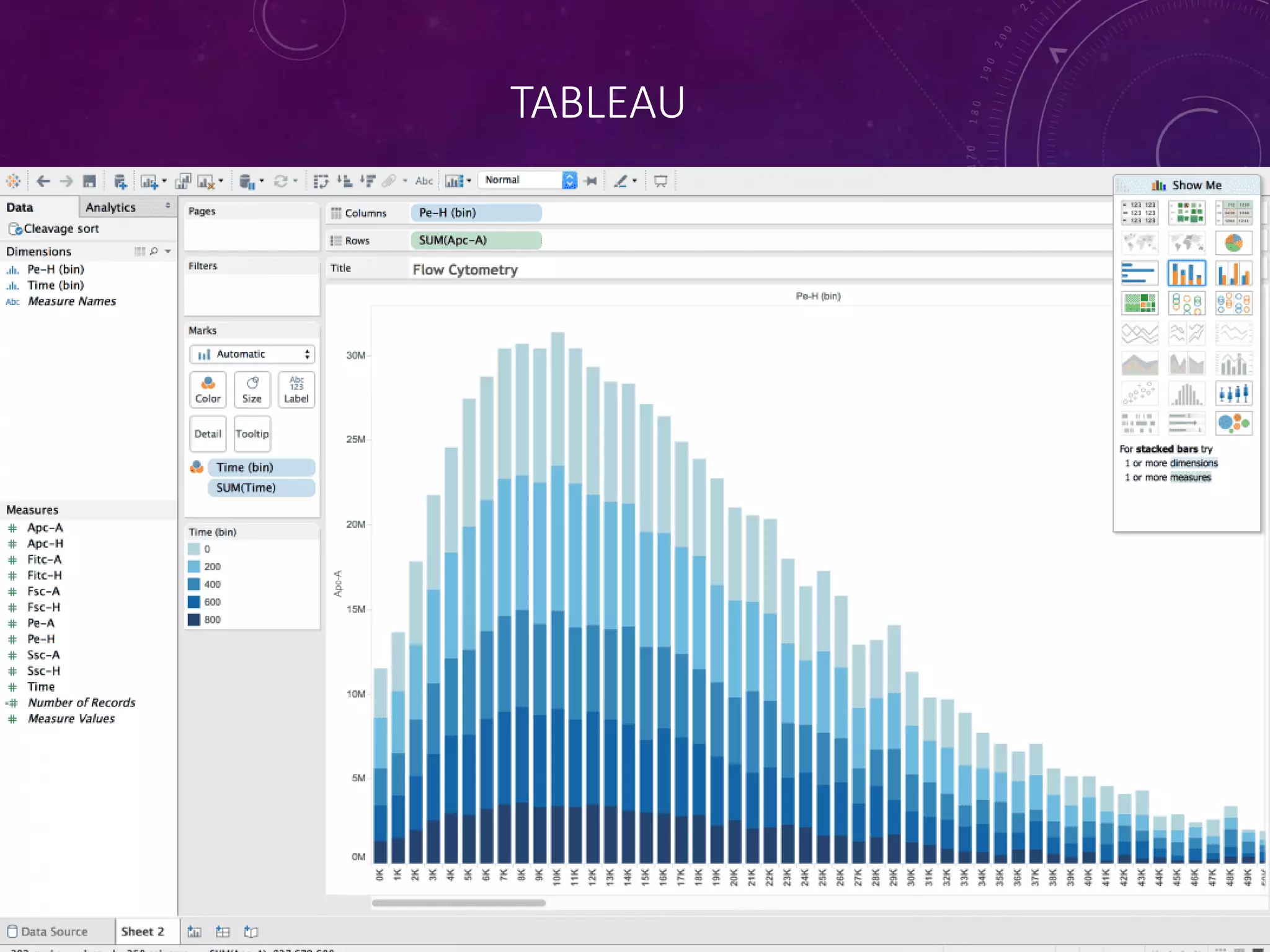
TABLEAU
MICROSOFT POWER BI
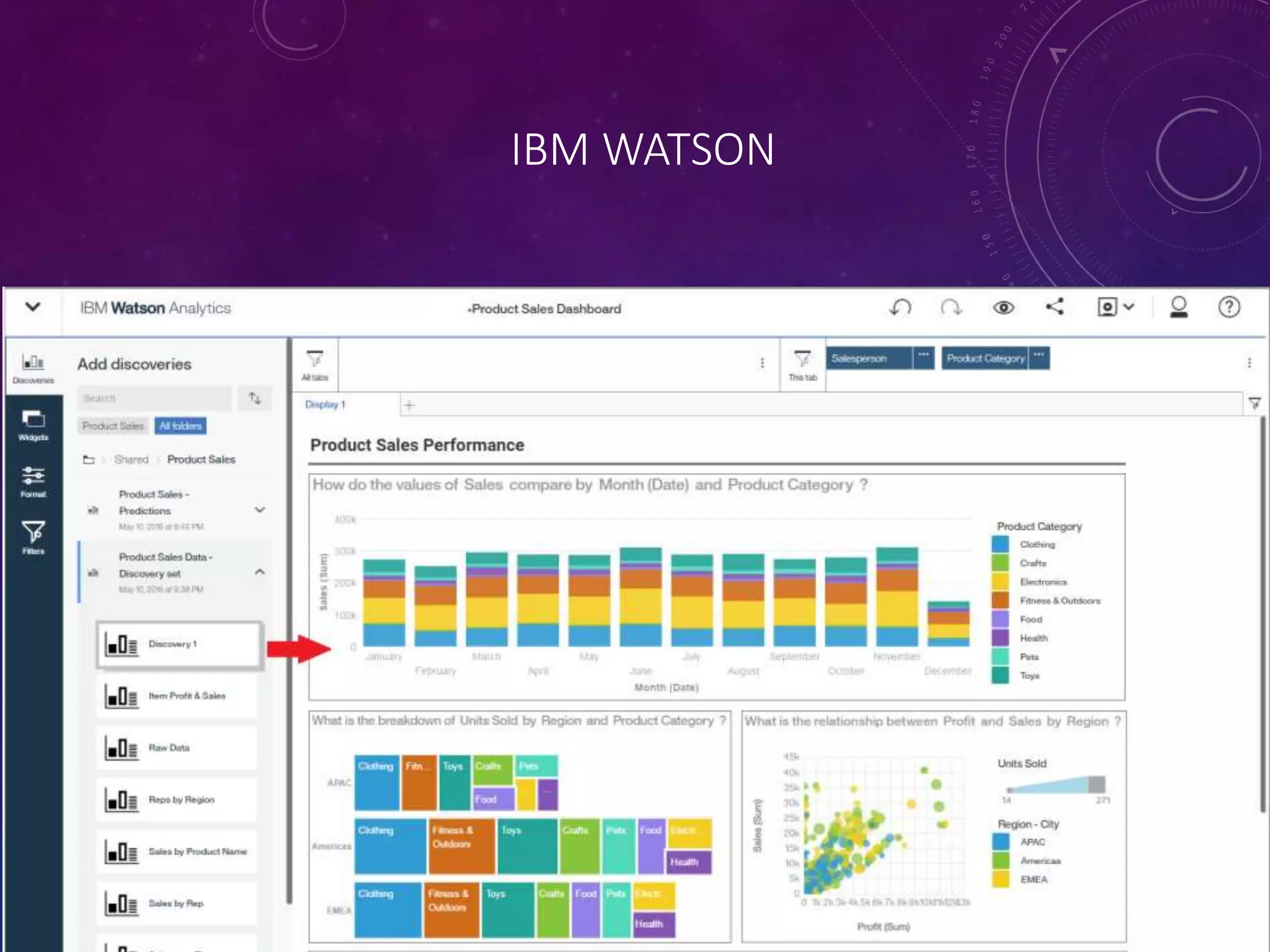
IBM WATSON
QLIKVIEW
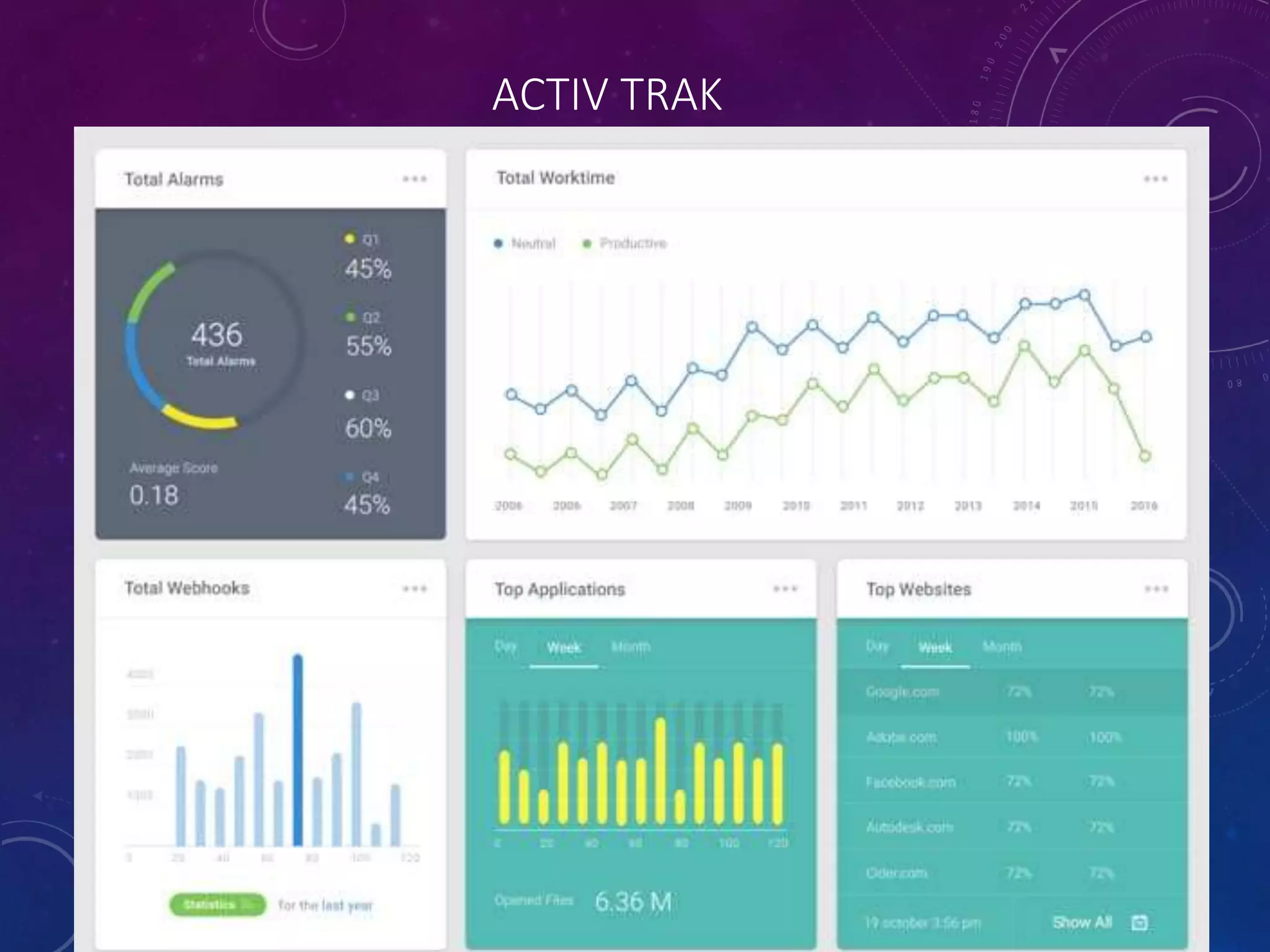
ACTIV TRAK
CLUVIO
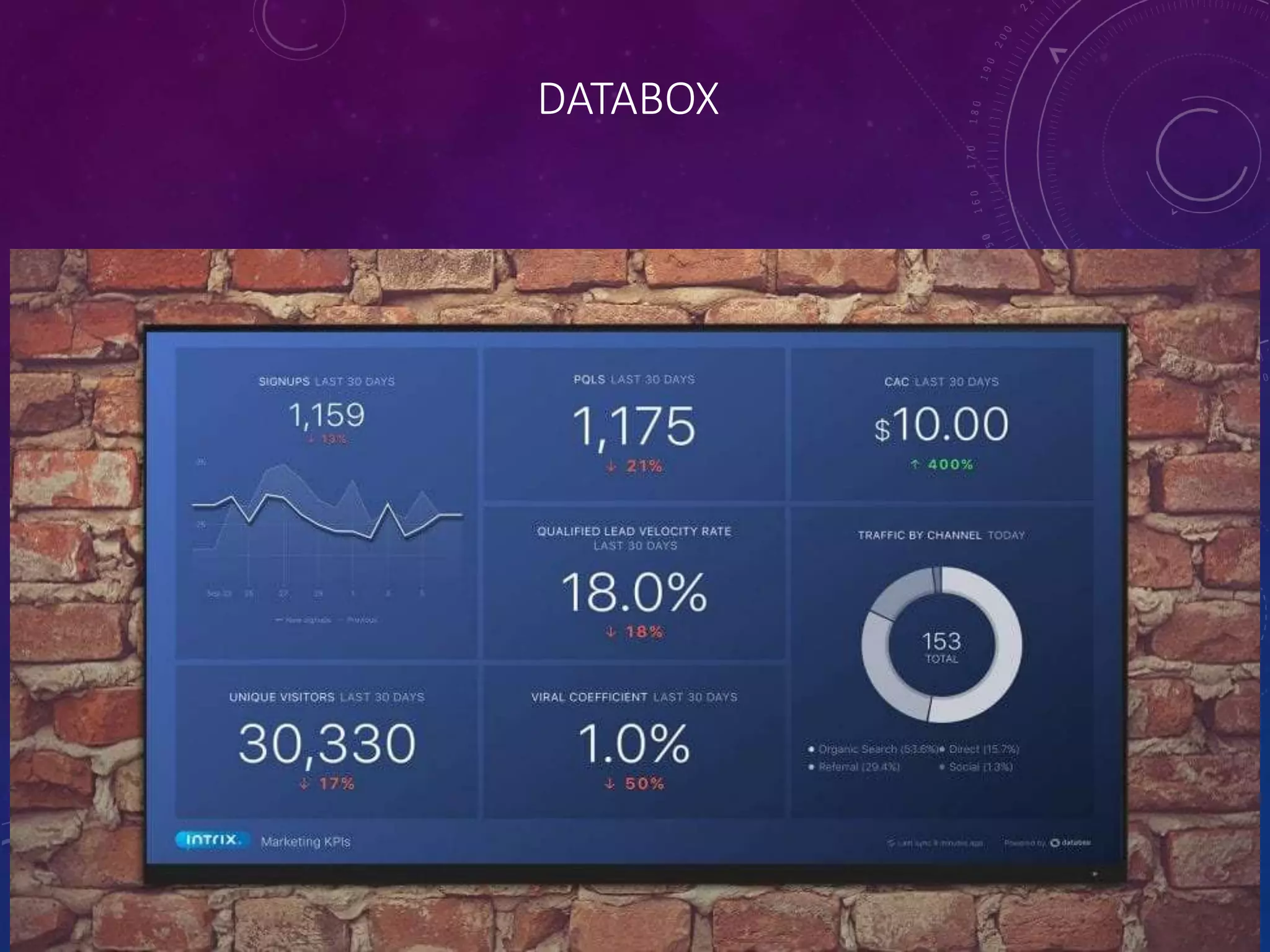
DATABOX
CAN I BUILD MY OWN BI TOOL?
YES, IT IS POSSIBLE! BUT HOW?
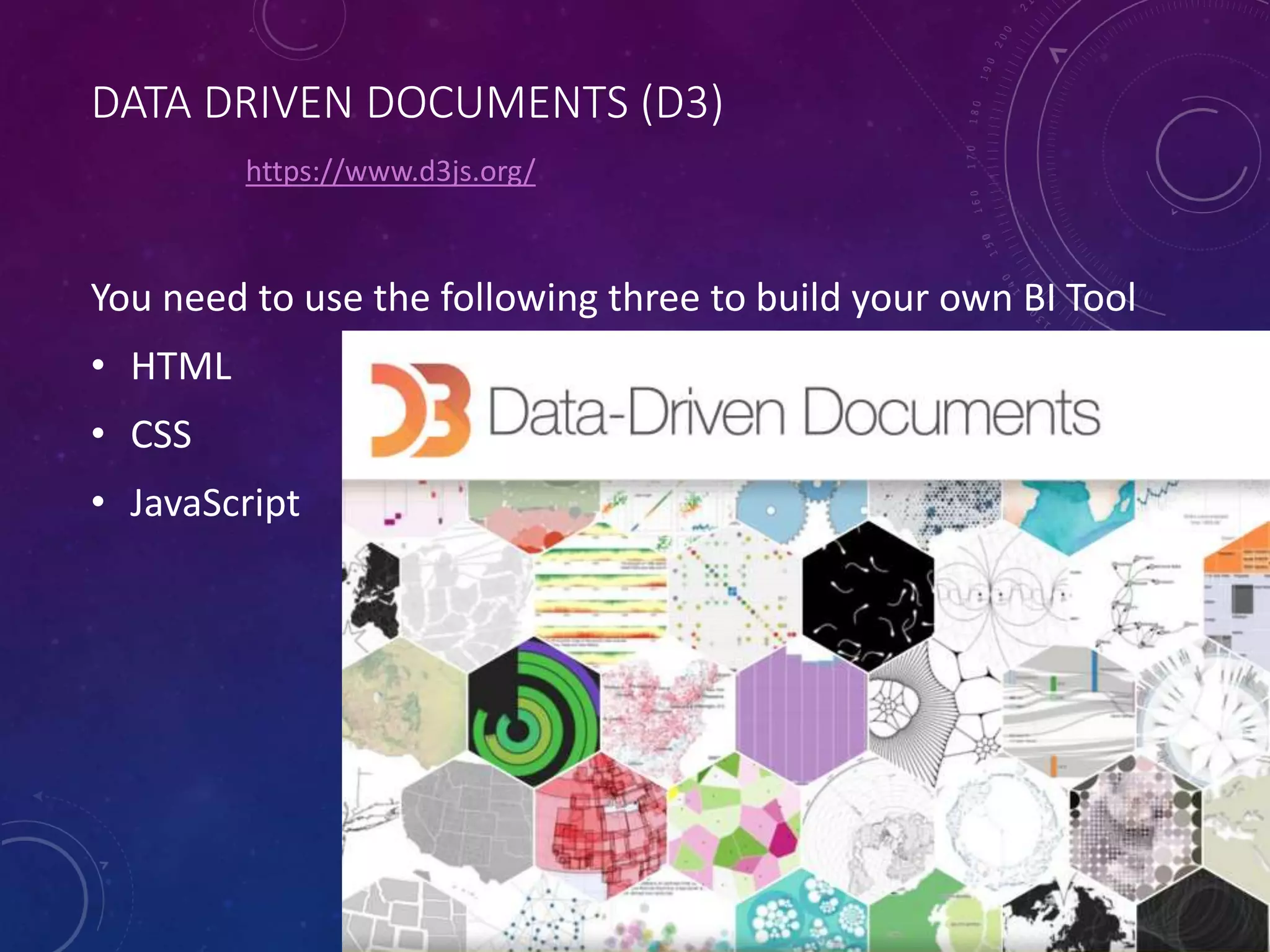
DATA DRIVEN DOCUMENTS (D3)
You need to use the following three to build your own BI Tool
• HTML
• CSS
• JavaScript
https://www.d3js.org/
43
5. BI CAREER
BI CAREERS
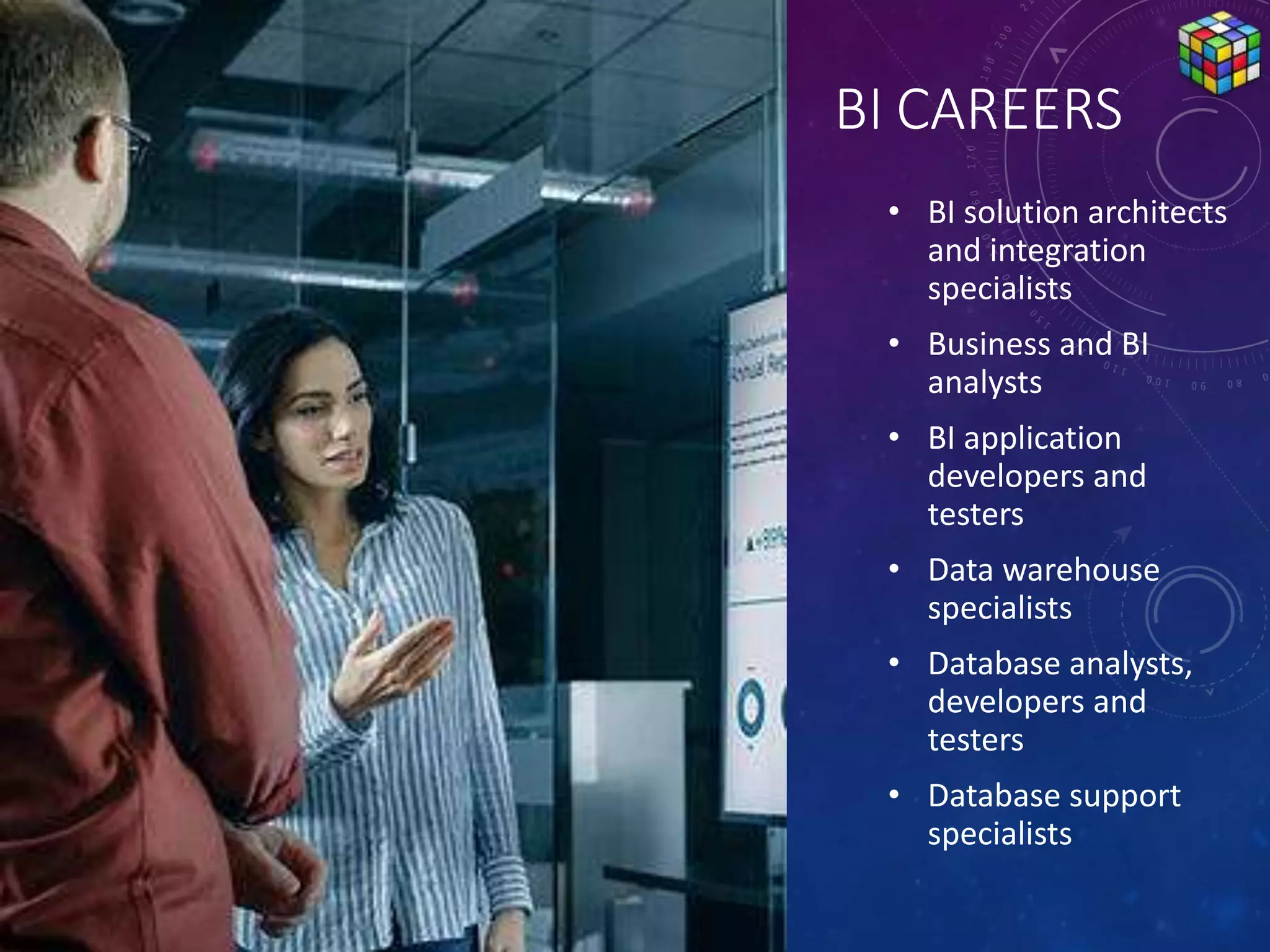
• BI solution architects
and integration
specialists
• Business and BI
analysts
• BI application
developers and
testers
• Data warehouse
specialists
• Database analysts,
developers and
testers
• Database support
specialists
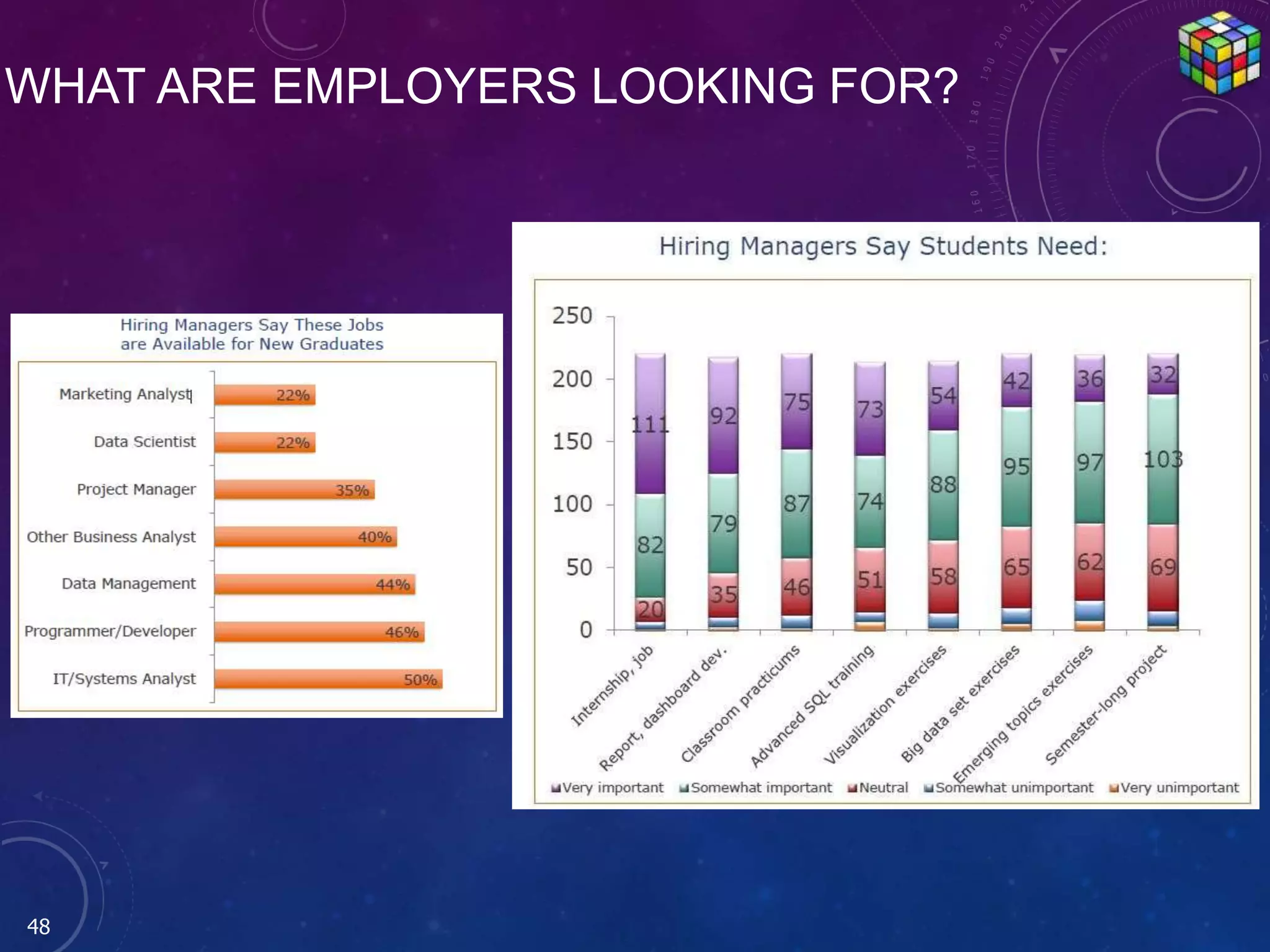
WHAT ARE EMPLOYERS LOOKING FOR?
48
CRITICAL KNOWLEDGE AND SKILLS
• Three competencies
– Technical, Business, Analytical
• Five skills in your kit
- Free Open Source BI Tools
- R, Python & SQL
- Socio-emotional Skills
- Reporting Skills
- Business Analysis
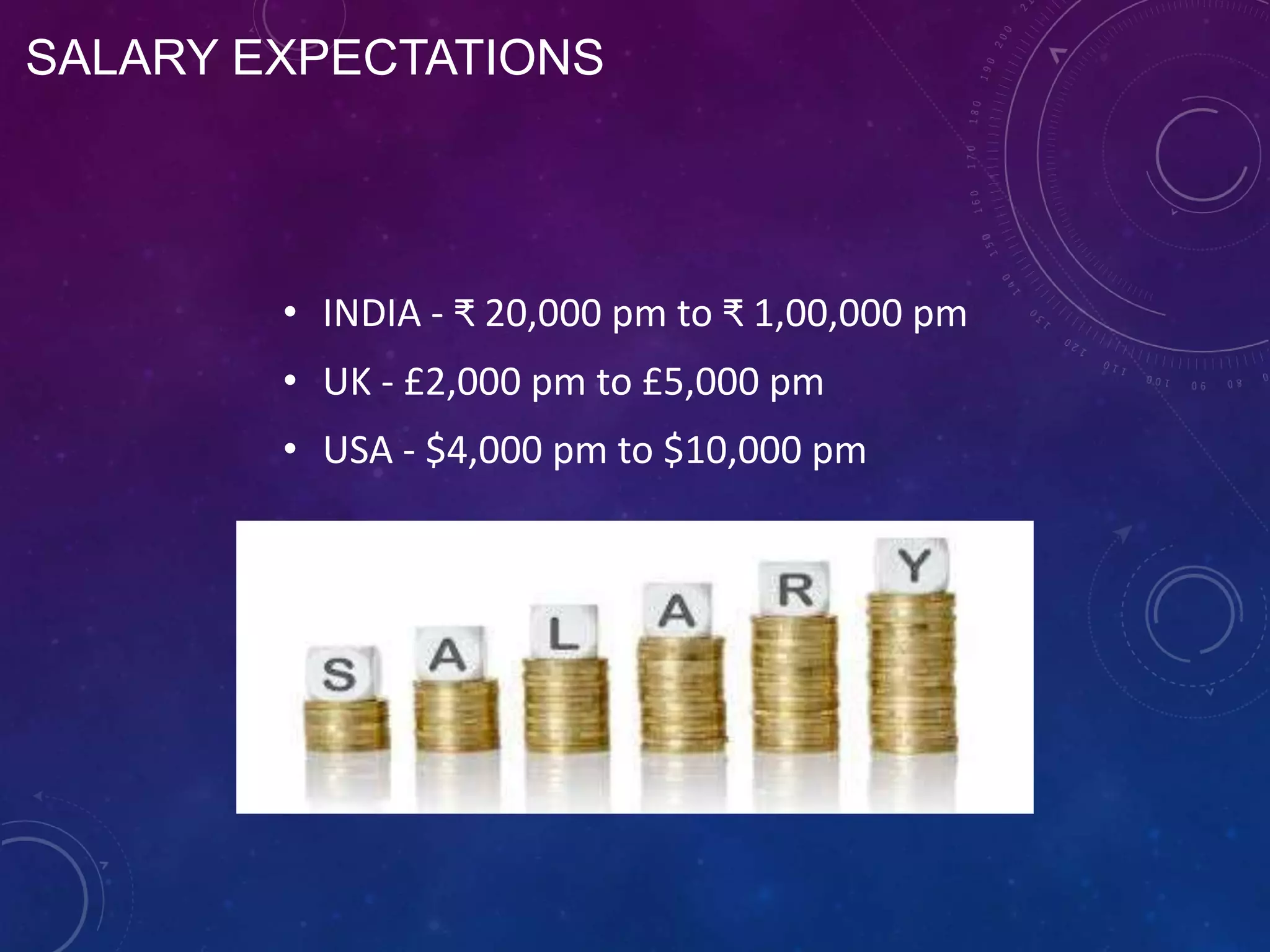
• INDIA - ₹ 20,000 pm to ₹ 1,00,000 pm
• UK - £2,000 pm to £5,000 pm
• USA - $4,000 pm to $10,000 pm
SALARY EXPECTATIONS
SUMMARY
48
What is Business Intelligence (BI)?
BI Evolution and Trend
BI Users & Application Areas
BI Tools
BI Career
OPPORTUNITIES
• Incubation Support
• Product Development
• Patent Filing
• Internship & Training
• Joint Funding
• PhD & Post Doc
Opportunities in India
& UK
• International
Collaboration
THANK YOU
You can reach me any time
LinkedIn: Mithileysh Sathiyanarayanan
Personal Email: s.mithileysh@gmail.com

Business Intelligence

  • 1.
    BUSINESS INTELLIGENCE (BI) DrMithileysh Sathiyanarayanan MIT Square, London City, University of London Web: www.mitsquare.com Email: mithileysh@mitsquare.com
  • 2.
    RAJ SQUARE CHARITYFOUNDATION www.rajsquare.com RAJ CORONA WARRIORS Thanks to the Volunteers from Tamilnadu.
  • 3.
    AGENDA 3 What is Business Intelligence(BI)? BI Evolution and Trend BI Users & Application Areas BI Tools BI Career
  • 4.
    4 1. WHAT ISBUSINESS INTELLIGENCE (BI)?
  • 5.
     Business Intelligence(BI) is about using the right data to get the right information, to the right decision makers, at the right time.  BI is an enterprise-wide platform that supports reporting, analysis and decision making. – BI as an information system – BI as a data analytic processor – BI as a decision management BUSINESS INTELLIGENCE (BI)
  • 6.
     fact-based decisionmaking.  “single version of the truth”.  useful, actionable insight from stored data.  effective business decisions can be made.  allows the act of using historical data to gain new information.  quick decisions can be made. BI LEADS TO: Improving organizations by providing business insights to all employees leading to better, faster, more relevant decisions.
  • 7.
    HOW CAN WEDEFINE BI? 7 Business Intelligence is a set of methods, processes, frameworks, architectures, applications, and technologies that gather and transform raw data into meaningful and useful information used to enable more effective strategic, tactical, and operational insights and decision- making (to drive business performance).
  • 8.
     Techniques include: statistical analysis  visualisations  visual analytics  ad-hoc queries  reporting  dashboards BI TECHNIQUES • Traditionally BI has been also understood as Decision Support System (DSS) – data directly contributes to decision without intensive and advanced analytical techniques.
  • 9.
    BASIC TECHNIQUES INBUSINESSANALYTICS 9 • Correlation • Regression • Forecasting • Cluster analysis • Factor analysis
  • 10.
    TYPES OF INFORMATIONPROCESSING 10 Transactional Processing • Focus on individual data item processing: data insertion, modification, deletion, and transmission Analytical Processing • Focus on reporting, analysis, transformation, and decision support
  • 11.
    “DIK" TO ACHIEVEBUSINESS SUCCESS • Data: raw value elements or facts • Information: the result of collecting and organizing data that provides context and meaning • Knowledge: the concept of understanding information that provides insight to information, thus useful and actionable 11 Analytical Processing Transactional Processing
  • 12.
  • 13.
    QUESTIONS BI ISDESIGNED TO ANSWER • What happened? • What is happening? • Why did it happen? • What will happen? • What do I want to happen? Past Present Future
  • 14.
    A LEVELS OF ANALYTICALPROCESSING 14AdvancedAnalytics and Business Intelligence https://www.youtube.com/watch?v=oNNk9-tmsZY
  • 15.
    DATA PRESENTATIONS 29 REPORTS DASHBOARDVISUAL ANALYTIC TOOL SCORECARD
  • 16.
  • 17.
    EXAMPLES OFANALYSIS 17 Should weinvest more on our e- business? (fuzzy question  need high level analysis for decision making) How do advertising activities affect sales of different products bought by different type of customers, in different regions? (synthesizing) Figure from Database Processing, 13th Edition, by David Kroenke and David Auer What is the reason fora decrease of total sales this year? (reasoning)
  • 18.
  • 19.
    THE EVOLUTION OFBI SEMANTICS 19http://www.b-eye-network.com/blogs/eckerson/archives/2011/02/whats_in_a_word.php Analytics can be viewed as the evolved or improved BI 2020
  • 20.
    THE EVOLUTION OFBI SEMANTICS 20
  • 23.
    8 BUSINESS INTELLIGENCE VISION Is ArtificialIntelligence (AI) and Business Intelligence (BI) same? – Strategic: focused on high level organizational strategies and directions – Tactic: focused on goals of a organization unit – Operational: focused on streamlining day-to-day operations. Institutional Intelligence (II)
  • 24.
    24 3. BI USERS& APPLICATION AREAS
  • 25.
    BUSINESS INTELLIGENCE USERS ExecutivesCasual Users Functional Users Super/Power Users
  • 26.
    BI USERS HAVEDIFFERENT NEEDS 26
  • 27.
    BI PRODUCERS & CONSUMERS 32Technical vs. Business users
  • 28.
    QUESTIONS BI ISDESIGNED TOANSWER  Sales and marketing  Which customers should I target?  What has caused the change in my pipeline?  Which are my most profitable campaigns per region?  Did store sales spike when we advertised in the local paper or launched an email campaign?  What is the most profitable source of sales leads and how has that changed over time?
  • 29.
    QUESTIONS BI ISDESIGNED TOANSWER  Operational  Which vendors are best at delivering on time and on budget?  Financial  What is the expected annual profit/loss based on current marketing and sales forecasts?  Overall business performance  What are the most important risk factors impacting the company’s ability to meet annual profit goals?
  • 30.
    BI APPLICATIONAREAS 30 • BIcan be applied in all “businesses” (industries, functional areas, or domains) to drive “business” performance in both private and public sector – Private • Retail, manufacture, real-estate, financial, sports, media, entertainment, publication, etc. – Public (non-profit) • Education, government, healthcare, association, etc.
  • 31.
    SAMPLE BIAPPLICATIONS 31 • Marketingand sales • Financial management • Human resource/capital • Project and program management • Power and energy management • Business management • IT management • Supply chain & logistics • Healthcare management • Insurance • City planning • Education • Internet and web • Sports and games analytics
  • 32.
  • 33.
  • 34.
  • 35.
  • 36.
  • 37.
  • 38.
  • 39.
  • 40.
  • 41.
    CAN I BUILDMY OWN BI TOOL? YES, IT IS POSSIBLE! BUT HOW?
  • 42.
    DATA DRIVEN DOCUMENTS(D3) You need to use the following three to build your own BI Tool • HTML • CSS • JavaScript https://www.d3js.org/
  • 43.
  • 44.
    BI CAREERS • BIsolution architects and integration specialists • Business and BI analysts • BI application developers and testers • Data warehouse specialists • Database analysts, developers and testers • Database support specialists
  • 45.
    WHAT ARE EMPLOYERSLOOKING FOR? 48
  • 46.
    CRITICAL KNOWLEDGE ANDSKILLS • Three competencies – Technical, Business, Analytical • Five skills in your kit - Free Open Source BI Tools - R, Python & SQL - Socio-emotional Skills - Reporting Skills - Business Analysis
  • 47.
    • INDIA -₹ 20,000 pm to ₹ 1,00,000 pm • UK - £2,000 pm to £5,000 pm • USA - $4,000 pm to $10,000 pm SALARY EXPECTATIONS
  • 48.
    SUMMARY 48 What is BusinessIntelligence (BI)? BI Evolution and Trend BI Users & Application Areas BI Tools BI Career
  • 49.
    OPPORTUNITIES • Incubation Support •Product Development • Patent Filing • Internship & Training • Joint Funding • PhD & Post Doc Opportunities in India & UK • International Collaboration
  • 50.
    THANK YOU You canreach me any time LinkedIn: Mithileysh Sathiyanarayanan Personal Email: s.mithileysh@gmail.com