Extended Microteaching (XMT)
Innovative Teaching Pedagogies for the New
Normal Education System in India
Prof Sushila Rajan
Dr Mithileysh Sathiyanarayanan
MIT SQUARE, India
Raj Square Charity Foundation, India
Email: mithileysh@mitsquare.com
6th IEEE International Conference on E-learning, Bahrain
6th – 7th December 2020
Current Scenario
• India’s latest National Education Policy (NEP) has been updated, revised and
approved on 29 July 2020.
• The policy signifies a huge milestone for India’s Education system, which will
certainly make India an attractive destination for higher education world-
wide.
• However, to transform India into a vibrant knowledge hub and motivate
Indian students to focus on “Make in India” initiatives, it is highly important to
focus on innovative teaching pedagogies at the Higher Education Institutions
(HEIs).
• Integrating Information, Communication, and Technology (ICT) with improved
traditional teaching pedagogies can be one of the main elements in
transforming the country’s future development. Innovative practices in
pedagogy have by and large crept into the domain of higher education in
India in the last 30 years.
Microteaching
• Microteaching is practised to enhance the quality of teach- ing in the
teaching process.
• It is a scaled down teaching technique in terms of class size, time frame
and qualitative analysis.
• It considerably reduces the complexities of teaching in a real time
classroom. It involves student participation to a greater extent as it
reduces class size, time duration, topic size.
Components of Microteaching
There are seven components of microteaching that aids in better teaching
and learning.
• Eliciting information from prior knowledge
• Proper sequencing of ideas
• Objectives and teaching aids
• Cohesion between content statement and objectives
• Duration of Introduction
• Aptitude for creating interest and motivation
• Feedback
Extended Microteaching
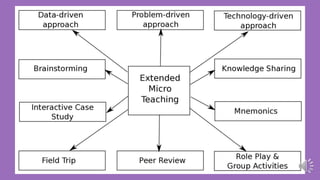
• We identified 10 teaching pedagogies that can fit within
microteaching and we coined the term as “Extended Microteaching
(XMT)”.
XMT – 1. Brainstorming
• Brainstorming is an ideal method to involve the students in the learning
process.
• The teacher acts as a moderator or facilitator and allows the students to
come up with ideas related to the topic straight after the microteaching.
• There is no restriction or criticism. Free flow of thoughts is allowed; even
absurd ideas are accepted. Hence the shy and timid students also give up
their inhibitions and participate freely.
• The teacher steps in to give a form and shape to the discussed ideas. The
students learn concepts easily in an unrestrained manner.
XMT – 2. Knowledge Sharing
• Knowledge Sharing is another way to promote easy learning.
• The topic is given in advance before the microteaching starts.
• Students gather information from different sources.
• Exchange of information and thoughts takes place between the teacher
and students.
• Even the teacher gains knowledge unknown to him or her.
• Some students may not have prepared themselves for the session; they
are passive participants but assimilate knowledge in the knowledge sharing
process.
XMT – 3. Interactive Case Study
• Case study is a comprehensive study which is based on any event,
community, institution or incident that has already taken place.
• It focuses on a particular problem and its solutions.
• Case study method is a story of someone else experiences that is used for
solving the problems.
XMT – 4. Mnemonics
• Mnemonics is a system which involves a pattern of letters, ideas, or
associations which assists in remembering something.
• It means ‘of memory.’ They help use information already stored in long-
term memory to make memorization easier.
• Example:- To remember the color of the rainbow through VIBGYOR.
XMT – 5. Field Trips
• Field Trip is an experience that makes learning tangible.
• There is a saying I hear I forget, I see I remember, I do I understand. Field
trips express this idea explicitly whenever one resorts to it to learn and
acquire knowledge.
• A trip to a factory enables students to understand the production process.
• A trip to a museum makes students connect to civilizations in the past.
XMT – 6. Role Play & Practical Group
Activities
• Role Play is one of those innovative methods which link theory to practice.
It makes learning a true life experience.
• It brings life experiences into the classroom (after microteaching) and
helps in permanent retention of information.
• For example banking transactions and terms can be taught using role play.
• Any business transaction which requires complex dealings and terms can
be simplified using role play. Role play can be used to teach any subject in
a simplified manner.
XMT – 7. Peer Learning & Review
• Peer learning and review is an educational practice in which students
interact with each other to attain educational goals.
• It includes peer teaching and peer evaluation. This includes
referencing skills, grasping of information and good communication
skills.
• Peer learning essentially refers to students learning with and from
each other as fellow learners without any implied authority to any
individual.
XMT – 8. Data-driven Approach
• Data-driven approach relies heavily on quantitative and qualitative data of
the students result to inform teaching and learning.
• The idea refers to a method teachers use to improve instruction by looking
at the information they have about their students.
• Examples of quantitative data include assessment scores, test/exam
scores, results on a quiz/IQ/EQ, and so on.
• Examples of qualitative data include field notes, student work/artifacts,
interviews, focus groups, digital pictures, video, reflective journals.
• This approach can take place within the classroom (physical or online).
XMT – 9. Problem-driven Approach
• Problem-driven approach is a teaching and learning strategy in which
students learn about a subject through the experience of solving an open-
ended problem found in a particular material.
• The problem-driven approach does not focus on problem solving with a
defined solution, but it allows for the development of other desirable skills
and attributes.
• This includes knowledge acquisition, enhanced group collaboration and
communication.
• In the microteaching process, the teachers can include real-world case
studies or problems to develop solutions which will help students to learn
and understand a subject.
XMT – 10. Technology-driven Approach
• The revolution in information and communication technology (ICT) has
revolutionised the education system.
• The role of technology in education is continuously expanding.
• In fact, digital technologies have greatly transformed the dynamics of
teaching and learning in education.
• Some of the tasks can be prepared such that the students address the
challenges/questions using the latest gadgets, technologies (such as IoT, AI
etc.).
• The use of simulations, models, graphic calculators, animations, 3D images
and video clips on smart boards enhance students’ ability to grasp the
concepts.
Results
• UG teachers feel extended microteaching will improve the performance of
teachers in teaching and learning.
• UG teachers have a positive attitude towards using extended
microteaching in teaching and learning.
• UG teachers have a positive intention of using extended microteaching
from their next term.
• UG teachers feel extended microteaching is very easy to use for their
teaching and learning.
• UG teachers feel they need more motivation from their colleagues and
college authorities for using extended microteaching.
• UG teachers feel they need more support from the school, IT help,
infrastructure and resources to use extended microteaching for teaching.
Recomendations
• The colleges must take initiative to motivate and improve infrastructure
and resources needed for using extended microteaching.
• Efforts to advance the adoption of extended microteach- ing in higher
education in India should focus on improv- ing attitude towards the use of
the innovative pedagogies for education and on ensuring that the
facilitating conditions are addressed.
• Social factors also play a role in influencing adoption. Hence, the
motivation and supportiveness of lecturers and colleagues is important in
promoting the adoption of extended microteaching.
Advantages of Extended Microteaching
• Extended microteaching is possible in real time class room conditions or in
replicated conditions.
• Teaching skills can be improved, enhanced and validated through
microteaching.
• It is a training procedure for improving teaching techniques and paves the
way for effective teaching.
• It is an effective feedback device for the modification of teacher behaviour.
• Microteaching minimizes the complexities of the normal classroom
teaching by scaled down teaching.
• Microteaching is appropriate for developing teaching competence in pre
service and in service teacher schooling programmes
Extended Microteaching - Innovative Teaching Pedagogies

Extended Microteaching - Innovative Teaching Pedagogies

  • 1.
    Extended Microteaching (XMT) InnovativeTeaching Pedagogies for the New Normal Education System in India Prof Sushila Rajan Dr Mithileysh Sathiyanarayanan MIT SQUARE, India Raj Square Charity Foundation, India Email: mithileysh@mitsquare.com 6th IEEE International Conference on E-learning, Bahrain 6th – 7th December 2020
  • 2.
    Current Scenario • India’slatest National Education Policy (NEP) has been updated, revised and approved on 29 July 2020. • The policy signifies a huge milestone for India’s Education system, which will certainly make India an attractive destination for higher education world- wide. • However, to transform India into a vibrant knowledge hub and motivate Indian students to focus on “Make in India” initiatives, it is highly important to focus on innovative teaching pedagogies at the Higher Education Institutions (HEIs). • Integrating Information, Communication, and Technology (ICT) with improved traditional teaching pedagogies can be one of the main elements in transforming the country’s future development. Innovative practices in pedagogy have by and large crept into the domain of higher education in India in the last 30 years.
  • 3.
    Microteaching • Microteaching ispractised to enhance the quality of teach- ing in the teaching process. • It is a scaled down teaching technique in terms of class size, time frame and qualitative analysis. • It considerably reduces the complexities of teaching in a real time classroom. It involves student participation to a greater extent as it reduces class size, time duration, topic size.
  • 4.
    Components of Microteaching Thereare seven components of microteaching that aids in better teaching and learning. • Eliciting information from prior knowledge • Proper sequencing of ideas • Objectives and teaching aids • Cohesion between content statement and objectives • Duration of Introduction • Aptitude for creating interest and motivation • Feedback
  • 5.
    Extended Microteaching • Weidentified 10 teaching pedagogies that can fit within microteaching and we coined the term as “Extended Microteaching (XMT)”.
  • 7.
    XMT – 1.Brainstorming • Brainstorming is an ideal method to involve the students in the learning process. • The teacher acts as a moderator or facilitator and allows the students to come up with ideas related to the topic straight after the microteaching. • There is no restriction or criticism. Free flow of thoughts is allowed; even absurd ideas are accepted. Hence the shy and timid students also give up their inhibitions and participate freely. • The teacher steps in to give a form and shape to the discussed ideas. The students learn concepts easily in an unrestrained manner.
  • 8.
    XMT – 2.Knowledge Sharing • Knowledge Sharing is another way to promote easy learning. • The topic is given in advance before the microteaching starts. • Students gather information from different sources. • Exchange of information and thoughts takes place between the teacher and students. • Even the teacher gains knowledge unknown to him or her. • Some students may not have prepared themselves for the session; they are passive participants but assimilate knowledge in the knowledge sharing process.
  • 9.
    XMT – 3.Interactive Case Study • Case study is a comprehensive study which is based on any event, community, institution or incident that has already taken place. • It focuses on a particular problem and its solutions. • Case study method is a story of someone else experiences that is used for solving the problems.
  • 10.
    XMT – 4.Mnemonics • Mnemonics is a system which involves a pattern of letters, ideas, or associations which assists in remembering something. • It means ‘of memory.’ They help use information already stored in long- term memory to make memorization easier. • Example:- To remember the color of the rainbow through VIBGYOR.
  • 11.
    XMT – 5.Field Trips • Field Trip is an experience that makes learning tangible. • There is a saying I hear I forget, I see I remember, I do I understand. Field trips express this idea explicitly whenever one resorts to it to learn and acquire knowledge. • A trip to a factory enables students to understand the production process. • A trip to a museum makes students connect to civilizations in the past.
  • 12.
    XMT – 6.Role Play & Practical Group Activities • Role Play is one of those innovative methods which link theory to practice. It makes learning a true life experience. • It brings life experiences into the classroom (after microteaching) and helps in permanent retention of information. • For example banking transactions and terms can be taught using role play. • Any business transaction which requires complex dealings and terms can be simplified using role play. Role play can be used to teach any subject in a simplified manner.
  • 13.
    XMT – 7.Peer Learning & Review • Peer learning and review is an educational practice in which students interact with each other to attain educational goals. • It includes peer teaching and peer evaluation. This includes referencing skills, grasping of information and good communication skills. • Peer learning essentially refers to students learning with and from each other as fellow learners without any implied authority to any individual.
  • 14.
    XMT – 8.Data-driven Approach • Data-driven approach relies heavily on quantitative and qualitative data of the students result to inform teaching and learning. • The idea refers to a method teachers use to improve instruction by looking at the information they have about their students. • Examples of quantitative data include assessment scores, test/exam scores, results on a quiz/IQ/EQ, and so on. • Examples of qualitative data include field notes, student work/artifacts, interviews, focus groups, digital pictures, video, reflective journals. • This approach can take place within the classroom (physical or online).
  • 15.
    XMT – 9.Problem-driven Approach • Problem-driven approach is a teaching and learning strategy in which students learn about a subject through the experience of solving an open- ended problem found in a particular material. • The problem-driven approach does not focus on problem solving with a defined solution, but it allows for the development of other desirable skills and attributes. • This includes knowledge acquisition, enhanced group collaboration and communication. • In the microteaching process, the teachers can include real-world case studies or problems to develop solutions which will help students to learn and understand a subject.
  • 16.
    XMT – 10.Technology-driven Approach • The revolution in information and communication technology (ICT) has revolutionised the education system. • The role of technology in education is continuously expanding. • In fact, digital technologies have greatly transformed the dynamics of teaching and learning in education. • Some of the tasks can be prepared such that the students address the challenges/questions using the latest gadgets, technologies (such as IoT, AI etc.). • The use of simulations, models, graphic calculators, animations, 3D images and video clips on smart boards enhance students’ ability to grasp the concepts.
  • 17.
    Results • UG teachersfeel extended microteaching will improve the performance of teachers in teaching and learning. • UG teachers have a positive attitude towards using extended microteaching in teaching and learning. • UG teachers have a positive intention of using extended microteaching from their next term. • UG teachers feel extended microteaching is very easy to use for their teaching and learning. • UG teachers feel they need more motivation from their colleagues and college authorities for using extended microteaching. • UG teachers feel they need more support from the school, IT help, infrastructure and resources to use extended microteaching for teaching.
  • 18.
    Recomendations • The collegesmust take initiative to motivate and improve infrastructure and resources needed for using extended microteaching. • Efforts to advance the adoption of extended microteach- ing in higher education in India should focus on improv- ing attitude towards the use of the innovative pedagogies for education and on ensuring that the facilitating conditions are addressed. • Social factors also play a role in influencing adoption. Hence, the motivation and supportiveness of lecturers and colleagues is important in promoting the adoption of extended microteaching.
  • 19.
    Advantages of ExtendedMicroteaching • Extended microteaching is possible in real time class room conditions or in replicated conditions. • Teaching skills can be improved, enhanced and validated through microteaching. • It is a training procedure for improving teaching techniques and paves the way for effective teaching. • It is an effective feedback device for the modification of teacher behaviour. • Microteaching minimizes the complexities of the normal classroom teaching by scaled down teaching. • Microteaching is appropriate for developing teaching competence in pre service and in service teacher schooling programmes