WIRELESSLY ACTUATED SNAKE
      PROTOTYPE (WASP)


             Presented By,

             George Rahul Paul
             Meenu Saji
             Titto Thomas
             Tony Mohan Varghese
             Vidya Sekhar
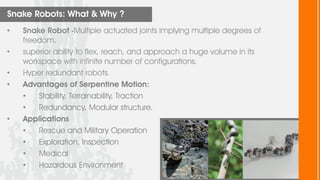
Snake Robots: What & Why ?
•   Snake Robot -Multiple actuated joints implying multiple degrees of
    freedom.
•   superior ability to flex, reach, and approach a huge volume in its
    workspace with infinite number of configurations.
•   Hyper redundant robots.
•   Advantages of Serpentine Motion:
    •   Stability, Terrainability, Traction
    •   Redundancy, Modular structure.
•   Applications
    •   Rescue and Military Operation
    •   Exploration, Inspection
    •   Medical
    •   Hazardous Environment
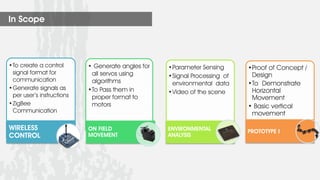
In Scope


•To create a control       • Generate angles for   •Parameter Sensing      •Proof of Concept /
 signal format for          all servos using                                Design
                                                   •Signal Processing of
 communication              algorithms              environmental data     •To Demonstrate
•Generate signals as       •To Pass them in                                 Horizontal
                                                   •Video of the scene
 per user’s instructions    proper format to                                Movement
•ZigBee                     motors                                         • Basic vertical
 Communication                                                              movement

WIRELESS                   ON FIELD                ENVIRONMENTAL           PROTOTYPE I
CONTROL                    MOVEMENT                ANALYSIS
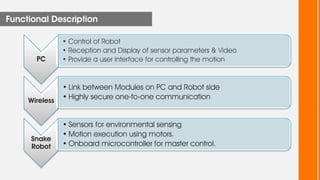
Functional Description

                • Control of Robot
                • Reception and Display of sensor parameters & Video
       PC       • Provide a user interface for controlling the motion


                • Link between Modules on PC and Robot side
     Wireless
                • Highly secure one-to-one communication


                • Sensors for environmental sensing
                • Motion execution using motors.
      Snake
      Robot     • Onboard microcontroller for master control.
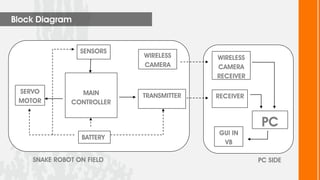
Block Diagram


                 SENSORS
                           WIRELESS      WIRELESS
                           CAMERA        CAMERA
                                         RECEIVER

 SERVO          MAIN       TRANSMITTER   RECEIVER
 MOTOR        CONTROLLER


                                                     PC
                                         GUI IN
                 BATTERY
                                          VB

    SNAKE ROBOT ON FIELD                            PC SIDE
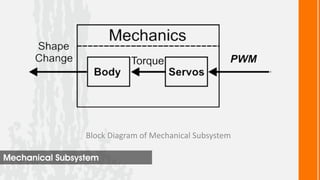
Block Diagram of Mechanical Subsystem

Mechanical Subsystem
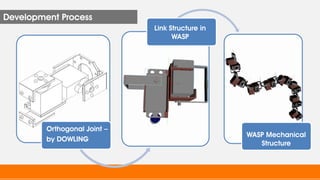
Development Process
                              Link Structure in
                                    WASP


         Orthogonal Joint –
                                                  WASP Mechanical
         by DOWLING
                                                     Structure
Mechanical specification

           SPECIFICATIONS                             DETAILS

            Material Used              Light weight, Low cost Aluminum alloy
           Number of links                               8

           Size of link(mm)                         130x62x77

          Weight of link(Kg)                           0.28

      Motion Range of joint(deg)                     [-90,+90]

              Actuators              Servo motor, (Vigor – 6Kg cm Stall Torque)

               Sensors             Temperature Sensor ( LM35 ) Light sensor (LDR)
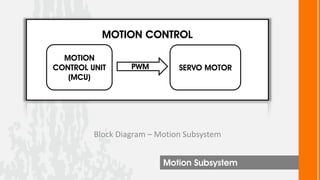
MOTION CONTROL

  MOTION
CONTROL UNIT      PWM         SERVO MOTOR
   (MCU)


         Block Diagram – Motion Subsystem


                          Motion Subsystem
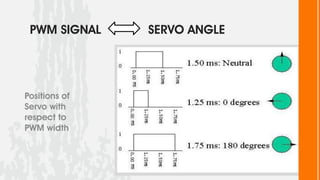
PWM SIGNAL    SERVO ANGLE


Positions of
Servo with
respect to
PWM width
Motion Subsystem


    •   Head is controlled to trace a desired path
    •   Head performs a new set of actions at a time,
        previous set of actions is propagated to next
        link
    •   Speed at which one link performs the previously
        executed actions of head must be modulated.
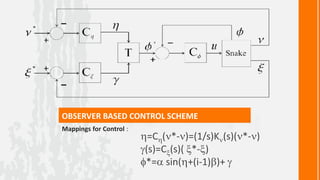
OBSERVER BASED CONTROL SCHEME
Mappings for Control :
                         =C(*-)=(1/s)K(s)(*-)
                         (s)=C(s)( *-)
                         *= sin(+(i-1))+ 
CIRCUIT SUBSYSTEM
Circuit subsystem includes following selection processes:

•Microcontroller Selection
•Wireless interface Selection
•Sensor Selection
MICROCONTROLLER SELECTION
 Various Alternatives
 • Separate Servo Controllers
 • PIC with PWM Modules


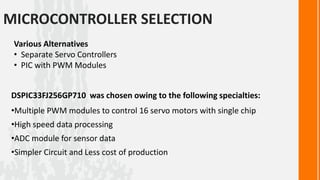
DSPIC33FJ256GP710 was chosen owing to the following specialties:
•Multiple PWM modules to control 16 servo motors with single chip
•High speed data processing
•ADC module for sensor data
•Simpler Circuit and Less cost of production
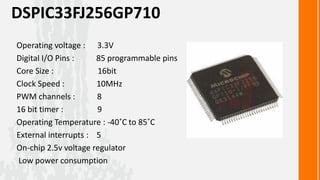
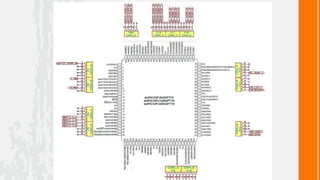
DSPIC33FJ256GP710
Operating voltage : 3.3V
Digital I/O Pins :    85 programmable pins
Core Size :           16bit
Clock Speed :         10MHz
PWM channels :        8
16 bit timer :        9
Operating Temperature : -40˚C to 85˚C
External interrupts : 5
On-chip 2.5v voltage regulator
Low power consumption
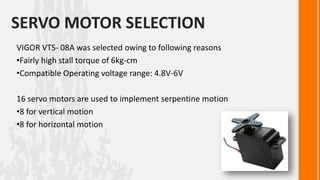
SERVO MOTOR SELECTION
VIGOR VTS- 08A was selected owing to following reasons
•Fairly high stall torque of 6kg-cm
•Compatible Operating voltage range: 4.8V-6V

16 servo motors are used to implement serpentine motion
•8 for vertical motion
•8 for horizontal motion
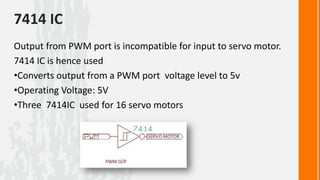
7414 IC
Output from PWM port is incompatible for input to servo motor.
7414 IC is hence used
•Converts output from a PWM port voltage level to 5v
•Operating Voltage: 5V
•Three 7414IC used for 16 servo motors
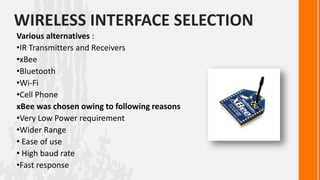
WIRELESS INTERFACE SELECTION
Various alternatives :
•IR Transmitters and Receivers
•xBee
•Bluetooth
•Wi-Fi
•Cell Phone
xBee was chosen owing to following reasons
•Very Low Power requirement
•Wider Range
• Ease of use
• High baud rate
•Fast response
SENSOR SELECTION
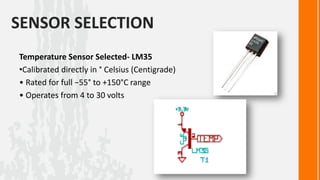
Temperature Sensor Selected- LM35
•Calibrated directly in ° Celsius (Centigrade)
• Rated for full −55° to +150°C range
• Operates from 4 to 30 volts
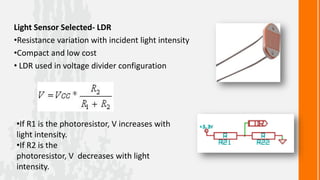
Light Sensor Selected- LDR
•Resistance variation with incident light intensity
•Compact and low cost
• LDR used in voltage divider configuration


•If R1 is the photoresistor, V increases with
light intensity.
•If R2 is the
photoresistor, V decreases with light
intensity.
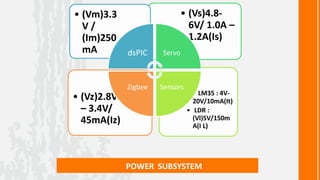
• (Vm)3.3                   • (Vs)4.8-
  V/                          6V/ 1.0A –
  (Im)250                     1.2A(Is)
  mA         dsPIC    Servo


             Zigbee   Sensors
                                • LM35 : 4V-
• (Vz)2.8V                        20V/10mA(It)
  – 3.4V/                       • LDR :
  45mA(Iz)                        (Vl)5V/150m
                                  A(I L)


             POWER SUBSYSTEM
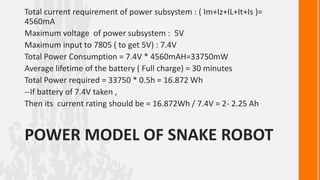
Total current requirement of power subsystem : ( Im+Iz+IL+It+Is )=
4560mA
Maximum voltage of power subsystem : 5V
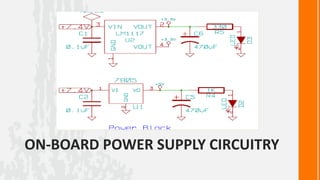
Maximum input to 7805 ( to get 5V) : 7.4V
Total Power Consumption = 7.4V * 4560mAH=33750mW
Average lifetime of the battery ( Full charge) = 30 minutes
Total Power required = 33750 * 0.5h = 16.872 Wh
--If battery of 7.4V taken ,
Then its current rating should be = 16.872Wh / 7.4V = 2- 2.25 Ah


POWER MODEL OF SNAKE ROBOT
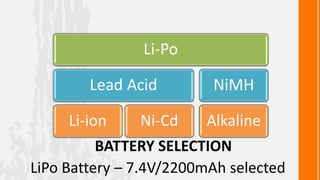
Li-Po

        Lead Acid        NiMH

      Li-ion     Ni-Cd   Alkaline
           BATTERY SELECTION
LiPo Battery – 7.4V/2200mAh selected
BATTERY
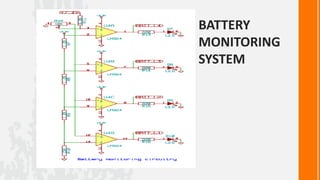
MONITORING
SYSTEM
ON-BOARD POWER SUPPLY CIRCUITRY
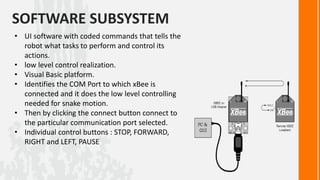
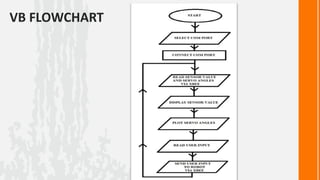
SOFTWARE SUBSYSTEM
• UI software with coded commands that tells the
  robot what tasks to perform and control its
  actions.
• low level control realization.
• Visual Basic platform.
• Identifies the COM Port to which xBee is
  connected and it does the low level controlling
  needed for snake motion.
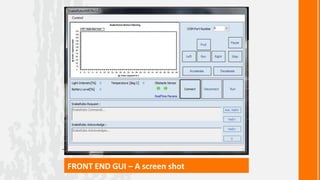
• Then by clicking the connect button connect to
  the particular communication port selected.
• Individual control buttons : STOP, FORWARD,
  RIGHT and LEFT, PAUSE
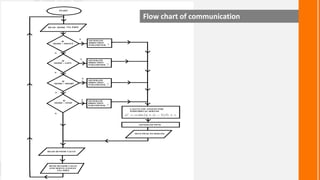
Flow chart of communication
VB FLOWCHART
- Using VB platform

 FRONT END GUI – A screen shot
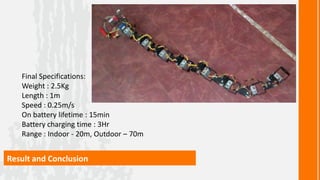
Final Specifications:
   Weight : 2.5Kg
   Length : 1m
   Speed : 0.25m/s
   On battery lifetime : 15min
   Battery charging time : 3Hr
   Range : Indoor - 20m, Outdoor – 70m


Result and Conclusion
•   Various Gaits : Additional work in steering and gait transitions is necessary for more
    general locomotion.
•   Mechanism : an easier-to-disassemble joint structure with a rapid mechanical and
    electric connection, light weight materials such as polymers etc.
•   Power: Power efficient working system with long term battery life.
•   Sensing: use of sensors in achieving an autonomous locomotion and terrain
    adaptability.
•   Electronics: SMT miniaturization of circuits
•   Learning: Learning the environment , introducing a memory and adaptability.


              FUTURE SCOPES
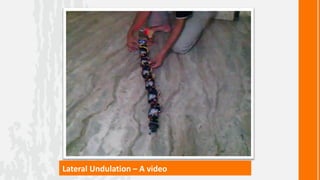
Lateral Undulation – A video
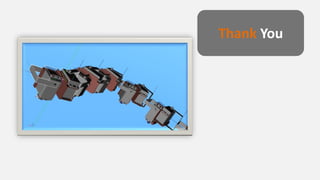
Thank You

Wirelessly Actuated Snake Prototype

  • 1.
    WIRELESSLY ACTUATED SNAKE PROTOTYPE (WASP) Presented By, George Rahul Paul Meenu Saji Titto Thomas Tony Mohan Varghese Vidya Sekhar
  • 2.
    Snake Robots: What& Why ? • Snake Robot -Multiple actuated joints implying multiple degrees of freedom. • superior ability to flex, reach, and approach a huge volume in its workspace with infinite number of configurations. • Hyper redundant robots. • Advantages of Serpentine Motion: • Stability, Terrainability, Traction • Redundancy, Modular structure. • Applications • Rescue and Military Operation • Exploration, Inspection • Medical • Hazardous Environment
  • 3.
    In Scope •To createa control • Generate angles for •Parameter Sensing •Proof of Concept / signal format for all servos using Design •Signal Processing of communication algorithms environmental data •To Demonstrate •Generate signals as •To Pass them in Horizontal •Video of the scene per user’s instructions proper format to Movement •ZigBee motors • Basic vertical Communication movement WIRELESS ON FIELD ENVIRONMENTAL PROTOTYPE I CONTROL MOVEMENT ANALYSIS
  • 4.
    Functional Description • Control of Robot • Reception and Display of sensor parameters & Video PC • Provide a user interface for controlling the motion • Link between Modules on PC and Robot side Wireless • Highly secure one-to-one communication • Sensors for environmental sensing • Motion execution using motors. Snake Robot • Onboard microcontroller for master control.
  • 5.
    Block Diagram SENSORS WIRELESS WIRELESS CAMERA CAMERA RECEIVER SERVO MAIN TRANSMITTER RECEIVER MOTOR CONTROLLER PC GUI IN BATTERY VB SNAKE ROBOT ON FIELD PC SIDE
  • 6.
    Block Diagram ofMechanical Subsystem Mechanical Subsystem
  • 7.
    Development Process Link Structure in WASP Orthogonal Joint – WASP Mechanical by DOWLING Structure
  • 8.
    Mechanical specification SPECIFICATIONS DETAILS Material Used Light weight, Low cost Aluminum alloy Number of links 8 Size of link(mm) 130x62x77 Weight of link(Kg) 0.28 Motion Range of joint(deg) [-90,+90] Actuators Servo motor, (Vigor – 6Kg cm Stall Torque) Sensors Temperature Sensor ( LM35 ) Light sensor (LDR)
  • 9.
    MOTION CONTROL MOTION CONTROL UNIT PWM SERVO MOTOR (MCU) Block Diagram – Motion Subsystem Motion Subsystem
  • 10.
    PWM SIGNAL SERVO ANGLE Positions of Servo with respect to PWM width
  • 11.
    Motion Subsystem • Head is controlled to trace a desired path • Head performs a new set of actions at a time, previous set of actions is propagated to next link • Speed at which one link performs the previously executed actions of head must be modulated.
  • 12.
    OBSERVER BASED CONTROLSCHEME Mappings for Control : =C(*-)=(1/s)K(s)(*-) (s)=C(s)( *-) *= sin(+(i-1))+ 
  • 13.
    CIRCUIT SUBSYSTEM Circuit subsystemincludes following selection processes: •Microcontroller Selection •Wireless interface Selection •Sensor Selection
  • 14.
    MICROCONTROLLER SELECTION VariousAlternatives • Separate Servo Controllers • PIC with PWM Modules DSPIC33FJ256GP710 was chosen owing to the following specialties: •Multiple PWM modules to control 16 servo motors with single chip •High speed data processing •ADC module for sensor data •Simpler Circuit and Less cost of production
  • 15.
    DSPIC33FJ256GP710 Operating voltage :3.3V Digital I/O Pins : 85 programmable pins Core Size : 16bit Clock Speed : 10MHz PWM channels : 8 16 bit timer : 9 Operating Temperature : -40˚C to 85˚C External interrupts : 5 On-chip 2.5v voltage regulator Low power consumption
  • 17.
    SERVO MOTOR SELECTION VIGORVTS- 08A was selected owing to following reasons •Fairly high stall torque of 6kg-cm •Compatible Operating voltage range: 4.8V-6V 16 servo motors are used to implement serpentine motion •8 for vertical motion •8 for horizontal motion
  • 18.
    7414 IC Output fromPWM port is incompatible for input to servo motor. 7414 IC is hence used •Converts output from a PWM port voltage level to 5v •Operating Voltage: 5V •Three 7414IC used for 16 servo motors
  • 19.
    WIRELESS INTERFACE SELECTION Variousalternatives : •IR Transmitters and Receivers •xBee •Bluetooth •Wi-Fi •Cell Phone xBee was chosen owing to following reasons •Very Low Power requirement •Wider Range • Ease of use • High baud rate •Fast response
  • 20.
    SENSOR SELECTION Temperature SensorSelected- LM35 •Calibrated directly in ° Celsius (Centigrade) • Rated for full −55° to +150°C range • Operates from 4 to 30 volts
  • 21.
    Light Sensor Selected-LDR •Resistance variation with incident light intensity •Compact and low cost • LDR used in voltage divider configuration •If R1 is the photoresistor, V increases with light intensity. •If R2 is the photoresistor, V decreases with light intensity.
  • 22.
    • (Vm)3.3 • (Vs)4.8- V/ 6V/ 1.0A – (Im)250 1.2A(Is) mA dsPIC Servo Zigbee Sensors • LM35 : 4V- • (Vz)2.8V 20V/10mA(It) – 3.4V/ • LDR : 45mA(Iz) (Vl)5V/150m A(I L) POWER SUBSYSTEM
  • 23.
    Total current requirementof power subsystem : ( Im+Iz+IL+It+Is )= 4560mA Maximum voltage of power subsystem : 5V Maximum input to 7805 ( to get 5V) : 7.4V Total Power Consumption = 7.4V * 4560mAH=33750mW Average lifetime of the battery ( Full charge) = 30 minutes Total Power required = 33750 * 0.5h = 16.872 Wh --If battery of 7.4V taken , Then its current rating should be = 16.872Wh / 7.4V = 2- 2.25 Ah POWER MODEL OF SNAKE ROBOT
  • 24.
    Li-Po Lead Acid NiMH Li-ion Ni-Cd Alkaline BATTERY SELECTION LiPo Battery – 7.4V/2200mAh selected
  • 25.
  • 26.
  • 27.
    SOFTWARE SUBSYSTEM • UIsoftware with coded commands that tells the robot what tasks to perform and control its actions. • low level control realization. • Visual Basic platform. • Identifies the COM Port to which xBee is connected and it does the low level controlling needed for snake motion. • Then by clicking the connect button connect to the particular communication port selected. • Individual control buttons : STOP, FORWARD, RIGHT and LEFT, PAUSE
  • 28.
    Flow chart ofcommunication
  • 29.
  • 30.
    - Using VBplatform FRONT END GUI – A screen shot
  • 31.
    Final Specifications: Weight : 2.5Kg Length : 1m Speed : 0.25m/s On battery lifetime : 15min Battery charging time : 3Hr Range : Indoor - 20m, Outdoor – 70m Result and Conclusion
  • 32.
    Various Gaits : Additional work in steering and gait transitions is necessary for more general locomotion. • Mechanism : an easier-to-disassemble joint structure with a rapid mechanical and electric connection, light weight materials such as polymers etc. • Power: Power efficient working system with long term battery life. • Sensing: use of sensors in achieving an autonomous locomotion and terrain adaptability. • Electronics: SMT miniaturization of circuits • Learning: Learning the environment , introducing a memory and adaptability. FUTURE SCOPES
  • 33.
  • 34.