1
Discretization and Concept
Hierarchy Generation
2
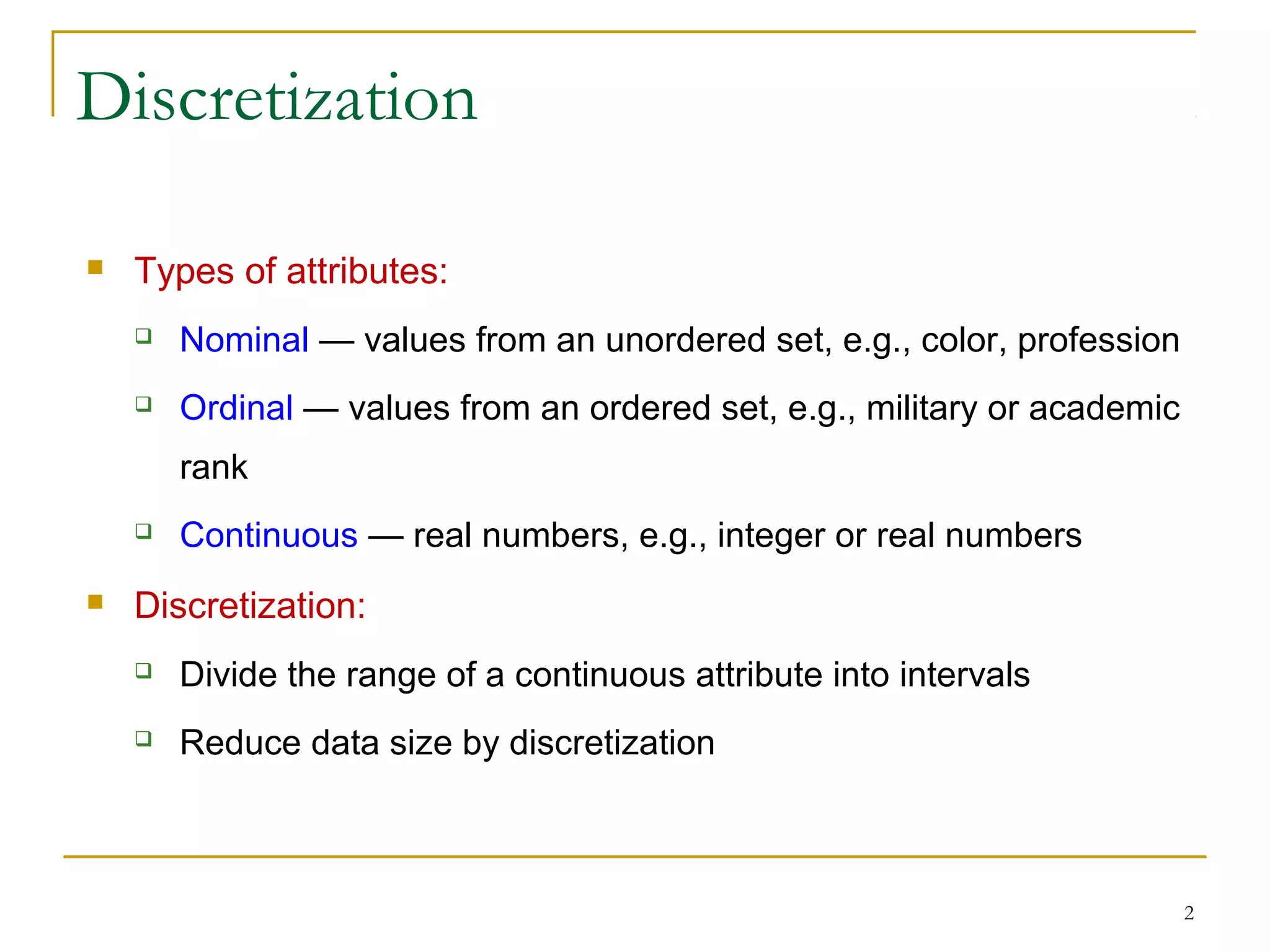
Discretization
 Types of attributes:
 Nominal — values from an unordered set, e.g., color, profession
 Ordinal — values from an ordered set, e.g., military or academic
rank
 Continuous — real numbers, e.g., integer or real numbers
 Discretization:
 Divide the range of a continuous attribute into intervals
 Reduce data size by discretization
3
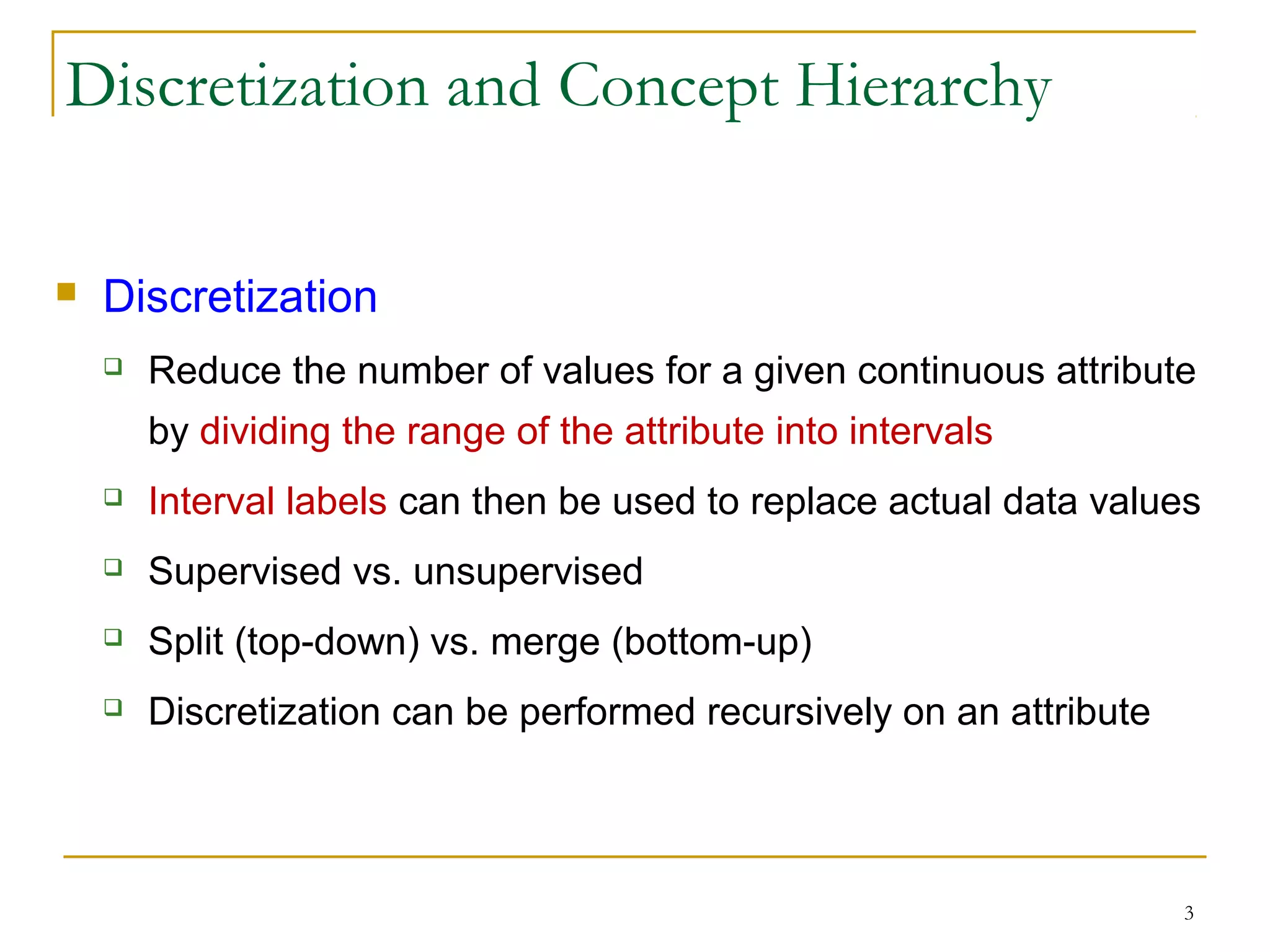
Discretization and Concept Hierarchy
 Discretization
 Reduce the number of values for a given continuous attribute
by dividing the range of the attribute into intervals
 Interval labels can then be used to replace actual data values
 Supervised vs. unsupervised
 Split (top-down) vs. merge (bottom-up)
 Discretization can be performed recursively on an attribute
4
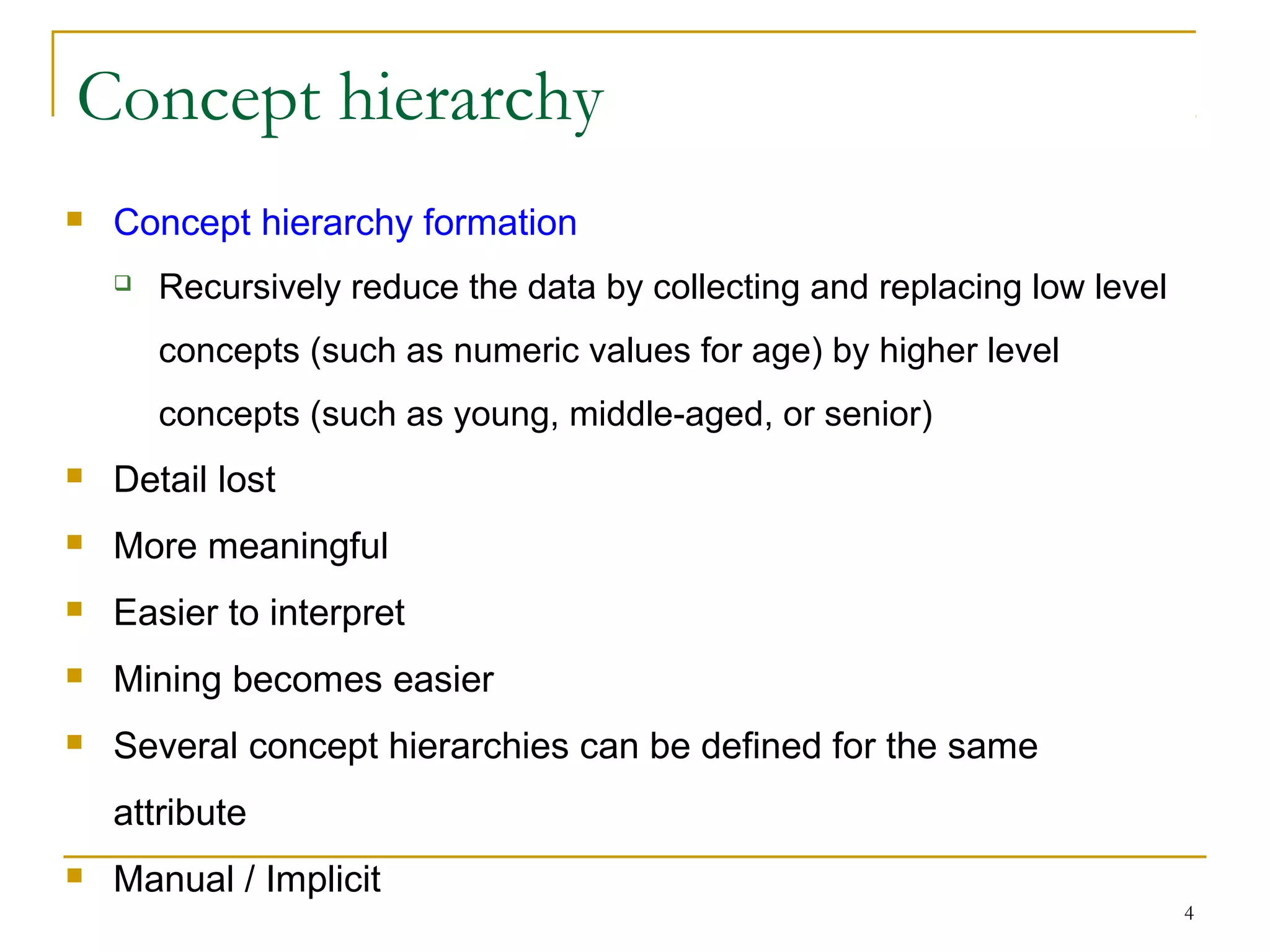
Concept hierarchy
 Concept hierarchy formation
 Recursively reduce the data by collecting and replacing low level
concepts (such as numeric values for age) by higher level
concepts (such as young, middle-aged, or senior)
 Detail lost
 More meaningful
 Easier to interpret
 Mining becomes easier
 Several concept hierarchies can be defined for the same
attribute
 Manual / Implicit
5
Discretization and Concept Hierarchy
Generation for Numeric Data
 Typical methods:
 Binning
 Histogram analysis
 Clustering analysis
 Entropy-based discretization
 χ2
merging
 Segmentation by natural partitioning
All the methods can be applied recursively
6
Techniques
 Binning
 Distribute values into bins
 Replace by bin mean / median
 Recursive application – leads to concept hierarchies
 Unsupervised technique
 Histogram Analysis
 Data Distribution – Partition
 Equiwidth – (0-100], (100-200], …
 Equidepth
 Recursive
 Minimum Interval size
 Unsupervised
7
Techniques
 Cluster Analysis
 Clusters form nodes of concept hierarchy
 Can decompose / combine
 Lower level / higher level of hierarchy
8
Entropy-Based Discretization
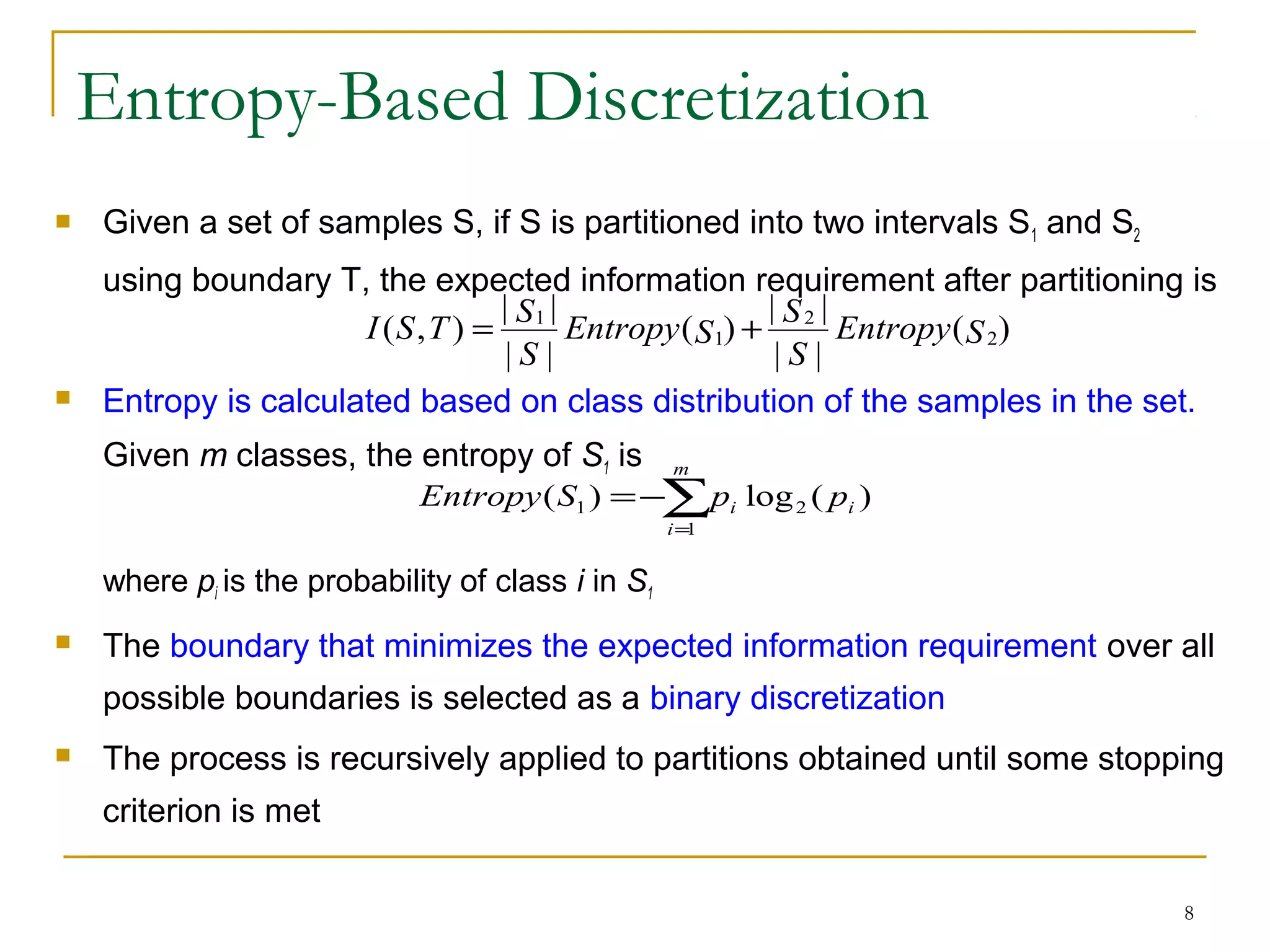
 Given a set of samples S, if S is partitioned into two intervals S1 and S2
using boundary T, the expected information requirement after partitioning is
 Entropy is calculated based on class distribution of the samples in the set.
Given m classes, the entropy of S1 is
where pi is the probability of class i in S1
 The boundary that minimizes the expected information requirement over all
possible boundaries is selected as a binary discretization
 The process is recursively applied to partitions obtained until some stopping
criterion is met
)(
||
||
)(
||
||
),( 2
2
1
1
SEntropy
S
S
SEntropy
S
S
TSI +=
∑=
−=
m
i
ii ppSEntropy
1
21 )(log)(
9
 Reduces data size
 Class information is considered
 Improves accuracy
Entropy-Based Discretization
10
Interval Merging by χ2
Analysis
 ChiMerge
 Bottom-up approach
 find the best neighbouring intervals and merges them to form larger intervals
 Supervised
 If two adjacent intervals have similar distribution of classes – they can be
merged
 Initially each value is in a separate interval
 χ2
tests are performed for adjacent intervals. Those with least
values are merged
 Can be repeated
 Stopping condition (Threshold, Number of intervals)
11
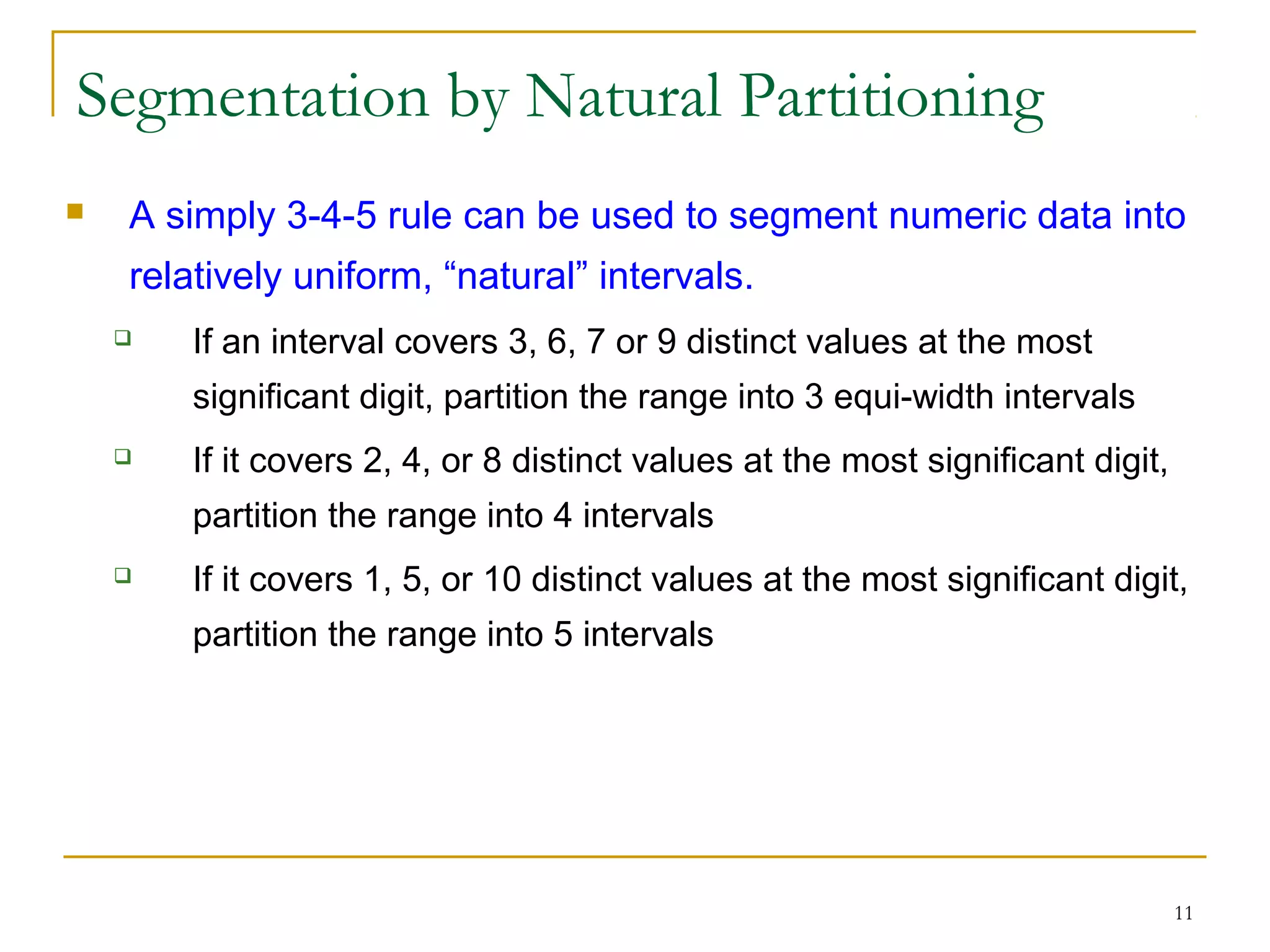
Segmentation by Natural Partitioning
 A simply 3-4-5 rule can be used to segment numeric data into
relatively uniform, “natural” intervals.
 If an interval covers 3, 6, 7 or 9 distinct values at the most
significant digit, partition the range into 3 equi-width intervals
 If it covers 2, 4, or 8 distinct values at the most significant digit,
partition the range into 4 intervals
 If it covers 1, 5, or 10 distinct values at the most significant digit,
partition the range into 5 intervals
12
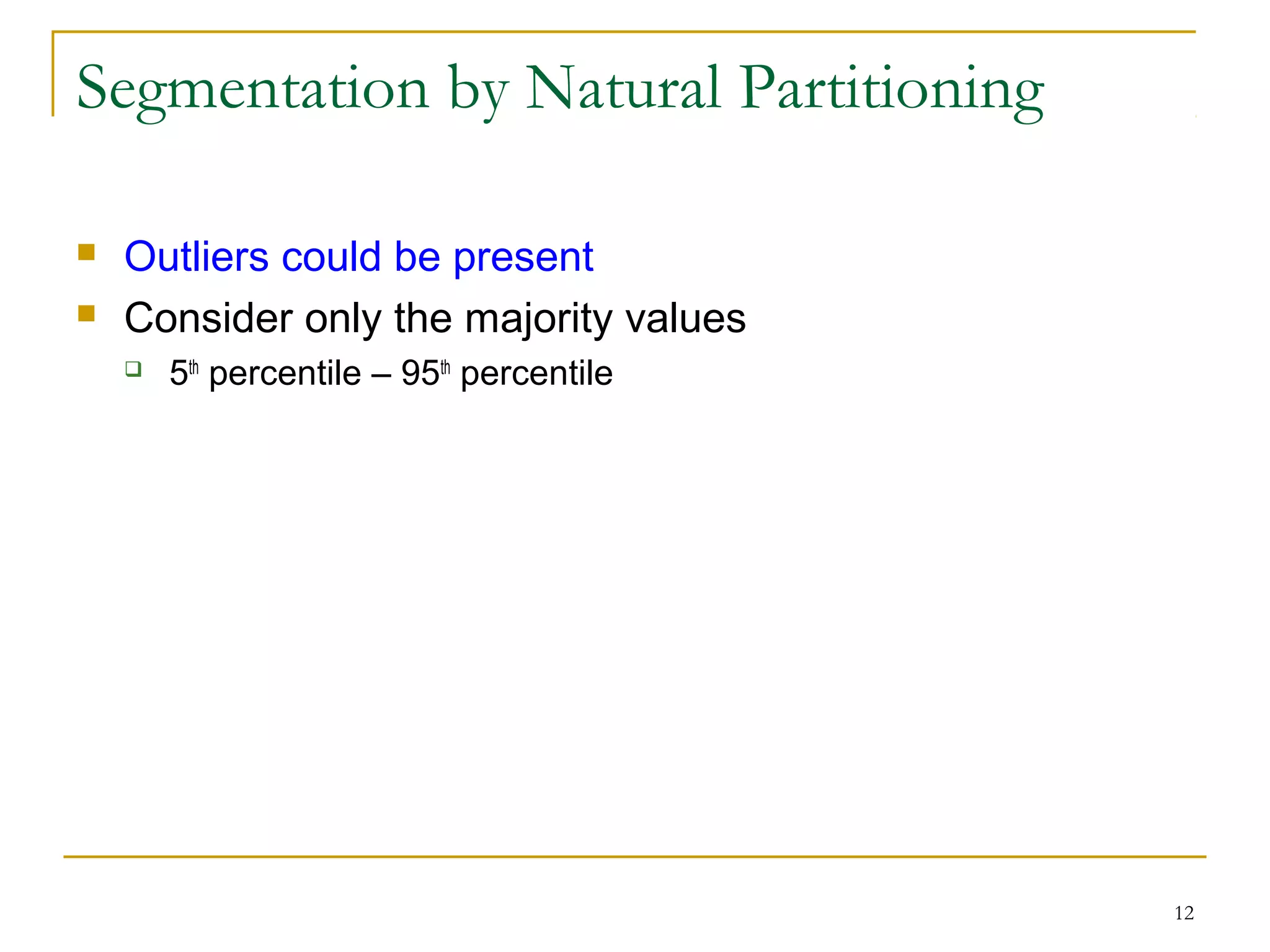
 Outliers could be present
 Consider only the majority values
 5th
percentile – 95th
percentile
Segmentation by Natural Partitioning
13
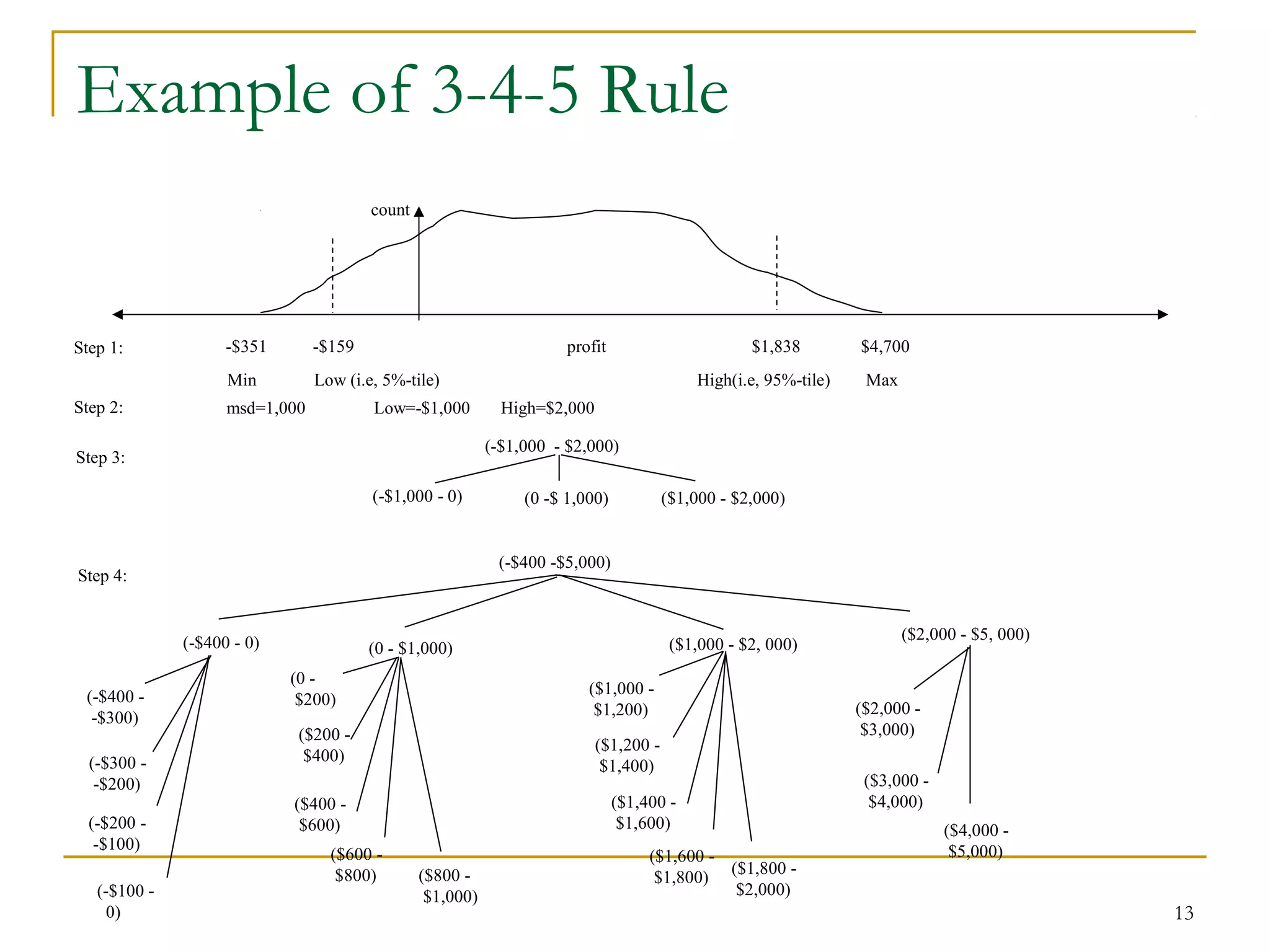
Example of 3-4-5 Rule
(-$400 -$5,000)
(-$400 - 0)
(-$400 -
-$300)
(-$300 -
-$200)
(-$200 -
-$100)
(-$100 -
0)
(0 - $1,000)
(0 -
$200)
($200 -
$400)
($400 -
$600)
($600 -
$800) ($800 -
$1,000)
($2,000 - $5, 000)
($2,000 -
$3,000)
($3,000 -
$4,000)
($4,000 -
$5,000)
($1,000 - $2, 000)
($1,000 -
$1,200)
($1,200 -
$1,400)
($1,400 -
$1,600)
($1,600 -
$1,800)
($1,800 -
$2,000)
msd=1,000 Low=-$1,000 High=$2,000Step 2:
Step 4:
Step 1: -$351 -$159 profit $1,838 $4,700
Min Low (i.e, 5%-tile) High(i.e, 95%-tile) Max
count
(-$1,000 - $2,000)
(-$1,000 - 0) (0 -$ 1,000)
Step 3:
($1,000 - $2,000)
14
Concept Hierarchy Generation for
Categorical Data
 Specification of a partial ordering of attributes explicitly at
the schema level by users or experts
 User / Expert defines hierarchy
 Street < city < state < country
 Specification of a portion of a hierarchy by explicit data
grouping
 Manual
 Intermediate level information specified
 Industrial, Agricultural..
15
Concept Hierarchy Generation for
Categorical Data
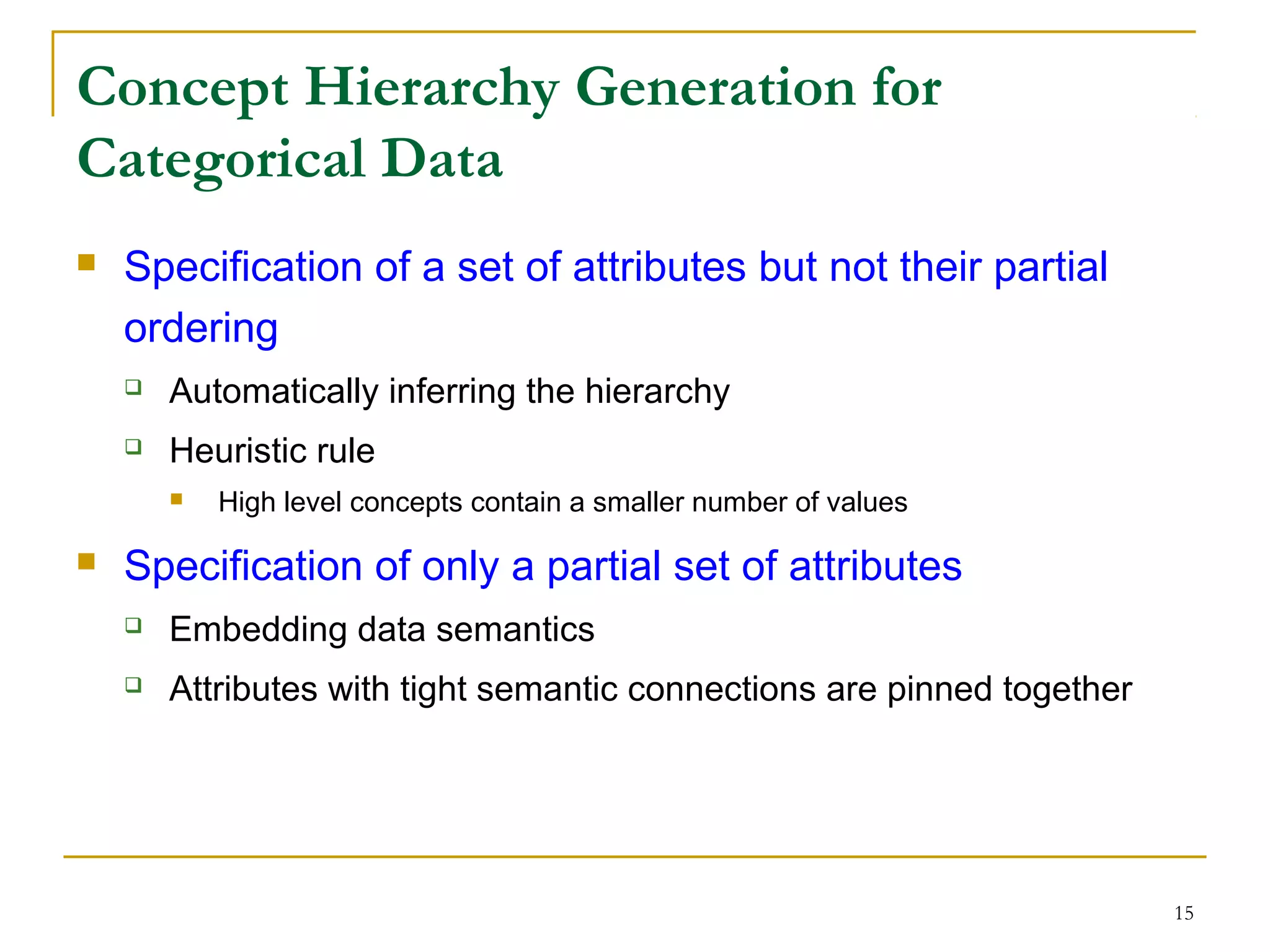
 Specification of a set of attributes but not their partial
ordering
 Automatically inferring the hierarchy
 Heuristic rule
 High level concepts contain a smaller number of values
 Specification of only a partial set of attributes
 Embedding data semantics
 Attributes with tight semantic connections are pinned together

1.8 discretization

  • 1.
  • 2.
    2 Discretization  Types ofattributes:  Nominal — values from an unordered set, e.g., color, profession  Ordinal — values from an ordered set, e.g., military or academic rank  Continuous — real numbers, e.g., integer or real numbers  Discretization:  Divide the range of a continuous attribute into intervals  Reduce data size by discretization
  • 3.
    3 Discretization and ConceptHierarchy  Discretization  Reduce the number of values for a given continuous attribute by dividing the range of the attribute into intervals  Interval labels can then be used to replace actual data values  Supervised vs. unsupervised  Split (top-down) vs. merge (bottom-up)  Discretization can be performed recursively on an attribute
  • 4.
    4 Concept hierarchy  Concepthierarchy formation  Recursively reduce the data by collecting and replacing low level concepts (such as numeric values for age) by higher level concepts (such as young, middle-aged, or senior)  Detail lost  More meaningful  Easier to interpret  Mining becomes easier  Several concept hierarchies can be defined for the same attribute  Manual / Implicit
  • 5.
    5 Discretization and ConceptHierarchy Generation for Numeric Data  Typical methods:  Binning  Histogram analysis  Clustering analysis  Entropy-based discretization  χ2 merging  Segmentation by natural partitioning All the methods can be applied recursively
  • 6.
    6 Techniques  Binning  Distributevalues into bins  Replace by bin mean / median  Recursive application – leads to concept hierarchies  Unsupervised technique  Histogram Analysis  Data Distribution – Partition  Equiwidth – (0-100], (100-200], …  Equidepth  Recursive  Minimum Interval size  Unsupervised
  • 7.
    7 Techniques  Cluster Analysis Clusters form nodes of concept hierarchy  Can decompose / combine  Lower level / higher level of hierarchy
  • 8.
    8 Entropy-Based Discretization  Givena set of samples S, if S is partitioned into two intervals S1 and S2 using boundary T, the expected information requirement after partitioning is  Entropy is calculated based on class distribution of the samples in the set. Given m classes, the entropy of S1 is where pi is the probability of class i in S1  The boundary that minimizes the expected information requirement over all possible boundaries is selected as a binary discretization  The process is recursively applied to partitions obtained until some stopping criterion is met )( || || )( || || ),( 2 2 1 1 SEntropy S S SEntropy S S TSI += ∑= −= m i ii ppSEntropy 1 21 )(log)(
  • 9.
    9  Reduces datasize  Class information is considered  Improves accuracy Entropy-Based Discretization
  • 10.
    10 Interval Merging byχ2 Analysis  ChiMerge  Bottom-up approach  find the best neighbouring intervals and merges them to form larger intervals  Supervised  If two adjacent intervals have similar distribution of classes – they can be merged  Initially each value is in a separate interval  χ2 tests are performed for adjacent intervals. Those with least values are merged  Can be repeated  Stopping condition (Threshold, Number of intervals)
  • 11.
    11 Segmentation by NaturalPartitioning  A simply 3-4-5 rule can be used to segment numeric data into relatively uniform, “natural” intervals.  If an interval covers 3, 6, 7 or 9 distinct values at the most significant digit, partition the range into 3 equi-width intervals  If it covers 2, 4, or 8 distinct values at the most significant digit, partition the range into 4 intervals  If it covers 1, 5, or 10 distinct values at the most significant digit, partition the range into 5 intervals
  • 12.
    12  Outliers couldbe present  Consider only the majority values  5th percentile – 95th percentile Segmentation by Natural Partitioning
  • 13.
    13 Example of 3-4-5Rule (-$400 -$5,000) (-$400 - 0) (-$400 - -$300) (-$300 - -$200) (-$200 - -$100) (-$100 - 0) (0 - $1,000) (0 - $200) ($200 - $400) ($400 - $600) ($600 - $800) ($800 - $1,000) ($2,000 - $5, 000) ($2,000 - $3,000) ($3,000 - $4,000) ($4,000 - $5,000) ($1,000 - $2, 000) ($1,000 - $1,200) ($1,200 - $1,400) ($1,400 - $1,600) ($1,600 - $1,800) ($1,800 - $2,000) msd=1,000 Low=-$1,000 High=$2,000Step 2: Step 4: Step 1: -$351 -$159 profit $1,838 $4,700 Min Low (i.e, 5%-tile) High(i.e, 95%-tile) Max count (-$1,000 - $2,000) (-$1,000 - 0) (0 -$ 1,000) Step 3: ($1,000 - $2,000)
  • 14.
    14 Concept Hierarchy Generationfor Categorical Data  Specification of a partial ordering of attributes explicitly at the schema level by users or experts  User / Expert defines hierarchy  Street < city < state < country  Specification of a portion of a hierarchy by explicit data grouping  Manual  Intermediate level information specified  Industrial, Agricultural..
  • 15.
    15 Concept Hierarchy Generationfor Categorical Data  Specification of a set of attributes but not their partial ordering  Automatically inferring the hierarchy  Heuristic rule  High level concepts contain a smaller number of values  Specification of only a partial set of attributes  Embedding data semantics  Attributes with tight semantic connections are pinned together