1
Data Reduction
2
Data Reduction Strategies
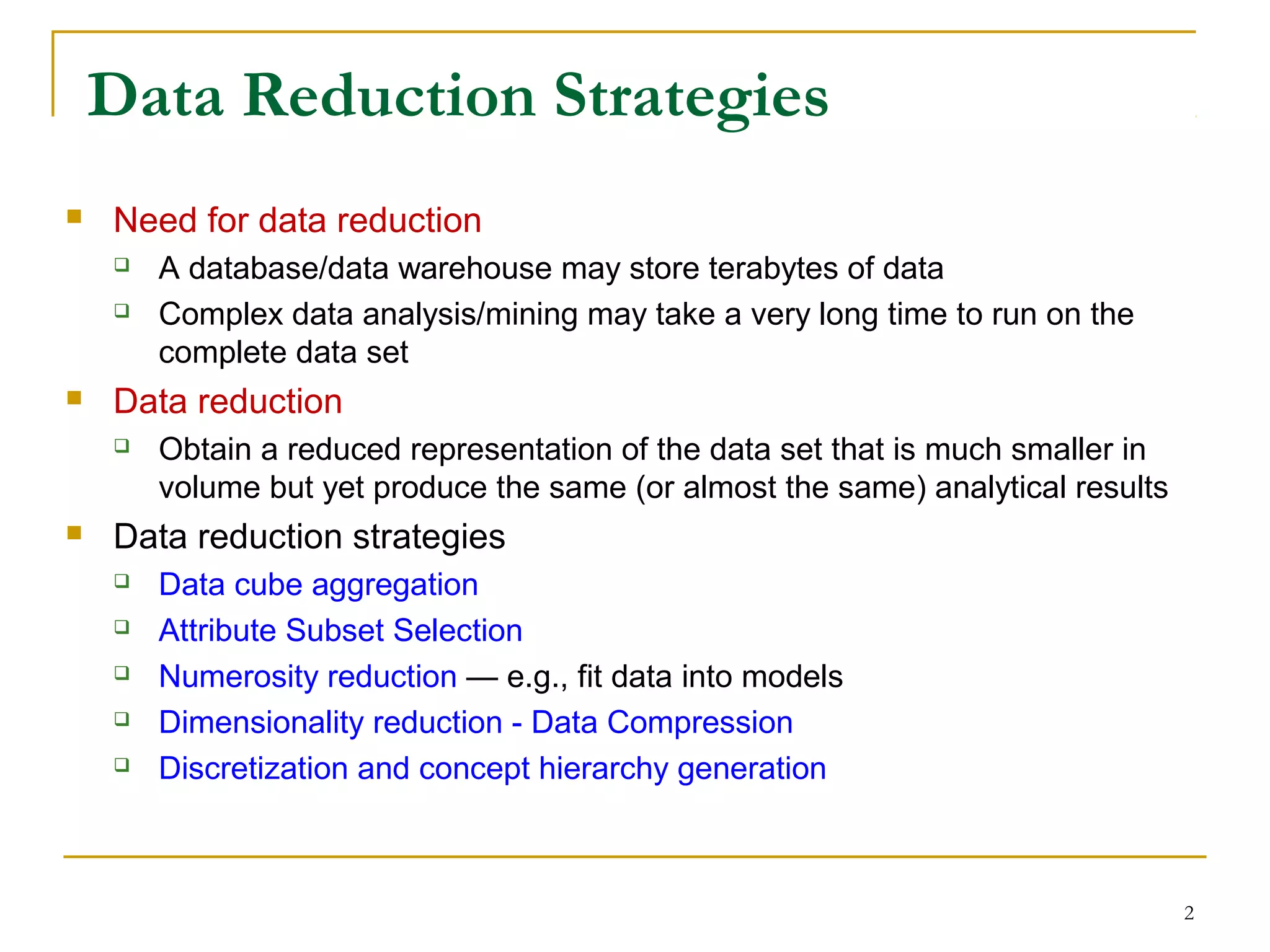
 Need for data reduction
 A database/data warehouse may store terabytes of data
 Complex data analysis/mining may take a very long time to run on the
complete data set
 Data reduction
 Obtain a reduced representation of the data set that is much smaller in
volume but yet produce the same (or almost the same) analytical results
 Data reduction strategies
 Data cube aggregation
 Attribute Subset Selection
 Numerosity reduction — e.g., fit data into models
 Dimensionality reduction - Data Compression
 Discretization and concept hierarchy generation
3
2. Attribute Subset Selection
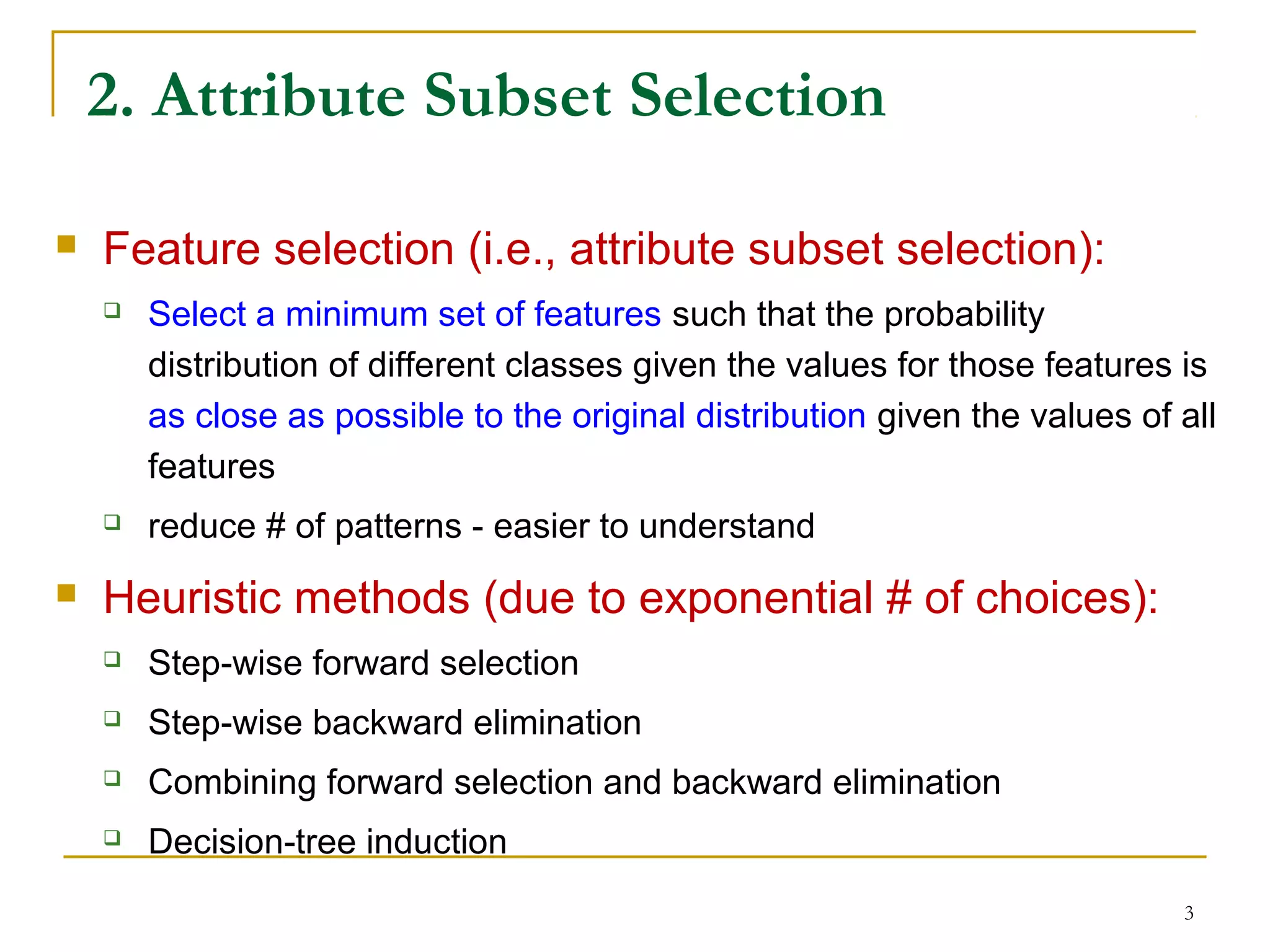
 Feature selection (i.e., attribute subset selection):
 Select a minimum set of features such that the probability
distribution of different classes given the values for those features is
as close as possible to the original distribution given the values of all
features
 reduce # of patterns - easier to understand
 Heuristic methods (due to exponential # of choices):
 Step-wise forward selection
 Step-wise backward elimination
 Combining forward selection and backward elimination
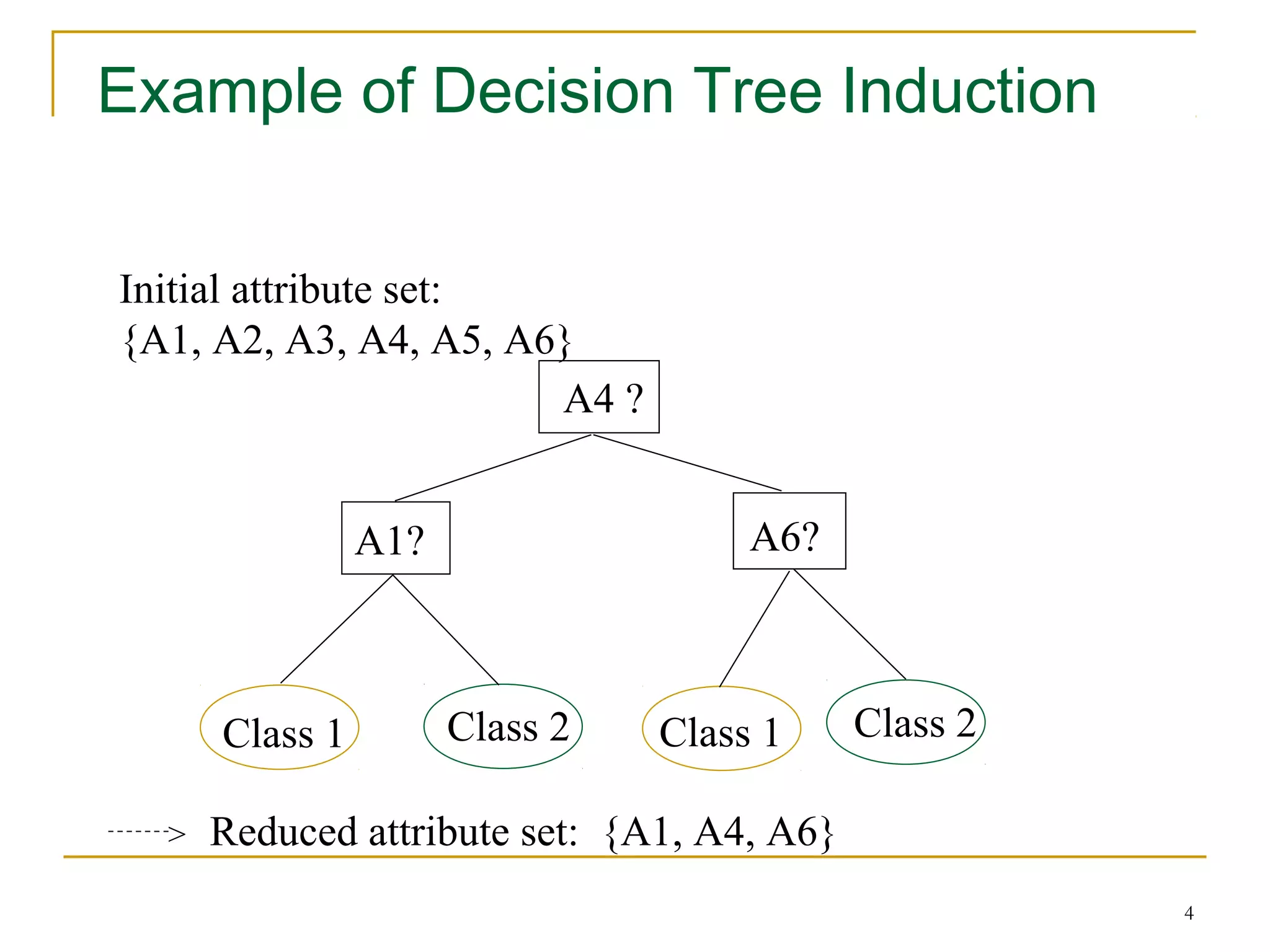
 Decision-tree induction
4
Example of Decision Tree Induction
Initial attribute set:
{A1, A2, A3, A4, A5, A6}
A4 ?
A1? A6?
Class 1 Class 2 Class 1 Class 2
> Reduced attribute set: {A1, A4, A6}
5
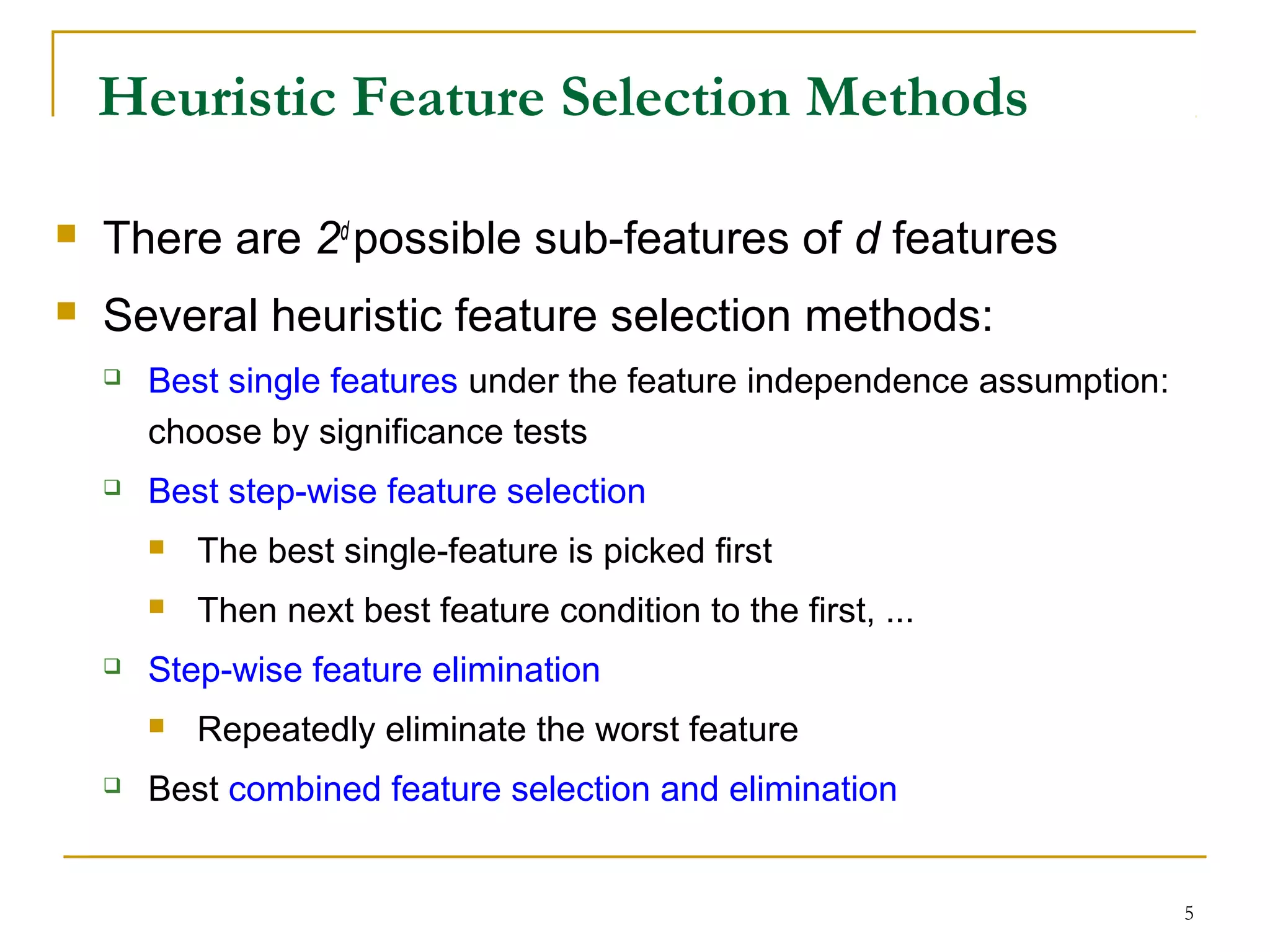
Heuristic Feature Selection Methods
 There are 2d
possible sub-features of d features
 Several heuristic feature selection methods:
 Best single features under the feature independence assumption:
choose by significance tests
 Best step-wise feature selection
 The best single-feature is picked first
 Then next best feature condition to the first, ...
 Step-wise feature elimination
 Repeatedly eliminate the worst feature
 Best combined feature selection and elimination
6
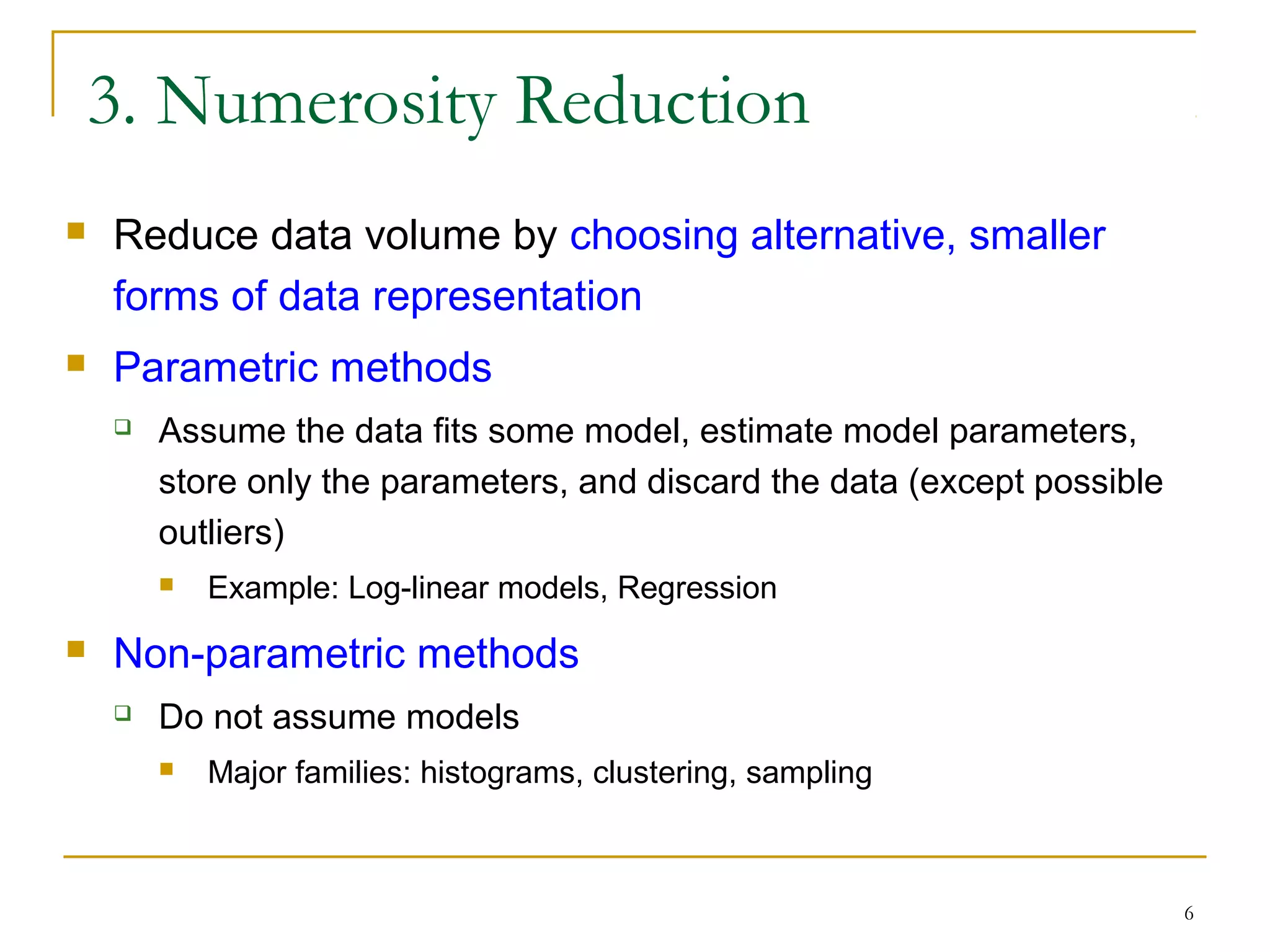
3. Numerosity Reduction
 Reduce data volume by choosing alternative, smaller
forms of data representation
 Parametric methods
 Assume the data fits some model, estimate model parameters,
store only the parameters, and discard the data (except possible
outliers)
 Example: Log-linear models, Regression
 Non-parametric methods
 Do not assume models
 Major families: histograms, clustering, sampling
7
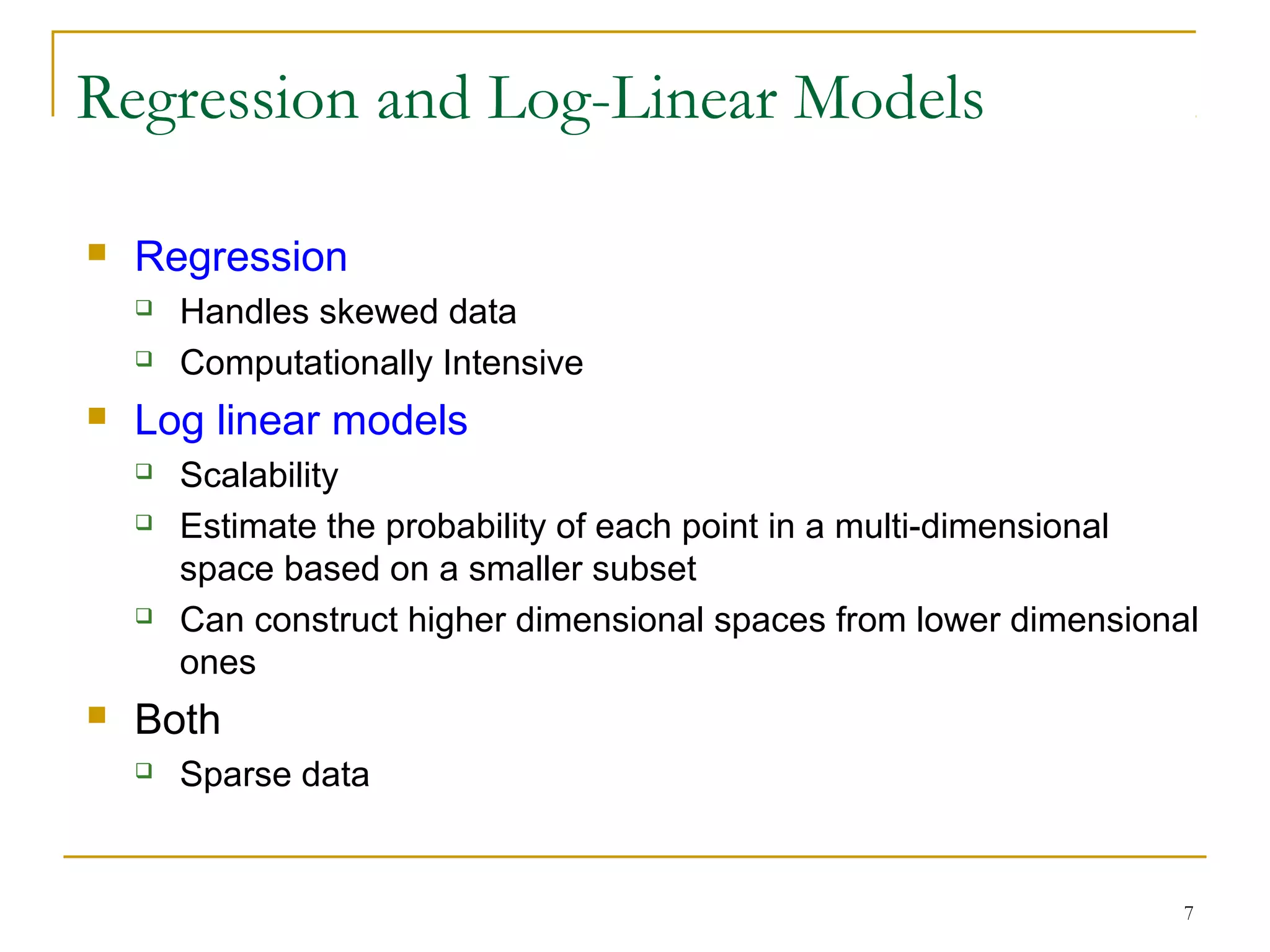
 Regression
 Handles skewed data
 Computationally Intensive
 Log linear models
 Scalability
 Estimate the probability of each point in a multi-dimensional
space based on a smaller subset
 Can construct higher dimensional spaces from lower dimensional
ones
 Both
 Sparse data
Regression and Log-Linear Models
8
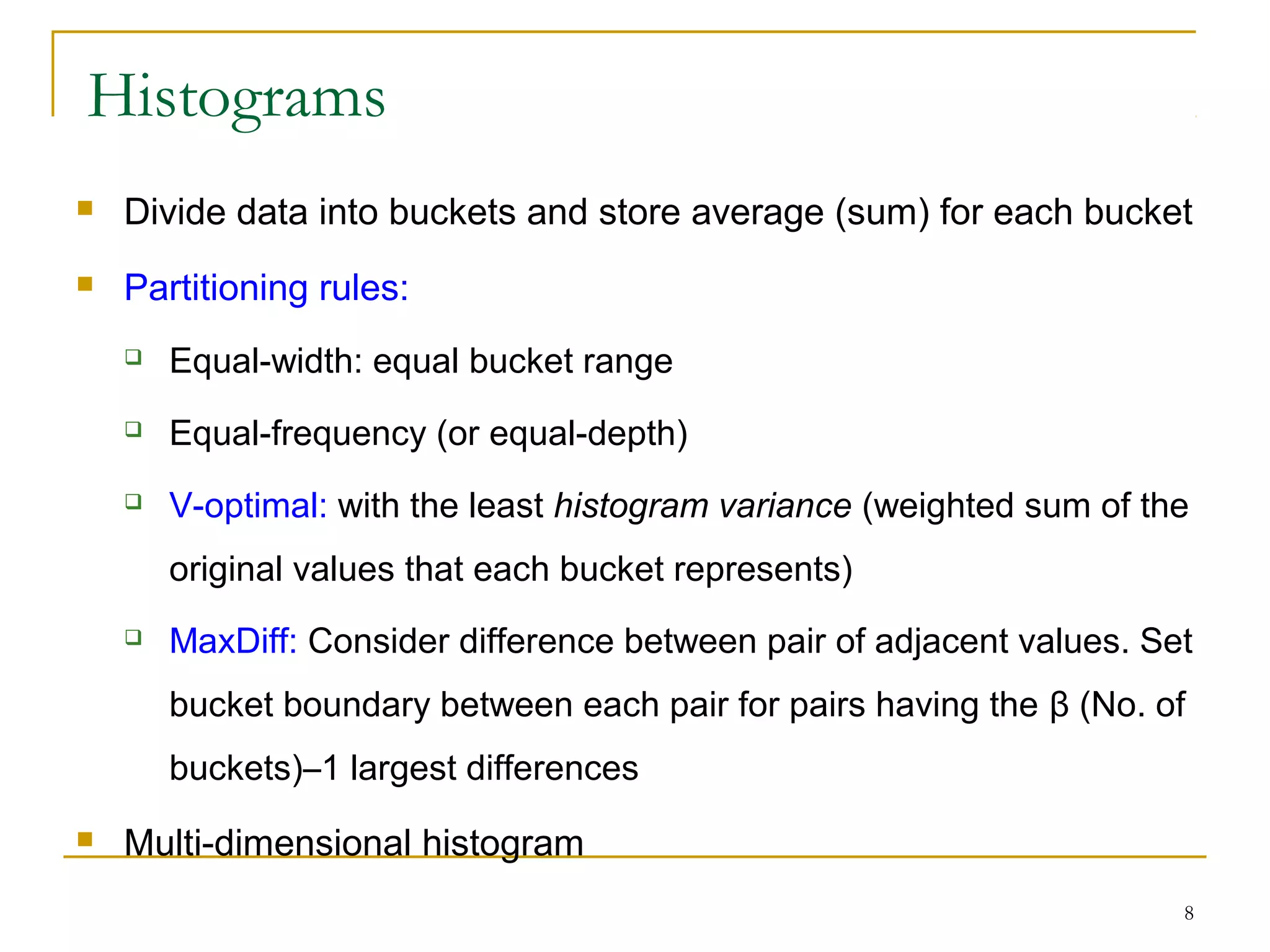
Histograms
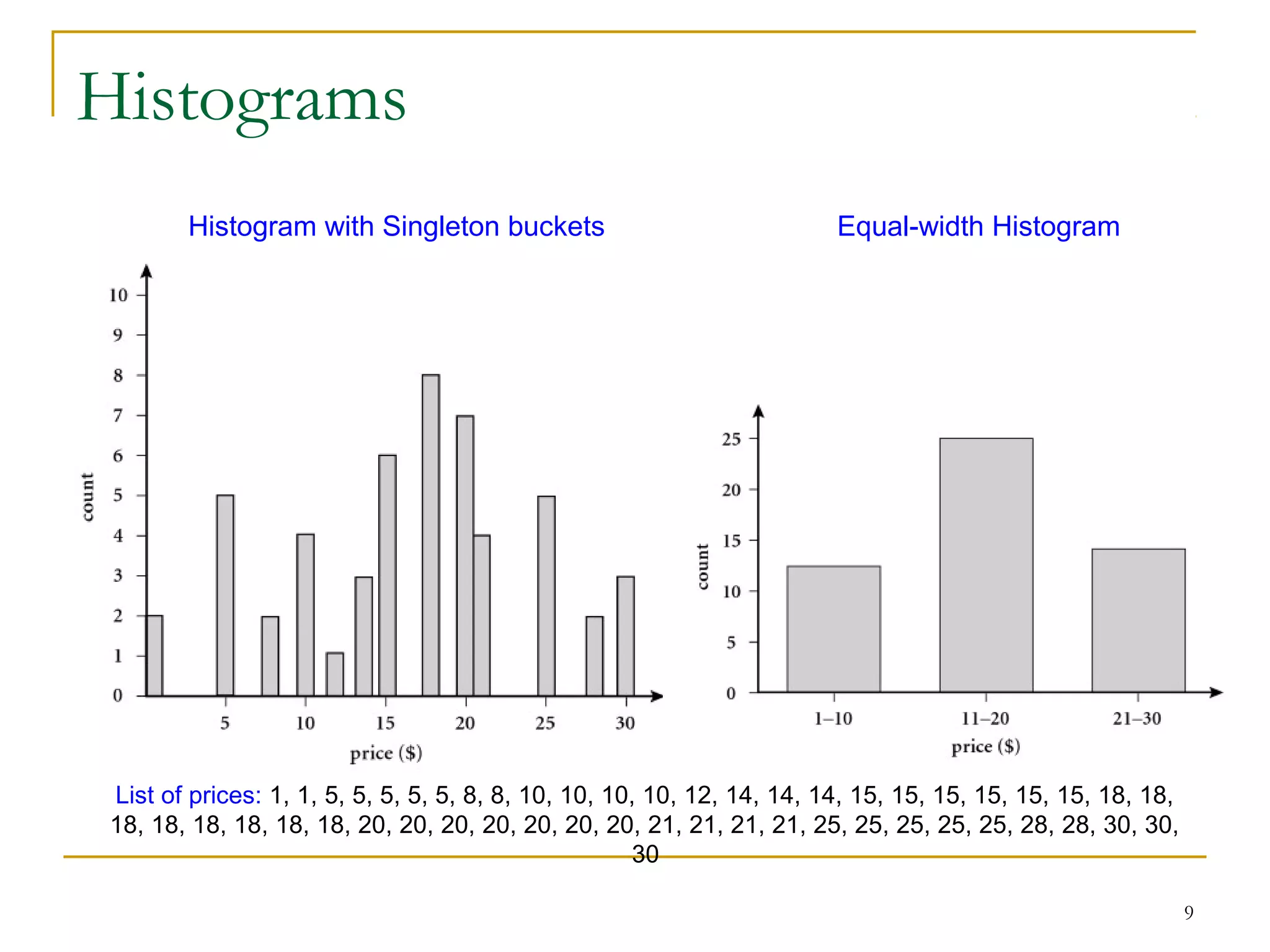
 Divide data into buckets and store average (sum) for each bucket
 Partitioning rules:
 Equal-width: equal bucket range
 Equal-frequency (or equal-depth)
 V-optimal: with the least histogram variance (weighted sum of the
original values that each bucket represents)
 MaxDiff: Consider difference between pair of adjacent values. Set
bucket boundary between each pair for pairs having the β (No. of
buckets)–1 largest differences
 Multi-dimensional histogram
Histograms
9
List of prices: 1, 1, 5, 5, 5, 5, 5, 8, 8, 10, 10, 10, 10, 12, 14, 14, 14, 15, 15, 15, 15, 15, 15, 18, 18,
18, 18, 18, 18, 18, 18, 20, 20, 20, 20, 20, 20, 20, 21, 21, 21, 21, 25, 25, 25, 25, 25, 28, 28, 30, 30,
30
Histogram with Singleton buckets Equal-width Histogram
10
Clustering
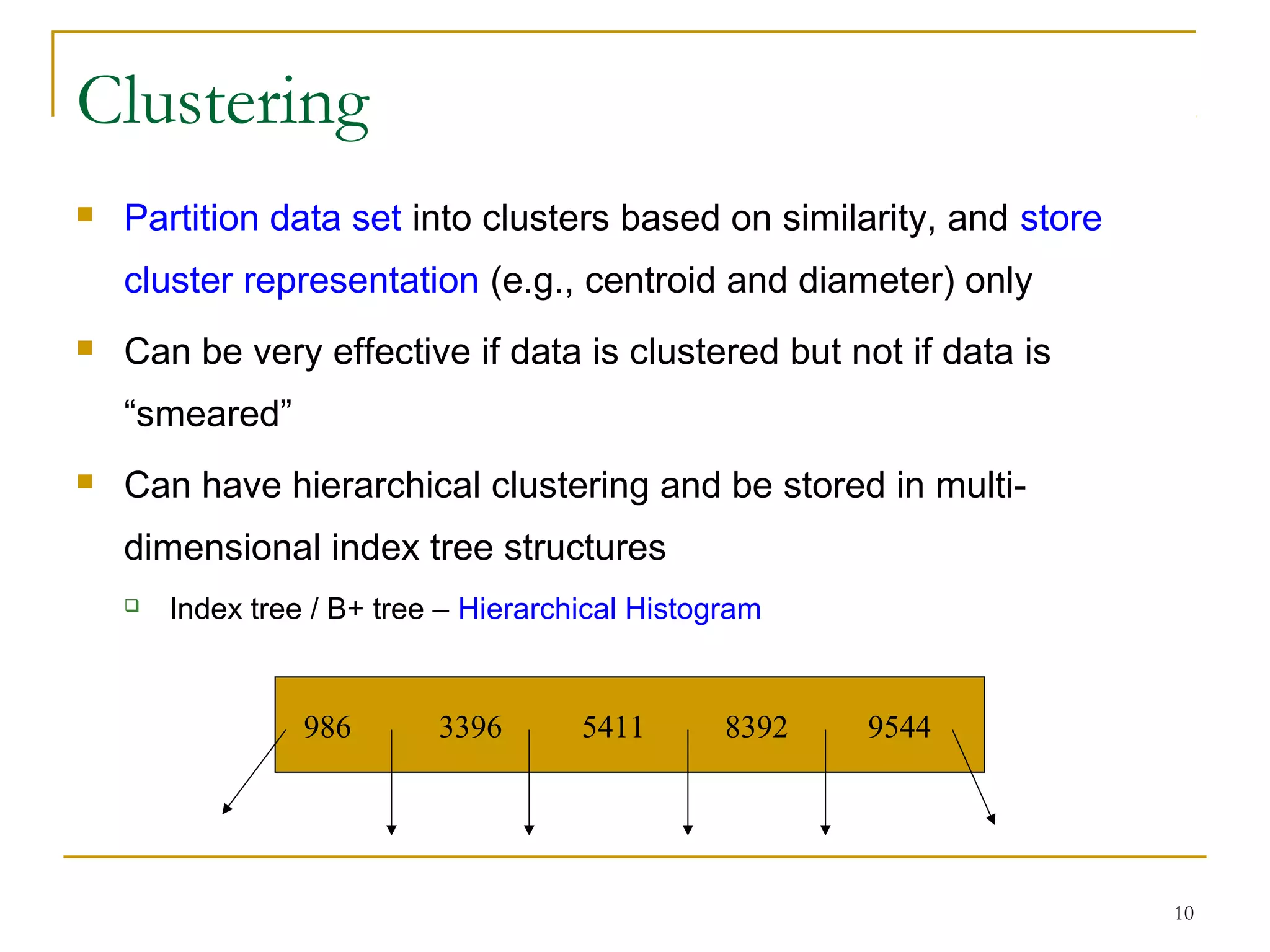
 Partition data set into clusters based on similarity, and store
cluster representation (e.g., centroid and diameter) only
 Can be very effective if data is clustered but not if data is
“smeared”
 Can have hierarchical clustering and be stored in multi-
dimensional index tree structures
 Index tree / B+ tree – Hierarchical Histogram
986 3396 5411 8392 9544
11
Sampling
 Sampling: obtaining a small sample s to represent the whole data
set N
 Allow a mining algorithm to run in complexity that is potentially
sub-linear to the size of the data
 Choose a representative subset of the data
 Simple random sampling may have very poor performance in the
presence of skew
 Develop adaptive sampling methods
 Stratified sampling
12
Sampling Techniques
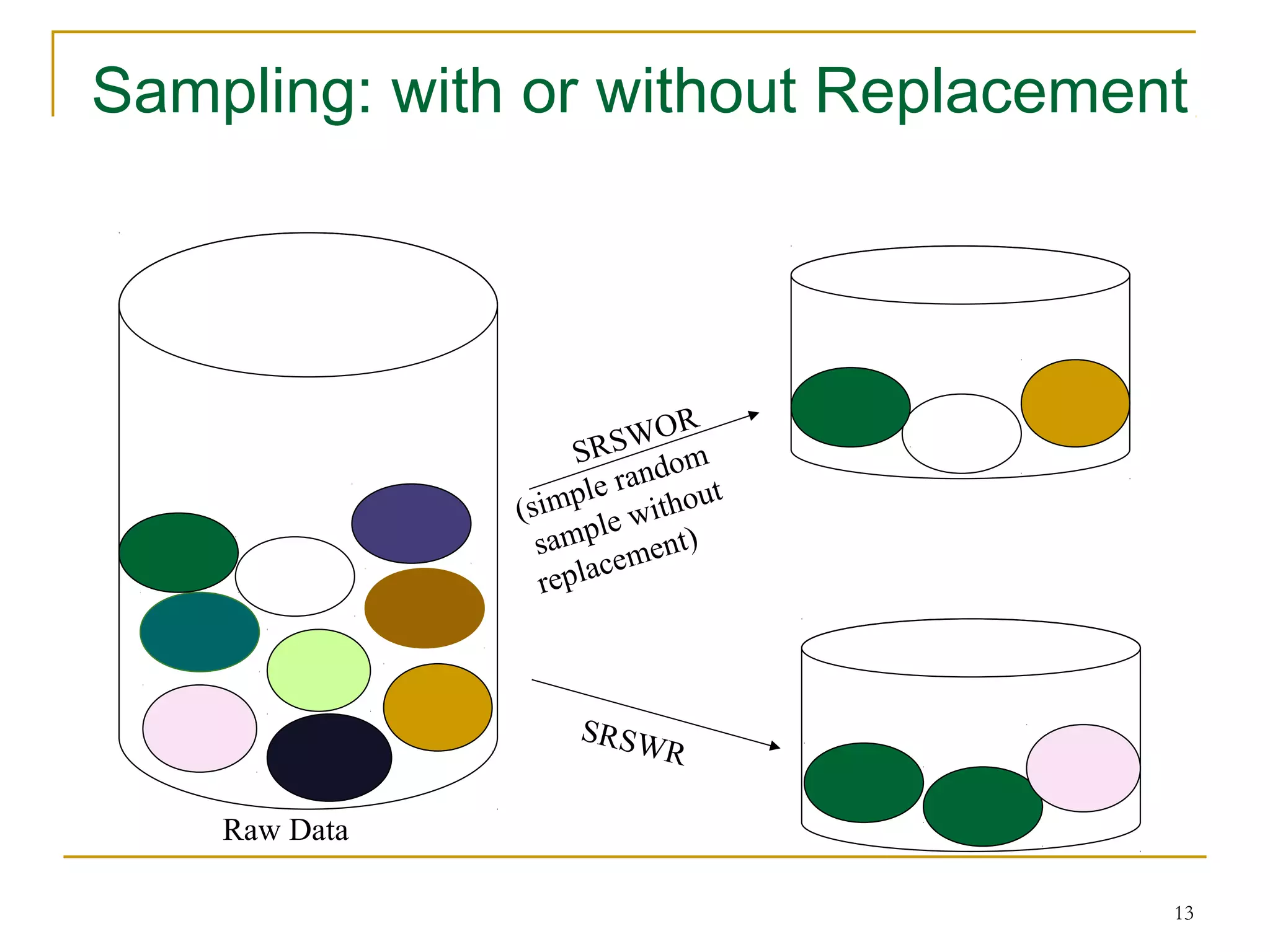
 Simple Random Sample Without Replacement (SRSWOR)
 Simple Random Sample With Replacement (SRSWR)
 Cluster Sample
 Stratified Sample
13
Sampling: with or without Replacement
SRSWOR
(simple random
sample without
replacement)
SRSWR
Raw Data
14
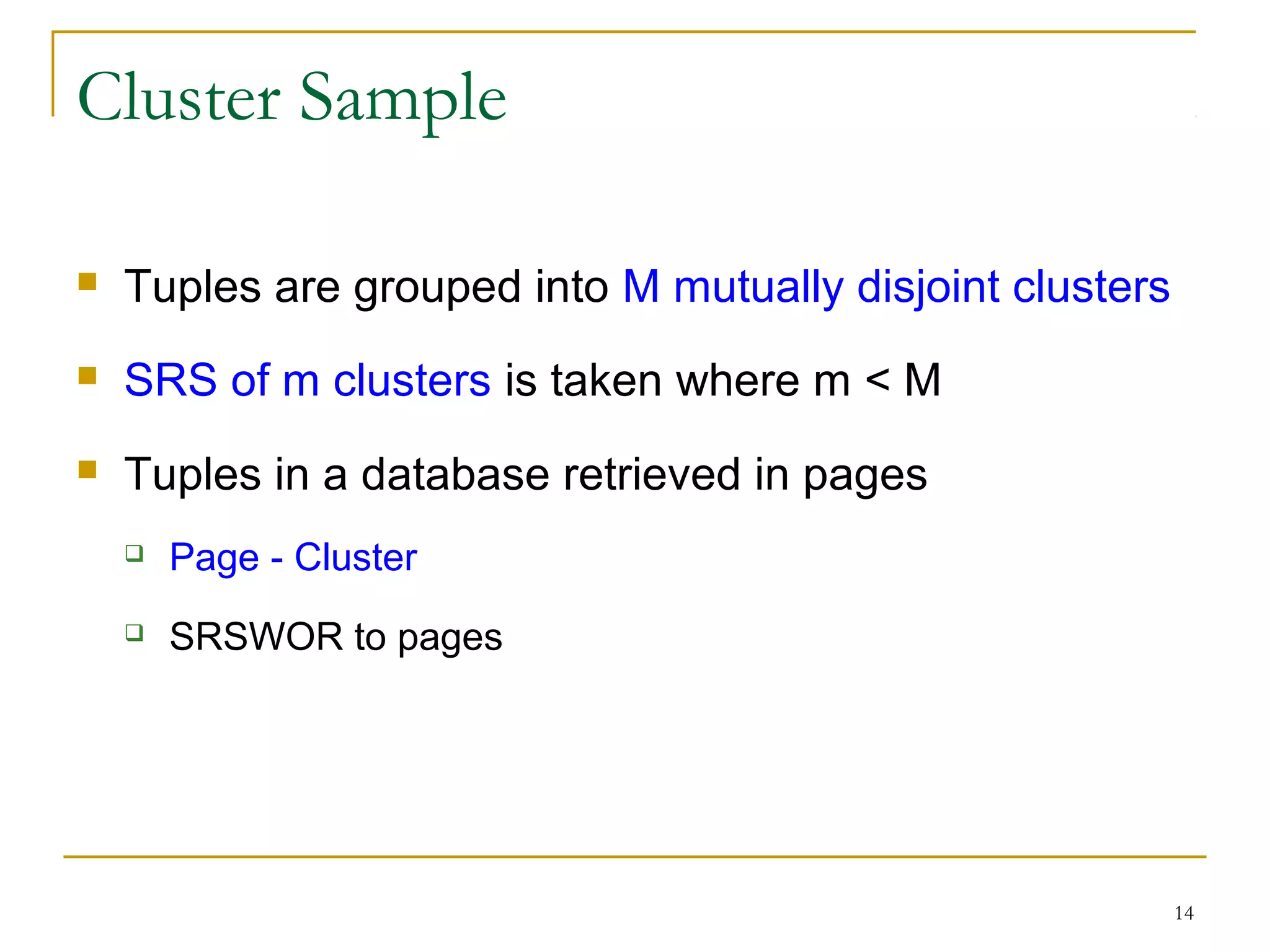
Cluster Sample
 Tuples are grouped into M mutually disjoint clusters
 SRS of m clusters is taken where m < M
 Tuples in a database retrieved in pages
 Page - Cluster
 SRSWOR to pages
15
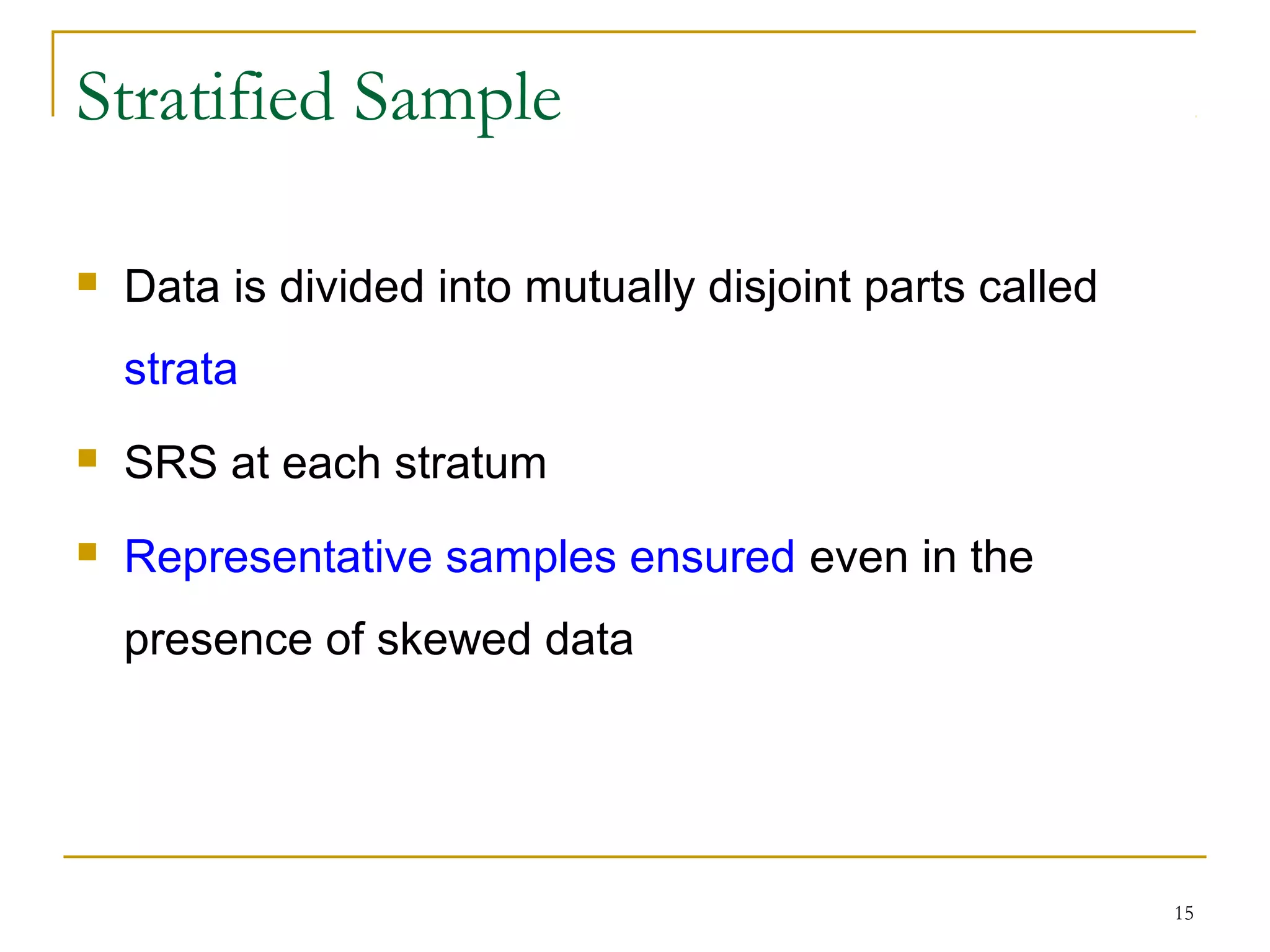
Stratified Sample
 Data is divided into mutually disjoint parts called
strata
 SRS at each stratum
 Representative samples ensured even in the
presence of skewed data
16
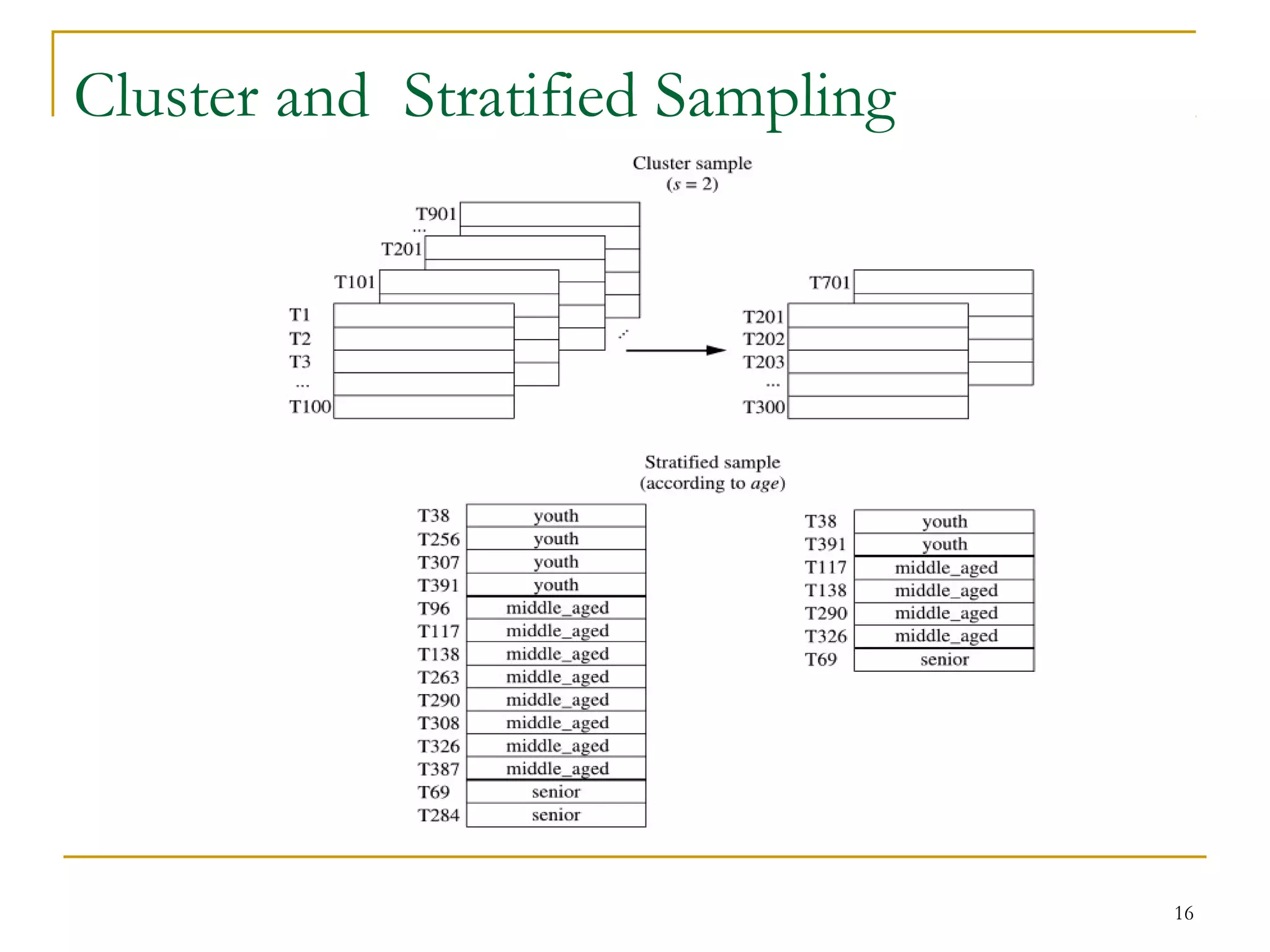
Cluster and Stratified Sampling
Raw Data
17
Features
 Cost depends on size of sample
 Sub-linear on size of data
 Linear with respect to dimensions
 Estimates answer to an aggregate query
18
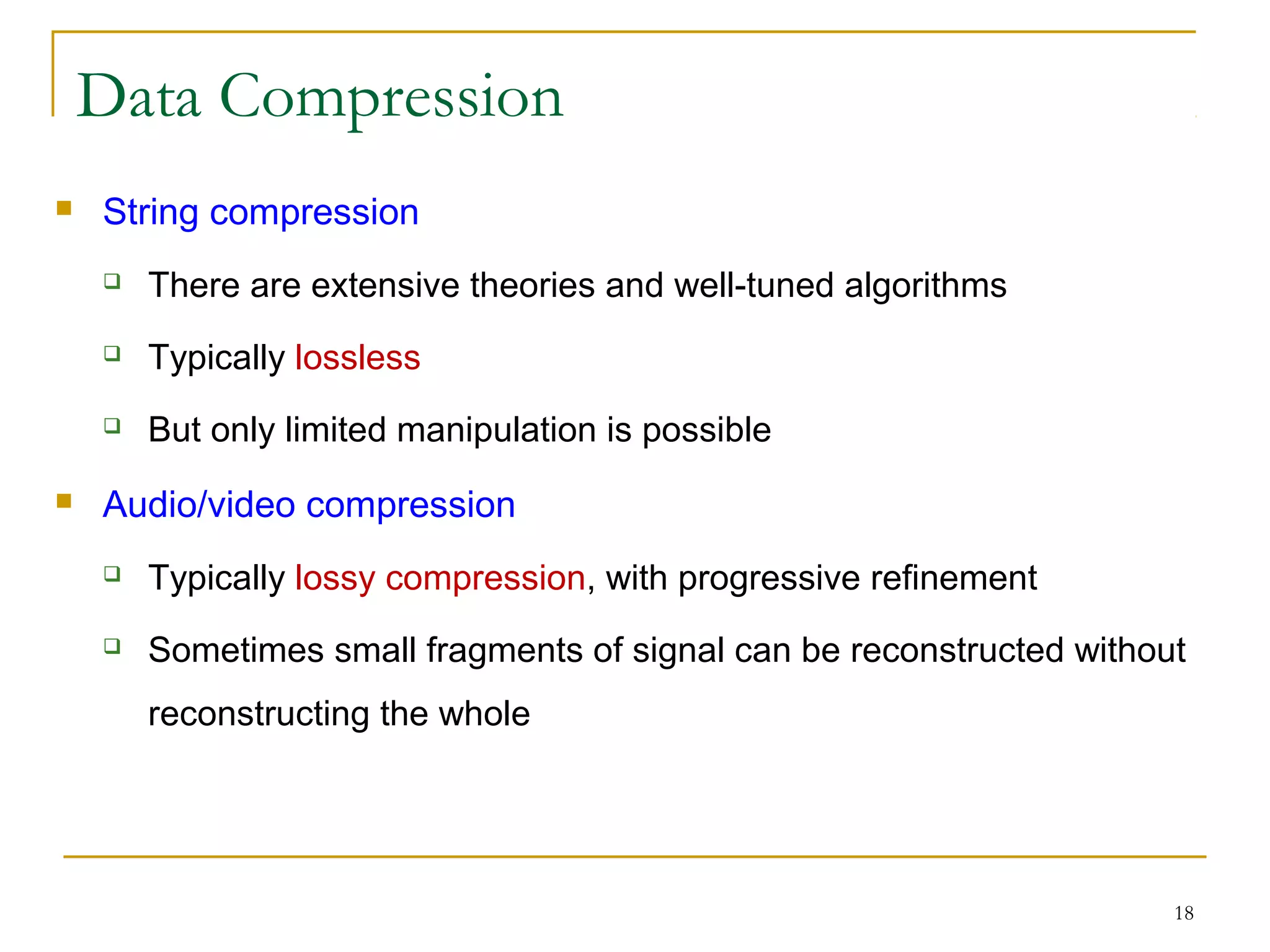
Data Compression
 String compression
 There are extensive theories and well-tuned algorithms
 Typically lossless
 But only limited manipulation is possible
 Audio/video compression
 Typically lossy compression, with progressive refinement
 Sometimes small fragments of signal can be reconstructed without
reconstructing the whole
19
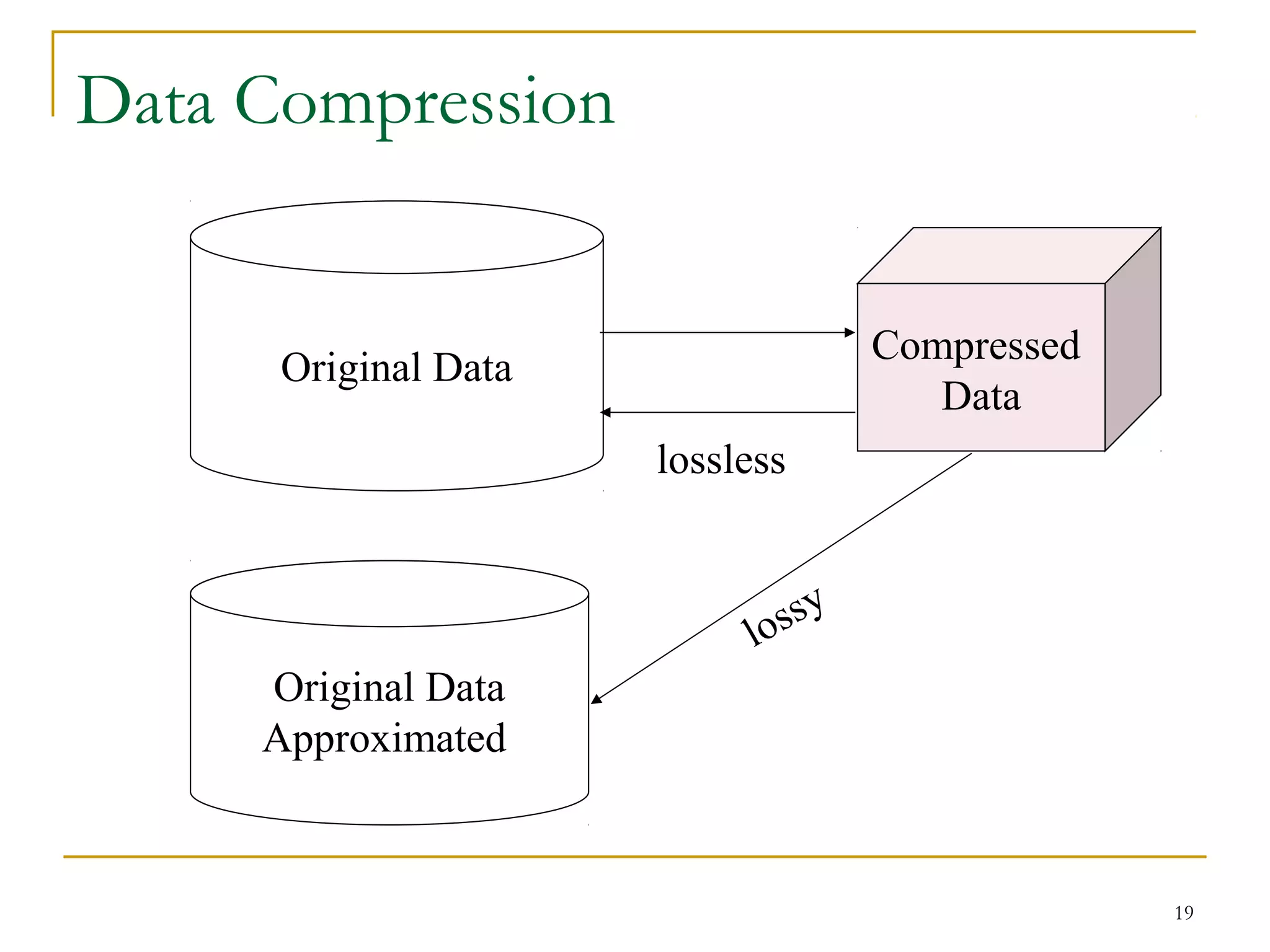
Data Compression
Original Data
Compressed
Data
lossless
Original Data
Approximated
lossy
20
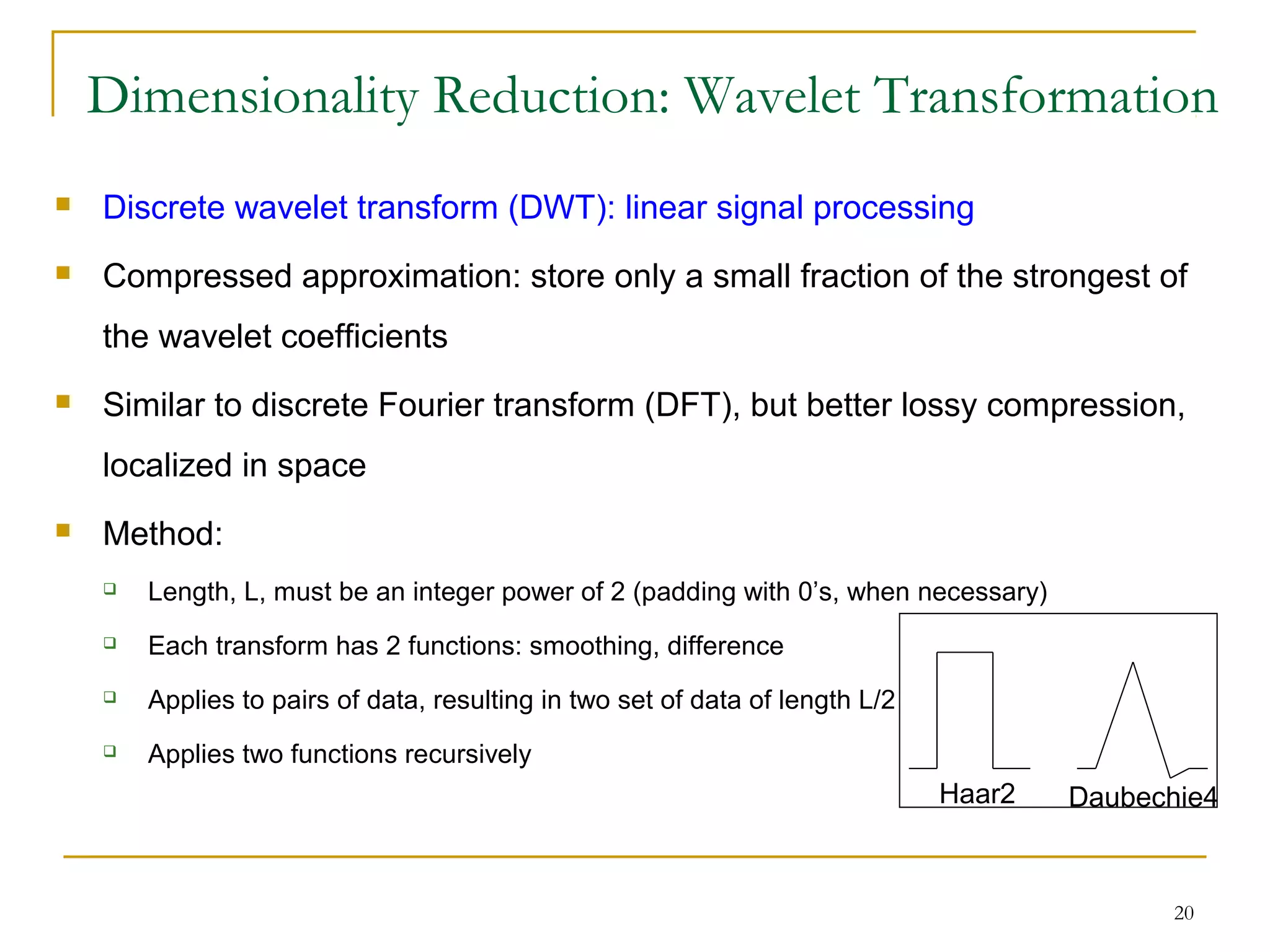
Dimensionality Reduction: Wavelet Transformation
 Discrete wavelet transform (DWT): linear signal processing
 Compressed approximation: store only a small fraction of the strongest of
the wavelet coefficients
 Similar to discrete Fourier transform (DFT), but better lossy compression,
localized in space
 Method:
 Length, L, must be an integer power of 2 (padding with 0’s, when necessary)
 Each transform has 2 functions: smoothing, difference
 Applies to pairs of data, resulting in two set of data of length L/2
 Applies two functions recursively
Haar2 Daubechie4
21
Discrete Wavelet Transform
 Can also apply Matrix Multiplication
 Fast DWT algorithm
 Can be applied to Multi-Dimensional data such as Data Cubes
 Wavelet transforms work well on sparse or skewed data
 Used in Computer Vision, Compression of finger print images
22
 Given N data vectors from k-dimensions, find c ≤ k orthogonal vectors
(Principal components) that can be best used to represent data
 Steps
 Normalize input data: Each attribute falls within the same range
 Compute c orthonormal (unit) vectors, i.e., principal components
 Each input data (vector) is a linear combination of the c principal component
vectors
 The principal components are sorted in order of decreasing “significance” or
strength
 Since the components are sorted, the size of the data can be reduced by
eliminating the weak components, i.e., those with low variance. (i.e., using the
strongest principal components, it is possible to reconstruct a good
approximation of the original data)
 Works for numeric data only
 Used for handling sparse data
Dimensionality Reduction: Principal
Component Analysis (PCA)
23
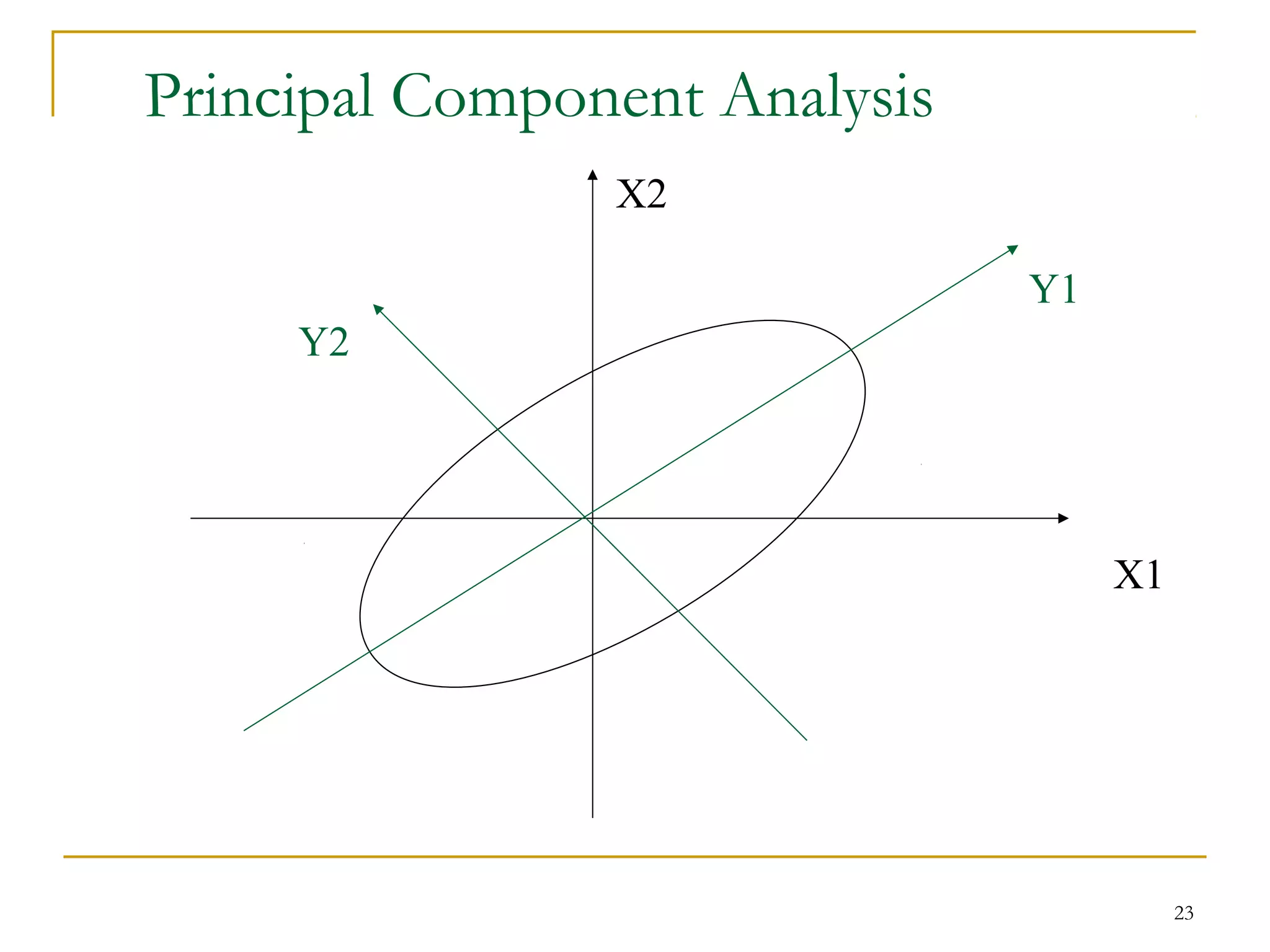
X1
X2
Y1
Y2
Principal Component Analysis

1.7 data reduction

  • 1.
  • 2.
    2 Data Reduction Strategies Need for data reduction  A database/data warehouse may store terabytes of data  Complex data analysis/mining may take a very long time to run on the complete data set  Data reduction  Obtain a reduced representation of the data set that is much smaller in volume but yet produce the same (or almost the same) analytical results  Data reduction strategies  Data cube aggregation  Attribute Subset Selection  Numerosity reduction — e.g., fit data into models  Dimensionality reduction - Data Compression  Discretization and concept hierarchy generation
  • 3.
    3 2. Attribute SubsetSelection  Feature selection (i.e., attribute subset selection):  Select a minimum set of features such that the probability distribution of different classes given the values for those features is as close as possible to the original distribution given the values of all features  reduce # of patterns - easier to understand  Heuristic methods (due to exponential # of choices):  Step-wise forward selection  Step-wise backward elimination  Combining forward selection and backward elimination  Decision-tree induction
  • 4.
    4 Example of DecisionTree Induction Initial attribute set: {A1, A2, A3, A4, A5, A6} A4 ? A1? A6? Class 1 Class 2 Class 1 Class 2 > Reduced attribute set: {A1, A4, A6}
  • 5.
    5 Heuristic Feature SelectionMethods  There are 2d possible sub-features of d features  Several heuristic feature selection methods:  Best single features under the feature independence assumption: choose by significance tests  Best step-wise feature selection  The best single-feature is picked first  Then next best feature condition to the first, ...  Step-wise feature elimination  Repeatedly eliminate the worst feature  Best combined feature selection and elimination
  • 6.
    6 3. Numerosity Reduction Reduce data volume by choosing alternative, smaller forms of data representation  Parametric methods  Assume the data fits some model, estimate model parameters, store only the parameters, and discard the data (except possible outliers)  Example: Log-linear models, Regression  Non-parametric methods  Do not assume models  Major families: histograms, clustering, sampling
  • 7.
    7  Regression  Handlesskewed data  Computationally Intensive  Log linear models  Scalability  Estimate the probability of each point in a multi-dimensional space based on a smaller subset  Can construct higher dimensional spaces from lower dimensional ones  Both  Sparse data Regression and Log-Linear Models
  • 8.
    8 Histograms  Divide datainto buckets and store average (sum) for each bucket  Partitioning rules:  Equal-width: equal bucket range  Equal-frequency (or equal-depth)  V-optimal: with the least histogram variance (weighted sum of the original values that each bucket represents)  MaxDiff: Consider difference between pair of adjacent values. Set bucket boundary between each pair for pairs having the β (No. of buckets)–1 largest differences  Multi-dimensional histogram
  • 9.
    Histograms 9 List of prices:1, 1, 5, 5, 5, 5, 5, 8, 8, 10, 10, 10, 10, 12, 14, 14, 14, 15, 15, 15, 15, 15, 15, 18, 18, 18, 18, 18, 18, 18, 18, 20, 20, 20, 20, 20, 20, 20, 21, 21, 21, 21, 25, 25, 25, 25, 25, 28, 28, 30, 30, 30 Histogram with Singleton buckets Equal-width Histogram
  • 10.
    10 Clustering  Partition dataset into clusters based on similarity, and store cluster representation (e.g., centroid and diameter) only  Can be very effective if data is clustered but not if data is “smeared”  Can have hierarchical clustering and be stored in multi- dimensional index tree structures  Index tree / B+ tree – Hierarchical Histogram 986 3396 5411 8392 9544
  • 11.
    11 Sampling  Sampling: obtaininga small sample s to represent the whole data set N  Allow a mining algorithm to run in complexity that is potentially sub-linear to the size of the data  Choose a representative subset of the data  Simple random sampling may have very poor performance in the presence of skew  Develop adaptive sampling methods  Stratified sampling
  • 12.
    12 Sampling Techniques  SimpleRandom Sample Without Replacement (SRSWOR)  Simple Random Sample With Replacement (SRSWR)  Cluster Sample  Stratified Sample
  • 13.
    13 Sampling: with orwithout Replacement SRSWOR (simple random sample without replacement) SRSWR Raw Data
  • 14.
    14 Cluster Sample  Tuplesare grouped into M mutually disjoint clusters  SRS of m clusters is taken where m < M  Tuples in a database retrieved in pages  Page - Cluster  SRSWOR to pages
  • 15.
    15 Stratified Sample  Datais divided into mutually disjoint parts called strata  SRS at each stratum  Representative samples ensured even in the presence of skewed data
  • 16.
    16 Cluster and StratifiedSampling Raw Data
  • 17.
    17 Features  Cost dependson size of sample  Sub-linear on size of data  Linear with respect to dimensions  Estimates answer to an aggregate query
  • 18.
    18 Data Compression  Stringcompression  There are extensive theories and well-tuned algorithms  Typically lossless  But only limited manipulation is possible  Audio/video compression  Typically lossy compression, with progressive refinement  Sometimes small fragments of signal can be reconstructed without reconstructing the whole
  • 19.
  • 20.
    20 Dimensionality Reduction: WaveletTransformation  Discrete wavelet transform (DWT): linear signal processing  Compressed approximation: store only a small fraction of the strongest of the wavelet coefficients  Similar to discrete Fourier transform (DFT), but better lossy compression, localized in space  Method:  Length, L, must be an integer power of 2 (padding with 0’s, when necessary)  Each transform has 2 functions: smoothing, difference  Applies to pairs of data, resulting in two set of data of length L/2  Applies two functions recursively Haar2 Daubechie4
  • 21.
    21 Discrete Wavelet Transform Can also apply Matrix Multiplication  Fast DWT algorithm  Can be applied to Multi-Dimensional data such as Data Cubes  Wavelet transforms work well on sparse or skewed data  Used in Computer Vision, Compression of finger print images
  • 22.
    22  Given Ndata vectors from k-dimensions, find c ≤ k orthogonal vectors (Principal components) that can be best used to represent data  Steps  Normalize input data: Each attribute falls within the same range  Compute c orthonormal (unit) vectors, i.e., principal components  Each input data (vector) is a linear combination of the c principal component vectors  The principal components are sorted in order of decreasing “significance” or strength  Since the components are sorted, the size of the data can be reduced by eliminating the weak components, i.e., those with low variance. (i.e., using the strongest principal components, it is possible to reconstruct a good approximation of the original data)  Works for numeric data only  Used for handling sparse data Dimensionality Reduction: Principal Component Analysis (PCA)
  • 23.