By,
S. Moni Sindhu
 Collection of conceptual tools for describing data, data
relationships, data semantics and consistency
constraint.
 Conceptual representation of data structures required
for database
 Model for data management where the
databases are developed according to user's
preferences, in order to be used for specific
types of retrievals.
 Multidimensional database (MDB) is mainly
optimized for data warehouse and online
analytical processing (OLAP) applications
 Multidimensional data-base technology is a
key factor in the interactive analysis of large
amounts of data for decision-making
purposes
 MDB mainly useful for sales and marketing
applications that involve time series.
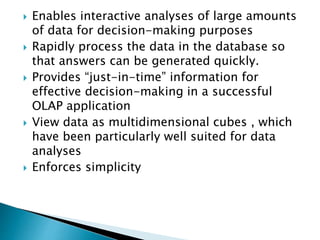
 Enables interactive analyses of large amounts
of data for decision-making purposes
 Rapidly process the data in the database so
that answers can be generated quickly.
 Provides “just-in-time” information for
effective decision-making in a successful
OLAP application
 View data as multidimensional cubes , which
have been particularly well suited for data
analyses
 Enforces simplicity
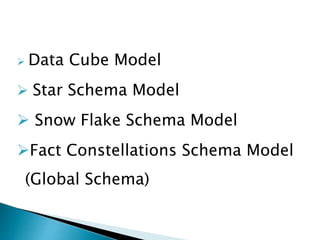
 Data Cube Model
 Star Schema Model
 Snow Flake Schema Model
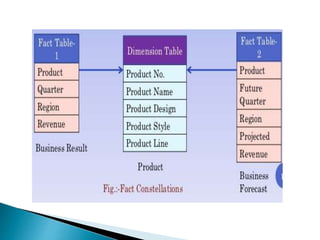
Fact Constellations Schema Model
(Global Schema)
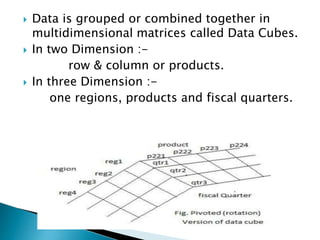
 Data is grouped or combined together in
multidimensional matrices called Data Cubes.
 In two Dimension :-
row & column or products.
 In three Dimension :-
one regions, products and fiscal quarters.
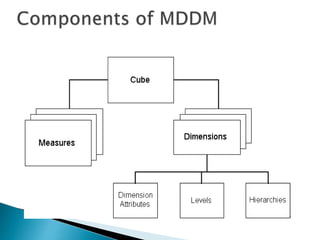
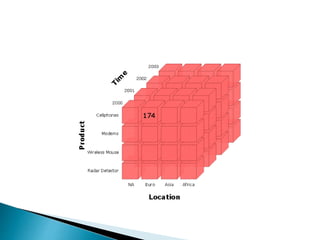
 data cubes have categories of data called
dimensions and measures.
 measure
◦ represents some fact (or number) such as cost or
units of service.
 dimension
◦ represents descriptive categories of data such as
time or location.
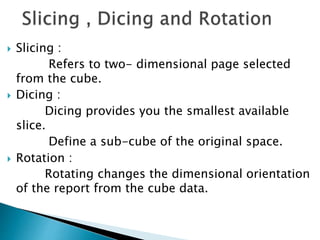
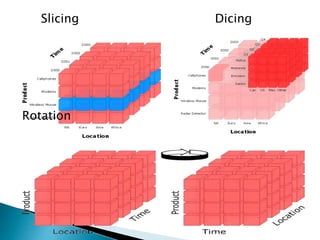
 Slicing :
Refers to two- dimensional page selected
from the cube.
 Dicing :
Dicing provides you the smallest available
slice.
Define a sub-cube of the original space.
 Rotation :
Rotating changes the dimensional orientation
of the report from the cube data.
Slicing Dicing
Rotation
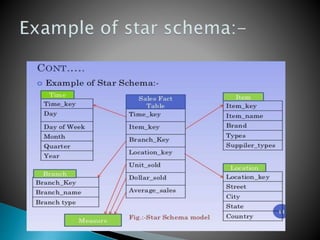
 It is the simplest form of data warehousing
schema.
 It consists one large central table (fact)
containing the bulk of data and a set of
smaller dimension tables one for each
dimension .
 Its entity relationship diagram between
dimensions and fact table resembles a star
where one fact table is connected to multiple
dimensions or table.
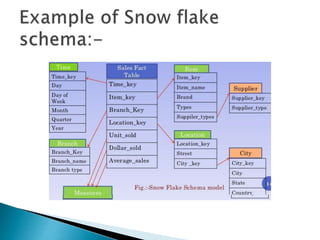
 It is difficult from a star schema .
 In this dimensional table are organized into
hierarchy by normalization them.
 The Snow Flake Schema is represented by
centralized fact table which are connected to
multiple dimensions.
 It is a set of fact tables that shares some
dimensional tables.
 It limits the possible queries for the data
warehouse.
multi dimensional data model

multi dimensional data model

  • 1.
  • 3.
     Collection ofconceptual tools for describing data, data relationships, data semantics and consistency constraint.  Conceptual representation of data structures required for database
  • 5.
     Model fordata management where the databases are developed according to user's preferences, in order to be used for specific types of retrievals.  Multidimensional database (MDB) is mainly optimized for data warehouse and online analytical processing (OLAP) applications
  • 6.
     Multidimensional data-basetechnology is a key factor in the interactive analysis of large amounts of data for decision-making purposes  MDB mainly useful for sales and marketing applications that involve time series.
  • 8.
     Enables interactiveanalyses of large amounts of data for decision-making purposes  Rapidly process the data in the database so that answers can be generated quickly.  Provides “just-in-time” information for effective decision-making in a successful OLAP application  View data as multidimensional cubes , which have been particularly well suited for data analyses  Enforces simplicity
  • 11.
     Data CubeModel  Star Schema Model  Snow Flake Schema Model Fact Constellations Schema Model (Global Schema)
  • 13.
     Data isgrouped or combined together in multidimensional matrices called Data Cubes.  In two Dimension :- row & column or products.  In three Dimension :- one regions, products and fiscal quarters.
  • 14.
     data cubeshave categories of data called dimensions and measures.  measure ◦ represents some fact (or number) such as cost or units of service.  dimension ◦ represents descriptive categories of data such as time or location.
  • 16.
     Slicing : Refersto two- dimensional page selected from the cube.  Dicing : Dicing provides you the smallest available slice. Define a sub-cube of the original space.  Rotation : Rotating changes the dimensional orientation of the report from the cube data.
  • 17.
  • 19.
     It isthe simplest form of data warehousing schema.  It consists one large central table (fact) containing the bulk of data and a set of smaller dimension tables one for each dimension .  Its entity relationship diagram between dimensions and fact table resembles a star where one fact table is connected to multiple dimensions or table.
  • 22.
     It isdifficult from a star schema .  In this dimensional table are organized into hierarchy by normalization them.  The Snow Flake Schema is represented by centralized fact table which are connected to multiple dimensions.
  • 25.
     It isa set of fact tables that shares some dimensional tables.  It limits the possible queries for the data warehouse.

Editor's Notes

  • #10 Helps Analysts to know which business measures they are interested in examining, which dimensions and attributes make the data meaningful, and how the dimensions of their business are organized into levels and hierarchies.