CSCE 411H
Design and Analysis of
Algorithms
Set 8: Greedy Algorithms
Prof. Evdokia Nikolova*
Spring 2013
CSCE 411H, Spring 2013: Set 8 1
* Slides adapted from Prof. Jennifer Welch
CSCE 411H, Spring 2013: Set 8 2
Greedy Algorithm Paradigm
 Characteristics of greedy algorithms:
 make a sequence of choices
 each choice is the one that seems best so far, only
depends on what's been done so far
 choice produces a smaller problem to be solved
 In order for greedy heuristic to solve the
problem, it must be that the optimal solution
to the big problem contains optimal solutions
to subproblems
CSCE 411H, Spring 2013: Set 8 3
Designing a Greedy Algorithm
 Cast the problem so that we make a greedy (locally
optimal) choice and are left with one subproblem
 Prove there is always a (globally) optimal solution to
the original problem that makes the greedy choice
 Show that the choice together with an optimal
solution to the subproblem gives an optimal solution
to the original problem
CSCE 411H, Spring 2013: Set 8 4
Some Greedy Algorithms
 fractional knapsack algorithm
 Huffman codes
 Kruskal's MST algorithm
 Prim's MST algorithm
 Dijkstra's SSSP algorithm
 …
CSCE 411H, Spring 2013: Set 8 5
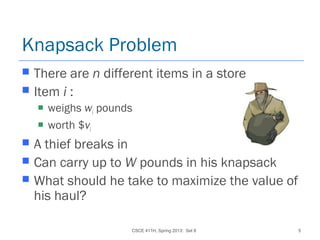
Knapsack Problem
 There are n different items in a store
 Item i :
 weighs wi pounds
 worth $vi
 A thief breaks in
 Can carry up to W pounds in his knapsack
 What should he take to maximize the value of
his haul?
CSCE 411H, Spring 2013: Set 8 6
0-1 vs. Fractional Knapsack
 0-1 Knapsack Problem:
 the items cannot be divided
 thief must take entire item or leave it behind
 Fractional Knapsack Problem:
 thief can take partial items
 for instance, items are liquids or powders
 solvable with a greedy algorithm…
CSCE 411H, Spring 2013: Set 8 7
Greedy Fractional Knapsack
Algorithm
 Sort items in decreasing order of value per
pound
 While still room in the knapsack (limit of W
pounds) do
 consider next item in sorted list
 take as much as possible (all there is or as much
as will fit)
 O(n log n) running time (for the sort)
CSCE 411H, Spring 2013: Set 8 8
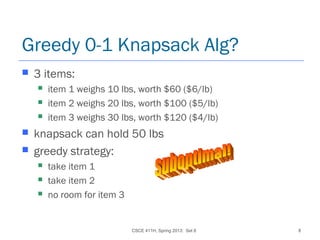
Greedy 0-1 Knapsack Alg?
 3 items:
 item 1 weighs 10 lbs, worth $60 ($6/lb)
 item 2 weighs 20 lbs, worth $100 ($5/lb)
 item 3 weighs 30 lbs, worth $120 ($4/lb)
 knapsack can hold 50 lbs
 greedy strategy:
 take item 1
 take item 2
 no room for item 3
CSCE 411H, Spring 2013: Set 8 9
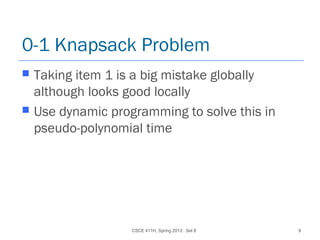
0-1 Knapsack Problem
 Taking item 1 is a big mistake globally
although looks good locally
 Use dynamic programming to solve this in
pseudo-polynomial time
CSCE 411H, Spring 2013: Set 8 10
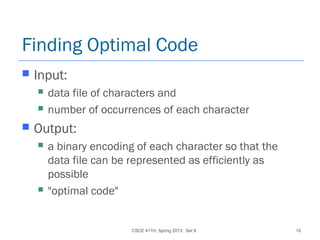
Finding Optimal Code
 Input:
 data file of characters and
 number of occurrences of each character
 Output:
 a binary encoding of each character so that the
data file can be represented as efficiently as
possible
 "optimal code"
CSCE 411H, Spring 2013: Set 8 11
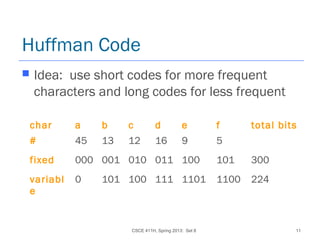
Huffman Code
 Idea: use short codes for more frequent
characters and long codes for less frequent
char a b c d e f total bits
# 45 13 12 16 9 5
fixed 000 001 010 011 100 101 300
variabl
e
0 101 100 111 1101 1100 224
CSCE 411H, Spring 2013: Set 8 12
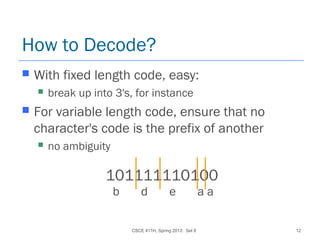
How to Decode?
 With fixed length code, easy:
 break up into 3's, for instance
 For variable length code, ensure that no
character's code is the prefix of another
 no ambiguity
101111110100
b d e a a
CSCE 411H, Spring 2013: Set 8 13
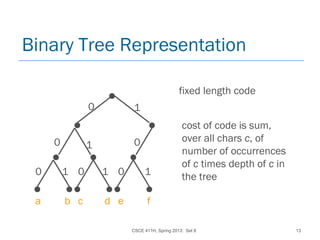
Binary Tree Representation
0 1
0 1 0
0 1 0 1 0 1
a b c d e f
fixed length code
cost of code is sum,
over all chars c, of
number of occurrences
of c times depth of c in
the tree
CSCE 411H, Spring 2013: Set 8 14
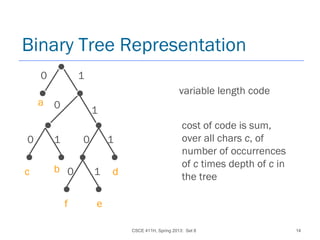
0 1
f e
Binary Tree Representation
10
0
1
0 1 0 1
a
bc d
variable length code
cost of code is sum,
over all chars c, of
number of occurrences
of c times depth of c in
the tree
CSCE 411H, Spring 2013: Set 8 15
Algorithm to Construct Tree
Representing Huffman Code
 Given set C of n chars, c occurs f[c] times
 insert each c into priority queue Q using f[c] as key
 for i := 1 to n-1 do
 x := extract-min(Q)
 y := extract-min(Q)
 make a new node z w/ left child x (label edge 0), right child y
(label edge 1), and f[z] = f[x] + f[y]
 insert z into Q
CSCE 411H, Spring 2013: Set 8 16
<board work>
CSCE 411H, Spring 2013: Set 8 17
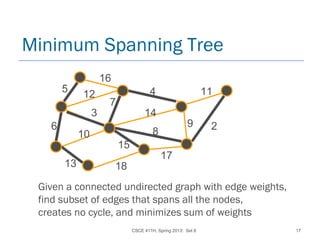
Minimum Spanning Tree
7
16
45
6
8
11
15
14
17
10
13
3
12
29
18
Given a connected undirected graph with edge weights,
find subset of edges that spans all the nodes,
creates no cycle, and minimizes sum of weights
CSCE 411H, Spring 2013: Set 8 18
Facts About MSTs
 There can be many spanning trees of a graph
 In fact, there can be many minimum spanning
trees of a graph
 But if every edge has a unique weight, then
there is a unique MST
CSCE 411H, Spring 2013: Set 8 19
Uniqueness of MST
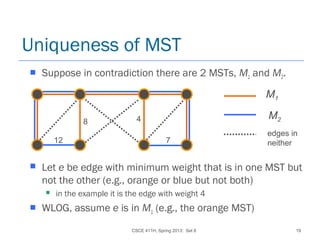
 Suppose in contradiction there are 2 MSTs, M1 and M2.
 Let e be edge with minimum weight that is in one MST but
not the other (e.g., orange or blue but not both)
 in the example it is the edge with weight 4
 WLOG, assume e is in M1 (e.g., the orange MST)
M1
M2
edges in
neither12
8 4
7
CSCE 411H, Spring 2013: Set 8 20
Uniqueness of MST
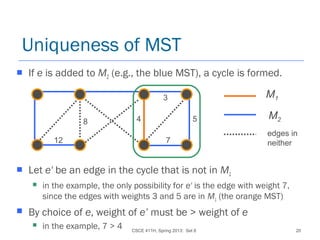
 If e is added to M2 (e.g., the blue MST), a cycle is formed.
 Let e' be an edge in the cycle that is not in M1
 in the example, the only possibility for e' is the edge with weight 7,
since the edges with weights 3 and 5 are in M1 (the orange MST)
 By choice of e, weight of e’ must be > weight of e
 in the example, 7 > 4
M1
M2
edges in
neither12
8 4
7
3
5
CSCE 411H, Spring 2013: Set 8 21
Uniqueness of MST
 Replacing e with e' in M2 creates a new MST M3 whose
weight is less than that of M2
 in the example, replace edge with weight 7 in blue MST by edge with
weight 4
 Result is a new spanning tree, M3, whose weight is less
than that of M2!
M3
edges not
in M3
12
8 4
7
3
5
CSCE 411H, Spring 2013: Set 8 22
Generic MST Algorithm
 input: weighted undirected graph
G = (V,E,w)
 T := empty set
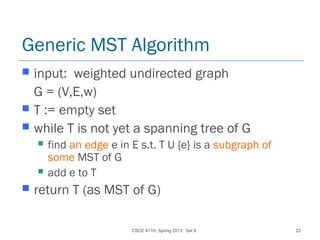
 while T is not yet a spanning tree of G
 find an edge e in E s.t. T U {e} is a subgraph of
some MST of G
 add e to T
 return T (as MST of G)
CSCE 411H, Spring 2013: Set 8 23
Kruskal's MST algorithm
7
16
45
6
8
11
15
14
17
10
13
3
12
29
18
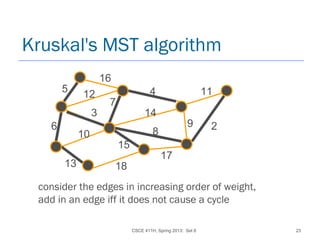
consider the edges in increasing order of weight,
add in an edge iff it does not cause a cycle
CSCE 411H, Spring 2013: Set 8 24
Kruskal's Algorithm as a Special
Case of Generic Algorithm
 Consider edges in increasing order of weight
 Add the next edge iff it doesn't cause a cycle
 At any point, T is a forest (set of trees);
eventually T is a single tree
CSCE 411H, Spring 2013: Set 8 25
Why is Kruskal's Greedy?
 Algorithm manages a set of edges s.t.
 these edges are a subset of some MST
 At each iteration:
 choose an edge so that the MST-subset property
remains true
 subproblem left is to do the same with the remaining
edges
 Always try to add cheapest available edge that will
not violate the tree property
 locally optimal choice
CSCE 411H, Spring 2013: Set 8 26
Correctness of Kruskal's Alg.
 Let e1, e2, …, en-1 be sequence of edges chosen
 Clearly they form a spanning tree
 Suppose it is not minimum weight
 Let ei be the edge where the algorithm goes
wrong
 {e1,…,ei-1} is part of some MST M
 but {e1,…,ei} is not part of any MST
CSCE 411H, Spring 2013: Set 8 27
Correctness of Kruskal's Alg.
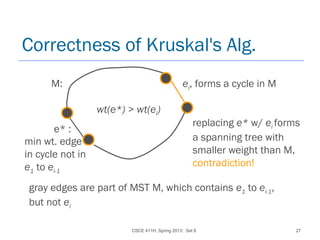
gray edges are part of MST M, which contains e1 to ei-1,
but not ei
M: ei, forms a cycle in M
e* :
min wt. edge
in cycle not in
e1 to ei-1
replacing e* w/ ei forms
a spanning tree with
smaller weight than M,
contradiction!
wt(e*) > wt(ei)
CSCE 411H, Spring 2013: Set 8 28
Note on Correctness Proof
 Argument on previous slide works for case
when every edge has a unique weight
 Algorithm also works when edge weights are
not necessarily unique
 Modify proof on previous slide: contradiction
is reached to assumption that ei is not part of
any MST
CSCE 411H, Spring 2013: Set 8 29
Implementing Kruskal's Alg.
 Sort edges by weight
 efficient algorithms known
 How to test quickly if adding in the next edge
would cause a cycle?
 use disjoint set data structure!
CSCE 411H, Spring 2013: Set 8 30
Running Time of Kruskal's
Algorithm
 |V| Make-Sets, one per node
 2|E| Find-Sets, two per edge
 |V| - 1 Unions, since spanning tree has |V| - 1
edges in it
 So sequence of O(E) operations, |V| of which are
Make-Sets
 Time for Disjoint Sets ops is O(E log*V)
 Dominated by time to sort the edges, which is
O(E log E) = O(E log V).
CSCE 411H, Spring 2013: Set 8 31
Another Greedy MST Alg.
 Kruskal's algorithm maintains a forest that
grows until it forms a spanning tree
 Alternative idea is keep just one tree and
grow it until it spans all the nodes
 Prim's algorithm
 At each iteration, choose the minimum weight
outgoing edge to add
 greedy!
CSCE 411H, Spring 2013: Set 8 32
Idea of Prim's Algorithm
 Instead of growing the MST as possibly
multiple trees that eventually all merge, grow
the MST from a single vertex, so that there is
only one tree at any point.
 Also a special case of the generic algorithm:
at each step, add the minimum weight edge
that goes out from the tree constructed so
far.
CSCE 411H, Spring 2013: Set 8 33
Prim's Algorithm
 input: weighted undirected graph G = (V,E,w)
 T := empty set
 S := {any vertex in V}
 while |T| < |V| - 1 do
 let (u,v) be a min wt. outgoing edge (u in S, v not in S)
 add (u,v) to T
 add v to S
 return (S,T) (as MST of G)
CSCE 411H, Spring 2013: Set 8 34
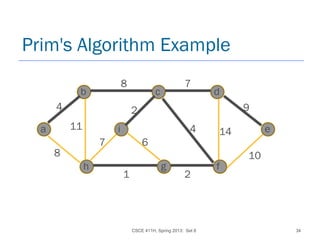
Prim's Algorithm Example
a
b
h
i
c
g
d
f
e
4
8 7
8
11
2
7 6
1 2
4 14
9
10
CSCE 411H, Spring 2013: Set 8 35
Correctness of Prim's Algorithm
 Let Ti be the tree represented by (S,T) at the
end of iteration i.
 Show by induction on i that Ti is a subtree of
some MST of G.
 Basis: i = 0 (before first iteration). T0
contains just a single vertex, and thus is a
subtree of every MST of G.
CSCE 411H, Spring 2013: Set 8 36
Correctness of Prim's Algorithm
 Induction: Assume Ti is a subtree of some
MST M. We must show Ti+1 is a subtree of
some MST.
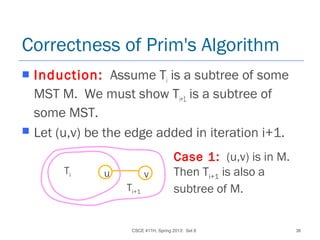
 Let (u,v) be the edge added in iteration i+1.
u vTi
Ti+1
Case 1: (u,v) is in M.
Then Ti+1 is also a
subtree of M.
CSCE 411H, Spring 2013: Set 8 37
Correctness of Prim's Algorithm
Case 2: (u,v) is not in M.
 There is a path P in M from u to v, since M spans G.
 Let (x,y) be the first edge in P with one endpoint in Ti
and the other not in Ti.
u v
Ti
x
y
P
CSCE 411H, Spring 2013: Set 8 38
Correctness of Prim's Algorithm
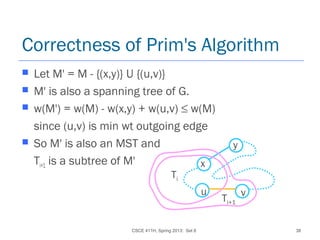
 Let M' = M - {(x,y)} U {(u,v)}
 M' is also a spanning tree of G.
 w(M') = w(M) - w(x,y) + w(u,v) ≤ w(M)
since (u,v) is min wt outgoing edge
 So M' is also an MST and
Ti+1 is a subtree of M'
u v
Ti
x
y
Ti+1
CSCE 411H, Spring 2013: Set 8 39
Implementing Prim's Algorithm
 How do we find minimum weight outgoing
edge?
 First cut: scan all adjacency lists at each
iteration.
 Results in O(VE) time.
 Try to do better.
CSCE 411H, Spring 2013: Set 8 40
Implementing Prim's Algorithm
 Idea: have each vertex not yet in the tree
keep track of its best (cheapest) edge to the
tree constructed so far.
 To find min wt. outgoing edge, find minimum
among these values
 use a priority queue to store the best edge info
(insert and extract-min operations)
CSCE 411H, Spring 2013: Set 8 41
Implementing Prim's Algorithm
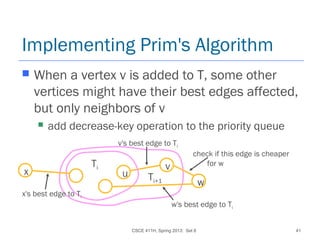
 When a vertex v is added to T, some other
vertices might have their best edges affected,
but only neighbors of v
 add decrease-key operation to the priority queue
u
vTi
Ti+1 w
w's best edge to Ti
check if this edge is cheaper
for w
x
x's best edge to Ti
v's best edge to Ti
CSCE 411H, Spring 2013: Set 8 42
Details on Prim's Algorithm
Associate with each vertex v two fields:
 best-wt[v] : if v is not yet in the tree, then it
holds the min. wt. of all edges from v to a
vertex in the tree. Initially infinity.
 best-node[v] : if v is not yet in the tree, then it
holds the name of the vertex (node) u in the
tree s.t. w(v,u) is v's best-wt. Initially nil.
CSCE 411H, Spring 2013: Set 8 43
Details on Prim's Algorithm
 input: G = (V,E,w)
// initialization
 initialize priority queue Q to contain all vertices,
using best-wt values as keys
 let v0 be any vertex in V
 decrease-key(Q,v0,0)
// last line means change best-wt[v0] to 0 and adjust Q
accordingly
CSCE 411H, Spring 2013: Set 8 44
Details on Prim's Algorithm
 while Q is not empty do
 u := extract-min(Q) // vertex w/ smallest best-wt
 if u is not v0 then add (u,best-node[u]) to T
 for each neighbor v of u do
 if v is in Q and w(u,v) < best-wt[v] then
 best-node[v] := u
 decrease-key(Q,v,w(u,v))
 return (V,T) // as MST of G
CSCE 411H, Spring 2013: Set 8 45
Running Time of Prim's Algorithm
Depends on priority queue implementation. Let
 Tins be time for insert
 Tdec be time for decrease-key
 Tex be time for extract-min
Then we have
 |V| inserts and one decrease-key in the
initialization: O(V•Tins+Tdec)
 |V| iterations of while
 one extract-min per iteration: O(V•Tex) total
CSCE 411H, Spring 2013: Set 8 46
Running Time of Prim's Algorithm
 Each iteration of while includes a for loop.
 Number of iterations of for loop varies,
depending on how many neighbors the
current vertex has
 Total number of iterations of for loop is O(E).
 Each iteration of for loop:
 one decrease key, so O(E•Tdec) total
CSCE 411H, Spring 2013: Set 8 47
Running Time of Prim's Algorithm
 O(V(Tins + Tex) + E•Tdec)
 If priority queue is implemented with a binary
heap, then
 Tins = Tex = Tdec = O(log V)
 total time is O(E log V)
 (Think about how to implement decrease-key
in O(log V) time.)
CSCE 411H, Spring 2013: Set 8 48
Shortest Paths in a Graph
 We’ve already seen one single-source
shortest path algorithm
 Bellman-Ford algorithm
 based on dynamic programming
 Now let’s review a greedy one:
 Dijkstra’s algorithm
CSCE 411H, Spring 2013: Set 8 49
Dijkstra's SSSP Algorithm
 Assumes all edge weights are nonnegative
 Similar to Prim's MST algorithm
 Start with source vertex s and iteratively construct a
tree rooted at s
 Each vertex keeps track of tree vertex that provides
cheapest path from s (not just cheapest path from
any tree vertex)
 At each iteration, include the vertex whose cheapest
path from s is the overall cheapest
CSCE 411H, Spring 2013: Set 8 50
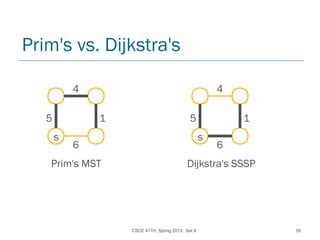
Prim's vs. Dijkstra's
s
5
4
1
6
Prim's MST
s
5
4
1
6
Dijkstra's SSSP
CSCE 411H, Spring 2013: Set 8 51
Implementing Dijkstra's Alg.
 How can each vertex u keep track of its best path
from s?
 Keep an estimate, d[u], of shortest path distance
from s to u
 Use d as a key in a priority queue
 When u is added to the tree, check each of u's
neighbors v to see if u provides v with a cheaper
path from s:
 compare d[v] to d[u] + w(u,v)
CSCE 411H, Spring 2013: Set 8 52
Dijkstra's Algorithm
 input: G = (V,E,w) and source vertex s
// initialization
 d[s] := 0
 d[v] := infinity for all other vertices v
 initialize priority queue Q to contain all
vertices using d values as keys
CSCE 411H, Spring 2013: Set 8 53
Dijkstra's Algorithm
 while Q is not empty do
 u := extract-min(Q)
 for each neighbor v of u do
 if d[u] + w(u,v) < d[v] then
d[v] := d[u] + w(u,v)
decrease-key(Q,v,d[v])
parent(v) := u
CSCE 411H, Spring 2013: Set 8 54
Dijkstra's Algorithm Example
a b
d e
c
2
8
4
9
2
4
12
10
6 3
source is vertex a
0 1 2 3 4 5
Q abcde bcde cde de d Ø
d[a] 0 0 0 0 0 0
d[b] ∞ 2 2 2 2 2
d[c] ∞ 12 10 10 10 10
d[d] ∞ ∞ ∞ 16 13 13
d[e] ∞ ∞ 11 11 11 11
iteration
CSCE 411H, Spring 2013: Set 8 55
Correctness of Dijkstra's Alg.
 Let Ti be the tree constructed after i-th iteration of
while loop:
 vertices not in Q
 edges indicated by parent variables
 Show by induction on i that the path in Tifrom
s to u is a shortest path and has distance d[u],
for all u in Ti (i.e., show that Ti is a correct shortest
path tree).
 Basis: i = 1. s is the only vertex in T1 and d[s] = 0.
CSCE 411H, Spring 2013: Set 8 56
Correctness of Dijkstra's Alg.
 Induction: Assume Ti is a correct shortest path tree. Show
that Ti+1 is a correct shortest path tree.
 Let u be the vertex added in iteration i.
 Let x = parent(u).
s x
Ti
u
Ti+1
Need to show path
in Ti+1 from s to u is
a shortest path, and
has distance d[u]
CSCE 411H, Spring 2013: Set 8 57
Correctness of Dijkstra's Alg
s
x
Ti
u
Ti+1
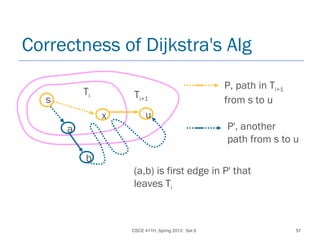
P, path in Ti+1
from s to u
(a,b) is first edge in P' that
leaves Ti
a
b
P', another
path from s to u
CSCE 411H, Spring 2013: Set 8 58
Correctness of Dijkstra's Alg
s
x
Ti
u
Ti+1
a
b
P'
PLet P1 be part of P' before (a,b).
Let P2 be part of P' after (a,b).
w(P') = w(P1) + w(a,b) + w(P2)
≥ w(P1) + w(a,b) (nonneg wts)
≥ w(s->a path in Ti) + w(a,b) (inductive hypothesis)
≥ w(s->x path in Ti) + w(x,u) (alg chose u in iteration i and
d-values are accurate, by inductive hypothesis)
= w(P).
So P is a shortest path, and d[u] is accurate after iteration i+1.
CSCE 411H, Spring 2013: Set 8 59
Running Time of Dijkstra's Alg.
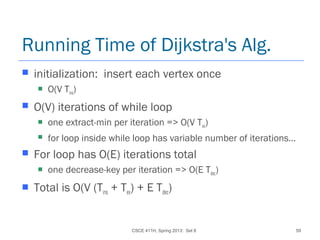
 initialization: insert each vertex once
 O(V Tins)
 O(V) iterations of while loop
 one extract-min per iteration => O(V Tex)
 for loop inside while loop has variable number of iterations…
 For loop has O(E) iterations total
 one decrease-key per iteration => O(E Tdec)
 Total is O(V (Tins + Tex) + E Tdec)
CSCE 411H, Spring 2013: Set 8 60
Using Different Heap
Implementations
 O(V(Tins + Tex) + E•Tdec)
 If priority queue is implemented with a binary heap,
then
 Tins = Tex = Tdec = O(log V)
 total time is O(E log V)
 There are fancier implementations of the priority
queue, such as Fibonacci heap:
 Tins = O(1), Tex = O(log V), Tdec = O(1) (amortized)
 total time is O(V log V + E)
CSCE 411H, Spring 2013: Set 8 61
Using Simpler Heap
Implementations
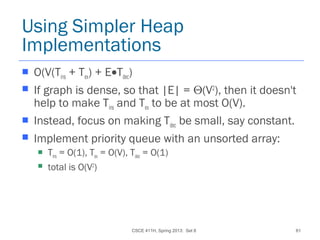
 O(V(Tins + Tex) + E•Tdec)
 If graph is dense, so that |E| = Θ(V2
), then it doesn't
help to make Tins and Tex to be at most O(V).
 Instead, focus on making Tdec be small, say constant.
 Implement priority queue with an unsorted array:
 Tins = O(1), Tex = O(V), Tdec = O(1)
 total is O(V2
)

5.1 greedy 03

  • 1.
    CSCE 411H Design andAnalysis of Algorithms Set 8: Greedy Algorithms Prof. Evdokia Nikolova* Spring 2013 CSCE 411H, Spring 2013: Set 8 1 * Slides adapted from Prof. Jennifer Welch
  • 2.
    CSCE 411H, Spring2013: Set 8 2 Greedy Algorithm Paradigm  Characteristics of greedy algorithms:  make a sequence of choices  each choice is the one that seems best so far, only depends on what's been done so far  choice produces a smaller problem to be solved  In order for greedy heuristic to solve the problem, it must be that the optimal solution to the big problem contains optimal solutions to subproblems
  • 3.
    CSCE 411H, Spring2013: Set 8 3 Designing a Greedy Algorithm  Cast the problem so that we make a greedy (locally optimal) choice and are left with one subproblem  Prove there is always a (globally) optimal solution to the original problem that makes the greedy choice  Show that the choice together with an optimal solution to the subproblem gives an optimal solution to the original problem
  • 4.
    CSCE 411H, Spring2013: Set 8 4 Some Greedy Algorithms  fractional knapsack algorithm  Huffman codes  Kruskal's MST algorithm  Prim's MST algorithm  Dijkstra's SSSP algorithm  …
  • 5.
    CSCE 411H, Spring2013: Set 8 5 Knapsack Problem  There are n different items in a store  Item i :  weighs wi pounds  worth $vi  A thief breaks in  Can carry up to W pounds in his knapsack  What should he take to maximize the value of his haul?
  • 6.
    CSCE 411H, Spring2013: Set 8 6 0-1 vs. Fractional Knapsack  0-1 Knapsack Problem:  the items cannot be divided  thief must take entire item or leave it behind  Fractional Knapsack Problem:  thief can take partial items  for instance, items are liquids or powders  solvable with a greedy algorithm…
  • 7.
    CSCE 411H, Spring2013: Set 8 7 Greedy Fractional Knapsack Algorithm  Sort items in decreasing order of value per pound  While still room in the knapsack (limit of W pounds) do  consider next item in sorted list  take as much as possible (all there is or as much as will fit)  O(n log n) running time (for the sort)
  • 8.
    CSCE 411H, Spring2013: Set 8 8 Greedy 0-1 Knapsack Alg?  3 items:  item 1 weighs 10 lbs, worth $60 ($6/lb)  item 2 weighs 20 lbs, worth $100 ($5/lb)  item 3 weighs 30 lbs, worth $120 ($4/lb)  knapsack can hold 50 lbs  greedy strategy:  take item 1  take item 2  no room for item 3
  • 9.
    CSCE 411H, Spring2013: Set 8 9 0-1 Knapsack Problem  Taking item 1 is a big mistake globally although looks good locally  Use dynamic programming to solve this in pseudo-polynomial time
  • 10.
    CSCE 411H, Spring2013: Set 8 10 Finding Optimal Code  Input:  data file of characters and  number of occurrences of each character  Output:  a binary encoding of each character so that the data file can be represented as efficiently as possible  "optimal code"
  • 11.
    CSCE 411H, Spring2013: Set 8 11 Huffman Code  Idea: use short codes for more frequent characters and long codes for less frequent char a b c d e f total bits # 45 13 12 16 9 5 fixed 000 001 010 011 100 101 300 variabl e 0 101 100 111 1101 1100 224
  • 12.
    CSCE 411H, Spring2013: Set 8 12 How to Decode?  With fixed length code, easy:  break up into 3's, for instance  For variable length code, ensure that no character's code is the prefix of another  no ambiguity 101111110100 b d e a a
  • 13.
    CSCE 411H, Spring2013: Set 8 13 Binary Tree Representation 0 1 0 1 0 0 1 0 1 0 1 a b c d e f fixed length code cost of code is sum, over all chars c, of number of occurrences of c times depth of c in the tree
  • 14.
    CSCE 411H, Spring2013: Set 8 14 0 1 f e Binary Tree Representation 10 0 1 0 1 0 1 a bc d variable length code cost of code is sum, over all chars c, of number of occurrences of c times depth of c in the tree
  • 15.
    CSCE 411H, Spring2013: Set 8 15 Algorithm to Construct Tree Representing Huffman Code  Given set C of n chars, c occurs f[c] times  insert each c into priority queue Q using f[c] as key  for i := 1 to n-1 do  x := extract-min(Q)  y := extract-min(Q)  make a new node z w/ left child x (label edge 0), right child y (label edge 1), and f[z] = f[x] + f[y]  insert z into Q
  • 16.
    CSCE 411H, Spring2013: Set 8 16 <board work>
  • 17.
    CSCE 411H, Spring2013: Set 8 17 Minimum Spanning Tree 7 16 45 6 8 11 15 14 17 10 13 3 12 29 18 Given a connected undirected graph with edge weights, find subset of edges that spans all the nodes, creates no cycle, and minimizes sum of weights
  • 18.
    CSCE 411H, Spring2013: Set 8 18 Facts About MSTs  There can be many spanning trees of a graph  In fact, there can be many minimum spanning trees of a graph  But if every edge has a unique weight, then there is a unique MST
  • 19.
    CSCE 411H, Spring2013: Set 8 19 Uniqueness of MST  Suppose in contradiction there are 2 MSTs, M1 and M2.  Let e be edge with minimum weight that is in one MST but not the other (e.g., orange or blue but not both)  in the example it is the edge with weight 4  WLOG, assume e is in M1 (e.g., the orange MST) M1 M2 edges in neither12 8 4 7
  • 20.
    CSCE 411H, Spring2013: Set 8 20 Uniqueness of MST  If e is added to M2 (e.g., the blue MST), a cycle is formed.  Let e' be an edge in the cycle that is not in M1  in the example, the only possibility for e' is the edge with weight 7, since the edges with weights 3 and 5 are in M1 (the orange MST)  By choice of e, weight of e’ must be > weight of e  in the example, 7 > 4 M1 M2 edges in neither12 8 4 7 3 5
  • 21.
    CSCE 411H, Spring2013: Set 8 21 Uniqueness of MST  Replacing e with e' in M2 creates a new MST M3 whose weight is less than that of M2  in the example, replace edge with weight 7 in blue MST by edge with weight 4  Result is a new spanning tree, M3, whose weight is less than that of M2! M3 edges not in M3 12 8 4 7 3 5
  • 22.
    CSCE 411H, Spring2013: Set 8 22 Generic MST Algorithm  input: weighted undirected graph G = (V,E,w)  T := empty set  while T is not yet a spanning tree of G  find an edge e in E s.t. T U {e} is a subgraph of some MST of G  add e to T  return T (as MST of G)
  • 23.
    CSCE 411H, Spring2013: Set 8 23 Kruskal's MST algorithm 7 16 45 6 8 11 15 14 17 10 13 3 12 29 18 consider the edges in increasing order of weight, add in an edge iff it does not cause a cycle
  • 24.
    CSCE 411H, Spring2013: Set 8 24 Kruskal's Algorithm as a Special Case of Generic Algorithm  Consider edges in increasing order of weight  Add the next edge iff it doesn't cause a cycle  At any point, T is a forest (set of trees); eventually T is a single tree
  • 25.
    CSCE 411H, Spring2013: Set 8 25 Why is Kruskal's Greedy?  Algorithm manages a set of edges s.t.  these edges are a subset of some MST  At each iteration:  choose an edge so that the MST-subset property remains true  subproblem left is to do the same with the remaining edges  Always try to add cheapest available edge that will not violate the tree property  locally optimal choice
  • 26.
    CSCE 411H, Spring2013: Set 8 26 Correctness of Kruskal's Alg.  Let e1, e2, …, en-1 be sequence of edges chosen  Clearly they form a spanning tree  Suppose it is not minimum weight  Let ei be the edge where the algorithm goes wrong  {e1,…,ei-1} is part of some MST M  but {e1,…,ei} is not part of any MST
  • 27.
    CSCE 411H, Spring2013: Set 8 27 Correctness of Kruskal's Alg. gray edges are part of MST M, which contains e1 to ei-1, but not ei M: ei, forms a cycle in M e* : min wt. edge in cycle not in e1 to ei-1 replacing e* w/ ei forms a spanning tree with smaller weight than M, contradiction! wt(e*) > wt(ei)
  • 28.
    CSCE 411H, Spring2013: Set 8 28 Note on Correctness Proof  Argument on previous slide works for case when every edge has a unique weight  Algorithm also works when edge weights are not necessarily unique  Modify proof on previous slide: contradiction is reached to assumption that ei is not part of any MST
  • 29.
    CSCE 411H, Spring2013: Set 8 29 Implementing Kruskal's Alg.  Sort edges by weight  efficient algorithms known  How to test quickly if adding in the next edge would cause a cycle?  use disjoint set data structure!
  • 30.
    CSCE 411H, Spring2013: Set 8 30 Running Time of Kruskal's Algorithm  |V| Make-Sets, one per node  2|E| Find-Sets, two per edge  |V| - 1 Unions, since spanning tree has |V| - 1 edges in it  So sequence of O(E) operations, |V| of which are Make-Sets  Time for Disjoint Sets ops is O(E log*V)  Dominated by time to sort the edges, which is O(E log E) = O(E log V).
  • 31.
    CSCE 411H, Spring2013: Set 8 31 Another Greedy MST Alg.  Kruskal's algorithm maintains a forest that grows until it forms a spanning tree  Alternative idea is keep just one tree and grow it until it spans all the nodes  Prim's algorithm  At each iteration, choose the minimum weight outgoing edge to add  greedy!
  • 32.
    CSCE 411H, Spring2013: Set 8 32 Idea of Prim's Algorithm  Instead of growing the MST as possibly multiple trees that eventually all merge, grow the MST from a single vertex, so that there is only one tree at any point.  Also a special case of the generic algorithm: at each step, add the minimum weight edge that goes out from the tree constructed so far.
  • 33.
    CSCE 411H, Spring2013: Set 8 33 Prim's Algorithm  input: weighted undirected graph G = (V,E,w)  T := empty set  S := {any vertex in V}  while |T| < |V| - 1 do  let (u,v) be a min wt. outgoing edge (u in S, v not in S)  add (u,v) to T  add v to S  return (S,T) (as MST of G)
  • 34.
    CSCE 411H, Spring2013: Set 8 34 Prim's Algorithm Example a b h i c g d f e 4 8 7 8 11 2 7 6 1 2 4 14 9 10
  • 35.
    CSCE 411H, Spring2013: Set 8 35 Correctness of Prim's Algorithm  Let Ti be the tree represented by (S,T) at the end of iteration i.  Show by induction on i that Ti is a subtree of some MST of G.  Basis: i = 0 (before first iteration). T0 contains just a single vertex, and thus is a subtree of every MST of G.
  • 36.
    CSCE 411H, Spring2013: Set 8 36 Correctness of Prim's Algorithm  Induction: Assume Ti is a subtree of some MST M. We must show Ti+1 is a subtree of some MST.  Let (u,v) be the edge added in iteration i+1. u vTi Ti+1 Case 1: (u,v) is in M. Then Ti+1 is also a subtree of M.
  • 37.
    CSCE 411H, Spring2013: Set 8 37 Correctness of Prim's Algorithm Case 2: (u,v) is not in M.  There is a path P in M from u to v, since M spans G.  Let (x,y) be the first edge in P with one endpoint in Ti and the other not in Ti. u v Ti x y P
  • 38.
    CSCE 411H, Spring2013: Set 8 38 Correctness of Prim's Algorithm  Let M' = M - {(x,y)} U {(u,v)}  M' is also a spanning tree of G.  w(M') = w(M) - w(x,y) + w(u,v) ≤ w(M) since (u,v) is min wt outgoing edge  So M' is also an MST and Ti+1 is a subtree of M' u v Ti x y Ti+1
  • 39.
    CSCE 411H, Spring2013: Set 8 39 Implementing Prim's Algorithm  How do we find minimum weight outgoing edge?  First cut: scan all adjacency lists at each iteration.  Results in O(VE) time.  Try to do better.
  • 40.
    CSCE 411H, Spring2013: Set 8 40 Implementing Prim's Algorithm  Idea: have each vertex not yet in the tree keep track of its best (cheapest) edge to the tree constructed so far.  To find min wt. outgoing edge, find minimum among these values  use a priority queue to store the best edge info (insert and extract-min operations)
  • 41.
    CSCE 411H, Spring2013: Set 8 41 Implementing Prim's Algorithm  When a vertex v is added to T, some other vertices might have their best edges affected, but only neighbors of v  add decrease-key operation to the priority queue u vTi Ti+1 w w's best edge to Ti check if this edge is cheaper for w x x's best edge to Ti v's best edge to Ti
  • 42.
    CSCE 411H, Spring2013: Set 8 42 Details on Prim's Algorithm Associate with each vertex v two fields:  best-wt[v] : if v is not yet in the tree, then it holds the min. wt. of all edges from v to a vertex in the tree. Initially infinity.  best-node[v] : if v is not yet in the tree, then it holds the name of the vertex (node) u in the tree s.t. w(v,u) is v's best-wt. Initially nil.
  • 43.
    CSCE 411H, Spring2013: Set 8 43 Details on Prim's Algorithm  input: G = (V,E,w) // initialization  initialize priority queue Q to contain all vertices, using best-wt values as keys  let v0 be any vertex in V  decrease-key(Q,v0,0) // last line means change best-wt[v0] to 0 and adjust Q accordingly
  • 44.
    CSCE 411H, Spring2013: Set 8 44 Details on Prim's Algorithm  while Q is not empty do  u := extract-min(Q) // vertex w/ smallest best-wt  if u is not v0 then add (u,best-node[u]) to T  for each neighbor v of u do  if v is in Q and w(u,v) < best-wt[v] then  best-node[v] := u  decrease-key(Q,v,w(u,v))  return (V,T) // as MST of G
  • 45.
    CSCE 411H, Spring2013: Set 8 45 Running Time of Prim's Algorithm Depends on priority queue implementation. Let  Tins be time for insert  Tdec be time for decrease-key  Tex be time for extract-min Then we have  |V| inserts and one decrease-key in the initialization: O(V•Tins+Tdec)  |V| iterations of while  one extract-min per iteration: O(V•Tex) total
  • 46.
    CSCE 411H, Spring2013: Set 8 46 Running Time of Prim's Algorithm  Each iteration of while includes a for loop.  Number of iterations of for loop varies, depending on how many neighbors the current vertex has  Total number of iterations of for loop is O(E).  Each iteration of for loop:  one decrease key, so O(E•Tdec) total
  • 47.
    CSCE 411H, Spring2013: Set 8 47 Running Time of Prim's Algorithm  O(V(Tins + Tex) + E•Tdec)  If priority queue is implemented with a binary heap, then  Tins = Tex = Tdec = O(log V)  total time is O(E log V)  (Think about how to implement decrease-key in O(log V) time.)
  • 48.
    CSCE 411H, Spring2013: Set 8 48 Shortest Paths in a Graph  We’ve already seen one single-source shortest path algorithm  Bellman-Ford algorithm  based on dynamic programming  Now let’s review a greedy one:  Dijkstra’s algorithm
  • 49.
    CSCE 411H, Spring2013: Set 8 49 Dijkstra's SSSP Algorithm  Assumes all edge weights are nonnegative  Similar to Prim's MST algorithm  Start with source vertex s and iteratively construct a tree rooted at s  Each vertex keeps track of tree vertex that provides cheapest path from s (not just cheapest path from any tree vertex)  At each iteration, include the vertex whose cheapest path from s is the overall cheapest
  • 50.
    CSCE 411H, Spring2013: Set 8 50 Prim's vs. Dijkstra's s 5 4 1 6 Prim's MST s 5 4 1 6 Dijkstra's SSSP
  • 51.
    CSCE 411H, Spring2013: Set 8 51 Implementing Dijkstra's Alg.  How can each vertex u keep track of its best path from s?  Keep an estimate, d[u], of shortest path distance from s to u  Use d as a key in a priority queue  When u is added to the tree, check each of u's neighbors v to see if u provides v with a cheaper path from s:  compare d[v] to d[u] + w(u,v)
  • 52.
    CSCE 411H, Spring2013: Set 8 52 Dijkstra's Algorithm  input: G = (V,E,w) and source vertex s // initialization  d[s] := 0  d[v] := infinity for all other vertices v  initialize priority queue Q to contain all vertices using d values as keys
  • 53.
    CSCE 411H, Spring2013: Set 8 53 Dijkstra's Algorithm  while Q is not empty do  u := extract-min(Q)  for each neighbor v of u do  if d[u] + w(u,v) < d[v] then d[v] := d[u] + w(u,v) decrease-key(Q,v,d[v]) parent(v) := u
  • 54.
    CSCE 411H, Spring2013: Set 8 54 Dijkstra's Algorithm Example a b d e c 2 8 4 9 2 4 12 10 6 3 source is vertex a 0 1 2 3 4 5 Q abcde bcde cde de d Ø d[a] 0 0 0 0 0 0 d[b] ∞ 2 2 2 2 2 d[c] ∞ 12 10 10 10 10 d[d] ∞ ∞ ∞ 16 13 13 d[e] ∞ ∞ 11 11 11 11 iteration
  • 55.
    CSCE 411H, Spring2013: Set 8 55 Correctness of Dijkstra's Alg.  Let Ti be the tree constructed after i-th iteration of while loop:  vertices not in Q  edges indicated by parent variables  Show by induction on i that the path in Tifrom s to u is a shortest path and has distance d[u], for all u in Ti (i.e., show that Ti is a correct shortest path tree).  Basis: i = 1. s is the only vertex in T1 and d[s] = 0.
  • 56.
    CSCE 411H, Spring2013: Set 8 56 Correctness of Dijkstra's Alg.  Induction: Assume Ti is a correct shortest path tree. Show that Ti+1 is a correct shortest path tree.  Let u be the vertex added in iteration i.  Let x = parent(u). s x Ti u Ti+1 Need to show path in Ti+1 from s to u is a shortest path, and has distance d[u]
  • 57.
    CSCE 411H, Spring2013: Set 8 57 Correctness of Dijkstra's Alg s x Ti u Ti+1 P, path in Ti+1 from s to u (a,b) is first edge in P' that leaves Ti a b P', another path from s to u
  • 58.
    CSCE 411H, Spring2013: Set 8 58 Correctness of Dijkstra's Alg s x Ti u Ti+1 a b P' PLet P1 be part of P' before (a,b). Let P2 be part of P' after (a,b). w(P') = w(P1) + w(a,b) + w(P2) ≥ w(P1) + w(a,b) (nonneg wts) ≥ w(s->a path in Ti) + w(a,b) (inductive hypothesis) ≥ w(s->x path in Ti) + w(x,u) (alg chose u in iteration i and d-values are accurate, by inductive hypothesis) = w(P). So P is a shortest path, and d[u] is accurate after iteration i+1.
  • 59.
    CSCE 411H, Spring2013: Set 8 59 Running Time of Dijkstra's Alg.  initialization: insert each vertex once  O(V Tins)  O(V) iterations of while loop  one extract-min per iteration => O(V Tex)  for loop inside while loop has variable number of iterations…  For loop has O(E) iterations total  one decrease-key per iteration => O(E Tdec)  Total is O(V (Tins + Tex) + E Tdec)
  • 60.
    CSCE 411H, Spring2013: Set 8 60 Using Different Heap Implementations  O(V(Tins + Tex) + E•Tdec)  If priority queue is implemented with a binary heap, then  Tins = Tex = Tdec = O(log V)  total time is O(E log V)  There are fancier implementations of the priority queue, such as Fibonacci heap:  Tins = O(1), Tex = O(log V), Tdec = O(1) (amortized)  total time is O(V log V + E)
  • 61.
    CSCE 411H, Spring2013: Set 8 61 Using Simpler Heap Implementations  O(V(Tins + Tex) + E•Tdec)  If graph is dense, so that |E| = Θ(V2 ), then it doesn't help to make Tins and Tex to be at most O(V).  Instead, focus on making Tdec be small, say constant.  Implement priority queue with an unsorted array:  Tins = O(1), Tex = O(V), Tdec = O(1)  total is O(V2 )