Concurrency  Control  Techniques Chapter 18
Two-Phase Locking Techniques for Concurrency Control Concurrency Control Based on Timestamp Ordering Multiversion Concurrency Control Techniques Validation (Optimistic) Concurrency Control Techniques Granularity of Data Items and Multiple Granularity Locking  Using Locks for Concurrency Control in Indexes Chapter Outline
Locking data items is a commonly used technique for controlling concurrent execution of transactions. A  lock   is a variable associated with a data item that describes the status of the item with respect to possible operations that can b applied to it. The various types of locks include: Binary Locks Shared/Exclusive (or Read/Write) Locks Locking Techniques
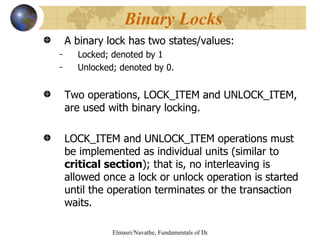
A binary lock has two states/values: Locked; denoted by 1 Unlocked; denoted by 0.  Two operations, LOCK_ITEM and UNLOCK_ITEM, are used with binary locking. LOCK_ITEM and UNLOCK_ITEM operations must be implemented as individual units (similar to  critical section ); that is, no interleaving is allowed once a lock or unlock operation is started until the operation terminates or the transaction waits. Binary Locks
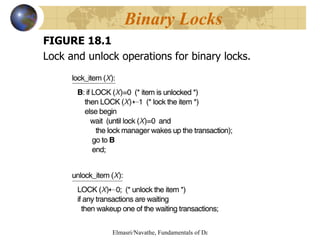
FIGURE 18.1 Lock and unlock operations for binary locks. Binary Locks
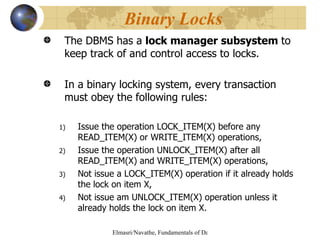
The DBMS has a  lock manager subsystem  to keep track of and control access to locks. In a binary locking system, every transaction  must obey the following rules: Issue the operation LOCK_ITEM(X) before any READ_ITEM(X) or WRITE_ITEM(X) operations, Issue the operation UNLOCK_ITEM(X) after all READ_ITEM(X) and WRITE_ITEM(X) operations, Not issue a LOCK_ITEM(X) operation if it already holds the lock on item X, Not issue am UNLOCK_ITEM(X) operation unless it already holds the lock on item X.  Binary Locks
In binary locks at most one transaction can hold a lock on a given item, X. Shared/exclusive locking allows several transactions to access the same item X if they all access X for  reading purpose only. Shared/Exclusive (or Read/Write) locking system uses three locking operations: READ_LOCK ITEM, is also called  shared lock, WRITE_LOCK ITEM, is also called  exclusive lock,   UNLOCK_ITEM Shared/Exclusive (or Read/Write) Locks
In shared locking system, every transaction must obey the following rules: Issue the operation READ_LOCK(X) or WRITE_LOCK(X) before any READ_ITEM(X) operation, Issue the operation WRITE_LOCK(X) before any WRITE_ITEM(X) operation is performed, Issue the operation UNLOCK(X) after all READ_ITEM(X) and WRITE_ITEM(X) operations, Not issue a READ_LOCK(X) operation if it already holds a read (shared) lock or write (exclusive) lock on item X, Not issue a WRITE_LOCK(X) operation if it already holds a read (shared) lock or write (exclusive) lock on item X, Not issue an UNLOCK(X) operation unless it already holds a read lock or write lock on item X. Shared/Exclusive (or Read/Write) Locks
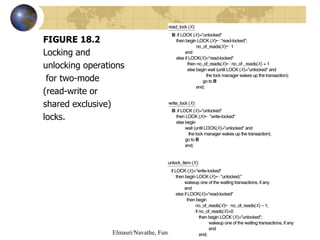
FIGURE 18.2 Locking and  unlocking operations for two-mode  (read-write or  shared exclusive)  locks.
It is possible for a transaction T to issue a READ_LOCK(X) and then later on to  upgrade  the lock by issuing a WRITE_LOCK(X) operation. It is also possible for a transaction T to issue a WRITE_LOCK(X) and then later on to  downgrade  the lock by issuing a READ_LOCK(X) operation. Using binary locks or shared locks in transactions  does not guarantee serializability  of schedules on its own.  Conversion of Locks
In a transaction that follows two-phase locking,  all  locking precede the  first  unlock operation. Hence, a transaction can be divided into two phases: Expanding  or  growing (first) phase,  during which new locks on items can be acquired but none of them can be released, Shrinking (second) phase,  during which existing locks can be released but no new lock can be acquired. If every transaction in a schedule follows the two-phase locking protocol, the schedule is  guaranteed to be serializable. Two-Phase Locking
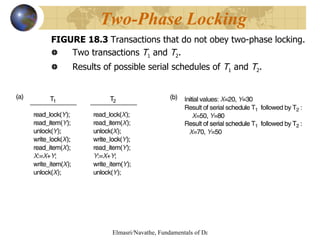
FIGURE 18.3  Transactions that do not obey two-phase locking.  Two transactions  T 1  and  T 2 .  Results of possible serial schedules of  T 1  and  T 2 . Two-Phase Locking
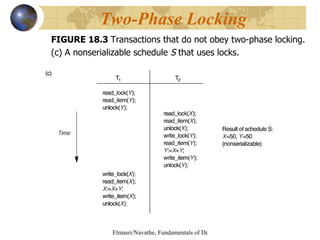
FIGURE 18.3  Transactions that do not obey two-phase locking. (c) A nonserializable schedule  S  that uses locks. Two-Phase Locking
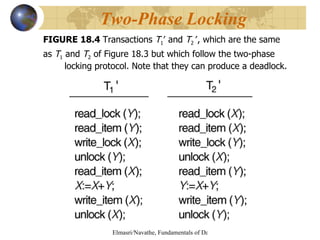
FIGURE 18.4  Transactions  T 1   and  T 2   , which are the same  as  T 1  and  T 2  of Figure 18.3 but which follow the two-phase locking protocol. Note that they can produce a deadlock. Two-Phase Locking
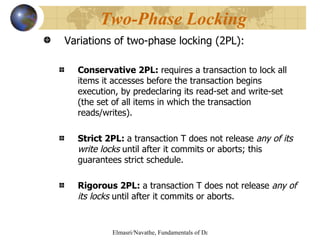
Variations of two-phase locking (2PL): Conservative 2PL:   requires a transaction to lock all items it accesses before the transaction begins execution, by predeclaring its read-set and write-set (the set of all items in which the transaction reads/writes). Strict 2PL:   a transaction T does not release  any of its write locks  until after it commits or aborts; this guarantees strict schedule.   Rigorous 2PL:  a transaction T does not release  any of its locks  until after it commits or aborts. Two-Phase Locking
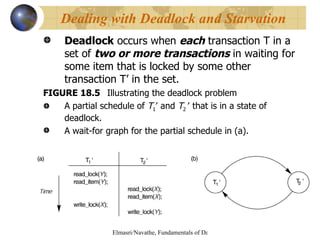
Deadlock  occurs when  each  transaction T in a set of  two or more transactions  in waiting for some item that is locked by some other transaction T’ in the set. FIGURE 18.5  Illustrating the deadlock problem A partial schedule of  T 1   and  T 2    that is in a state of deadlock. A wait-for graph for the partial schedule in (a). Dealing with Deadlock and Starvation
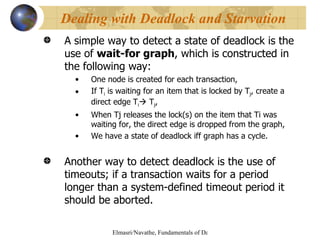
A simple way to detect a state of deadlock is the use of  wait-for graph , which is constructed in the following way:  One node is created for each transaction, If T i  is waiting for an item that is locked by T j , create a direct edge T i   T j ,  When Tj releases the lock(s) on the item that Ti was waiting for, the direct edge is dropped from the graph, We have a state of deadlock iff graph has a cycle. Another way to detect deadlock is the use of timeouts; if a transaction waits for a period longer than a system-defined timeout period it should be aborted. Dealing with Deadlock and Starvation
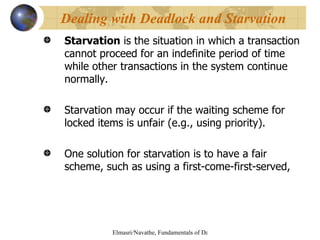
Starvation  is the situation in which a transaction cannot proceed for an indefinite period of time while other transactions in the system continue normally.  Starvation may occur if the waiting scheme for locked items is unfair (e.g., using priority). One solution for starvation is to have a fair scheme, such as using a first-come-first-served, Dealing with Deadlock and Starvation
A  timestamp  is a unique identifier created by the DBMS to identify a transaction (can be thought as the transaction start time). Concurrency control techniques based on timestamp ordering do no use locks, and thus  deadlocks cannot occur . Using timestamps provides a serialized schedule,  that is called  timestamp ordering . Concurrency Control Based on Timestamp Ordering
The timestamp ordering (TO) algorithm associates two timestamp (TS) values with each database item X: READ_TS(X) – this is the largest timestamp among all the timestamps of transactions that have successfully read item X. WRITE_TS(X) – this is the largest of all the timestamps of transactions that have successfully written item X. Concurrency Control Based on Timestamp Ordering
The basic TO algorithm works as follows. Transaction T issues a WRITE_ITEM(X): If READ_TS(X) > TS(T) or if WRITE_TS(X) > TS, then abort and rollback T and reject the operation. Else, execute the WRITE_ITEM(X) operation of T and set WRITE_TS(X) to TS(T). Transaction T issues a READ_ITEM(X): IF WRITE_TS(X) > TS(T), then abort and rollback T and reject the operation. Else, execute the READ_ITEM(X) operation of T and set READ_TS(X) to the larger of TS(T) and the current READ_TS(X). Concurrency Control Based on Timestamp Ordering
Multiversion concurrency control  keeps the old values of a data item when it is updated. When a transaction requires access to an item, an appropriate version is chosen to maintain the serializability of the currently executing schedule, if possible. An obvious drawback is that more storage is needed to maintain multiple versions of the database items. Multiversion Concurrency Control Techniques
Multiversion technique based on TO  – in this method, for each version, the value of version X i  and the following two timestamps are kept: READ_TS(X i ): the largest of all the timestamps of transactions that have successfully read version X i . WRITE_TS(X i ): the timestamp of the transaction that wrote the value of version X i . Multiversion Concurrency Control Techniques
To ensure serializabilty, the following two rules are used: If transaction T issues a WRITE_ITEM(X) operation, and Xi has the highest WRITE_TS(X i ) of all versions of X that is also  less than or equal to  TS(T), and READ_TS(X i ) > TS(T), then abort and rollback transaction T; otherwise create a new version  X j  of X with  READ_TS(X j ) = WRITE_TS(Xj) = TS(T). If transaction T issues a READ_ITEM(X) operation, find Xi that has the highest WRITE_TS(X i ) of all versions of X that is also  less than or equal to  TS(T); then return the value of Xi to transaction T, and set the value of READ_TS(X i ) to the larger of TS(T) and the current READ_TS(X i ). Multiversion Concurrency Control Techniques
Multiversion 2PL Using Certify Locks –  in this scheme, there are three locking modes for an item; READ, WRITE, and CERTIFY. This scheme allows other transactions T’ to read an item X while a single transaction T holds a write lock on X. This is done by allowing two versions for each item X. Once T is ready to commit, it must obtain a CERTIFY LOCK on all items that it currently holds write locks on before it can commit.  Multiversion Concurrency Control Techniques
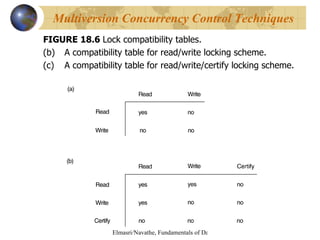
FIGURE 18.6  Lock compatibility tables.  A compatibility table for read/write locking scheme.  A compatibility table for read/write/certify locking scheme. Multiversion Concurrency Control Techniques
No checking is done while the transaction is executing. It contain three phases: Read phase:  a transaction can read values of committed data items from the database. However, updates are applied only to local copies of the data items kept in the transaction workspace. Validation phase:  checking is performed to ensure that serializabilty will not be violated if the transaction updates are applied to the database. Write phase:  If serializabilty is not violated, the transaction is committed and the databas is updated from the local copies; otherwise the transaction is aborted and then restarted later. Validation (Optimistic) Concurrency Control
All concurrency control techniques assumed that the database was formed of a number of named data items, but it could be a record, a field value of a record, a disk block, a whole file, or the whole database. The size of data items is often called the  data item granularity. Fine granularity  refers to small item sizes, Coarse granularity  refers to large item sizes The larger the data item size is, the lower the degree of concurrency permitted. Granularity of Data Items
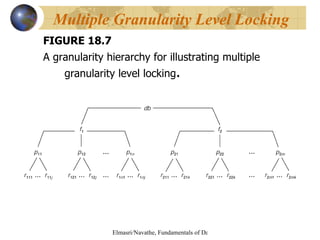
FIGURE 18.7  A granularity hierarchy for illustrating multiple granularity level locking . Multiple Granularity Level Locking
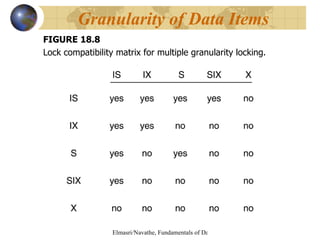
In multiple granularity level 2PL protocol, a lock can be requested at any level. However, additional types of locks, called  intension locks , are needed: Intension-shared  (IS) indicates that a shared lock(s) will be requested on some descendant node(s), Intension-exclusive  (IX) indicates that an exclusive lock(s) will be requested on some descendant node(s), Shared-intension-exclusive (SIX) indicates that the current node is locked in shared mode but an exclusive lock(s) will be requested on some descendant node(s). Granularity of Data Items
FIGURE 18.8 Lock compatibility matrix for multiple granularity locking. Granularity of Data Items

Chapter18

  • 1.
  • 2.
    Concurrency Control Techniques Chapter 18
  • 3.
    Two-Phase Locking Techniquesfor Concurrency Control Concurrency Control Based on Timestamp Ordering Multiversion Concurrency Control Techniques Validation (Optimistic) Concurrency Control Techniques Granularity of Data Items and Multiple Granularity Locking Using Locks for Concurrency Control in Indexes Chapter Outline
  • 4.
    Locking data itemsis a commonly used technique for controlling concurrent execution of transactions. A lock is a variable associated with a data item that describes the status of the item with respect to possible operations that can b applied to it. The various types of locks include: Binary Locks Shared/Exclusive (or Read/Write) Locks Locking Techniques
  • 5.
    A binary lockhas two states/values: Locked; denoted by 1 Unlocked; denoted by 0. Two operations, LOCK_ITEM and UNLOCK_ITEM, are used with binary locking. LOCK_ITEM and UNLOCK_ITEM operations must be implemented as individual units (similar to critical section ); that is, no interleaving is allowed once a lock or unlock operation is started until the operation terminates or the transaction waits. Binary Locks
  • 6.
    FIGURE 18.1 Lockand unlock operations for binary locks. Binary Locks
  • 7.
    The DBMS hasa lock manager subsystem to keep track of and control access to locks. In a binary locking system, every transaction must obey the following rules: Issue the operation LOCK_ITEM(X) before any READ_ITEM(X) or WRITE_ITEM(X) operations, Issue the operation UNLOCK_ITEM(X) after all READ_ITEM(X) and WRITE_ITEM(X) operations, Not issue a LOCK_ITEM(X) operation if it already holds the lock on item X, Not issue am UNLOCK_ITEM(X) operation unless it already holds the lock on item X. Binary Locks
  • 8.
    In binary locksat most one transaction can hold a lock on a given item, X. Shared/exclusive locking allows several transactions to access the same item X if they all access X for reading purpose only. Shared/Exclusive (or Read/Write) locking system uses three locking operations: READ_LOCK ITEM, is also called shared lock, WRITE_LOCK ITEM, is also called exclusive lock, UNLOCK_ITEM Shared/Exclusive (or Read/Write) Locks
  • 9.
    In shared lockingsystem, every transaction must obey the following rules: Issue the operation READ_LOCK(X) or WRITE_LOCK(X) before any READ_ITEM(X) operation, Issue the operation WRITE_LOCK(X) before any WRITE_ITEM(X) operation is performed, Issue the operation UNLOCK(X) after all READ_ITEM(X) and WRITE_ITEM(X) operations, Not issue a READ_LOCK(X) operation if it already holds a read (shared) lock or write (exclusive) lock on item X, Not issue a WRITE_LOCK(X) operation if it already holds a read (shared) lock or write (exclusive) lock on item X, Not issue an UNLOCK(X) operation unless it already holds a read lock or write lock on item X. Shared/Exclusive (or Read/Write) Locks
  • 10.
    FIGURE 18.2 Lockingand unlocking operations for two-mode (read-write or shared exclusive) locks.
  • 11.
    It is possiblefor a transaction T to issue a READ_LOCK(X) and then later on to upgrade the lock by issuing a WRITE_LOCK(X) operation. It is also possible for a transaction T to issue a WRITE_LOCK(X) and then later on to downgrade the lock by issuing a READ_LOCK(X) operation. Using binary locks or shared locks in transactions does not guarantee serializability of schedules on its own. Conversion of Locks
  • 12.
    In a transactionthat follows two-phase locking, all locking precede the first unlock operation. Hence, a transaction can be divided into two phases: Expanding or growing (first) phase, during which new locks on items can be acquired but none of them can be released, Shrinking (second) phase, during which existing locks can be released but no new lock can be acquired. If every transaction in a schedule follows the two-phase locking protocol, the schedule is guaranteed to be serializable. Two-Phase Locking
  • 13.
    FIGURE 18.3 Transactions that do not obey two-phase locking. Two transactions T 1 and T 2 . Results of possible serial schedules of T 1 and T 2 . Two-Phase Locking
  • 14.
    FIGURE 18.3 Transactions that do not obey two-phase locking. (c) A nonserializable schedule S that uses locks. Two-Phase Locking
  • 15.
    FIGURE 18.4 Transactions T 1  and T 2  , which are the same as T 1 and T 2 of Figure 18.3 but which follow the two-phase locking protocol. Note that they can produce a deadlock. Two-Phase Locking
  • 16.
    Variations of two-phaselocking (2PL): Conservative 2PL: requires a transaction to lock all items it accesses before the transaction begins execution, by predeclaring its read-set and write-set (the set of all items in which the transaction reads/writes). Strict 2PL: a transaction T does not release any of its write locks until after it commits or aborts; this guarantees strict schedule. Rigorous 2PL: a transaction T does not release any of its locks until after it commits or aborts. Two-Phase Locking
  • 17.
    Deadlock occurswhen each transaction T in a set of two or more transactions in waiting for some item that is locked by some other transaction T’ in the set. FIGURE 18.5 Illustrating the deadlock problem A partial schedule of T 1  and T 2  that is in a state of deadlock. A wait-for graph for the partial schedule in (a). Dealing with Deadlock and Starvation
  • 18.
    A simple wayto detect a state of deadlock is the use of wait-for graph , which is constructed in the following way: One node is created for each transaction, If T i is waiting for an item that is locked by T j , create a direct edge T i  T j , When Tj releases the lock(s) on the item that Ti was waiting for, the direct edge is dropped from the graph, We have a state of deadlock iff graph has a cycle. Another way to detect deadlock is the use of timeouts; if a transaction waits for a period longer than a system-defined timeout period it should be aborted. Dealing with Deadlock and Starvation
  • 19.
    Starvation isthe situation in which a transaction cannot proceed for an indefinite period of time while other transactions in the system continue normally. Starvation may occur if the waiting scheme for locked items is unfair (e.g., using priority). One solution for starvation is to have a fair scheme, such as using a first-come-first-served, Dealing with Deadlock and Starvation
  • 20.
    A timestamp is a unique identifier created by the DBMS to identify a transaction (can be thought as the transaction start time). Concurrency control techniques based on timestamp ordering do no use locks, and thus deadlocks cannot occur . Using timestamps provides a serialized schedule, that is called timestamp ordering . Concurrency Control Based on Timestamp Ordering
  • 21.
    The timestamp ordering(TO) algorithm associates two timestamp (TS) values with each database item X: READ_TS(X) – this is the largest timestamp among all the timestamps of transactions that have successfully read item X. WRITE_TS(X) – this is the largest of all the timestamps of transactions that have successfully written item X. Concurrency Control Based on Timestamp Ordering
  • 22.
    The basic TOalgorithm works as follows. Transaction T issues a WRITE_ITEM(X): If READ_TS(X) > TS(T) or if WRITE_TS(X) > TS, then abort and rollback T and reject the operation. Else, execute the WRITE_ITEM(X) operation of T and set WRITE_TS(X) to TS(T). Transaction T issues a READ_ITEM(X): IF WRITE_TS(X) > TS(T), then abort and rollback T and reject the operation. Else, execute the READ_ITEM(X) operation of T and set READ_TS(X) to the larger of TS(T) and the current READ_TS(X). Concurrency Control Based on Timestamp Ordering
  • 23.
    Multiversion concurrency control keeps the old values of a data item when it is updated. When a transaction requires access to an item, an appropriate version is chosen to maintain the serializability of the currently executing schedule, if possible. An obvious drawback is that more storage is needed to maintain multiple versions of the database items. Multiversion Concurrency Control Techniques
  • 24.
    Multiversion technique basedon TO – in this method, for each version, the value of version X i and the following two timestamps are kept: READ_TS(X i ): the largest of all the timestamps of transactions that have successfully read version X i . WRITE_TS(X i ): the timestamp of the transaction that wrote the value of version X i . Multiversion Concurrency Control Techniques
  • 25.
    To ensure serializabilty,the following two rules are used: If transaction T issues a WRITE_ITEM(X) operation, and Xi has the highest WRITE_TS(X i ) of all versions of X that is also less than or equal to TS(T), and READ_TS(X i ) > TS(T), then abort and rollback transaction T; otherwise create a new version X j of X with READ_TS(X j ) = WRITE_TS(Xj) = TS(T). If transaction T issues a READ_ITEM(X) operation, find Xi that has the highest WRITE_TS(X i ) of all versions of X that is also less than or equal to TS(T); then return the value of Xi to transaction T, and set the value of READ_TS(X i ) to the larger of TS(T) and the current READ_TS(X i ). Multiversion Concurrency Control Techniques
  • 26.
    Multiversion 2PL UsingCertify Locks – in this scheme, there are three locking modes for an item; READ, WRITE, and CERTIFY. This scheme allows other transactions T’ to read an item X while a single transaction T holds a write lock on X. This is done by allowing two versions for each item X. Once T is ready to commit, it must obtain a CERTIFY LOCK on all items that it currently holds write locks on before it can commit. Multiversion Concurrency Control Techniques
  • 27.
    FIGURE 18.6 Lock compatibility tables. A compatibility table for read/write locking scheme. A compatibility table for read/write/certify locking scheme. Multiversion Concurrency Control Techniques
  • 28.
    No checking isdone while the transaction is executing. It contain three phases: Read phase: a transaction can read values of committed data items from the database. However, updates are applied only to local copies of the data items kept in the transaction workspace. Validation phase: checking is performed to ensure that serializabilty will not be violated if the transaction updates are applied to the database. Write phase: If serializabilty is not violated, the transaction is committed and the databas is updated from the local copies; otherwise the transaction is aborted and then restarted later. Validation (Optimistic) Concurrency Control
  • 29.
    All concurrency controltechniques assumed that the database was formed of a number of named data items, but it could be a record, a field value of a record, a disk block, a whole file, or the whole database. The size of data items is often called the data item granularity. Fine granularity refers to small item sizes, Coarse granularity refers to large item sizes The larger the data item size is, the lower the degree of concurrency permitted. Granularity of Data Items
  • 30.
    FIGURE 18.7 A granularity hierarchy for illustrating multiple granularity level locking . Multiple Granularity Level Locking
  • 31.
    In multiple granularitylevel 2PL protocol, a lock can be requested at any level. However, additional types of locks, called intension locks , are needed: Intension-shared (IS) indicates that a shared lock(s) will be requested on some descendant node(s), Intension-exclusive (IX) indicates that an exclusive lock(s) will be requested on some descendant node(s), Shared-intension-exclusive (SIX) indicates that the current node is locked in shared mode but an exclusive lock(s) will be requested on some descendant node(s). Granularity of Data Items
  • 32.
    FIGURE 18.8 Lockcompatibility matrix for multiple granularity locking. Granularity of Data Items