Support Vector Machines
(C) CDAC Mumbai Workshop on Machine Learning
Support Vector Machines
Prakash B. Pimpale
CDAC Mumbai
Outline
Introduction
Towards SVM
Basic Concept
(C) CDAC Mumbai Workshop on Machine Learning
Basic Concept
Implementations
Issues
Conclusion & References
Introduction:
SVMs – a supervised learning methods for
classification and Regression
Base: Vapnik-Chervonenkis theory
First practical implementation: Early nineties
(C) CDAC Mumbai Workshop on Machine Learning
First practical implementation: Early nineties
Satisfying from theoretical point of view
Can lead to high performance in practical
applications
Currently considered one of the most efficient
family of algorithms in Machine Learning
Towards SVM
A:I found really good function describing the training
examples using ANN but couldn’t classify test example
that efficiently, what could be the problem?
B: It didn’t generalize well!
A: What should I do now?
(C) CDAC Mumbai Workshop on Machine Learning
A: What should I do now?
B: Try SVM!
A: why?
B: SVM
1)Generalises well
And what's more….
2)Computationally efficient (just a convex optimization
problem)
3)Robust in high dimensions also (no overfitting)
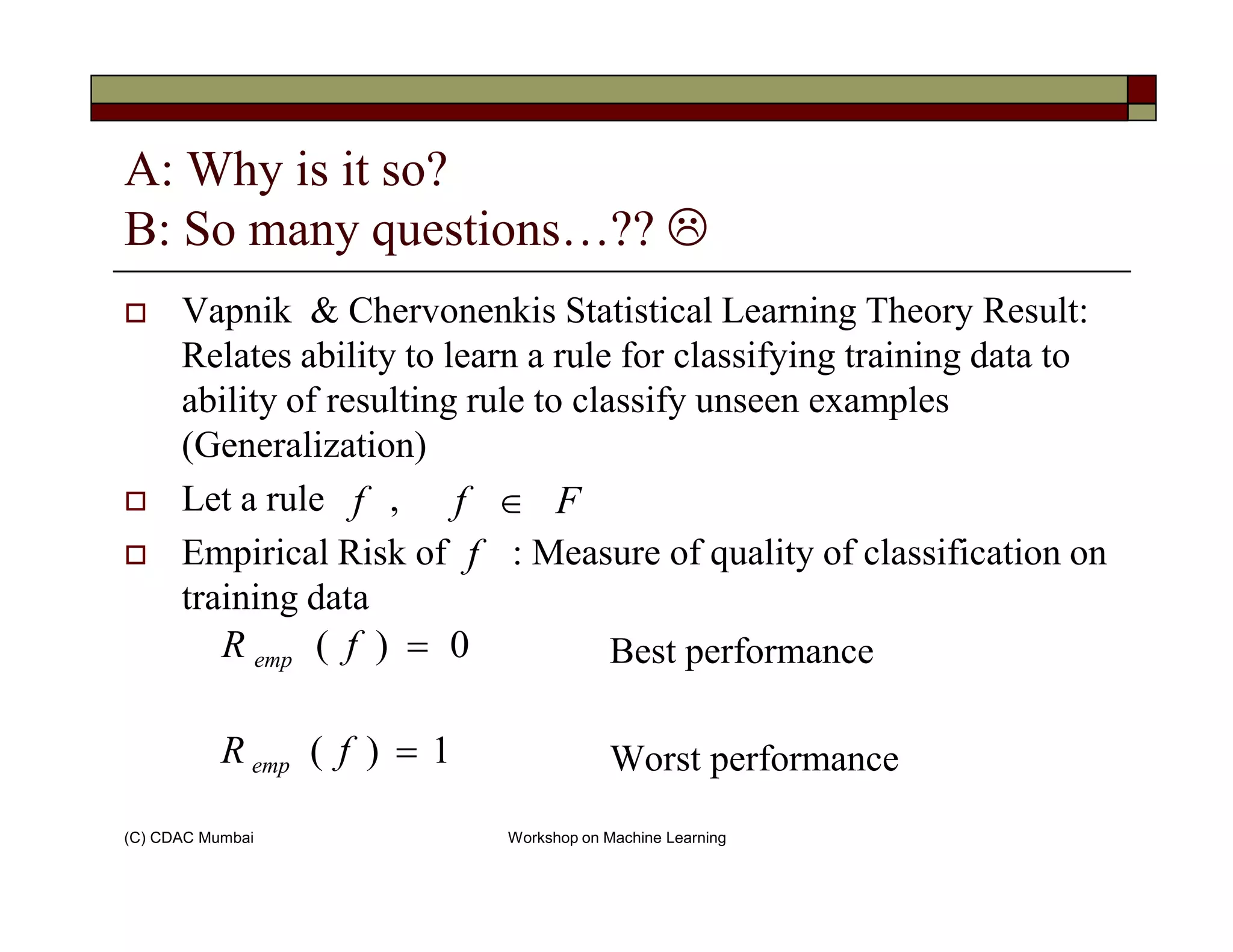
A: Why is it so?
B: So many questions…??
Vapnik & Chervonenkis Statistical Learning Theory Result:
Relates ability to learn a rule for classifying training data to
ability of resulting rule to classify unseen examples
(Generalization)
(C) CDAC Mumbai Workshop on Machine Learning
Let a rule ,
Empirical Risk of : Measure of quality of classification on
training data
Best performance
Worst performance
f Ff ∈
f
0)( =fR emp
1)( =fR emp
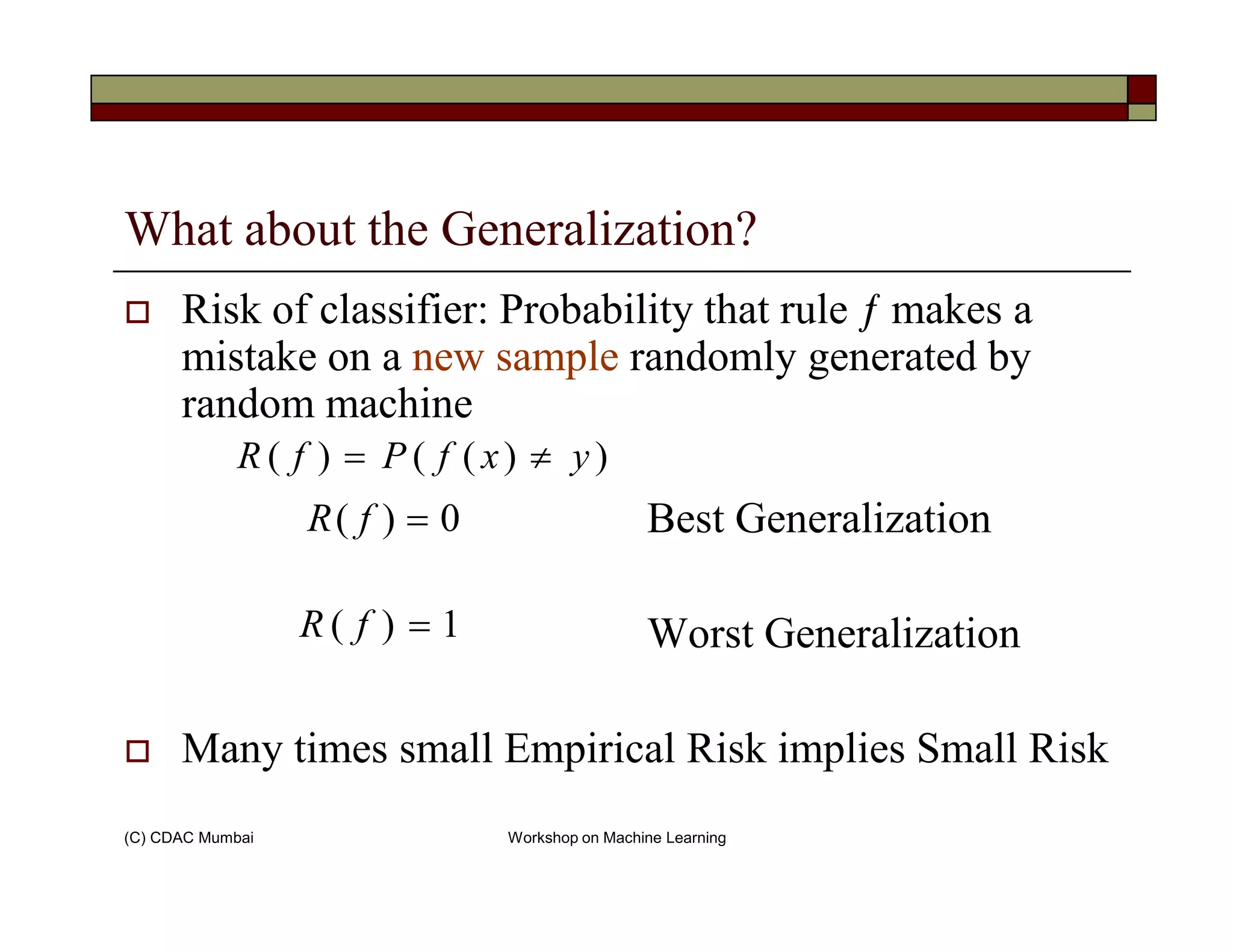
What about the Generalization?
Risk of classifier: Probability that rule ƒ makes a
mistake on a new sample randomly generated by
random machine
))(()( yxfPfR ≠=
(C) CDAC Mumbai Workshop on Machine Learning
Best Generalization
Worst Generalization
Many times small Empirical Risk implies Small Risk
0)( =fR
1)( =fR
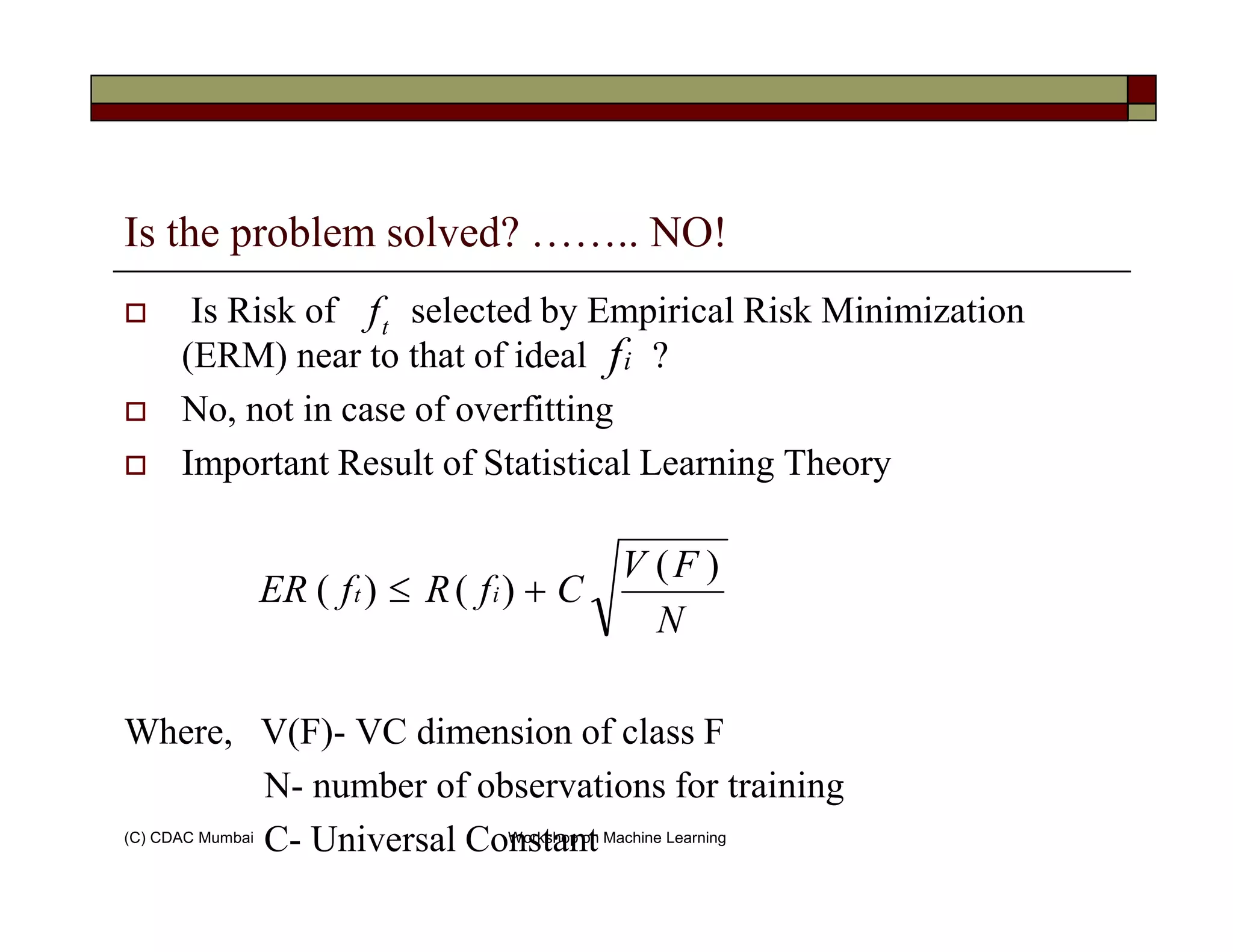
Is the problem solved? …….. NO!
Is Risk of selected by Empirical Risk Minimization
(ERM) near to that of ideal ?
No, not in case of overfitting
Important Result of Statistical Learning Theory
tf
if
(C) CDAC Mumbai Workshop on Machine Learning
Important Result of Statistical Learning Theory
Where, V(F)- VC dimension of class F
N- number of observations for training
C- Universal Constant
N
FV
CfRfER it
)(
)()( +≤
What it says:
Risk of rule selected by ERM is not far from Risk of
the ideal rule if-
1) N is large enough
2)VC dimension of F should be small enough
(C) CDAC Mumbai Workshop on Machine Learning
2)VC dimension of F should be small enough
[VC dimension? In short larger a class F, the larger its VC dimension (Sorry Vapnik sir!)]
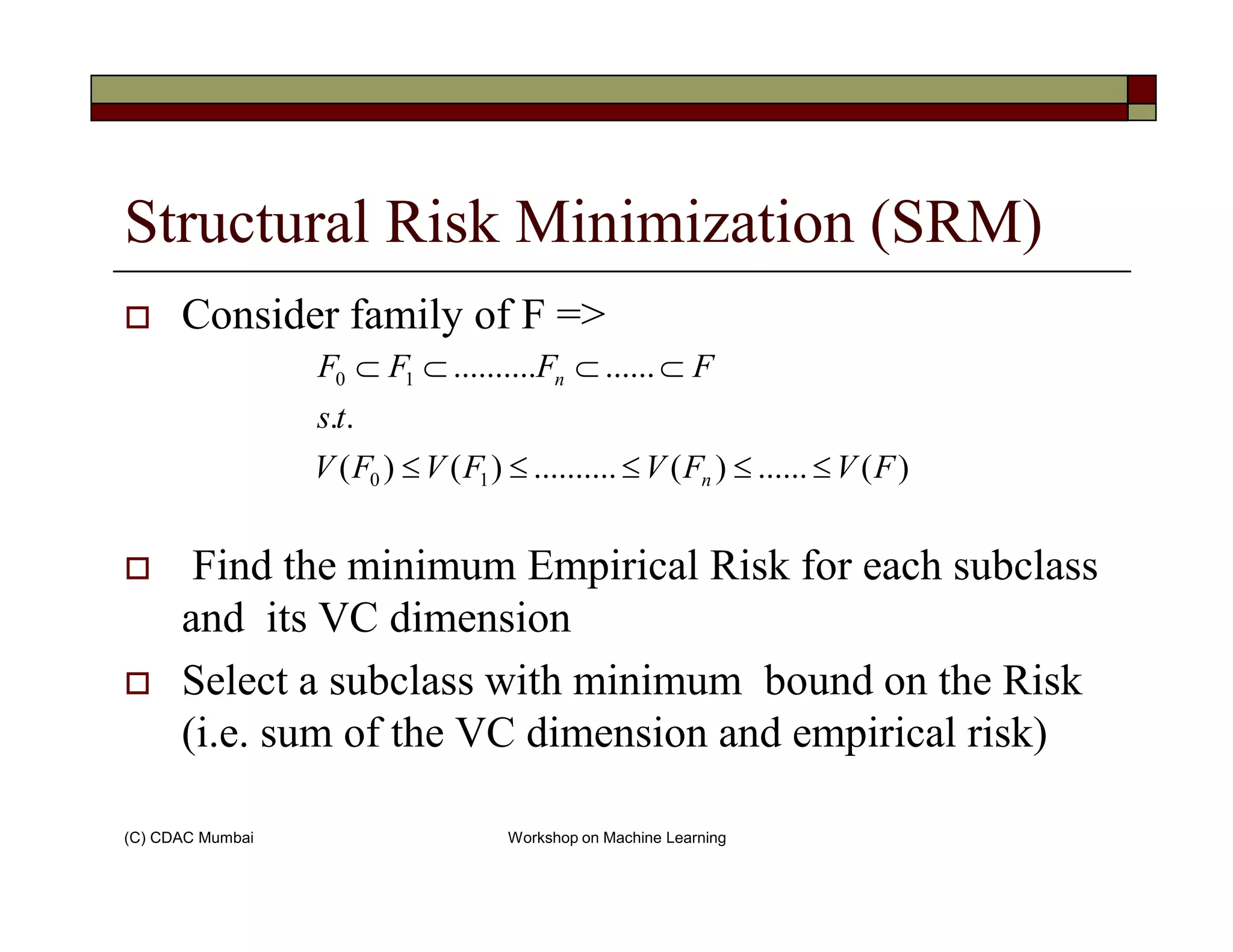
Structural Risk Minimization (SRM)
Consider family of F =>
)(......)(..........)()(
..
................
10
10
FVFVFVFV
ts
FFFF
n
n
≤≤≤≤≤
⊂⊂⊂⊂
(C) CDAC Mumbai Workshop on Machine Learning
Find the minimum Empirical Risk for each subclass
and its VC dimension
Select a subclass with minimum bound on the Risk
(i.e. sum of the VC dimension and empirical risk)
)(......)(..........)()( 10 FVFVFVFV n ≤≤≤≤≤
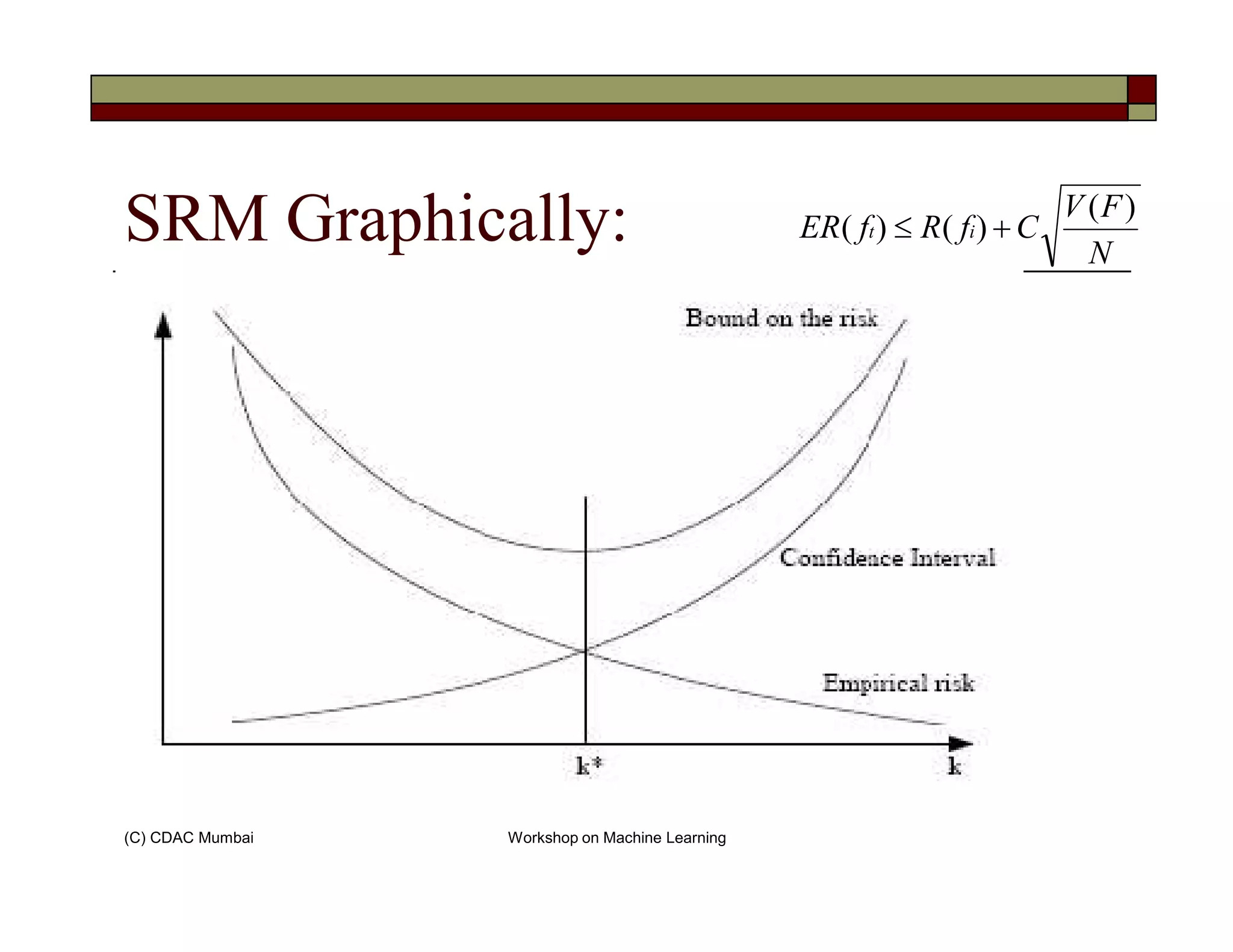
SRM Graphically: N
FV
CfRfER it
)(
)()( +≤
(C) CDAC Mumbai Workshop on Machine Learning
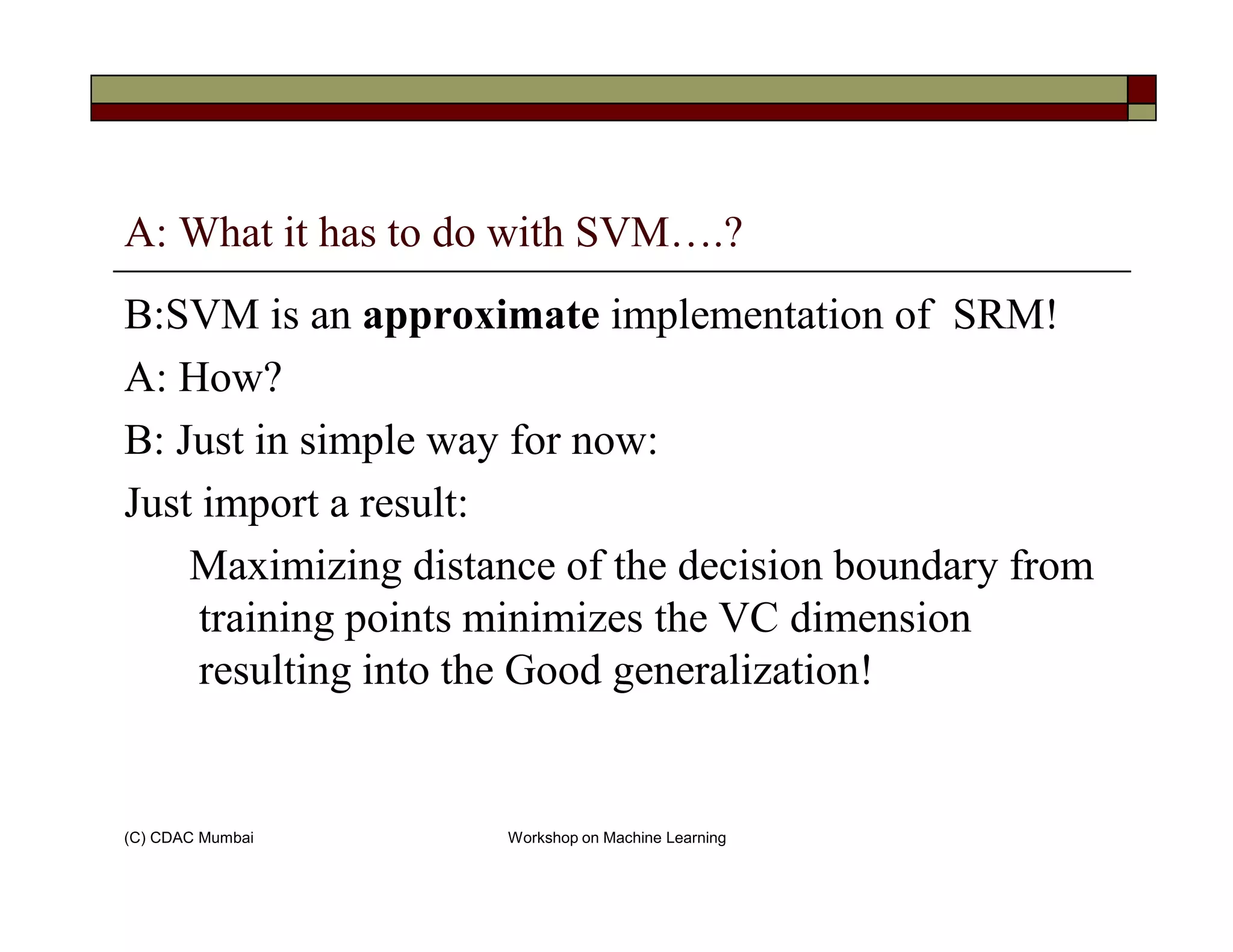
A: What it has to do with SVM….?
B:SVM is an approximate implementation of SRM!
A: How?
B: Just in simple way for now:
(C) CDAC Mumbai Workshop on Machine Learning
Just import a result:
Maximizing distance of the decision boundary from
training points minimizes the VC dimension
resulting into the Good generalization!
A: Means Now onwards our target is Maximizing Distance
between decision boundary and the Training points!
B: Yeah, Right!
A: Ok, I am convinced that SVM will generalize well,
but can you please explain what is the concept of
SVM and how to implement it, are there any
(C) CDAC Mumbai Workshop on Machine Learning
SVM and how to implement it, are there any
packages available?
B: Yeah, don’t worry, there are many implementations
available, just use them for your application, now the
next part of the presentation will give a basic idea
about the SVM, so be with me!
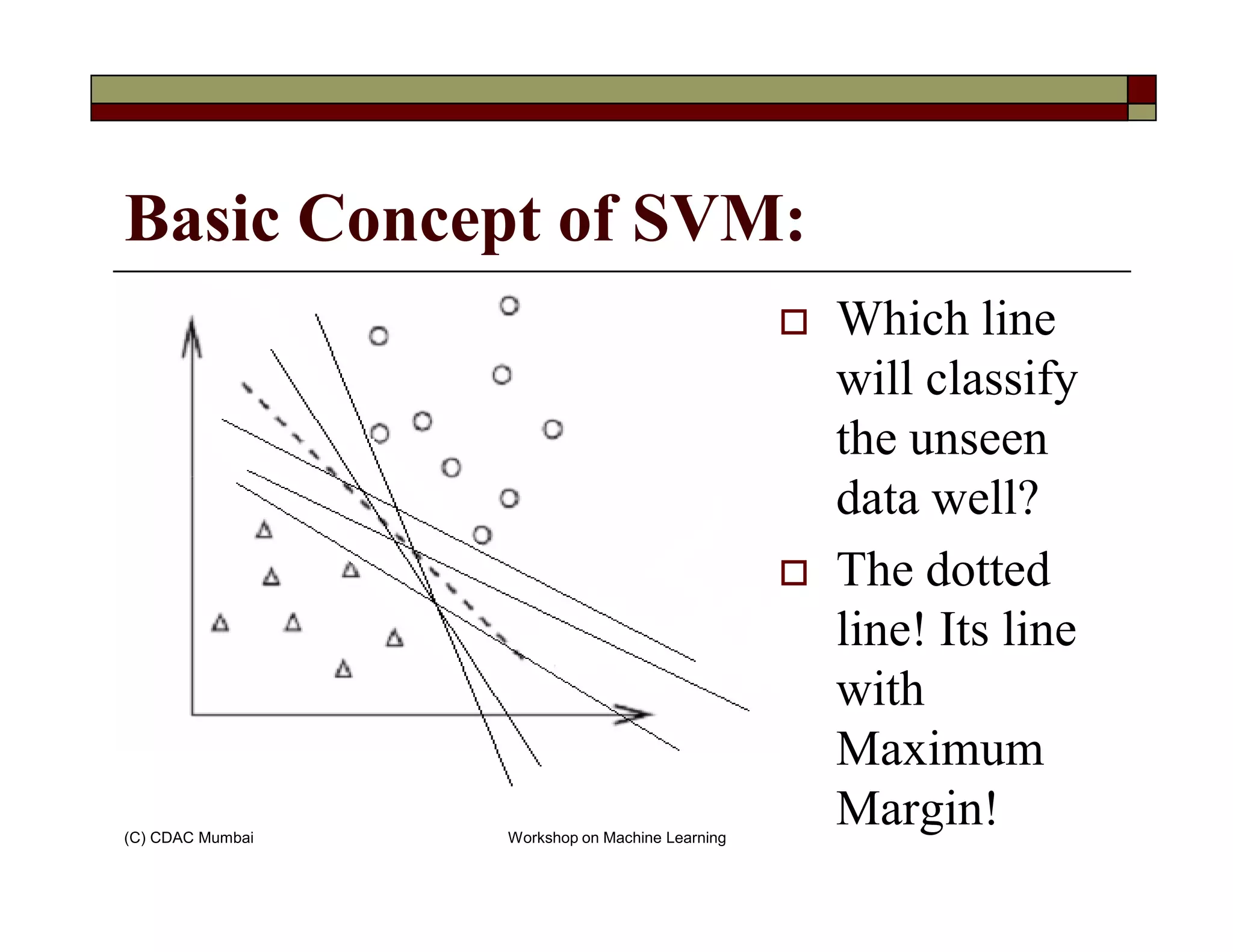
Basic Concept of SVM:
Which line
will classify
the unseen
data well?
(C) CDAC Mumbai Workshop on Machine Learning
data well?
The dotted
line! Its line
with
Maximum
Margin!
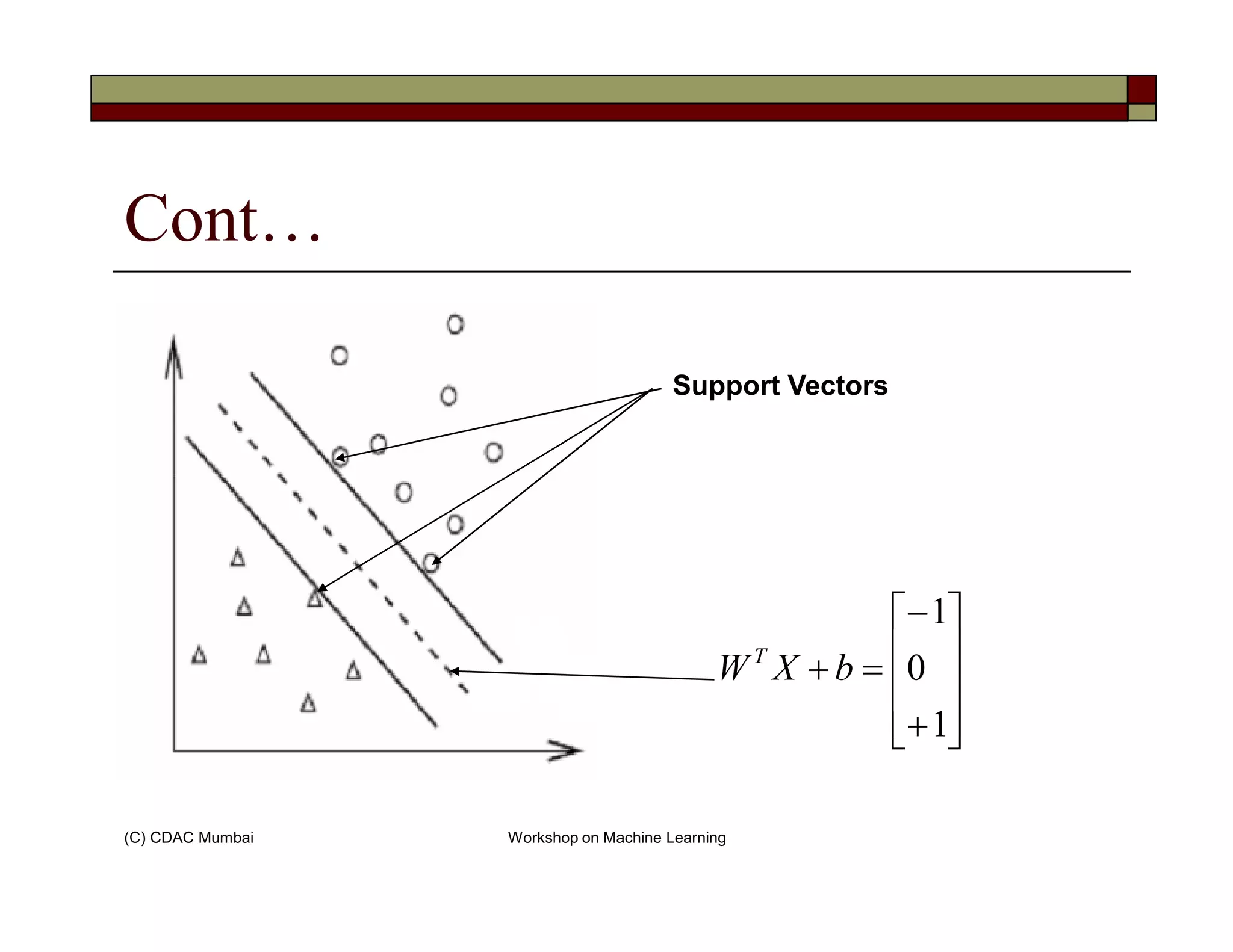
Cont…
Support Vectors Support Vectors
(C) CDAC Mumbai Workshop on Machine Learning










+
−
=+
1
0
1
bXWT
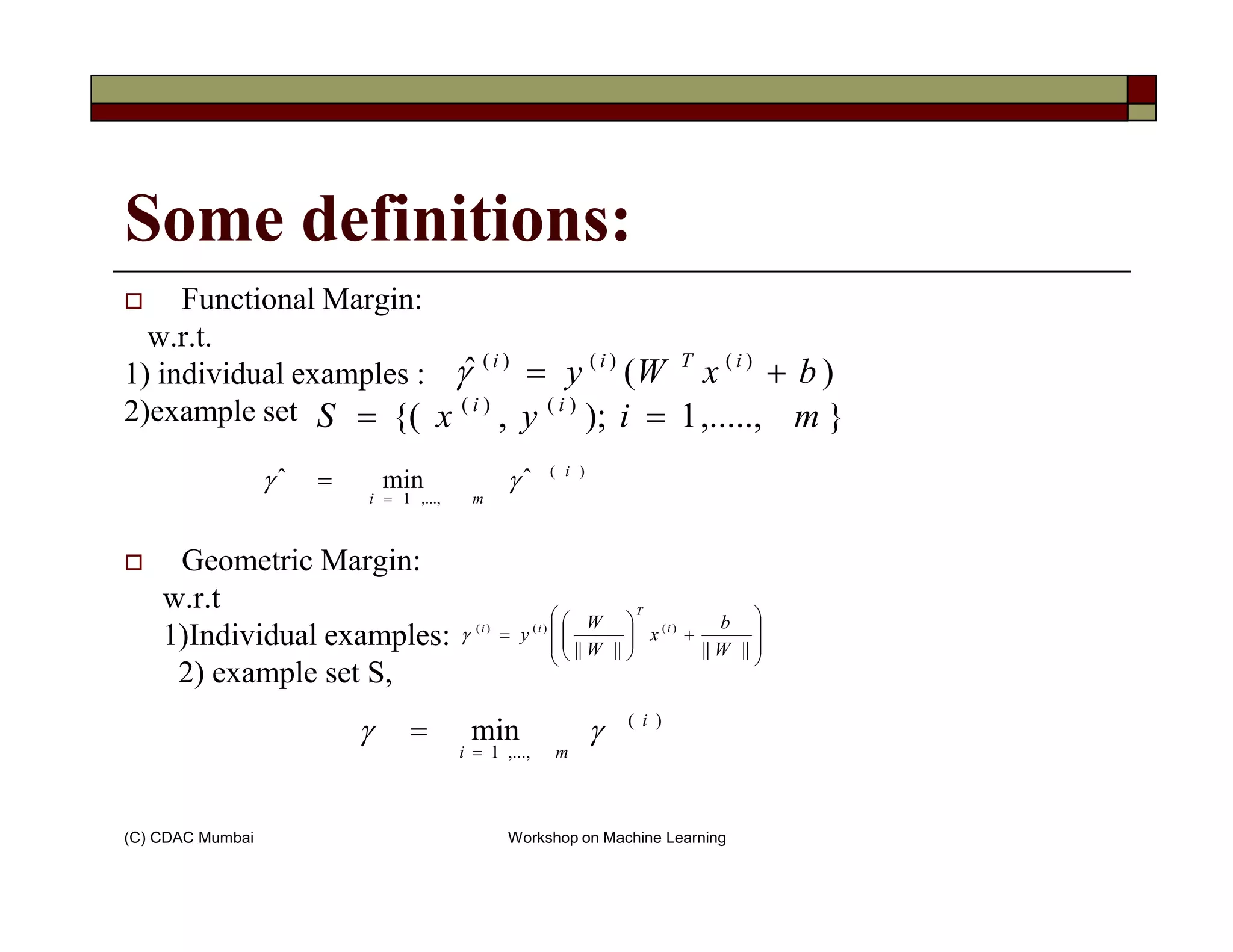
Some definitions:
Functional Margin:
w.r.t.
1) individual examples :
2)example set },.....,1);,{( )()(
miyxS ii
==
)(ˆ )()()(
bxWy iTii
+=γ
)(
ˆminˆ i
γγ =
(C) CDAC Mumbai Workshop on Machine Learning
Geometric Margin:
w.r.t
1)Individual examples:
2) example set S,
)(
,...,1
ˆminˆ i
mi
γγ
=
=








+





=
||||||||
)()()(
W
b
x
W
W
y i
T
ii
γ
)(
,...,1
min i
mi
γγ
=
=
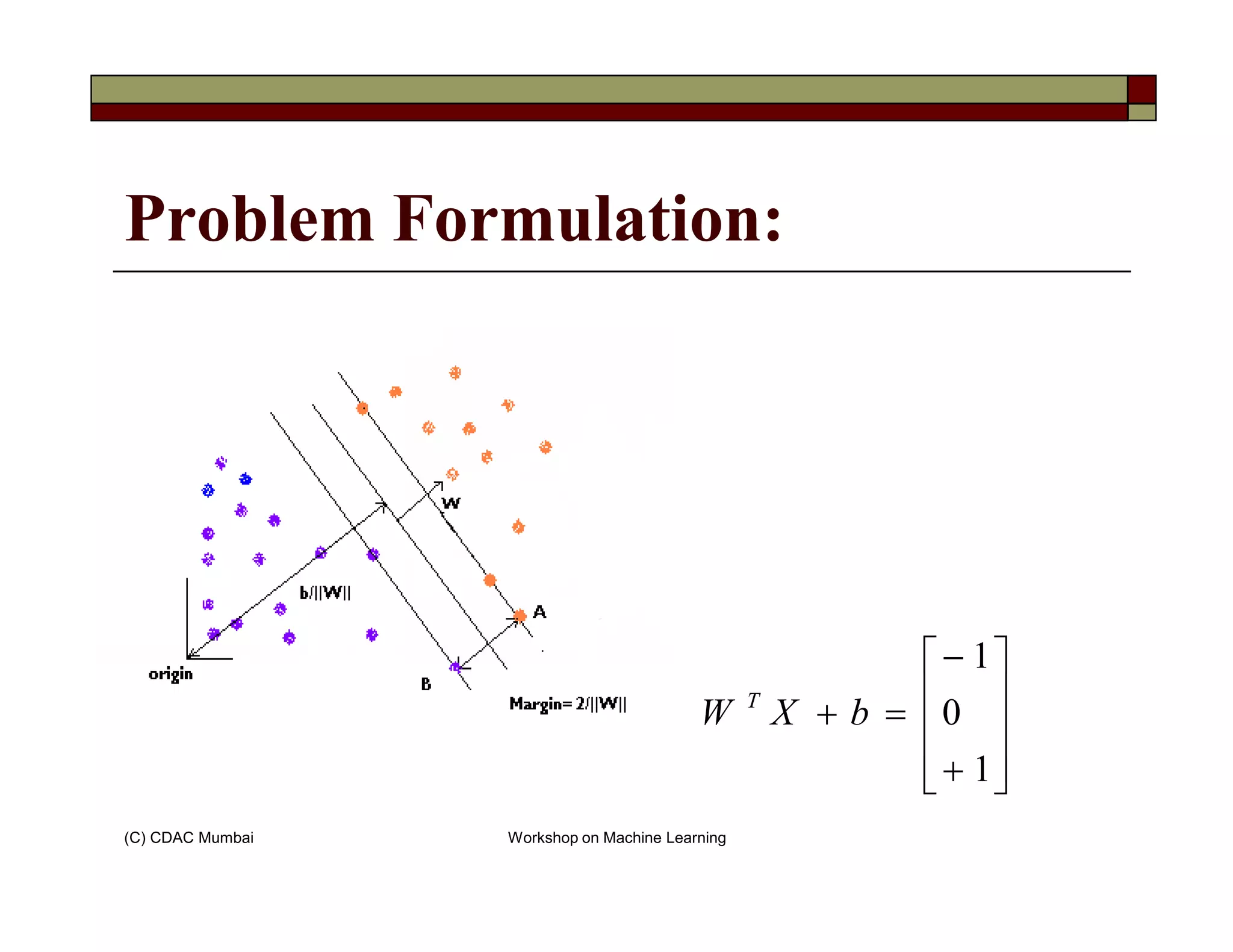
Problem Formulation:
(C) CDAC Mumbai Workshop on Machine Learning










+
−
=+
1
0
1
bXW T
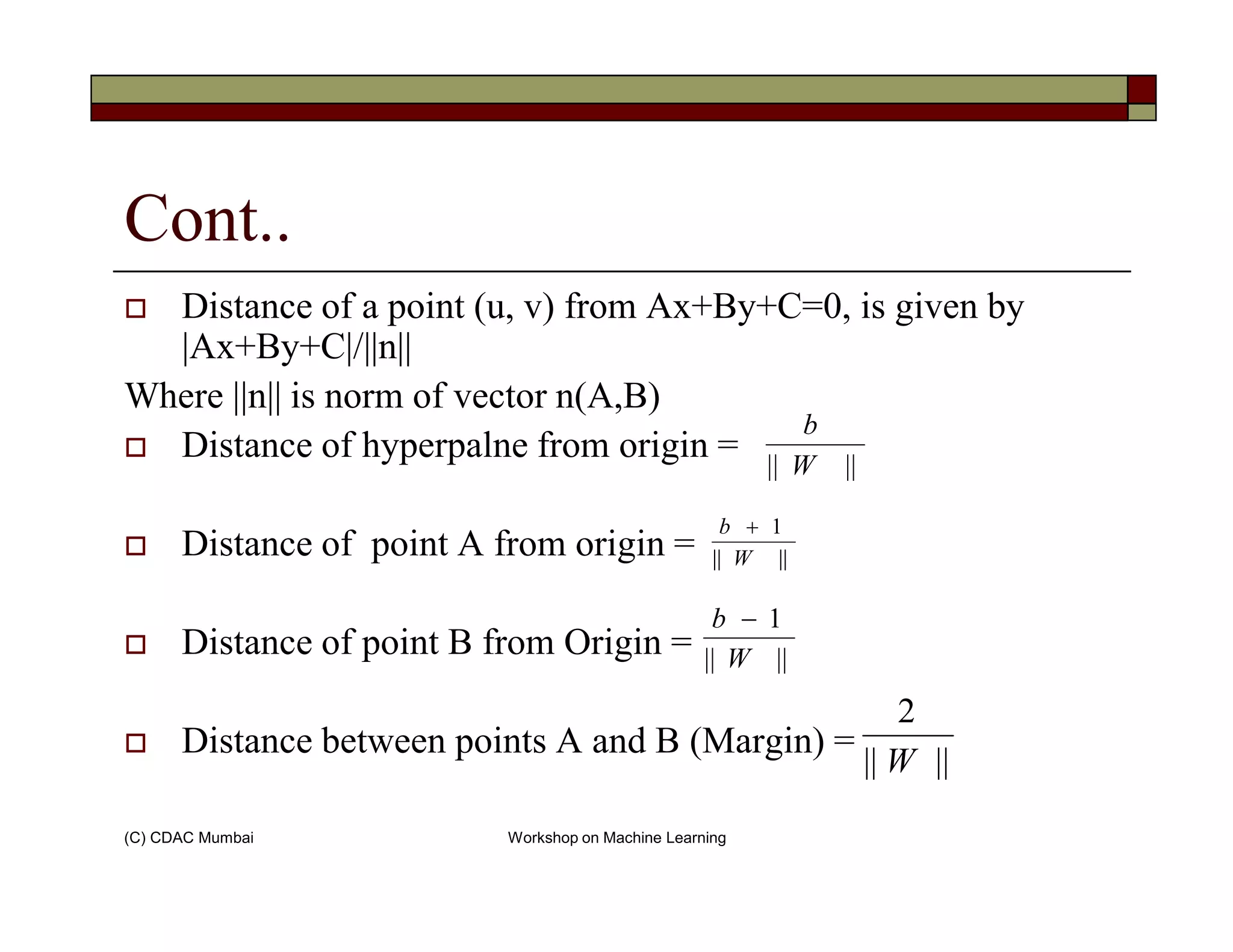
Cont..
Distance of a point (u, v) from Ax+By+C=0, is given by
|Ax+By+C|/||n||
Where ||n|| is norm of vector n(A,B)
Distance of hyperpalne from origin = |||| W
b
(C) CDAC Mumbai Workshop on Machine Learning
Distance of point A from origin =
Distance of point B from Origin =
Distance between points A and B (Margin) =
|||| W
||||
1
W
b +
||||
1
W
b −
||||
2
W
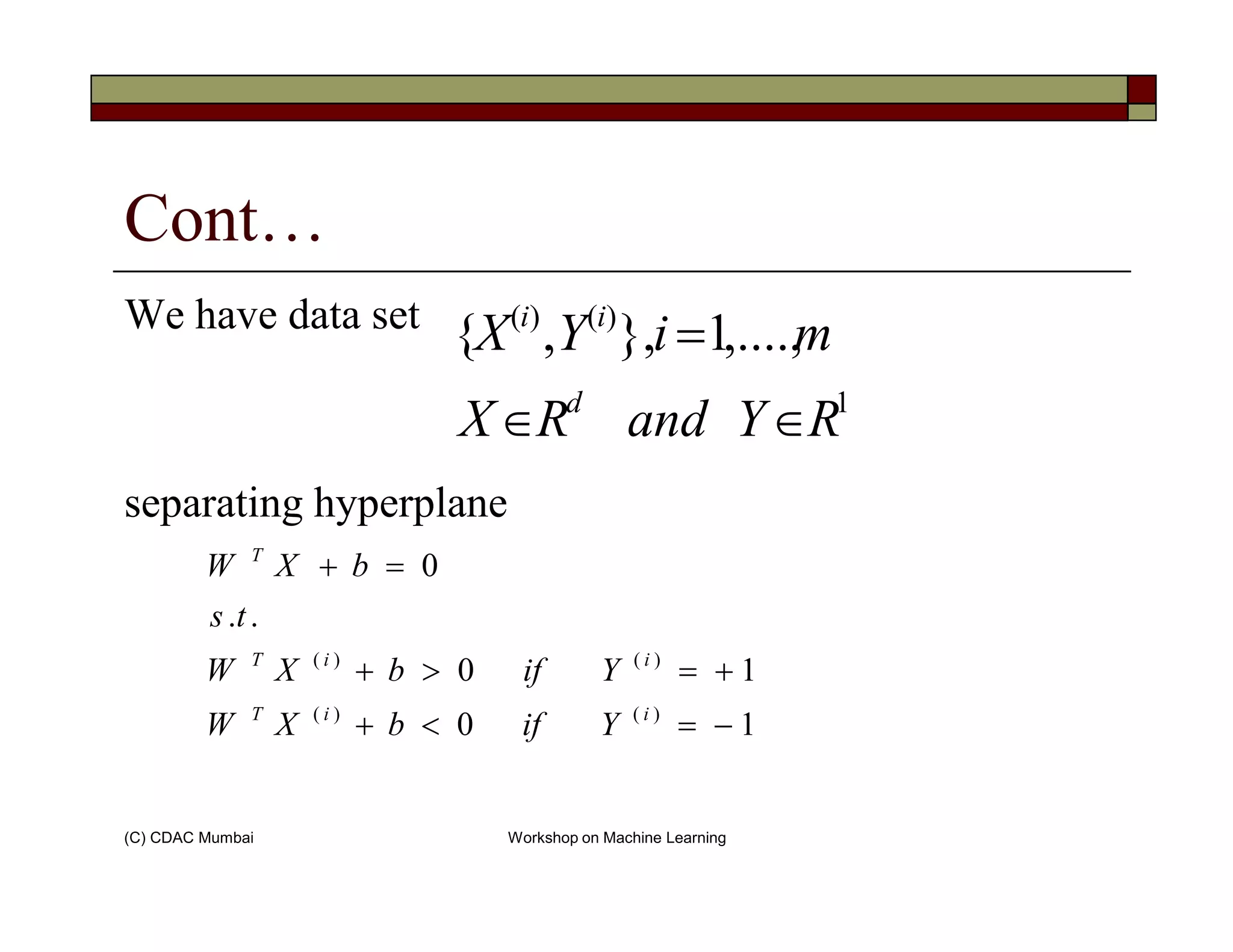
Cont…
We have data set
1
)()(
,....,1},,{
RYandRX
miYX
d
ii
∈∈
=
(C) CDAC Mumbai Workshop on Machine Learning
separating hyperplane
10
10
..
0
)()(
)()(
−=<+
+=>+
=+
iiT
iiT
T
YifbXW
YifbXW
ts
bXW
Cont…
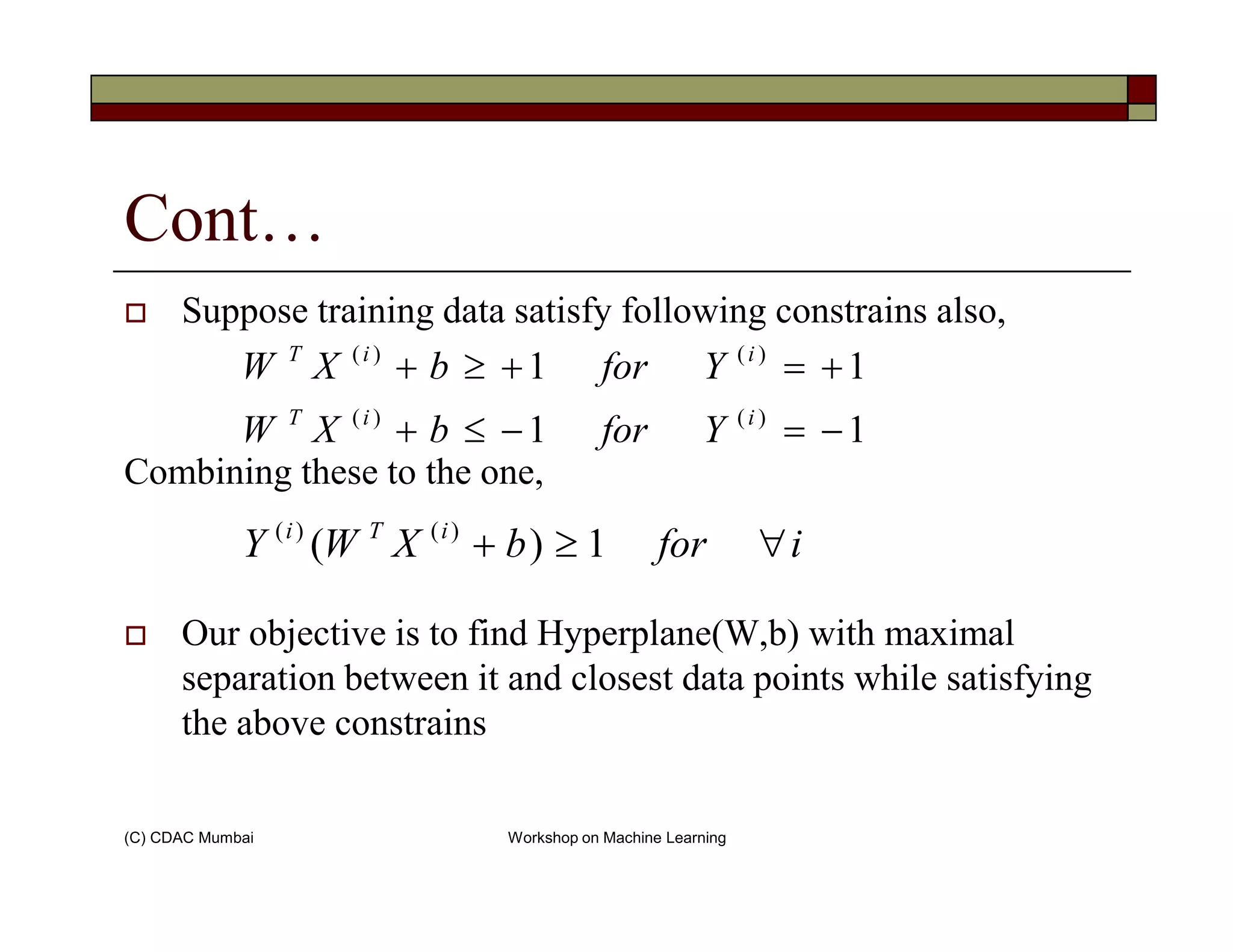
Suppose training data satisfy following constrains also,
Combining these to the one,
11
11
)()(
)()(
−=−≤+
+=+≥+
iiT
iiT
YforbXW
YforbXW
(C) CDAC Mumbai Workshop on Machine Learning
Combining these to the one,
Our objective is to find Hyperplane(W,b) with maximal
separation between it and closest data points while satisfying
the above constrains
iforbXWY iTi
∀≥+ 1)( )()(
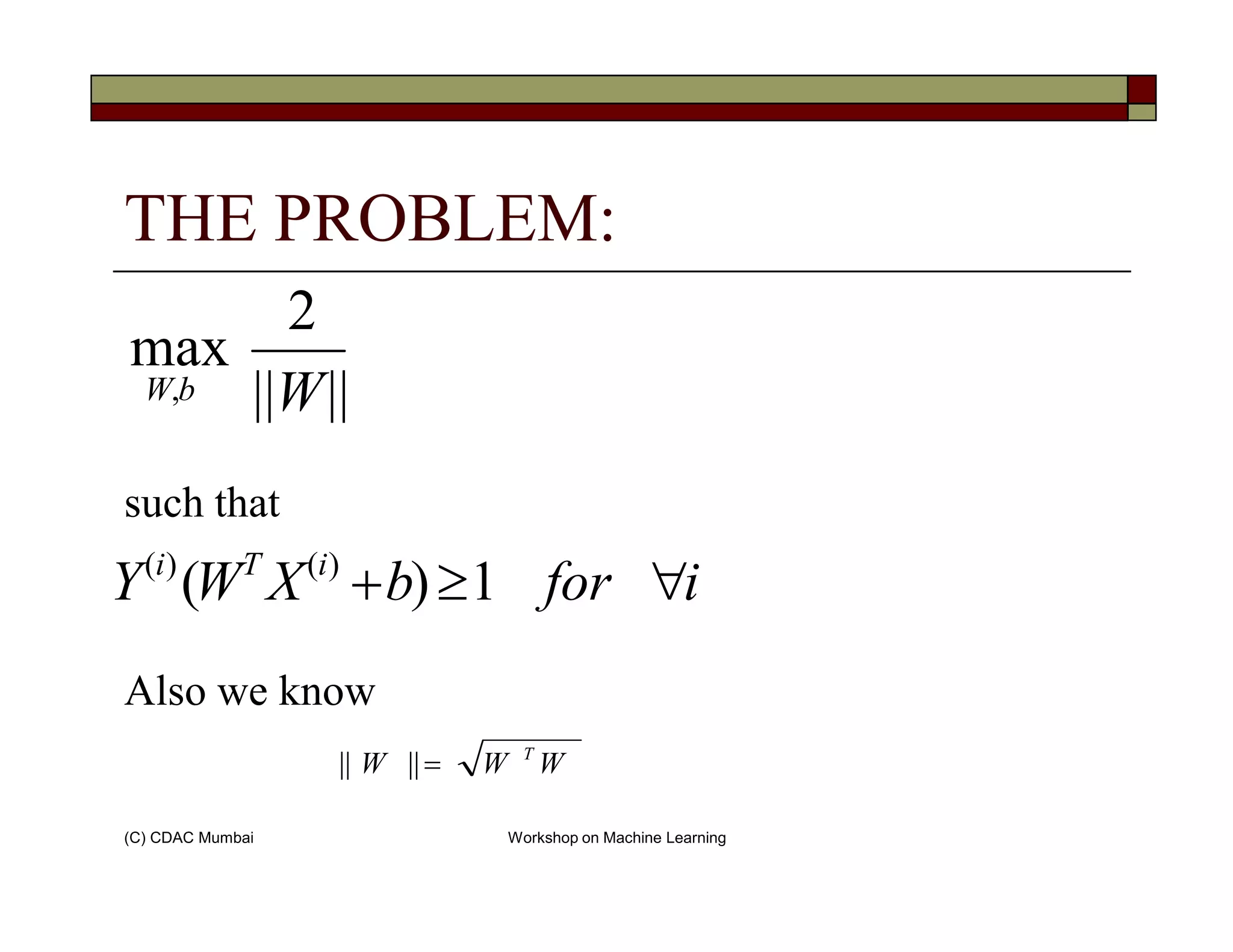
THE PROBLEM:
||||
2
max
, WbW
(C) CDAC Mumbai Workshop on Machine Learning
such that
Also we know
iforbXWY iTi
∀≥+ 1)( )()(
WWW T
=||||
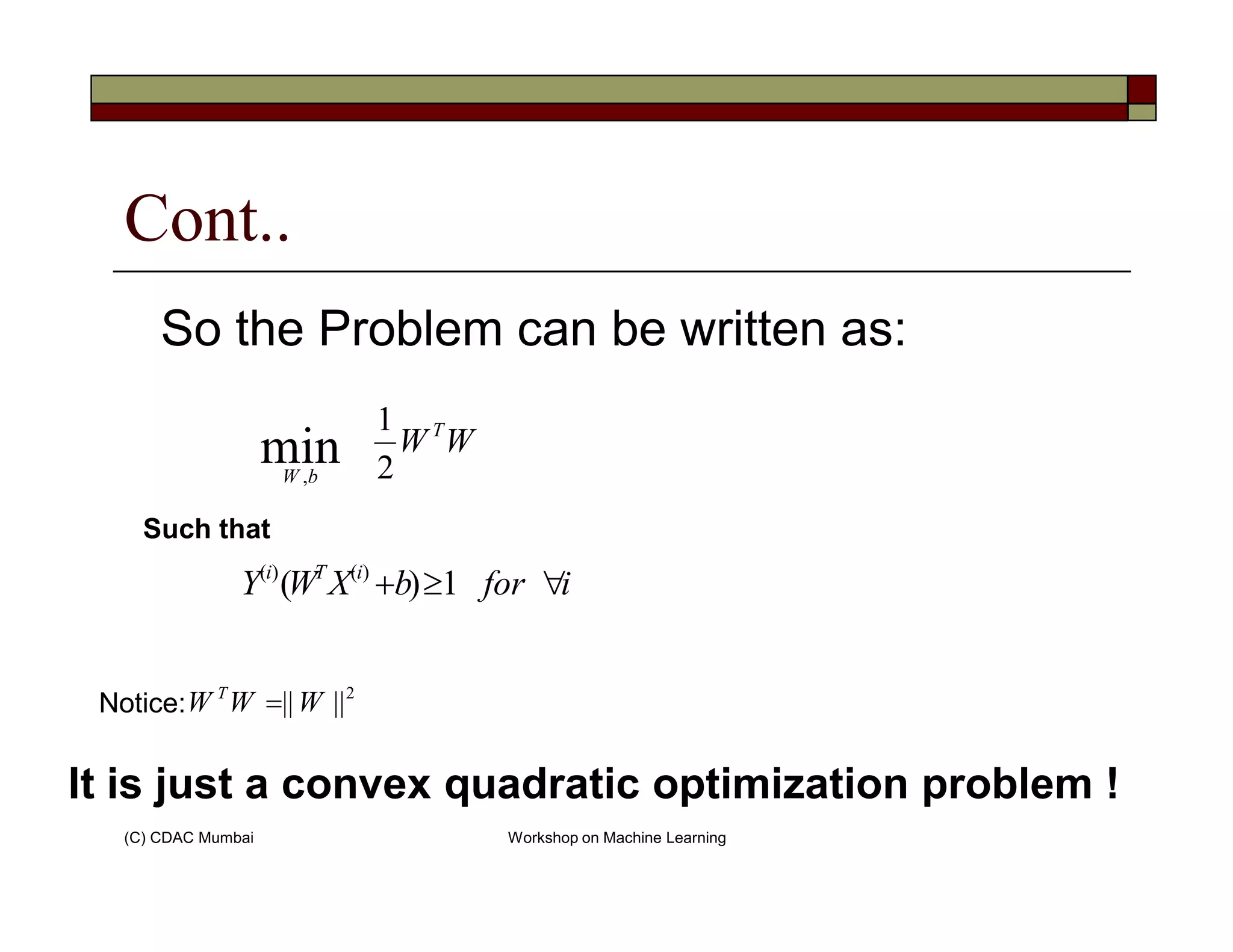
Cont..
WW T
bW 2
1
min,
So the Problem can be written as:
(C) CDAC Mumbai Workshop on Machine Learning
bW 2,
iforbXWY iTi
∀≥+ 1)( )()(
Such that
It is just a convex quadratic optimization problem !
2
||||WWW T
=Notice:
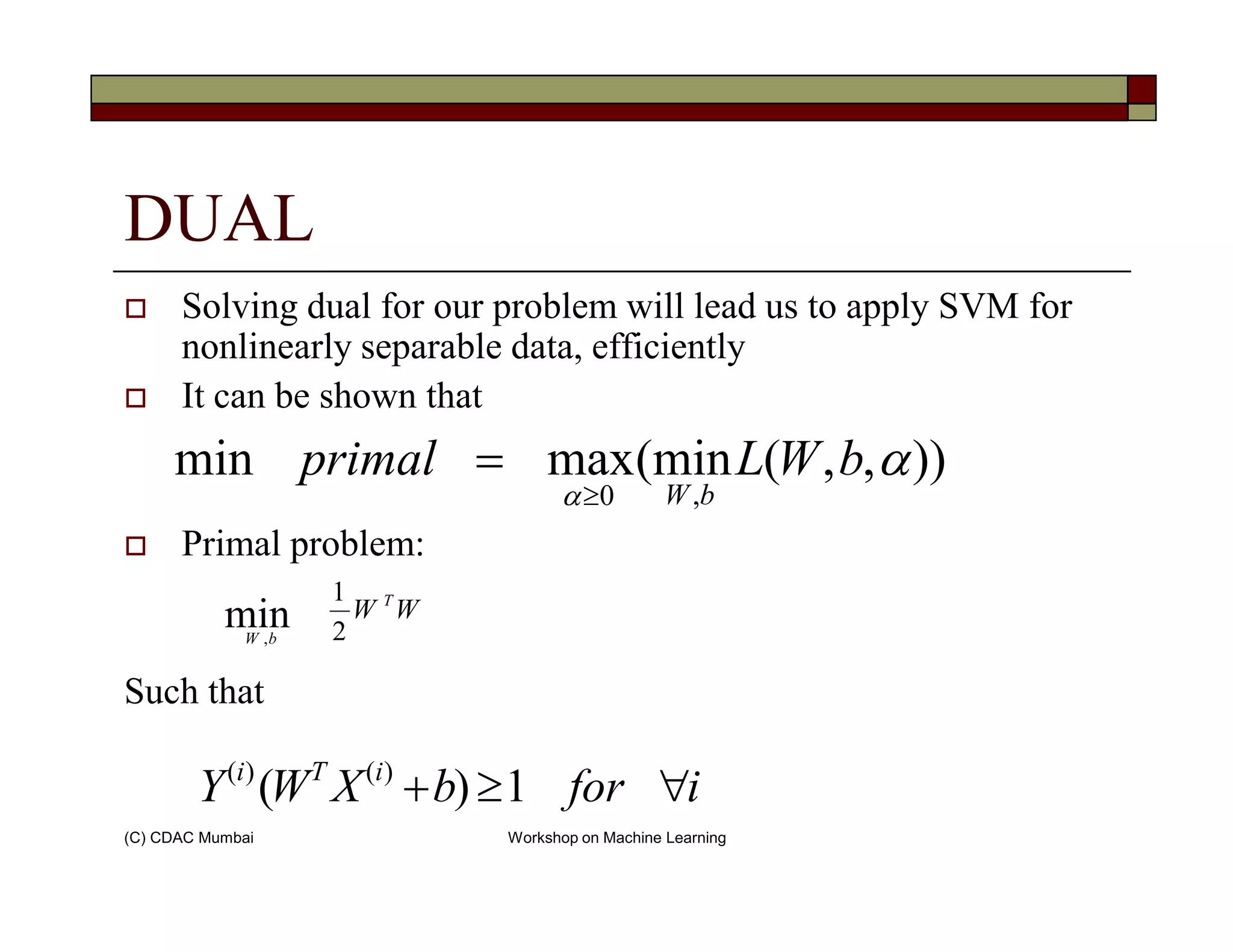
DUAL
Solving dual for our problem will lead us to apply SVM for
nonlinearly separable data, efficiently
It can be shown that
)),,(min(maxmin α
α
bWLprimal
≥
=
(C) CDAC Mumbai Workshop on Machine Learning
Primal problem:
Such that
)),,(min(maxmin
,0
α
α
bWLprimal
bW≥
=
WW T
bW 2
1
min,
iforbXWY iTi
∀≥+ 1)( )()(
Constructing Lagrangian
Lagrangian for our problem:
[ ]∑ −+−=
m
iTi
i bXWYWbWL )()(2
1)(||||
2
1
),,( αα
(C) CDAC Mumbai Workshop on Machine Learning
Where a Lagrange multiplier and
Now minimizing it w.r.t. W and b:
We set derivatives of Lagrangian w.r.t. W and b to zero
[ ]∑=
−+−=
i
i bXWYWbWL
1
1)(||||
2
),,( αα
α 0≥iα
Cont…
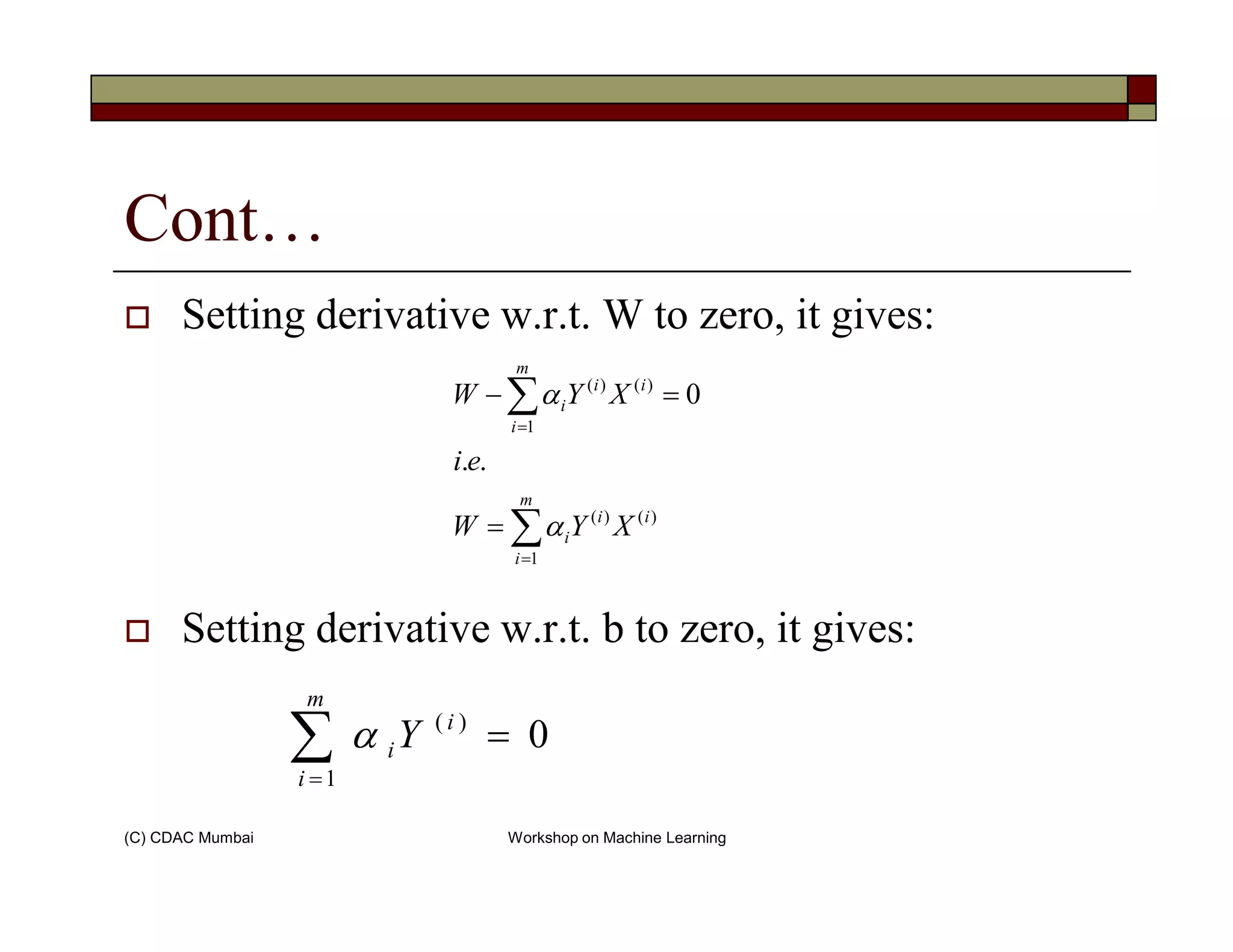
Setting derivative w.r.t. W to zero, it gives:
)(
1
)(
..
0i
m
i
i
i
ei
XYW ∑=
=− α
(C) CDAC Mumbai Workshop on Machine Learning
Setting derivative w.r.t. b to zero, it gives:
)(
1
)(
..
i
m
i
i
i XYW
ei
∑=
= α
∑=
=
m
i
i
iY
1
)(
0α
Cont…
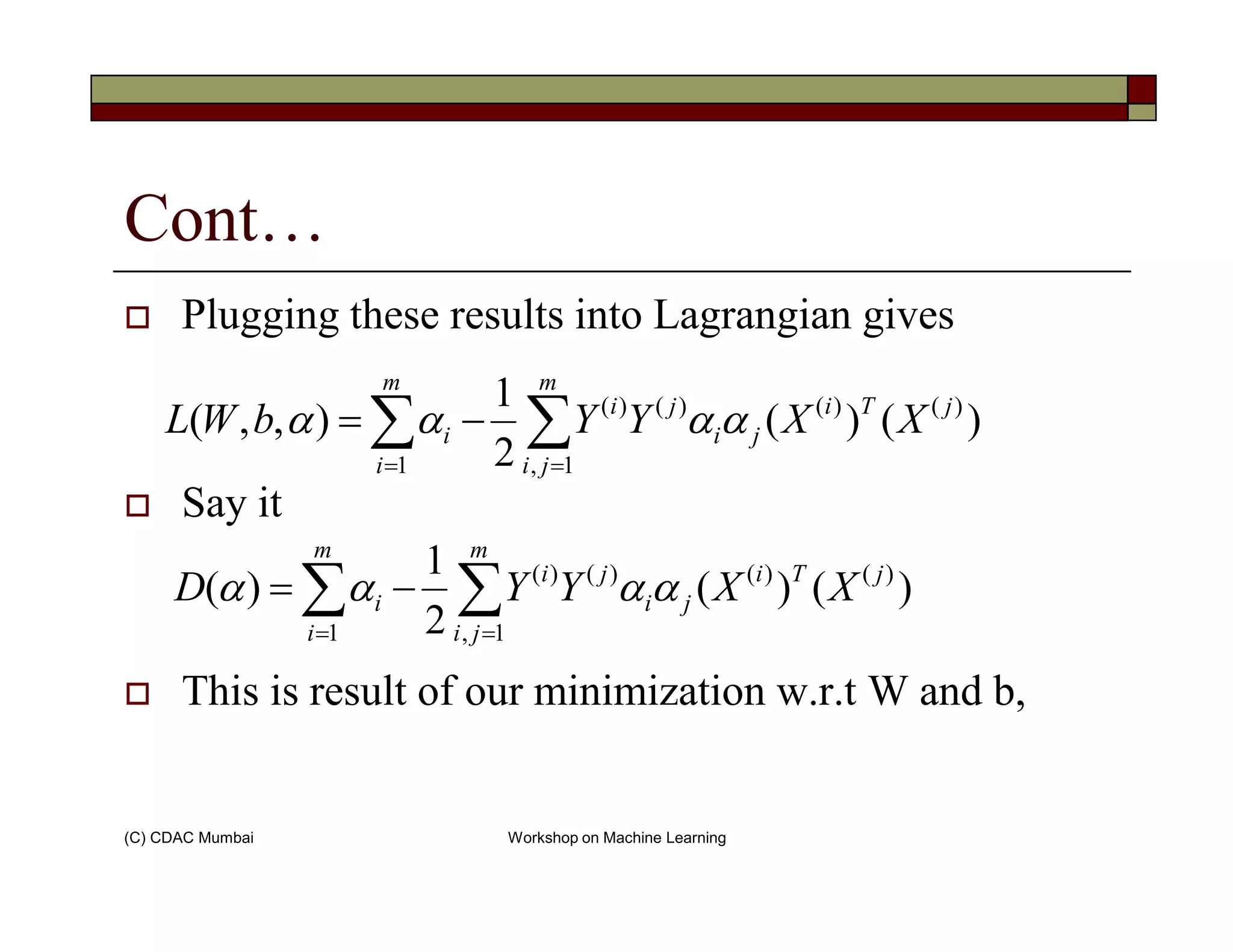
Plugging these results into Lagrangian gives
∑∑ ==
−=
m
ji
jTi
ji
ji
m
i
i XXYYbWL
1,
)()()()(
1
)()(
2
1
),,( αααα
(C) CDAC Mumbai Workshop on Machine Learning
Say it
This is result of our minimization w.r.t W and b,
== jii 1,1
∑∑ ==
−=
m
ji
jTi
ji
ji
m
i
i XXYYD
1,
)()()()(
1
)()(
2
1
)( αααα
So The DUAL:
Now Dual becomes::
∑∑ ==
=≥
−=
i
m
ji
ji
ji
ji
m
i
i
mi
ts
XXYYD
1,
)()()()(
1
,...,1,0
..
,
2
1
)(max
α
αααα
α
(C) CDAC Mumbai Workshop on Machine Learning
Solving this optimization problem gives us
Also Karush-Kuhn-Tucker (KKT) condition is
satisfied at this solution i.e.
∑=
=
=≥
m
i
i
i
i
Y
mi
1
)(
0
,...,1,0
α
α
iα
[ ] miforbXWY iTi
i ,...,1,01)( )()(
==−+α
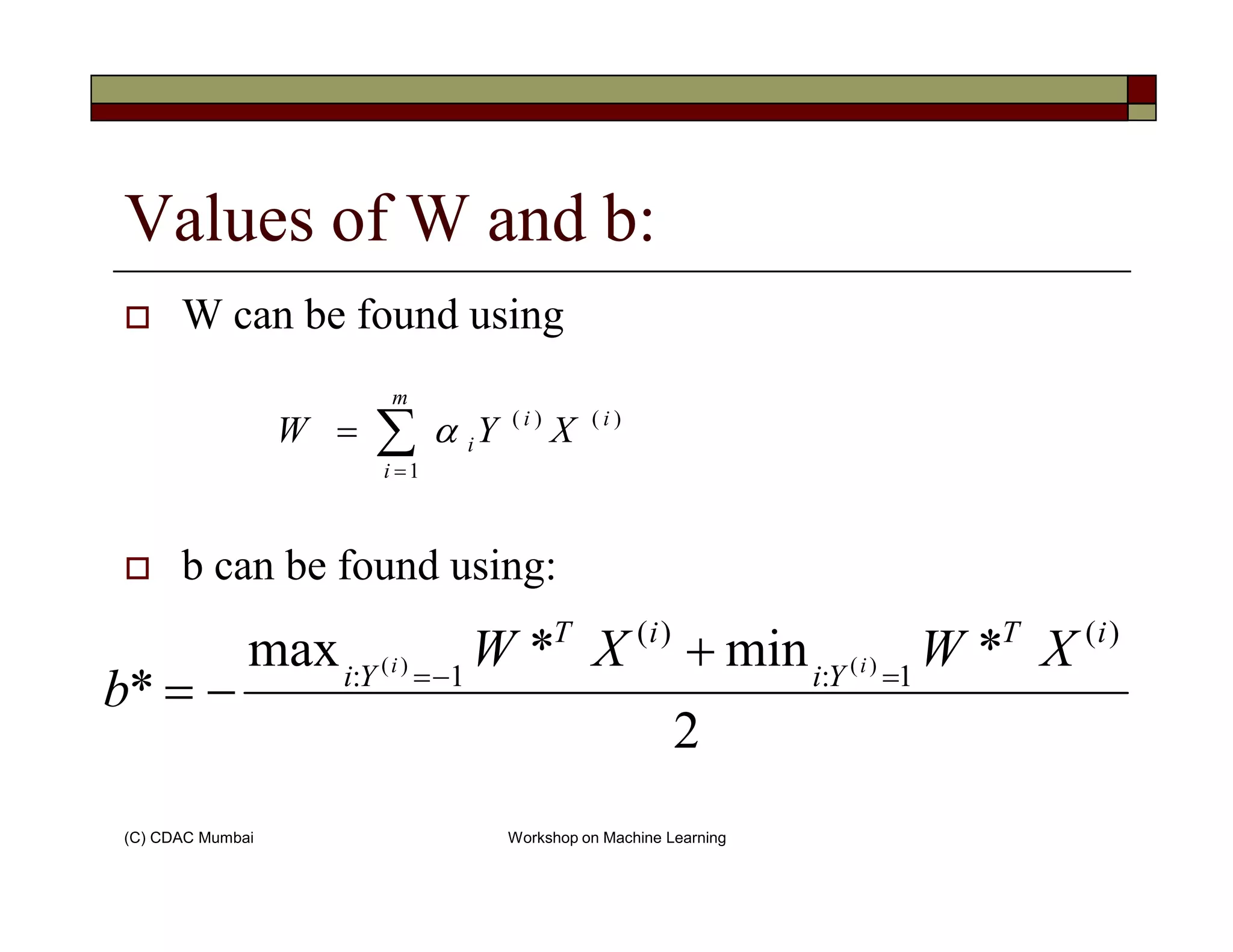
Values of W and b:
W can be found using
)(
1
)( i
m
i
i
i XYW ∑=
= α
(C) CDAC Mumbai Workshop on Machine Learning
b can be found using:
1i =
2
*min*max
*
)(
1:
)(
1: )()(
iT
Yi
iT
Yi
XWXW
b
ii
=−=
+
−=
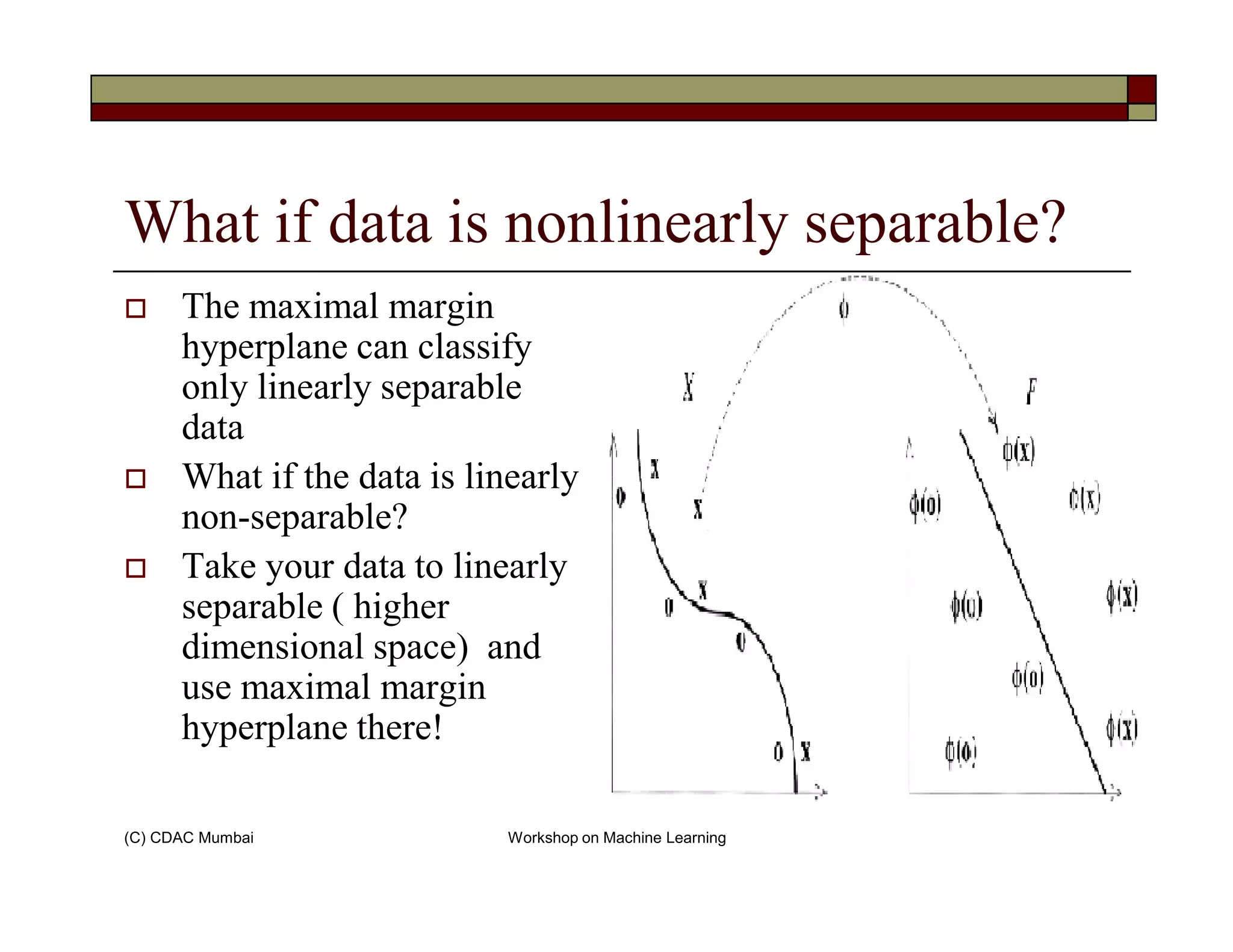
What if data is nonlinearly separable?
The maximal margin
hyperplane can classify
only linearly separable
data
What if the data is linearly
(C) CDAC Mumbai Workshop on Machine Learning
What if the data is linearly
non-separable?
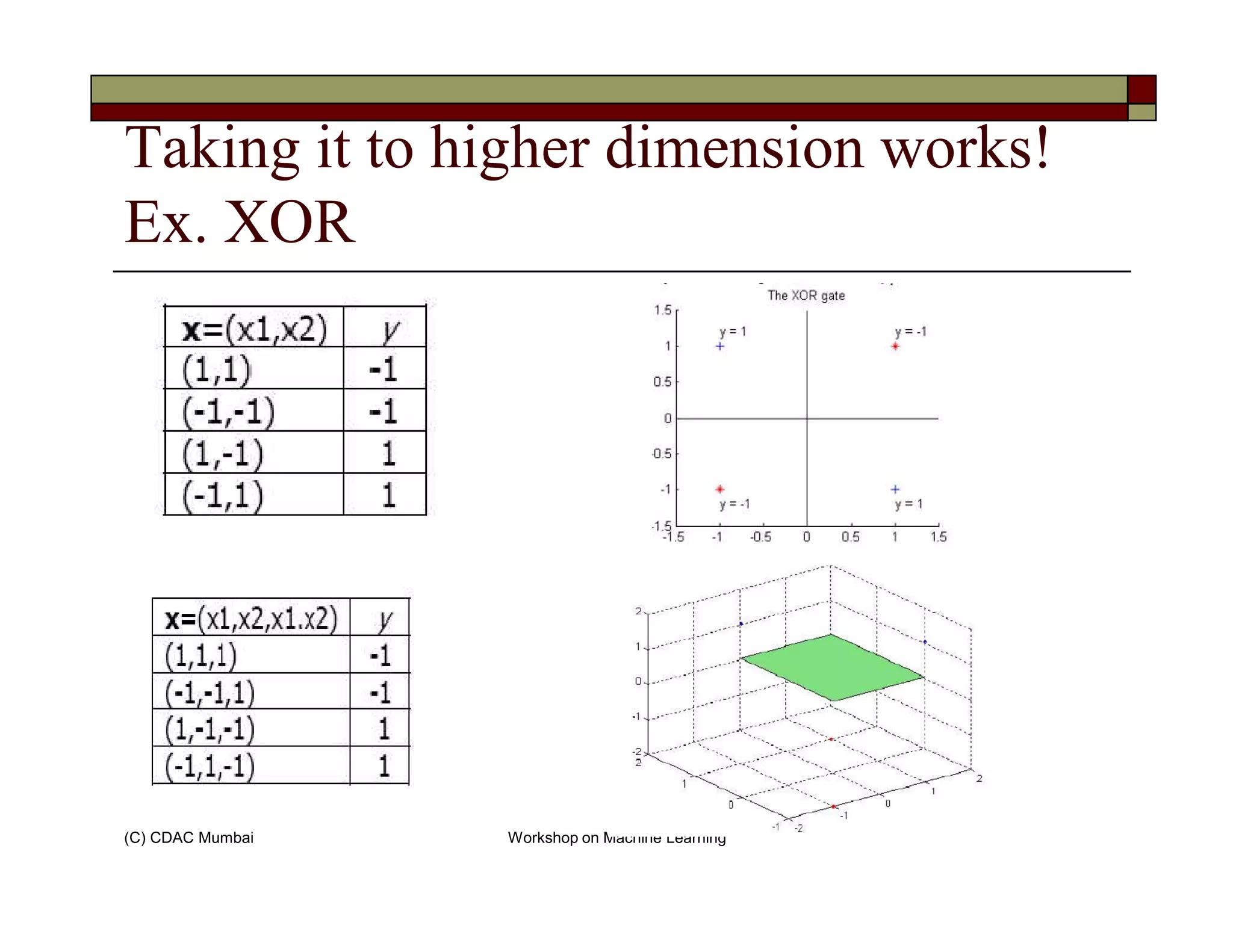
Take your data to linearly
separable ( higher
dimensional space) and
use maximal margin
hyperplane there!
Taking it to higher dimension works!
Ex. XOR
(C) CDAC Mumbai Workshop on Machine Learning
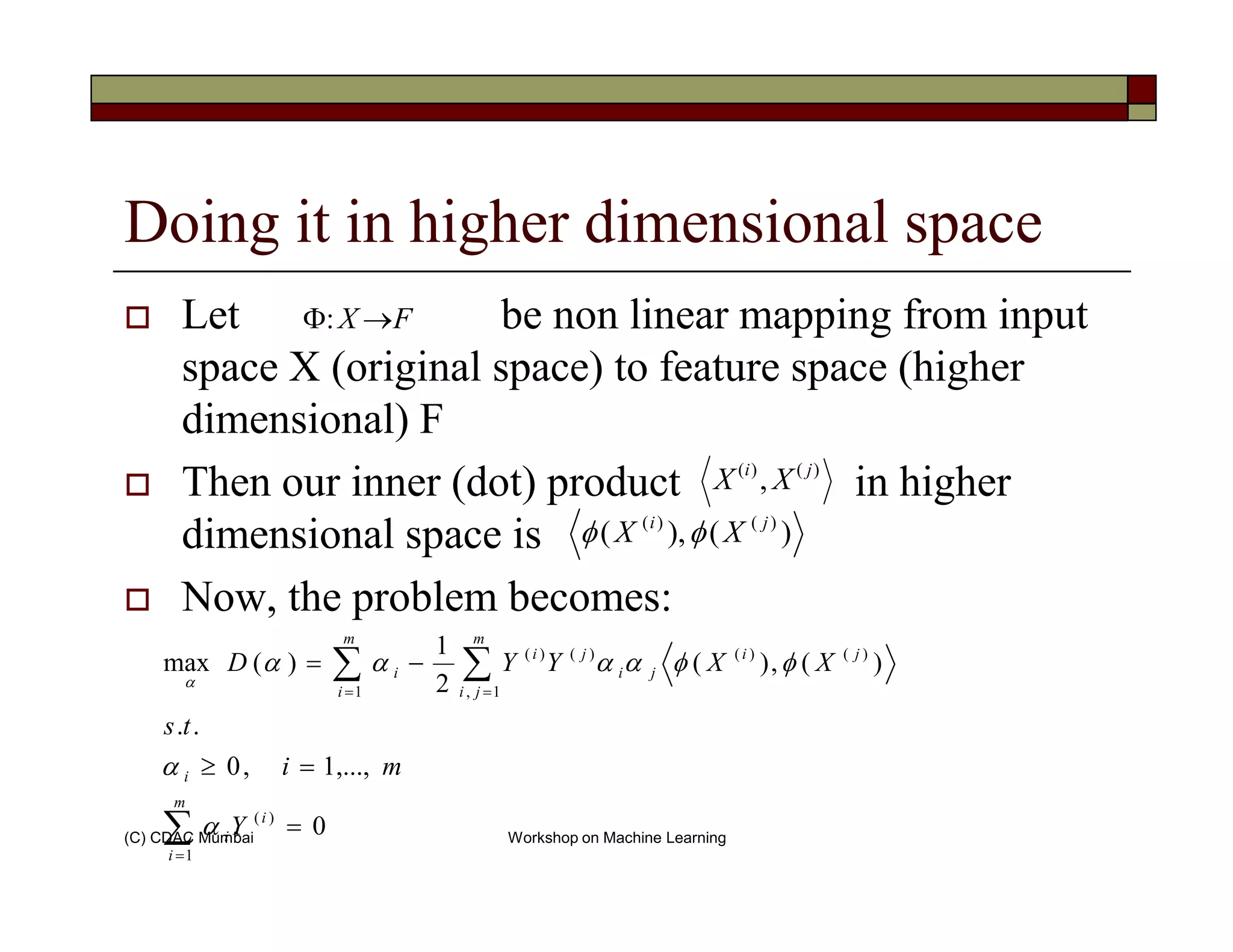
Doing it in higher dimensional space
Let be non linear mapping from input
space X (original space) to feature space (higher
dimensional) F
Then our inner (dot) product in higher
FX →Φ:
)()(
, ji
XX
(C) CDAC Mumbai Workshop on Machine Learning
Then our inner (dot) product in higher
dimensional space is
Now, the problem becomes:
)()(
, ji
XX
)(),( )()( ji
XX φφ
∑
∑∑
=
==
=
=≥
−=
m
i
i
i
i
m
ji
ji
ji
ji
m
i
i
Y
mi
ts
XXYYD
1
)(
1,
)()()()(
1
0
,...,1,0
..
)(,)(
2
1
)(max
α
α
φφαααα
α
Kernel function:
There exist a way to compute inner product in feature
space as function of original input points – Its kernel
function!
Kernel function:
(C) CDAC Mumbai Workshop on Machine Learning
Kernel function:
We need not know to compute
)(),(),( zxzxK φφ=
),( zxKφ
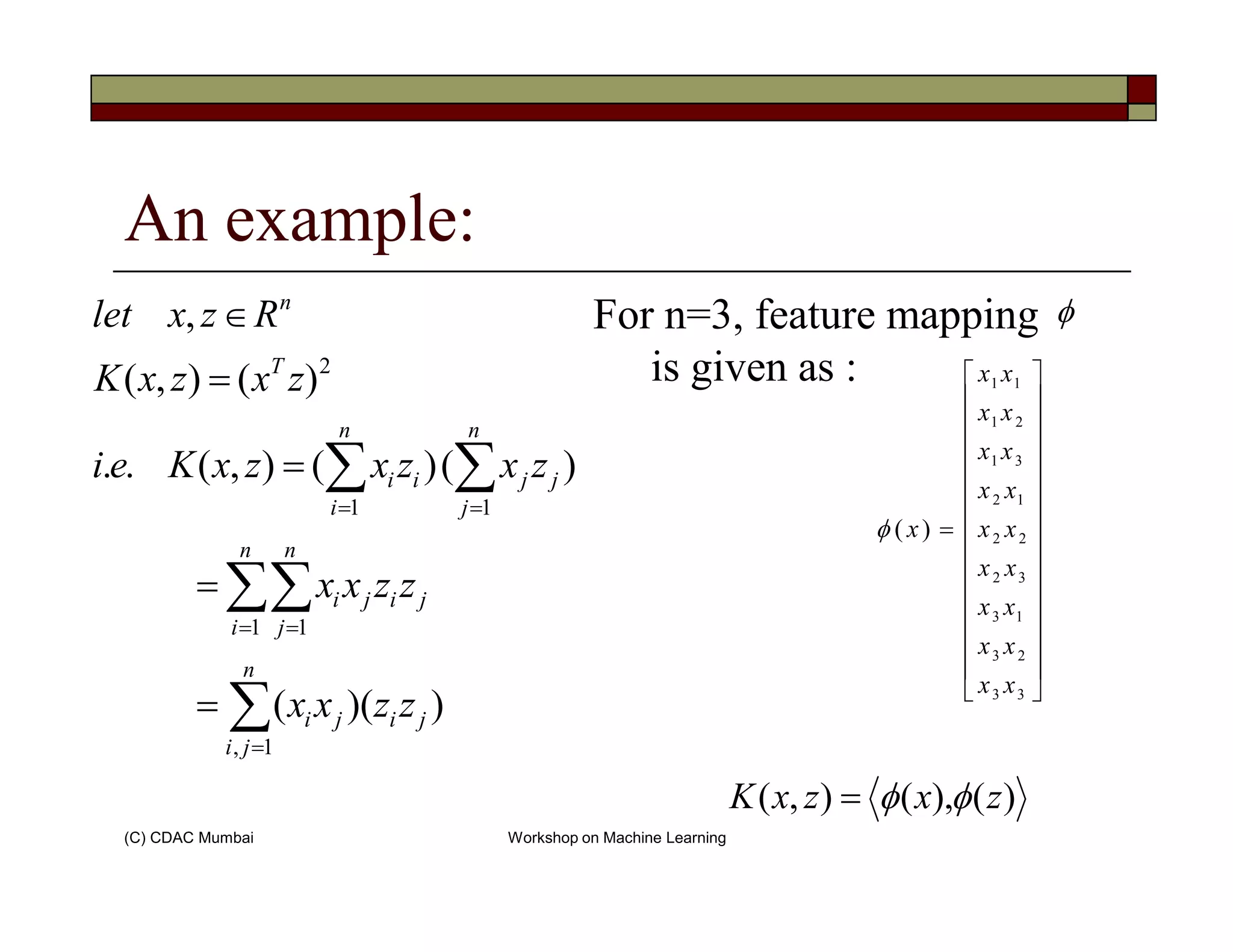
An example:
For n=3, feature mapping
is given as :
∑∑=
=
∈
n
jj
n
ii
T
n
zxzxzxKei
zxzxK
Rzxlet
2
)()(),(..
)(),(
, φ










31
21
11
xx
xx
xx
xx
(C) CDAC Mumbai Workshop on Machine Learning
∑
∑∑
∑∑
=
= =
==
=
=
=
n
ji
jiji
n
i
n
j
jiji
j
jj
i
ii
zzxx
zzxx
zxzxzxKei
1,
1 1
11
))((
)()(),(..




















=
33
23
13
32
22
12
)(
xx
xx
xx
xx
xx
xx
xφ
)(),(),( zxzxK φφ=
example cont…
Here,
31
)(),( 2

=

=
=
zx
zxzxK
for
T
4
2
2
1
)(
22
12
21
11












=












=
xx
xx
xx
xx
xφ
(C) CDAC Mumbai Workshop on Machine Learning
[ ]
121)(),(
11
4
3
21
4
3
2
1
2
==
=






=






=





=
zxzxK
zx
zx
T
T
[ ]
121
16
12
12
9
4221)()(
16
12
12
9
)(
=












=












=
zx
z
T
φφ
φ
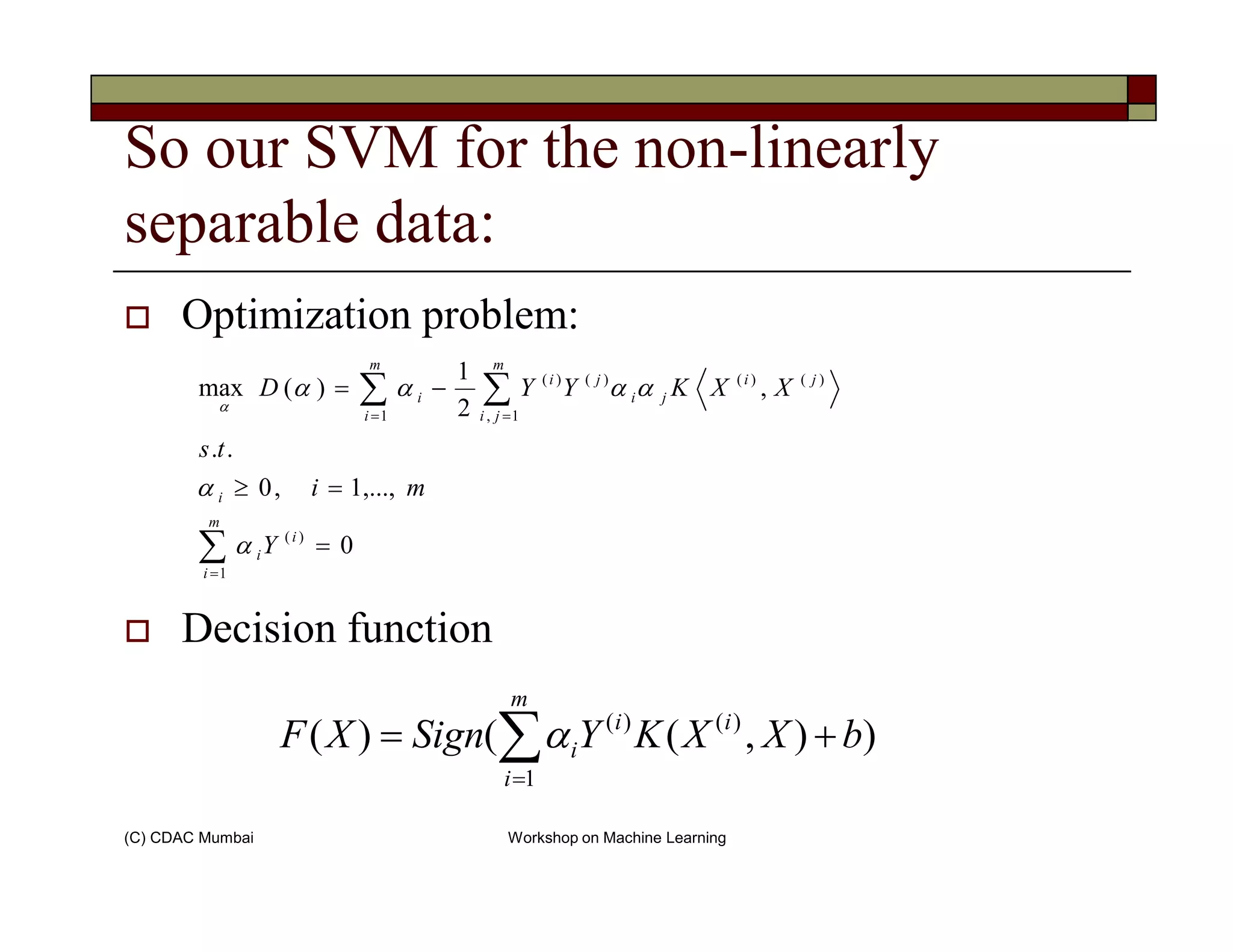
So our SVM for the non-linearly
separable data:
Optimization problem:
∑∑ ==
=≥
−=
m
ji
ji
ji
ji
m
i
i
mi
ts
XXKYYD
1,
)()()()(
1
,...,1,0
..
,
2
1
)(max
α
αααα
α
(C) CDAC Mumbai Workshop on Machine Learning
Decision function
∑=
=
=≥
m
i
i
i
i
Y
mi
1
)(
0
,...,1,0
α
α
)),(()(
1
)()(
∑=
+=
m
i
ii
i bXXKYSignXF α
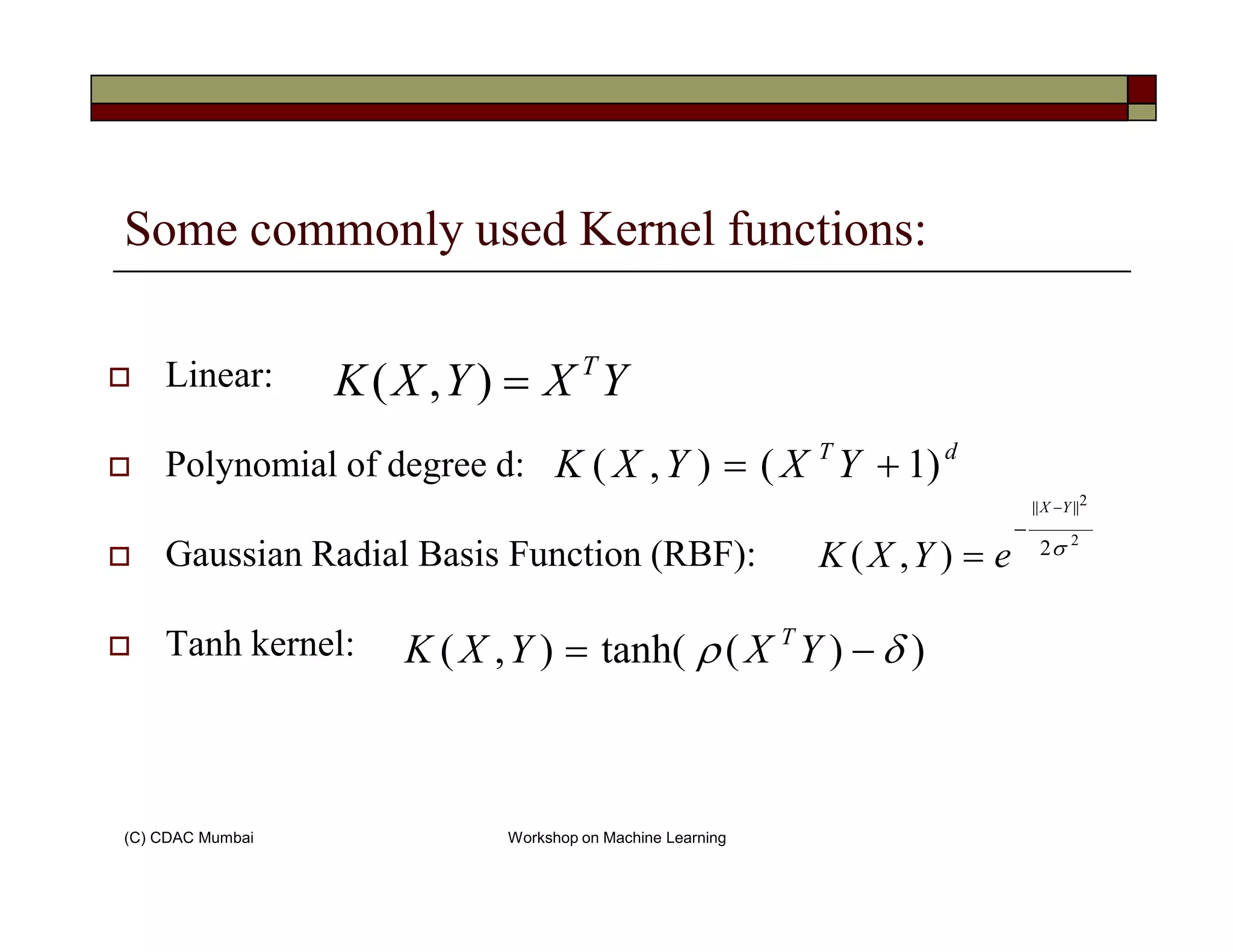
Some commonly used Kernel functions:
Linear:
Polynomial of degree d: dT
YXYXK )1(),( +=
YXYXK T
=),(
(C) CDAC Mumbai Workshop on Machine Learning
Polynomial of degree d:
Gaussian Radial Basis Function (RBF):
Tanh kernel:
YXYXK )1(),( +=
2
2||||
2
),( σ
YX
eYXK
−
−
=
))(tanh(),( δρ −= YXYXK T
Implementations:
Some Ready to use available SVM implementations:
1)LIBSVM:A library for SVM by Chih-Chung Chang and
chih-Jen Lin
(at: http://www.csie.ntu.edu.tw/~cjlin/libsvm/)
(C) CDAC Mumbai Workshop on Machine Learning
(at: http://www.csie.ntu.edu.tw/~cjlin/libsvm/)
2)SVM light : An implementation in C by Thorsten
Joachims
(at: http://svmlight.joachims.org/ )
3)Weka: A Data Mining Software in Java by University
of Waikato
(at: http://www.cs.waikato.ac.nz/ml/weka/ )
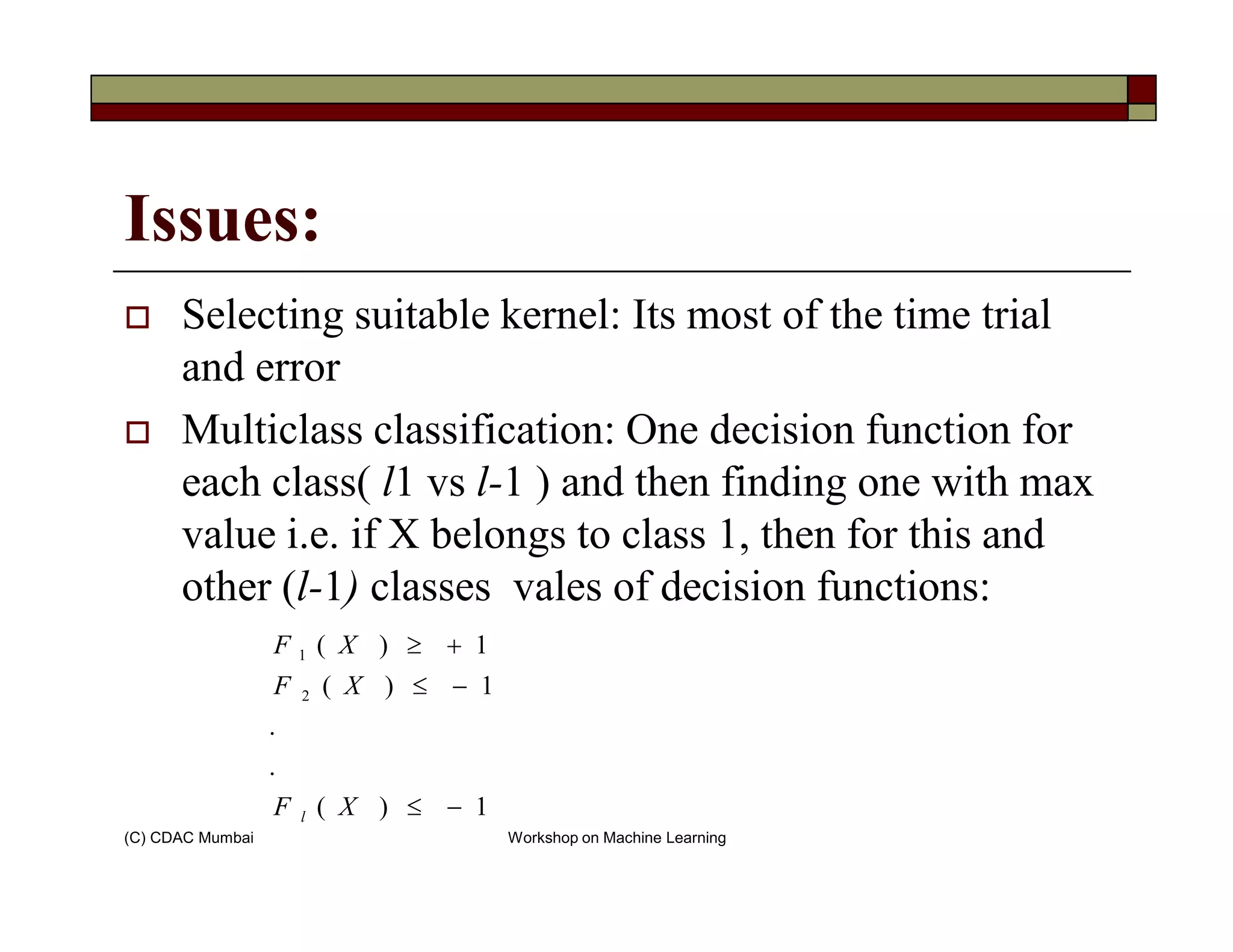
Issues:
Selecting suitable kernel: Its most of the time trial
and error
Multiclass classification: One decision function for
each class( l1 vs l-1 ) and then finding one with max
(C) CDAC Mumbai Workshop on Machine Learning
each class( l1 vs l-1 ) and then finding one with max
value i.e. if X belongs to class 1, then for this and
other (l-1) classes vales of decision functions:
1)(
.
.
1)(
1)(
2
1
−≤
−≤
+≥
XF
XF
XF
l
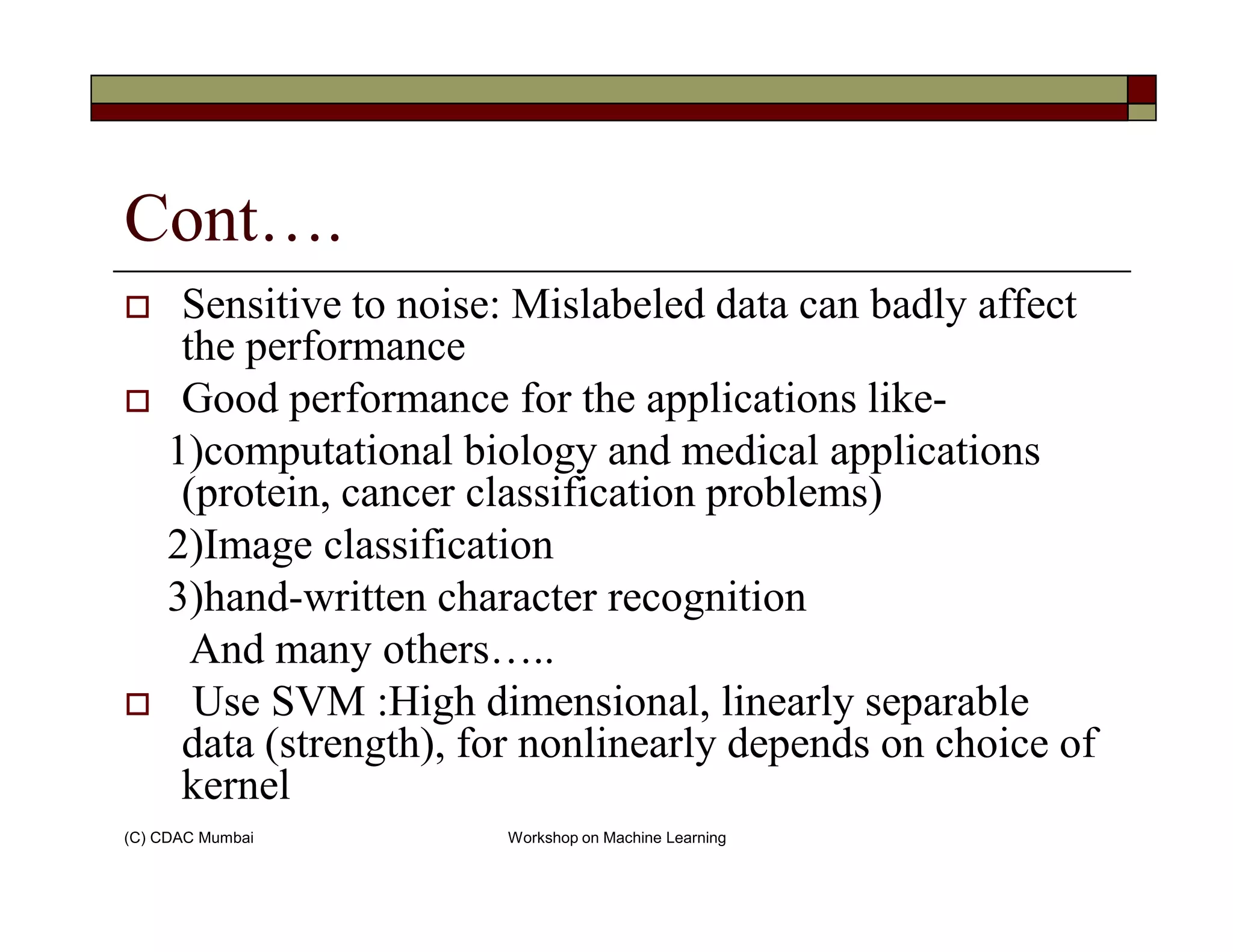
Cont….
Sensitive to noise: Mislabeled data can badly affect
the performance
Good performance for the applications like-
1)computational biology and medical applications
(protein, cancer classification problems)
(C) CDAC Mumbai Workshop on Machine Learning
(protein, cancer classification problems)
2)Image classification
3)hand-written character recognition
And many others…..
Use SVM :High dimensional, linearly separable
data (strength), for nonlinearly depends on choice of
kernel
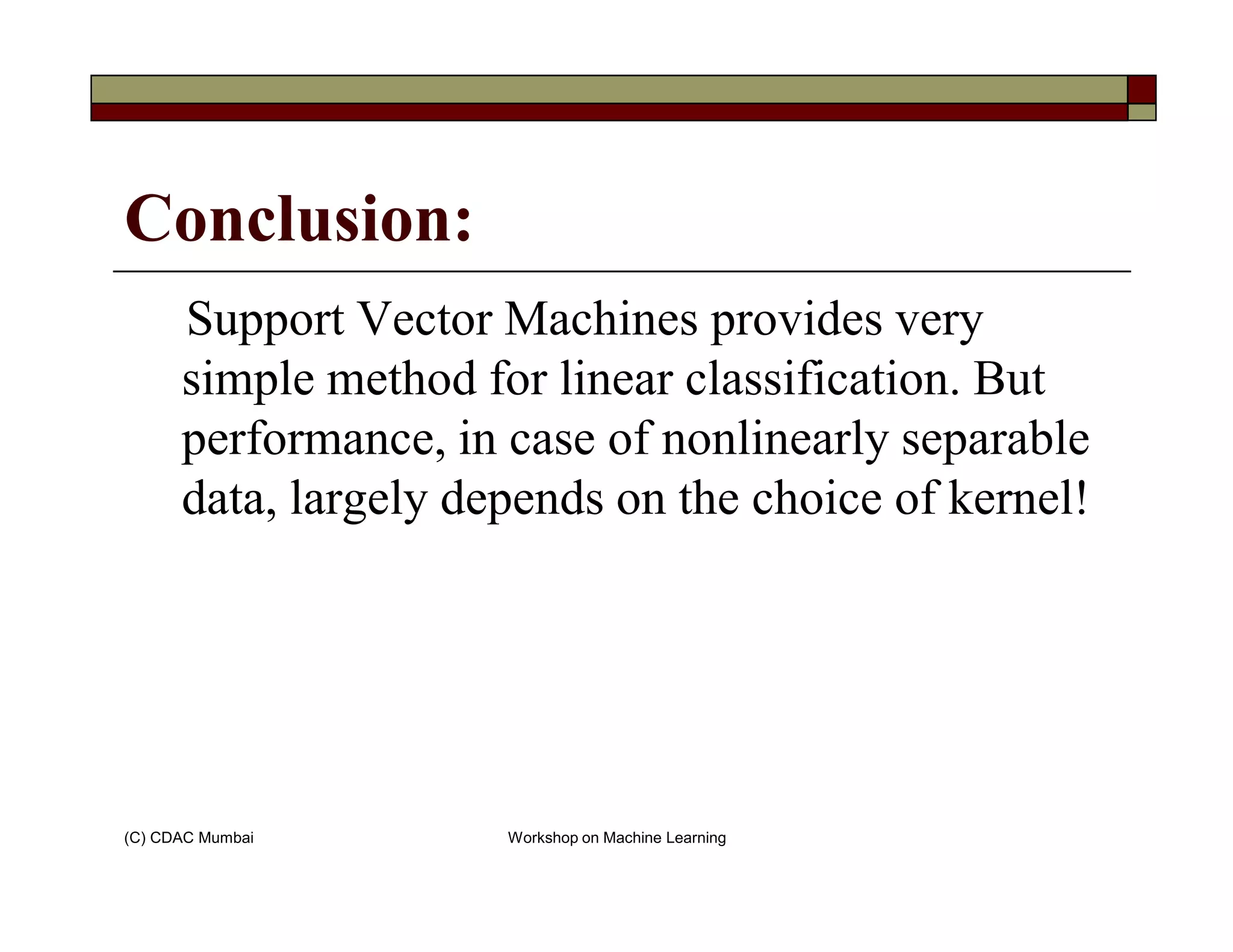
Conclusion:
Support Vector Machines provides very
simple method for linear classification. But
performance, in case of nonlinearly separable
data, largely depends on the choice of kernel!
(C) CDAC Mumbai Workshop on Machine Learning
data, largely depends on the choice of kernel!
References:
Nello Cristianini and John Shawe-Taylor (2000)??
An Introduction to Support Vector Machines and Other Kernel-based Learning Methods
Cambridge University Press
Christopher J.C. Burges (1998)??
A tutorial on Support Vector Machines for pattern recognition
Usama Fayyad, editor, Data Mining and Knowledge Discovery, 2, 121-167.
Kluwer Academic Publishers, Boston.
(C) CDAC Mumbai Workshop on Machine Learning
Kluwer Academic Publishers, Boston.
Andrew Ng (2007)
CSS229 Lecture Notes
Stanford Engineering Everywhere, Stanford University .
Support Vector Machines <http://www.svms.org > (Accessed 10.11.2008)
Wikipedia
Kernel-Machines.org<http://www.kernel-machines.org >(Accessed 10.11.2008)
Thank You!
(C) CDAC Mumbai Workshop on Machine Learning
Thank You!
prakash@cdacmumbai.in ;
pbpimpale@gmail.com

Support Vector Machines for Classification

  • 1.
    Support Vector Machines (C)CDAC Mumbai Workshop on Machine Learning Support Vector Machines Prakash B. Pimpale CDAC Mumbai
  • 2.
    Outline Introduction Towards SVM Basic Concept (C)CDAC Mumbai Workshop on Machine Learning Basic Concept Implementations Issues Conclusion & References
  • 3.
    Introduction: SVMs – asupervised learning methods for classification and Regression Base: Vapnik-Chervonenkis theory First practical implementation: Early nineties (C) CDAC Mumbai Workshop on Machine Learning First practical implementation: Early nineties Satisfying from theoretical point of view Can lead to high performance in practical applications Currently considered one of the most efficient family of algorithms in Machine Learning
  • 4.
    Towards SVM A:I foundreally good function describing the training examples using ANN but couldn’t classify test example that efficiently, what could be the problem? B: It didn’t generalize well! A: What should I do now? (C) CDAC Mumbai Workshop on Machine Learning A: What should I do now? B: Try SVM! A: why? B: SVM 1)Generalises well And what's more…. 2)Computationally efficient (just a convex optimization problem) 3)Robust in high dimensions also (no overfitting)
  • 5.
    A: Why isit so? B: So many questions…?? Vapnik & Chervonenkis Statistical Learning Theory Result: Relates ability to learn a rule for classifying training data to ability of resulting rule to classify unseen examples (Generalization) (C) CDAC Mumbai Workshop on Machine Learning Let a rule , Empirical Risk of : Measure of quality of classification on training data Best performance Worst performance f Ff ∈ f 0)( =fR emp 1)( =fR emp
  • 6.
    What about theGeneralization? Risk of classifier: Probability that rule ƒ makes a mistake on a new sample randomly generated by random machine ))(()( yxfPfR ≠= (C) CDAC Mumbai Workshop on Machine Learning Best Generalization Worst Generalization Many times small Empirical Risk implies Small Risk 0)( =fR 1)( =fR
  • 7.
    Is the problemsolved? …….. NO! Is Risk of selected by Empirical Risk Minimization (ERM) near to that of ideal ? No, not in case of overfitting Important Result of Statistical Learning Theory tf if (C) CDAC Mumbai Workshop on Machine Learning Important Result of Statistical Learning Theory Where, V(F)- VC dimension of class F N- number of observations for training C- Universal Constant N FV CfRfER it )( )()( +≤
  • 8.
    What it says: Riskof rule selected by ERM is not far from Risk of the ideal rule if- 1) N is large enough 2)VC dimension of F should be small enough (C) CDAC Mumbai Workshop on Machine Learning 2)VC dimension of F should be small enough [VC dimension? In short larger a class F, the larger its VC dimension (Sorry Vapnik sir!)]
  • 9.
    Structural Risk Minimization(SRM) Consider family of F => )(......)(..........)()( .. ................ 10 10 FVFVFVFV ts FFFF n n ≤≤≤≤≤ ⊂⊂⊂⊂ (C) CDAC Mumbai Workshop on Machine Learning Find the minimum Empirical Risk for each subclass and its VC dimension Select a subclass with minimum bound on the Risk (i.e. sum of the VC dimension and empirical risk) )(......)(..........)()( 10 FVFVFVFV n ≤≤≤≤≤
  • 10.
    SRM Graphically: N FV CfRfERit )( )()( +≤ (C) CDAC Mumbai Workshop on Machine Learning
  • 11.
    A: What ithas to do with SVM….? B:SVM is an approximate implementation of SRM! A: How? B: Just in simple way for now: (C) CDAC Mumbai Workshop on Machine Learning Just import a result: Maximizing distance of the decision boundary from training points minimizes the VC dimension resulting into the Good generalization!
  • 12.
    A: Means Nowonwards our target is Maximizing Distance between decision boundary and the Training points! B: Yeah, Right! A: Ok, I am convinced that SVM will generalize well, but can you please explain what is the concept of SVM and how to implement it, are there any (C) CDAC Mumbai Workshop on Machine Learning SVM and how to implement it, are there any packages available? B: Yeah, don’t worry, there are many implementations available, just use them for your application, now the next part of the presentation will give a basic idea about the SVM, so be with me!
  • 13.
    Basic Concept ofSVM: Which line will classify the unseen data well? (C) CDAC Mumbai Workshop on Machine Learning data well? The dotted line! Its line with Maximum Margin!
  • 14.
    Cont… Support Vectors SupportVectors (C) CDAC Mumbai Workshop on Machine Learning           + − =+ 1 0 1 bXWT
  • 15.
    Some definitions: Functional Margin: w.r.t. 1)individual examples : 2)example set },.....,1);,{( )()( miyxS ii == )(ˆ )()()( bxWy iTii +=γ )( ˆminˆ i γγ = (C) CDAC Mumbai Workshop on Machine Learning Geometric Margin: w.r.t 1)Individual examples: 2) example set S, )( ,...,1 ˆminˆ i mi γγ = =         +      = |||||||| )()()( W b x W W y i T ii γ )( ,...,1 min i mi γγ = =
  • 16.
    Problem Formulation: (C) CDACMumbai Workshop on Machine Learning           + − =+ 1 0 1 bXW T
  • 17.
    Cont.. Distance of apoint (u, v) from Ax+By+C=0, is given by |Ax+By+C|/||n|| Where ||n|| is norm of vector n(A,B) Distance of hyperpalne from origin = |||| W b (C) CDAC Mumbai Workshop on Machine Learning Distance of point A from origin = Distance of point B from Origin = Distance between points A and B (Margin) = |||| W |||| 1 W b + |||| 1 W b − |||| 2 W
  • 18.
    Cont… We have dataset 1 )()( ,....,1},,{ RYandRX miYX d ii ∈∈ = (C) CDAC Mumbai Workshop on Machine Learning separating hyperplane 10 10 .. 0 )()( )()( −=<+ +=>+ =+ iiT iiT T YifbXW YifbXW ts bXW
  • 19.
    Cont… Suppose training datasatisfy following constrains also, Combining these to the one, 11 11 )()( )()( −=−≤+ +=+≥+ iiT iiT YforbXW YforbXW (C) CDAC Mumbai Workshop on Machine Learning Combining these to the one, Our objective is to find Hyperplane(W,b) with maximal separation between it and closest data points while satisfying the above constrains iforbXWY iTi ∀≥+ 1)( )()(
  • 20.
    THE PROBLEM: |||| 2 max , WbW (C)CDAC Mumbai Workshop on Machine Learning such that Also we know iforbXWY iTi ∀≥+ 1)( )()( WWW T =||||
  • 21.
    Cont.. WW T bW 2 1 min, Sothe Problem can be written as: (C) CDAC Mumbai Workshop on Machine Learning bW 2, iforbXWY iTi ∀≥+ 1)( )()( Such that It is just a convex quadratic optimization problem ! 2 ||||WWW T =Notice:
  • 22.
    DUAL Solving dual forour problem will lead us to apply SVM for nonlinearly separable data, efficiently It can be shown that )),,(min(maxmin α α bWLprimal ≥ = (C) CDAC Mumbai Workshop on Machine Learning Primal problem: Such that )),,(min(maxmin ,0 α α bWLprimal bW≥ = WW T bW 2 1 min, iforbXWY iTi ∀≥+ 1)( )()(
  • 23.
    Constructing Lagrangian Lagrangian forour problem: [ ]∑ −+−= m iTi i bXWYWbWL )()(2 1)(|||| 2 1 ),,( αα (C) CDAC Mumbai Workshop on Machine Learning Where a Lagrange multiplier and Now minimizing it w.r.t. W and b: We set derivatives of Lagrangian w.r.t. W and b to zero [ ]∑= −+−= i i bXWYWbWL 1 1)(|||| 2 ),,( αα α 0≥iα
  • 24.
    Cont… Setting derivative w.r.t.W to zero, it gives: )( 1 )( .. 0i m i i i ei XYW ∑= =− α (C) CDAC Mumbai Workshop on Machine Learning Setting derivative w.r.t. b to zero, it gives: )( 1 )( .. i m i i i XYW ei ∑= = α ∑= = m i i iY 1 )( 0α
  • 25.
    Cont… Plugging these resultsinto Lagrangian gives ∑∑ == −= m ji jTi ji ji m i i XXYYbWL 1, )()()()( 1 )()( 2 1 ),,( αααα (C) CDAC Mumbai Workshop on Machine Learning Say it This is result of our minimization w.r.t W and b, == jii 1,1 ∑∑ == −= m ji jTi ji ji m i i XXYYD 1, )()()()( 1 )()( 2 1 )( αααα
  • 26.
    So The DUAL: NowDual becomes:: ∑∑ == =≥ −= i m ji ji ji ji m i i mi ts XXYYD 1, )()()()( 1 ,...,1,0 .. , 2 1 )(max α αααα α (C) CDAC Mumbai Workshop on Machine Learning Solving this optimization problem gives us Also Karush-Kuhn-Tucker (KKT) condition is satisfied at this solution i.e. ∑= = =≥ m i i i i Y mi 1 )( 0 ,...,1,0 α α iα [ ] miforbXWY iTi i ,...,1,01)( )()( ==−+α
  • 27.
    Values of Wand b: W can be found using )( 1 )( i m i i i XYW ∑= = α (C) CDAC Mumbai Workshop on Machine Learning b can be found using: 1i = 2 *min*max * )( 1: )( 1: )()( iT Yi iT Yi XWXW b ii =−= + −=
  • 28.
    What if datais nonlinearly separable? The maximal margin hyperplane can classify only linearly separable data What if the data is linearly (C) CDAC Mumbai Workshop on Machine Learning What if the data is linearly non-separable? Take your data to linearly separable ( higher dimensional space) and use maximal margin hyperplane there!
  • 29.
    Taking it tohigher dimension works! Ex. XOR (C) CDAC Mumbai Workshop on Machine Learning
  • 30.
    Doing it inhigher dimensional space Let be non linear mapping from input space X (original space) to feature space (higher dimensional) F Then our inner (dot) product in higher FX →Φ: )()( , ji XX (C) CDAC Mumbai Workshop on Machine Learning Then our inner (dot) product in higher dimensional space is Now, the problem becomes: )()( , ji XX )(),( )()( ji XX φφ ∑ ∑∑ = == = =≥ −= m i i i i m ji ji ji ji m i i Y mi ts XXYYD 1 )( 1, )()()()( 1 0 ,...,1,0 .. )(,)( 2 1 )(max α α φφαααα α
  • 31.
    Kernel function: There exista way to compute inner product in feature space as function of original input points – Its kernel function! Kernel function: (C) CDAC Mumbai Workshop on Machine Learning Kernel function: We need not know to compute )(),(),( zxzxK φφ= ),( zxKφ
  • 32.
    An example: For n=3,feature mapping is given as : ∑∑= = ∈ n jj n ii T n zxzxzxKei zxzxK Rzxlet 2 )()(),(.. )(),( , φ           31 21 11 xx xx xx xx (C) CDAC Mumbai Workshop on Machine Learning ∑ ∑∑ ∑∑ = = = == = = = n ji jiji n i n j jiji j jj i ii zzxx zzxx zxzxzxKei 1, 1 1 11 ))(( )()(),(..                     = 33 23 13 32 22 12 )( xx xx xx xx xx xx xφ )(),(),( zxzxK φφ=
  • 33.
    example cont… Here, 31 )(),( 2  =  = = zx zxzxK for T 4 2 2 1 )( 22 12 21 11             =             = xx xx xx xx xφ (C)CDAC Mumbai Workshop on Machine Learning [ ] 121)(),( 11 4 3 21 4 3 2 1 2 == =       =       =      = zxzxK zx zx T T [ ] 121 16 12 12 9 4221)()( 16 12 12 9 )( =             =             = zx z T φφ φ
  • 34.
    So our SVMfor the non-linearly separable data: Optimization problem: ∑∑ == =≥ −= m ji ji ji ji m i i mi ts XXKYYD 1, )()()()( 1 ,...,1,0 .. , 2 1 )(max α αααα α (C) CDAC Mumbai Workshop on Machine Learning Decision function ∑= = =≥ m i i i i Y mi 1 )( 0 ,...,1,0 α α )),(()( 1 )()( ∑= += m i ii i bXXKYSignXF α
  • 35.
    Some commonly usedKernel functions: Linear: Polynomial of degree d: dT YXYXK )1(),( += YXYXK T =),( (C) CDAC Mumbai Workshop on Machine Learning Polynomial of degree d: Gaussian Radial Basis Function (RBF): Tanh kernel: YXYXK )1(),( += 2 2|||| 2 ),( σ YX eYXK − − = ))(tanh(),( δρ −= YXYXK T
  • 36.
    Implementations: Some Ready touse available SVM implementations: 1)LIBSVM:A library for SVM by Chih-Chung Chang and chih-Jen Lin (at: http://www.csie.ntu.edu.tw/~cjlin/libsvm/) (C) CDAC Mumbai Workshop on Machine Learning (at: http://www.csie.ntu.edu.tw/~cjlin/libsvm/) 2)SVM light : An implementation in C by Thorsten Joachims (at: http://svmlight.joachims.org/ ) 3)Weka: A Data Mining Software in Java by University of Waikato (at: http://www.cs.waikato.ac.nz/ml/weka/ )
  • 37.
    Issues: Selecting suitable kernel:Its most of the time trial and error Multiclass classification: One decision function for each class( l1 vs l-1 ) and then finding one with max (C) CDAC Mumbai Workshop on Machine Learning each class( l1 vs l-1 ) and then finding one with max value i.e. if X belongs to class 1, then for this and other (l-1) classes vales of decision functions: 1)( . . 1)( 1)( 2 1 −≤ −≤ +≥ XF XF XF l
  • 38.
    Cont…. Sensitive to noise:Mislabeled data can badly affect the performance Good performance for the applications like- 1)computational biology and medical applications (protein, cancer classification problems) (C) CDAC Mumbai Workshop on Machine Learning (protein, cancer classification problems) 2)Image classification 3)hand-written character recognition And many others….. Use SVM :High dimensional, linearly separable data (strength), for nonlinearly depends on choice of kernel
  • 39.
    Conclusion: Support Vector Machinesprovides very simple method for linear classification. But performance, in case of nonlinearly separable data, largely depends on the choice of kernel! (C) CDAC Mumbai Workshop on Machine Learning data, largely depends on the choice of kernel!
  • 40.
    References: Nello Cristianini andJohn Shawe-Taylor (2000)?? An Introduction to Support Vector Machines and Other Kernel-based Learning Methods Cambridge University Press Christopher J.C. Burges (1998)?? A tutorial on Support Vector Machines for pattern recognition Usama Fayyad, editor, Data Mining and Knowledge Discovery, 2, 121-167. Kluwer Academic Publishers, Boston. (C) CDAC Mumbai Workshop on Machine Learning Kluwer Academic Publishers, Boston. Andrew Ng (2007) CSS229 Lecture Notes Stanford Engineering Everywhere, Stanford University . Support Vector Machines <http://www.svms.org > (Accessed 10.11.2008) Wikipedia Kernel-Machines.org<http://www.kernel-machines.org >(Accessed 10.11.2008)
  • 41.
    Thank You! (C) CDACMumbai Workshop on Machine Learning Thank You! prakash@cdacmumbai.in ; pbpimpale@gmail.com