By,
K.B.Snega,M.sc(cs)
NADAR SARASWATHI COLLEGE OF ARTS AND SCIENCE
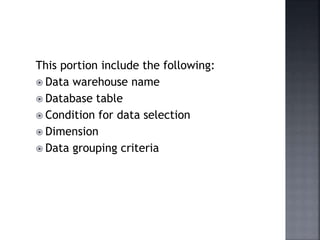
This portion include the following:
 Data warehouse name
 Database table
 Condition for data selection
 Dimension
 Data grouping criteria
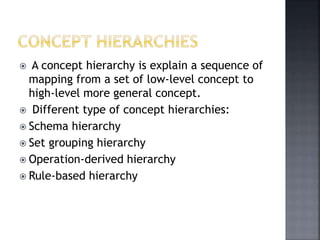
 A concept hierarchy is explain a sequence of
mapping from a set of low-level concept to
high-level more general concept.
 Different type of concept hierarchies:
 Schema hierarchy
 Set grouping hierarchy
 Operation-derived hierarchy
 Rule-based hierarchy
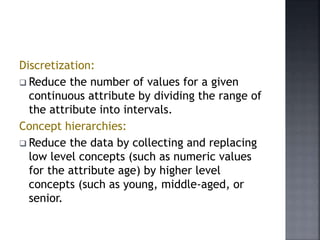
Discretization:
 Reduce the number of values for a given
continuous attribute by dividing the range of
the attribute into intervals.
Concept hierarchies:
 Reduce the data by collecting and replacing
low level concepts (such as numeric values
for the attribute age) by higher level
concepts (such as young, middle-aged, or
senior.
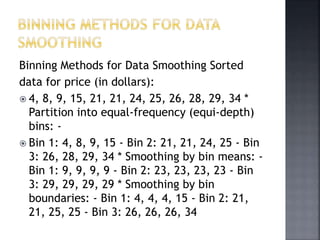
Binning Methods for Data Smoothing Sorted
data for price (in dollars):
 4, 8, 9, 15, 21, 21, 24, 25, 26, 28, 29, 34 *
Partition into equal-frequency (equi-depth)
bins: -
 Bin 1: 4, 8, 9, 15 - Bin 2: 21, 21, 24, 25 - Bin
3: 26, 28, 29, 34 * Smoothing by bin means: -
Bin 1: 9, 9, 9, 9 - Bin 2: 23, 23, 23, 23 - Bin
3: 29, 29, 29, 29 * Smoothing by bin
boundaries: - Bin 1: 4, 4, 4, 15 - Bin 2: 21,
21, 25, 25 - Bin 3: 26, 26, 26, 34
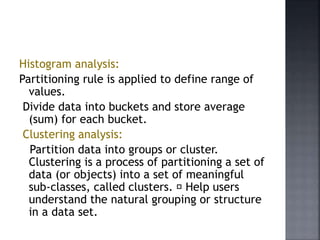
Histogram analysis:
Partitioning rule is applied to define range of
values.
Divide data into buckets and store average
(sum) for each bucket.
Clustering analysis:
Partition data into groups or cluster.
Clustering is a process of partitioning a set of
data (or objects) into a set of meaningful
sub-classes, called clusters. Help users
understand the natural grouping or structure
in a data set.
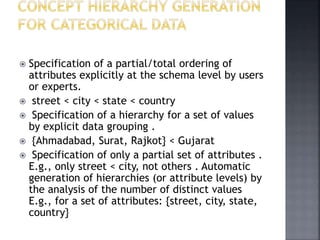
 Specification of a partial/total ordering of
attributes explicitly at the schema level by users
or experts.
 street < city < state < country
 Specification of a hierarchy for a set of values
by explicit data grouping .
 {Ahmadabad, Surat, Rajkot} < Gujarat
 Specification of only a partial set of attributes .
E.g., only street < city, not others . Automatic
generation of hierarchies (or attribute levels) by
the analysis of the number of distinct values
E.g., for a set of attributes: {street, city, state,
country}
Discretization and concept hierarchy(os)

Discretization and concept hierarchy(os)

  • 1.
  • 2.
    This portion includethe following:  Data warehouse name  Database table  Condition for data selection  Dimension  Data grouping criteria
  • 3.
     A concepthierarchy is explain a sequence of mapping from a set of low-level concept to high-level more general concept.  Different type of concept hierarchies:  Schema hierarchy  Set grouping hierarchy  Operation-derived hierarchy  Rule-based hierarchy
  • 4.
    Discretization:  Reduce thenumber of values for a given continuous attribute by dividing the range of the attribute into intervals. Concept hierarchies:  Reduce the data by collecting and replacing low level concepts (such as numeric values for the attribute age) by higher level concepts (such as young, middle-aged, or senior.
  • 5.
    Binning Methods forData Smoothing Sorted data for price (in dollars):  4, 8, 9, 15, 21, 21, 24, 25, 26, 28, 29, 34 * Partition into equal-frequency (equi-depth) bins: -  Bin 1: 4, 8, 9, 15 - Bin 2: 21, 21, 24, 25 - Bin 3: 26, 28, 29, 34 * Smoothing by bin means: - Bin 1: 9, 9, 9, 9 - Bin 2: 23, 23, 23, 23 - Bin 3: 29, 29, 29, 29 * Smoothing by bin boundaries: - Bin 1: 4, 4, 4, 15 - Bin 2: 21, 21, 25, 25 - Bin 3: 26, 26, 26, 34
  • 6.
    Histogram analysis: Partitioning ruleis applied to define range of values. Divide data into buckets and store average (sum) for each bucket. Clustering analysis: Partition data into groups or cluster. Clustering is a process of partitioning a set of data (or objects) into a set of meaningful sub-classes, called clusters. Help users understand the natural grouping or structure in a data set.
  • 7.
     Specification ofa partial/total ordering of attributes explicitly at the schema level by users or experts.  street < city < state < country  Specification of a hierarchy for a set of values by explicit data grouping .  {Ahmadabad, Surat, Rajkot} < Gujarat  Specification of only a partial set of attributes . E.g., only street < city, not others . Automatic generation of hierarchies (or attribute levels) by the analysis of the number of distinct values E.g., for a set of attributes: {street, city, state, country}