CS 311 – Design and Algorithms Analysis PSU
Divide and Conquer Strategy
2
CS 311 – Design and Algorithms Analysis PSU
General Concept of Divide & Conquer
Given a function to compute on n inputs, the
divide-and-conquer strategy consists of:
splitting the inputs into k distinct subsets, 1<k≤n,
yielding k subproblems.
solving these subproblems
combining the subsolutions into solution of the whole.
if the subproblems are relatively large, then
divide_Conquer is applied again.
if the subproblems are small, the are solved without
splitting.
3
CS 311 – Design and Algorithms Analysis PSU
The Divide and Conquer Algorithm
Divide_Conquer(problem P)
{
if Small(P) return S(P);
else {
divide P into smaller instances P1, P2, …, Pk, k≥1;
Apply Divide_Conquer to each of these subproblems;
return Combine(Divide_Conque(P1), Divide_Conque(P2),…,
Divide_Conque(Pk));
}
}
4
CS 311 – Design and Algorithms Analysis PSU
Divde_Conquer recurrence relation
The computing time of Divde_Conquer is
T(n) is the time for Divde_Conquer on any input size n.
g(n) is the time to compute the answer directly (for
small inputs)
f(n) is the time for dividing P and combining the
solutions.



++++
=
)()(...)()(
)(
)(
21 nfnTnTnT
ng
nT
k
n small
otherwise
5
CS 311 – Design and Algorithms Analysis PSU
Three Steps of The Divide and Conquer
Approach
The most well known algorithm design strategy:
1. Divide the problem into two or more smaller
subproblems.
2. Conquer the subproblems by solving them
recursively.
3. Combine the solutions to the subproblems into
the solutions for the original problem.
6
CS 311 – Design and Algorithms Analysis PSU
A Typical Divide and Conquer Case
subproblem 2
of size n/2
subproblem 1
of size n/2
a solution to
subproblem 1
a solution to
the original problem
a solution to
subproblem 2
a problem of size n
7
CS 311 – Design and Algorithms Analysis PSU
An Example: Calculating a0 + a1 + … + an-1
Efficiency: (for n = 2
k
)
A(n) = 2A(n/2) + 1, n >1
A(1) = 0;
ALGORITHM RecursiveSum(A[0..n-1])
//Input: An array A[0..n-1] of orderable elements
//Output: the summation of the array elements
if n > 1
return ( RecursiveSum(A[0.. n/2 – 1]) + RecursiveSum(A[n/2 .. n– 1]) )
8
CS 311 – Design and Algorithms Analysis PSU
General Divide and Conquer recurrence
The Master Theorem
T(n) = aT(n/b) + f (n), where f (n) ∈ Θ(nk
)
1. a < bk
T(n) ∈ Θ(nk
)
2. a = bk
T(n) ∈ Θ(nk
lg n )
3. a > bk
T(n) ∈ Θ(nlog b a
)
the time spent on solving a subproblem of size n/b.
the time spent on dividing the problem
into smaller ones and combining their solutions.
9
CS 311 – Design and Algorithms Analysis PSU
Divide and Conquer Other Examples
Sorting: mergesort and quicksort
Binary search
Matrix multiplication-Strassen’s algorithm
10
CS 311 – Design and Algorithms Analysis PSU
The Divide, Conquer and Combine Steps in
Quicksort
Divide: Partition array A[l..r] into 2 subarrays, A[l..s-
1] and A[s+1..r] such that each element of the first
array is ≤A[s] and each element of the second array
is ≥ A[s]. (computing the index of s is part of partition.)
Implication: A[s] will be in its final position in the
sorted array.
Conquer: Sort the two subarrays A[l..s-1] and A[s+1..r] by
recursive calls to quicksort
Combine: No work is needed, because A[s] is already in its
correct place after the partition is done, and the two subarrays
have been sorted.
11
CS 311 – Design and Algorithms Analysis PSU
Quicksort
Select a pivot whose value we are going to divide
the sublist. (e.g., p = A[l])
Rearrange the list so that it starts with the pivot
followed by a ≤ sublist (a sublist whose elements
are all smaller than or equal to the pivot) and a ≥
sublist (a sublist whose elements are all greater
than or equal to the pivot ) (See algorithm Partition
in section 4.2)
Exchange the pivot with the last element in the
first sublist(i.e., ≤ sublist) – the pivot is now in its
final position
Sort the two sublists recursively using quicksort.
p
A[i]≤p A[i] ≥ p
12
CS 311 – Design and Algorithms Analysis PSU
The Quicksort Algorithm
ALGORITHM Quicksort(A[l..r])
//Sorts a subarray by quicksort
//Input: A subarray A[l..r] of A[0..n-1],defined by its left
and right indices l and r
//Output: The subarray A[l..r] sorted in nondecreasing
order
if l < r
s  Partition (A[l..r]) // s is a split position
Quicksort(A[l..s-1])
Quicksort(A[s+1..r]
13
CS 311 – Design and Algorithms Analysis PSU
The Partition Algorithm
ALGORITHM Partition (A[l ..r])
//Partitions a subarray by using its first element as a pivot
//Input: A subarray A[l..r] of A[0..n-1], defined by its left and right
indices l and r (l < r)
//Output: A partition of A[l..r], with the split position returned as
this function’s value
P A[l]
i l; j  r + 1;
Repeat
repeat i  i + 1 until A[i]>=p //left-right scan
repeat j j – 1 until A[j] <= p//right-left scan
if (i < j) //need to continue with the scan
swap(A[i], a[j])
until i >= j //no need to scan
swap(A[l], A[j])
return j
14
CS 311 – Design and Algorithms Analysis PSU
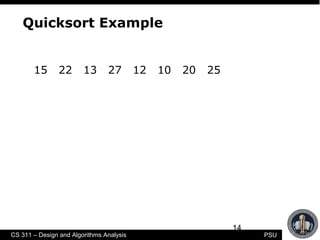
Quicksort Example
15 22 13 27 12 10 20 25
15
CS 311 – Design and Algorithms Analysis PSU
Efficiency of Quicksort
Based on whether the partitioning is balanced.
Best case: split in the middle — Θ( n log n)
T(n) = 2T(n/2) + Θ(n) //2 subproblems of size n/2 each
Worst case: sorted array! — Θ( n2
)
T(n) = T(n-1) + n+1 //2 subproblems of size 0 and n-1 respectively
Average case: random arrays — Θ( n log n)
16
CS 311 – Design and Algorithms Analysis PSU
Binary Search – an Iterative Algorithm
ALGORITHM BinarySearch(A[0..n-1], K)
//Implements nonrecursive binary search
//Input: An array A[0..n-1] sorted in ascending order and
// a search key K
//Output: An index of the array’s element that is equal to K
// or –1 if there is no such element
l  0, r  n – 1
while l ≤ r do //l and r crosses over can’t find K.
m (l + r) / 2
if K = A[m] return m //the key is found
else
if K < A[m] r m – 1//the key is on the left half of the array
else l  m + 1 // the key is on the right half of the array
return -1
17
CS 311 – Design and Algorithms Analysis PSU
Strassen’s Matrix Multiplication
Brute-force algorithm
c00 c01 a00 a01 b00 b01
= *
c10 c11 a10 a11 b10 b11
a00 * b00 + a01 * b10 a00 * b01 + a01 * b11
=
a10 * b00 + a11 * b10 a10 * b01 + a11 * b11
8 multiplications
4 additions
Efficiency class: Θ (n3
)
18
CS 311 – Design and Algorithms Analysis PSU
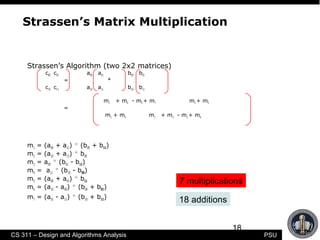
Strassen’s Matrix Multiplication
Strassen’s Algorithm (two 2x2 matrices)
c00 c01 a00 a01 b00 b01
= *
c10 c11 a10 a11 b10 b11
m1 + m4 - m5 + m7 m3 + m5
=
m2 + m4 m1 + m3 - m2 + m6
m1 = (a00 + a11) * (b00 + b11)
m2 = (a10 + a11) * b00
m3 = a00 * (b01 - b11)
m4 = a11 * (b10 - b00)
m5 = (a00 + a01) * b11
m6 = (a10 - a00) * (b00 + b01)
m7 = (a01 - a11) * (b10 + b11)
7 multiplications
18 additions
19
CS 311 – Design and Algorithms Analysis PSU
Strassen’s Matrix Multiplication
Two nxn matrices, where n is a power of two (What about the
situations where n is not a power of two?)
C00 C01 A00 A01 B00 B01
= *
C10 C11 A10 A11 B10 B11
M1 + M4 - M5 + M7 M3 + M5
=
M2 + M4 M1 + M3 - M2 + M6
20
CS 311 – Design and Algorithms Analysis PSU
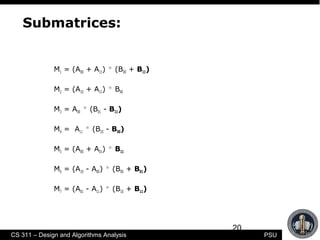
Submatrices:
M1 = (A00 + A11) * (B00 + B11)
M2 = (A10 + A11) * B00
M3 = A00 * (B01 - B11)
M4 = A11 * (B10 - B00)
M5 = (A00 + A01) * B11
M6 = (A10 - A00) * (B00 + B01)
M7 = (A01 - A11) * (B10 + B11)
21
CS 311 – Design and Algorithms Analysis PSU
Efficiency of Strassen’s Algorithm
If n is not a power of 2, matrices can be padded with
rows and columns with zeros
Number of multiplications
Number of additions
Other algorithms have improved this result, but are even
more complex
22
CS 311 – Design and Algorithms Analysis PSU
Important Recurrence Types
Decrease-by-one recurrences
A decrease-by-one algorithm solves a problem by
exploiting a relationship between a given instance of size
n and a smaller size n – 1.
Example: n!
The recurrence equation for investigating the time
efficiency of such algorithms typically has the form
T(n) = T(n-1) + f(n)
Decrease-by-a-constant-factor recurrences
A decrease-by-a-constant algorithm solves a problem by
dividing its given instance of size n into several smaller
instances of size n/b, solving each of them recursively,
and then, if necessary, combining the solutions to the
smaller instances into a solution to the given instance.
Example: binary search.
The recurrence equation for investigating the time
efficiency of such algorithms typically has the form
T(n) = aT(n/b) + f (n)
23
CS 311 – Design and Algorithms Analysis PSU
Decrease-by-one Recurrences
One (constant) operation reduces problem size by
one.
T(n) = T(n-1) + c T(1) = d
Solution:
A pass through input reduces problem size by
one.
T(n) = T(n-1) + c n T(1) = d
Solution:
T(n) = (n-1)c + d linear
T(n) = [n(n+1)/2 – 1] c + d quadratic
24
CS 311 – Design and Algorithms Analysis PSU
Decrease-by-a-constant-factor
recurrences – The Master Theorem
T(n) = aT(n/b) + f (n), where f (n) ∈ Θ(nk
) ,
k>=0
1. a < bk
T(n) ∈ Θ(nk
)
2. a = bk
T(n) ∈ Θ(nk
log n )
3. a > bk
T(n) ∈ Θ(nlog b a
)
4. Examples:
1. T(n) = T(n/2) + 1
2. T(n) = 2T(n/2) + n
3. T(n) = 3 T(n/2) + n Θ(nlog
2
3
)
Θ(logn)
Θ(nlogn)

5.5 back tracking 02

  • 1.
    CS 311 –Design and Algorithms Analysis PSU Divide and Conquer Strategy
  • 2.
    2 CS 311 –Design and Algorithms Analysis PSU General Concept of Divide & Conquer Given a function to compute on n inputs, the divide-and-conquer strategy consists of: splitting the inputs into k distinct subsets, 1<k≤n, yielding k subproblems. solving these subproblems combining the subsolutions into solution of the whole. if the subproblems are relatively large, then divide_Conquer is applied again. if the subproblems are small, the are solved without splitting.
  • 3.
    3 CS 311 –Design and Algorithms Analysis PSU The Divide and Conquer Algorithm Divide_Conquer(problem P) { if Small(P) return S(P); else { divide P into smaller instances P1, P2, …, Pk, k≥1; Apply Divide_Conquer to each of these subproblems; return Combine(Divide_Conque(P1), Divide_Conque(P2),…, Divide_Conque(Pk)); } }
  • 4.
    4 CS 311 –Design and Algorithms Analysis PSU Divde_Conquer recurrence relation The computing time of Divde_Conquer is T(n) is the time for Divde_Conquer on any input size n. g(n) is the time to compute the answer directly (for small inputs) f(n) is the time for dividing P and combining the solutions.    ++++ = )()(...)()( )( )( 21 nfnTnTnT ng nT k n small otherwise
  • 5.
    5 CS 311 –Design and Algorithms Analysis PSU Three Steps of The Divide and Conquer Approach The most well known algorithm design strategy: 1. Divide the problem into two or more smaller subproblems. 2. Conquer the subproblems by solving them recursively. 3. Combine the solutions to the subproblems into the solutions for the original problem.
  • 6.
    6 CS 311 –Design and Algorithms Analysis PSU A Typical Divide and Conquer Case subproblem 2 of size n/2 subproblem 1 of size n/2 a solution to subproblem 1 a solution to the original problem a solution to subproblem 2 a problem of size n
  • 7.
    7 CS 311 –Design and Algorithms Analysis PSU An Example: Calculating a0 + a1 + … + an-1 Efficiency: (for n = 2 k ) A(n) = 2A(n/2) + 1, n >1 A(1) = 0; ALGORITHM RecursiveSum(A[0..n-1]) //Input: An array A[0..n-1] of orderable elements //Output: the summation of the array elements if n > 1 return ( RecursiveSum(A[0.. n/2 – 1]) + RecursiveSum(A[n/2 .. n– 1]) )
  • 8.
    8 CS 311 –Design and Algorithms Analysis PSU General Divide and Conquer recurrence The Master Theorem T(n) = aT(n/b) + f (n), where f (n) ∈ Θ(nk ) 1. a < bk T(n) ∈ Θ(nk ) 2. a = bk T(n) ∈ Θ(nk lg n ) 3. a > bk T(n) ∈ Θ(nlog b a ) the time spent on solving a subproblem of size n/b. the time spent on dividing the problem into smaller ones and combining their solutions.
  • 9.
    9 CS 311 –Design and Algorithms Analysis PSU Divide and Conquer Other Examples Sorting: mergesort and quicksort Binary search Matrix multiplication-Strassen’s algorithm
  • 10.
    10 CS 311 –Design and Algorithms Analysis PSU The Divide, Conquer and Combine Steps in Quicksort Divide: Partition array A[l..r] into 2 subarrays, A[l..s- 1] and A[s+1..r] such that each element of the first array is ≤A[s] and each element of the second array is ≥ A[s]. (computing the index of s is part of partition.) Implication: A[s] will be in its final position in the sorted array. Conquer: Sort the two subarrays A[l..s-1] and A[s+1..r] by recursive calls to quicksort Combine: No work is needed, because A[s] is already in its correct place after the partition is done, and the two subarrays have been sorted.
  • 11.
    11 CS 311 –Design and Algorithms Analysis PSU Quicksort Select a pivot whose value we are going to divide the sublist. (e.g., p = A[l]) Rearrange the list so that it starts with the pivot followed by a ≤ sublist (a sublist whose elements are all smaller than or equal to the pivot) and a ≥ sublist (a sublist whose elements are all greater than or equal to the pivot ) (See algorithm Partition in section 4.2) Exchange the pivot with the last element in the first sublist(i.e., ≤ sublist) – the pivot is now in its final position Sort the two sublists recursively using quicksort. p A[i]≤p A[i] ≥ p
  • 12.
    12 CS 311 –Design and Algorithms Analysis PSU The Quicksort Algorithm ALGORITHM Quicksort(A[l..r]) //Sorts a subarray by quicksort //Input: A subarray A[l..r] of A[0..n-1],defined by its left and right indices l and r //Output: The subarray A[l..r] sorted in nondecreasing order if l < r s  Partition (A[l..r]) // s is a split position Quicksort(A[l..s-1]) Quicksort(A[s+1..r]
  • 13.
    13 CS 311 –Design and Algorithms Analysis PSU The Partition Algorithm ALGORITHM Partition (A[l ..r]) //Partitions a subarray by using its first element as a pivot //Input: A subarray A[l..r] of A[0..n-1], defined by its left and right indices l and r (l < r) //Output: A partition of A[l..r], with the split position returned as this function’s value P A[l] i l; j  r + 1; Repeat repeat i  i + 1 until A[i]>=p //left-right scan repeat j j – 1 until A[j] <= p//right-left scan if (i < j) //need to continue with the scan swap(A[i], a[j]) until i >= j //no need to scan swap(A[l], A[j]) return j
  • 14.
    14 CS 311 –Design and Algorithms Analysis PSU Quicksort Example 15 22 13 27 12 10 20 25
  • 15.
    15 CS 311 –Design and Algorithms Analysis PSU Efficiency of Quicksort Based on whether the partitioning is balanced. Best case: split in the middle — Θ( n log n) T(n) = 2T(n/2) + Θ(n) //2 subproblems of size n/2 each Worst case: sorted array! — Θ( n2 ) T(n) = T(n-1) + n+1 //2 subproblems of size 0 and n-1 respectively Average case: random arrays — Θ( n log n)
  • 16.
    16 CS 311 –Design and Algorithms Analysis PSU Binary Search – an Iterative Algorithm ALGORITHM BinarySearch(A[0..n-1], K) //Implements nonrecursive binary search //Input: An array A[0..n-1] sorted in ascending order and // a search key K //Output: An index of the array’s element that is equal to K // or –1 if there is no such element l  0, r  n – 1 while l ≤ r do //l and r crosses over can’t find K. m (l + r) / 2 if K = A[m] return m //the key is found else if K < A[m] r m – 1//the key is on the left half of the array else l  m + 1 // the key is on the right half of the array return -1
  • 17.
    17 CS 311 –Design and Algorithms Analysis PSU Strassen’s Matrix Multiplication Brute-force algorithm c00 c01 a00 a01 b00 b01 = * c10 c11 a10 a11 b10 b11 a00 * b00 + a01 * b10 a00 * b01 + a01 * b11 = a10 * b00 + a11 * b10 a10 * b01 + a11 * b11 8 multiplications 4 additions Efficiency class: Θ (n3 )
  • 18.
    18 CS 311 –Design and Algorithms Analysis PSU Strassen’s Matrix Multiplication Strassen’s Algorithm (two 2x2 matrices) c00 c01 a00 a01 b00 b01 = * c10 c11 a10 a11 b10 b11 m1 + m4 - m5 + m7 m3 + m5 = m2 + m4 m1 + m3 - m2 + m6 m1 = (a00 + a11) * (b00 + b11) m2 = (a10 + a11) * b00 m3 = a00 * (b01 - b11) m4 = a11 * (b10 - b00) m5 = (a00 + a01) * b11 m6 = (a10 - a00) * (b00 + b01) m7 = (a01 - a11) * (b10 + b11) 7 multiplications 18 additions
  • 19.
    19 CS 311 –Design and Algorithms Analysis PSU Strassen’s Matrix Multiplication Two nxn matrices, where n is a power of two (What about the situations where n is not a power of two?) C00 C01 A00 A01 B00 B01 = * C10 C11 A10 A11 B10 B11 M1 + M4 - M5 + M7 M3 + M5 = M2 + M4 M1 + M3 - M2 + M6
  • 20.
    20 CS 311 –Design and Algorithms Analysis PSU Submatrices: M1 = (A00 + A11) * (B00 + B11) M2 = (A10 + A11) * B00 M3 = A00 * (B01 - B11) M4 = A11 * (B10 - B00) M5 = (A00 + A01) * B11 M6 = (A10 - A00) * (B00 + B01) M7 = (A01 - A11) * (B10 + B11)
  • 21.
    21 CS 311 –Design and Algorithms Analysis PSU Efficiency of Strassen’s Algorithm If n is not a power of 2, matrices can be padded with rows and columns with zeros Number of multiplications Number of additions Other algorithms have improved this result, but are even more complex
  • 22.
    22 CS 311 –Design and Algorithms Analysis PSU Important Recurrence Types Decrease-by-one recurrences A decrease-by-one algorithm solves a problem by exploiting a relationship between a given instance of size n and a smaller size n – 1. Example: n! The recurrence equation for investigating the time efficiency of such algorithms typically has the form T(n) = T(n-1) + f(n) Decrease-by-a-constant-factor recurrences A decrease-by-a-constant algorithm solves a problem by dividing its given instance of size n into several smaller instances of size n/b, solving each of them recursively, and then, if necessary, combining the solutions to the smaller instances into a solution to the given instance. Example: binary search. The recurrence equation for investigating the time efficiency of such algorithms typically has the form T(n) = aT(n/b) + f (n)
  • 23.
    23 CS 311 –Design and Algorithms Analysis PSU Decrease-by-one Recurrences One (constant) operation reduces problem size by one. T(n) = T(n-1) + c T(1) = d Solution: A pass through input reduces problem size by one. T(n) = T(n-1) + c n T(1) = d Solution: T(n) = (n-1)c + d linear T(n) = [n(n+1)/2 – 1] c + d quadratic
  • 24.
    24 CS 311 –Design and Algorithms Analysis PSU Decrease-by-a-constant-factor recurrences – The Master Theorem T(n) = aT(n/b) + f (n), where f (n) ∈ Θ(nk ) , k>=0 1. a < bk T(n) ∈ Θ(nk ) 2. a = bk T(n) ∈ Θ(nk log n ) 3. a > bk T(n) ∈ Θ(nlog b a ) 4. Examples: 1. T(n) = T(n/2) + 1 2. T(n) = 2T(n/2) + n 3. T(n) = 3 T(n/2) + n Θ(nlog 2 3 ) Θ(logn) Θ(nlogn)

Editor's Notes

  • #8 &amp;lt;number&amp;gt;
  • #9 &amp;lt;number&amp;gt;
  • #10 &amp;lt;number&amp;gt;
  • #11 &amp;lt;number&amp;gt;
  • #14 &amp;lt;number&amp;gt;
  • #15 &amp;lt;number&amp;gt;
  • #16 &amp;lt;number&amp;gt;
  • #17 &amp;lt;number&amp;gt;
  • #23 &amp;lt;number&amp;gt;
  • #24 &amp;lt;number&amp;gt;
  • #25 &amp;lt;number&amp;gt;