OLAP
V. Saranya
AP/CSE
Sri Vidya college of Engineering & Technology,
Virudhunagar
Need for OLAP
• Business problems need query centric db.
• Need multidimensional approach.
Characteristics of above problems:
 Extract large number of records from large
data set.
 Data summary.
To solve these kind of problems we need OLAP
Introduction to OLAP
• Continuous iterative process.
• Operations are:
– Drill down
– Drill up
– pivot
Multidimensional data model
• How many students done the
conducted by department in college.
• Dimensions are:

exams

– Students
– Exams
– Department
– College.
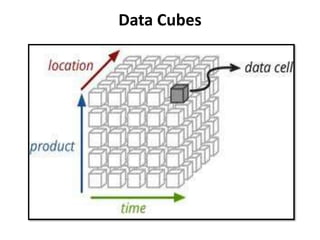
Response time of multidimensional query depends upon the number of cells to be
added on the fly.
Number of dimension increases=no of cube cell increase
Data Cubes
•
•
•
•
•
•
•
•
•
•
•
•

OLAP Guidelines
Multidimensional conceptual view
Transparency
Accessibility
Consistent reporting performance
Client/Server architecture
Generic dimensionality
Dynamic square matrix handling
Multiuser support
Unrestricted cross dimensional operation
Institutive data manipulation
Flexible reporting
Unlimited dimension and aggregation levels
•
•
•
•

Comprehensive database management tools
The ability to drill down to detail view
Incremental database refresh
SQL interface.
Classification of OLAP tools
• Based on multidimensional db.
• Allow the users to analyze the data using
views.
• Need MDDB.
• Classifications:
– MOLAP
– ROLAP
M(Multidimensional)OLAP
• Uses MDDBMS to organize and navigate data
• Data Structure: Array
• Segregate the OLAP thro API
Pros:
 Excellent performance
 Response time.
Cons:
 Series analysis
 iteration
Example
Organization tool
• Arbor software: ESSbase
• Oracle: Express server
• Pilot Software: Light Slip Server
• Snipper: TM/I
• Planning Science: Gentium
• Kenan technology: Multiway
Challenges
• Data structure to support multiple subject area of data.
• Analyze which data can be navigated and analyzed.
• When the navigation changes the data structure needs to be
physically reorganized.
• Need different skill set and tools for DBA to build, maintain
database.
• Need hybrid solution.
Hybrid Solution:
Integration of multidimensional data storage with
RDBMS,
Provide users with MDDS
Data maintained in RDBMS.
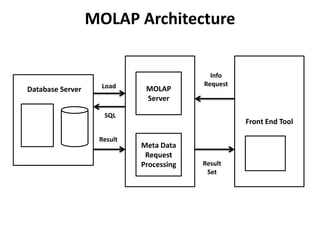
MOLAP Architecture

Database Server

Load

MOLAP
Server

Info
Request

SQL
Result

Front End Tool
Meta Data
Request
Processing

Result
Set
• This allows the MDDS to dynamically obtain
the detail maintained in RDBMS when the
application reaches the bottom of
multidimensional cells during drill down
analysis.
• Best for Sensitive applications.
ROLAP
• Fastest growing style of OLAP
• Products of ROLAP have been engineered to
support products directly through meta data.
• Enables multi dimensional views of 2D
relational tables.
• Pros:
– Flexibility

• Cons:
– Data base design
ROLAP
ROLAP
Server

Database Server

Info
Request

SQL

Result
set

Front End Tool
Meta Data
Request
Processing

Result
Set
•
•
•
•

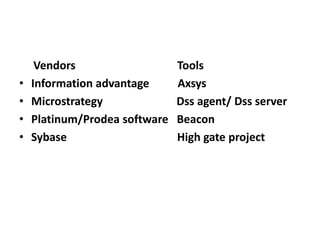
Vendors
Information advantage
Microstrategy
Platinum/Prodea software
Sybase

Tools
Axsys
Dss agent/ Dss server
Beacon
High gate project
Managed Query Environment/HOLAP
• Provides user with ability to perform limited analysis
capability either directly with RDBMS products or
• Intermediate MOLAP.
• The ad hoc query converted to provide data cube.
Done by:
1. Convert the query to select data from DBMS
2. Deliver the data to desktop where it is placed in data
cube.
3. Data cube is stored locally to reduce overhead of
creation of the cube.
4. Now user can perform multi dimensional analysis.
HOLAP/MQE/Hybrid architecture
SQL Query

Database Server
Result set OR
Load

RDB
MS

SQL
Result
set

Info
Request

MOLAP
Server
Result
Set

Front End Tool
• Pros:
– Simple installation
– Administration is easy
– Network traffic is less

• Cons:
– Redundancy
– Inconsistency.
OLAP tools and Internet
• Internet  free resource, provides connectivity, can do
complex administration jobs, store and manage data
applications
• Data warehousing
General features of web enabled data access:
• 1st generation websites:
– Static distribution model
– Client access static html pages via browser.
– Decision support reports stored as html doc and delivered to
users.

• Deficiencies:
– Interaction with clients.
• 2nd generation:
– Supports interaction
– Multi tiered architecture
– Client submits the query in html to web server
– Server transform the request to CGI
– The gateway submits SQL queries to db and
receives and translates to html and sends to page
requester.
Web Processing Model

OLAP

  • 1.
    OLAP V. Saranya AP/CSE Sri Vidyacollege of Engineering & Technology, Virudhunagar
  • 2.
    Need for OLAP •Business problems need query centric db. • Need multidimensional approach. Characteristics of above problems:  Extract large number of records from large data set.  Data summary. To solve these kind of problems we need OLAP
  • 3.
    Introduction to OLAP •Continuous iterative process. • Operations are: – Drill down – Drill up – pivot
  • 4.
    Multidimensional data model •How many students done the conducted by department in college. • Dimensions are: exams – Students – Exams – Department – College. Response time of multidimensional query depends upon the number of cells to be added on the fly. Number of dimension increases=no of cube cell increase
  • 5.
  • 6.
    • • • • • • • • • • • • OLAP Guidelines Multidimensional conceptualview Transparency Accessibility Consistent reporting performance Client/Server architecture Generic dimensionality Dynamic square matrix handling Multiuser support Unrestricted cross dimensional operation Institutive data manipulation Flexible reporting Unlimited dimension and aggregation levels
  • 7.
    • • • • Comprehensive database managementtools The ability to drill down to detail view Incremental database refresh SQL interface.
  • 8.
    Classification of OLAPtools • Based on multidimensional db. • Allow the users to analyze the data using views. • Need MDDB. • Classifications: – MOLAP – ROLAP
  • 9.
    M(Multidimensional)OLAP • Uses MDDBMSto organize and navigate data • Data Structure: Array • Segregate the OLAP thro API Pros:  Excellent performance  Response time. Cons:  Series analysis  iteration
  • 10.
    Example Organization tool • Arborsoftware: ESSbase • Oracle: Express server • Pilot Software: Light Slip Server • Snipper: TM/I • Planning Science: Gentium • Kenan technology: Multiway
  • 11.
    Challenges • Data structureto support multiple subject area of data. • Analyze which data can be navigated and analyzed. • When the navigation changes the data structure needs to be physically reorganized. • Need different skill set and tools for DBA to build, maintain database. • Need hybrid solution. Hybrid Solution: Integration of multidimensional data storage with RDBMS, Provide users with MDDS Data maintained in RDBMS.
  • 12.
  • 13.
    • This allowsthe MDDS to dynamically obtain the detail maintained in RDBMS when the application reaches the bottom of multidimensional cells during drill down analysis. • Best for Sensitive applications.
  • 14.
    ROLAP • Fastest growingstyle of OLAP • Products of ROLAP have been engineered to support products directly through meta data. • Enables multi dimensional views of 2D relational tables. • Pros: – Flexibility • Cons: – Data base design
  • 15.
  • 16.
  • 17.
    Managed Query Environment/HOLAP •Provides user with ability to perform limited analysis capability either directly with RDBMS products or • Intermediate MOLAP. • The ad hoc query converted to provide data cube. Done by: 1. Convert the query to select data from DBMS 2. Deliver the data to desktop where it is placed in data cube. 3. Data cube is stored locally to reduce overhead of creation of the cube. 4. Now user can perform multi dimensional analysis.
  • 18.
    HOLAP/MQE/Hybrid architecture SQL Query DatabaseServer Result set OR Load RDB MS SQL Result set Info Request MOLAP Server Result Set Front End Tool
  • 19.
    • Pros: – Simpleinstallation – Administration is easy – Network traffic is less • Cons: – Redundancy – Inconsistency.
  • 20.
    OLAP tools andInternet • Internet  free resource, provides connectivity, can do complex administration jobs, store and manage data applications • Data warehousing General features of web enabled data access: • 1st generation websites: – Static distribution model – Client access static html pages via browser. – Decision support reports stored as html doc and delivered to users. • Deficiencies: – Interaction with clients.
  • 21.
    • 2nd generation: –Supports interaction – Multi tiered architecture – Client submits the query in html to web server – Server transform the request to CGI – The gateway submits SQL queries to db and receives and translates to html and sends to page requester.
  • 22.