DATABASE MANAGEMENT
SYSTEM:
T WO PHASE LOCKING PROTOCOL
1 7 0 4 1 0 1 0 7 0 2 7
D H A N A N J AY S I N H J H A L A
S Y C E - I B AT C H B
INDEX
• Locks
• Locking protocols
• 2 phase locking protocol
–Phases
–Merits
–demerits
LOCKS
To ensure serializability, it is required that data items should be
accessed in mutual exclusive manner, i.e. if one transaction is accessing
a data item, no other transaction can modify that data item.
To implement this requirement locks are used.
A transaction is allowed to access a data item only if it is currently
holding a lock on that item.
There are 2 modes in which a data item may be locked:
Shared mode: if a transaction T1 has obtained a shared mode lock on
item Q, then T1 can read, but cannot write Q. it is denoted by S.
Exclusive: if a transaction T1 has obtained a exclusive mode lock on
item Q, then T1 can read & also write Q. it is denoted by X.
LOCKING PROTOCOLS
When a transaction requests a lock on a data item in a particular mode
and no other transaction has a lock on the same data item, the lock can
be granted.
Supposing a transaction T1 requests a lock on data item Q in a particular
mode M, the concurrency control manager grants the lock provided that
There is no other transaction holding a lock on Q in a mode that
conflicts with M
There is no other transaction that is waiting for a lock on Q, and that
made its lock request before T1.
2 PHASE LOCKING PROTOCOL
• This protocol requires that each transaction issue lock and
unlock requests in two phases:
– Growing phase: in this phase, a transaction may obtain locks, but
may not release any lock.
– Shrinking phase: in this phase, a transaction may release locks, but
may not obtain any new locks.
– Initially, a transaction is in the growing phase. The transaction
acquires locks as needed. Once a transaction releases a lock, it enters
in the shrinking phase and it cannot issue more lock requests.
2 PHASE LOCKING PROTOCOL
• E.g. Transaction given below is a two phase transaction.
• T3:
– lock X(B);
– read(B);
– B:= B-50;
– write(B);
– lock X(A);
– read(A);
– A:=A+50;
– write(A);
– unlock(B);
– unlock(A);
MERITS OF 2 PHASE LOCKING PROTOCOL
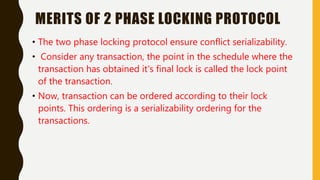
• The two phase locking protocol ensure conflict serializability.
• Consider any transaction, the point in the schedule where the
transaction has obtained it's final lock is called the lock point
of the transaction.
• Now, transaction can be ordered according to their lock
points. This ordering is a serializability ordering for the
transactions.
DEMERITS OF 2 PHASE LOCKING PROTOCOL
• The two phase locking protocol Does not ensure freedom from
deadlock:
– Consider the schedule shown in figure
– Transaction T3 and T4 are two phases but they are deadlocked.
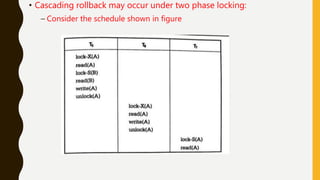
• Cascading rollback may occur under two phase locking:
– Consider the schedule shown in figure
• As shown in the above figure transactions T5,T6 and T7 are
two phase, but failure of T5 after the read(A) instruction of T7
leads to cascading rollback of T6 and T7.
• Cascading rollback can be avoided by modification of two
phase locking:
– 1. Strict two phase locking protocol: This protocol requires that
locking should be two phase and all executive mode locks taken by a
transaction should be held until the transaction commits. This
requirement prevents any transaction from reading the data written
by any uncommitted transaction under exclusive mode until the
transaction commits.
• 2. The rigorous two phase locking protocol: This protocol
requires that all locks be held until the transaction commits.
2 phase locking protocol DBMS

2 phase locking protocol DBMS

  • 1.
    DATABASE MANAGEMENT SYSTEM: T WOPHASE LOCKING PROTOCOL 1 7 0 4 1 0 1 0 7 0 2 7 D H A N A N J AY S I N H J H A L A S Y C E - I B AT C H B
  • 2.
    INDEX • Locks • Lockingprotocols • 2 phase locking protocol –Phases –Merits –demerits
  • 3.
    LOCKS To ensure serializability,it is required that data items should be accessed in mutual exclusive manner, i.e. if one transaction is accessing a data item, no other transaction can modify that data item. To implement this requirement locks are used. A transaction is allowed to access a data item only if it is currently holding a lock on that item. There are 2 modes in which a data item may be locked: Shared mode: if a transaction T1 has obtained a shared mode lock on item Q, then T1 can read, but cannot write Q. it is denoted by S. Exclusive: if a transaction T1 has obtained a exclusive mode lock on item Q, then T1 can read & also write Q. it is denoted by X.
  • 4.
    LOCKING PROTOCOLS When atransaction requests a lock on a data item in a particular mode and no other transaction has a lock on the same data item, the lock can be granted. Supposing a transaction T1 requests a lock on data item Q in a particular mode M, the concurrency control manager grants the lock provided that There is no other transaction holding a lock on Q in a mode that conflicts with M There is no other transaction that is waiting for a lock on Q, and that made its lock request before T1.
  • 5.
    2 PHASE LOCKINGPROTOCOL • This protocol requires that each transaction issue lock and unlock requests in two phases: – Growing phase: in this phase, a transaction may obtain locks, but may not release any lock. – Shrinking phase: in this phase, a transaction may release locks, but may not obtain any new locks. – Initially, a transaction is in the growing phase. The transaction acquires locks as needed. Once a transaction releases a lock, it enters in the shrinking phase and it cannot issue more lock requests.
  • 6.
    2 PHASE LOCKINGPROTOCOL • E.g. Transaction given below is a two phase transaction. • T3: – lock X(B); – read(B); – B:= B-50; – write(B); – lock X(A); – read(A); – A:=A+50; – write(A); – unlock(B); – unlock(A);
  • 7.
    MERITS OF 2PHASE LOCKING PROTOCOL • The two phase locking protocol ensure conflict serializability. • Consider any transaction, the point in the schedule where the transaction has obtained it's final lock is called the lock point of the transaction. • Now, transaction can be ordered according to their lock points. This ordering is a serializability ordering for the transactions.
  • 8.
    DEMERITS OF 2PHASE LOCKING PROTOCOL • The two phase locking protocol Does not ensure freedom from deadlock: – Consider the schedule shown in figure – Transaction T3 and T4 are two phases but they are deadlocked.
  • 9.
    • Cascading rollbackmay occur under two phase locking: – Consider the schedule shown in figure
  • 10.
    • As shownin the above figure transactions T5,T6 and T7 are two phase, but failure of T5 after the read(A) instruction of T7 leads to cascading rollback of T6 and T7. • Cascading rollback can be avoided by modification of two phase locking: – 1. Strict two phase locking protocol: This protocol requires that locking should be two phase and all executive mode locks taken by a transaction should be held until the transaction commits. This requirement prevents any transaction from reading the data written by any uncommitted transaction under exclusive mode until the transaction commits.
  • 11.
    • 2. Therigorous two phase locking protocol: This protocol requires that all locks be held until the transaction commits.