Introduction 
 OCT is noncontact noninvasive technique for imaging 
biological tissues. 
 In 1990, Fercher presented cross-sectional 
topographic image of the retinal pigment epithelium 
(RPE) of a human eye. 
 The first commercial instrument, OCT 1,was launched 
in 1996.
Scattering is a fundamental property of a 
heterogeneous medium, and occurs because of 
variations in the refractive index within tissue. 
5
Principle of OCT 
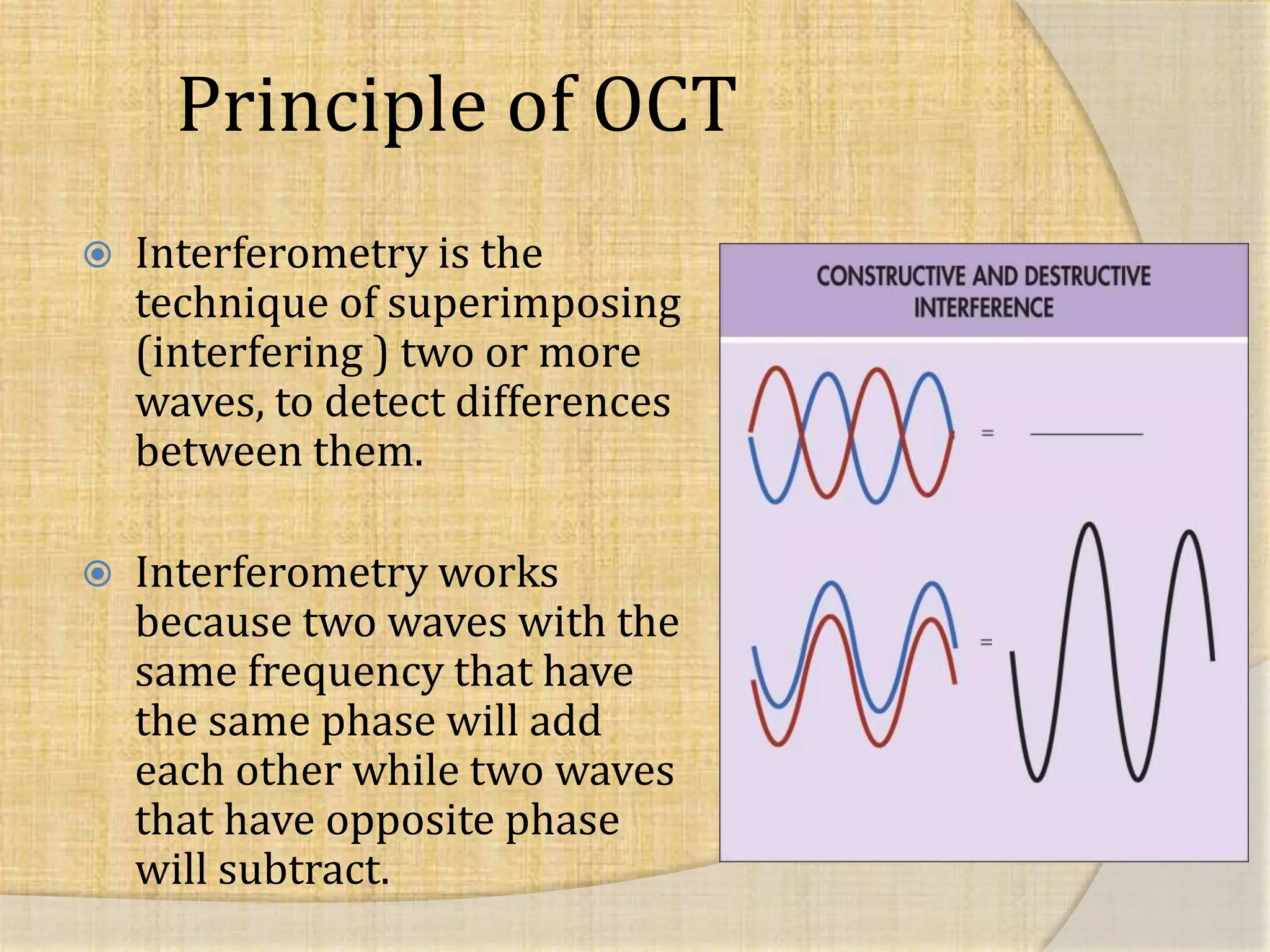
 Interferometry is the 
technique of superimposing 
(interfering ) two or more 
waves, to detect differences 
between them. 
 Interferometry works 
because two waves with the 
same frequency that have 
the same phase will add 
each other while two waves 
that have opposite phase 
will subtract.
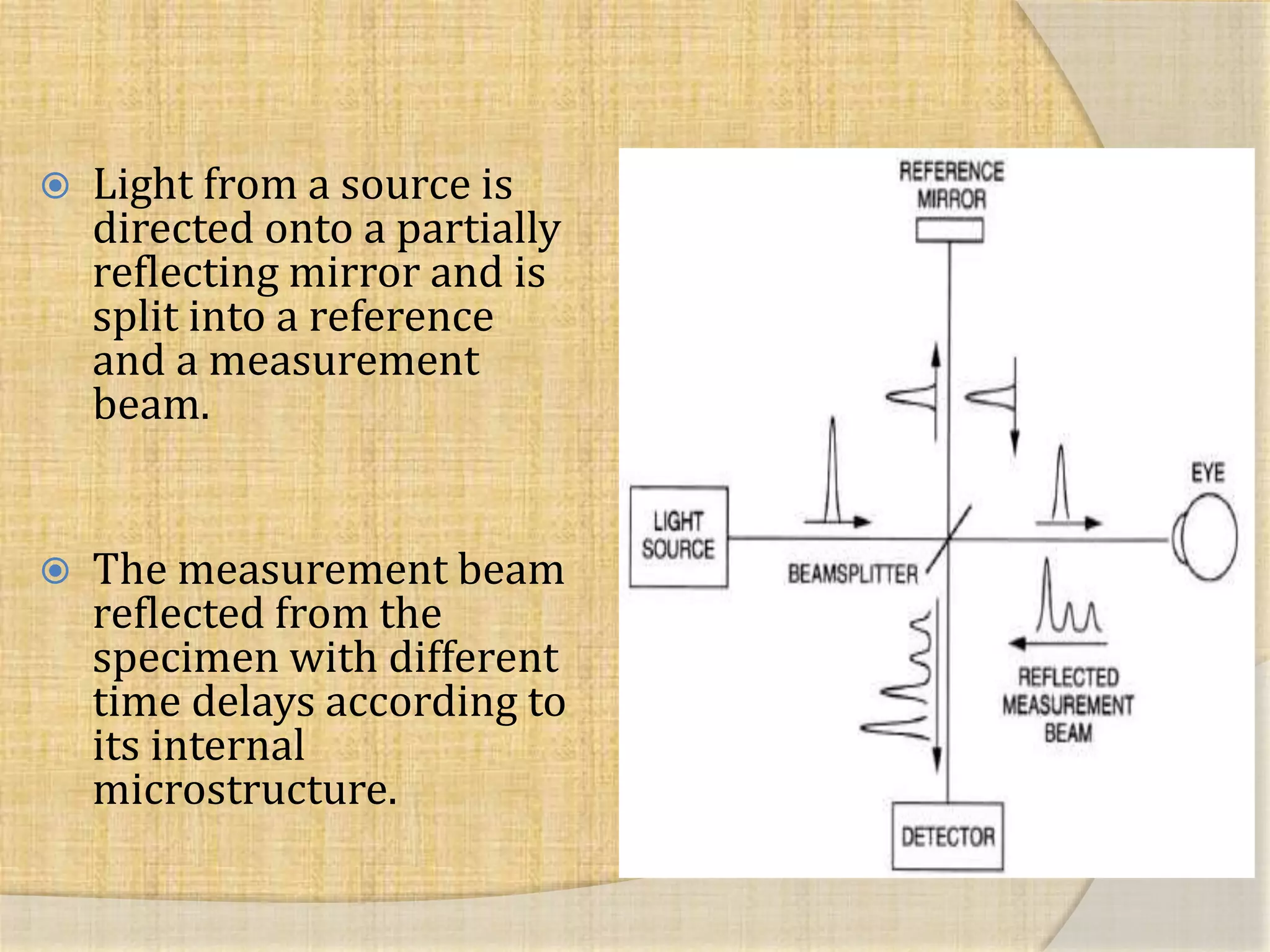
 Light from a source is 
directed onto a partially 
reflecting mirror and is 
split into a reference 
and a measurement 
beam. 
 The measurement beam 
reflected from the 
specimen with different 
time delays according to 
its internal 
microstructure.
 The light in the reference 
beam is reflected from a 
reference mirror at a 
variable distance which 
produces a variable time 
delay. 
 The light from the 
specimen, consisting of 
multiple echoes, and the 
light from the reference 
mirror, consisting of a 
single echo at a known 
delay are combined and 
detected.
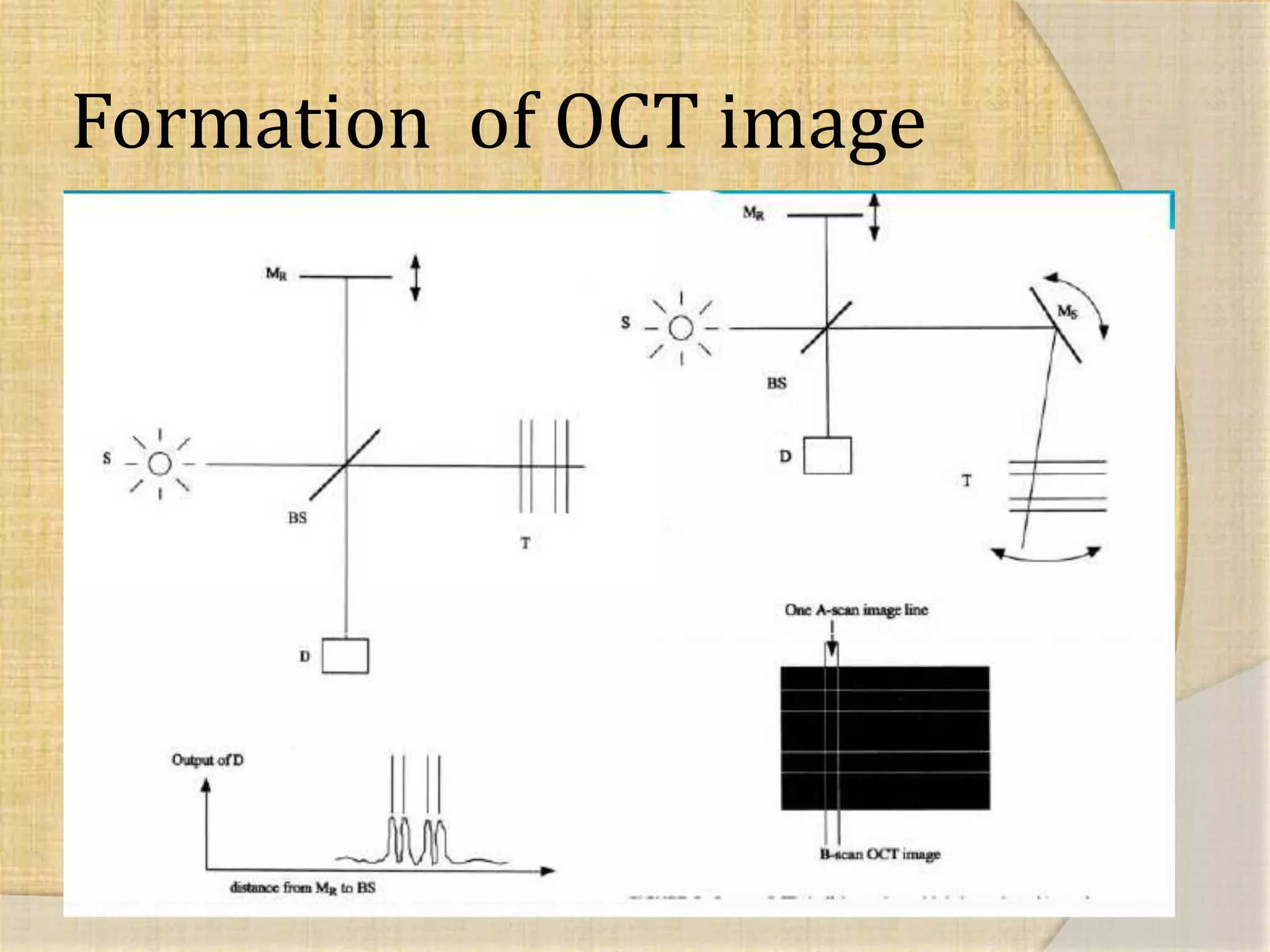
Formation of OCT image
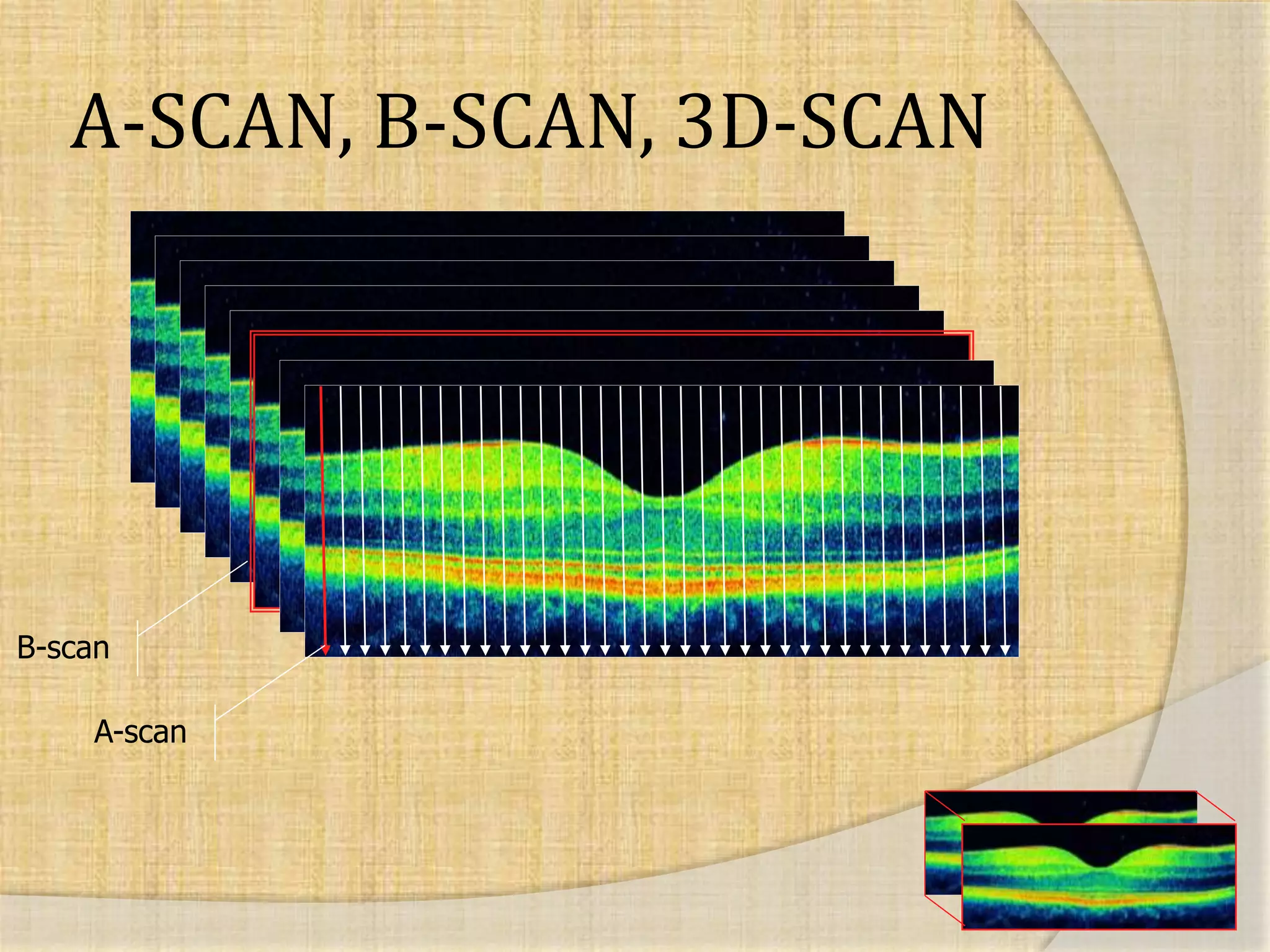
A-SCAN, B-SCAN, 3D-SCAN 
B-scan 
A-scan
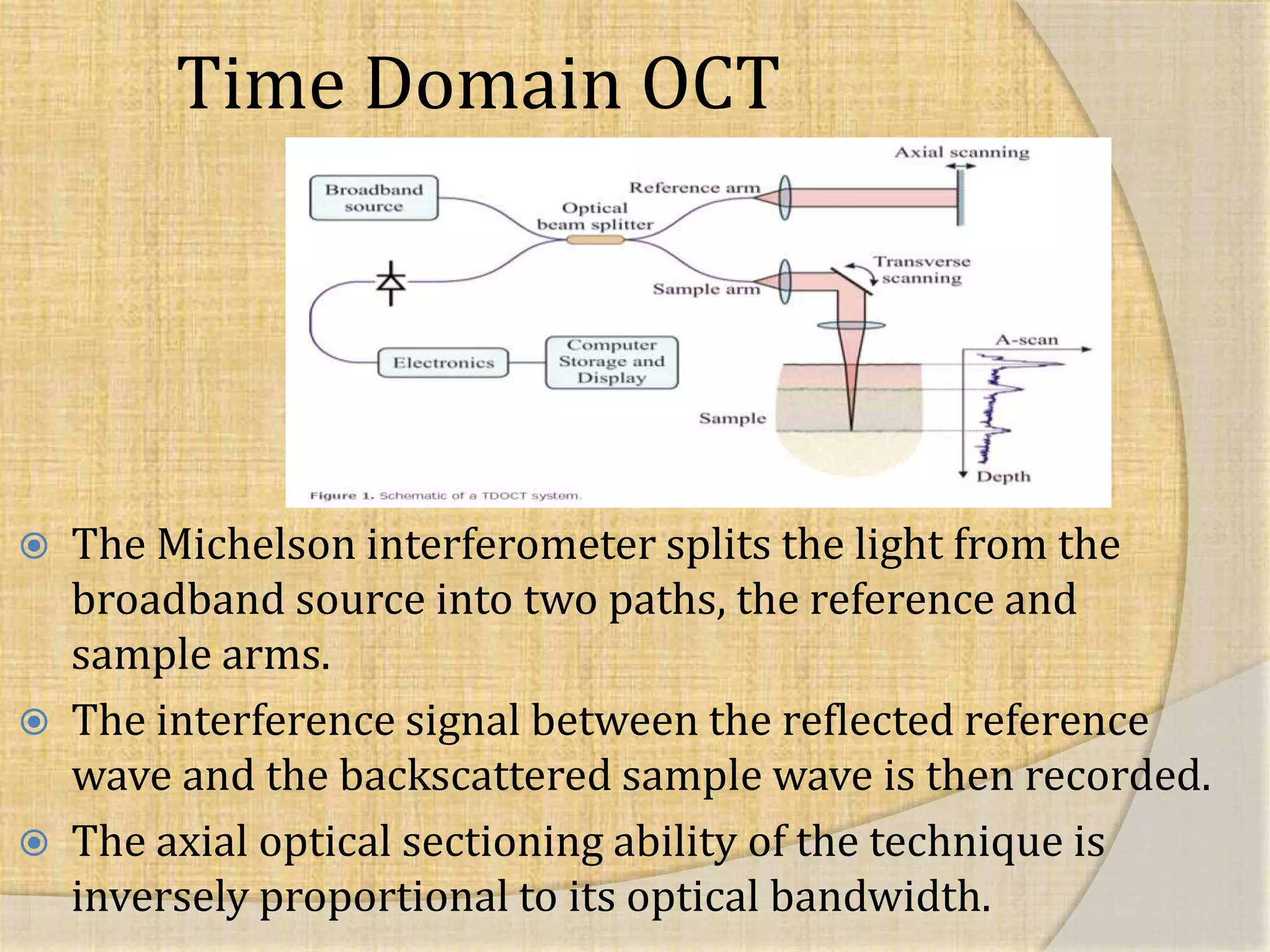
Time Domain OCT 
 The Michelson interferometer splits the light from the 
broadband source into two paths, the reference and 
sample arms. 
 The interference signal between the reflected reference 
wave and the backscattered sample wave is then recorded. 
 The axial optical sectioning ability of the technique is 
inversely proportional to its optical bandwidth.
Time Domain OCT 
 Transverse scanning of the sample is achieved via 
rotation of a sample arm galvonometer mirror. 
 In order to measure the time delays of light echoes 
coming from different structures within the eye, the 
position of the reference mirror is changed so that the 
time delay of the reference light pulse is adjusted 
accordingly
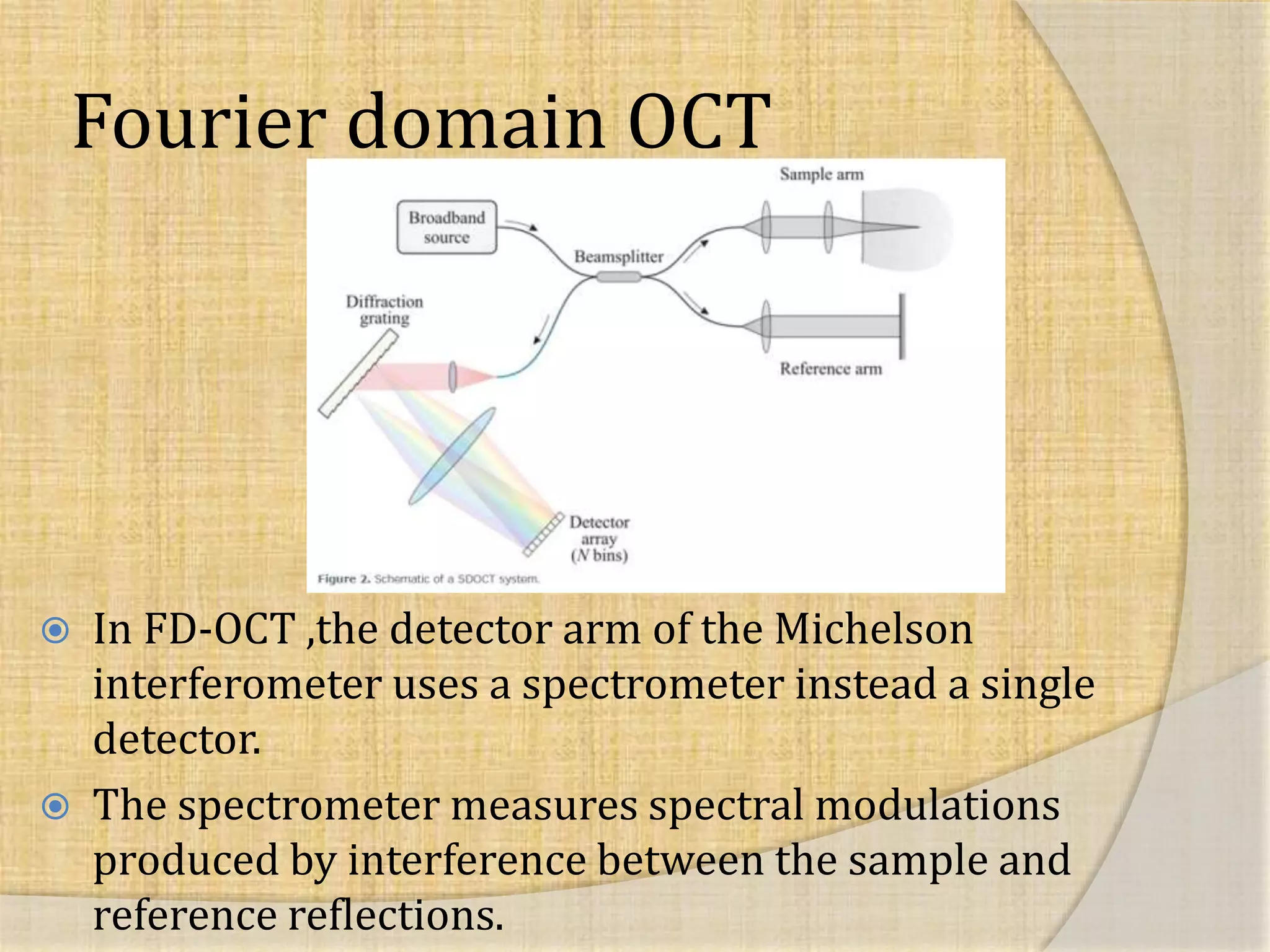
Fourier domain OCT 
 In FD-OCT ,the detector arm of the Michelson 
interferometer uses a spectrometer instead a single 
detector. 
 The spectrometer measures spectral modulations 
produced by interference between the sample and 
reference reflections.
 No physical scanning of the reference mirror is 
required; thus, FD-OCT can be much faster than 
TDOCT. 
 The simultaneous detection of reflections from a 
broad range of depths is much more efficient than 
TD-OCT, in which signals from various depths are 
scanned sequentially. 
 FD-OCT is also fast enough for sequential image 
frames to track the pulsation of blood vessels during 
the cardiac cycle.
 Time domain Optical 
Coherence tomography: 
 Fourier domain Optical 
Coherence tomography:
Time vs Fourier domain OCT 
Time domain OCT 
 A scan generated 
sequentially, one pixel at a 
time of 1.6 seconds 
 Moving reference mirror 
 400 scans/sec 
 Resolution – 10 micron 
 Slower than eye movement 
Fourier domain OCT 
 Entire A scan is generated at 
once based on Fourier 
transformation of 
spectrometer analysis 
 Stationary reference mirror 
 26,000 scans/sec 
 Resolution – 5 micron 
 Faster than eye movement 
17
Spectral OCT/SLO 
 Limitation of OCT technology was difficulty in 
accurately localizing the cross-sectional images 
and correlating them with a conventional en face 
view of the fundus. 
 To localize and visually interpret the images, 
integrating a scanning laser ophthalmoscopy 
(SLO) into the OCT was needed. 
 This rationale was used by OTI technologies 
(Toronto, Canada) to develop the Spectral 
OCT/SLO.
 The Spectral OCT/SLO is a computerized optical 
scanner device providing high-resolution, high-definition 
images of the fundus anatomy. 
 It integrats SLO’s confocal imaging principles with 
OCT’s high resolution tomographic images. 
 The system simultaneously produces SLO and OCT 
images that are created through the same optical path, 
and therefore correspond pixel to pixel. 
 It produces a new image format called as C scan
 The technique has already become 
established as a standard imaging modality 
for imaging of the eye. 
 The application of OCT imaging to other 
biomedical areas such as endoscopic imaging 
of gastro-intestinal and cardiovascular 
systems is currently an active field of 
research.
Principles of optical coherence tomography

Principles of optical coherence tomography

  • 2.
    Introduction  OCTis noncontact noninvasive technique for imaging biological tissues.  In 1990, Fercher presented cross-sectional topographic image of the retinal pigment epithelium (RPE) of a human eye.  The first commercial instrument, OCT 1,was launched in 1996.
  • 5.
    Scattering is afundamental property of a heterogeneous medium, and occurs because of variations in the refractive index within tissue. 5
  • 6.
    Principle of OCT  Interferometry is the technique of superimposing (interfering ) two or more waves, to detect differences between them.  Interferometry works because two waves with the same frequency that have the same phase will add each other while two waves that have opposite phase will subtract.
  • 7.
     Light froma source is directed onto a partially reflecting mirror and is split into a reference and a measurement beam.  The measurement beam reflected from the specimen with different time delays according to its internal microstructure.
  • 8.
     The lightin the reference beam is reflected from a reference mirror at a variable distance which produces a variable time delay.  The light from the specimen, consisting of multiple echoes, and the light from the reference mirror, consisting of a single echo at a known delay are combined and detected.
  • 9.
  • 10.
  • 12.
    Time Domain OCT  The Michelson interferometer splits the light from the broadband source into two paths, the reference and sample arms.  The interference signal between the reflected reference wave and the backscattered sample wave is then recorded.  The axial optical sectioning ability of the technique is inversely proportional to its optical bandwidth.
  • 13.
    Time Domain OCT  Transverse scanning of the sample is achieved via rotation of a sample arm galvonometer mirror.  In order to measure the time delays of light echoes coming from different structures within the eye, the position of the reference mirror is changed so that the time delay of the reference light pulse is adjusted accordingly
  • 14.
    Fourier domain OCT  In FD-OCT ,the detector arm of the Michelson interferometer uses a spectrometer instead a single detector.  The spectrometer measures spectral modulations produced by interference between the sample and reference reflections.
  • 15.
     No physicalscanning of the reference mirror is required; thus, FD-OCT can be much faster than TDOCT.  The simultaneous detection of reflections from a broad range of depths is much more efficient than TD-OCT, in which signals from various depths are scanned sequentially.  FD-OCT is also fast enough for sequential image frames to track the pulsation of blood vessels during the cardiac cycle.
  • 16.
     Time domainOptical Coherence tomography:  Fourier domain Optical Coherence tomography:
  • 17.
    Time vs Fourierdomain OCT Time domain OCT  A scan generated sequentially, one pixel at a time of 1.6 seconds  Moving reference mirror  400 scans/sec  Resolution – 10 micron  Slower than eye movement Fourier domain OCT  Entire A scan is generated at once based on Fourier transformation of spectrometer analysis  Stationary reference mirror  26,000 scans/sec  Resolution – 5 micron  Faster than eye movement 17
  • 18.
    Spectral OCT/SLO Limitation of OCT technology was difficulty in accurately localizing the cross-sectional images and correlating them with a conventional en face view of the fundus.  To localize and visually interpret the images, integrating a scanning laser ophthalmoscopy (SLO) into the OCT was needed.  This rationale was used by OTI technologies (Toronto, Canada) to develop the Spectral OCT/SLO.
  • 19.
     The SpectralOCT/SLO is a computerized optical scanner device providing high-resolution, high-definition images of the fundus anatomy.  It integrats SLO’s confocal imaging principles with OCT’s high resolution tomographic images.  The system simultaneously produces SLO and OCT images that are created through the same optical path, and therefore correspond pixel to pixel.  It produces a new image format called as C scan
  • 21.
     The techniquehas already become established as a standard imaging modality for imaging of the eye.  The application of OCT imaging to other biomedical areas such as endoscopic imaging of gastro-intestinal and cardiovascular systems is currently an active field of research.

Editor's Notes

  • #3 In a first approach towards tomographic imaging a cross-sectional topographic image of the retinal pigment epithelium (RPE) of a human eye obtained in vivo by the dual beam LCI technique was presented at the ICO-15 SAT conference by Fercher (1990) and published by Hitzenberger (1991). OCT using fibre optic Michelson LCI was pioneered by Fujimoto and co-workers (Huang et al 1991). First in vivo tomograms of the human retina were published by Fercher et al (1993a) and Swanson et al (1993). Later Chinn et al (1997) used wavelength tuning interferometry (WTI) to synthesize OCT images, whereas H¨ausler and Lindner (1998) generated OCT images using spectral interferometry. For a review of early work in LCI and OCT see the selection of key papers published by Masters (2001).
  • #7 Based on the principle of low-coherence interferometry where distance information concerning various ocular structures is extracted from time delays of reflected signals Light incident onto a scattering or turbid medium such as tissue is either transmitted, absorbed, or scattered. Absorbed light is converted into heat in the tissue and is effectively removed from the incident beam.
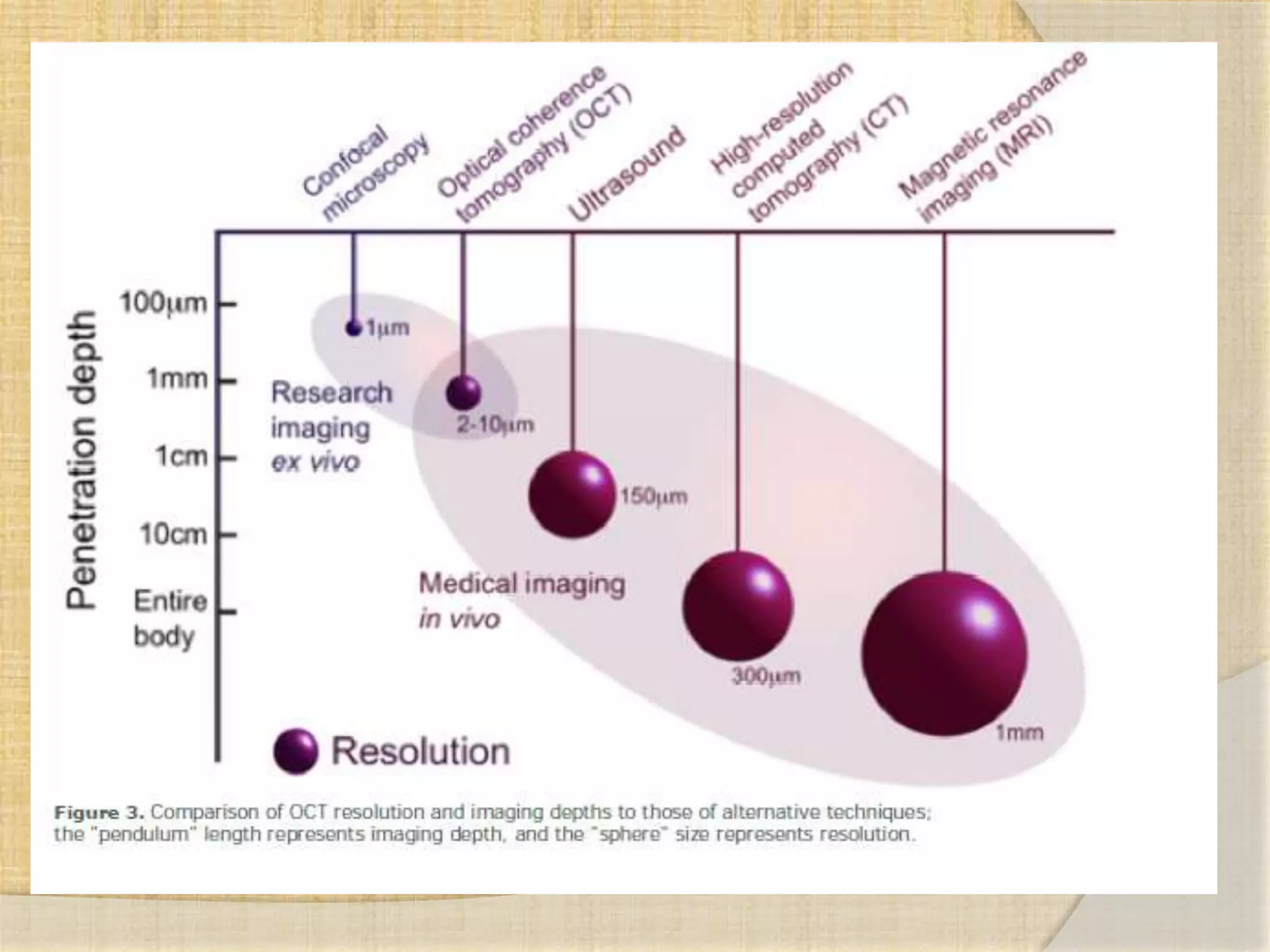
  • #11 Optical coherence tomography (OCT) is an imaging technique which works similar to ultrasound, simply using light waves instead of sound waves. By using the time information contained in the light waves which have been reflected from different depths inside a sample, an OCT system can reconstruct a depth-profile of the sample structure. Three-dimensional images can then be created by scanning the light beam laterally across the sample surface. Whilst the lateral resolution is determined by the spot size of the light beam, the depth (or axial) resolution depends primarily on the optical bandwidth of the light source.