Jagdish Dukre
Introduction
 In 1961, Zweng and Flocks introduced the concept
of applying light energy to the anterior chamber
angle for the treatment of glaucoma.
 In 1979, Wise and Witter described the first
successful protocol of what has become known as
laser trabeculoplasty
 1979 Argon Laser [488 nm blue-green, 514 nm
green]
 1984 Krypton Laser [red 647.1 nm, yellow 568.2
nm]
 1988 Nd:YAG Laser [1064 nm]
 1990 Diode Laser [810 nm]
 1996 Solid State “ALT” [532 nm]
 2001 Frequency Doubled Nd:YAG laser: SLT [532
nm]
 2006 Diode MicroPulse Laser: MLT [810 nm]
 2008 Titanium:Sapphire Laser [790 nm]
Indications
 when IOP remains above "target" IOP despite
maximally tolerated medical therapy
 when patients are noncompliant
 pseudoexfoliation glaucoma
 when surgery needs to be deferred due to a patient's
systemic status
Contraindications
 Narrow angles
 Presence of peripheral anterior synechiae
 Uveitis
 Advanced glaucoma
 Developmental glaucomas.
 Mechanical theory
 Biologic theory
 Cell division theory
Theories Of Mechanism
thermal energy
produced by
pigment absorption
shrinkage of
collagen in the
trabecular lamellae
shortening of the
treated meshwork
enlarge existing
spaces between
two treatment sites
Mechanical theory
Biologic Theory
 Laser energy causes tissue injury with a resultant
cascade of events.
 Upregulation of interleukin I and tumor necrosis factor
also upregulates metalloproteinase expression.
 Macrophages are attracted, and they alter the secreted
extracellular matrix, allowing an increased aqueous
outflow.
Cell Division Theory
 Laser applications stimulate cell division in the
anterior TM.
 Loss of endothelial cells over the trabecular beams
causes the peripheral corneal endothelial cells to
divide and slide over the lasered areas.
 These cells produce different extracellular matrix,
enhancing the aqueous outflow.
Preoperative Preparation
 Patients are instructed to continue all glaucoma
medications on their regular schedule.
 Patients are routinely pretreated with apraclonidine to
prevent a significant IOP spike that could adversely
affect visual function.
 The eye should not be exposed to diagnostic
procedures before the treatment because this can
affect corneal clarity.
Surgical Technique
 Argon laser trabeculoplasty is
performed using topical
anesthesia.
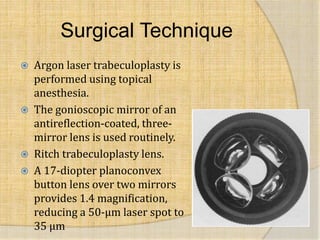
 The gonioscopic mirror of an
antireflection-coated, three-
mirror lens is used routinely.
 Ritch trabeculoplasty lens.
 A 17-diopter planoconvex
button lens over two mirrors
provides 1.4 magnification,
reducing a 50-µm laser spot to
35 µm
 Before starting treatment, it is critical to identify
the angle landmarks.
 The treatment begins with the gonioscopic mirror
at the 12 o'clock position viewing the inferior
angle.
 The inferior angle tends to be the most open part
and has the most pigmentation, making angle
structures more clearly defined in this area.
 This facilitates identification of the angle
landmarks and avoids treating the wrong part of
the angle.
 The use of a fixation light for the contralateral eye
assists the patient in maintaining the appropriate eye
position.
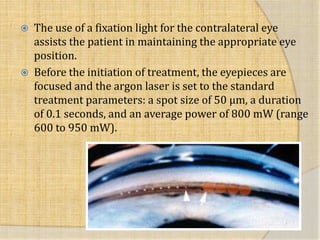
 Before the initiation of treatment, the eyepieces are
focused and the argon laser is set to the standard
treatment parameters: a spot size of 50 μm, a duration
of 0.1 seconds, and an average power of 800 mW (range
600 to 950 mW).
 During the treatment, the power setting required to
blanch the trabecular meshwork or cause a small
bubble formation is empirically determined.
 It is helpful to use a standardized treatment technique.
This involves starting with the mirror at the 12 o'clock
position and rotating it in a clockwise manner.
 The laser burns are placed at the anterior border of
the pigmented trabecular meshwork.
 The more posterior the treatment, the greater the
incidence of IOP elevation and formation of posterior
synechiae.
 The aiming beam should be the smallest and roundest
target possible.
 This can be achieved by mechanically directing the
laser beam forward and backward.
 If the treating contact lens is tilted and not
perpendicular to the eye, the aiming beam will appear
oval.
 the lens on the eye and making sure that the aiming
beam is perpendicular to the lens ensures that the full
power density of the treatment will be achieved.
 If the trabecular meshwork cannot be seen easily,
having the patient move the eye in the direction of the
gonioscopic mirror often opens the angle and improves
visibility.
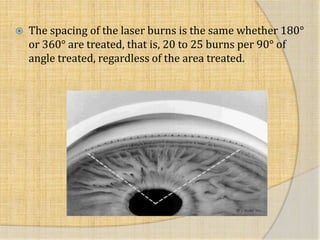
 The spacing of the laser burns is the same whether 180°
or 360° are treated, that is, 20 to 25 burns per 90° of
angle treated, regardless of the area treated.
POSTOPERATIVE
MANAGEMENT
 The patient is instructed to continue all glaucoma
medications as usual and begin a topical steroid drop
four times a day for 4 to 5 days.
 If the patient has had a significant IOP elevation or has
severe glaucomatous damage, the IOP is measured the
next day.
 Most patients are reexamined 2 to 5 days later and
then at about 4 weeks.
 If at 4 weeks the pretreatment goal has not been
achieved, the second half of the angle can be treated.
Complications
 Transient IOP elevation
 Iritis
 peripheral anterior synechiae
 membrane covering the entire trabecular
meshwork
Transient IOP elevation
 the pressure rise is mild and lasts less than 24 hours
 IOP rise occurs within 2 hours after treatment in most
cases
 IOP rise occurs within 2 hours after treatment in most
cases
 mechanism of posttrabeculoplasty pressure rise is an
inflammatory reaction, with fibrinous material and tissue
debris in the meshwork
Iritis
 common early posttrabeculoplasty complication
 49% eyes showed significant inflammation
 inflammation peaked 2 days after the treatment
 More frequent in eyes with exfoliation syndrome or
pigmentary glaucoma
 It is mild and transient and easily controlled with a brief
postoperative course of topical corticosteroids
 postoperative management includes prednisolone 1%,
or fluorometholone 0.1%, four times daily for 5 days
Peripheral Anterior
Synechiae
 The formation of peripheral anterior synechiae is
also a common complication of trabeculoplasty.
 These are typically small and tented, corresponding
to the location of the laser applications.
Membrane
 most serious late posttrabeculoplasty complication
 Histopathologic studies show changes in the trabecular
meshwork, including an endothelial layer over the inner
surface
 It can lead to an increase in resistance to aqueous outflow.
 It is more common in eyes in which a higher number of
trabeculoplasties was performed
Selective Laser Trabeculoplasty
 frequency-doubled Q-switched 532-nm Nd:YAG laser.
 repeatable procedure because of the lack of
coagulation damage to the trabecular meshwork.
 A total of approximately 50 to 60 adjacent,
nonoverlapping spots are placed over 180 degrees of
the trabecular meshwork with energy ranging from
0.5 to 1.2 mJ per pulse, set to prevent bubble
formation
 A Latina lens, Goldmann 3 mirror or Ritch lens is used
for he procedure
 The aim is to cover the angle, but taking care that the
laser spot should not impinge upon the iris
 3 nanoseconds (preset); Spot Size: 400 microns
(preset); Energy: 1.0 mJ/pulse
 It targets the melanocytes in the trabecular
meshwork.
 The biologic response in the trabecular meshwork
results in release of cytokines that trigger
macrophage recruitment.
 This in turn causes IOP reduction by increased
aqueous outflow through the TM.
 SLT treats the meshwork without causing any thermal
or coagulative damage to the surrounding structures
TITANIUM:SAPPHIRE LASER
TRABECULOPLASTY
Thank You…

Argon laser

  • 1.
  • 2.
    Introduction  In 1961,Zweng and Flocks introduced the concept of applying light energy to the anterior chamber angle for the treatment of glaucoma.  In 1979, Wise and Witter described the first successful protocol of what has become known as laser trabeculoplasty
  • 3.
     1979 ArgonLaser [488 nm blue-green, 514 nm green]  1984 Krypton Laser [red 647.1 nm, yellow 568.2 nm]  1988 Nd:YAG Laser [1064 nm]  1990 Diode Laser [810 nm]  1996 Solid State “ALT” [532 nm]  2001 Frequency Doubled Nd:YAG laser: SLT [532 nm]  2006 Diode MicroPulse Laser: MLT [810 nm]  2008 Titanium:Sapphire Laser [790 nm]
  • 4.
    Indications  when IOPremains above "target" IOP despite maximally tolerated medical therapy  when patients are noncompliant  pseudoexfoliation glaucoma  when surgery needs to be deferred due to a patient's systemic status
  • 5.
    Contraindications  Narrow angles Presence of peripheral anterior synechiae  Uveitis  Advanced glaucoma  Developmental glaucomas.
  • 6.
     Mechanical theory Biologic theory  Cell division theory Theories Of Mechanism
  • 7.
    thermal energy produced by pigmentabsorption shrinkage of collagen in the trabecular lamellae shortening of the treated meshwork enlarge existing spaces between two treatment sites Mechanical theory
  • 8.
    Biologic Theory  Laserenergy causes tissue injury with a resultant cascade of events.  Upregulation of interleukin I and tumor necrosis factor also upregulates metalloproteinase expression.  Macrophages are attracted, and they alter the secreted extracellular matrix, allowing an increased aqueous outflow.
  • 9.
    Cell Division Theory Laser applications stimulate cell division in the anterior TM.  Loss of endothelial cells over the trabecular beams causes the peripheral corneal endothelial cells to divide and slide over the lasered areas.  These cells produce different extracellular matrix, enhancing the aqueous outflow.
  • 10.
    Preoperative Preparation  Patientsare instructed to continue all glaucoma medications on their regular schedule.  Patients are routinely pretreated with apraclonidine to prevent a significant IOP spike that could adversely affect visual function.  The eye should not be exposed to diagnostic procedures before the treatment because this can affect corneal clarity.
  • 11.
    Surgical Technique  Argonlaser trabeculoplasty is performed using topical anesthesia.  The gonioscopic mirror of an antireflection-coated, three- mirror lens is used routinely.  Ritch trabeculoplasty lens.  A 17-diopter planoconvex button lens over two mirrors provides 1.4 magnification, reducing a 50-µm laser spot to 35 µm
  • 12.
     Before startingtreatment, it is critical to identify the angle landmarks.  The treatment begins with the gonioscopic mirror at the 12 o'clock position viewing the inferior angle.  The inferior angle tends to be the most open part and has the most pigmentation, making angle structures more clearly defined in this area.  This facilitates identification of the angle landmarks and avoids treating the wrong part of the angle.
  • 13.
     The useof a fixation light for the contralateral eye assists the patient in maintaining the appropriate eye position.  Before the initiation of treatment, the eyepieces are focused and the argon laser is set to the standard treatment parameters: a spot size of 50 μm, a duration of 0.1 seconds, and an average power of 800 mW (range 600 to 950 mW).
  • 14.
     During thetreatment, the power setting required to blanch the trabecular meshwork or cause a small bubble formation is empirically determined.  It is helpful to use a standardized treatment technique. This involves starting with the mirror at the 12 o'clock position and rotating it in a clockwise manner.
  • 15.
     The laserburns are placed at the anterior border of the pigmented trabecular meshwork.  The more posterior the treatment, the greater the incidence of IOP elevation and formation of posterior synechiae.
  • 16.
     The aimingbeam should be the smallest and roundest target possible.  This can be achieved by mechanically directing the laser beam forward and backward.  If the treating contact lens is tilted and not perpendicular to the eye, the aiming beam will appear oval.  the lens on the eye and making sure that the aiming beam is perpendicular to the lens ensures that the full power density of the treatment will be achieved.  If the trabecular meshwork cannot be seen easily, having the patient move the eye in the direction of the gonioscopic mirror often opens the angle and improves visibility.
  • 17.
     The spacingof the laser burns is the same whether 180° or 360° are treated, that is, 20 to 25 burns per 90° of angle treated, regardless of the area treated.
  • 18.
    POSTOPERATIVE MANAGEMENT  The patientis instructed to continue all glaucoma medications as usual and begin a topical steroid drop four times a day for 4 to 5 days.  If the patient has had a significant IOP elevation or has severe glaucomatous damage, the IOP is measured the next day.  Most patients are reexamined 2 to 5 days later and then at about 4 weeks.  If at 4 weeks the pretreatment goal has not been achieved, the second half of the angle can be treated.
  • 19.
    Complications  Transient IOPelevation  Iritis  peripheral anterior synechiae  membrane covering the entire trabecular meshwork
  • 20.
    Transient IOP elevation the pressure rise is mild and lasts less than 24 hours  IOP rise occurs within 2 hours after treatment in most cases  IOP rise occurs within 2 hours after treatment in most cases  mechanism of posttrabeculoplasty pressure rise is an inflammatory reaction, with fibrinous material and tissue debris in the meshwork
  • 21.
    Iritis  common earlyposttrabeculoplasty complication  49% eyes showed significant inflammation  inflammation peaked 2 days after the treatment  More frequent in eyes with exfoliation syndrome or pigmentary glaucoma  It is mild and transient and easily controlled with a brief postoperative course of topical corticosteroids  postoperative management includes prednisolone 1%, or fluorometholone 0.1%, four times daily for 5 days
  • 22.
    Peripheral Anterior Synechiae  Theformation of peripheral anterior synechiae is also a common complication of trabeculoplasty.  These are typically small and tented, corresponding to the location of the laser applications.
  • 23.
    Membrane  most seriouslate posttrabeculoplasty complication  Histopathologic studies show changes in the trabecular meshwork, including an endothelial layer over the inner surface  It can lead to an increase in resistance to aqueous outflow.  It is more common in eyes in which a higher number of trabeculoplasties was performed
  • 24.
    Selective Laser Trabeculoplasty frequency-doubled Q-switched 532-nm Nd:YAG laser.  repeatable procedure because of the lack of coagulation damage to the trabecular meshwork.  A total of approximately 50 to 60 adjacent, nonoverlapping spots are placed over 180 degrees of the trabecular meshwork with energy ranging from 0.5 to 1.2 mJ per pulse, set to prevent bubble formation
  • 25.
     A Latinalens, Goldmann 3 mirror or Ritch lens is used for he procedure  The aim is to cover the angle, but taking care that the laser spot should not impinge upon the iris  3 nanoseconds (preset); Spot Size: 400 microns (preset); Energy: 1.0 mJ/pulse
  • 26.
     It targetsthe melanocytes in the trabecular meshwork.  The biologic response in the trabecular meshwork results in release of cytokines that trigger macrophage recruitment.  This in turn causes IOP reduction by increased aqueous outflow through the TM.  SLT treats the meshwork without causing any thermal or coagulative damage to the surrounding structures
  • 28.
  • 30.

Editor's Notes

  • #16 Previously, the laser beam was aimed at the center of the pigmented trabecular meshwork, but now it is aimed at the anterior border of the pigmented trabecular meshwork. Histologically, this corresponds to the junction between the anterior nonpigmented and posterior pigmented trabecular meshwork. This location is preferred because posterior laser treatment caused a higher incidence of IOP elevation in the immediate postoperative period. Traverso and coworkers report the development of peripheral anterior synechiae in 43% of eyes that were treated posteriorly but only in 12% of eyes treated anteriorly.45  Posteriorly placed burns also are more likely to cause patient discomfort. The procedure usually is well tolerated by patients as long as the iris and scleral spur are not struck with the laser beam energy
  • #17 Occasionally, the initial plan may be to perform an ALT, but after more careful study of the angle, areas of peripheral anterior synechiae may be recognized or the approach may be so narrow that it may be concluded that treatment of the trabecular meshwork would be difficult. In these eyes, a laser iridectomy is performed initially to treat the narrow angle component or to facilitate future ALT. It is usually preferred to assess the effect of the iridotomy on IOP and angle configuration before later proceeding with ALT, but some glaucomatologists prefer to perform both at the same time. If only a small area of the angle is obscured because of a high iris roll, a gonioplasty can be performed.   Treatment is directed through a goniolens at the peripheral hump of the iris, causing the iris to retract and opening the approach to the trabecular meshwork.