
Simple & Toric Transposition
Md: Azizul Islam, Junior Optometrist
Oculoplasty Department
Ispahani Islamia Eye Institute & Hospital
IIEI&H
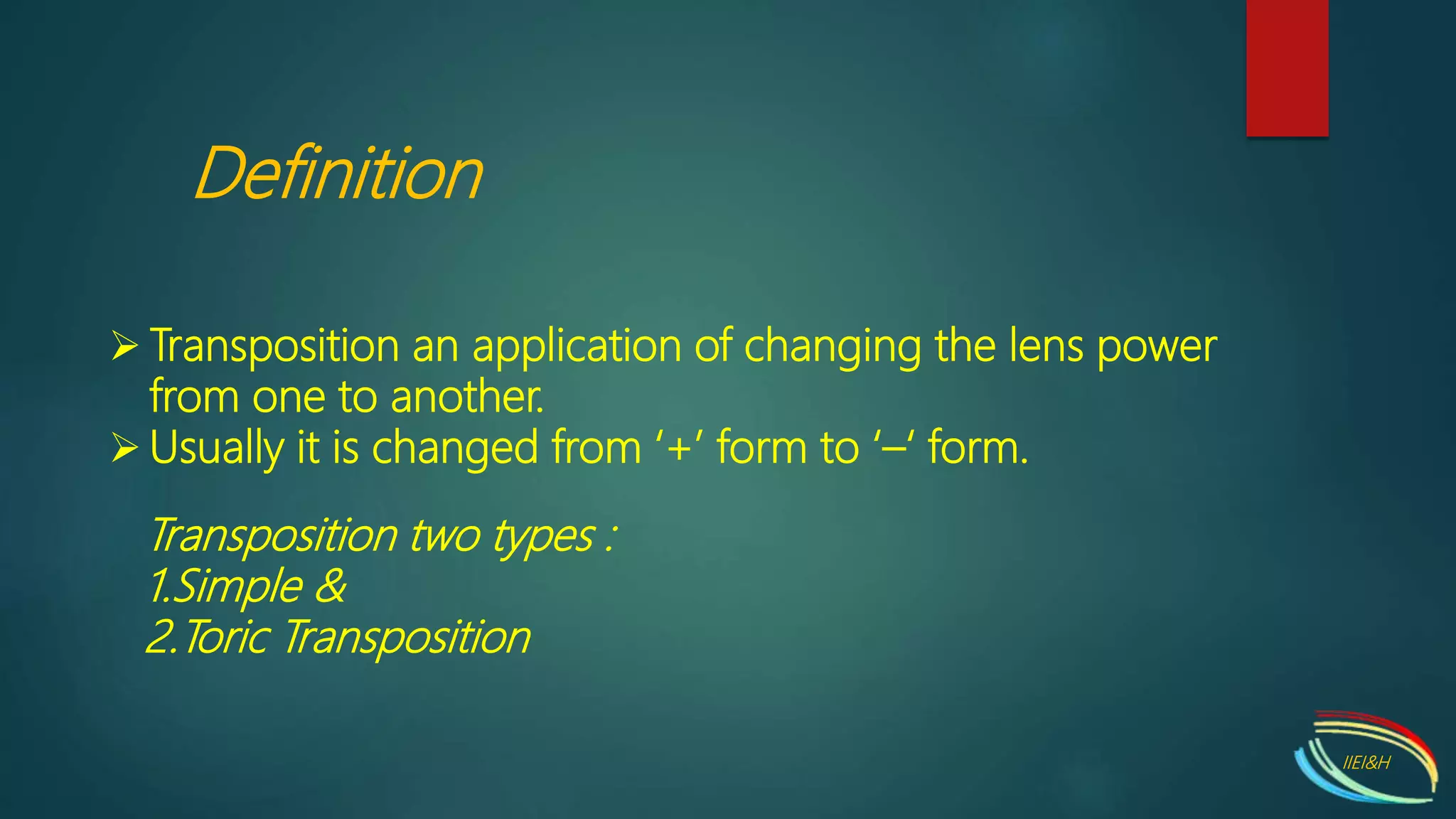
 Transposition an application of changing the lens power
from one to another.
 Usually it is changed from ‘+’ form to ‘–‘ form.
Definition
Transposition two types :
1.Simple &
2.Toric Transposition
IIEI&H
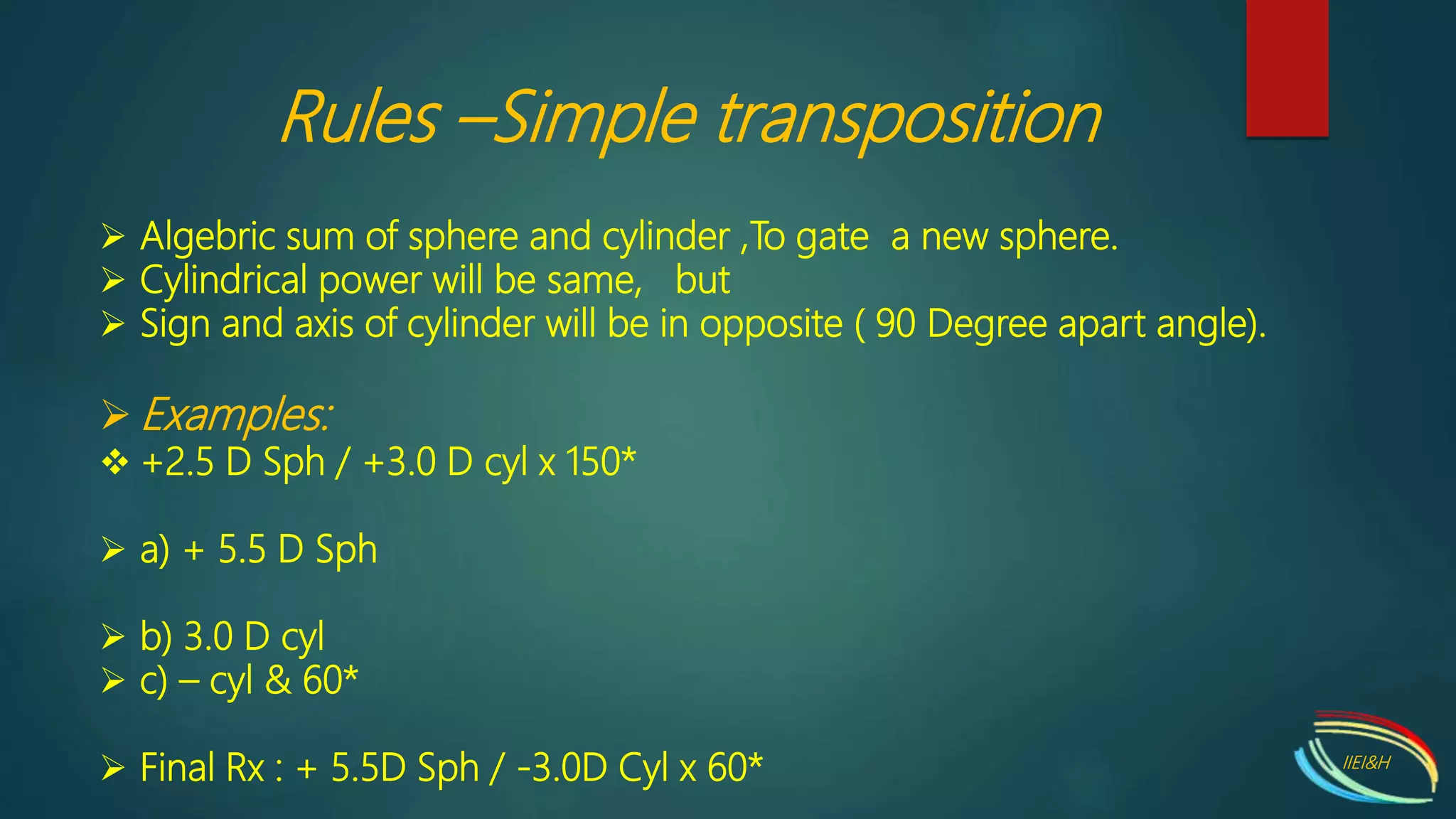
 Algebric sum of sphere and cylinder ,To gate a new sphere.
 Cylindrical power will be same, but
 Sign and axis of cylinder will be in opposite ( 90 Degree apart angle).
 Examples:
 +2.5 D Sph / +3.0 D cyl x 150*
 a) + 5.5 D Sph
 b) 3.0 D cyl
 c) – cyl & 60*
 Final Rx : + 5.5D Sph / -3.0D Cyl x 60*
Rules –Simple transposition
IIEI&H
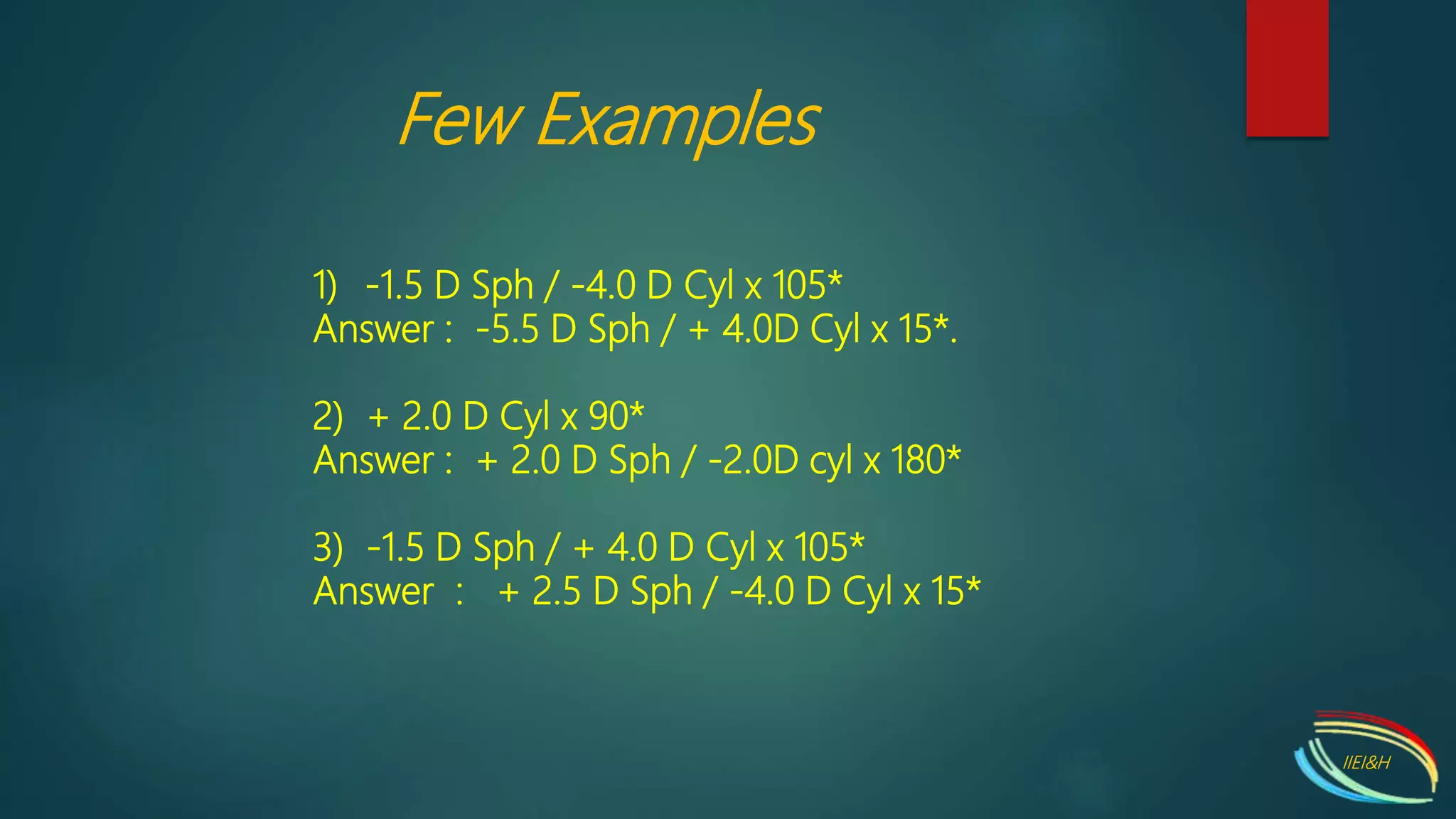
1) -1.5 D Sph / -4.0 D Cyl x 105*
Answer : -5.5 D Sph / + 4.0D Cyl x 15*.
2) + 2.0 D Cyl x 90*
Answer : + 2.0 D Sph / -2.0D cyl x 180*
3) -1.5 D Sph / + 4.0 D Cyl x 105*
Answer : + 2.5 D Sph / -4.0 D Cyl x 15*
Few Examples
IIEI&H
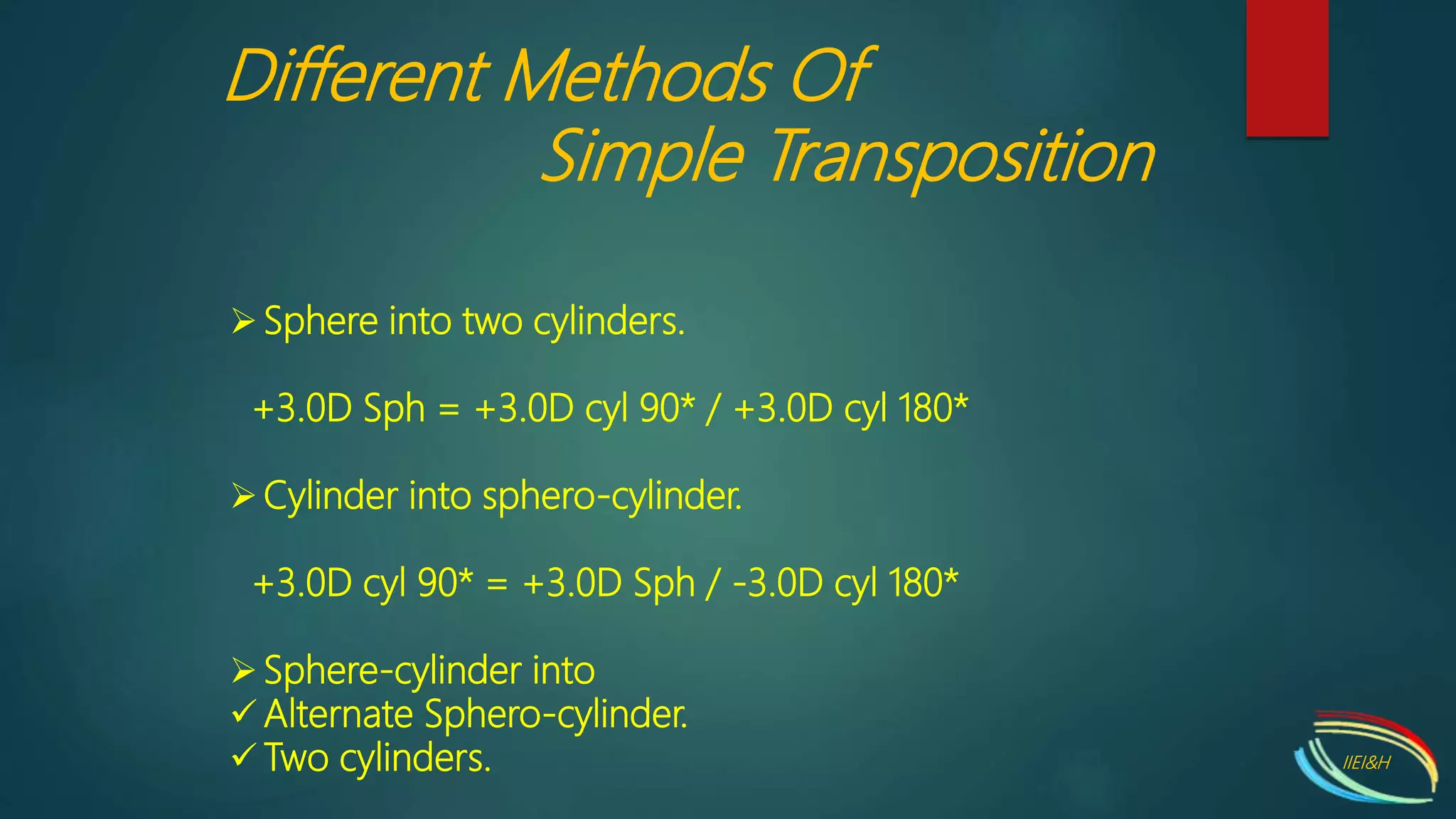
Sphere into two cylinders.
+3.0D Sph = +3.0D cyl 90* / +3.0D cyl 180*
Cylinder into sphero-cylinder.
+3.0D cyl 90* = +3.0D Sph / -3.0D cyl 180*
Sphere-cylinder into
 Alternate Sphero-cylinder.
 Two cylinders.
Different Methods Of
Simple Transposition
IIEI&H
 Objective: To select the proper tools in cylinder lens surfacing.
 Rules:
 1.Choose the Base curve first for proper curvature.
 2.Do simple transposition if sign of base curve &cylinder not same.
 3.To find out the spherical surface power,
 Subtract the base curve from sphere.
 4.To find out the cylindrical surface power,
 Fix the Base curve at the right angle to the axis of cylinder.
 Add the base curve with cylinder
 5.Both spherical & cylindrical surface determines the lens power.
IIEI&H
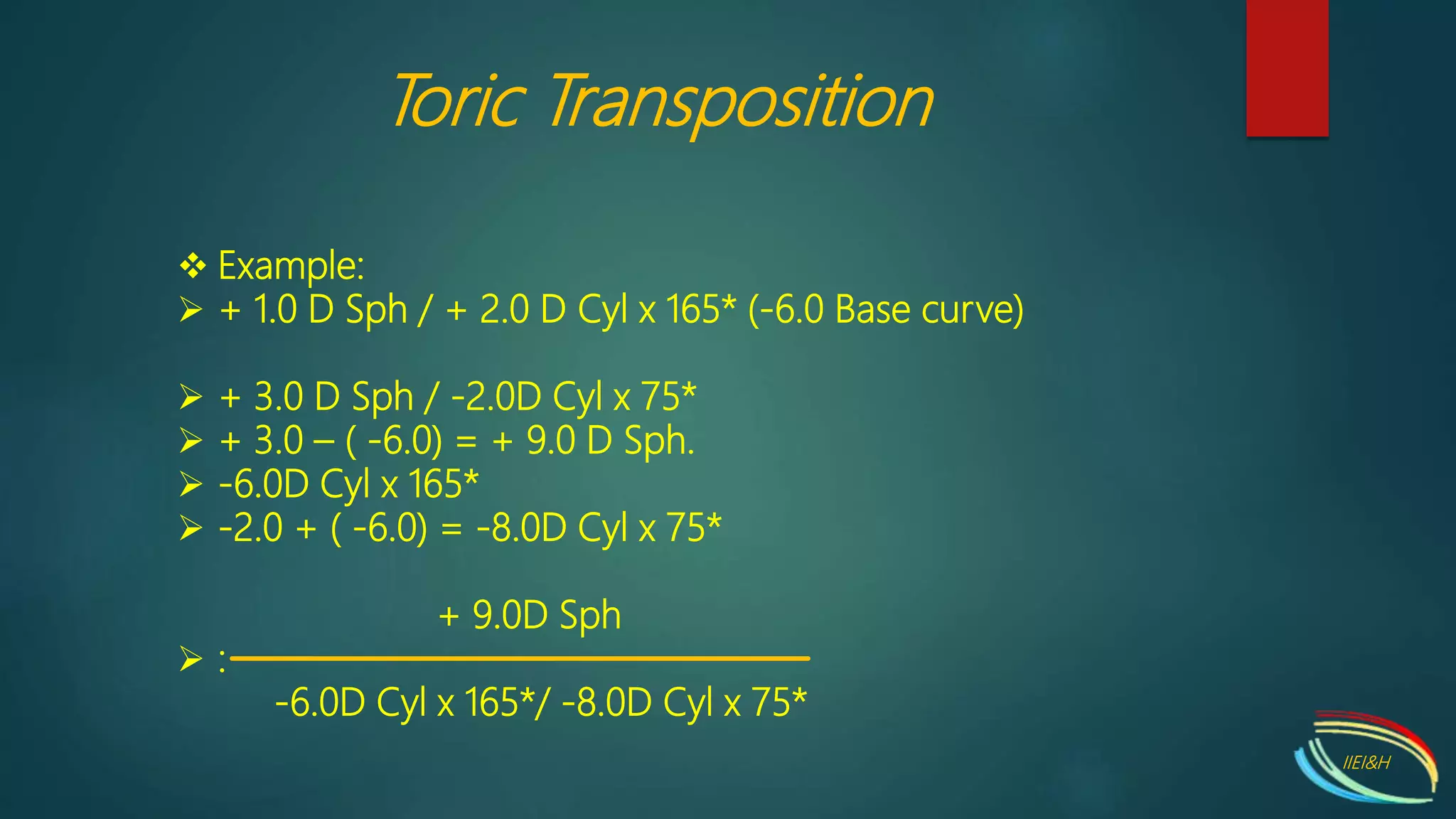
 Example:
 + 1.0 D Sph / + 2.0 D Cyl x 165* (-6.0 Base curve)
 + 3.0 D Sph / -2.0D Cyl x 75*
 + 3.0 – ( -6.0) = + 9.0 D Sph.
 -6.0D Cyl x 165*
 -2.0 + ( -6.0) = -8.0D Cyl x 75*
+ 9.0D Sph
 :
-6.0D Cyl x 165*/ -8.0D Cyl x 75*
Toric Transposition
IIEI&H
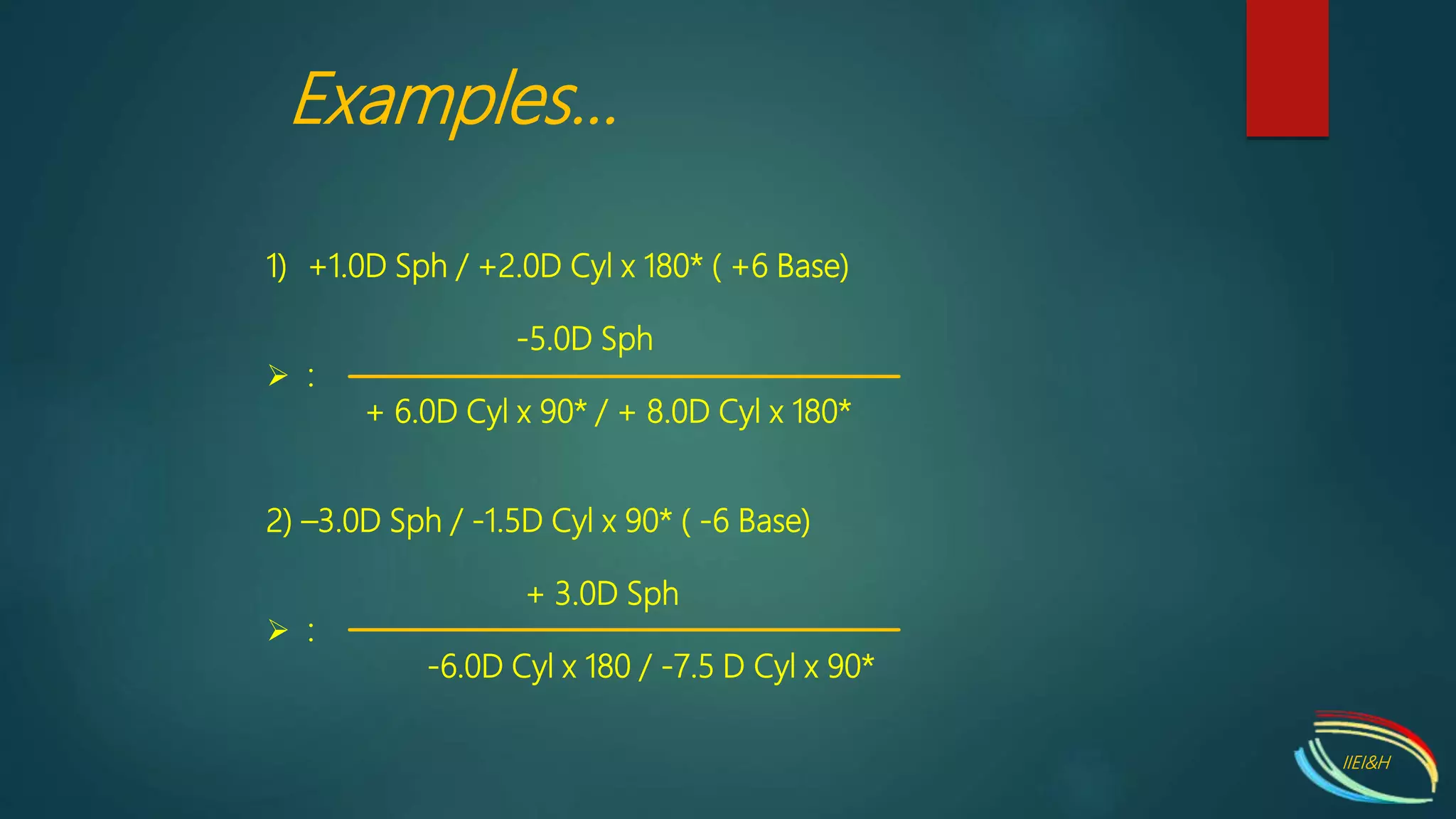
1) +1.0D Sph / +2.0D Cyl x 180* ( +6 Base)
-5.0D Sph
 :
+ 6.0D Cyl x 90* / + 8.0D Cyl x 180*
2) –3.0D Sph / -1.5D Cyl x 90* ( -6 Base)
+ 3.0D Sph
 :
-6.0D Cyl x 180 / -7.5 D Cyl x 90*
Examples...
IIEI&H
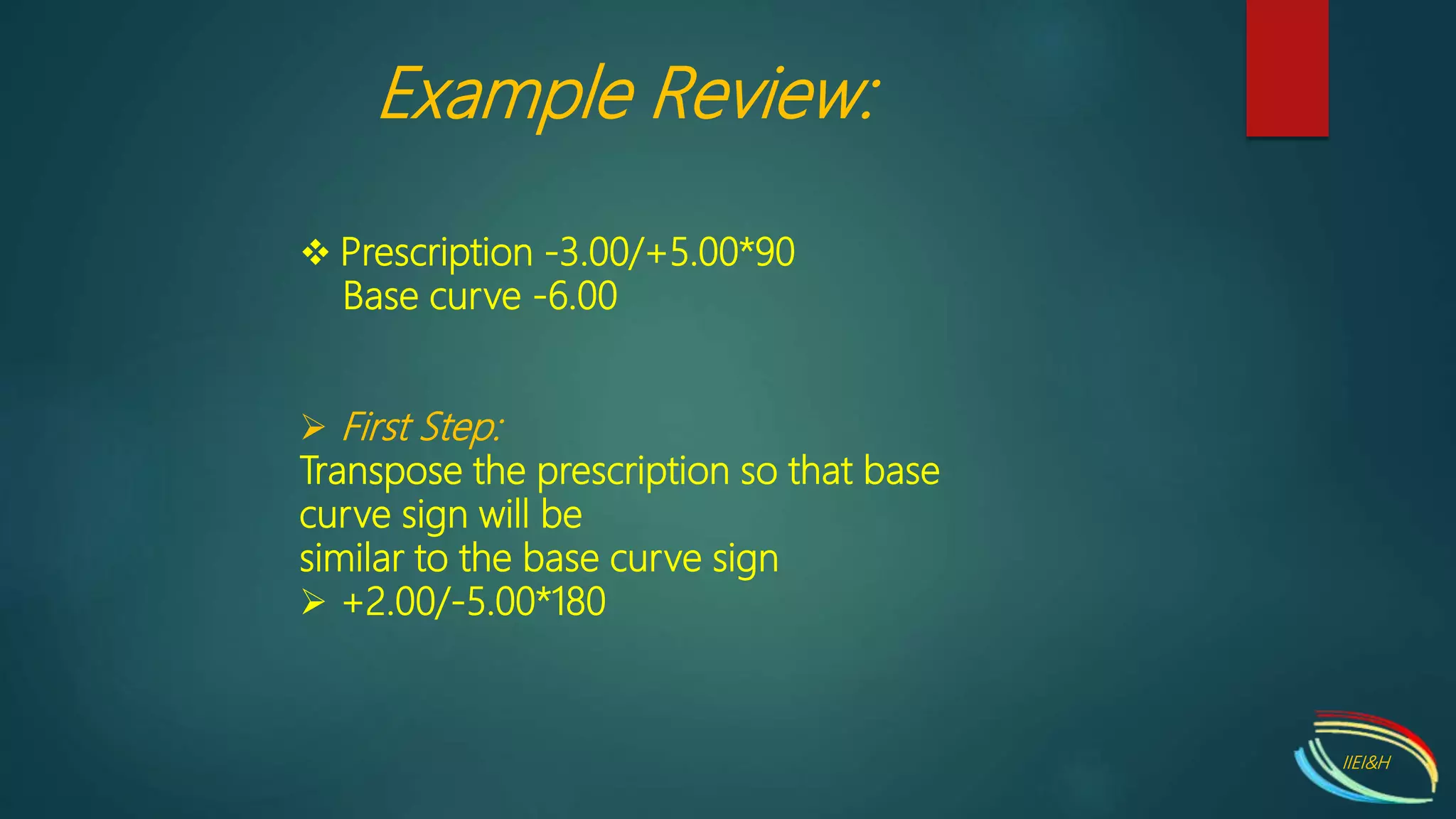
 Prescription -3.00/+5.00*90
Base curve -6.00
 First Step:
Transpose the prescription so that base
curve sign will be
similar to the base curve sign
 +2.00/-5.00*180
Example Review:
IIEI&H
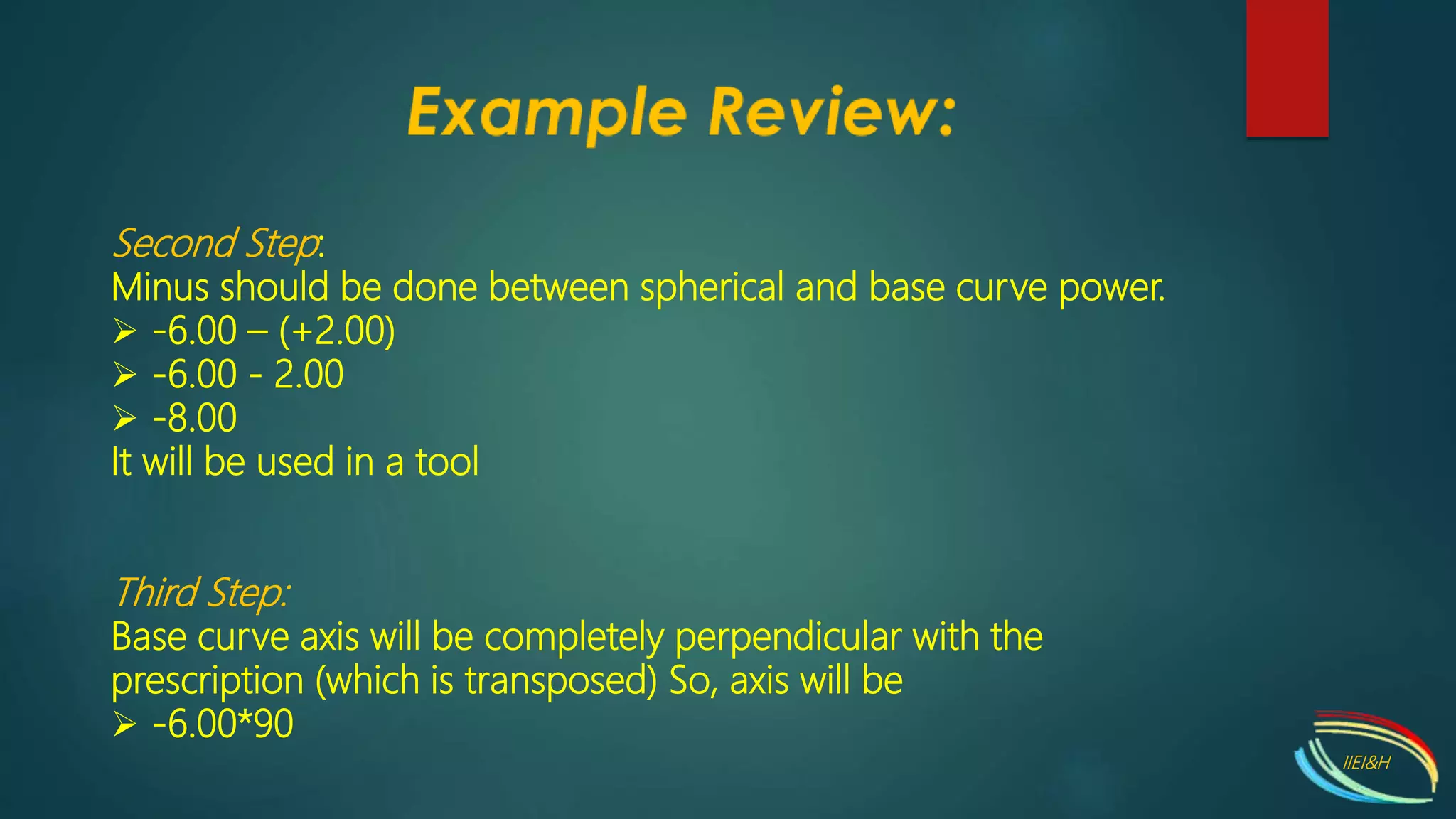
Second Step:
Minus should be done between spherical and base curve power.
 -6.00 – (+2.00)
 -6.00 - 2.00
 -8.00
It will be used in a tool
Third Step:
Base curve axis will be completely perpendicular with the
prescription (which is transposed) So, axis will be
 -6.00*90
IIEI&H
Fourth Step:
Add Base curve and cylinder power
 -6.00 + (-5.00)*180
 -11.00*180
So, Final :
-8.00 Sph

-6.00 Cyl*90 / -11.00 Cyl*180
IIEI&H
A sphero-cylinder lens will correct for astigmatism and myopia or hyperopia. If it was
necessary to correct a nearsighted or farsighted person who also has astigmatism, but
there were no cylinder lenses available, what would be the best correction using only a
sphere lens.
How to Find the Spherical equivalent :
1. Take half the value of the cylinder and
2. Add it to the sphere power.
In other words, as a formula the spherical equivalent
Spherical Equivalent = Sphere + (Cylinder)/2
Example: +3.00 − 1.00 × 180º
spherical equivalent = +3.00 + (-1.00) /2 = +2.50D
Spherical Equivalent
IIEI&H
IIEI&H
IIEI&H

Simple & Toric Transposition

  • 1.
    Simple & ToricTransposition Md: Azizul Islam, Junior Optometrist Oculoplasty Department Ispahani Islamia Eye Institute & Hospital IIEI&H
  • 2.
     Transposition anapplication of changing the lens power from one to another.  Usually it is changed from ‘+’ form to ‘–‘ form. Definition Transposition two types : 1.Simple & 2.Toric Transposition IIEI&H
  • 3.
     Algebric sumof sphere and cylinder ,To gate a new sphere.  Cylindrical power will be same, but  Sign and axis of cylinder will be in opposite ( 90 Degree apart angle).  Examples:  +2.5 D Sph / +3.0 D cyl x 150*  a) + 5.5 D Sph  b) 3.0 D cyl  c) – cyl & 60*  Final Rx : + 5.5D Sph / -3.0D Cyl x 60* Rules –Simple transposition IIEI&H
  • 4.
    1) -1.5 DSph / -4.0 D Cyl x 105* Answer : -5.5 D Sph / + 4.0D Cyl x 15*. 2) + 2.0 D Cyl x 90* Answer : + 2.0 D Sph / -2.0D cyl x 180* 3) -1.5 D Sph / + 4.0 D Cyl x 105* Answer : + 2.5 D Sph / -4.0 D Cyl x 15* Few Examples IIEI&H
  • 5.
    Sphere into twocylinders. +3.0D Sph = +3.0D cyl 90* / +3.0D cyl 180* Cylinder into sphero-cylinder. +3.0D cyl 90* = +3.0D Sph / -3.0D cyl 180* Sphere-cylinder into  Alternate Sphero-cylinder.  Two cylinders. Different Methods Of Simple Transposition IIEI&H
  • 6.
     Objective: Toselect the proper tools in cylinder lens surfacing.  Rules:  1.Choose the Base curve first for proper curvature.  2.Do simple transposition if sign of base curve &cylinder not same.  3.To find out the spherical surface power,  Subtract the base curve from sphere.  4.To find out the cylindrical surface power,  Fix the Base curve at the right angle to the axis of cylinder.  Add the base curve with cylinder  5.Both spherical & cylindrical surface determines the lens power. IIEI&H
  • 7.
     Example:  +1.0 D Sph / + 2.0 D Cyl x 165* (-6.0 Base curve)  + 3.0 D Sph / -2.0D Cyl x 75*  + 3.0 – ( -6.0) = + 9.0 D Sph.  -6.0D Cyl x 165*  -2.0 + ( -6.0) = -8.0D Cyl x 75* + 9.0D Sph  : -6.0D Cyl x 165*/ -8.0D Cyl x 75* Toric Transposition IIEI&H
  • 8.
    1) +1.0D Sph/ +2.0D Cyl x 180* ( +6 Base) -5.0D Sph  : + 6.0D Cyl x 90* / + 8.0D Cyl x 180* 2) –3.0D Sph / -1.5D Cyl x 90* ( -6 Base) + 3.0D Sph  : -6.0D Cyl x 180 / -7.5 D Cyl x 90* Examples... IIEI&H
  • 9.
     Prescription -3.00/+5.00*90 Basecurve -6.00  First Step: Transpose the prescription so that base curve sign will be similar to the base curve sign  +2.00/-5.00*180 Example Review: IIEI&H
  • 10.
    Second Step: Minus shouldbe done between spherical and base curve power.  -6.00 – (+2.00)  -6.00 - 2.00  -8.00 It will be used in a tool Third Step: Base curve axis will be completely perpendicular with the prescription (which is transposed) So, axis will be  -6.00*90 IIEI&H
  • 11.
    Fourth Step: Add Basecurve and cylinder power  -6.00 + (-5.00)*180  -11.00*180 So, Final : -8.00 Sph  -6.00 Cyl*90 / -11.00 Cyl*180 IIEI&H
  • 12.
    A sphero-cylinder lenswill correct for astigmatism and myopia or hyperopia. If it was necessary to correct a nearsighted or farsighted person who also has astigmatism, but there were no cylinder lenses available, what would be the best correction using only a sphere lens. How to Find the Spherical equivalent : 1. Take half the value of the cylinder and 2. Add it to the sphere power. In other words, as a formula the spherical equivalent Spherical Equivalent = Sphere + (Cylinder)/2 Example: +3.00 − 1.00 × 180º spherical equivalent = +3.00 + (-1.00) /2 = +2.50D Spherical Equivalent IIEI&H
  • 13.