Indra P Sharma
B.Optom, M.Optom, JDWNRH, Bhutan
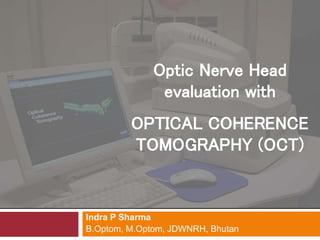
Optic Nerve Head
evaluation with
OPTICAL COHERENCE
TOMOGRAPHY (OCT)
Optical coherence tomography
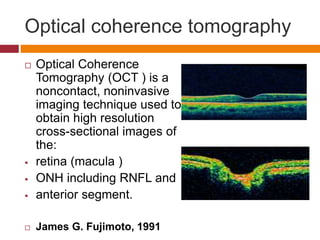
 Optical Coherence
Tomography (OCT ) is a
noncontact, noninvasive
imaging technique used to
obtain high resolution
cross-sectional images of
the:
 retina (macula )
 ONH including RNFL and
 anterior segment.
 James G. Fujimoto, 1991
 Based on principle of low coherence
interferometry
 involves interference between reflected light and
a reference beam.
 Three-dimensional imaging technique with
ultrahigh spatial resolution
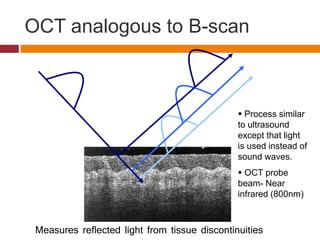
 Process similar
to ultrasound
except that light
is used instead of
sound waves.
 OCT probe
beam- Near
infrared (800nm)
Measures reflected light from tissue discontinuities
OCT analogous to B-scan
Contd...
 Doing OCT of the retina is like doing a vertical
biopsy section of the retina.
 Uses light source (superluminescent diode)
 Instead of viewing a stained section under a
microscope, we are presented with a "false-
color" view with micron level resolution(<10
microns)
 A tomogram is display in either grey scale or
false colour on high resolution computer
screen.
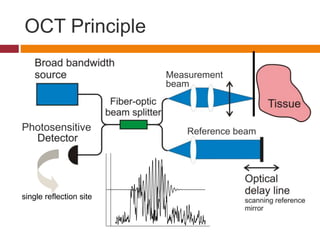
OCT Principle
single reflection site
Measurement
beam
Reference beamPhotosensitive
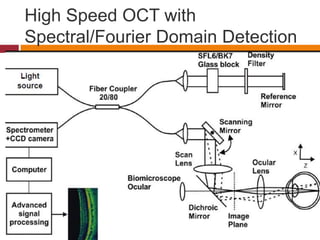
High Speed OCT with
Spectral/Fourier Domain Detection
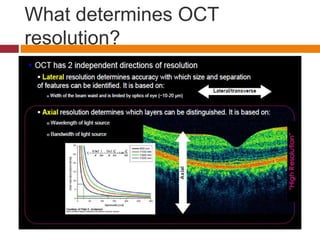
What determines OCT
resolution?
Transverse Scanning
Backscatter Intensity
Axial
Scanning
(Depth)
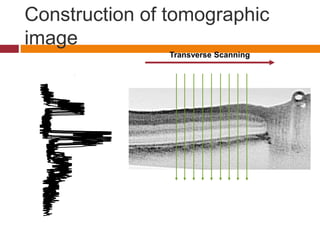
Construction of tomographic
image
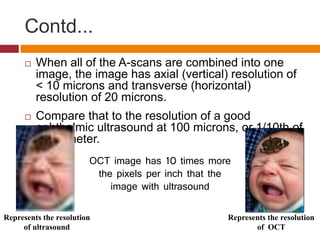
Contd...
 When all of the A-scans are combined into one
image, the image has axial (vertical) resolution of
< 10 microns and transverse (horizontal)
resolution of 20 microns.
 Compare that to the resolution of a good
ophthalmic ultrasound at 100 microns, or 1/10th of
a millimeter.
Represents the resolution
of ultrasound
Represents the resolution
of OCT
OCT image has 10 times more
the pixels per inch that the
image with ultrasound
Application
 OCT images contains quantitative information and
aid in:
1. Follow up of clinical course, understanding the
pathogenesis of disease.
2. For assessing the response to medical/ surgical/
laser theapy.
3. For documentation and explaining the prognosis of
a particular disease.
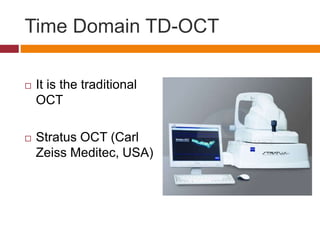
Time Domain TD-OCT
 It is the traditional
OCT
 Stratus OCT (Carl
Zeiss Meditec, USA)
Contd...
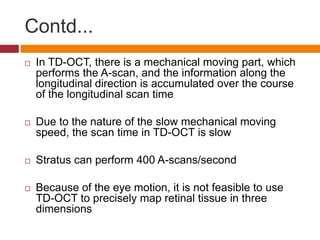
 In TD-OCT, there is a mechanical moving part, which
performs the A-scan, and the information along the
longitudinal direction is accumulated over the course
of the longitudinal scan time
 Due to the nature of the slow mechanical moving
speed, the scan time in TD-OCT is slow
 Stratus can perform 400 A-scans/second
 Because of the eye motion, it is not feasible to use
TD-OCT to precisely map retinal tissue in three
dimensions
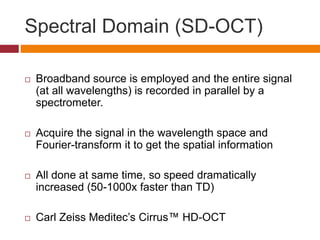
Spectral Domain (SD-OCT)
 Broadband source is employed and the entire signal
(at all wavelengths) is recorded in parallel by a
spectrometer.
 Acquire the signal in the wavelength space and
Fourier-transform it to get the spatial information
 All done at same time, so speed dramatically
increased (50-1000x faster than TD)
 Carl Zeiss Meditec’s Cirrus™ HD-OCT
SD- OCT Advantages
 Improved resolution
 Improved acquisition speed
 Reduces motion artifacts
 Digital processing not required to align
adjacent axial scans = More accurate retinal
scans
 3D views
 More accurate segmentation
 Precise registration/orientation
OCT Imaging Speeds and
Technologies
Time Domain OCT
 400 axial scans per second
(Zeiss Stratus - 2002)
 8-10 um axial resolution
Spectral / Fourier Domain OCT –
spectrometer
 25,000 – 50,000 axial scans per
second (2006)
 5 - 7 um axial resolution
Next Generation Spectral /
Fourier OCT
 70,000 – 100,000 axial scans
per second
~3 - 5 um axial resolution
 100,000 – 250,000 axial scans
per second
~5 - 10 um axial resolution
Swept Source / Fourier OCT –
swept laser
 200,000 + axial scans per
second
~5 - 7 um axial resolution at
1050 nm wavelengths
Procedure
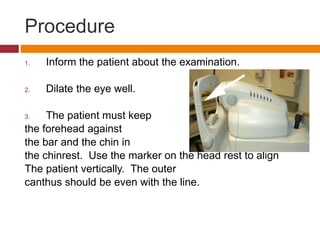
1. Inform the patient about the examination.
2. Dilate the eye well.
3. The patient must keep
the forehead against
the bar and the chin in
the chinrest. Use the marker on the head rest to align
The patient vertically. The outer
canthus should be even with the line.
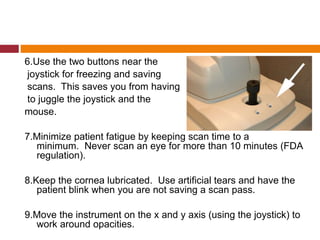
6.Use the two buttons near the
joystick for freezing and saving
scans. This saves you from having
to juggle the joystick and the
mouse.
7.Minimize patient fatigue by keeping scan time to a
minimum. Never scan an eye for more than 10 minutes (FDA
regulation).
8.Keep the cornea lubricated. Use artificial tears and have the
patient blink when you are not saving a scan pass.
9.Move the instrument on the x and y axis (using the joystick) to
work around opacities.
ONH evaluation with
OCT
OCT in Glaucoma
 Glaucoma-related neural losses result in characteristic
structural changes to the optic nerve head (ONH) and
peripapillary retinal nerve fiber layer (RNFL) such as a loss of
the neuroretinal rim and diffuse or localized RNFL defects.
 The clinician’s recognition of ONH topographical changes is
therefore important for diagnosing glaucoma and detecting
progression, particularly because structural changes often
precede observable defects on perimetry.
 In Glaucoma, OCT helps in evaluation of:
 Optic Nerve Head
 RNFL
 Peri-papillary Region
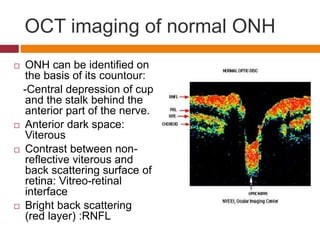
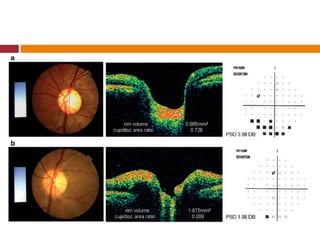
OCT imaging of normal ONH
 ONH can be identified on
the basis of its countour:
-Central depression of cup
and the stalk behind the
anterior part of the nerve.
 Anterior dark space:
Viterous
 Contrast between non-
reflective viterous and
back scattering surface of
retina: Vitreo-retinal
interface
 Bright back scattering
(red layer) :RNFL
In Glaucoma
Protocols for Glaucoma
 Following protocols may be used for glaucoma:
1. Optic disc scan
2. Concentric 3 ring scan
3. Nerve head circle scan
4. Fast optic disc scan
5. RNFL map scan
6. RNFL thickness scan
7. Fast RNFL thickness scan
8. Proportional circle scan
9. Radial line scan
10. Cross hair scan
RNFL Protocol
 RNFL thickness is important driscriminator for
glaucomatous from normal eye and has to be
found to be reduced in ocular hypertension
also.
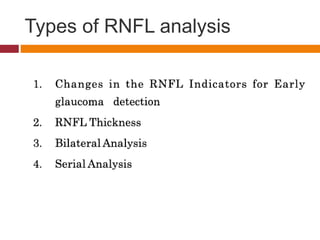
Types of RNFL analysis
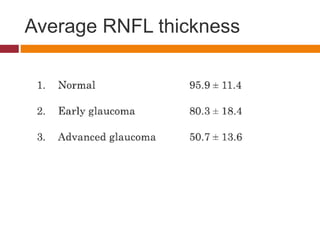
Average RNFL thickness
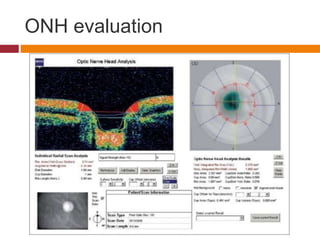
ONH evaluation
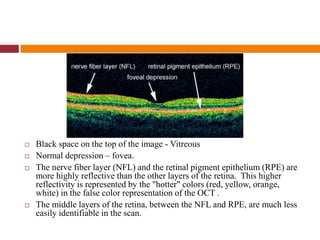
 Black space on the top of the image - Vitreous
 Normal depression – fovea.
 The nerve fiber layer (NFL) and the retinal pigment epithelium (RPE) are
more highly reflective than the other layers of the retina. This higher
reflectivity is represented by the "hotter" colors (red, yellow, orange,
white) in the false color representation of the OCT .
 The middle layers of the retina, between the NFL and RPE, are much less
easily identifiable in the scan.
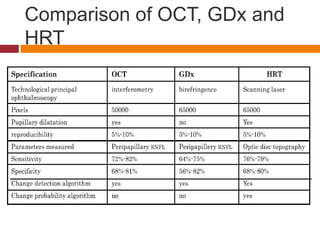
Comparison of OCT, GDx and
HRT
References
 JOEL S. SCHUMAN. FDA AGS
WORKSHOP:The Validity, Reliability, and
Usability of Glaucoma Imaging Devices, 5
October 2012
 A.J Mahant et al. 2011.Study of RNFL with
help of OCT in normal person,ocular
hypertension and primary open angle
glaucoma.Gujrat Medical Journal

OCT in Ophthalmology

  • 1.
    Indra P Sharma B.Optom,M.Optom, JDWNRH, Bhutan Optic Nerve Head evaluation with OPTICAL COHERENCE TOMOGRAPHY (OCT)
  • 2.
    Optical coherence tomography Optical Coherence Tomography (OCT ) is a noncontact, noninvasive imaging technique used to obtain high resolution cross-sectional images of the:  retina (macula )  ONH including RNFL and  anterior segment.  James G. Fujimoto, 1991
  • 3.
     Based onprinciple of low coherence interferometry  involves interference between reflected light and a reference beam.  Three-dimensional imaging technique with ultrahigh spatial resolution
  • 4.
     Process similar toultrasound except that light is used instead of sound waves.  OCT probe beam- Near infrared (800nm) Measures reflected light from tissue discontinuities OCT analogous to B-scan
  • 5.
    Contd...  Doing OCTof the retina is like doing a vertical biopsy section of the retina.  Uses light source (superluminescent diode)  Instead of viewing a stained section under a microscope, we are presented with a "false- color" view with micron level resolution(<10 microns)  A tomogram is display in either grey scale or false colour on high resolution computer screen.
  • 6.
    OCT Principle single reflectionsite Measurement beam Reference beamPhotosensitive
  • 7.
    High Speed OCTwith Spectral/Fourier Domain Detection
  • 8.
  • 9.
  • 10.
    Contd...  When allof the A-scans are combined into one image, the image has axial (vertical) resolution of < 10 microns and transverse (horizontal) resolution of 20 microns.  Compare that to the resolution of a good ophthalmic ultrasound at 100 microns, or 1/10th of a millimeter. Represents the resolution of ultrasound Represents the resolution of OCT OCT image has 10 times more the pixels per inch that the image with ultrasound
  • 11.
    Application  OCT imagescontains quantitative information and aid in: 1. Follow up of clinical course, understanding the pathogenesis of disease. 2. For assessing the response to medical/ surgical/ laser theapy. 3. For documentation and explaining the prognosis of a particular disease.
  • 12.
    Time Domain TD-OCT It is the traditional OCT  Stratus OCT (Carl Zeiss Meditec, USA)
  • 13.
    Contd...  In TD-OCT,there is a mechanical moving part, which performs the A-scan, and the information along the longitudinal direction is accumulated over the course of the longitudinal scan time  Due to the nature of the slow mechanical moving speed, the scan time in TD-OCT is slow  Stratus can perform 400 A-scans/second  Because of the eye motion, it is not feasible to use TD-OCT to precisely map retinal tissue in three dimensions
  • 14.
    Spectral Domain (SD-OCT) Broadband source is employed and the entire signal (at all wavelengths) is recorded in parallel by a spectrometer.  Acquire the signal in the wavelength space and Fourier-transform it to get the spatial information  All done at same time, so speed dramatically increased (50-1000x faster than TD)  Carl Zeiss Meditec’s Cirrus™ HD-OCT
  • 15.
    SD- OCT Advantages Improved resolution  Improved acquisition speed  Reduces motion artifacts  Digital processing not required to align adjacent axial scans = More accurate retinal scans  3D views  More accurate segmentation  Precise registration/orientation
  • 16.
    OCT Imaging Speedsand Technologies Time Domain OCT  400 axial scans per second (Zeiss Stratus - 2002)  8-10 um axial resolution Spectral / Fourier Domain OCT – spectrometer  25,000 – 50,000 axial scans per second (2006)  5 - 7 um axial resolution Next Generation Spectral / Fourier OCT  70,000 – 100,000 axial scans per second ~3 - 5 um axial resolution  100,000 – 250,000 axial scans per second ~5 - 10 um axial resolution Swept Source / Fourier OCT – swept laser  200,000 + axial scans per second ~5 - 7 um axial resolution at 1050 nm wavelengths
  • 17.
    Procedure 1. Inform thepatient about the examination. 2. Dilate the eye well. 3. The patient must keep the forehead against the bar and the chin in the chinrest. Use the marker on the head rest to align The patient vertically. The outer canthus should be even with the line.
  • 18.
    6.Use the twobuttons near the joystick for freezing and saving scans. This saves you from having to juggle the joystick and the mouse. 7.Minimize patient fatigue by keeping scan time to a minimum. Never scan an eye for more than 10 minutes (FDA regulation). 8.Keep the cornea lubricated. Use artificial tears and have the patient blink when you are not saving a scan pass. 9.Move the instrument on the x and y axis (using the joystick) to work around opacities.
  • 19.
  • 20.
    OCT in Glaucoma Glaucoma-related neural losses result in characteristic structural changes to the optic nerve head (ONH) and peripapillary retinal nerve fiber layer (RNFL) such as a loss of the neuroretinal rim and diffuse or localized RNFL defects.  The clinician’s recognition of ONH topographical changes is therefore important for diagnosing glaucoma and detecting progression, particularly because structural changes often precede observable defects on perimetry.  In Glaucoma, OCT helps in evaluation of:  Optic Nerve Head  RNFL  Peri-papillary Region
  • 21.
    OCT imaging ofnormal ONH  ONH can be identified on the basis of its countour: -Central depression of cup and the stalk behind the anterior part of the nerve.  Anterior dark space: Viterous  Contrast between non- reflective viterous and back scattering surface of retina: Vitreo-retinal interface  Bright back scattering (red layer) :RNFL
  • 22.
  • 23.
    Protocols for Glaucoma Following protocols may be used for glaucoma: 1. Optic disc scan 2. Concentric 3 ring scan 3. Nerve head circle scan 4. Fast optic disc scan 5. RNFL map scan 6. RNFL thickness scan 7. Fast RNFL thickness scan 8. Proportional circle scan 9. Radial line scan 10. Cross hair scan
  • 24.
    RNFL Protocol  RNFLthickness is important driscriminator for glaucomatous from normal eye and has to be found to be reduced in ocular hypertension also.
  • 25.
    Types of RNFLanalysis
  • 26.
  • 27.
  • 28.
     Black spaceon the top of the image - Vitreous  Normal depression – fovea.  The nerve fiber layer (NFL) and the retinal pigment epithelium (RPE) are more highly reflective than the other layers of the retina. This higher reflectivity is represented by the "hotter" colors (red, yellow, orange, white) in the false color representation of the OCT .  The middle layers of the retina, between the NFL and RPE, are much less easily identifiable in the scan.
  • 30.
    Comparison of OCT,GDx and HRT
  • 31.
    References  JOEL S.SCHUMAN. FDA AGS WORKSHOP:The Validity, Reliability, and Usability of Glaucoma Imaging Devices, 5 October 2012  A.J Mahant et al. 2011.Study of RNFL with help of OCT in normal person,ocular hypertension and primary open angle glaucoma.Gujrat Medical Journal

Editor's Notes

  • #7 The echo time delay of the reference and measurement beam is compared. Several data points over 2 mm of depth are integrated by the interferometer.Image thus produced have axial resolution of of <10 microns and travnservse resolution of 20 micron.