dr. JagdiSh duKre
CoNSultaNt
Shree KruShNa Netralay
 Strabismus or squint or simply deviation of the eye
refers to a misalignment of the visual axis.
 Strabismus originates from the Greek. Strabismus originates from the Greek.
 Hippocrates used the word streblos, ‘‘turned,’’
‘‘twisted,’’ when he talked about strabismic subjects
and the word is derived from the verb strephein, ‘‘to
twist,’’ ‘‘to turn.’’
 No classification is perfect or all-inclusive, and several
methods of classifying eye alignment and motility disorders
are used. Following are terms used in these classifications.
1. Fusional Status1. Fusional Status
2. Type of Deviation
3. Variation of the Deviation With Gaze Position or Fixating Eye
4. Fixation
5. Age of Onset
6. Depending upon the Etiology
1. Phoria A latent deviation in which fusional control is always
present.
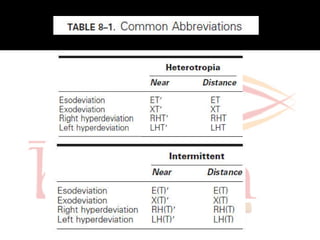
2. IntermittentTropia A deviation in which fusional control is
present part of the time.present part of the time.
3. Tropia A manifest deviation in which fusional control is not
present.
 Heterophoria, the term introduced by Stevens, refers to a
condition in which the tendency of the eyes to deviate is
overcome (kept latent) by the fusion reflex during binocular
vision.
 Therefore, when the influence of fusion is interrupted, the visual
axis of the non-fixing eye deviates from the orthoposition.axis of the non-fixing eye deviates from the orthoposition.
 Depending upon the direction of deviation, heterophoria may be
classified into:
1. Esophoria
2. Exophoria
3. Right hyperphoria
4. Left hyperphoria
5. Incyclophoria
6. Excyclophoria
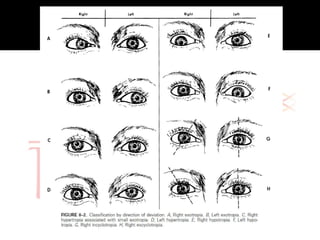
 Horizontal Esodeviation or exodeviation
 Vertical Hyperdeviation or hypodeviation Vertical Hyperdeviation or hypodeviation
 Torsional Incyclodeviation or excyclodeviation
 Combined Horizontal, vertical, torsional, pattern or
any combination thereof
1. Comitant (concomitant)
 The size of the deviation does not vary by more than a
few prism diopters with direction of gaze or with the eyefew prism diopters with direction of gaze or with the eye
used for fixating.
2. Incomitant (noncomitant)
 The deviation varies in size with the direction of gaze or
with the eye used for fixating. Most incomitant
strabismus is paralytic or restrictive.
 Alternating Spontaneous alternation of fixation
from one eye to the other.
 Monocular Definite preference for fixation with one
eye
 Congenital A deviation documented before age 6
months. presumably related to a defect present at
birth; the term infantile might be more appropriate.birth; the term infantile might be more appropriate.
 Acquired A deviation with later onset after a period
of apparently normal visual development.
 Primary heterotropia
 Accommodative heterotropia
 Secondary/sensory heterotropia Secondary/sensory heterotropia
 Consecutive heterotropia
 Paralytic strabismus
 Mechanical-Restrictive Strabismus
 Orbital Strabismus
 Wherein no obvious cause is found, Duane suggested following
terms:
1. Convergence excess type of esodeviation which is more for near
than distance fixation.than distance fixation.
2. Divergence insufficiency type of esodeviation which is more for
distance fixation than the near.
3. Convergence insufficient type of exodeviation which is more for
near fixation than the distance.
4. Divergence excess type of exodeviation which is more for
distance fixation than near.
Accommodative heterotropia
 In it, act of accommodation has a major influence on the
deviation.
Secondary/sensory heterotropiaSecondary/sensory heterotropia
 It is used to describe a deviation which results from some known
cause of visual deprivation/ sight impairing disease of one eye,
e.g. anisometropia, central chorioretinitis, etc.
Consecutive heterotropia
 It is used to describe the deviation resulting from surgical
overcorrection or spontaneous conversion of an esotropic eye
into an exodeviation.
 The term paralytic strabismus is limited to an
innervational cause of restricted motility.
 The terms N III, N IV, and NVI paralysis refer to paralyses
of muscles supplied by those cranial nerves.of muscles supplied by those cranial nerves.
 If all extraocular muscles supplied by the third cranial
nerve are paralyzed, the paralysis is termed a complete
oculomotor palsy; if one or more extraocular muscles are
spared, the oculomotor palsy is partial.
 If all extraocular muscles are paralyzed, it is called an
external ophthalmoplegia.
 If the intrinsic ocular muscles are paralytic, it is internal
ophthalmoplegia.
 If both the extrinsic and intrinsic ocular muscles are affected,
then complete ophthalmoplegia occurs.
Mechanical-Restrictive StrabismusMechanical-Restrictive Strabismus
 Structural alteration of the muscle itself or of its antagonist may
limit its ability to function normally.
Orbital Strabismus
 Any ocular misalignment caused by anomalies of the orbit or of the
face may be referred to as orbital strabismus. E.g. (craniofacial
dysostoses, plagiocephaly, hydrocephalus, heterotopia of muscle
pulleys, etc)
 BinocularVision and Ocular Motility, Gunter K. von Noorden,
Chapter 8 Classification of NeuromuscularAnomalies of the
Eyes
 Pediatric Ophthalmology and Strabismus, AAO Chapter 1: Pediatric Ophthalmology and Strabismus, AAO Chapter 1:
StrabismusTerminology.
 Theory and Practice of Squint & Orthoptics, A K Khurana,
Chapter 5 Strabismus: Definition, Classification and
Etiology.
Classification of strabismus

Classification of strabismus

  • 1.
  • 2.
     Strabismus orsquint or simply deviation of the eye refers to a misalignment of the visual axis.  Strabismus originates from the Greek. Strabismus originates from the Greek.  Hippocrates used the word streblos, ‘‘turned,’’ ‘‘twisted,’’ when he talked about strabismic subjects and the word is derived from the verb strephein, ‘‘to twist,’’ ‘‘to turn.’’
  • 3.
     No classificationis perfect or all-inclusive, and several methods of classifying eye alignment and motility disorders are used. Following are terms used in these classifications. 1. Fusional Status1. Fusional Status 2. Type of Deviation 3. Variation of the Deviation With Gaze Position or Fixating Eye 4. Fixation 5. Age of Onset 6. Depending upon the Etiology
  • 4.
    1. Phoria Alatent deviation in which fusional control is always present. 2. IntermittentTropia A deviation in which fusional control is present part of the time.present part of the time. 3. Tropia A manifest deviation in which fusional control is not present.
  • 5.
     Heterophoria, theterm introduced by Stevens, refers to a condition in which the tendency of the eyes to deviate is overcome (kept latent) by the fusion reflex during binocular vision.  Therefore, when the influence of fusion is interrupted, the visual axis of the non-fixing eye deviates from the orthoposition.axis of the non-fixing eye deviates from the orthoposition.  Depending upon the direction of deviation, heterophoria may be classified into: 1. Esophoria 2. Exophoria 3. Right hyperphoria 4. Left hyperphoria 5. Incyclophoria 6. Excyclophoria
  • 6.
     Horizontal Esodeviationor exodeviation  Vertical Hyperdeviation or hypodeviation Vertical Hyperdeviation or hypodeviation  Torsional Incyclodeviation or excyclodeviation  Combined Horizontal, vertical, torsional, pattern or any combination thereof
  • 9.
    1. Comitant (concomitant) The size of the deviation does not vary by more than a few prism diopters with direction of gaze or with the eyefew prism diopters with direction of gaze or with the eye used for fixating. 2. Incomitant (noncomitant)  The deviation varies in size with the direction of gaze or with the eye used for fixating. Most incomitant strabismus is paralytic or restrictive.
  • 10.
     Alternating Spontaneousalternation of fixation from one eye to the other.  Monocular Definite preference for fixation with one eye
  • 11.
     Congenital Adeviation documented before age 6 months. presumably related to a defect present at birth; the term infantile might be more appropriate.birth; the term infantile might be more appropriate.  Acquired A deviation with later onset after a period of apparently normal visual development.
  • 12.
     Primary heterotropia Accommodative heterotropia  Secondary/sensory heterotropia Secondary/sensory heterotropia  Consecutive heterotropia  Paralytic strabismus  Mechanical-Restrictive Strabismus  Orbital Strabismus
  • 13.
     Wherein noobvious cause is found, Duane suggested following terms: 1. Convergence excess type of esodeviation which is more for near than distance fixation.than distance fixation. 2. Divergence insufficiency type of esodeviation which is more for distance fixation than the near. 3. Convergence insufficient type of exodeviation which is more for near fixation than the distance. 4. Divergence excess type of exodeviation which is more for distance fixation than near.
  • 14.
    Accommodative heterotropia  Init, act of accommodation has a major influence on the deviation. Secondary/sensory heterotropiaSecondary/sensory heterotropia  It is used to describe a deviation which results from some known cause of visual deprivation/ sight impairing disease of one eye, e.g. anisometropia, central chorioretinitis, etc. Consecutive heterotropia  It is used to describe the deviation resulting from surgical overcorrection or spontaneous conversion of an esotropic eye into an exodeviation.
  • 15.
     The termparalytic strabismus is limited to an innervational cause of restricted motility.  The terms N III, N IV, and NVI paralysis refer to paralyses of muscles supplied by those cranial nerves.of muscles supplied by those cranial nerves.  If all extraocular muscles supplied by the third cranial nerve are paralyzed, the paralysis is termed a complete oculomotor palsy; if one or more extraocular muscles are spared, the oculomotor palsy is partial.  If all extraocular muscles are paralyzed, it is called an external ophthalmoplegia.
  • 16.
     If theintrinsic ocular muscles are paralytic, it is internal ophthalmoplegia.  If both the extrinsic and intrinsic ocular muscles are affected, then complete ophthalmoplegia occurs. Mechanical-Restrictive StrabismusMechanical-Restrictive Strabismus  Structural alteration of the muscle itself or of its antagonist may limit its ability to function normally. Orbital Strabismus  Any ocular misalignment caused by anomalies of the orbit or of the face may be referred to as orbital strabismus. E.g. (craniofacial dysostoses, plagiocephaly, hydrocephalus, heterotopia of muscle pulleys, etc)
  • 17.
     BinocularVision andOcular Motility, Gunter K. von Noorden, Chapter 8 Classification of NeuromuscularAnomalies of the Eyes  Pediatric Ophthalmology and Strabismus, AAO Chapter 1: Pediatric Ophthalmology and Strabismus, AAO Chapter 1: StrabismusTerminology.  Theory and Practice of Squint & Orthoptics, A K Khurana, Chapter 5 Strabismus: Definition, Classification and Etiology.