Presented By Shruti Dagar
Amity University
 Optical coherence tomography, or OCT is a
non- contact, noninvasive imaging technique
used to obtain high resolution 10 cross
sectional images of the retina and anterior
segment.
 Reflected light is used instead of sound
waves.
 Infrared ray of 830 nm with 78D internal lens.
 OCT is based on low coherence (white light)
interference of electromagnetic waves, which
was initially used in the measurement of
optoelectronic components. And the first
biological application of low coherence
interferometry was in ophthalmic biometry.
 Principle of OCT is based on Michaelson’s
interferometer.
TIME DOMAIN
 A scan generated
sequentially, one pixel at a
time of 1.6 seconds.
 Moving reference mirror
 400 scans/sec
 Resolution 10 microns
 Slower than eye
movement
FOURIER DOMAIN
 Entire A scan is generated
at once based on Fourier
transformation of
spectrometer analysis.
 Stationary reference mirror
 700,00 scans/sec
 Resolution 5 microns
 Faster than eye movement
 It is Non-Invasive technique and it gives
resolution level of <10 im which is of the level
of histopathology through light microscopy.
More resolution because of shorter
wavelength because of shorter wavelength
used as compared to ultrasound or light
waves.
 OCT provides cross-sectional biopsy of the
tissue in-vivo.
 It uses infrared radiation that does not get
focused by ocular refracting elements and does
not interfere with patient’s attention or cause
glare during testing or cause any photic retinal
injury.
 OCT is the most suitable diagnostic tool to
ophthalmic use, as it not only images anterior
parts of the eye but posterior segment can also
be scanned because the light rays can easily
penetrate the ocular tissues.
 Despite its varied usage OCT has certain
limitations like:
 Clear ocular media is needed for better
performance
 Minimum pupillary size of 4mm is required.
 It is a costly apparatus.
 Oct is used for diagnosis, monitoring,
quantitative and qualitative assessment of
macular pathology and is used in most of the
Vitreo-retinal conditions, some of them are
listed.
 PosteriorVitreous Detachment (PVD)
 Vitreo-MacularTraction Syndrome (VMT)
 Asteriod Hyalosis
 Intra-retinal Hemorrhage.
 Macular Edema ( CME, CSME)
 Macular Holes and cysts.
 Epiretinal Membrane in Diabetic Retinopathy.
 Central Serous Retinopathy.
 Foveal thining in Retinitis Pigmentosa and in
Myopic Degeneration.
 Age Related Macular Degeneration.
 Post Retinal Detachment Surgery.
Following things need to observed in OCT:
 Vitro-retinal interface.
 RetinalThickness:
Increases: Edema,Traction.
Decreases: Foveal atrophy.
 Reflectivity:
Hyper-reflective lesions: Hard
Exudates, Blood, Scars.
Hypo-reflective lesions: Serous Fluid, Hypo-
pigmented lesions of Retinal Pigment
Epithelium, Media Hazy.
 Foveal Contour.
 Continuity of tissues
 Distinction between:
Serous fluid and blood.
Detachment of neurosensory retina & RPE.
 Highly reflective structures are shown in bright
colures (white and red) .
 Those with low reflectivity are represented by
dark colors (black and blue).
 Intermediate reflectivity is shown Green.
 Sponge like retinal thickness.
 Macular edema and Cystoid Macular Edema.
 Serous Retinal Detachment.
 Epi-retinal Membrane.
 Vitro-macular traction.
 Focal elevation of Retinal Pigment
Epithelium.
 Large drusen shows irregular elevation of
Retinal Pigment Epithelium with shadow
from underlying choroid.
 Large drusen carry high risk of Choroidal
Neo-Vascular Membrane.
 There are three type of macular hole we can
see:
 Impending Macular Hole.
 Lamellar Macular Hole.
 FullThickness Macular Hole.
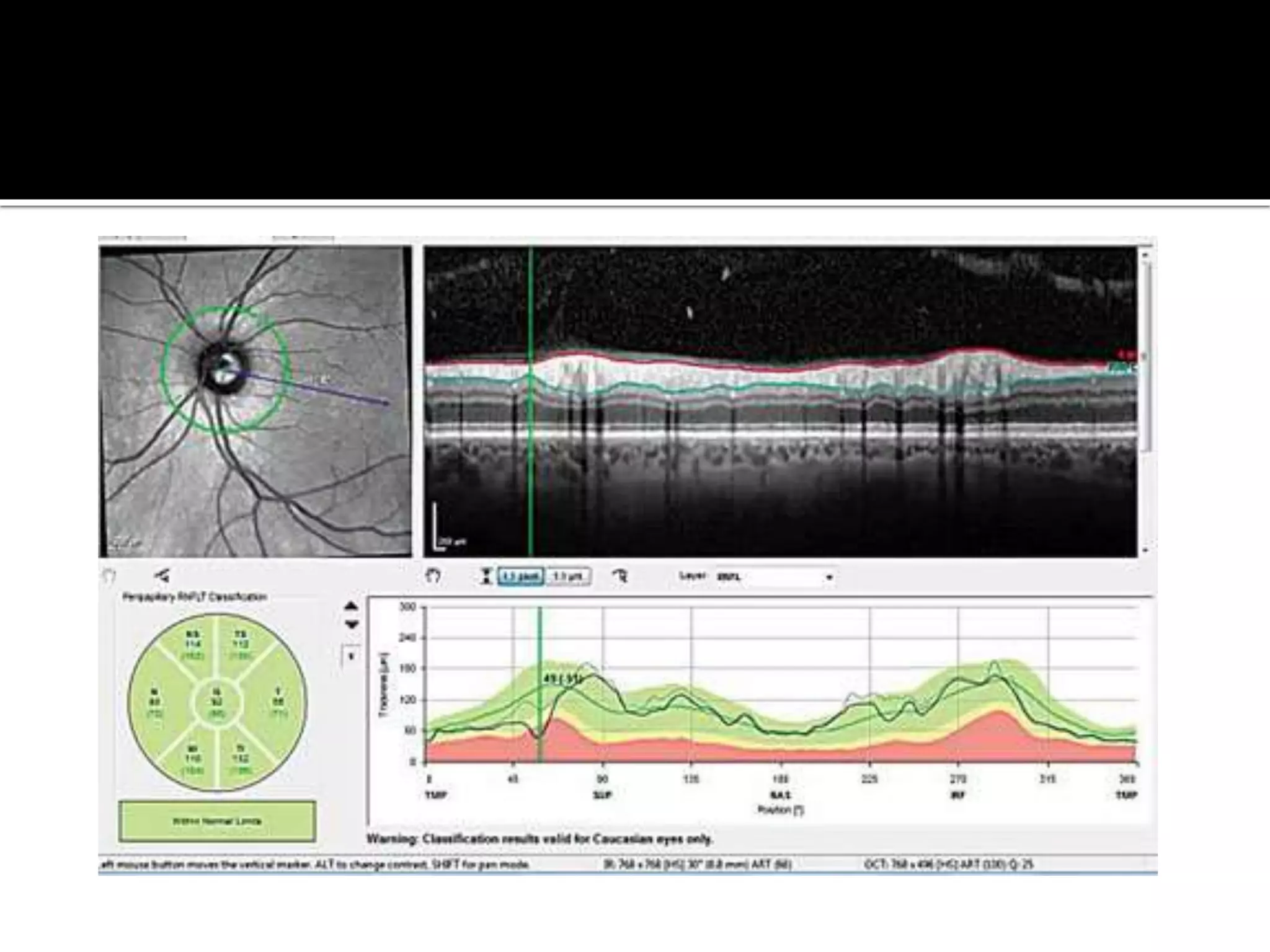
 OCT can be used to rapidly evaluate the
integrity of the RNFL and the macula for the
purpose of tracking disease progression, and
could also potentially be used to visualize
neuro protection.
The clinical indications of RNFL measurement
are:
 A sensitive indicator of glaucomatous
damage.
 Quantification of RNFL loss which is highly
correlated with visual field loss.
 Quantification of diffuse loss of ganglionic
cells.
 Identification of early focal defects
 https://optometryeducation.blogspot.com/20
11/12/oct.html?view=magazine
 https://www.slideshare.net/aryalmanu/optica
l-coherence-tomography-37170447
 Optometric Instruments Book
Optical Coherence Tomography (OCT)

Optical Coherence Tomography (OCT)

  • 1.
    Presented By ShrutiDagar Amity University
  • 2.
     Optical coherencetomography, or OCT is a non- contact, noninvasive imaging technique used to obtain high resolution 10 cross sectional images of the retina and anterior segment.  Reflected light is used instead of sound waves.  Infrared ray of 830 nm with 78D internal lens.
  • 3.
     OCT isbased on low coherence (white light) interference of electromagnetic waves, which was initially used in the measurement of optoelectronic components. And the first biological application of low coherence interferometry was in ophthalmic biometry.  Principle of OCT is based on Michaelson’s interferometer.
  • 6.
    TIME DOMAIN  Ascan generated sequentially, one pixel at a time of 1.6 seconds.  Moving reference mirror  400 scans/sec  Resolution 10 microns  Slower than eye movement FOURIER DOMAIN  Entire A scan is generated at once based on Fourier transformation of spectrometer analysis.  Stationary reference mirror  700,00 scans/sec  Resolution 5 microns  Faster than eye movement
  • 8.
     It isNon-Invasive technique and it gives resolution level of <10 im which is of the level of histopathology through light microscopy. More resolution because of shorter wavelength because of shorter wavelength used as compared to ultrasound or light waves.  OCT provides cross-sectional biopsy of the tissue in-vivo.
  • 9.
     It usesinfrared radiation that does not get focused by ocular refracting elements and does not interfere with patient’s attention or cause glare during testing or cause any photic retinal injury.  OCT is the most suitable diagnostic tool to ophthalmic use, as it not only images anterior parts of the eye but posterior segment can also be scanned because the light rays can easily penetrate the ocular tissues.
  • 10.
     Despite itsvaried usage OCT has certain limitations like:  Clear ocular media is needed for better performance  Minimum pupillary size of 4mm is required.  It is a costly apparatus.
  • 11.
     Oct isused for diagnosis, monitoring, quantitative and qualitative assessment of macular pathology and is used in most of the Vitreo-retinal conditions, some of them are listed.  PosteriorVitreous Detachment (PVD)  Vitreo-MacularTraction Syndrome (VMT)  Asteriod Hyalosis  Intra-retinal Hemorrhage.
  • 12.
     Macular Edema( CME, CSME)  Macular Holes and cysts.  Epiretinal Membrane in Diabetic Retinopathy.  Central Serous Retinopathy.  Foveal thining in Retinitis Pigmentosa and in Myopic Degeneration.  Age Related Macular Degeneration.  Post Retinal Detachment Surgery.
  • 13.
    Following things needto observed in OCT:  Vitro-retinal interface.  RetinalThickness: Increases: Edema,Traction. Decreases: Foveal atrophy.  Reflectivity: Hyper-reflective lesions: Hard Exudates, Blood, Scars. Hypo-reflective lesions: Serous Fluid, Hypo- pigmented lesions of Retinal Pigment Epithelium, Media Hazy.
  • 14.
     Foveal Contour. Continuity of tissues  Distinction between: Serous fluid and blood. Detachment of neurosensory retina & RPE.
  • 15.
     Highly reflectivestructures are shown in bright colures (white and red) .  Those with low reflectivity are represented by dark colors (black and blue).  Intermediate reflectivity is shown Green.
  • 16.
     Sponge likeretinal thickness.  Macular edema and Cystoid Macular Edema.  Serous Retinal Detachment.  Epi-retinal Membrane.  Vitro-macular traction.
  • 24.
     Focal elevationof Retinal Pigment Epithelium.  Large drusen shows irregular elevation of Retinal Pigment Epithelium with shadow from underlying choroid.  Large drusen carry high risk of Choroidal Neo-Vascular Membrane.
  • 30.
     There arethree type of macular hole we can see:  Impending Macular Hole.  Lamellar Macular Hole.  FullThickness Macular Hole.
  • 36.
     OCT canbe used to rapidly evaluate the integrity of the RNFL and the macula for the purpose of tracking disease progression, and could also potentially be used to visualize neuro protection.
  • 37.
    The clinical indicationsof RNFL measurement are:  A sensitive indicator of glaucomatous damage.  Quantification of RNFL loss which is highly correlated with visual field loss.  Quantification of diffuse loss of ganglionic cells.  Identification of early focal defects
  • 39.