Contrast 
sensitivity 
Jagdish Dukre
What is contrast sensitivity ? 
 Visual ability to see object that may not be 
outlined clearly or not stand out from their 
background. 
 The ability to see a shade of gray on white 
background or to see white on light gray 
background.
Contrast sensitivity 
 Contrast Def. 
The difference in the luminance of target 
against the background. 
 contrast 
target luminance – background luminance 
target luminance + background luminance
Contrast threshold 
 The minimum resolvable contrast. 
 It described in logarithmic terms.
Contrast sensitivity function 
 The manner in which contrast sensitivity 
changes as function of spatial frequency of 
the target . 
 Contrast sensitivity can be tested with sine 
wave grating using either charts or video 
gratings or 
 with opto types of variable contrast such as 
pelli-robson or regan chart.
How is c.s different than acuity :- 
 CS is unlike acuity , c.s measures tow 
variable size & contrast while acuity 
measures only size. 
 CS measure the degree to which this ability 
has been lost , while snellen visual acuity 
measures the ability to see object of different 
size. 
 Snellen chart useful for describing changes 
in vision caused by spherical blur but unable 
to detect many types of vision loss are not 
cased by spherical blur.
Compare: 
E 
smaller 
E 
Letter Size Spatial Frequency 
higher
 Some patient can have normal visual acuity 
& reduced c.s such as those with 
1. Optic neuritis . 
2. Multiple sclerosis 
3. Parkinson’s disease 
4. Papilloedema 
5. Primary open angel glaucoma 
6. Diabetic retinopathy 
7. Compressive lesions of visual pathways
Benefits of c.s testing 
 early detection of serious eye diseases, It also helps in more 
accurate monitoring of ocular conditions 
 Contrast sensitivity testing complements the traditional 20/20 visual 
acuity value by measuring more subtle vision losses due to 
problems with spectacle lenses and contact lenses. 
 It also offers important information in the fitting of contact lens 
 Contrast sensitivity testing assists in more precise assessments of 
patients prior to surgery and post-operatively.
Sinusoidal gratings 
 The most commonly used stimuli for 
assessing the contrast sensitivity 
characteristics of the human visual 
system are sinusoidal gratings, 
consisting of an alternating pattern of 
light and dark bars whose luminance 
varies sinusoidally in the direction 
perpendicular to the grating's 
orientation.
The Physical Stimulus: Spatial pattern 
photometer
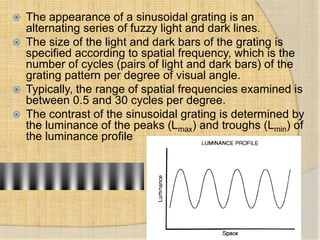
 The appearance of a sinusoidal grating is an 
alternating series of fuzzy light and dark lines. 
 The size of the light and dark bars of the grating is 
specified according to spatial frequency, which is the 
number of cycles (pairs of light and dark bars) of the 
grating pattern per degree of visual angle. 
 Typically, the range of spatial frequencies examined is 
between 0.5 and 30 cycles per degree. 
 The contrast of the sinusoidal grating is determined by 
the luminance of the peaks (Lmax) and troughs (Lmin) of 
the luminance profile
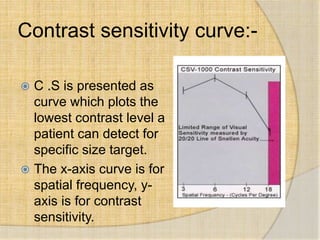
Contrast sensitivity curve:- 
 C .S is presented as 
curve which plots the 
lowest contrast level a 
patient can detect for 
specific size target. 
 The x-axis curve is for 
spatial frequency, y-axis 
is for contrast 
sensitivity.
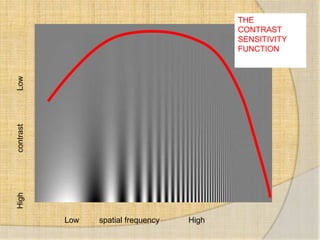
Seeing your own CSF 
Contrast 
Spatial Frequency
Low spatial frequency High 
High contrast Low 
THE 
CONTRAST 
SENSITIVITY 
FUNCTION
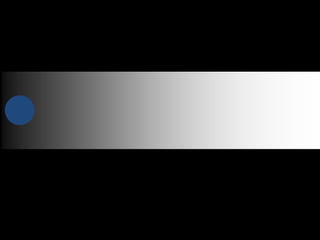
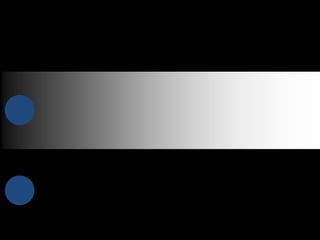
Brightness Perception
What are symptoms of low c.s? 
 Have problems with 
night driving, including 
inability to see traffic 
lights 
 May require extra light 
to read 
 Their eyes may become 
tired when they read or 
watch television 
 Not being able to see 
spots on clothes, 
counters, or dishes 
 Missing facial gestures
CONTRAST SENSITIVITY 
TESTING 
 It will be done while you wear your eye 
glasses or contact lenses if you require 
vision correction 
 Testing done with both eye together to 
determine ability to see low contrast object 
 For evaluation of eye disease contrast 
sensitivity contrast sensitivity is tested on 
each eye individually .
Contrast sensitivity 
 Contrast sensitivity measured at normal 
room illumination which about 30-70 
footlamberts 
 Luminance must be kept constant when 
contrast sensitivity tested because mean 
luminance has an effect on the shape at 
normal contrast sensitivity function
Conditions affects cs 
 Pupil size has effect on contrast sensitivity as it does on 
snellen acuity 
 miotic pupils =diffraction reduce contrast sensitivity 
 Dilated pupils leads to optical aberration 
 Contrast sensitivity can also be affected by a distortion or 
edema. 
 Lens changes due cataract leads to decrease contrast 
sensitivity. 
 Retinal pathology may affect contrast sensitivity. 
 Retinitis pigmentosa. 
 Central serous retinopathy. 
 Macular degeneration. 
 Glaucoma. 
 Retrobulber optic neuritis. 
 Amblyopia.
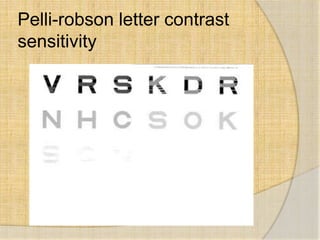
Pelli-robson letter contrast 
sensitivity 
 It is simply of quickly measured and provides a 
reliable measurement of low spatial frequency 
contrast sensitivity ( 0.5 – 2 cycles) 
Method: 
 Sit the patient 1m from the chart with his or her 
correction if needs 
Occlude one eye or with both eye 
 With both eyes result high with 0.15 log units 
Asked patient to read lowest letter that can see
Pelli-robson letter contrast 
sensitivity
Record the contrast sensitivity score in log 
units 
Results: 
For patient 20-50 years old monocular 
contrast sensitivity should be 1.80 log unit 
Patient less than 20 years and older so 
years =1.65 log units
Most common errors 
 Not allowing patient at least 20 second 
for letters to become visible 
 Not pushing patient to guess 
 Illumination is poor
Cambridge low contrast 
gratings 
 It is a rapid and simple screening test for 
contrast sensitivity. 
 Performed at a distance of 6m. 
 It comprises of 12 pair of plates consisting 
of stripes of varying contrast. 
 First one is for demonstration and rest are 
for the proper testing and are numbered 
from 1-10. 
 The plates are changed sequentially 
starting from plate 1 till the patient fails to 
respond.
Cambridge low contrast 
gratings 
 Then a new series is begun starting 4 
plates prior to where the patient failed to 
respond. 
 Four such series are completed and the 
score of each series is noted (numbered as 
per the number of plate read) and added. 
 The final total value is converted into 
contrast sensitivity from the provided table.
Functional Acuity Contrast Testing 
(FACT) 
 FACT charts were developed by Dr. Arthur 
Ginsburg. 
 FACT comprises of a chart with sine-wave 
gratings of varying contrast as well as 
varying spatial frequencies. 
 It is an accurate and comprehensive 
grating chart that tests functional visual 
acuity. 
 This test is performed at a distance of 10 
feet.
 The chart tests five spatial frequencies (sizes) and nine levels of 
contrast. 
 The Contrast varies in a row, decrease from left to right. 
 And the spatial frequencies increase as one move down the 
various columns from top to bottom 
 The patient determines the last grating seen for each row (A, B, 
C, D and E) and reports the orientation of the grating: right, up or 
left. 
 The last correct grating seen for each spatial frequency is plotted 
on a contrast sensitivity curve.

Contrast sensitivity

  • 1.
  • 2.
    What is contrastsensitivity ?  Visual ability to see object that may not be outlined clearly or not stand out from their background.  The ability to see a shade of gray on white background or to see white on light gray background.
  • 3.
    Contrast sensitivity Contrast Def. The difference in the luminance of target against the background.  contrast target luminance – background luminance target luminance + background luminance
  • 4.
    Contrast threshold The minimum resolvable contrast.  It described in logarithmic terms.
  • 5.
    Contrast sensitivity function  The manner in which contrast sensitivity changes as function of spatial frequency of the target .  Contrast sensitivity can be tested with sine wave grating using either charts or video gratings or  with opto types of variable contrast such as pelli-robson or regan chart.
  • 6.
    How is c.sdifferent than acuity :-  CS is unlike acuity , c.s measures tow variable size & contrast while acuity measures only size.  CS measure the degree to which this ability has been lost , while snellen visual acuity measures the ability to see object of different size.  Snellen chart useful for describing changes in vision caused by spherical blur but unable to detect many types of vision loss are not cased by spherical blur.
  • 7.
    Compare: E smaller E Letter Size Spatial Frequency higher
  • 9.
     Some patientcan have normal visual acuity & reduced c.s such as those with 1. Optic neuritis . 2. Multiple sclerosis 3. Parkinson’s disease 4. Papilloedema 5. Primary open angel glaucoma 6. Diabetic retinopathy 7. Compressive lesions of visual pathways
  • 10.
    Benefits of c.stesting  early detection of serious eye diseases, It also helps in more accurate monitoring of ocular conditions  Contrast sensitivity testing complements the traditional 20/20 visual acuity value by measuring more subtle vision losses due to problems with spectacle lenses and contact lenses.  It also offers important information in the fitting of contact lens  Contrast sensitivity testing assists in more precise assessments of patients prior to surgery and post-operatively.
  • 11.
    Sinusoidal gratings The most commonly used stimuli for assessing the contrast sensitivity characteristics of the human visual system are sinusoidal gratings, consisting of an alternating pattern of light and dark bars whose luminance varies sinusoidally in the direction perpendicular to the grating's orientation.
  • 12.
    The Physical Stimulus:Spatial pattern photometer
  • 13.
     The appearanceof a sinusoidal grating is an alternating series of fuzzy light and dark lines.  The size of the light and dark bars of the grating is specified according to spatial frequency, which is the number of cycles (pairs of light and dark bars) of the grating pattern per degree of visual angle.  Typically, the range of spatial frequencies examined is between 0.5 and 30 cycles per degree.  The contrast of the sinusoidal grating is determined by the luminance of the peaks (Lmax) and troughs (Lmin) of the luminance profile
  • 14.
    Contrast sensitivity curve:-  C .S is presented as curve which plots the lowest contrast level a patient can detect for specific size target.  The x-axis curve is for spatial frequency, y-axis is for contrast sensitivity.
  • 15.
    Seeing your ownCSF Contrast Spatial Frequency
  • 16.
    Low spatial frequencyHigh High contrast Low THE CONTRAST SENSITIVITY FUNCTION
  • 19.
  • 22.
    What are symptomsof low c.s?  Have problems with night driving, including inability to see traffic lights  May require extra light to read  Their eyes may become tired when they read or watch television  Not being able to see spots on clothes, counters, or dishes  Missing facial gestures
  • 23.
    CONTRAST SENSITIVITY TESTING  It will be done while you wear your eye glasses or contact lenses if you require vision correction  Testing done with both eye together to determine ability to see low contrast object  For evaluation of eye disease contrast sensitivity contrast sensitivity is tested on each eye individually .
  • 24.
    Contrast sensitivity Contrast sensitivity measured at normal room illumination which about 30-70 footlamberts  Luminance must be kept constant when contrast sensitivity tested because mean luminance has an effect on the shape at normal contrast sensitivity function
  • 25.
    Conditions affects cs  Pupil size has effect on contrast sensitivity as it does on snellen acuity  miotic pupils =diffraction reduce contrast sensitivity  Dilated pupils leads to optical aberration  Contrast sensitivity can also be affected by a distortion or edema.  Lens changes due cataract leads to decrease contrast sensitivity.  Retinal pathology may affect contrast sensitivity.  Retinitis pigmentosa.  Central serous retinopathy.  Macular degeneration.  Glaucoma.  Retrobulber optic neuritis.  Amblyopia.
  • 26.
    Pelli-robson letter contrast sensitivity  It is simply of quickly measured and provides a reliable measurement of low spatial frequency contrast sensitivity ( 0.5 – 2 cycles) Method:  Sit the patient 1m from the chart with his or her correction if needs Occlude one eye or with both eye  With both eyes result high with 0.15 log units Asked patient to read lowest letter that can see
  • 27.
  • 28.
    Record the contrastsensitivity score in log units Results: For patient 20-50 years old monocular contrast sensitivity should be 1.80 log unit Patient less than 20 years and older so years =1.65 log units
  • 29.
    Most common errors  Not allowing patient at least 20 second for letters to become visible  Not pushing patient to guess  Illumination is poor
  • 30.
    Cambridge low contrast gratings  It is a rapid and simple screening test for contrast sensitivity.  Performed at a distance of 6m.  It comprises of 12 pair of plates consisting of stripes of varying contrast.  First one is for demonstration and rest are for the proper testing and are numbered from 1-10.  The plates are changed sequentially starting from plate 1 till the patient fails to respond.
  • 31.
    Cambridge low contrast gratings  Then a new series is begun starting 4 plates prior to where the patient failed to respond.  Four such series are completed and the score of each series is noted (numbered as per the number of plate read) and added.  The final total value is converted into contrast sensitivity from the provided table.
  • 32.
    Functional Acuity ContrastTesting (FACT)  FACT charts were developed by Dr. Arthur Ginsburg.  FACT comprises of a chart with sine-wave gratings of varying contrast as well as varying spatial frequencies.  It is an accurate and comprehensive grating chart that tests functional visual acuity.  This test is performed at a distance of 10 feet.
  • 33.
     The charttests five spatial frequencies (sizes) and nine levels of contrast.  The Contrast varies in a row, decrease from left to right.  And the spatial frequencies increase as one move down the various columns from top to bottom  The patient determines the last grating seen for each row (A, B, C, D and E) and reports the orientation of the grating: right, up or left.  The last correct grating seen for each spatial frequency is plotted on a contrast sensitivity curve.