Feedback Control Systems (FCS)

Lecture-10-11
Signal Flow Graphs
Dr. Imtiaz Hussain
email: imtiaz.hussain@faculty.muet.edu.pk
URL :http://imtiazhussainkalwar.weebly.com/
Outline
• Introduction to Signal Flow Graphs
– Definitions
– Terminologies
– Examples
• Mason’s Gain Formula
– Examples

• Signal Flow Graph from Block Diagrams
• Design Examples
Introduction
• Alternative method to block diagram representation,
developed by Samuel Jefferson Mason.

• Advantage: the availability of a flow graph gain formula,
also called Mason’s gain formula.
• A signal-flow graph consists of a network in which nodes
are connected by directed branches.
• It depicts the flow of signals from one point of a system
to another and gives the relationships among the signals.
3
Fundamentals of Signal Flow Graphs
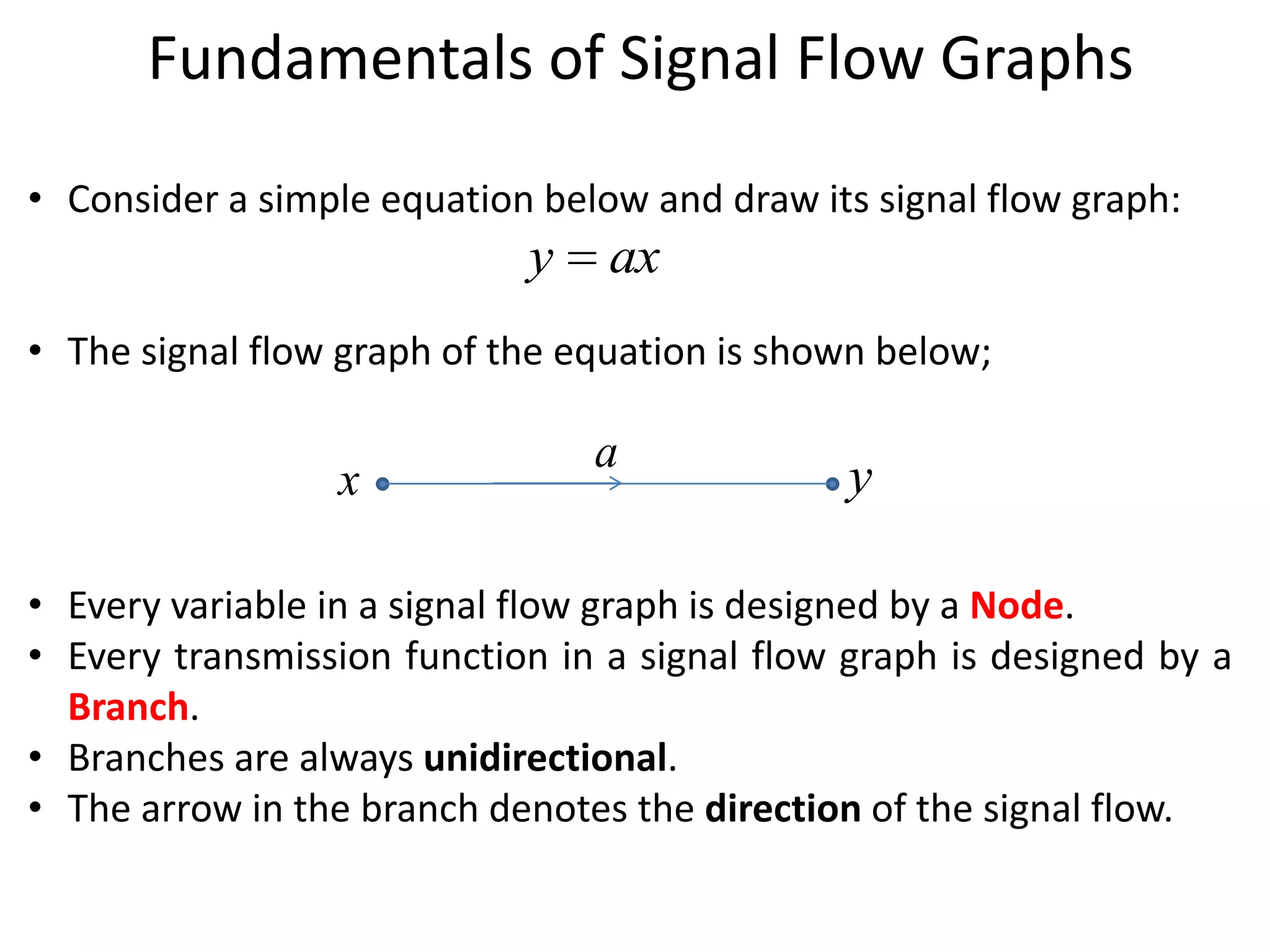
• Consider a simple equation below and draw its signal flow graph:

y

ax

• The signal flow graph of the equation is shown below;

x

a

y

• Every variable in a signal flow graph is designed by a Node.
• Every transmission function in a signal flow graph is designed by a
Branch.
• Branches are always unidirectional.
• The arrow in the branch denotes the direction of the signal flow.
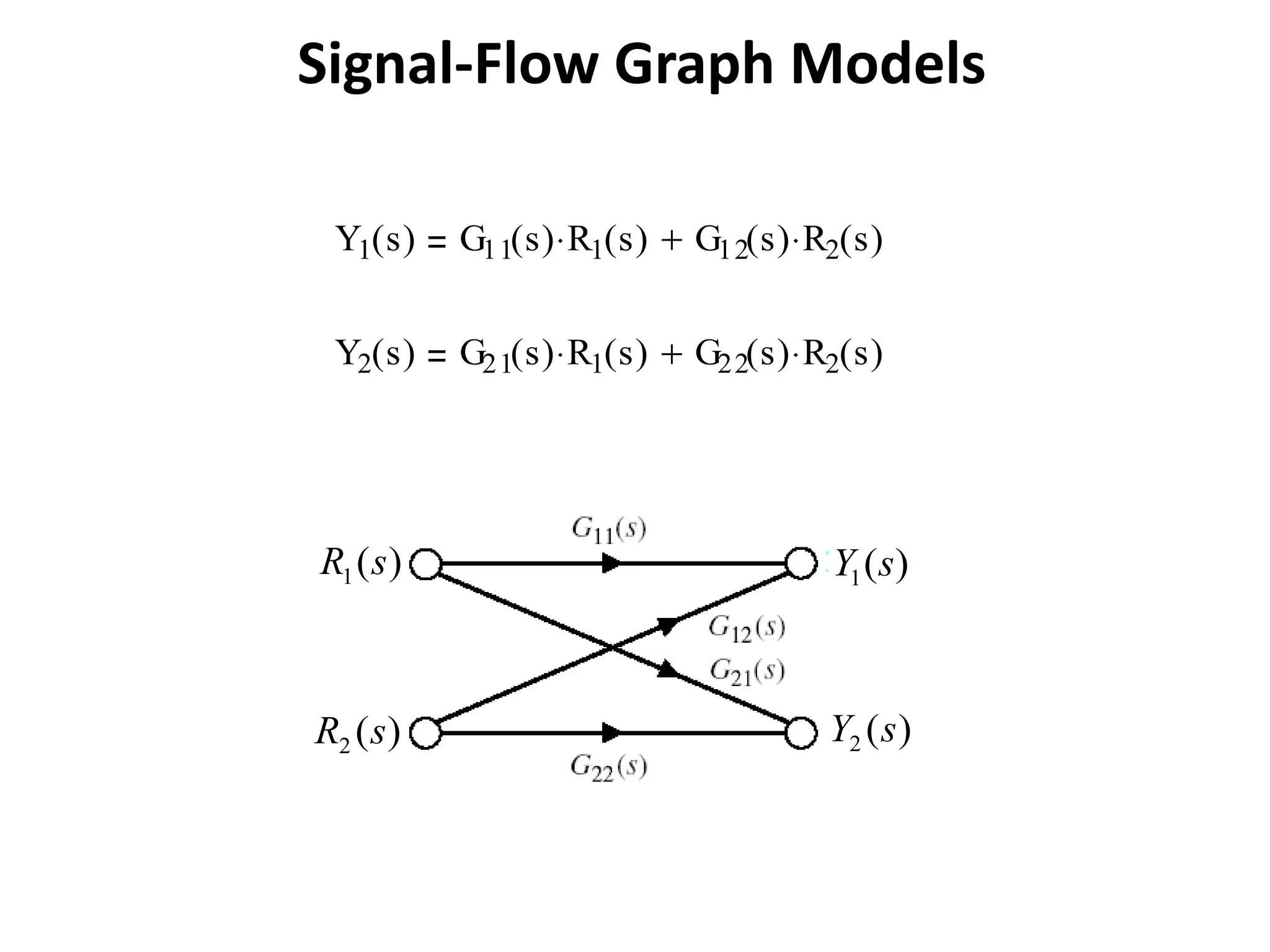
Signal-Flow Graph Models
Y1( s )

G11( s ) R1( s )

G12( s ) R2( s )

Y2( s )

G21( s ) R1( s )

G22( s ) R2( s )

R1 ( s )

Y1 ( s)

R2 ( s )

Y2 ( s )
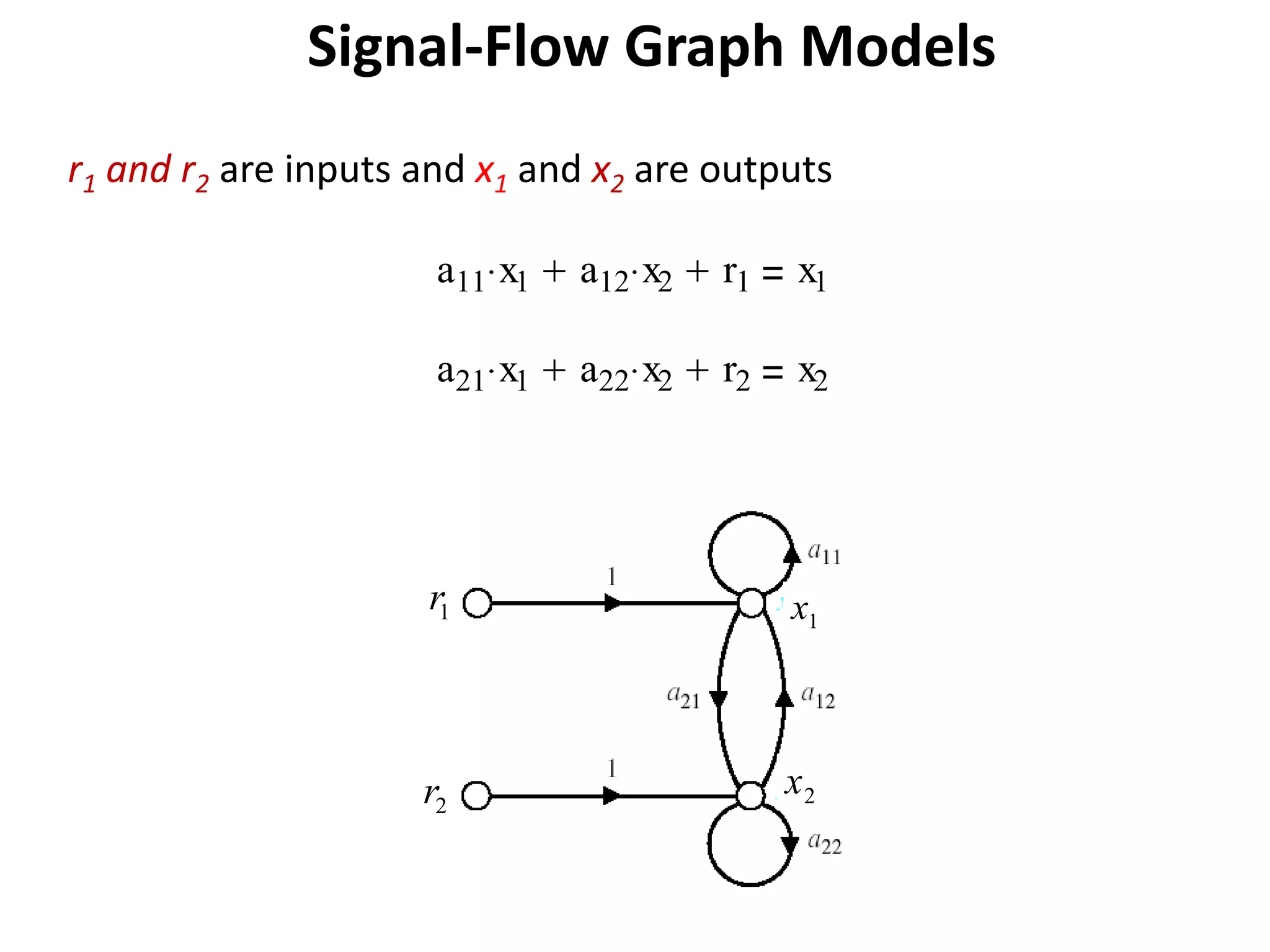
Signal-Flow Graph Models
r1 and r2 are inputs and x1 and x2 are outputs
a11 x1

a12 x2

r1

x1

a21 x1

a22 x2

r2

x2

r1

x1

r2

x2
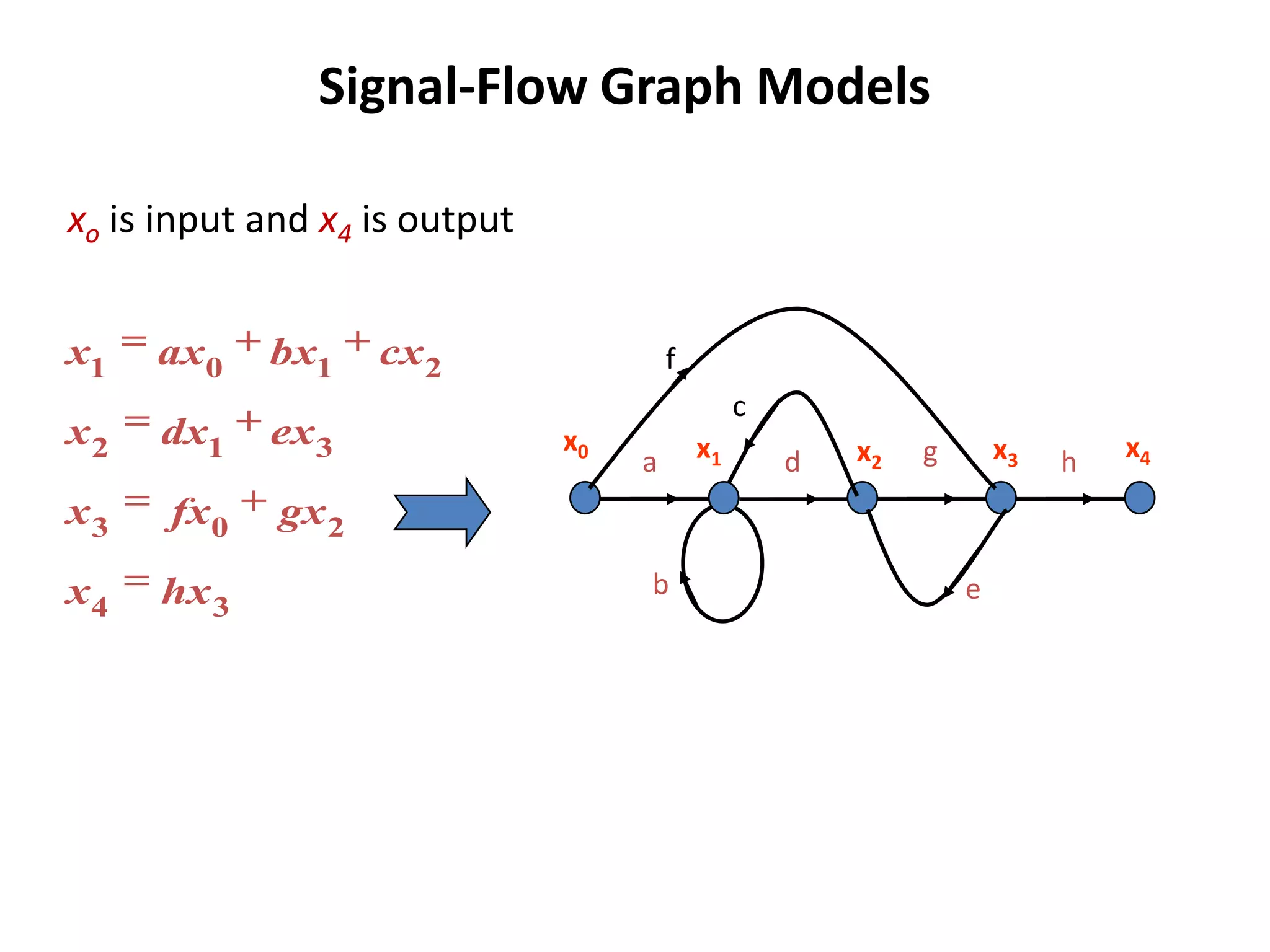
Signal-Flow Graph Models
xo is input and x4 is output
x1

ax0

bx1

x2

dx1

ex 3

x3

fx0
hx 3

f
c

gx 2

x4

cx 2
x0

a

b

x1

d

x2

x3

g

e

h

x4
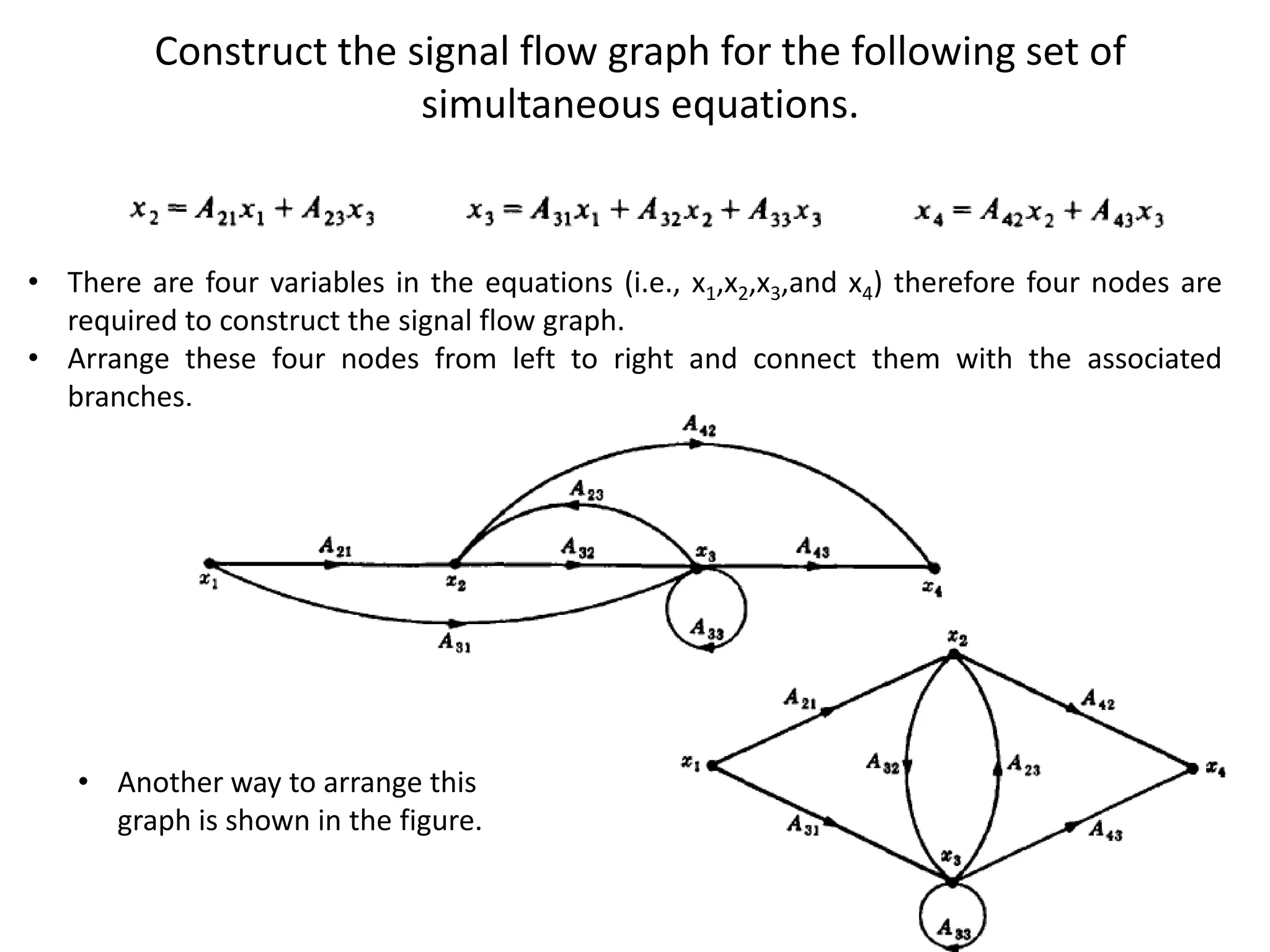
Construct the signal flow graph for the following set of
simultaneous equations.

• There are four variables in the equations (i.e., x1,x2,x3,and x4) therefore four nodes are
required to construct the signal flow graph.
• Arrange these four nodes from left to right and connect them with the associated
branches.

• Another way to arrange this
graph is shown in the figure.
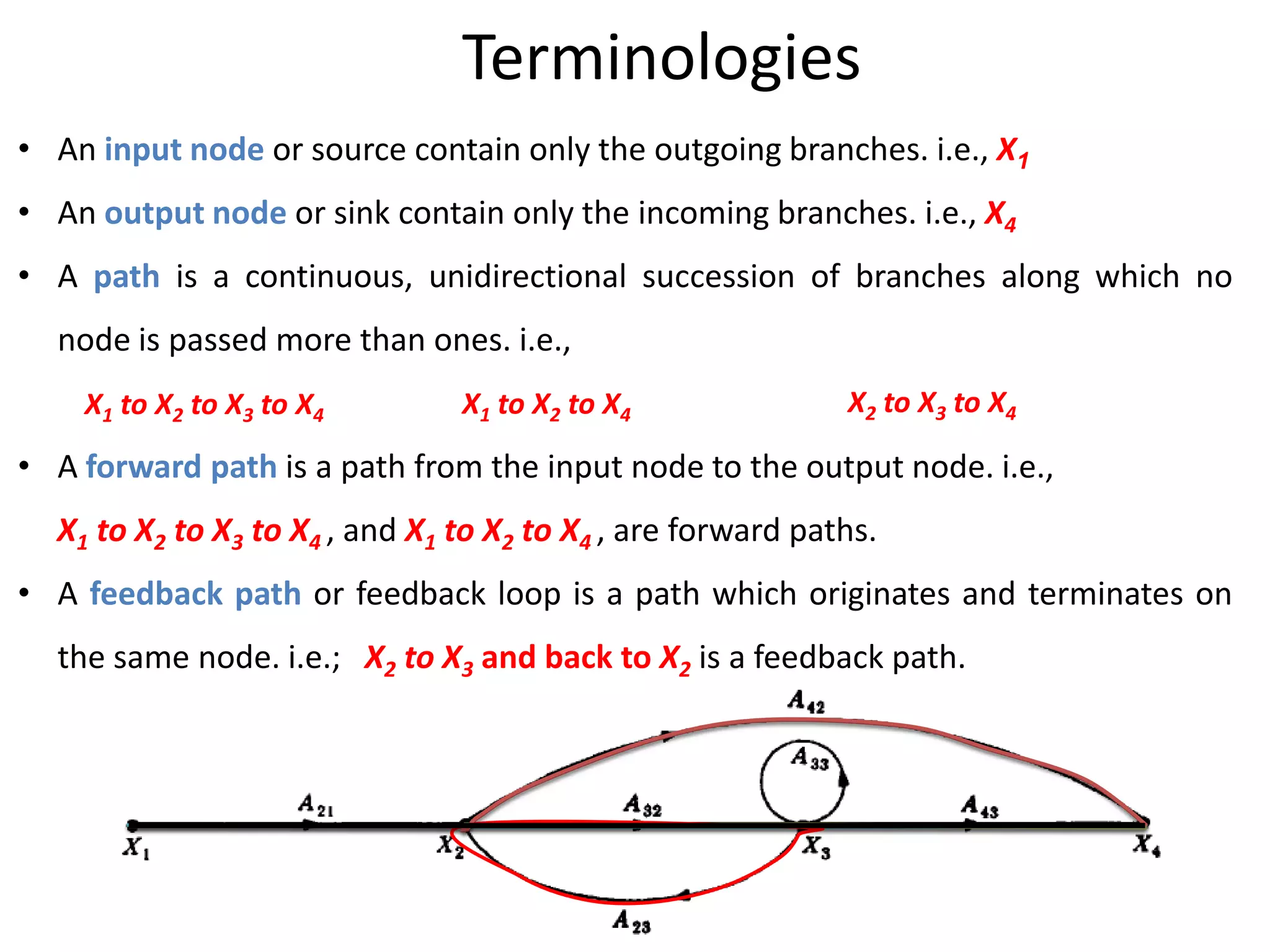
Terminologies
• An input node or source contain only the outgoing branches. i.e., X1
• An output node or sink contain only the incoming branches. i.e., X4
• A path is a continuous, unidirectional succession of branches along which no
node is passed more than ones. i.e.,
X1 to X2 to X3 to X4

X1 to X2 to X4

X2 to X3 to X4

• A forward path is a path from the input node to the output node. i.e.,
X1 to X2 to X3 to X4 , and X1 to X2 to X4 , are forward paths.

• A feedback path or feedback loop is a path which originates and terminates on
the same node. i.e.; X2 to X3 and back to X2 is a feedback path.
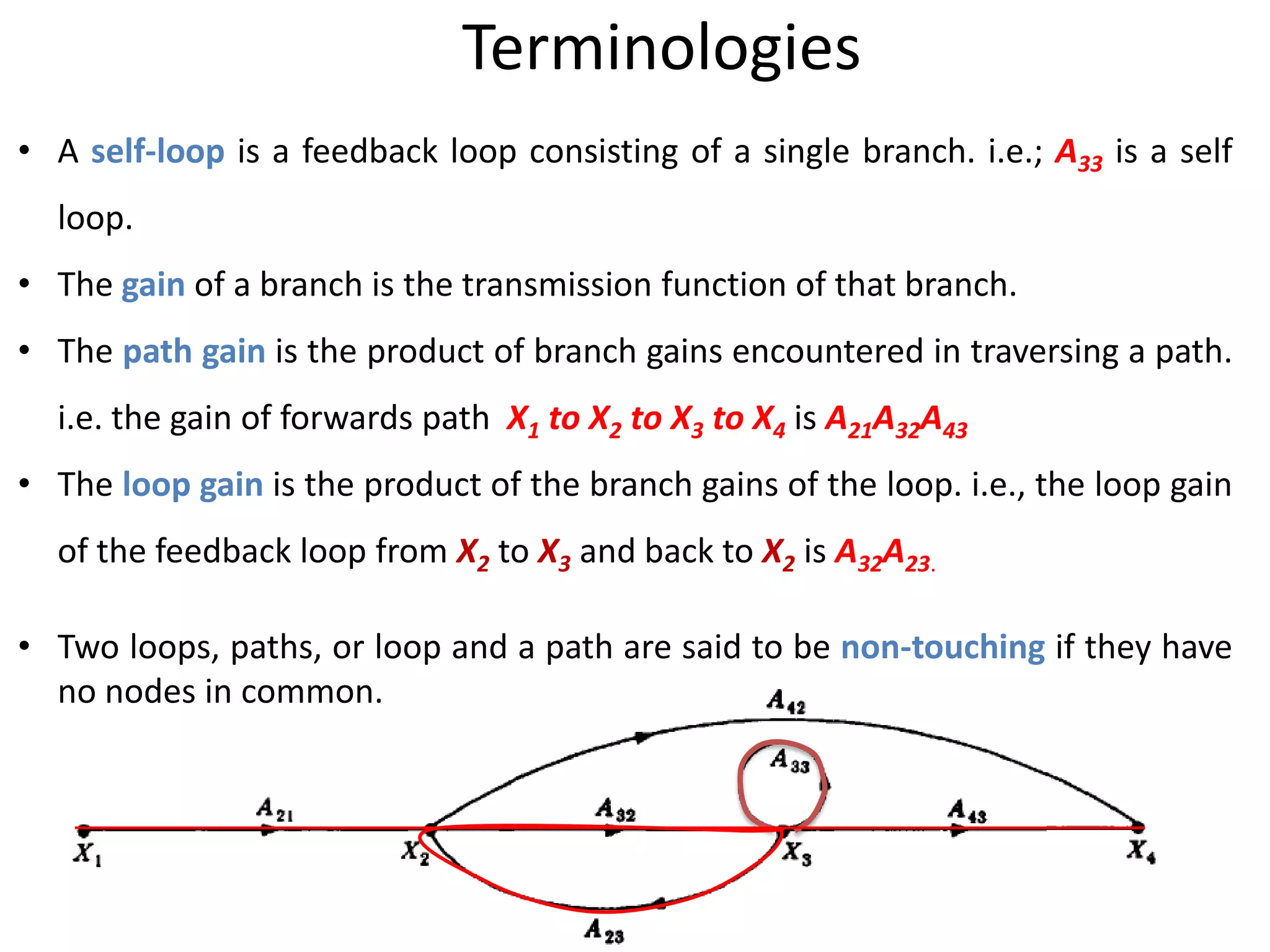
Terminologies
• A self-loop is a feedback loop consisting of a single branch. i.e.; A33 is a self
loop.
• The gain of a branch is the transmission function of that branch.
• The path gain is the product of branch gains encountered in traversing a path.
i.e. the gain of forwards path X1 to X2 to X3 to X4 is A21A32A43
• The loop gain is the product of the branch gains of the loop. i.e., the loop gain
of the feedback loop from X2 to X3 and back to X2 is A32A23.
• Two loops, paths, or loop and a path are said to be non-touching if they have
no nodes in common.
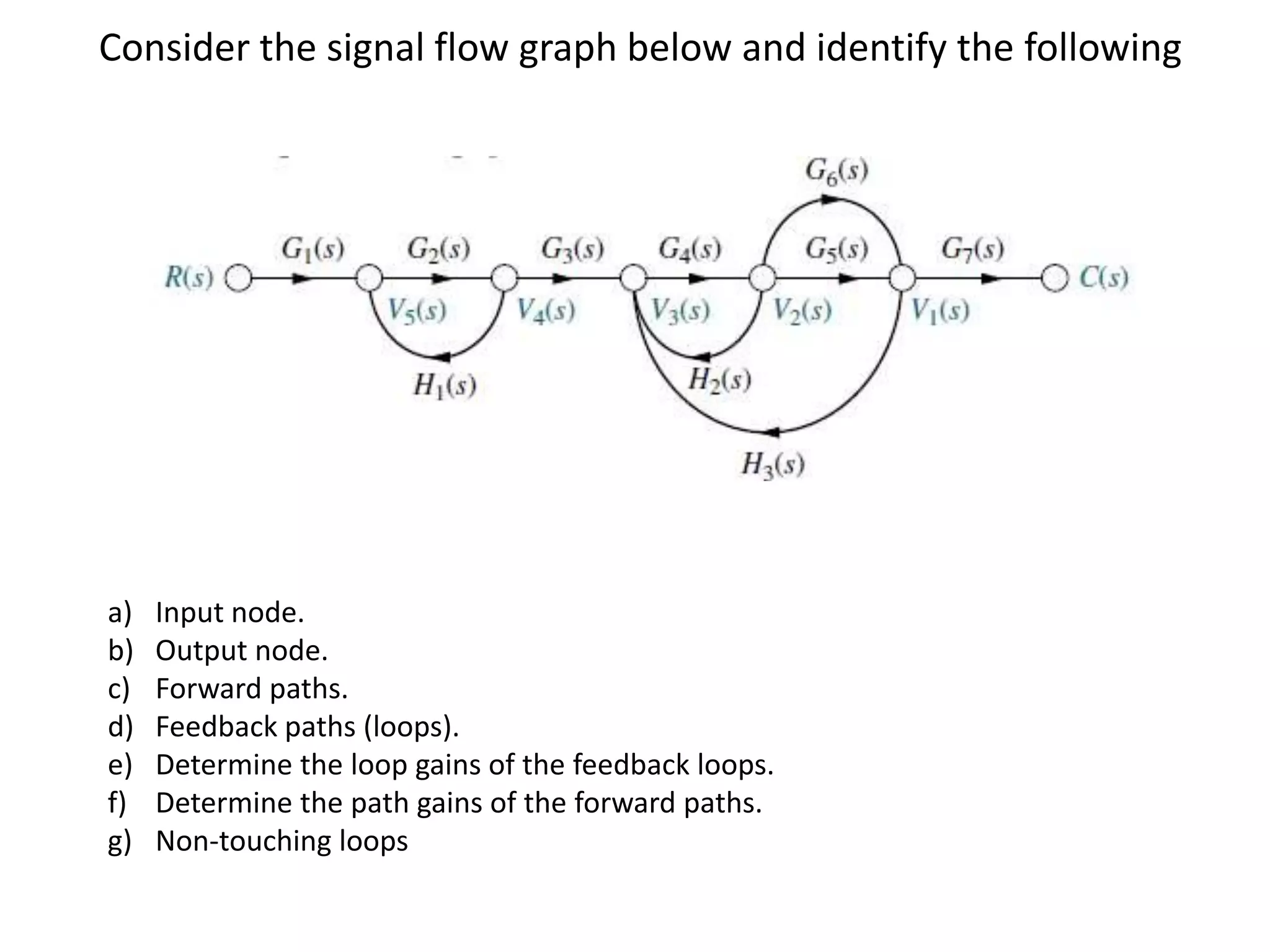
Consider the signal flow graph below and identify the following

a)
b)
c)
d)
e)
f)
g)

Input node.
Output node.
Forward paths.
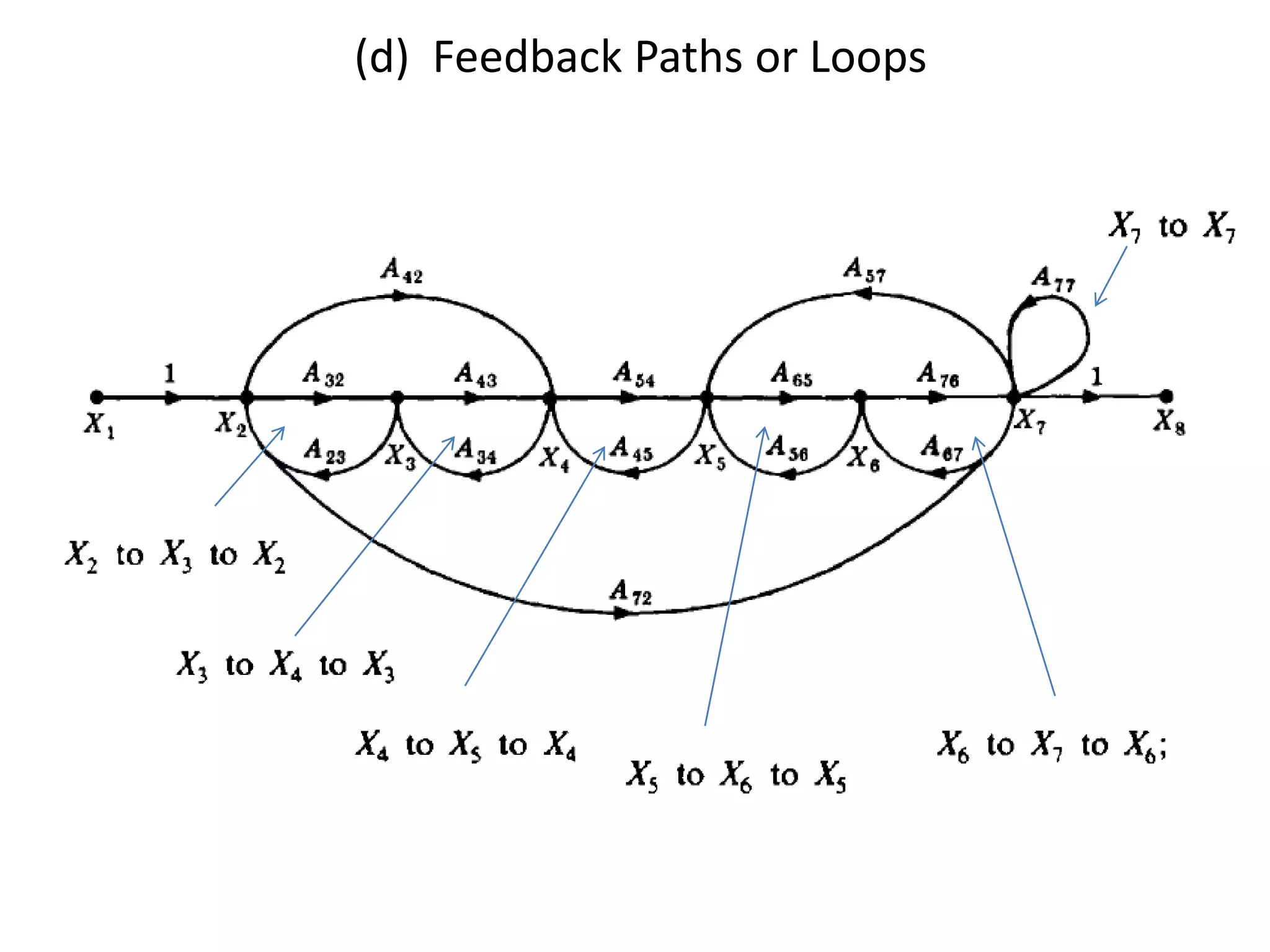
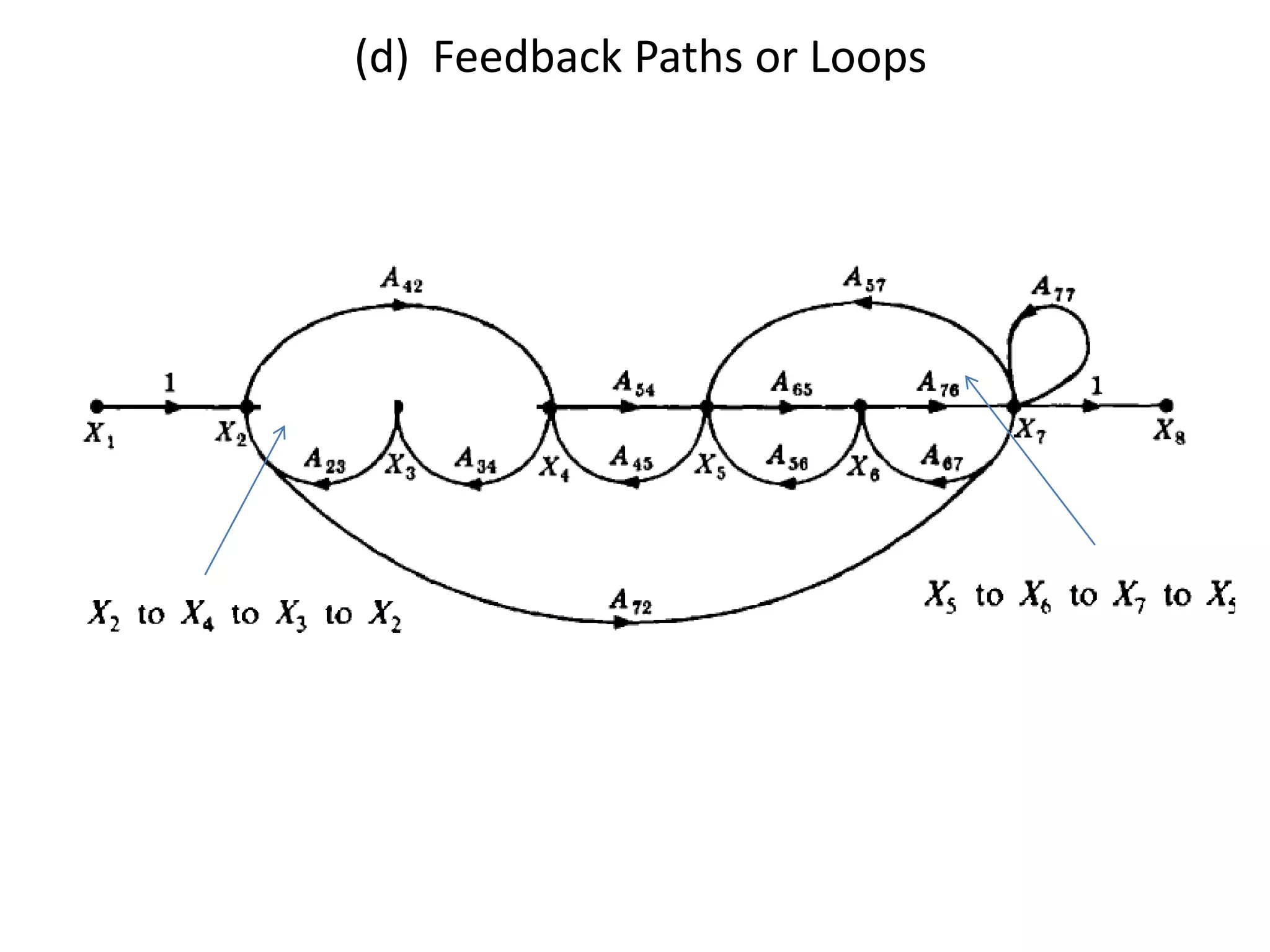
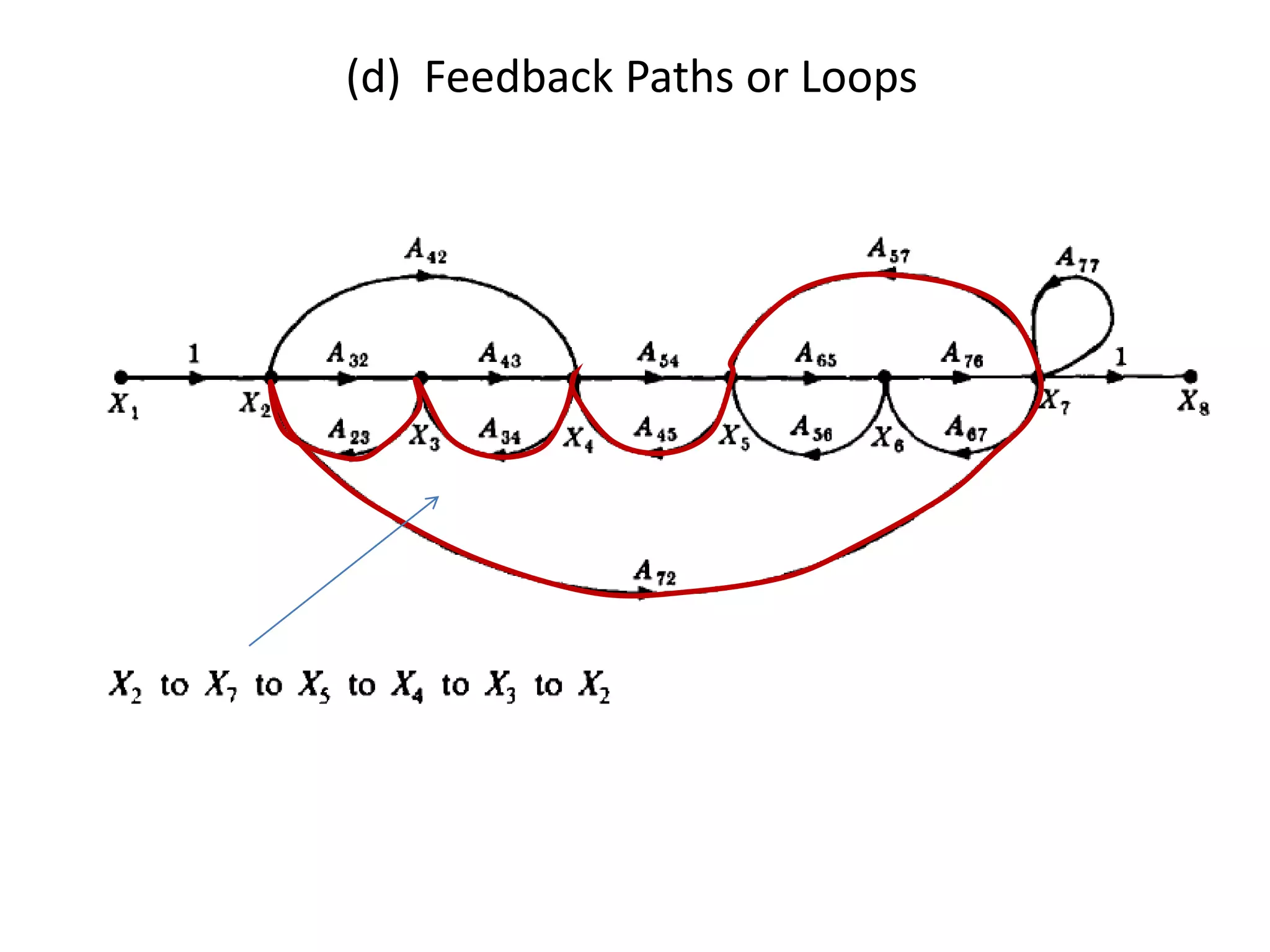
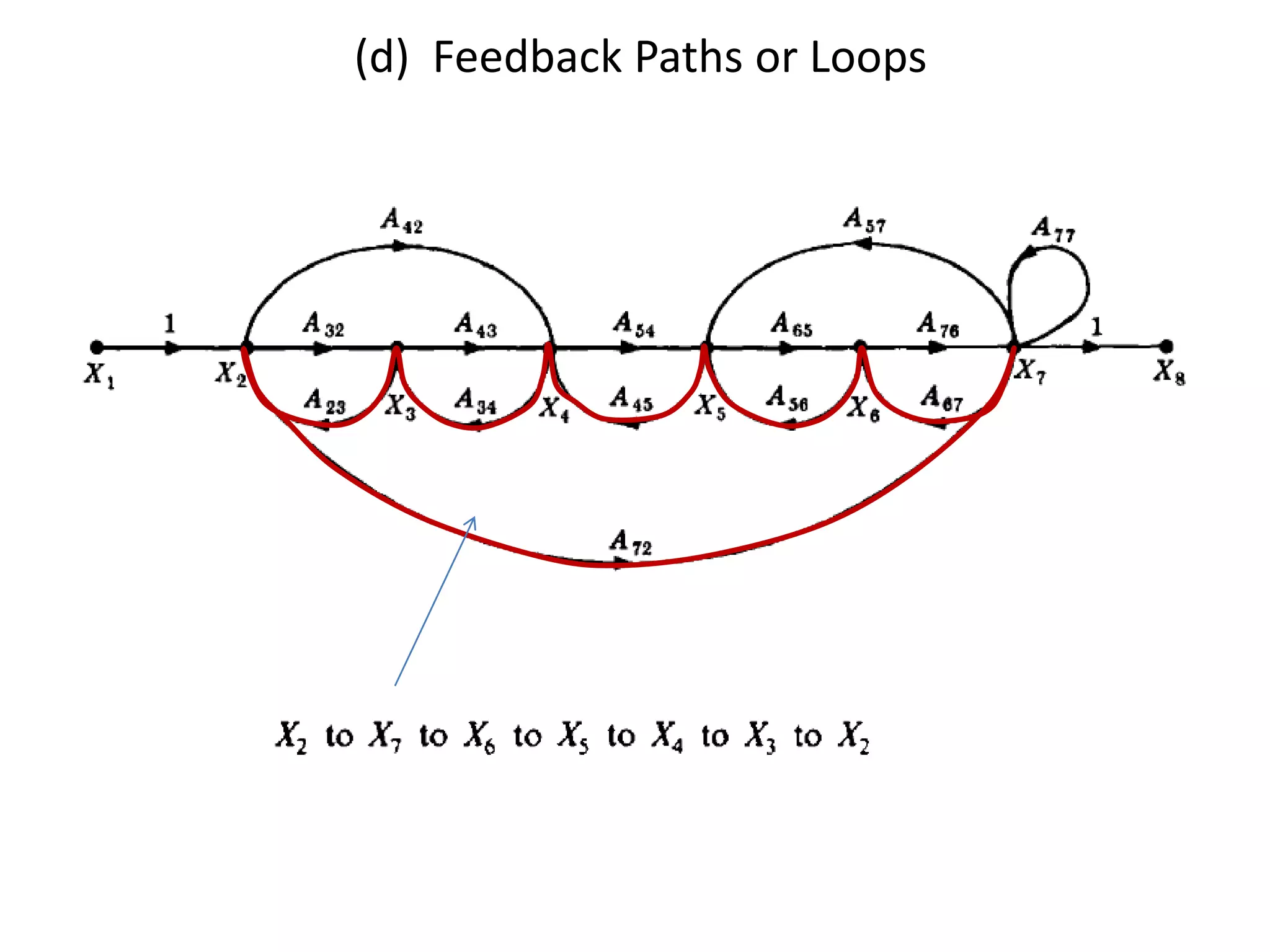
Feedback paths (loops).
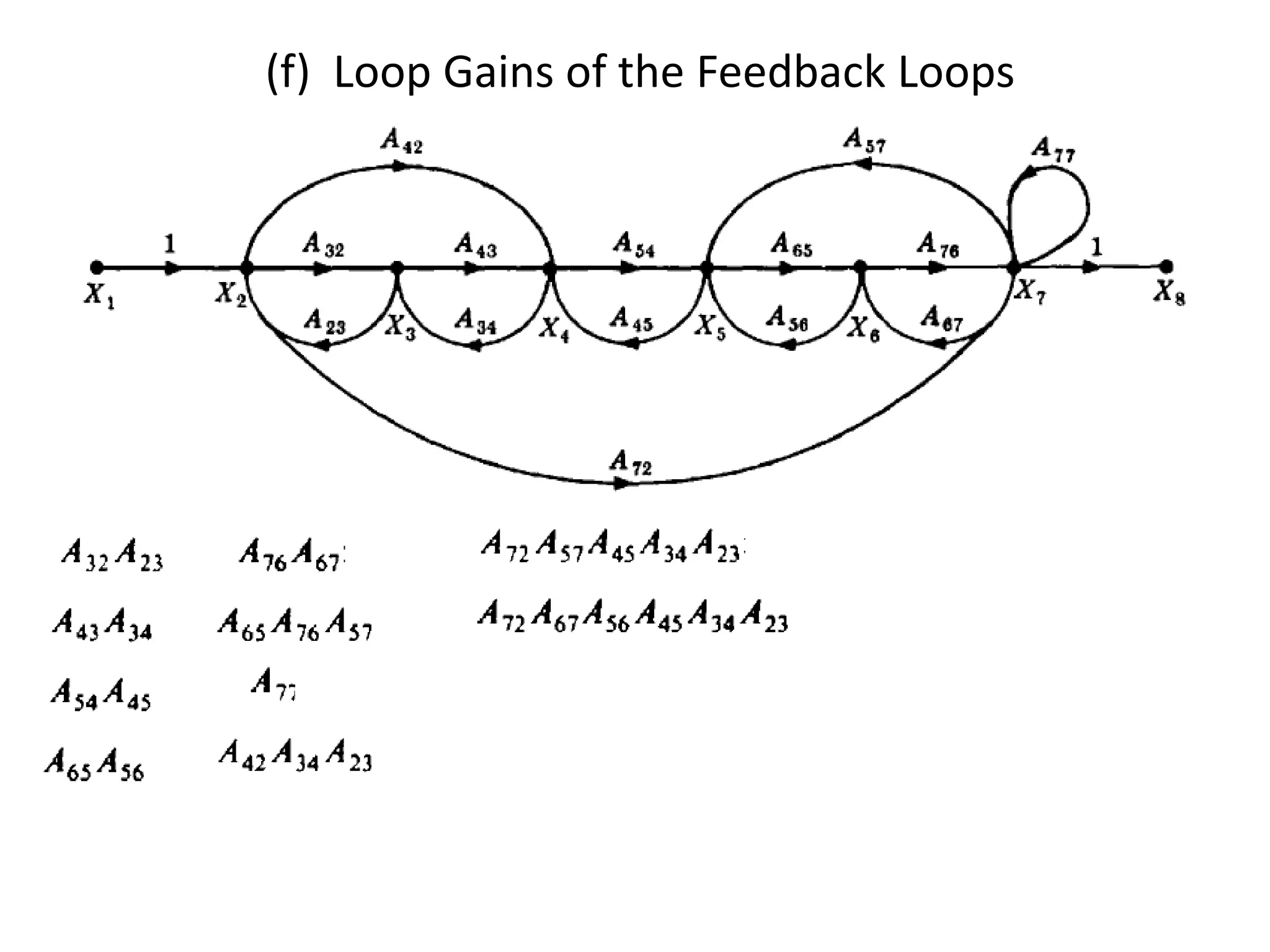
Determine the loop gains of the feedback loops.
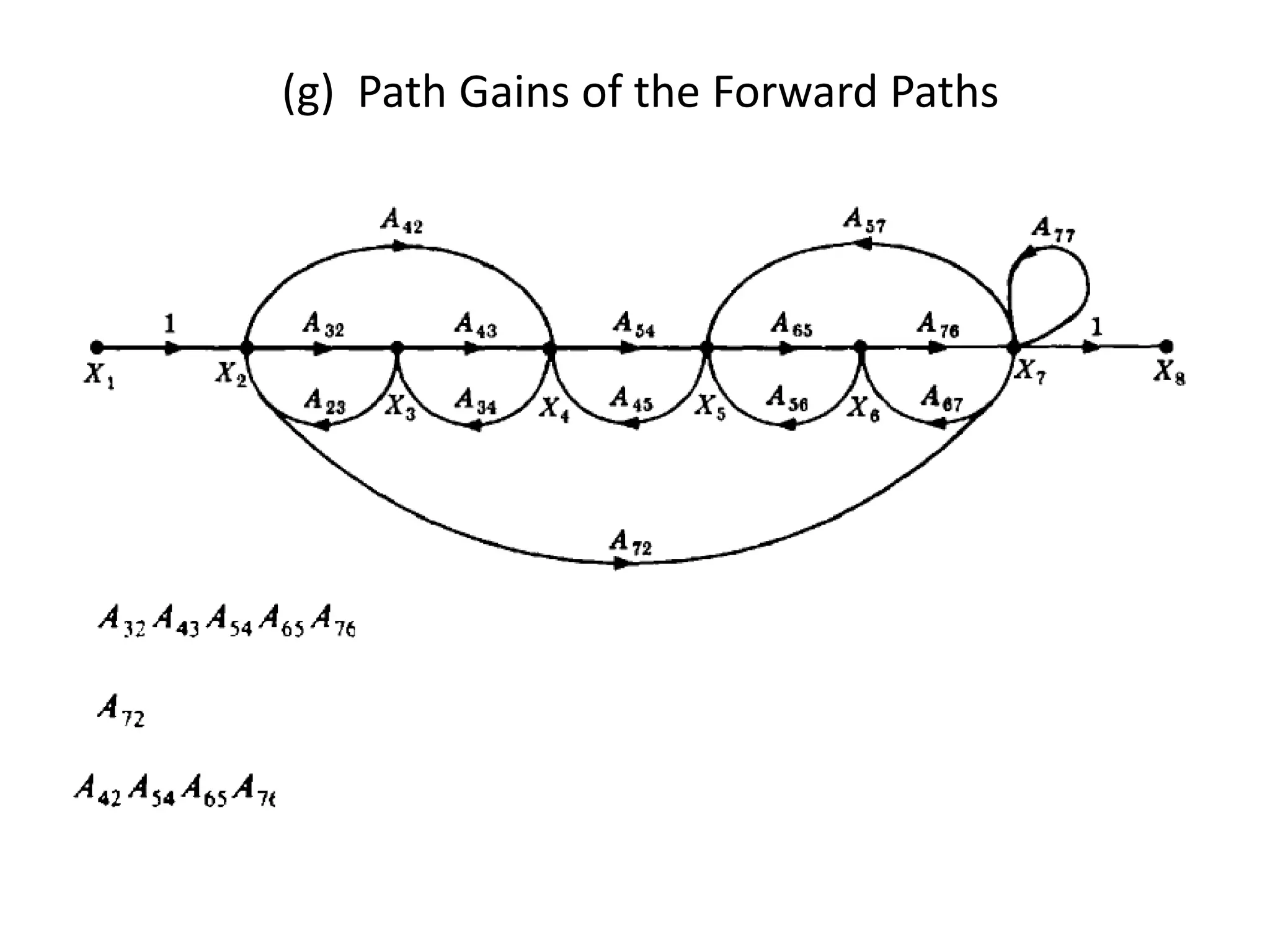
Determine the path gains of the forward paths.
Non-touching loops
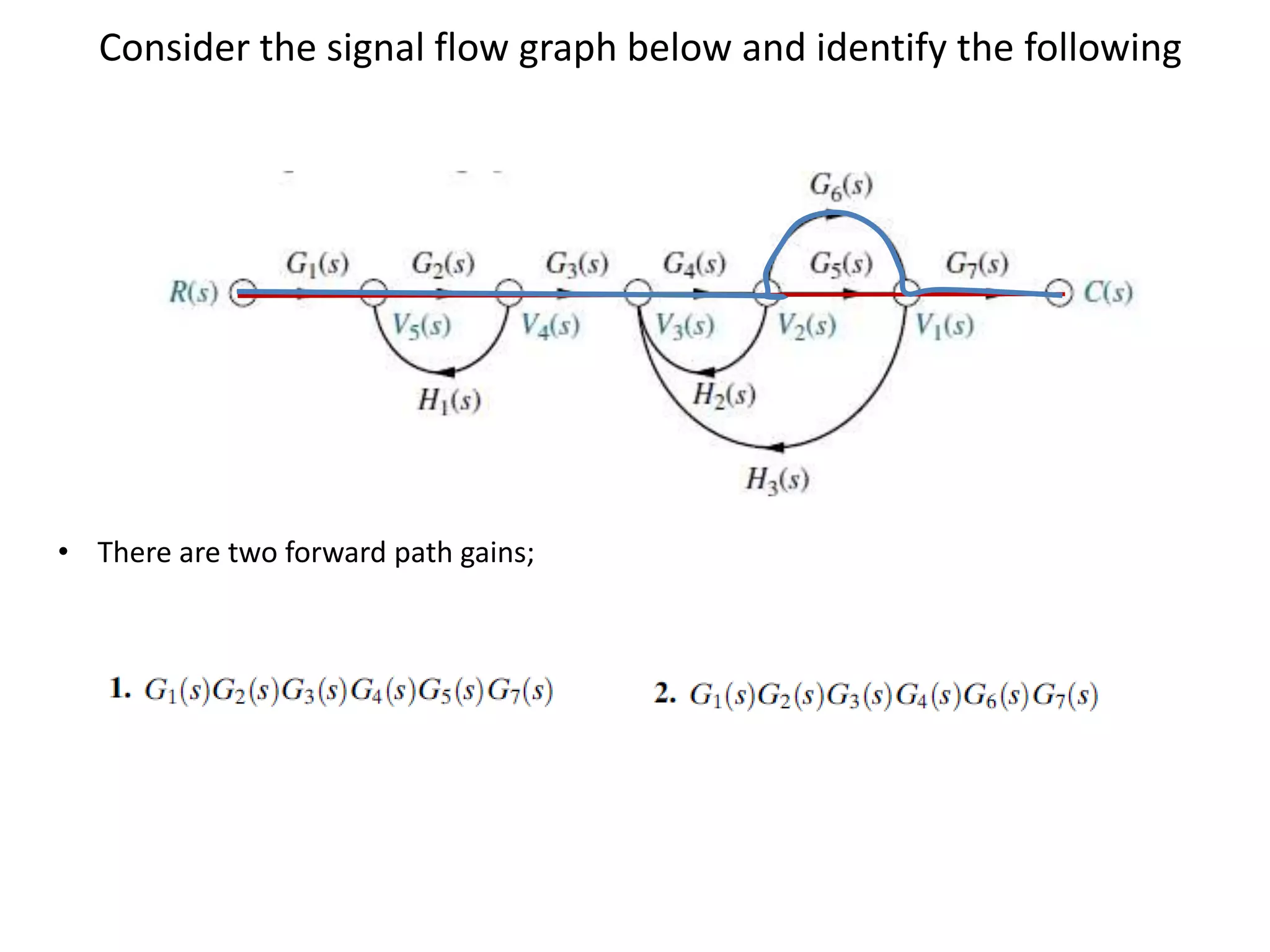
Consider the signal flow graph below and identify the following

• There are two forward path gains;
Consider the signal flow graph below and identify the following
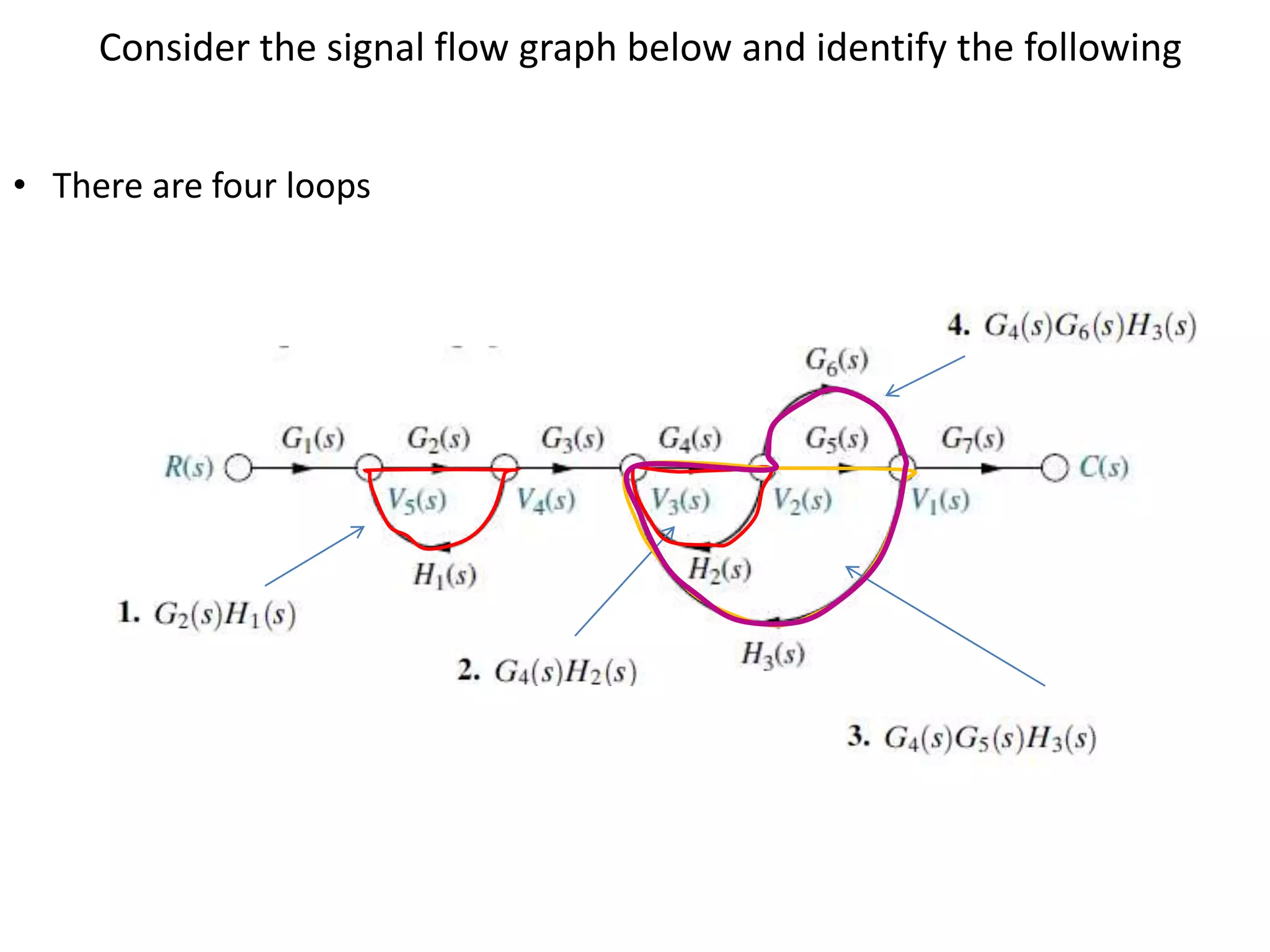
• There are four loops
Consider the signal flow graph below and identify the following

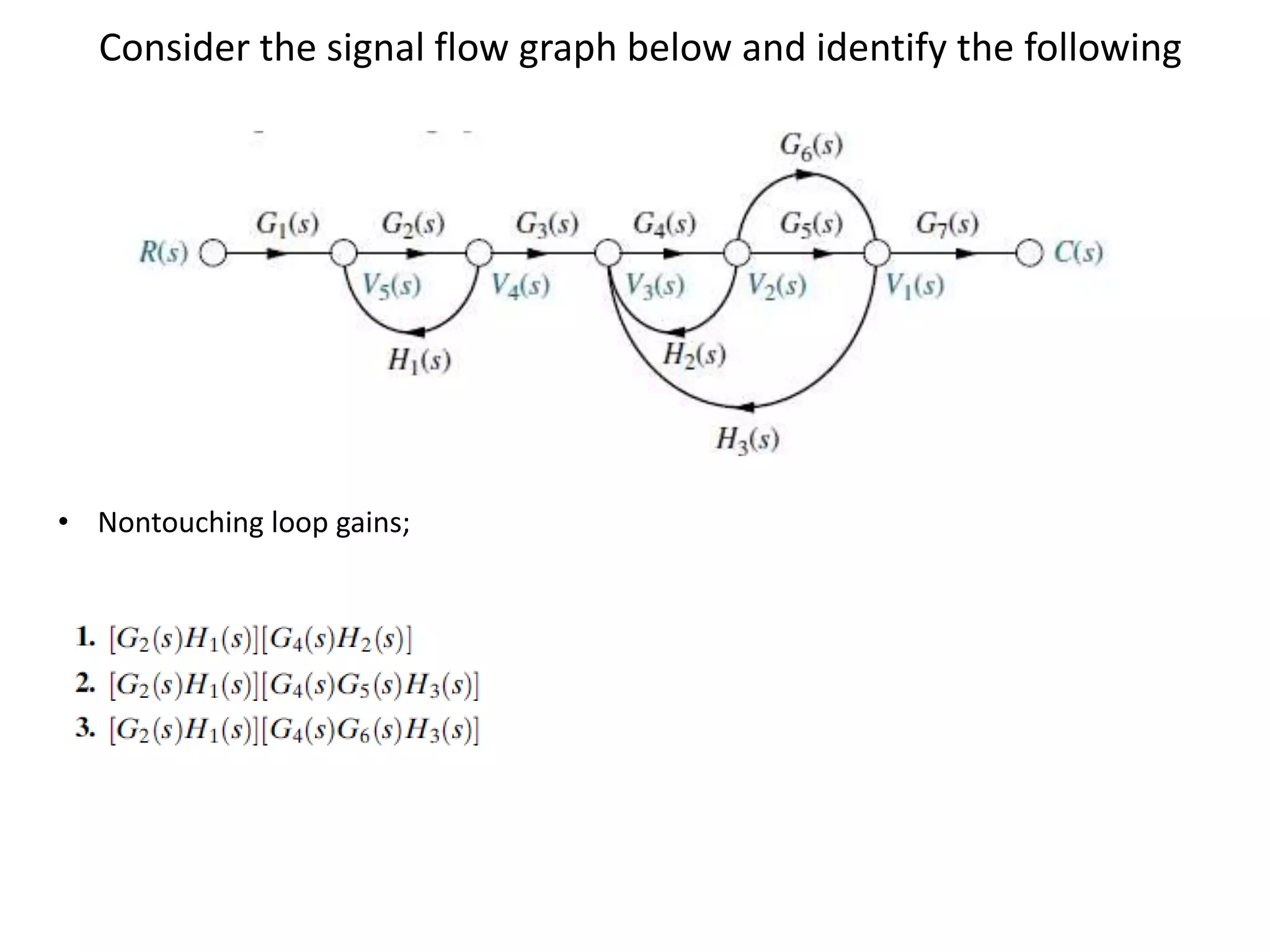
• Nontouching loop gains;
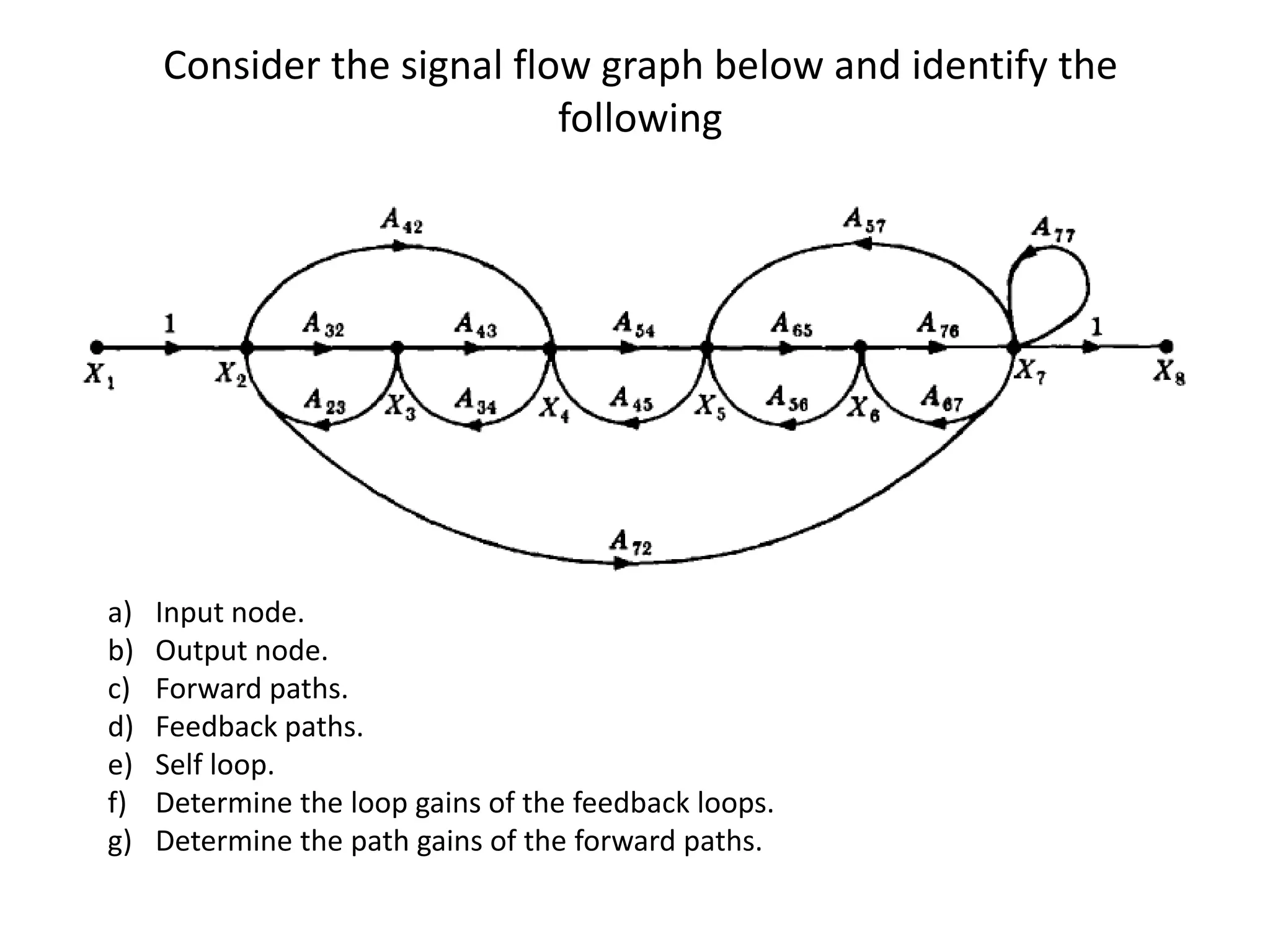
Consider the signal flow graph below and identify the
following

a)
b)
c)
d)
e)
f)
g)

Input node.
Output node.
Forward paths.
Feedback paths.
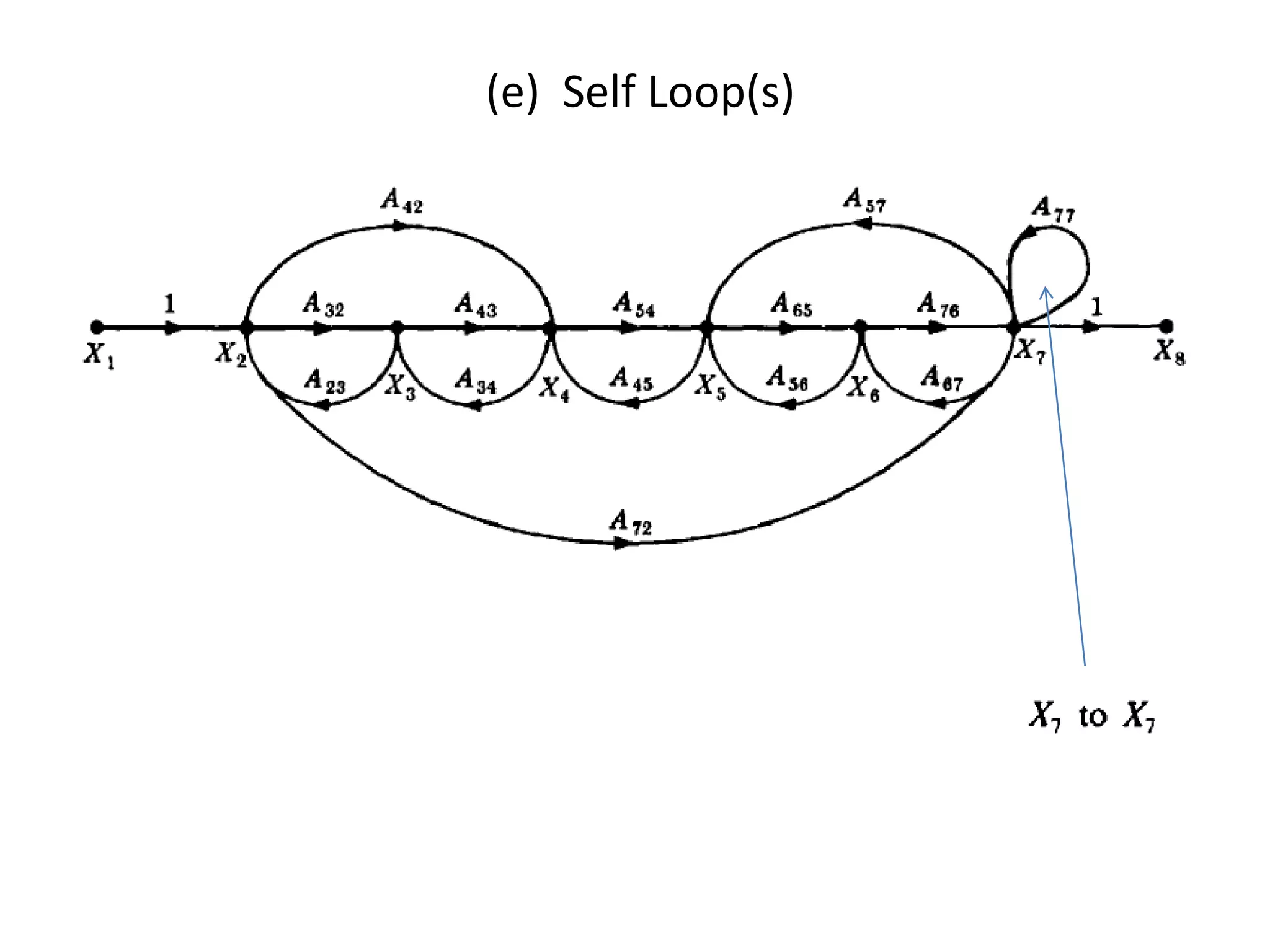
Self loop.
Determine the loop gains of the feedback loops.
Determine the path gains of the forward paths.
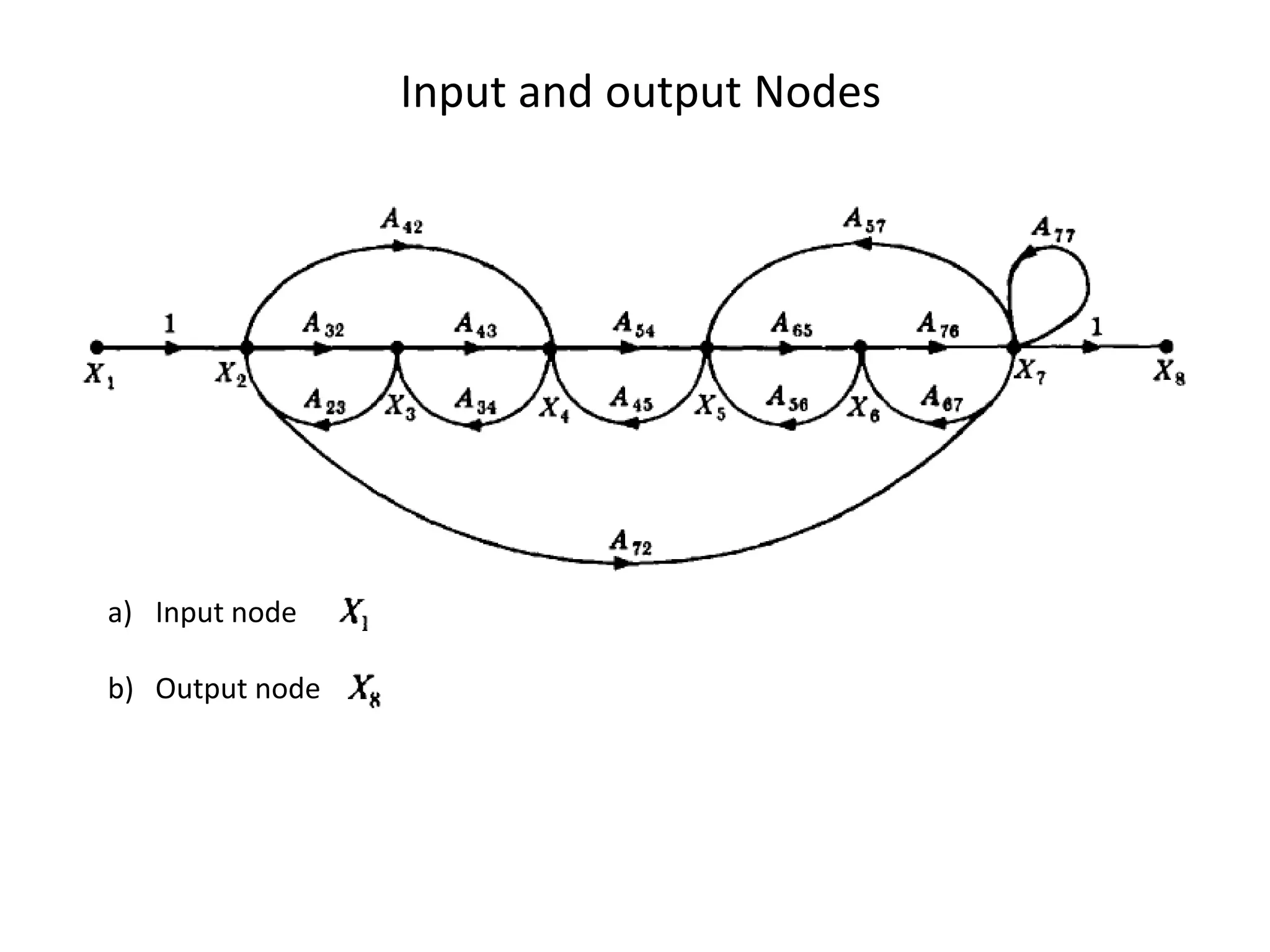
Input and output Nodes

a) Input node
b) Output node
(c) Forward Paths
(d) Feedback Paths or Loops
(e) Self Loop(s)
(f) Loop Gains of the Feedback Loops
(g) Path Gains of the Forward Paths
Mason’s Rule (Mason, 1953)
• The block diagram reduction technique requires successive
application of fundamental relationships in order to arrive at the
system transfer function.
• On the other hand, Mason’s rule for reducing a signal-flow graph
to a single transfer function requires the application of one
formula.
• The formula was derived by S. J. Mason when he related the
signal-flow graph to the simultaneous equations that can be
written from the graph.
Mason’s Rule:
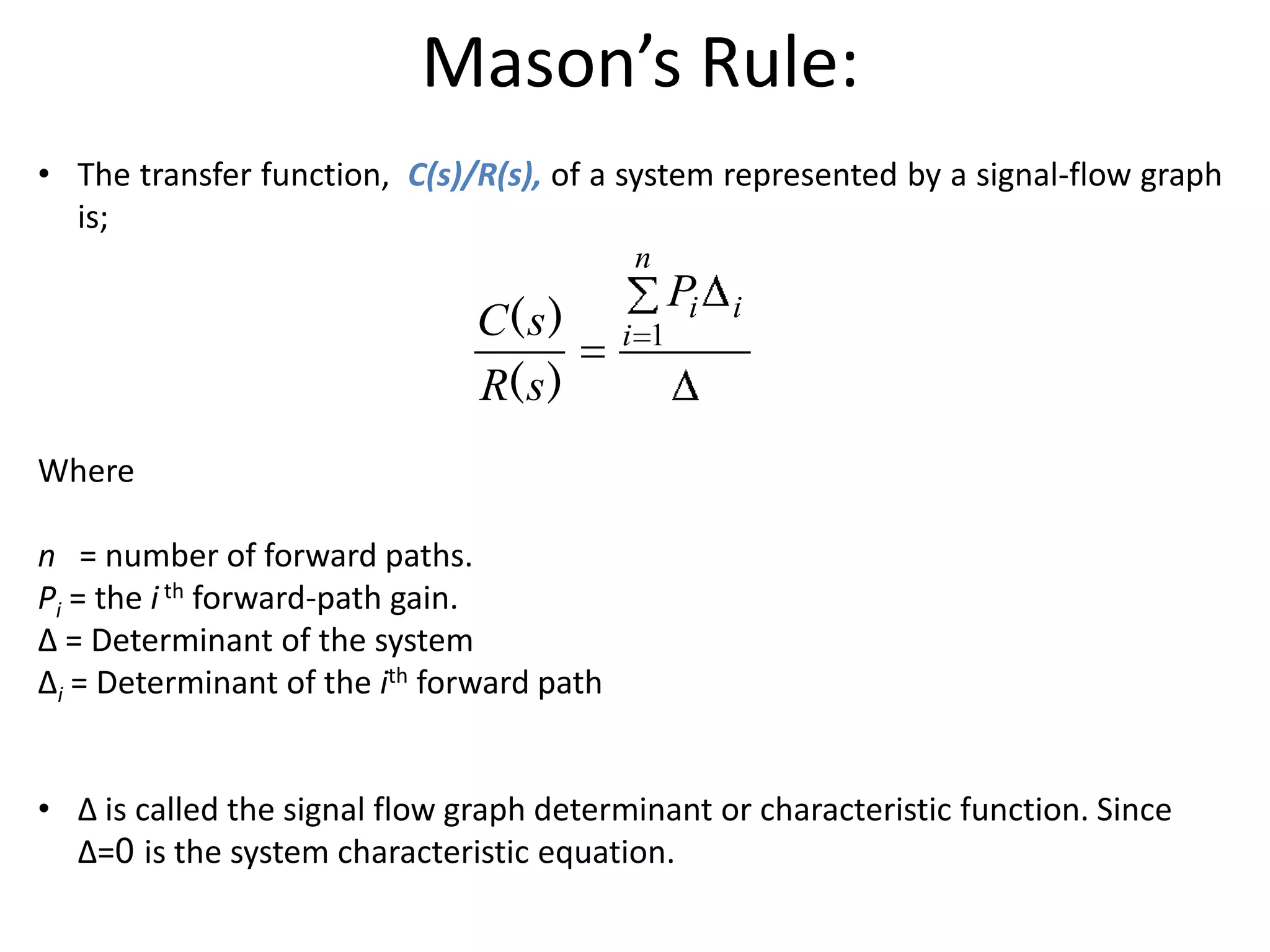
• The transfer function, C(s)/R(s), of a system represented by a signal-flow graph
is;
n

C( s )
R( s )

i 1

Pi

i

Where
n = number of forward paths.
Pi = the i th forward-path gain.
∆ = Determinant of the system
∆i = Determinant of the ith forward path
• ∆ is called the signal flow graph determinant or characteristic function. Since
∆=0 is the system characteristic equation.
Mason’s Rule:
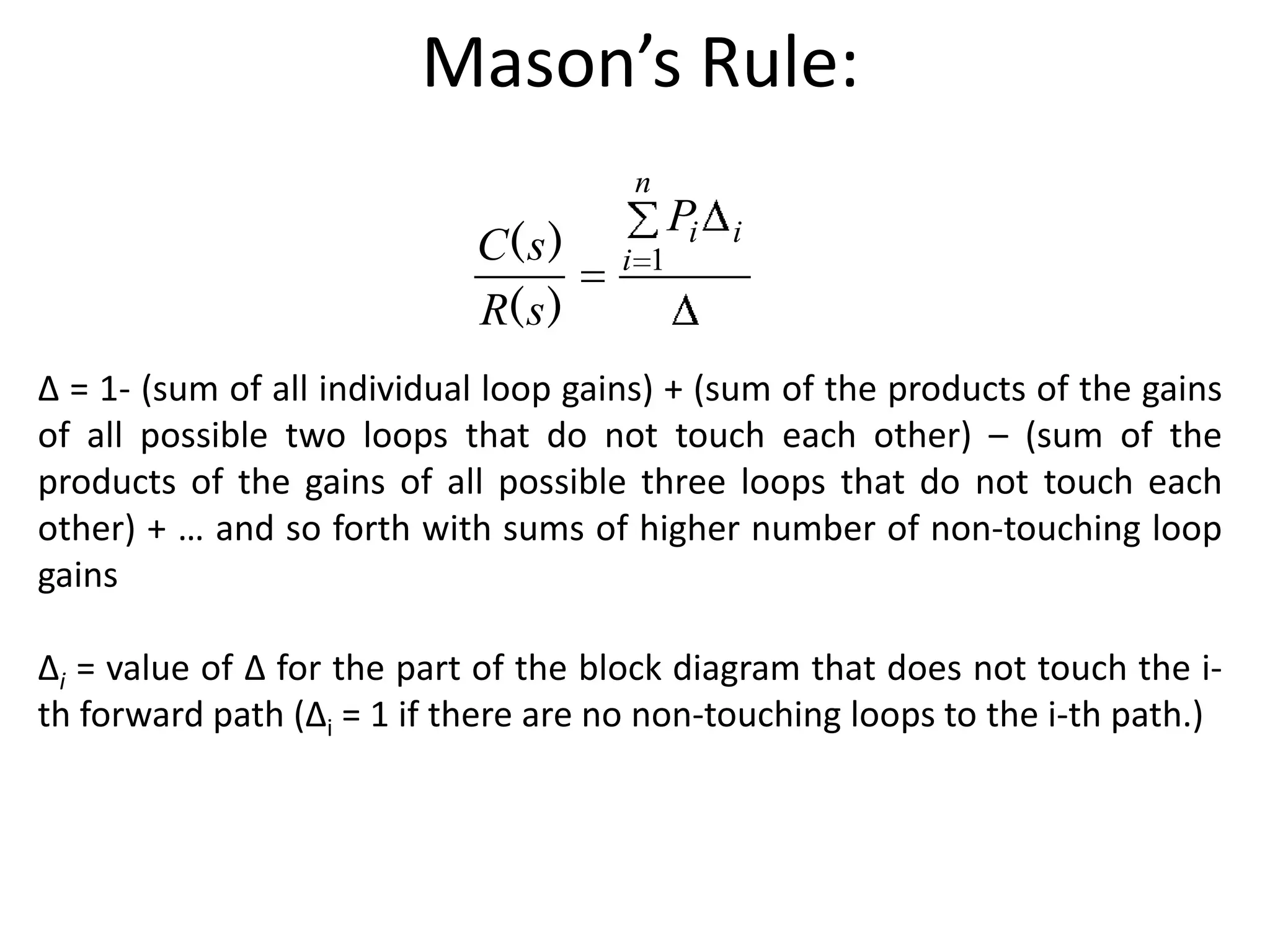
n

C( s )
R( s )

i 1

Pi

i

∆ = 1- (sum of all individual loop gains) + (sum of the products of the gains
of all possible two loops that do not touch each other) – (sum of the
products of the gains of all possible three loops that do not touch each
other) + … and so forth with sums of higher number of non-touching loop
gains
∆i = value of Δ for the part of the block diagram that does not touch the ith forward path (Δi = 1 if there are no non-touching loops to the i-th path.)
Systematic approach
1. Calculate forward path gain Pi for each forward
path i.
2. Calculate all loop transfer functions
3. Consider non-touching loops 2 at a time
4. Consider non-touching loops 3 at a time
5. etc
6. Calculate Δ from steps 2,3,4 and 5
7. Calculate Δi as portion of Δ not touching forward
path i
28
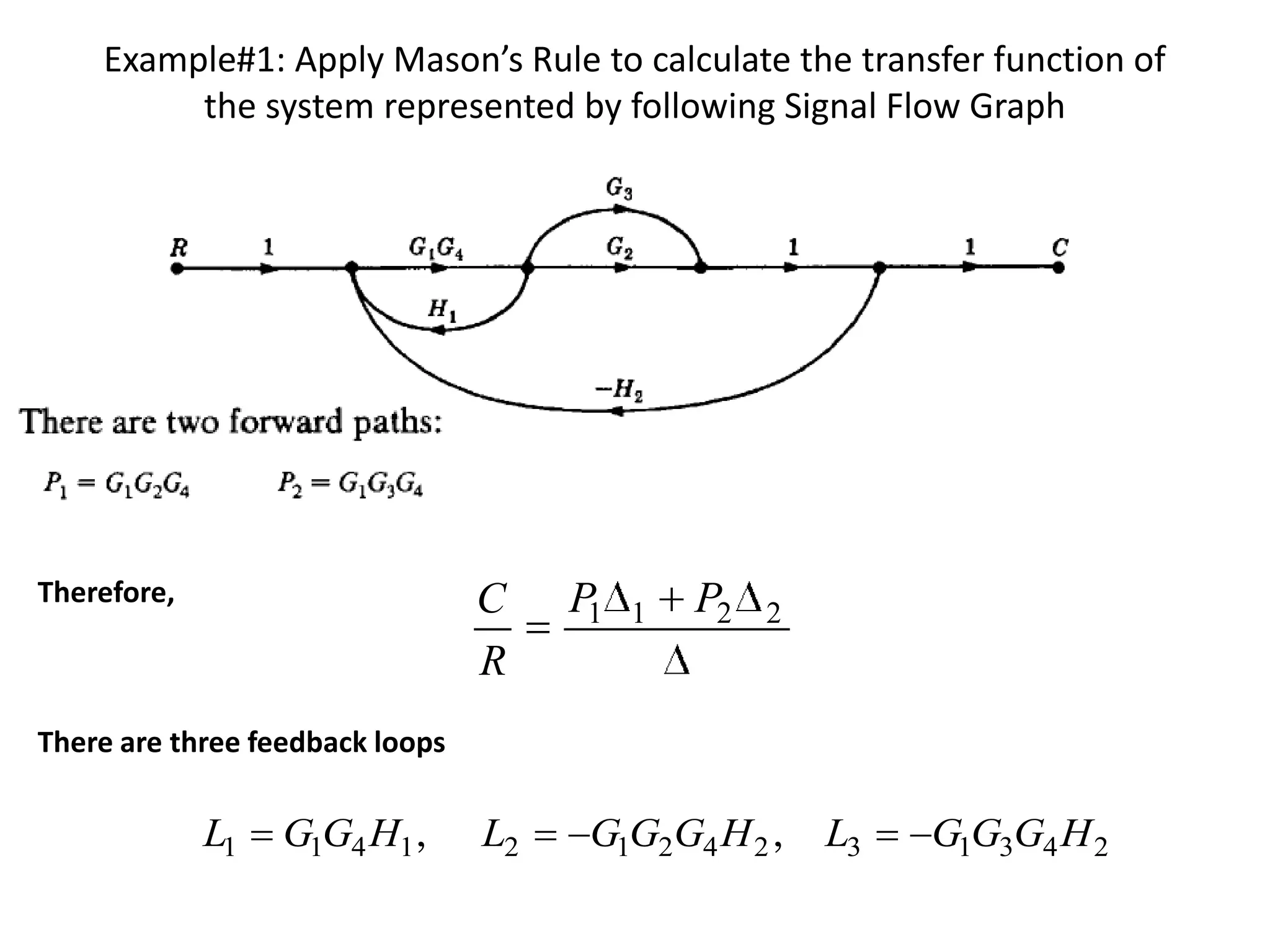
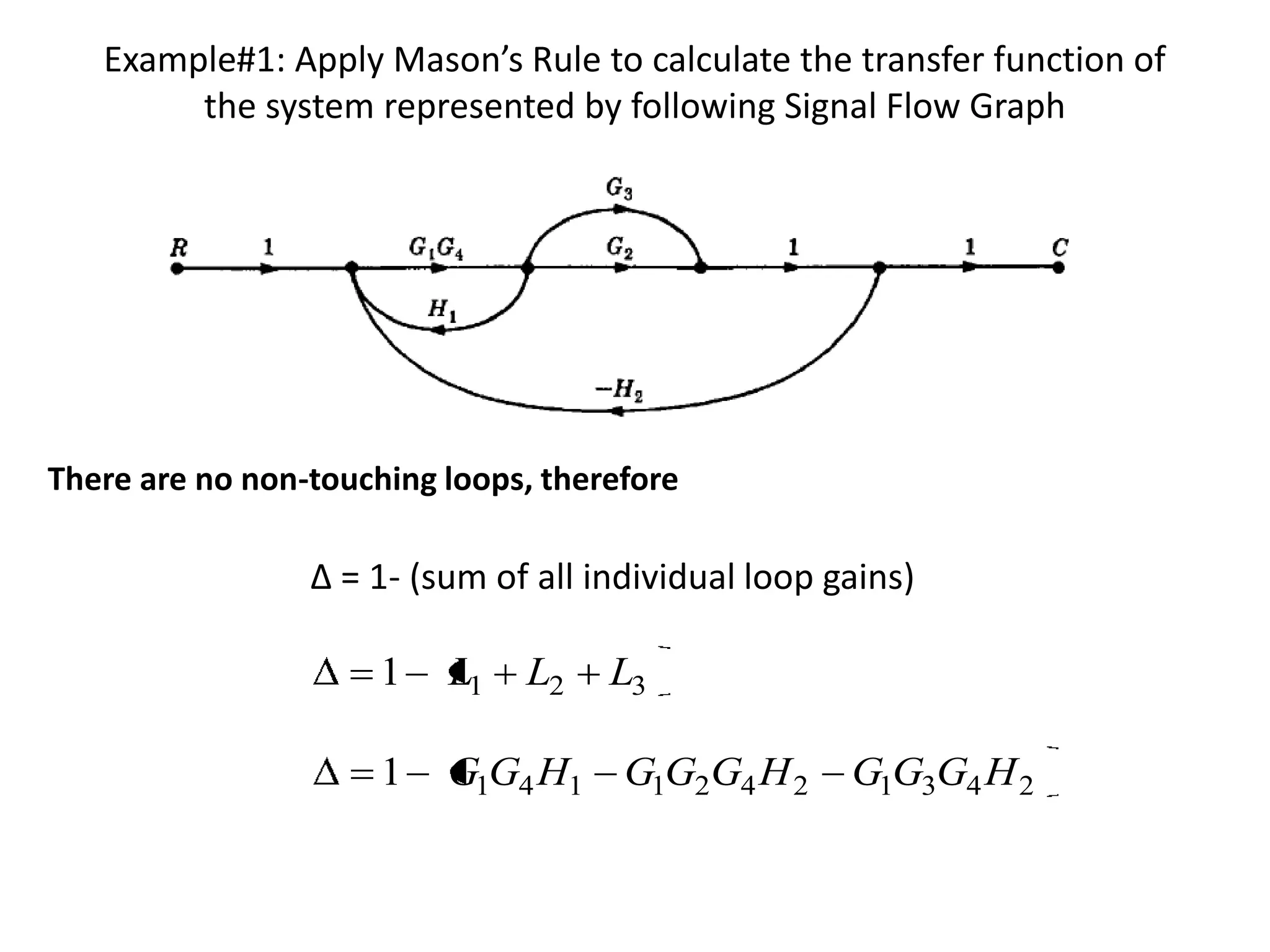
Example#1: Apply Mason’s Rule to calculate the transfer function of
the system represented by following Signal Flow Graph

Therefore,

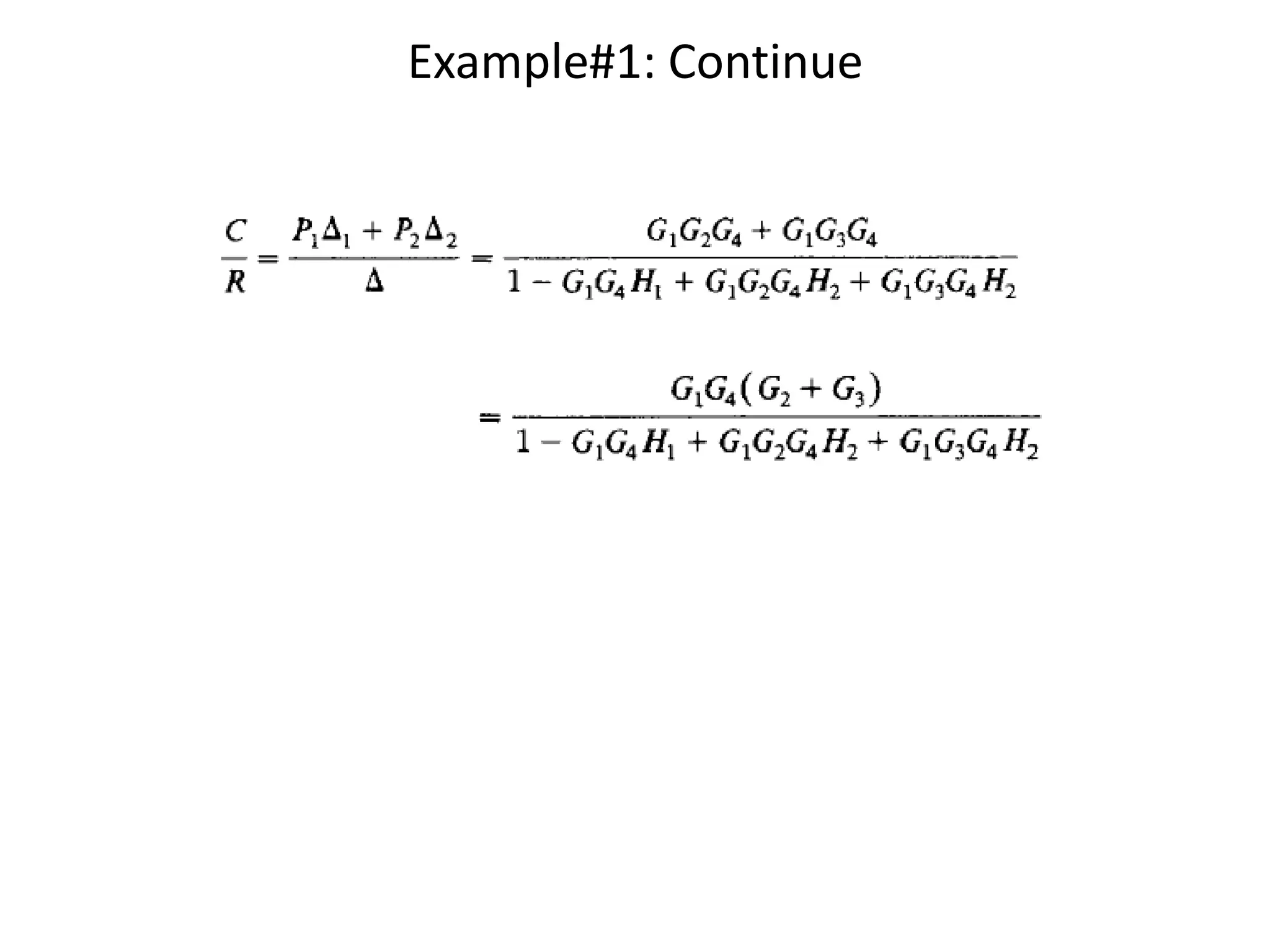
C
R

P1

1

P2

2

There are three feedback loops

L1

G1G4 H1 ,

L2

G1G2G4 H 2 ,

L3

G1G3G4 H 2
Example#1: Apply Mason’s Rule to calculate the transfer function of
the system represented by following Signal Flow Graph

There are no non-touching loops, therefore

∆ = 1- (sum of all individual loop gains)

1

L1

1

G1G4 H1

L2

L3
G1G2G4 H 2

G1G3G4 H 2
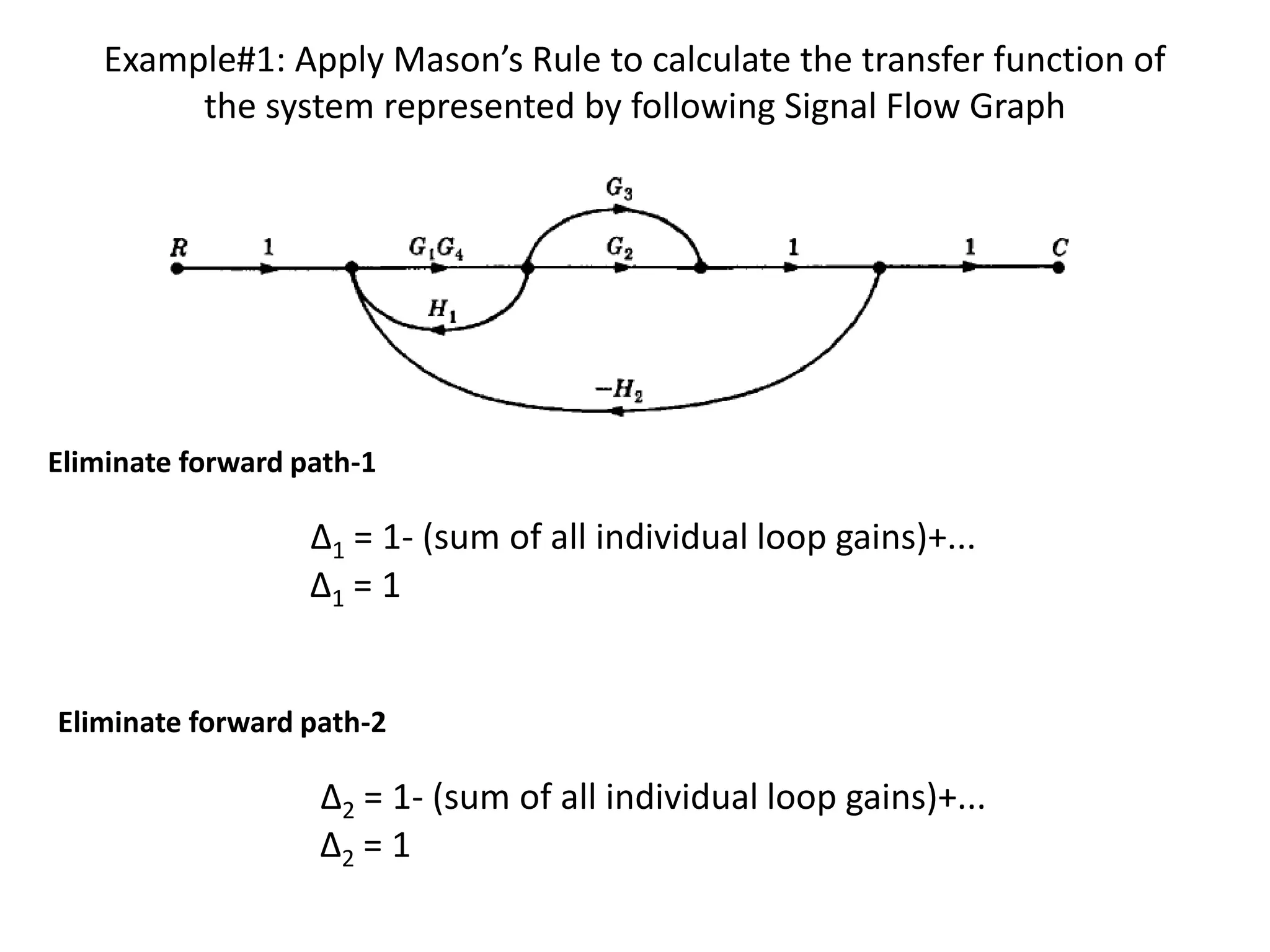
Example#1: Apply Mason’s Rule to calculate the transfer function of
the system represented by following Signal Flow Graph

Eliminate forward path-1

∆1 = 1- (sum of all individual loop gains)+...
∆1 = 1
Eliminate forward path-2

∆2 = 1- (sum of all individual loop gains)+...
∆2 = 1
Example#1: Continue
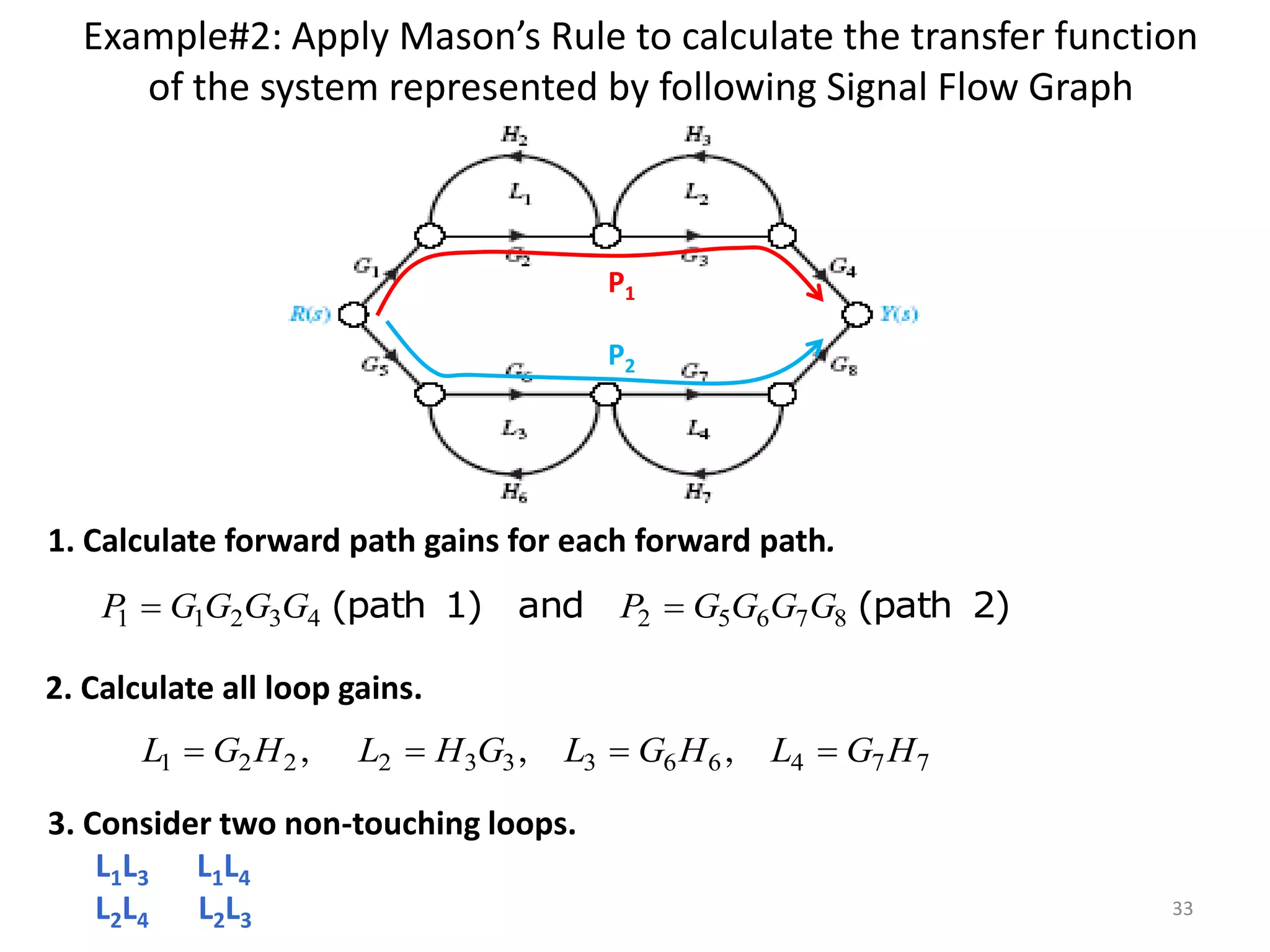
Example#2: Apply Mason’s Rule to calculate the transfer function
of the system represented by following Signal Flow Graph

P1
P2

1. Calculate forward path gains for each forward path.

P
1

G1G2G3G4 (path 1) and

P2

G5G6G7G8 (path 2)

2. Calculate all loop gains.

L1

G2 H 2 ,

L2

H 3G3 ,

L3

3. Consider two non-touching loops.
L1L3 L1L4
L2L4 L2L3

G6 H 6 ,

L4

G7 H 7

33
Example#2: continue
4. Consider three non-touching loops.
None.
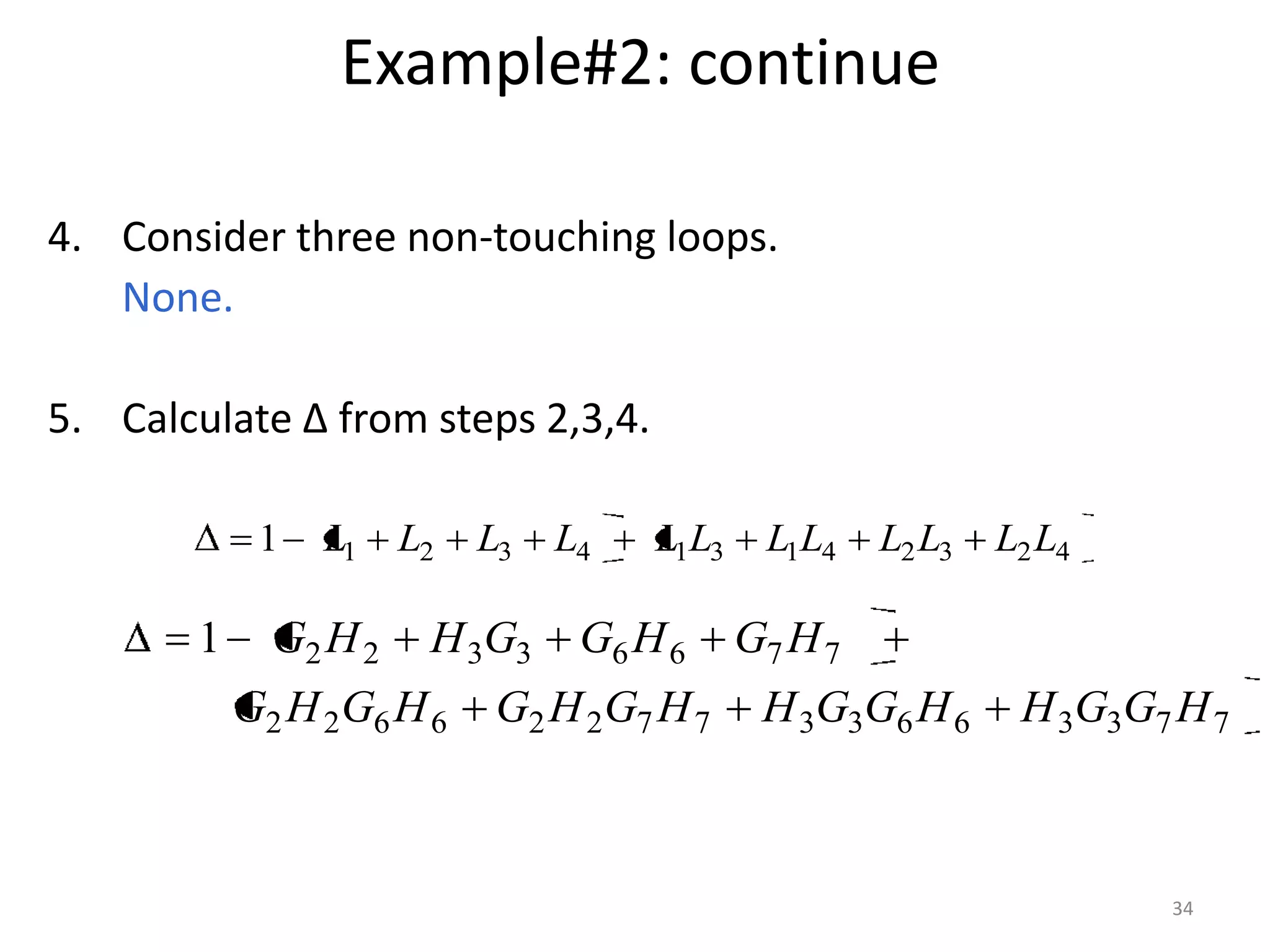
5. Calculate Δ from steps 2,3,4.
1

1

L1

G2 H 2

L2

L3

H 3G3

G2 H 2G6 H 6

L4

L1L3

G6 H 6

G2 H 2G7 H 7

L1L4

L2 L3

L2 L4

G7 H 7
H 3G3G6 H 6

H 3G3G7 H 7

34
Example#2: continue
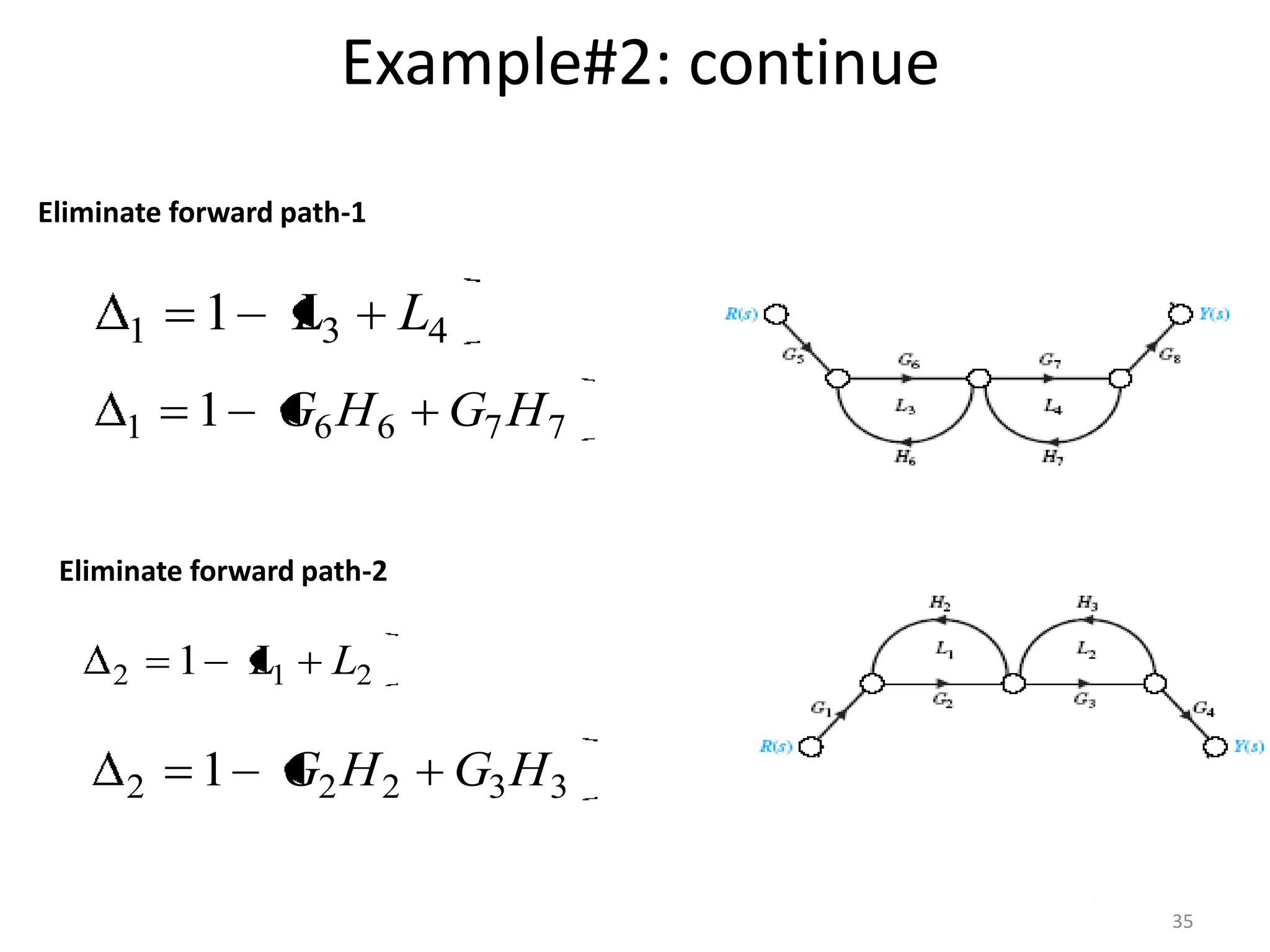
Eliminate forward path-1

1

1

1

1

L3

L4

G6 H 6

G7 H 7

Eliminate forward path-2
2

2

1

L1

1

L2

G2 H 2

G3 H 3
35
Example#2: continue
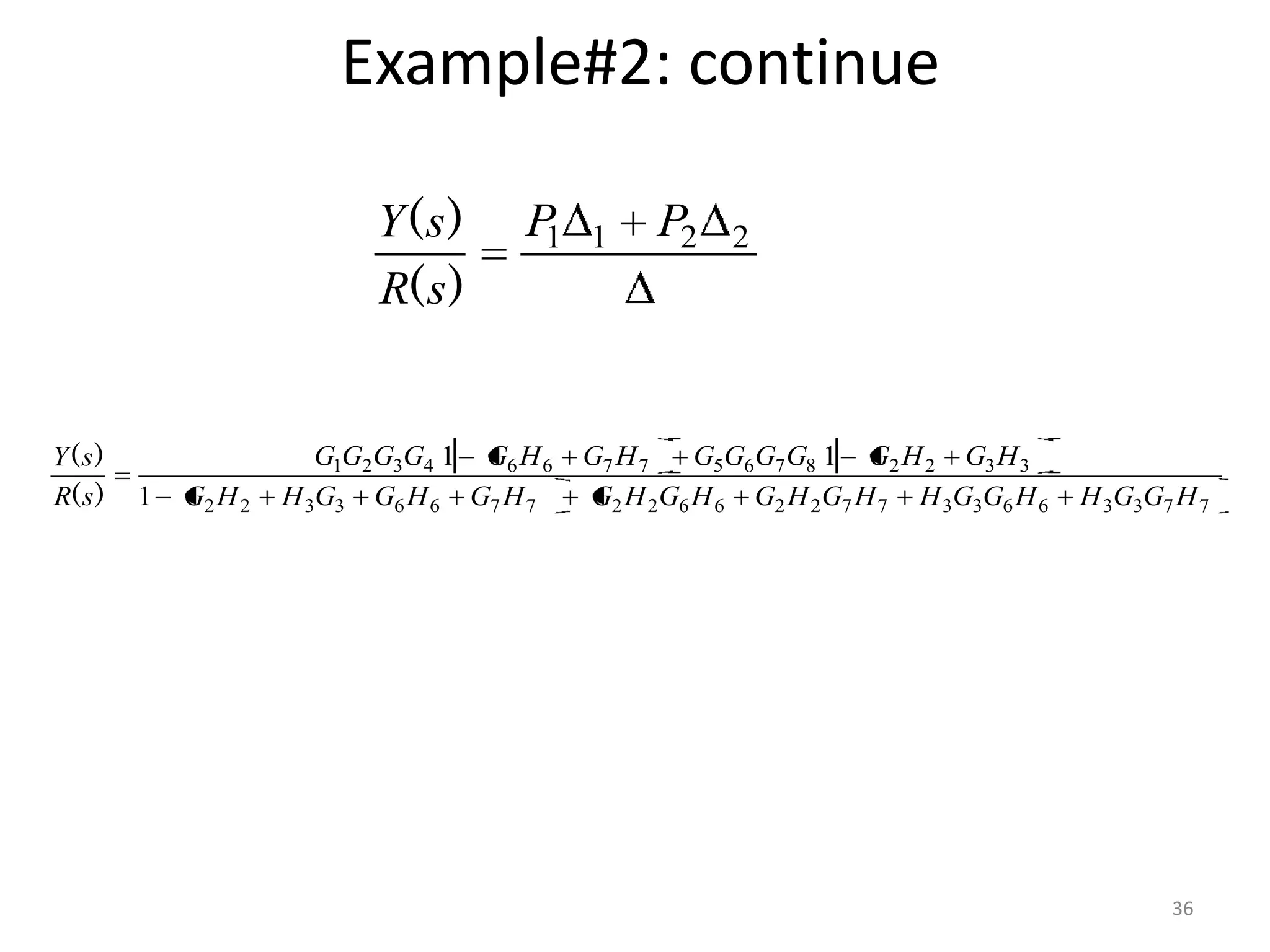
Y (s)
R( s )

Y (s)
R( s )

1

G2 H 2

P
1

G1G2G3G4 1 G6 H 6
H 3G3 G6 H 6 G7 H 7

1

P2

2

G7 H 7
G5G6G7 G8 1 G2 H 2 G3 H 3
G2 H 2G6 H 6 G2 H 2G7 H 7 H 3G3G6 H 6

H 3G3G7 H 7

36
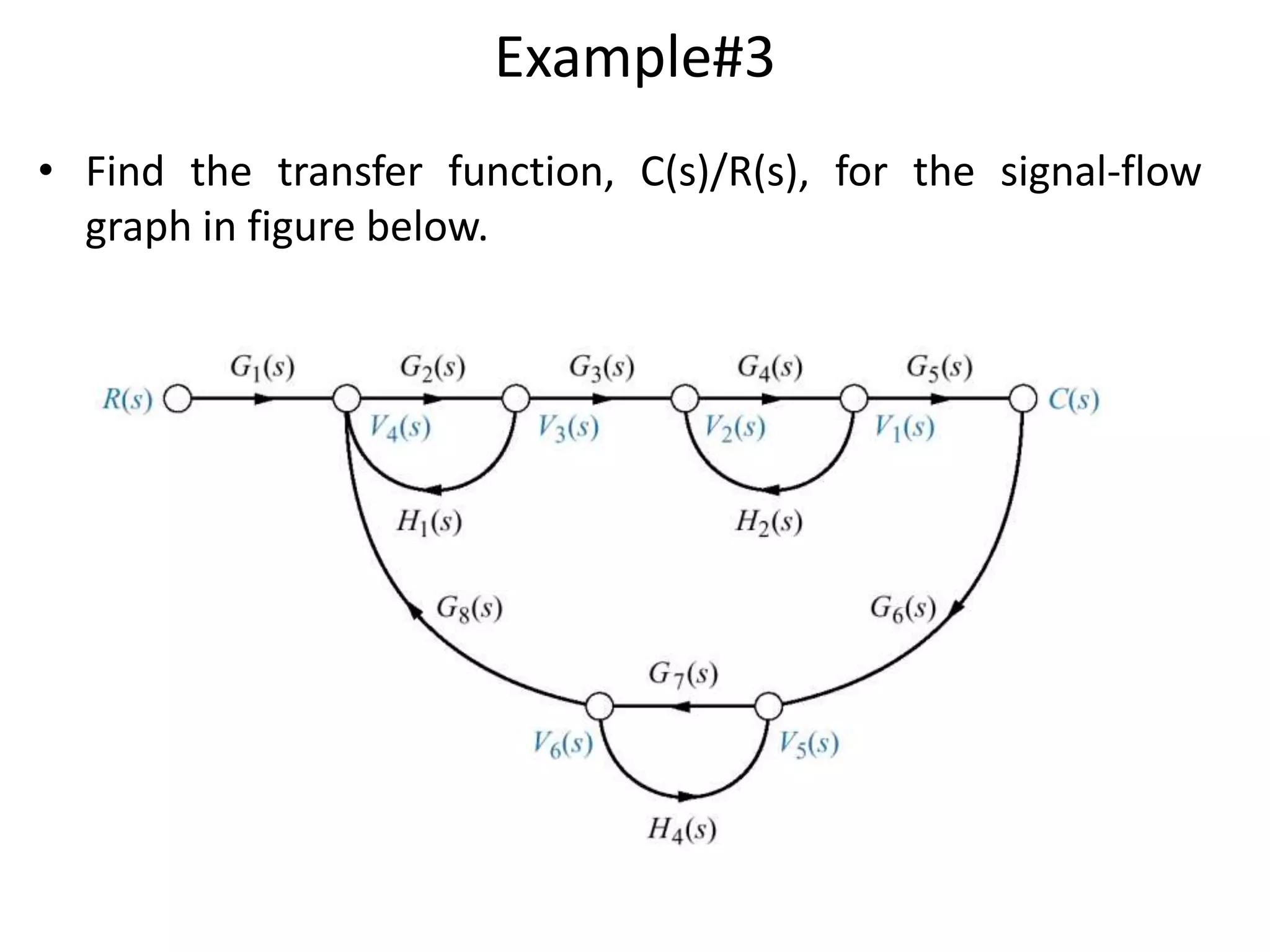
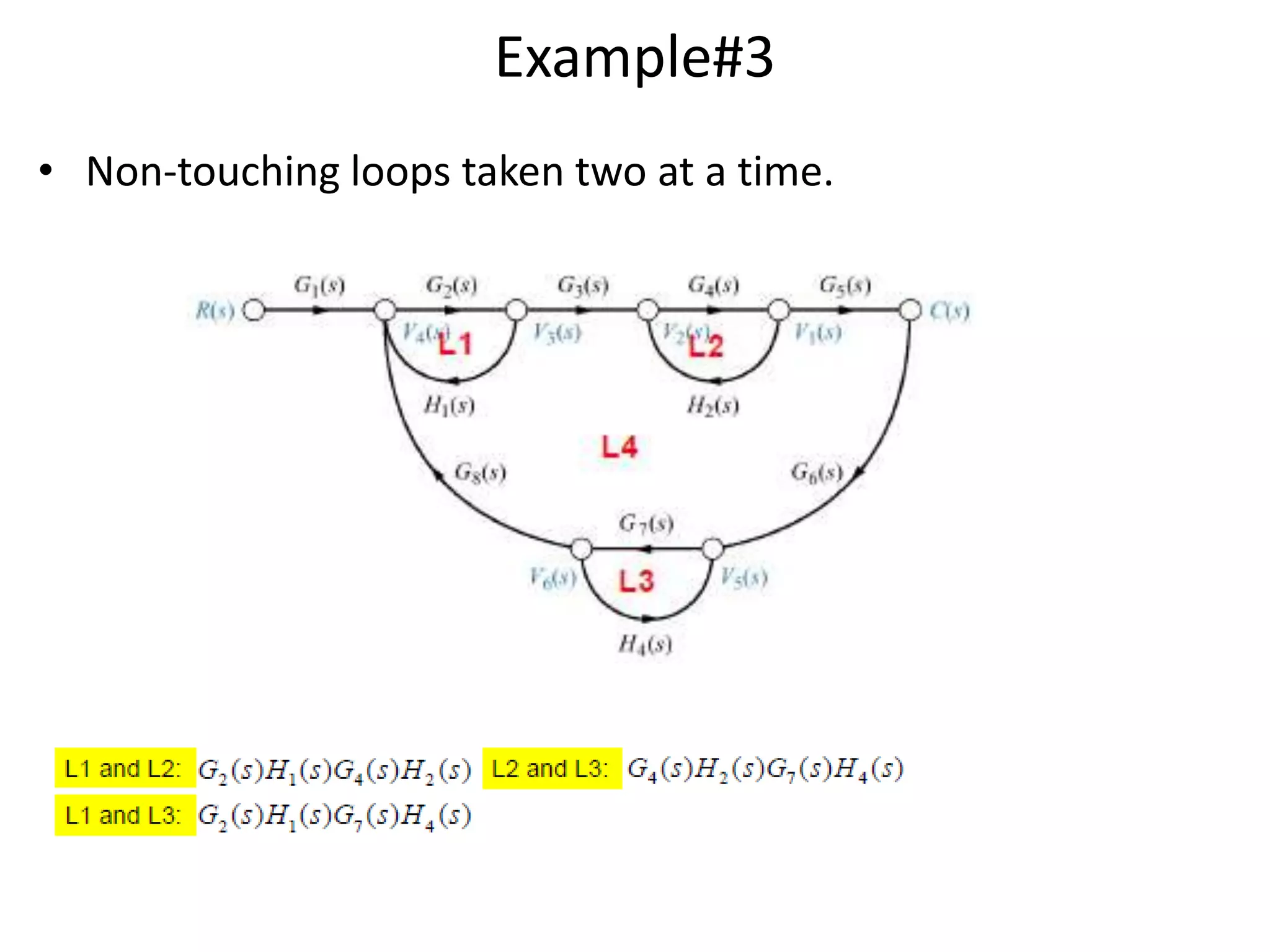
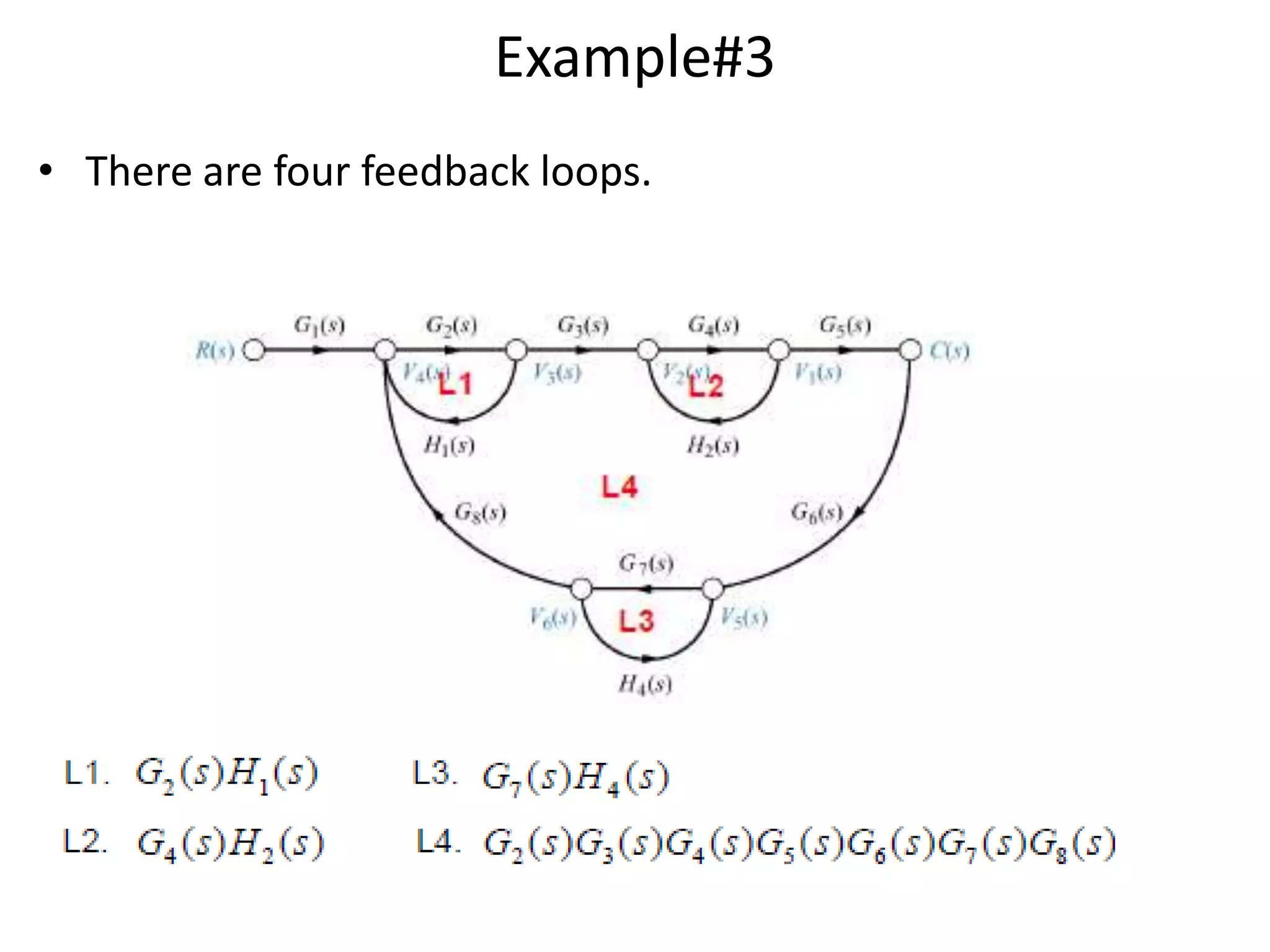
Example#3
• Find the transfer function, C(s)/R(s), for the signal-flow
graph in figure below.
Example#3
• There is only one forward Path.

P
1

G1( s )G2 ( s )G3 ( s )G4 ( s )G5 ( s )
Example#3
• There are four feedback loops.
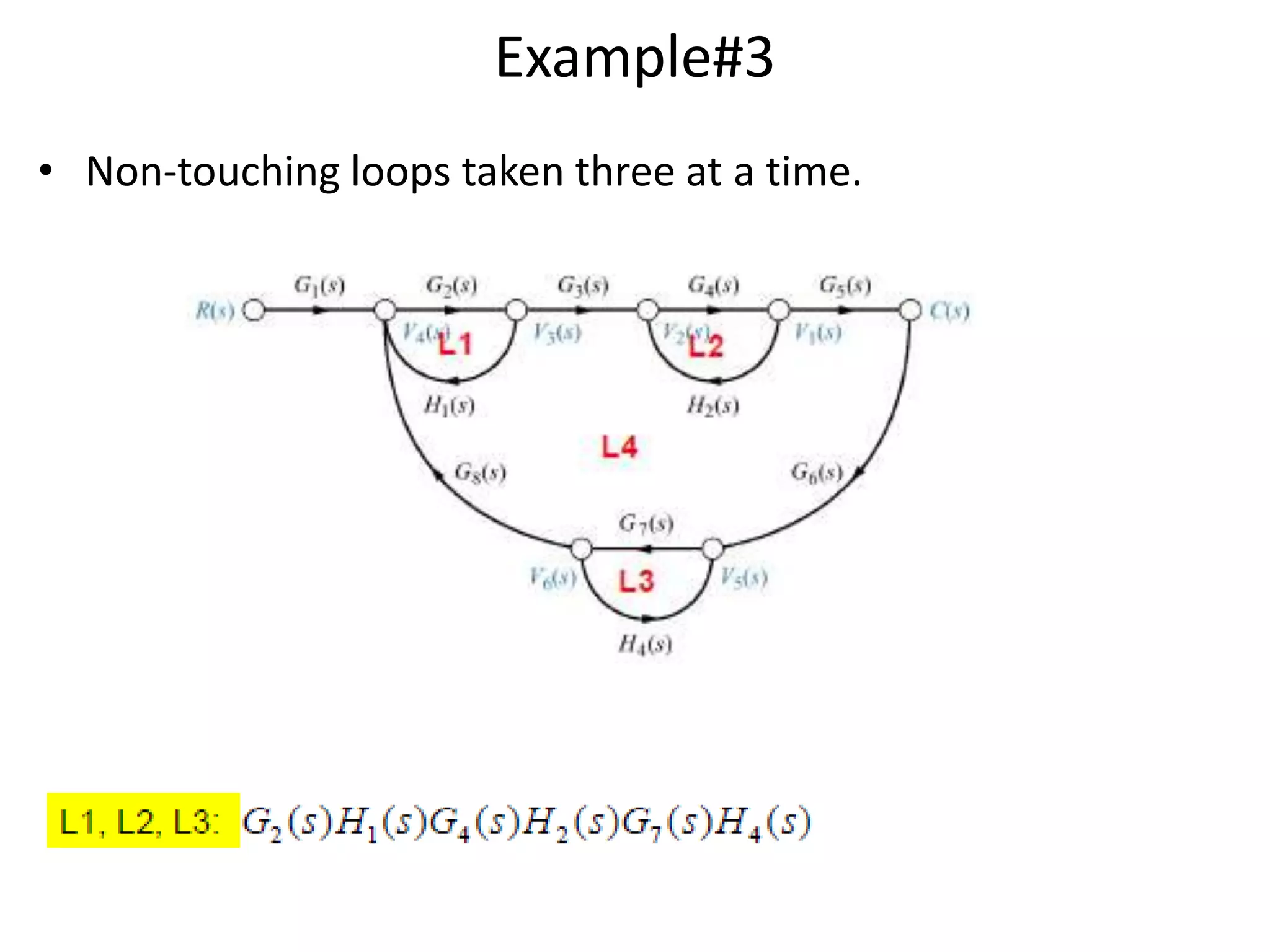
Example#3
• Non-touching loops taken two at a time.
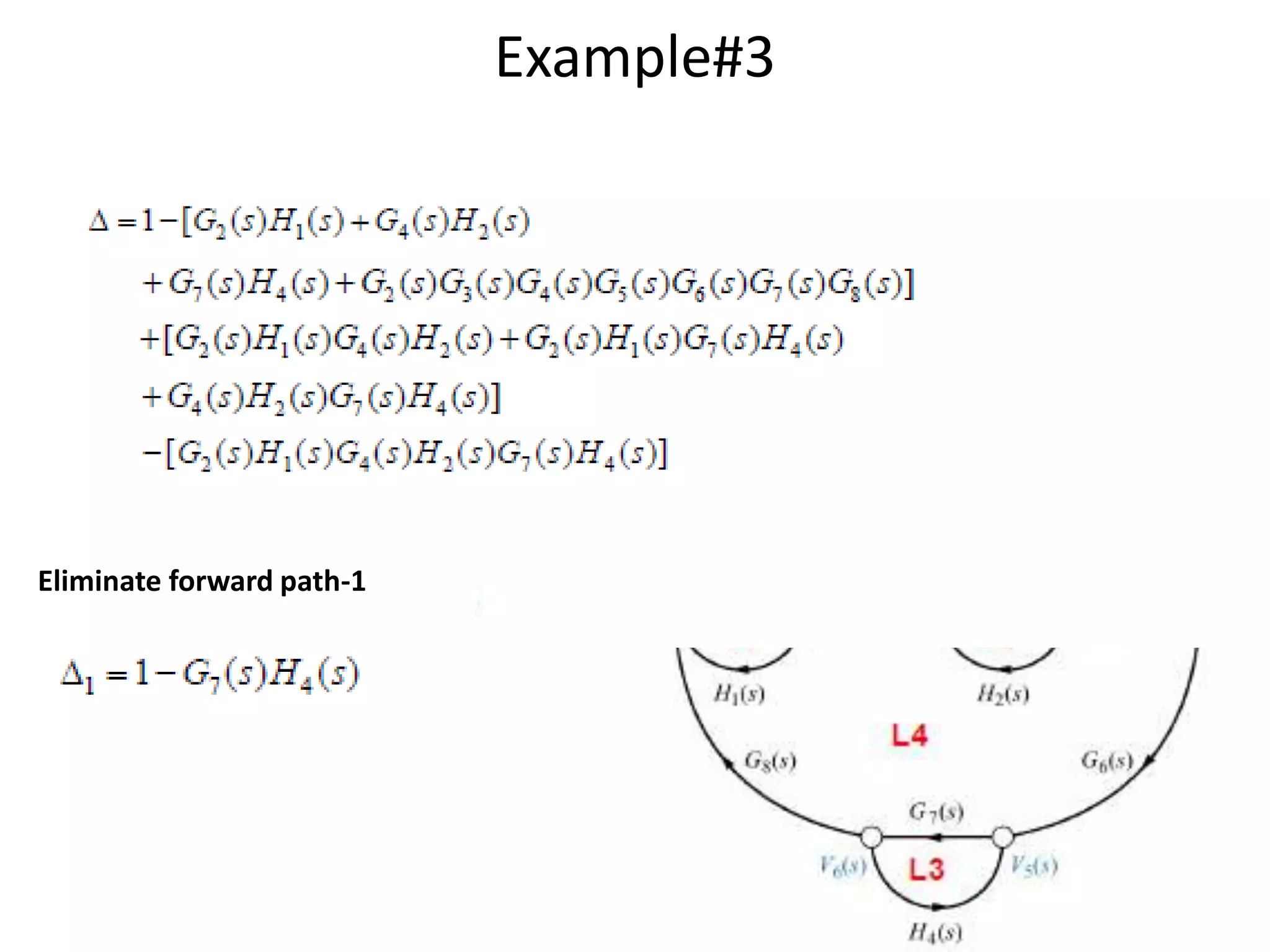
Example#3
• Non-touching loops taken three at a time.
Example#3

Eliminate forward path-1
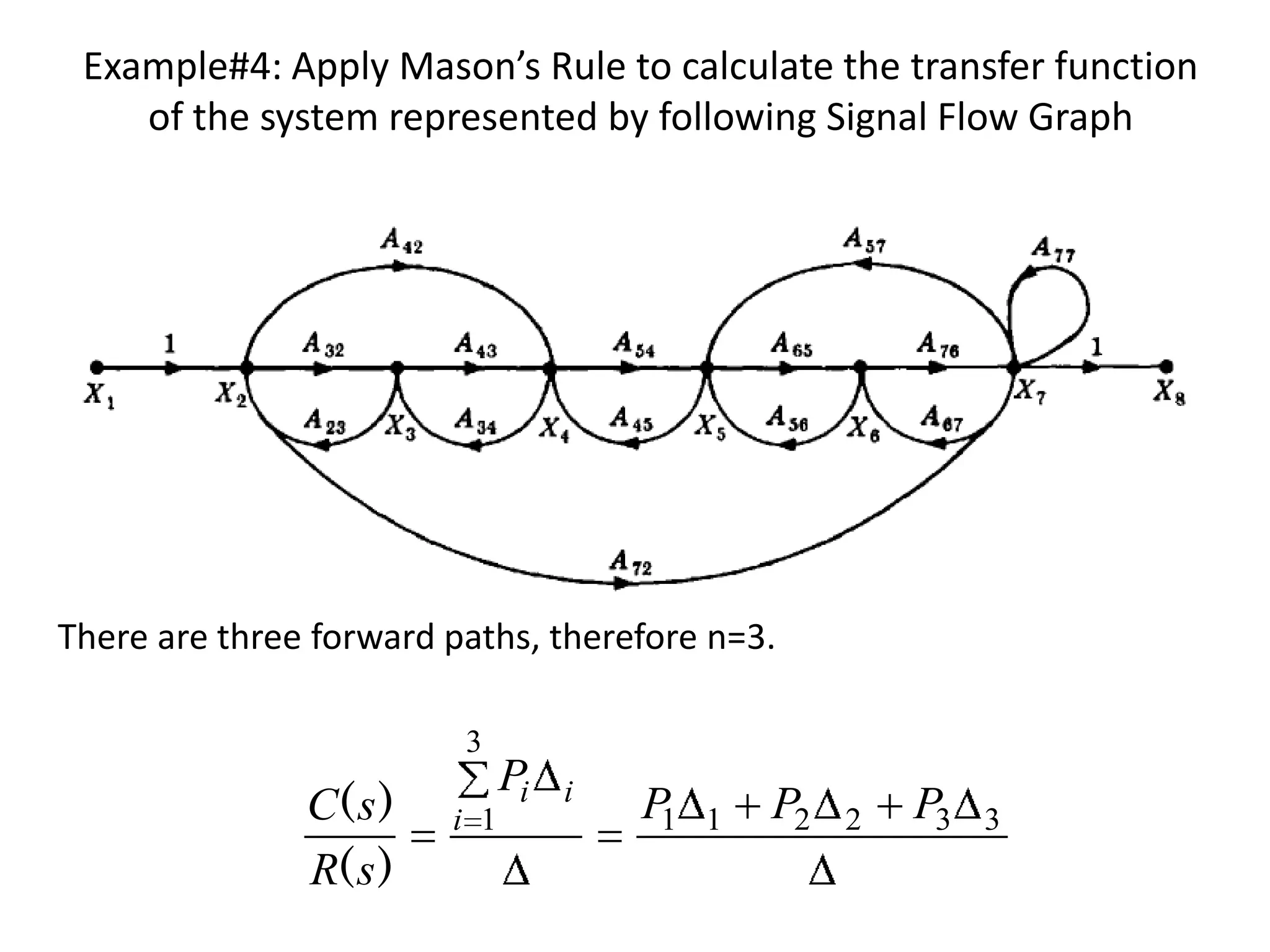
Example#4: Apply Mason’s Rule to calculate the transfer function
of the system represented by following Signal Flow Graph

There are three forward paths, therefore n=3.
3

C( s )
R( s )

i 1

Pi

i

P
1

1

P2

2

P3

3
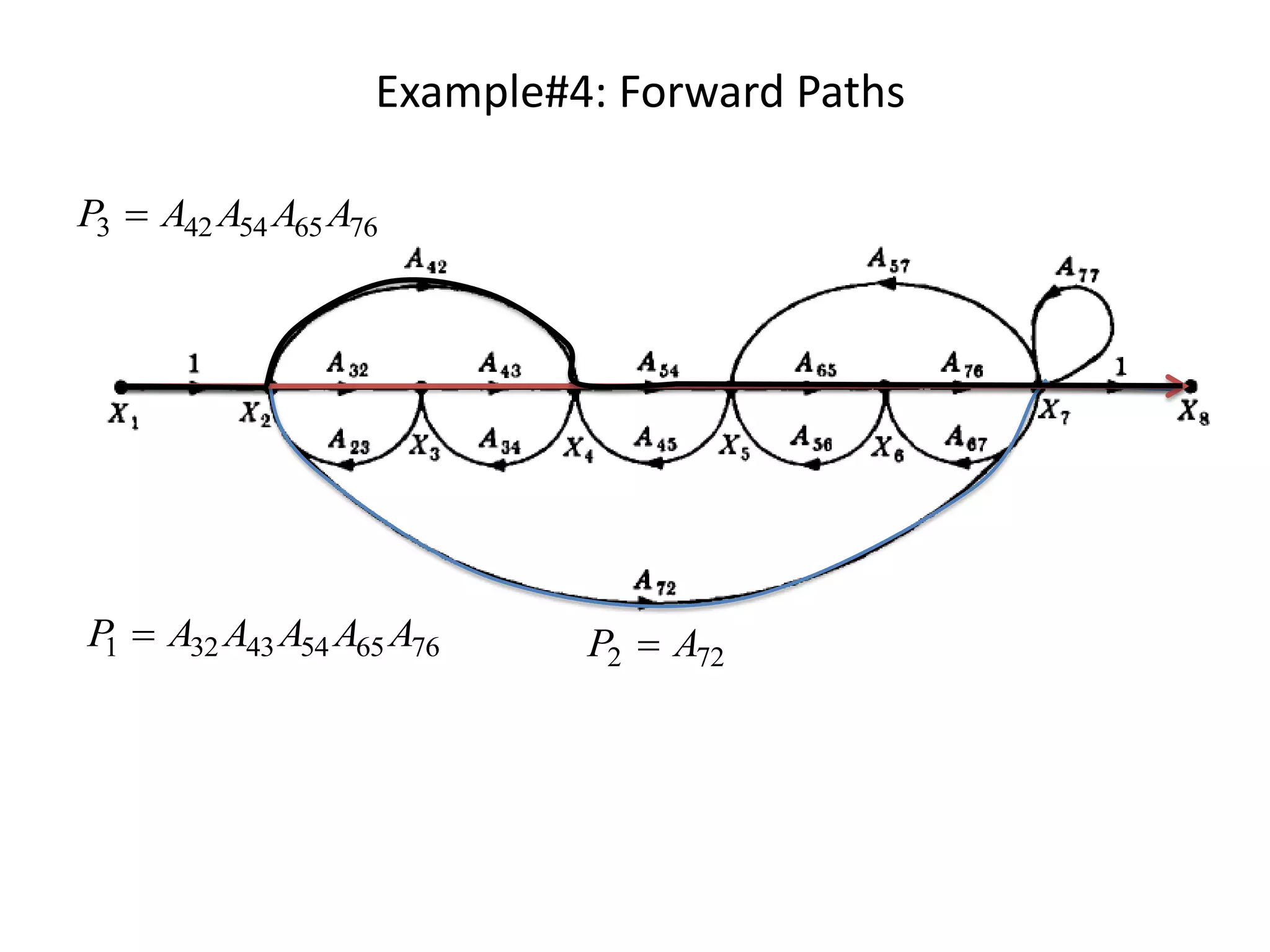
Example#4: Forward Paths
P3

A42 A54 A65 A76

P
1

A32 A43 A54 A65 A76

P2

A72
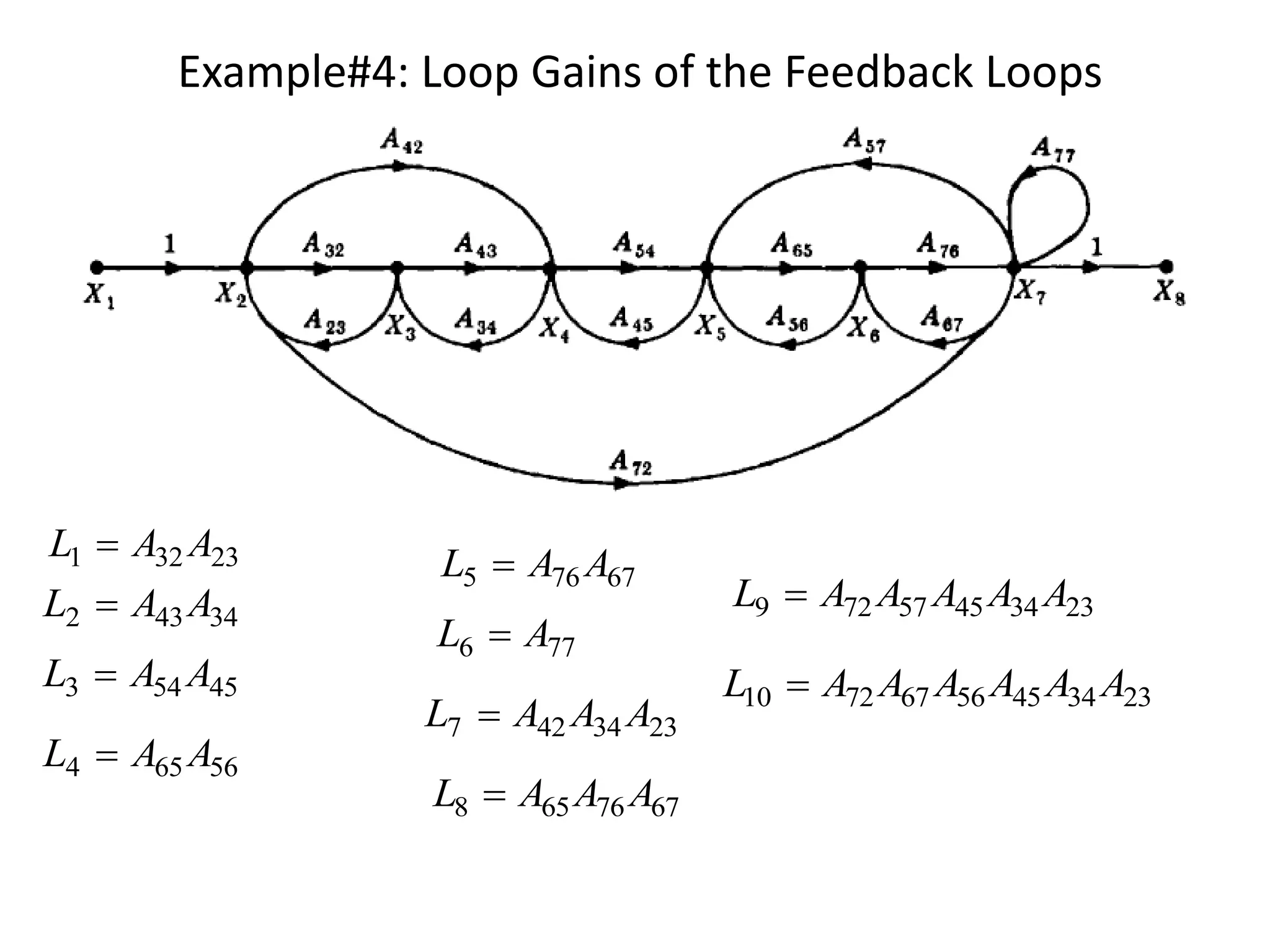
Example#4: Loop Gains of the Feedback Loops

L1
L2

A32 A23
A43 A34

L3

A54 A45

L4

A65 A56

L5

A76 A67

L6

A77

L7

A42 A34 A23

L8

A65 A76 A67

L9

A72 A57 A45 A34 A23

L10

A72 A67 A56 A45 A34 A23
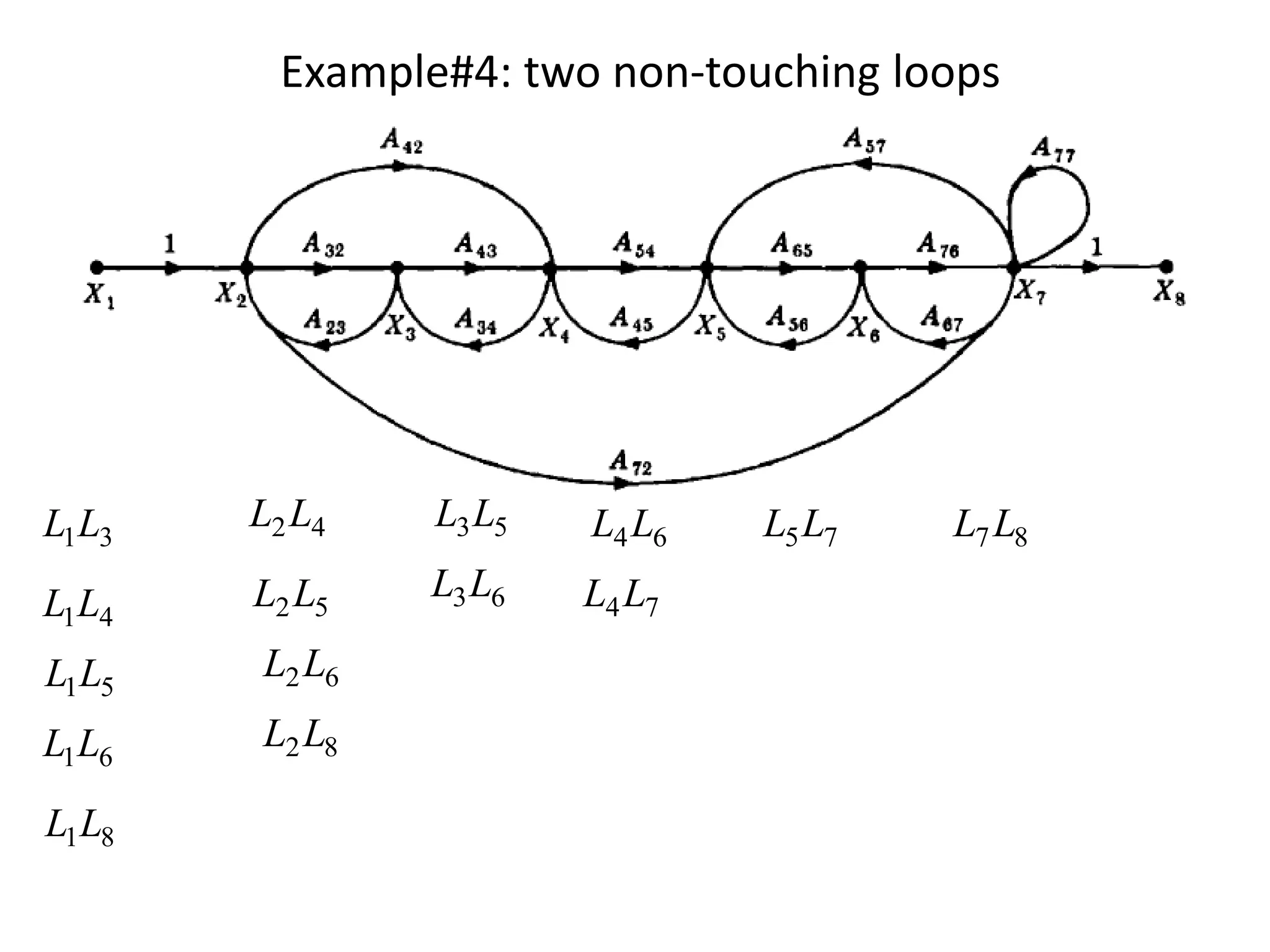
Example#4: two non-touching loops

L1 L3

L2 L4

L3 L5

L4 L6

L1 L4

L2 L5

L3 L6

L4 L7

L1 L5

L2 L6

L1 L6

L2 L8

L1 L8

L5 L7

L7 L8
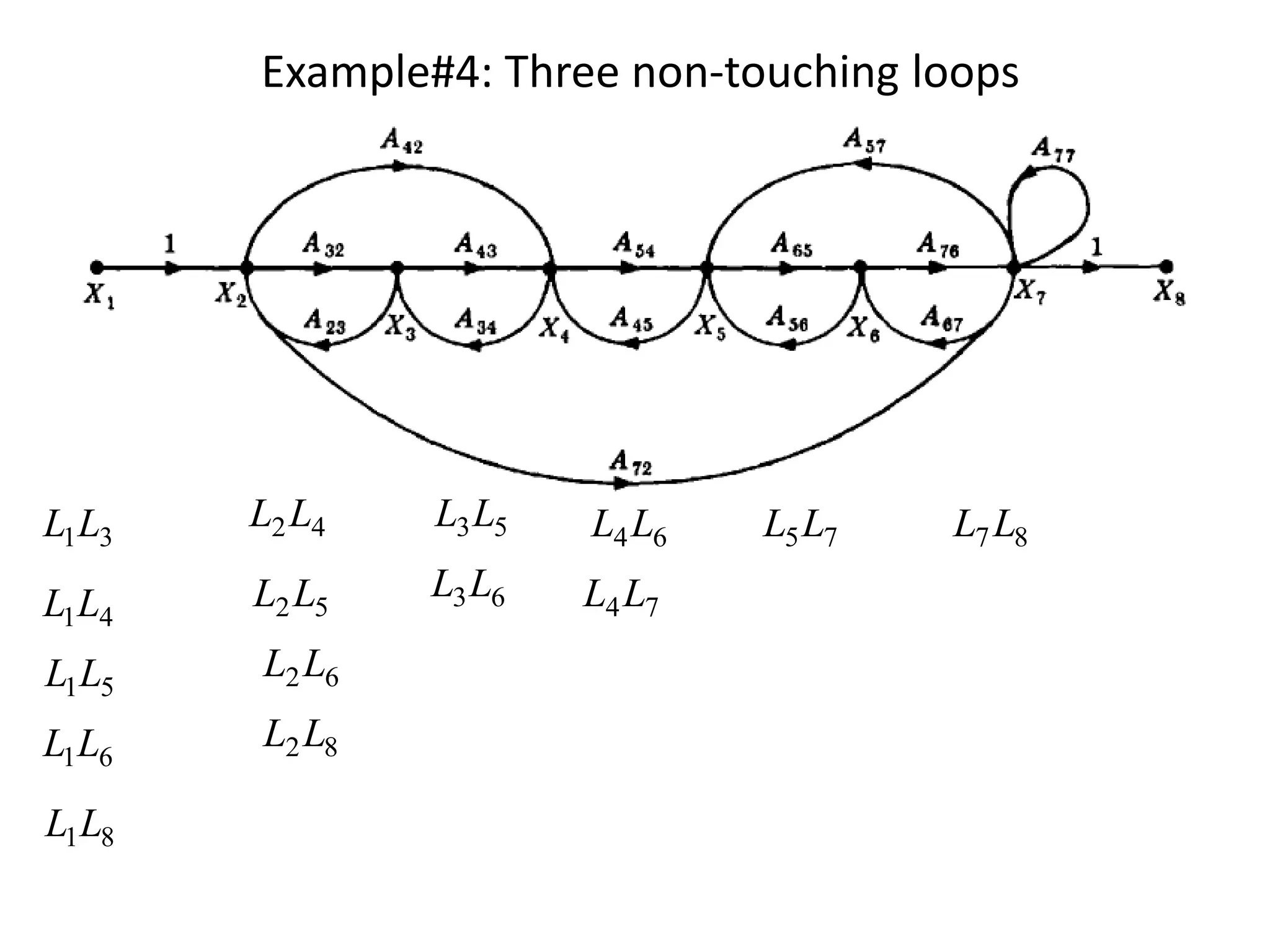
Example#4: Three non-touching loops

L1 L3

L2 L4

L3 L5

L4 L6

L1 L4

L2 L5

L3 L6

L4 L7

L1 L5

L2 L6

L1 L6

L2 L8

L1 L8

L5 L7

L7 L8
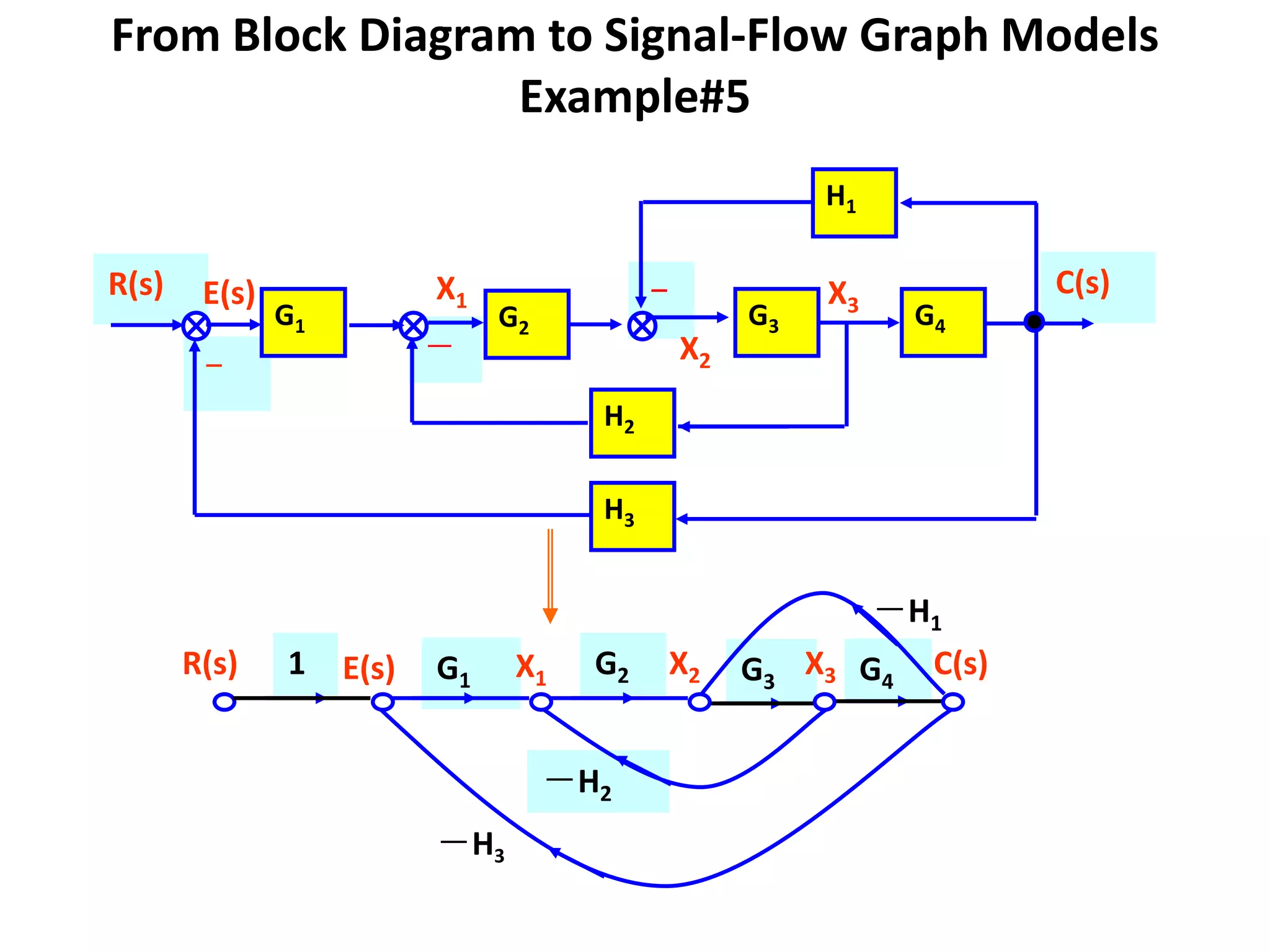
From Block Diagram to Signal-Flow Graph Models
Example#5
H1

R(s)

E(s)

X1

G1

-

-

-

G2

X2

G3

X3

G4

H2
H3

R(s)

1

E(s)

G1

X1

G2

-H2
-H3

X2

G3

-H1
X3 G4 C(s)

C(s)
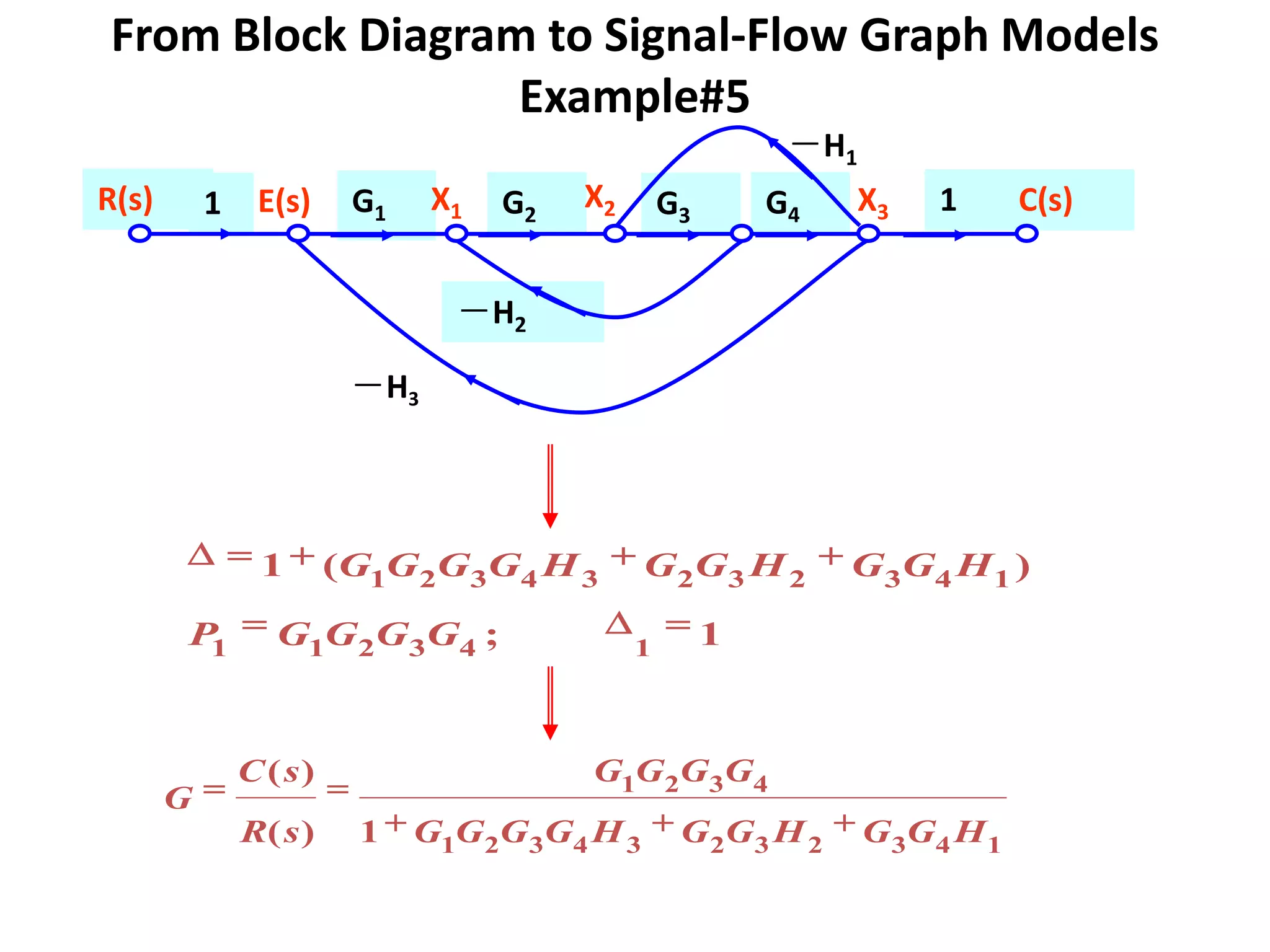
From Block Diagram to Signal-Flow Graph Models
Example#5
-H1
R(s)

1

E(s)

X1

G1

G2

X2

G4

G3

X3

1

C(s)

-H2
-H3

1
P1

G

(G1G2G3G4 H 3

G1G2G3G4 ;

1

G3G4 H 1 )

1

G1G2G3G4

C ( s)
R( s )

G2G3 H 2

1

G1G2G3G4 H 3

G2G3 H 2

G3G4 H 1
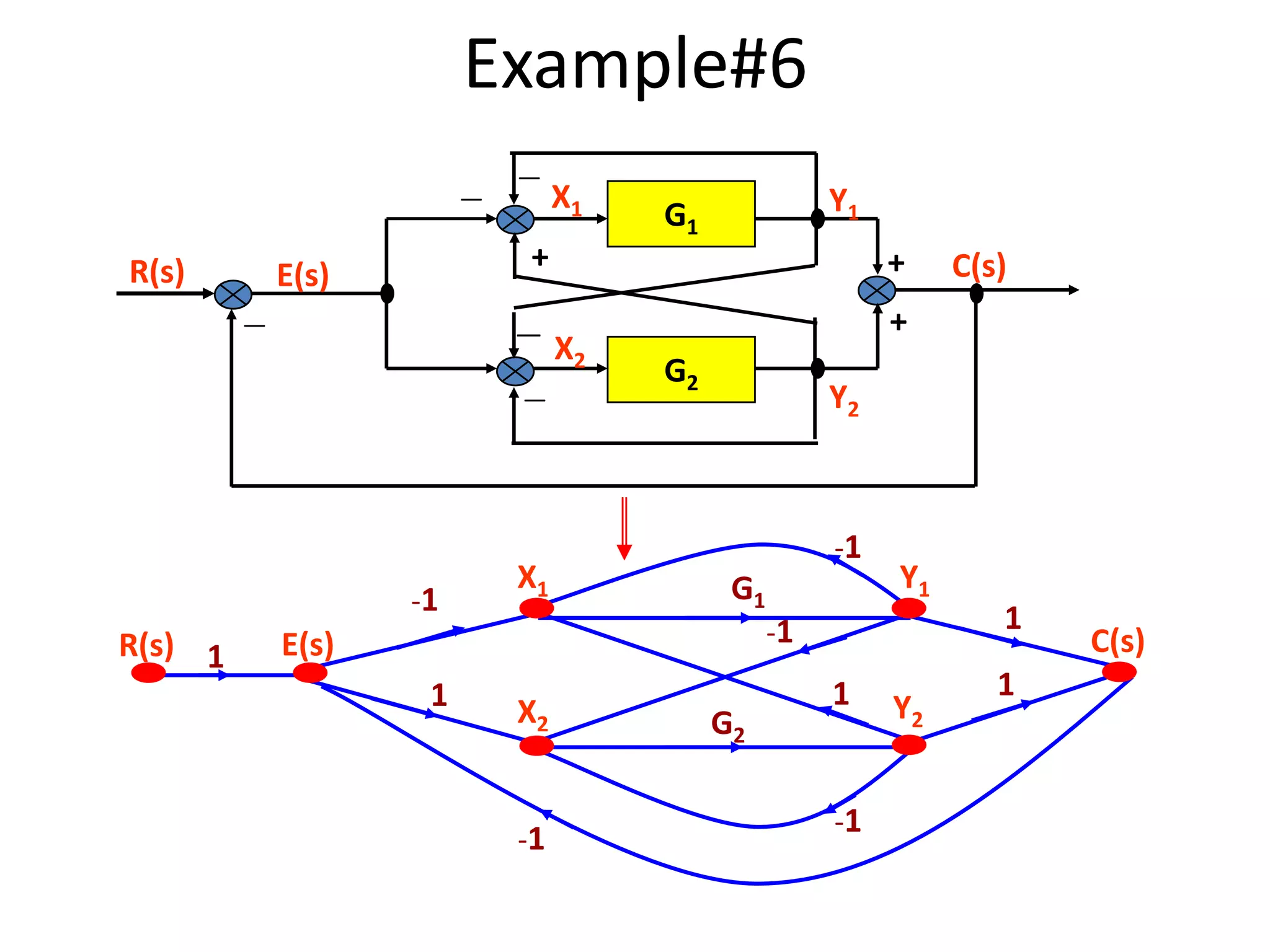
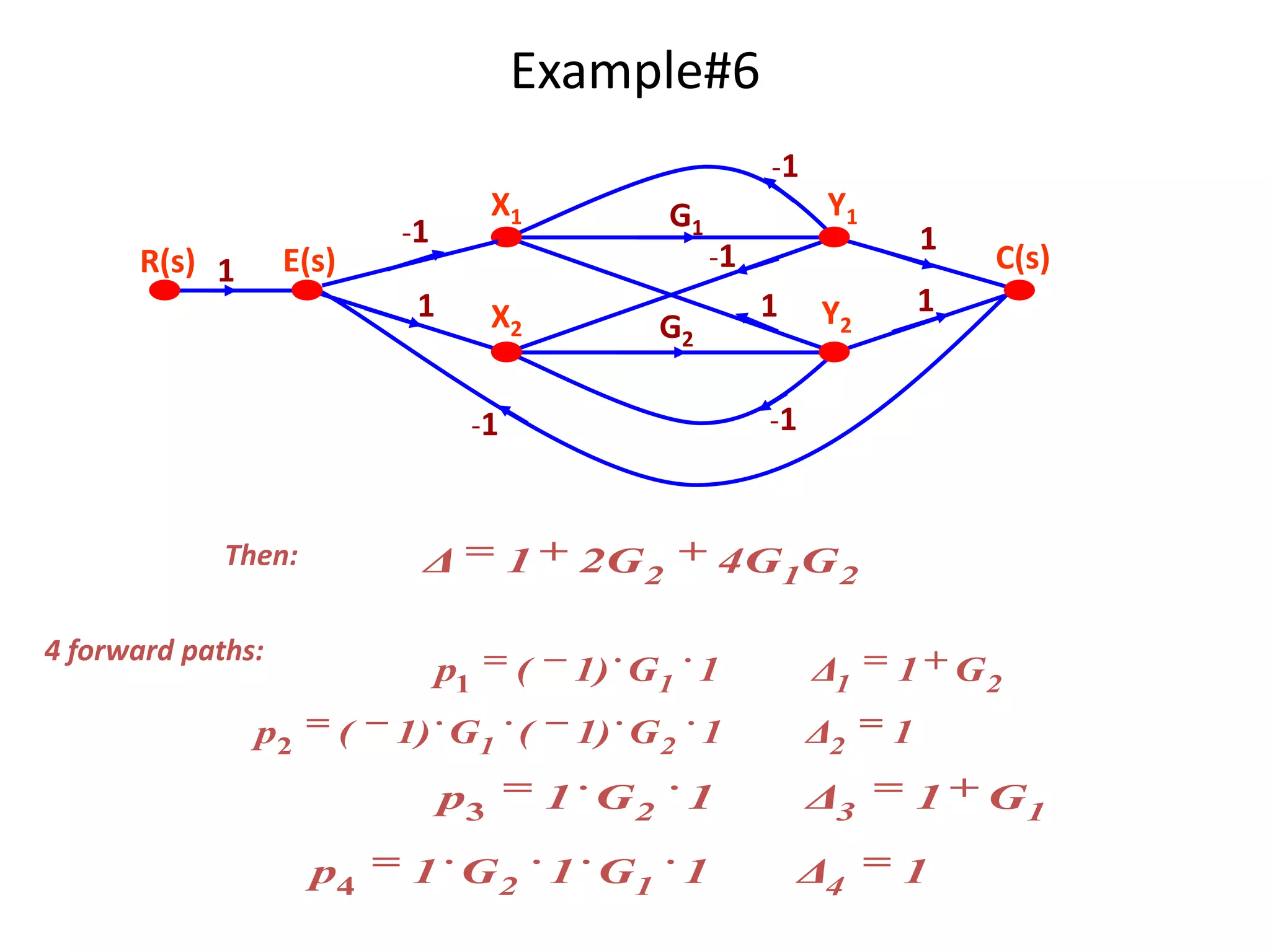
Example#6
-

R(s)

-

Y1

G1

+

+

-X
2

E(s)
-

+

-

-1

R(s) 1

X1

X1

G2

Y2

-1

G1

Y1

-1

E(s)
1

X2
-1

C(s)

G2

1

-1

Y2

1
1

C(s)
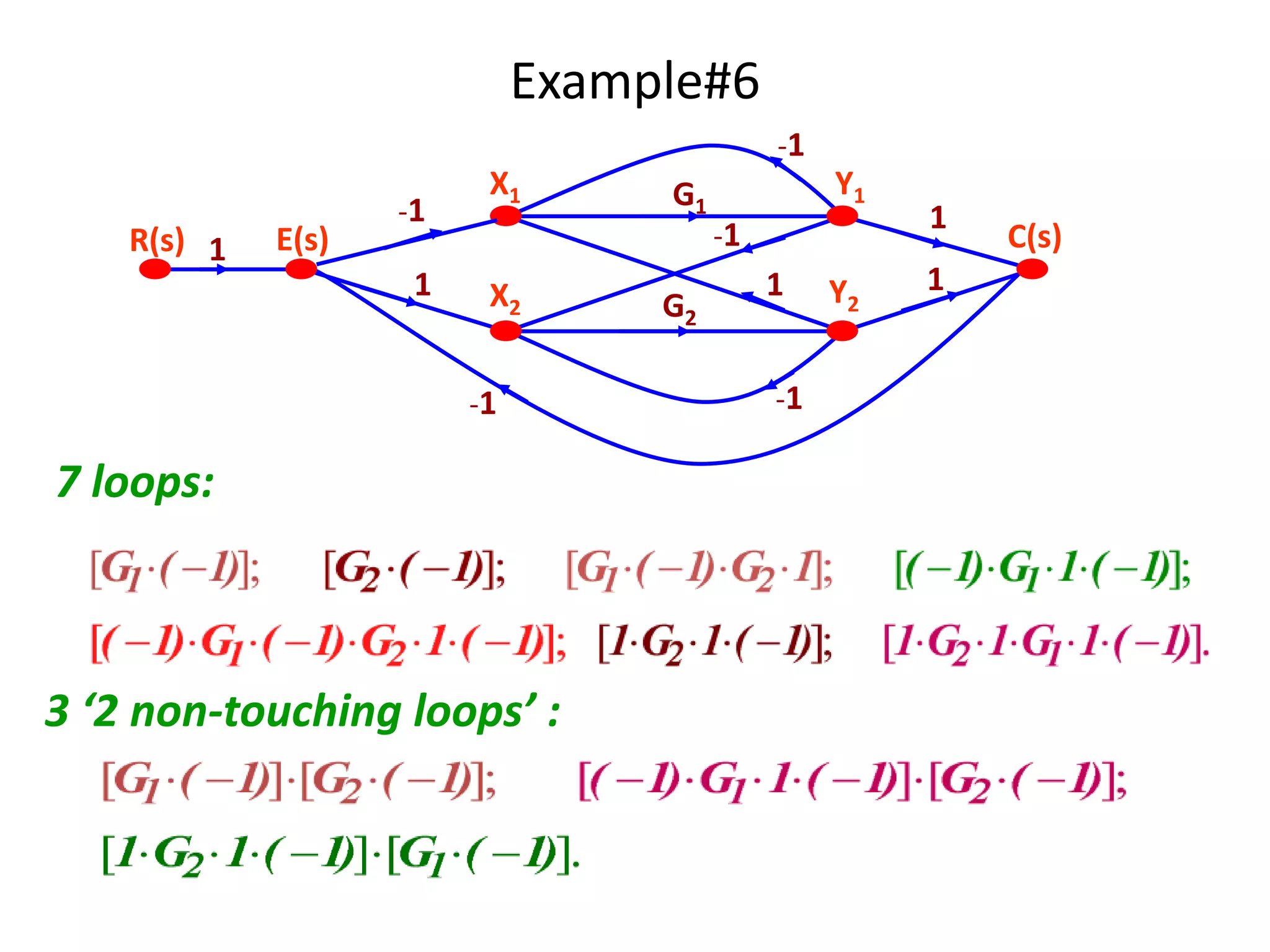
Example#6
-1

R(s) 1

E(s)

-1

1

X1
X2
-1

7 loops:

3 ‘2 non-touching loops’ :

G1
G2

Y1
-1

1
-1

Y2

1
1

C(s)
Example#6
-1
-1

E(s)

R(s) 1

X1

1

X2

G1

Y1
1

G2

Δ

4 forward paths:

p2

2G 2

(

1) G1 1

Δ1

1

1) G1 (

1) G 2 1

Δ2

1

p3

p4

1

Y2

1

p1
(

C(s)

-1

-1

Then:

1

-1

1 G2 1

1 G 2 1 G1 1

4G1G 2

Δ3

Δ4

1

1

G2

G1
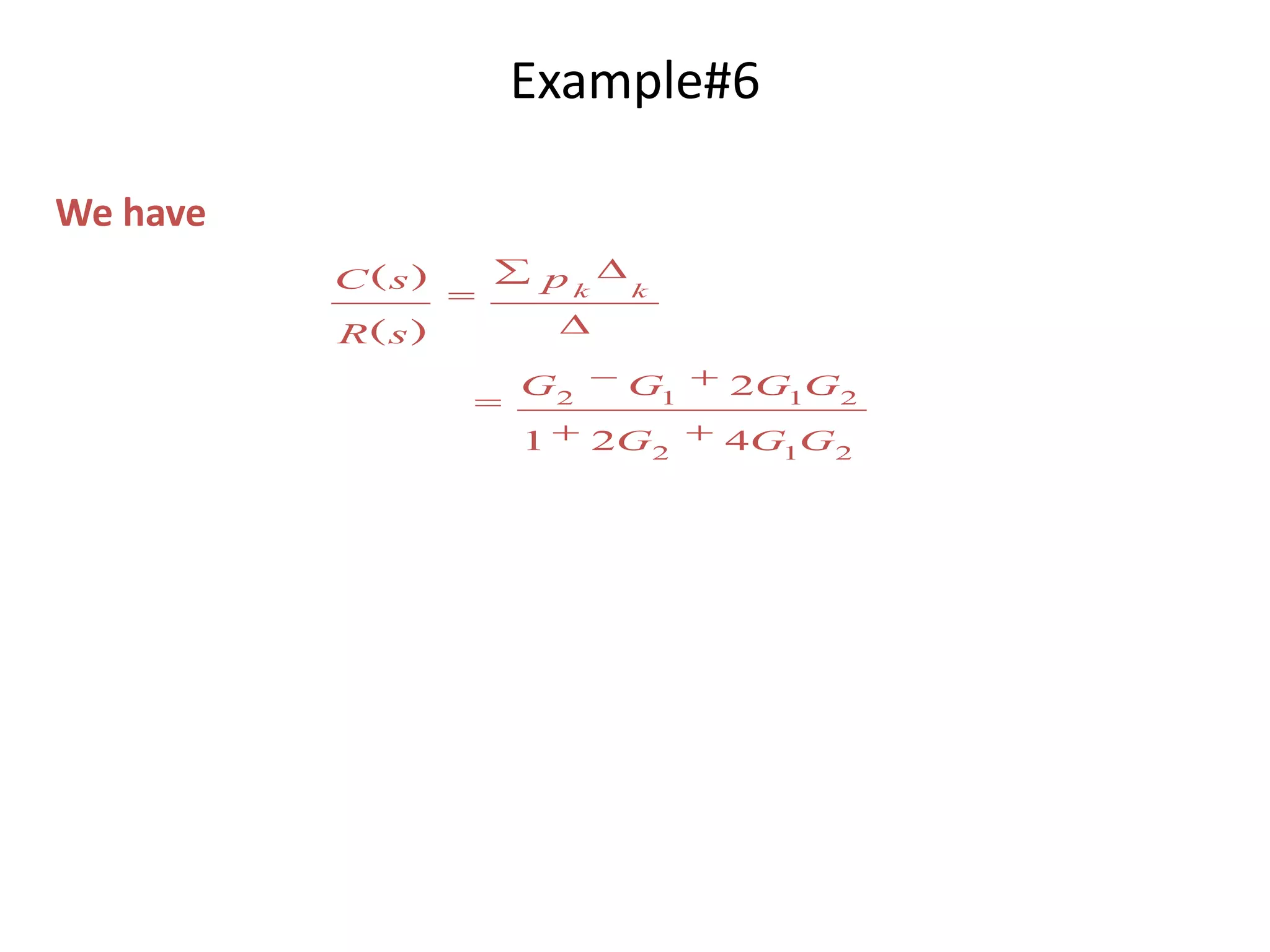
Example#6
We have
C( s )

pk

k

R( s )
G2
1

G1

2G1G2

2G2

4G1G2
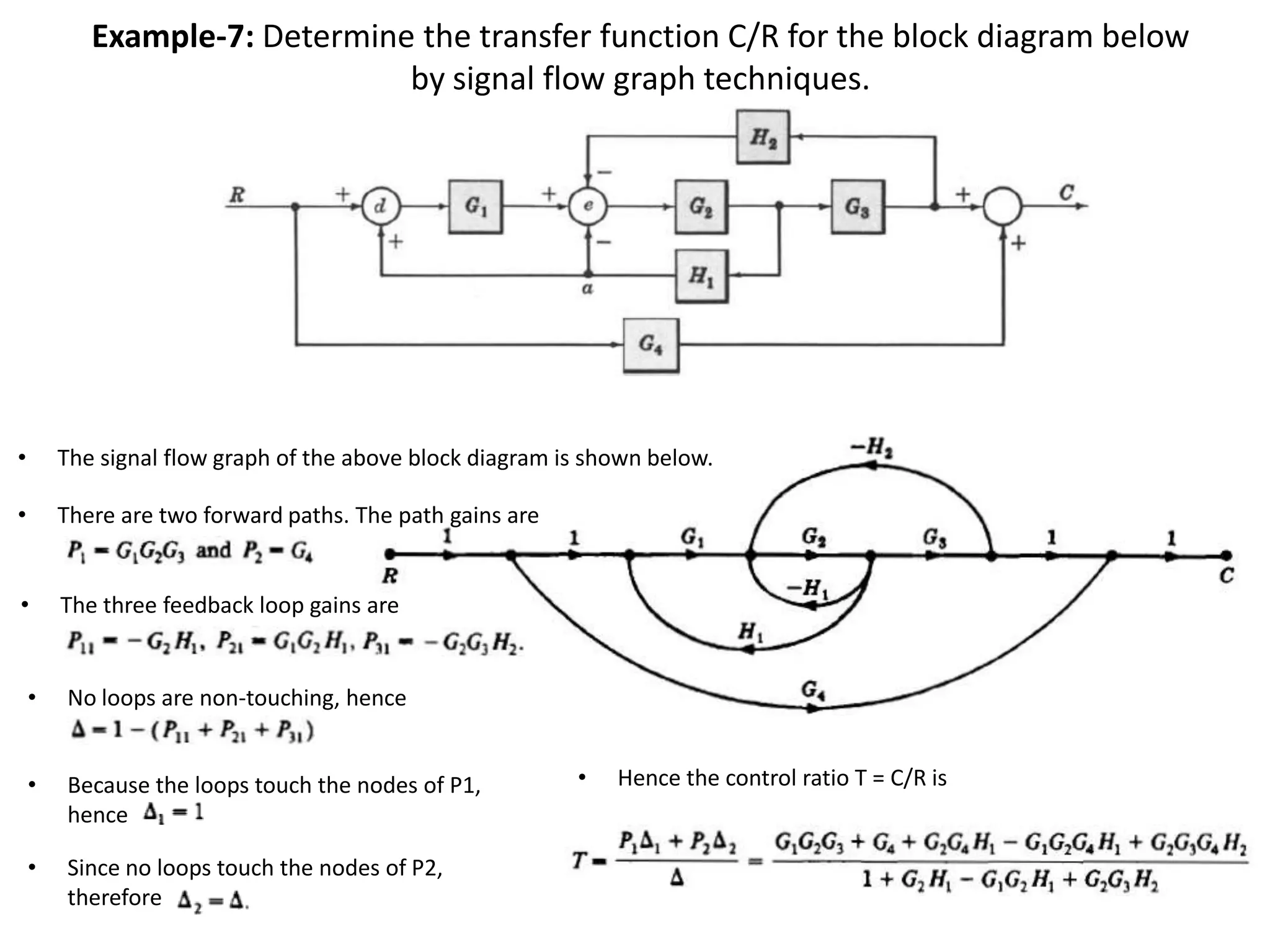
Example-7: Determine the transfer function C/R for the block diagram below
by signal flow graph techniques.

•

The signal flow graph of the above block diagram is shown below.

•

There are two forward paths. The path gains are

•

The three feedback loop gains are

•

No loops are non-touching, hence

•

Because the loops touch the nodes of P1,
hence

•

Since no loops touch the nodes of P2,
therefore

•

Hence the control ratio T = C/R is
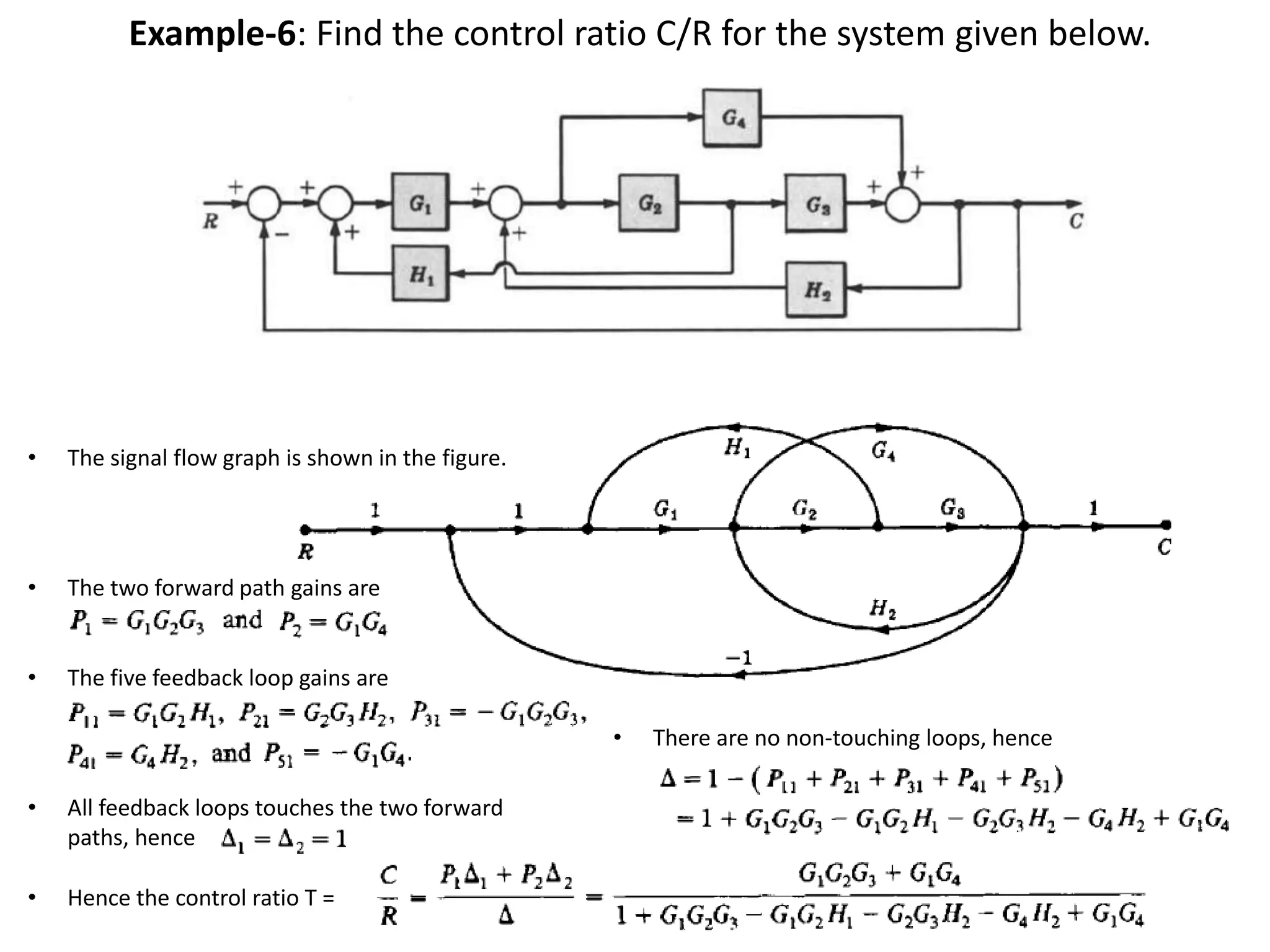
Example-6: Find the control ratio C/R for the system given below.

•

The signal flow graph is shown in the figure.

•

The two forward path gains are

•

The five feedback loop gains are
•

•

All feedback loops touches the two forward
paths, hence

•

Hence the control ratio T =

There are no non-touching loops, hence
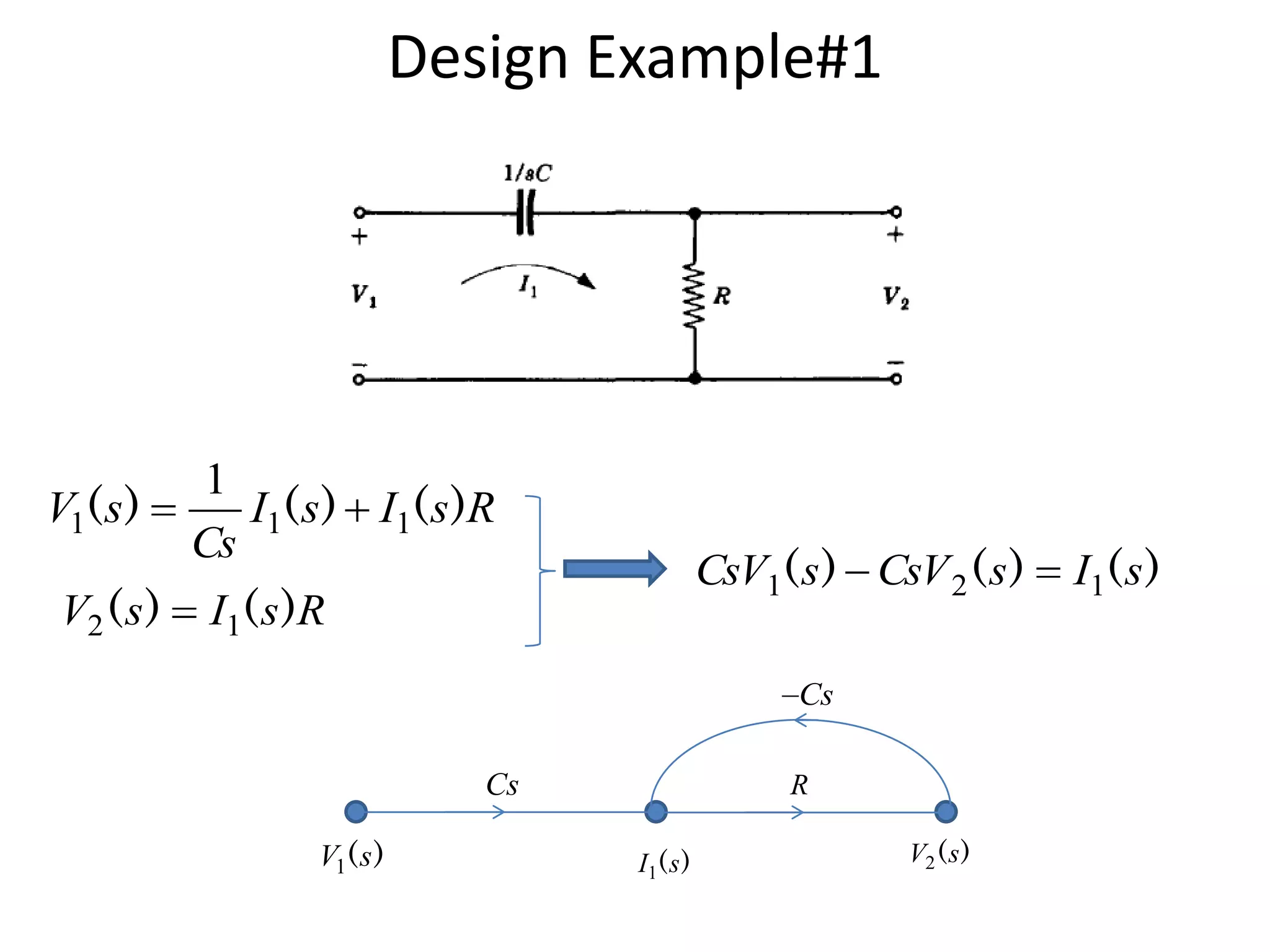
Design Example#1

V1( s )
V2 ( s )

1
I1( s ) I1( s )R
Cs

CsV1( s ) CsV 2 ( s )

I1 ( s ) R

Cs
Cs
V1 (s )

R
I1 (s )

V2 (s )

I1 ( s )
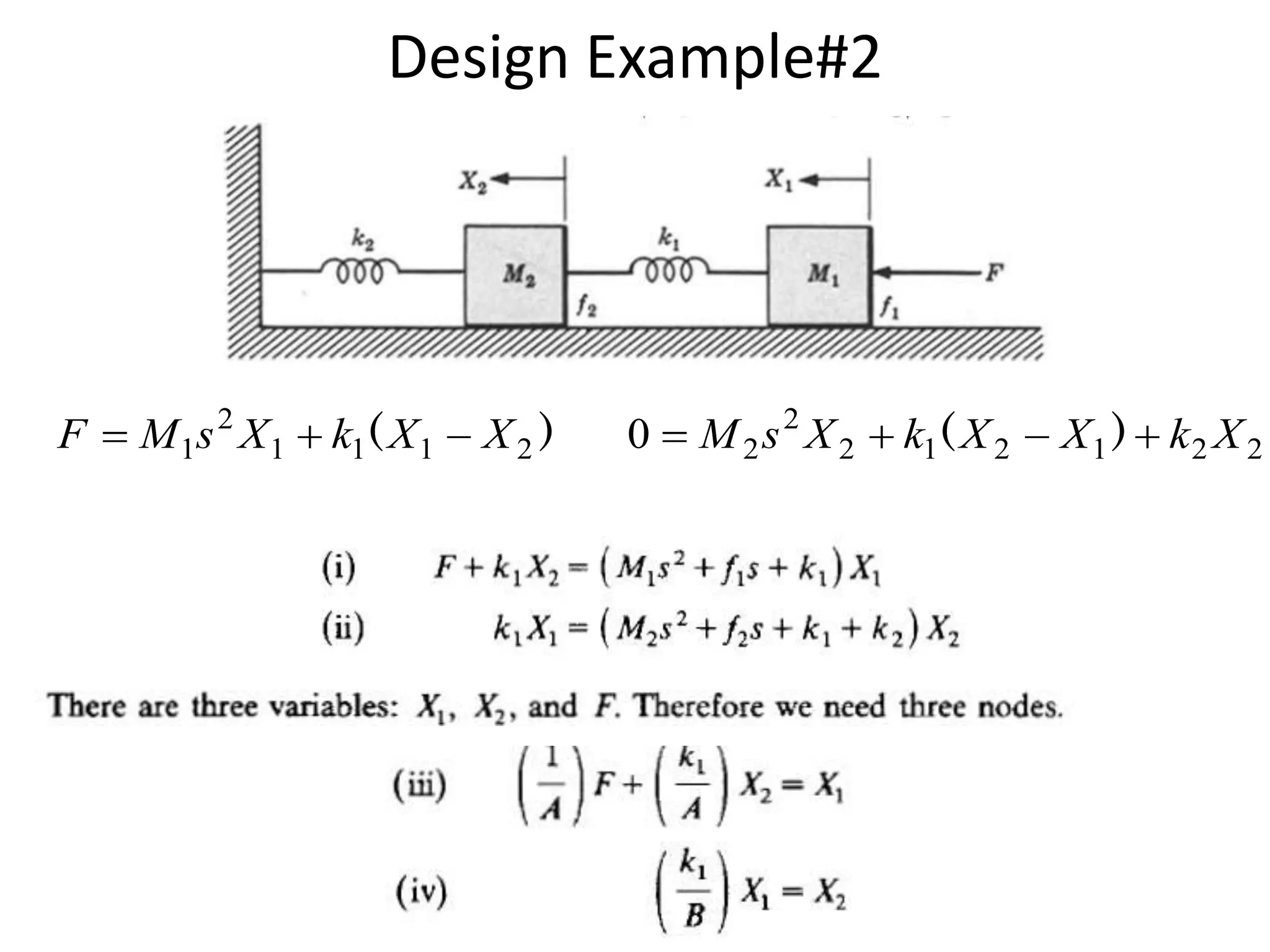
Design Example#2

F

M 1s 2 X 1

k1 ( X 1

X2)

0

M 2s2 X 2

k1 ( X 2

X1 ) k2 X 2
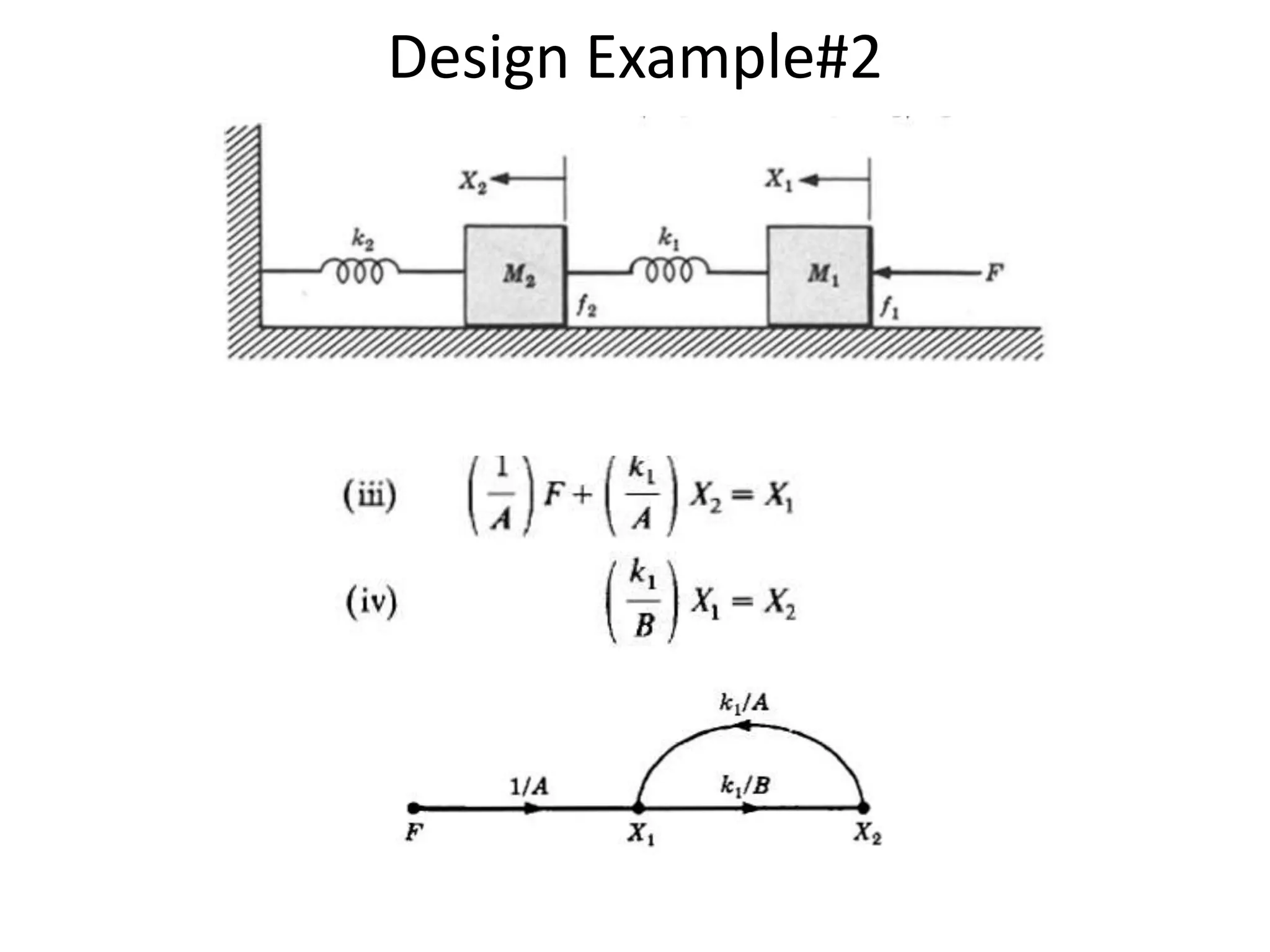
Design Example#2
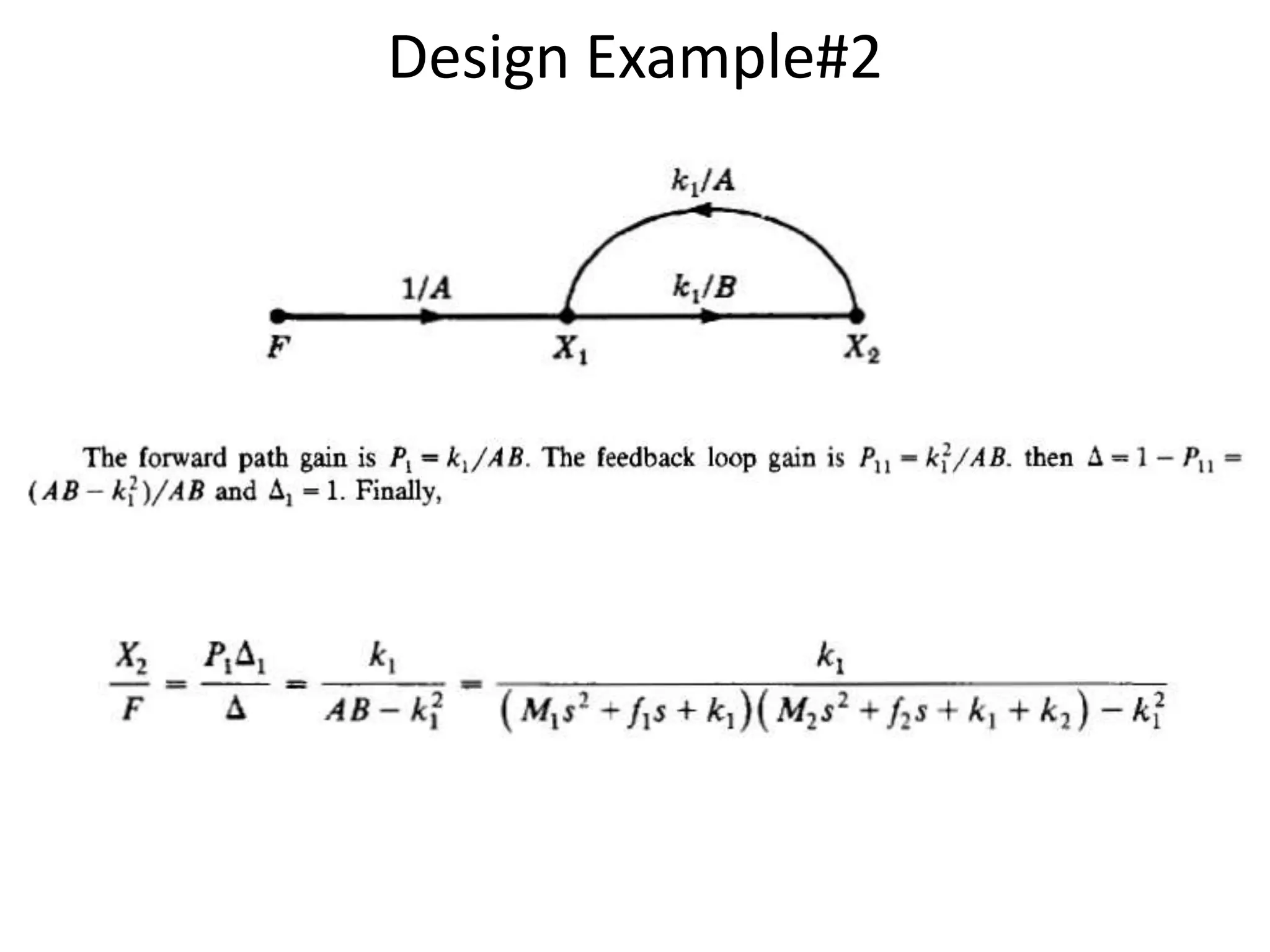
Design Example#2
To download this lecture visit
http://imtiazhussainkalwar.weebly.com/

END OF LECTURES-10-11

Lecture 10 11-signal_flow_graphs

  • 1.
    Feedback Control Systems(FCS) Lecture-10-11 Signal Flow Graphs Dr. Imtiaz Hussain email: imtiaz.hussain@faculty.muet.edu.pk URL :http://imtiazhussainkalwar.weebly.com/
  • 2.
    Outline • Introduction toSignal Flow Graphs – Definitions – Terminologies – Examples • Mason’s Gain Formula – Examples • Signal Flow Graph from Block Diagrams • Design Examples
  • 3.
    Introduction • Alternative methodto block diagram representation, developed by Samuel Jefferson Mason. • Advantage: the availability of a flow graph gain formula, also called Mason’s gain formula. • A signal-flow graph consists of a network in which nodes are connected by directed branches. • It depicts the flow of signals from one point of a system to another and gives the relationships among the signals. 3
  • 4.
    Fundamentals of SignalFlow Graphs • Consider a simple equation below and draw its signal flow graph: y ax • The signal flow graph of the equation is shown below; x a y • Every variable in a signal flow graph is designed by a Node. • Every transmission function in a signal flow graph is designed by a Branch. • Branches are always unidirectional. • The arrow in the branch denotes the direction of the signal flow.
  • 5.
    Signal-Flow Graph Models Y1(s ) G11( s ) R1( s ) G12( s ) R2( s ) Y2( s ) G21( s ) R1( s ) G22( s ) R2( s ) R1 ( s ) Y1 ( s) R2 ( s ) Y2 ( s )
  • 6.
    Signal-Flow Graph Models r1and r2 are inputs and x1 and x2 are outputs a11 x1 a12 x2 r1 x1 a21 x1 a22 x2 r2 x2 r1 x1 r2 x2
  • 7.
    Signal-Flow Graph Models xois input and x4 is output x1 ax0 bx1 x2 dx1 ex 3 x3 fx0 hx 3 f c gx 2 x4 cx 2 x0 a b x1 d x2 x3 g e h x4
  • 8.
    Construct the signalflow graph for the following set of simultaneous equations. • There are four variables in the equations (i.e., x1,x2,x3,and x4) therefore four nodes are required to construct the signal flow graph. • Arrange these four nodes from left to right and connect them with the associated branches. • Another way to arrange this graph is shown in the figure.
  • 9.
    Terminologies • An inputnode or source contain only the outgoing branches. i.e., X1 • An output node or sink contain only the incoming branches. i.e., X4 • A path is a continuous, unidirectional succession of branches along which no node is passed more than ones. i.e., X1 to X2 to X3 to X4 X1 to X2 to X4 X2 to X3 to X4 • A forward path is a path from the input node to the output node. i.e., X1 to X2 to X3 to X4 , and X1 to X2 to X4 , are forward paths. • A feedback path or feedback loop is a path which originates and terminates on the same node. i.e.; X2 to X3 and back to X2 is a feedback path.
  • 10.
    Terminologies • A self-loopis a feedback loop consisting of a single branch. i.e.; A33 is a self loop. • The gain of a branch is the transmission function of that branch. • The path gain is the product of branch gains encountered in traversing a path. i.e. the gain of forwards path X1 to X2 to X3 to X4 is A21A32A43 • The loop gain is the product of the branch gains of the loop. i.e., the loop gain of the feedback loop from X2 to X3 and back to X2 is A32A23. • Two loops, paths, or loop and a path are said to be non-touching if they have no nodes in common.
  • 11.
    Consider the signalflow graph below and identify the following a) b) c) d) e) f) g) Input node. Output node. Forward paths. Feedback paths (loops). Determine the loop gains of the feedback loops. Determine the path gains of the forward paths. Non-touching loops
  • 12.
    Consider the signalflow graph below and identify the following • There are two forward path gains;
  • 13.
    Consider the signalflow graph below and identify the following • There are four loops
  • 14.
    Consider the signalflow graph below and identify the following • Nontouching loop gains;
  • 15.
    Consider the signalflow graph below and identify the following a) b) c) d) e) f) g) Input node. Output node. Forward paths. Feedback paths. Self loop. Determine the loop gains of the feedback loops. Determine the path gains of the forward paths.
  • 16.
    Input and outputNodes a) Input node b) Output node
  • 17.
  • 18.
  • 19.
  • 20.
  • 21.
  • 22.
  • 23.
    (f) Loop Gainsof the Feedback Loops
  • 24.
    (g) Path Gainsof the Forward Paths
  • 25.
    Mason’s Rule (Mason,1953) • The block diagram reduction technique requires successive application of fundamental relationships in order to arrive at the system transfer function. • On the other hand, Mason’s rule for reducing a signal-flow graph to a single transfer function requires the application of one formula. • The formula was derived by S. J. Mason when he related the signal-flow graph to the simultaneous equations that can be written from the graph.
  • 26.
    Mason’s Rule: • Thetransfer function, C(s)/R(s), of a system represented by a signal-flow graph is; n C( s ) R( s ) i 1 Pi i Where n = number of forward paths. Pi = the i th forward-path gain. ∆ = Determinant of the system ∆i = Determinant of the ith forward path • ∆ is called the signal flow graph determinant or characteristic function. Since ∆=0 is the system characteristic equation.
  • 27.
    Mason’s Rule: n C( s) R( s ) i 1 Pi i ∆ = 1- (sum of all individual loop gains) + (sum of the products of the gains of all possible two loops that do not touch each other) – (sum of the products of the gains of all possible three loops that do not touch each other) + … and so forth with sums of higher number of non-touching loop gains ∆i = value of Δ for the part of the block diagram that does not touch the ith forward path (Δi = 1 if there are no non-touching loops to the i-th path.)
  • 28.
    Systematic approach 1. Calculateforward path gain Pi for each forward path i. 2. Calculate all loop transfer functions 3. Consider non-touching loops 2 at a time 4. Consider non-touching loops 3 at a time 5. etc 6. Calculate Δ from steps 2,3,4 and 5 7. Calculate Δi as portion of Δ not touching forward path i 28
  • 29.
    Example#1: Apply Mason’sRule to calculate the transfer function of the system represented by following Signal Flow Graph Therefore, C R P1 1 P2 2 There are three feedback loops L1 G1G4 H1 , L2 G1G2G4 H 2 , L3 G1G3G4 H 2
  • 30.
    Example#1: Apply Mason’sRule to calculate the transfer function of the system represented by following Signal Flow Graph There are no non-touching loops, therefore ∆ = 1- (sum of all individual loop gains) 1 L1 1 G1G4 H1 L2 L3 G1G2G4 H 2 G1G3G4 H 2
  • 31.
    Example#1: Apply Mason’sRule to calculate the transfer function of the system represented by following Signal Flow Graph Eliminate forward path-1 ∆1 = 1- (sum of all individual loop gains)+... ∆1 = 1 Eliminate forward path-2 ∆2 = 1- (sum of all individual loop gains)+... ∆2 = 1
  • 32.
  • 33.
    Example#2: Apply Mason’sRule to calculate the transfer function of the system represented by following Signal Flow Graph P1 P2 1. Calculate forward path gains for each forward path. P 1 G1G2G3G4 (path 1) and P2 G5G6G7G8 (path 2) 2. Calculate all loop gains. L1 G2 H 2 , L2 H 3G3 , L3 3. Consider two non-touching loops. L1L3 L1L4 L2L4 L2L3 G6 H 6 , L4 G7 H 7 33
  • 34.
    Example#2: continue 4. Considerthree non-touching loops. None. 5. Calculate Δ from steps 2,3,4. 1 1 L1 G2 H 2 L2 L3 H 3G3 G2 H 2G6 H 6 L4 L1L3 G6 H 6 G2 H 2G7 H 7 L1L4 L2 L3 L2 L4 G7 H 7 H 3G3G6 H 6 H 3G3G7 H 7 34
  • 35.
    Example#2: continue Eliminate forwardpath-1 1 1 1 1 L3 L4 G6 H 6 G7 H 7 Eliminate forward path-2 2 2 1 L1 1 L2 G2 H 2 G3 H 3 35
  • 36.
    Example#2: continue Y (s) R(s ) Y (s) R( s ) 1 G2 H 2 P 1 G1G2G3G4 1 G6 H 6 H 3G3 G6 H 6 G7 H 7 1 P2 2 G7 H 7 G5G6G7 G8 1 G2 H 2 G3 H 3 G2 H 2G6 H 6 G2 H 2G7 H 7 H 3G3G6 H 6 H 3G3G7 H 7 36
  • 37.
    Example#3 • Find thetransfer function, C(s)/R(s), for the signal-flow graph in figure below.
  • 38.
    Example#3 • There isonly one forward Path. P 1 G1( s )G2 ( s )G3 ( s )G4 ( s )G5 ( s )
  • 39.
    Example#3 • There arefour feedback loops.
  • 40.
  • 41.
    Example#3 • Non-touching loopstaken three at a time.
  • 42.
  • 43.
    Example#4: Apply Mason’sRule to calculate the transfer function of the system represented by following Signal Flow Graph There are three forward paths, therefore n=3. 3 C( s ) R( s ) i 1 Pi i P 1 1 P2 2 P3 3
  • 44.
    Example#4: Forward Paths P3 A42A54 A65 A76 P 1 A32 A43 A54 A65 A76 P2 A72
  • 45.
    Example#4: Loop Gainsof the Feedback Loops L1 L2 A32 A23 A43 A34 L3 A54 A45 L4 A65 A56 L5 A76 A67 L6 A77 L7 A42 A34 A23 L8 A65 A76 A67 L9 A72 A57 A45 A34 A23 L10 A72 A67 A56 A45 A34 A23
  • 46.
    Example#4: two non-touchingloops L1 L3 L2 L4 L3 L5 L4 L6 L1 L4 L2 L5 L3 L6 L4 L7 L1 L5 L2 L6 L1 L6 L2 L8 L1 L8 L5 L7 L7 L8
  • 47.
    Example#4: Three non-touchingloops L1 L3 L2 L4 L3 L5 L4 L6 L1 L4 L2 L5 L3 L6 L4 L7 L1 L5 L2 L6 L1 L6 L2 L8 L1 L8 L5 L7 L7 L8
  • 48.
    From Block Diagramto Signal-Flow Graph Models Example#5 H1 R(s) E(s) X1 G1 - - - G2 X2 G3 X3 G4 H2 H3 R(s) 1 E(s) G1 X1 G2 -H2 -H3 X2 G3 -H1 X3 G4 C(s) C(s)
  • 49.
    From Block Diagramto Signal-Flow Graph Models Example#5 -H1 R(s) 1 E(s) X1 G1 G2 X2 G4 G3 X3 1 C(s) -H2 -H3 1 P1 G (G1G2G3G4 H 3 G1G2G3G4 ; 1 G3G4 H 1 ) 1 G1G2G3G4 C ( s) R( s ) G2G3 H 2 1 G1G2G3G4 H 3 G2G3 H 2 G3G4 H 1
  • 50.
  • 51.
    Example#6 -1 R(s) 1 E(s) -1 1 X1 X2 -1 7 loops: 3‘2 non-touching loops’ : G1 G2 Y1 -1 1 -1 Y2 1 1 C(s)
  • 52.
    Example#6 -1 -1 E(s) R(s) 1 X1 1 X2 G1 Y1 1 G2 Δ 4 forwardpaths: p2 2G 2 ( 1) G1 1 Δ1 1 1) G1 ( 1) G 2 1 Δ2 1 p3 p4 1 Y2 1 p1 ( C(s) -1 -1 Then: 1 -1 1 G2 1 1 G 2 1 G1 1 4G1G 2 Δ3 Δ4 1 1 G2 G1
  • 53.
    Example#6 We have C( s) pk k R( s ) G2 1 G1 2G1G2 2G2 4G1G2
  • 54.
    Example-7: Determine thetransfer function C/R for the block diagram below by signal flow graph techniques. • The signal flow graph of the above block diagram is shown below. • There are two forward paths. The path gains are • The three feedback loop gains are • No loops are non-touching, hence • Because the loops touch the nodes of P1, hence • Since no loops touch the nodes of P2, therefore • Hence the control ratio T = C/R is
  • 55.
    Example-6: Find thecontrol ratio C/R for the system given below. • The signal flow graph is shown in the figure. • The two forward path gains are • The five feedback loop gains are • • All feedback loops touches the two forward paths, hence • Hence the control ratio T = There are no non-touching loops, hence
  • 56.
    Design Example#1 V1( s) V2 ( s ) 1 I1( s ) I1( s )R Cs CsV1( s ) CsV 2 ( s ) I1 ( s ) R Cs Cs V1 (s ) R I1 (s ) V2 (s ) I1 ( s )
  • 57.
    Design Example#2 F M 1s2 X 1 k1 ( X 1 X2) 0 M 2s2 X 2 k1 ( X 2 X1 ) k2 X 2
  • 58.
  • 59.
  • 60.
    To download thislecture visit http://imtiazhussainkalwar.weebly.com/ END OF LECTURES-10-11