This document provides an overview of signal flow graphs and Mason's rule for calculating transfer functions from such graphs. It begins with definitions of key signal flow graph concepts like nodes, branches, paths, and loops. It then gives examples of constructing signal flow graphs from sets of simultaneous equations and converting block diagrams. Mason's rule is explained as providing the transfer function from a single formula involving the forward path gains and graph determinants, avoiding successive block diagram reductions. Finally, the document works through two examples applying Mason's rule to calculate transfer functions from given signal flow graphs.
GANDHINAGAR INSTITUTE OF
TECHNOLOGY
CONTROLENGINEERING (2151908)
Active learning assignment
On
SIGNAL FLOW GRAPH
Prepared by:-
1). Sonani Manav 140120119223
2). Suthar Chandresh 140120119229
3). Tade Govind 140120119230
Guided by :-Asst. Prof. Kashyap Ramaiya
2.
Outline
• Introduction toSignal Flow Graphs
Definitions
Terminologies
• Signal-Flow Graph Models
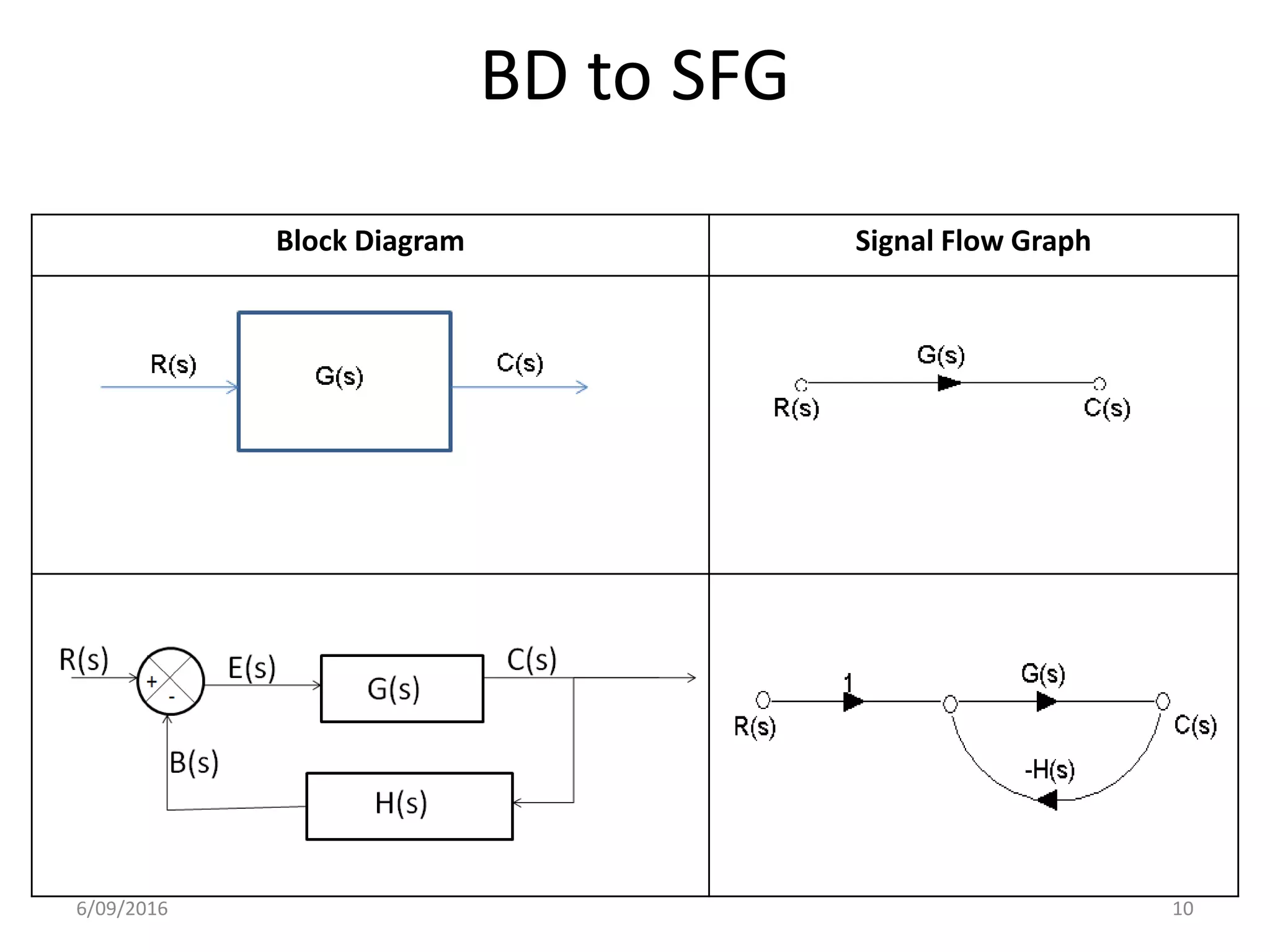
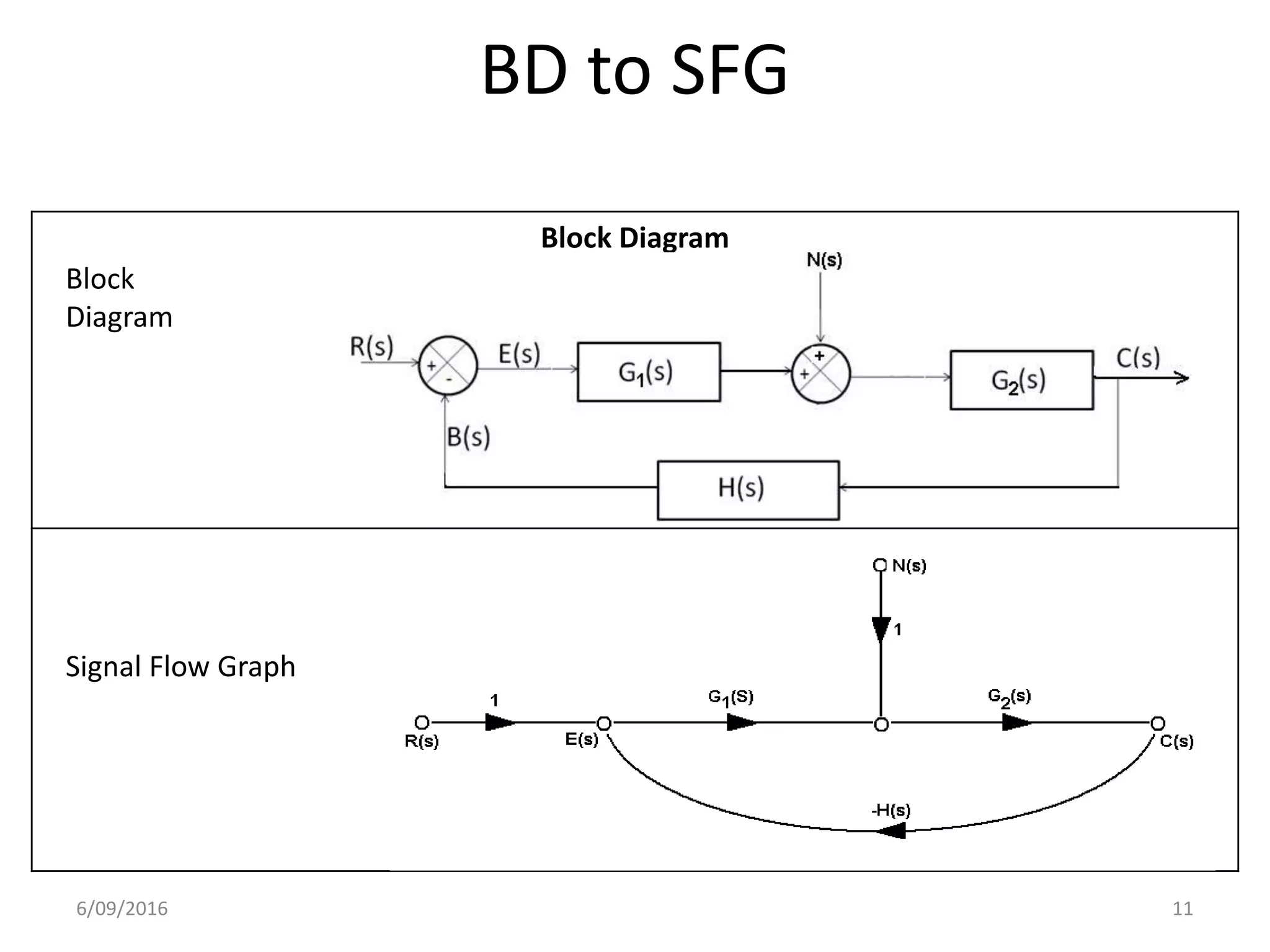
• BD to SFG
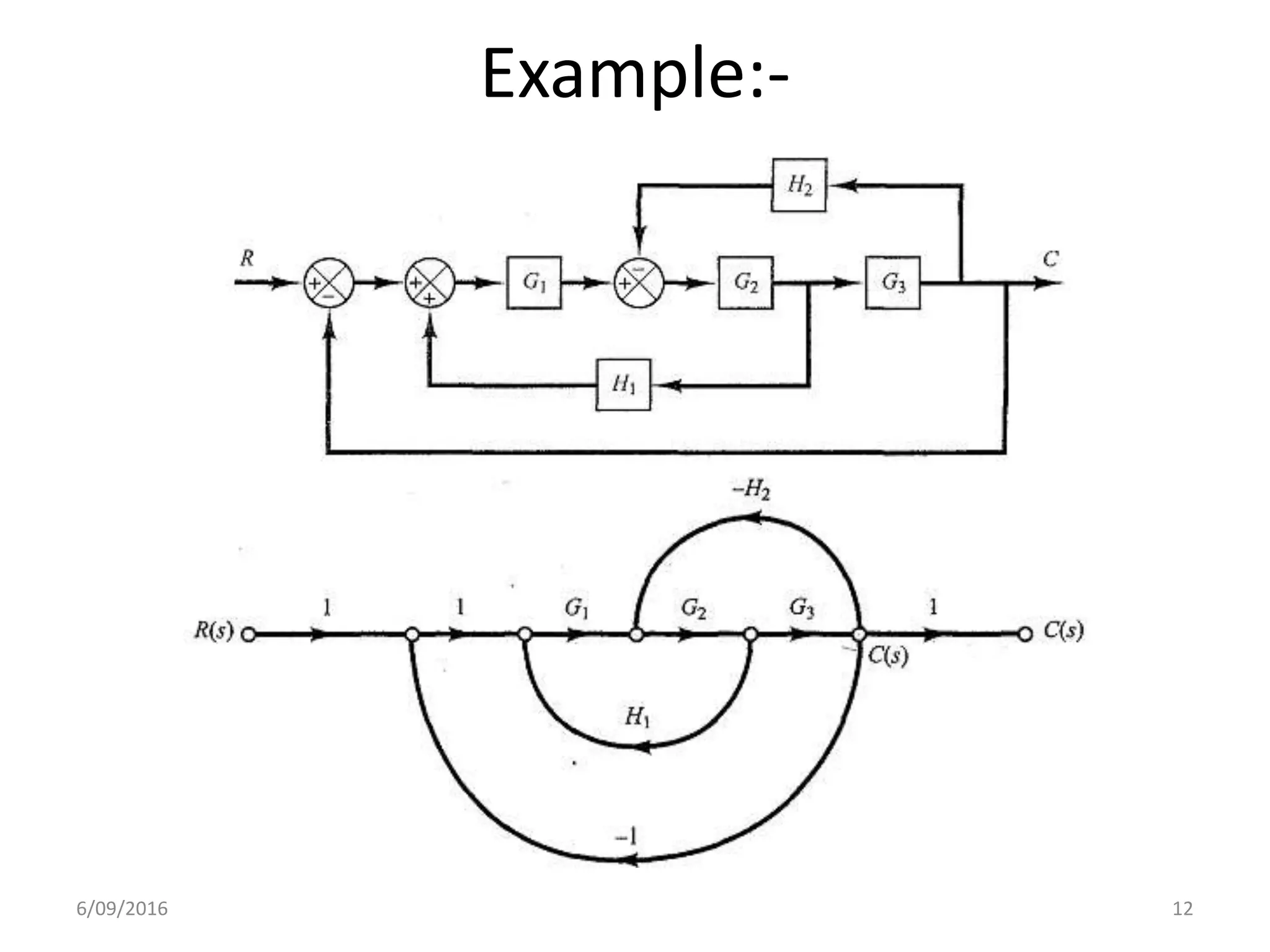
Example
• Mason’s Gain Formula
Example
6/09/2016 2
3.
Introduction
3
• Definition:-
“ Asignal flow graph is a graphical representation of the
relationship between variables of a set of linear algebraic
equation.”
• A signal-flow graph consists of a network in which nodes
are connected by directed branches.
• It depicts the flow of signals from one point of a system to
another and gives the relationships among the signals.
6/09/2016
4.
Fundamentals of SignalFlow Graphs
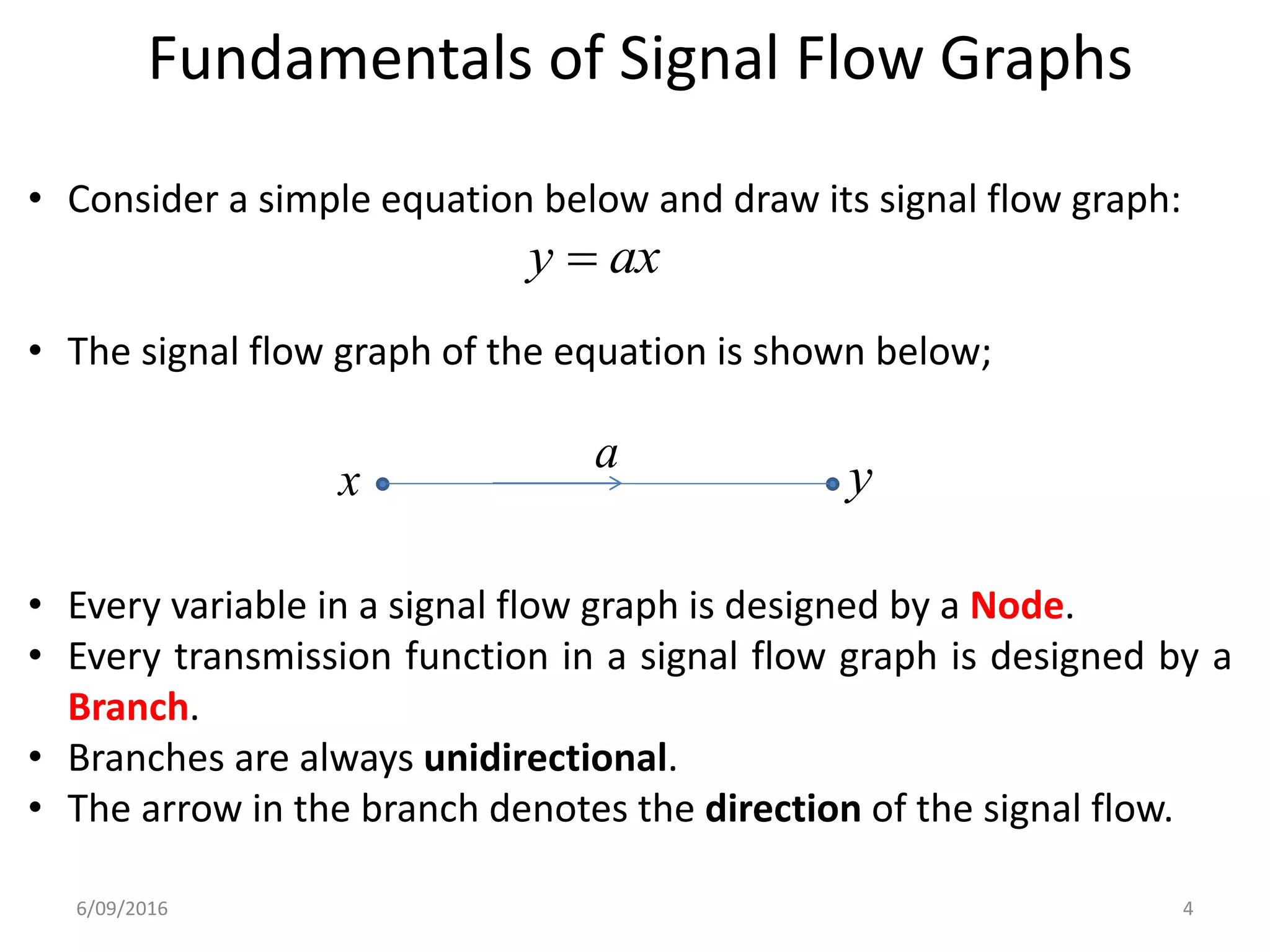
• Consider a simple equation below and draw its signal flow graph:
• The signal flow graph of the equation is shown below;
• Every variable in a signal flow graph is designed by a Node.
• Every transmission function in a signal flow graph is designed by a
Branch.
• Branches are always unidirectional.
• The arrow in the branch denotes the direction of the signal flow.
axy
x ya
6/09/2016 4
5.
Terminologies
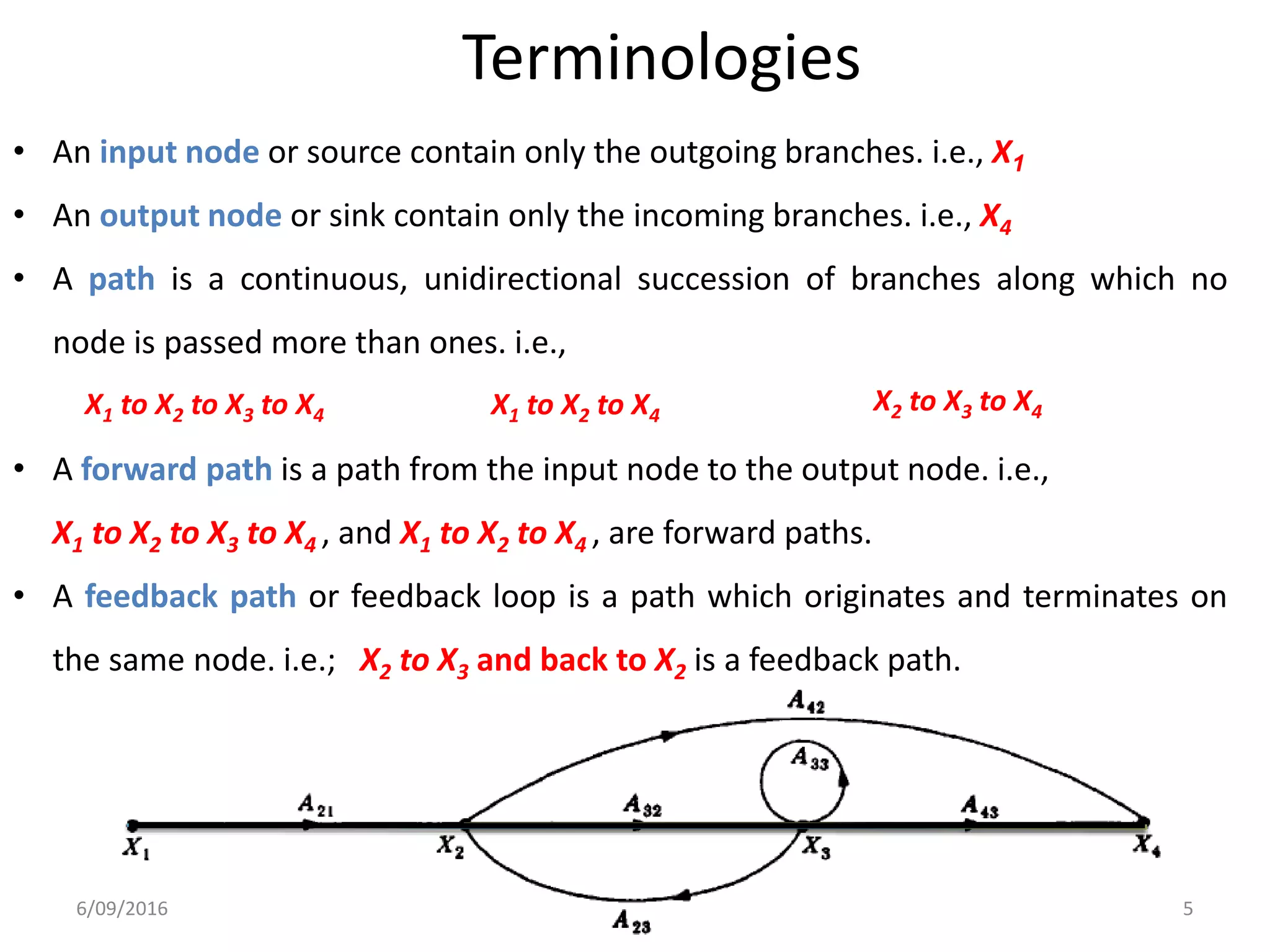
• An inputnode or source contain only the outgoing branches. i.e., X1
• An output node or sink contain only the incoming branches. i.e., X4
• A path is a continuous, unidirectional succession of branches along which no
node is passed more than ones. i.e.,
• A forward path is a path from the input node to the output node. i.e.,
X1 to X2 to X3 to X4 , and X1 to X2 to X4 , are forward paths.
• A feedback path or feedback loop is a path which originates and terminates on
the same node. i.e.; X2 to X3 and back to X2 is a feedback path.
X1 to X2 to X3 to X4
X2 to X3 to X4X1 to X2 to X4
6/09/2016 5
6.
Terminologies
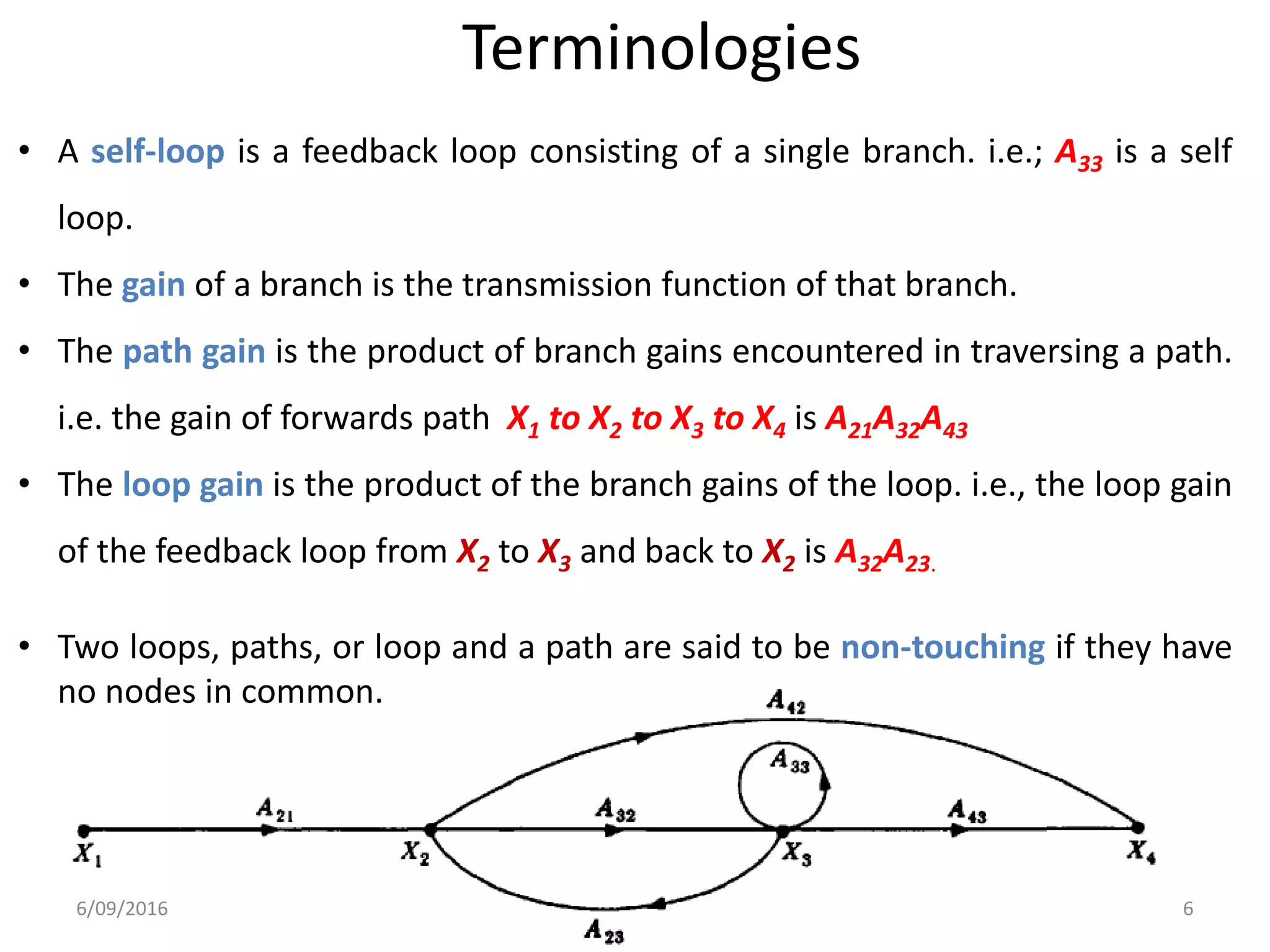
• A self-loopis a feedback loop consisting of a single branch. i.e.; A33 is a self
loop.
• The gain of a branch is the transmission function of that branch.
• The path gain is the product of branch gains encountered in traversing a path.
i.e. the gain of forwards path X1 to X2 to X3 to X4 is A21A32A43
• The loop gain is the product of the branch gains of the loop. i.e., the loop gain
of the feedback loop from X2 to X3 and back to X2 is A32A23.
• Two loops, paths, or loop and a path are said to be non-touching if they have
no nodes in common.
6/09/2016 6
7.
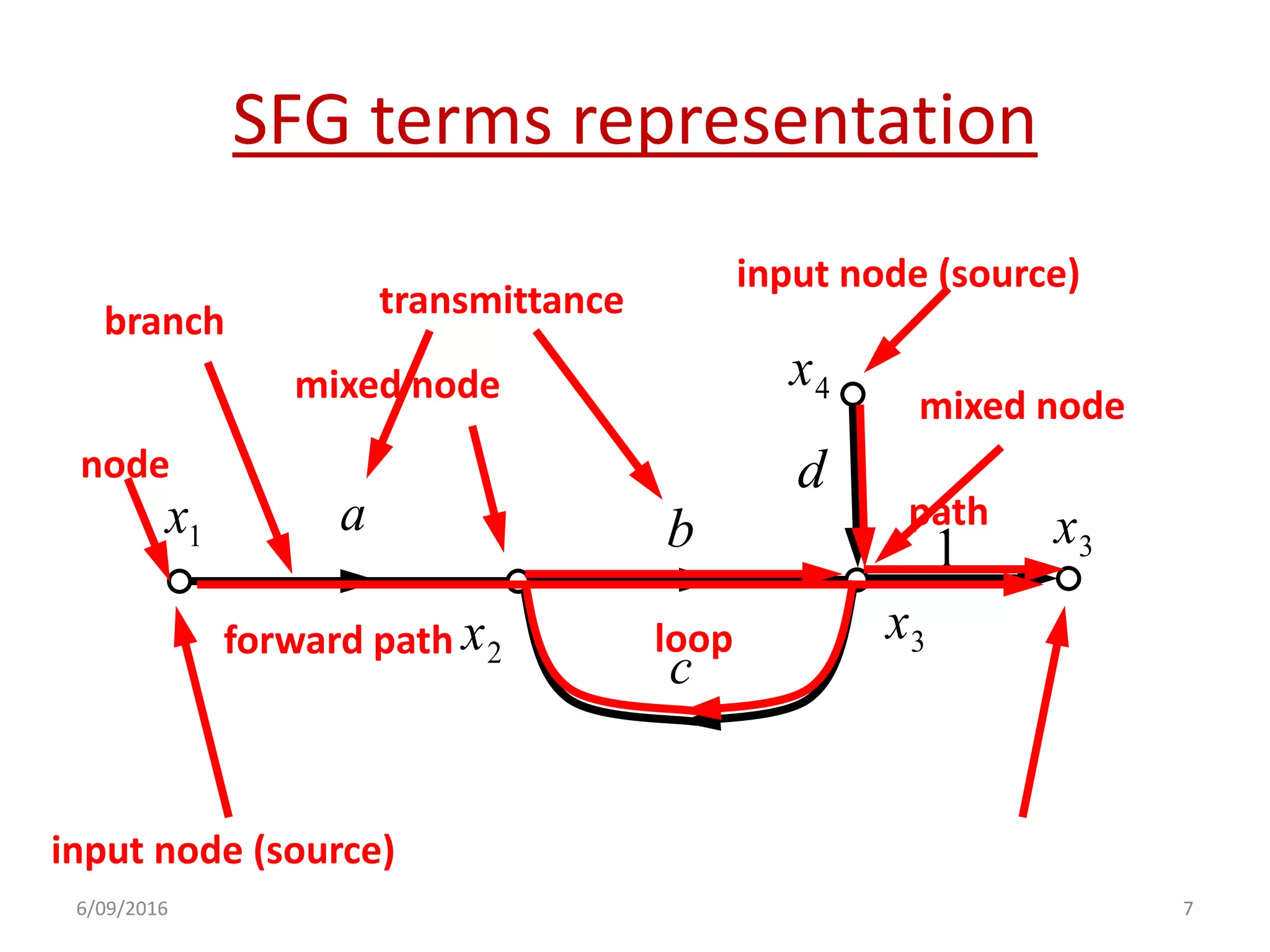
SFG terms representation
inputnode (source)
b1x a
2x
c
4x
d
1
3x
3x
mixed node mixed node
forward path
path
loop
branch
node
transmittance
input node (source)
6/09/2016 7
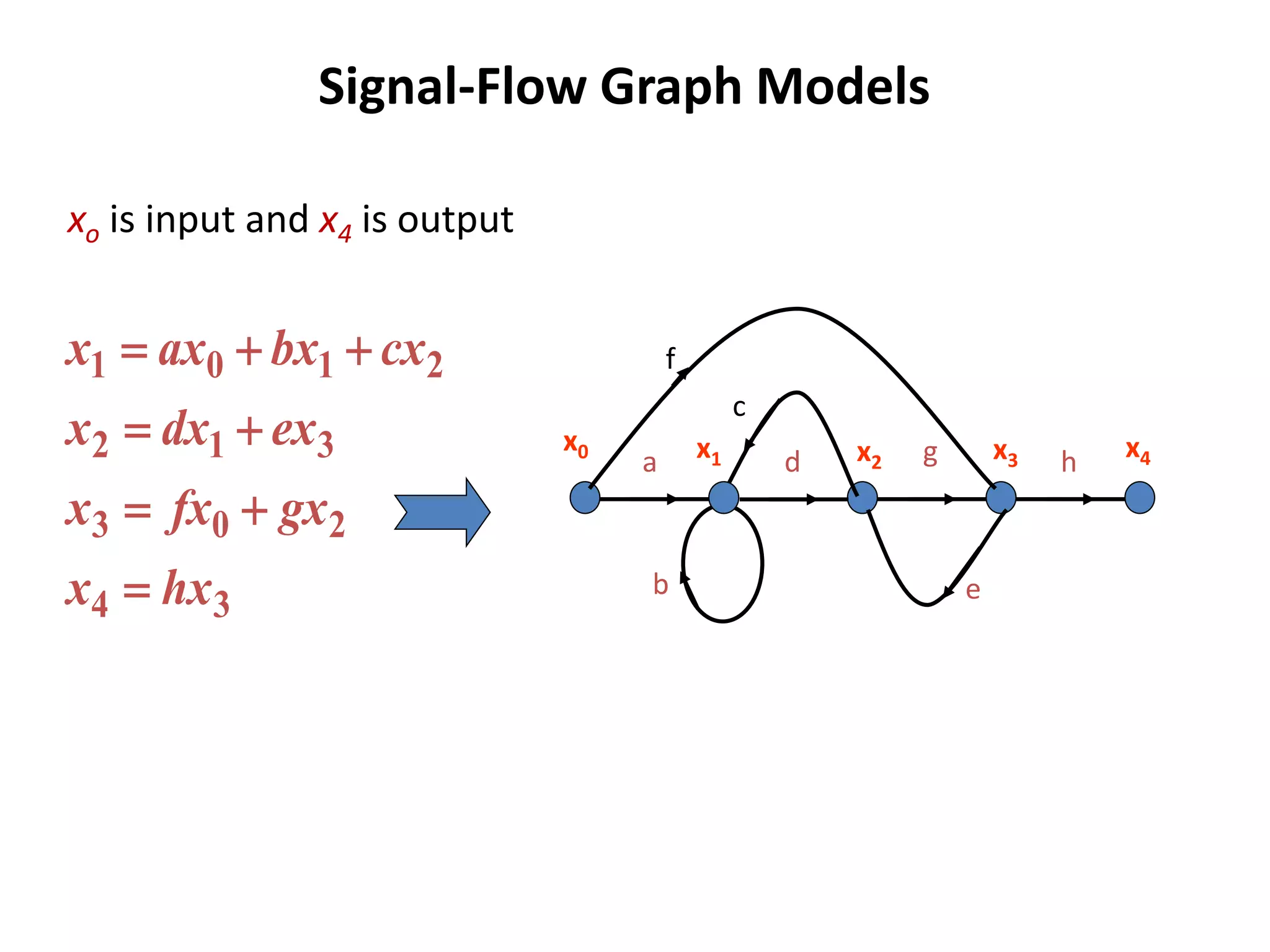
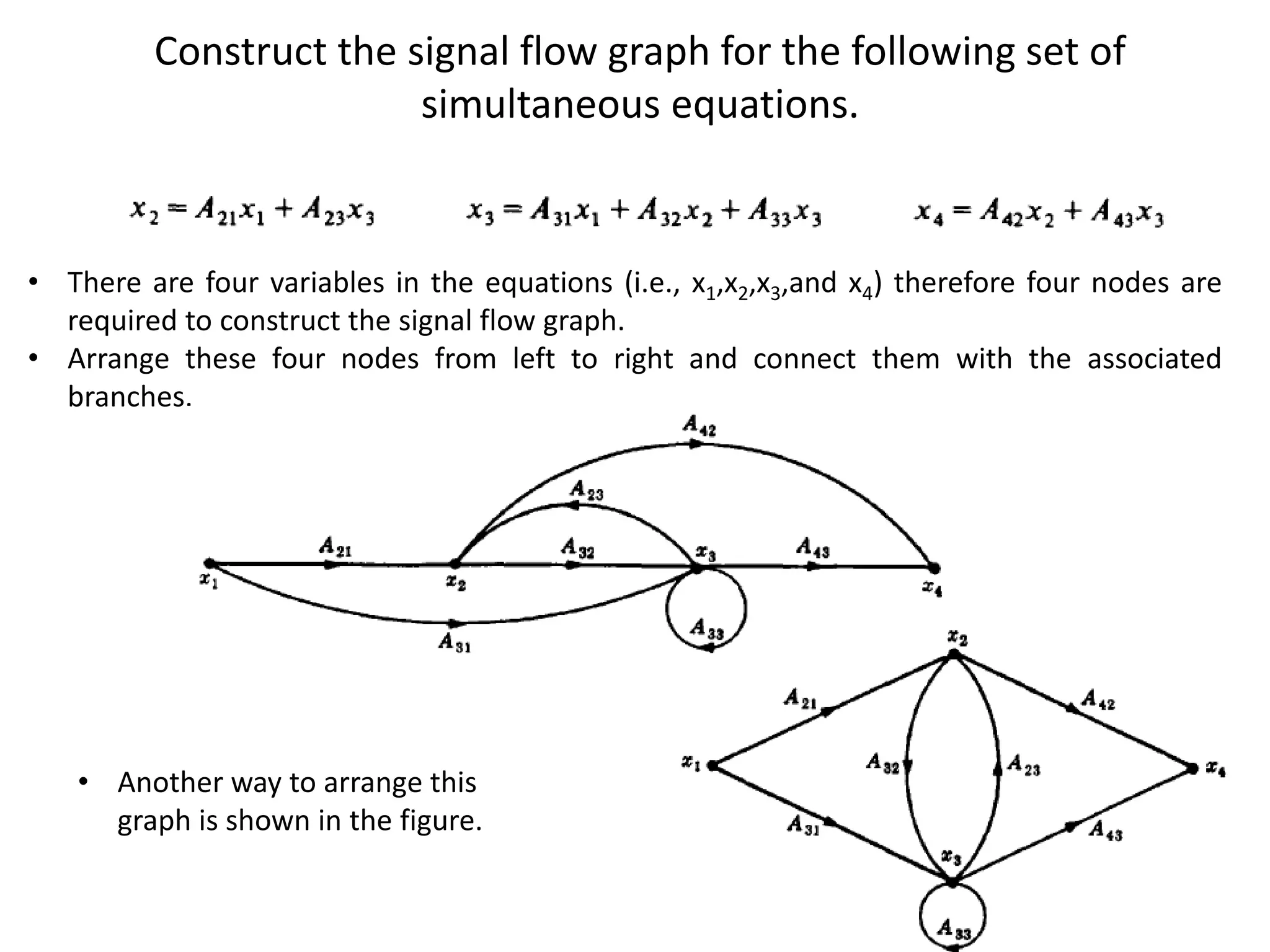
Construct the signalflow graph for the following set of
simultaneous equations.
• There are four variables in the equations (i.e., x1,x2,x3,and x4) therefore four nodes are
required to construct the signal flow graph.
• Arrange these four nodes from left to right and connect them with the associated
branches.
• Another way to arrange this
graph is shown in the figure.
Mason’s Rule (Mason,1953)
• The block diagram reduction technique requires successive
application of fundamental relationships in order to arrive at the
system transfer function.
• On the other hand, Mason’s rule for reducing a signal-flow graph
to a single transfer function requires the application of one
formula.
• The formula was derived by S. J. Mason when he related the
signal-flow graph to the simultaneous equations that can be
written from the graph.
6/09/2016 13
14.
Mason’s Rule:
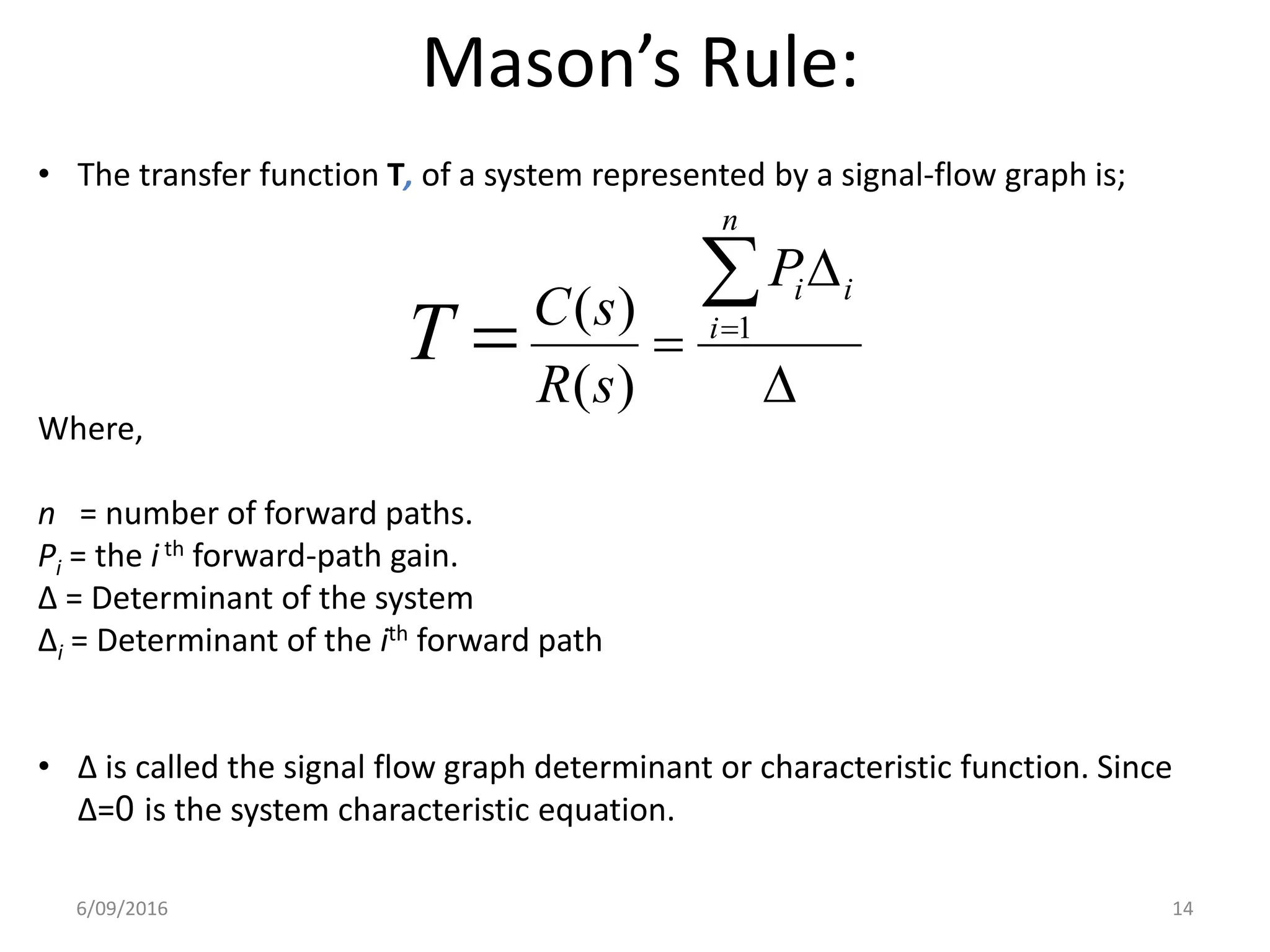
• Thetransfer function T, of a system represented by a signal-flow graph is;
Where,
n = number of forward paths.
Pi = the i th forward-path gain.
∆ = Determinant of the system
∆i = Determinant of the ith forward path
• ∆ is called the signal flow graph determinant or characteristic function. Since
∆=0 is the system characteristic equation.
n
i
iiP
sR
sC
T 1
)(
)(
6/09/2016 14
15.
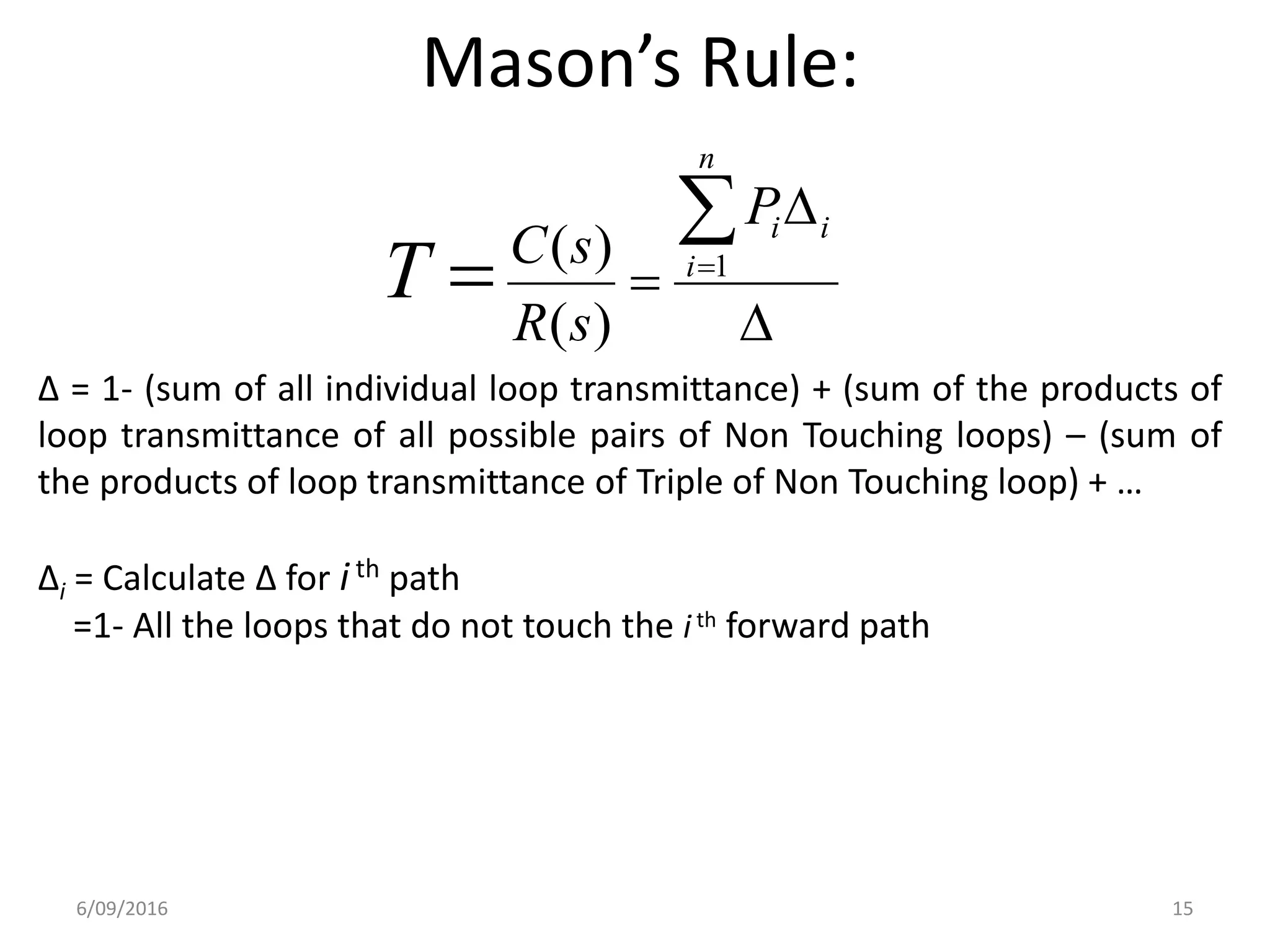
Mason’s Rule:
∆ =1- (sum of all individual loop transmittance) + (sum of the products of
loop transmittance of all possible pairs of Non Touching loops) – (sum of
the products of loop transmittance of Triple of Non Touching loop) + …
∆i = Calculate ∆ for ith path
=1- All the loops that do not touch the ith forward path
n
i
iiP
sR
sC
T 1
)(
)(
6/09/2016 15
16.
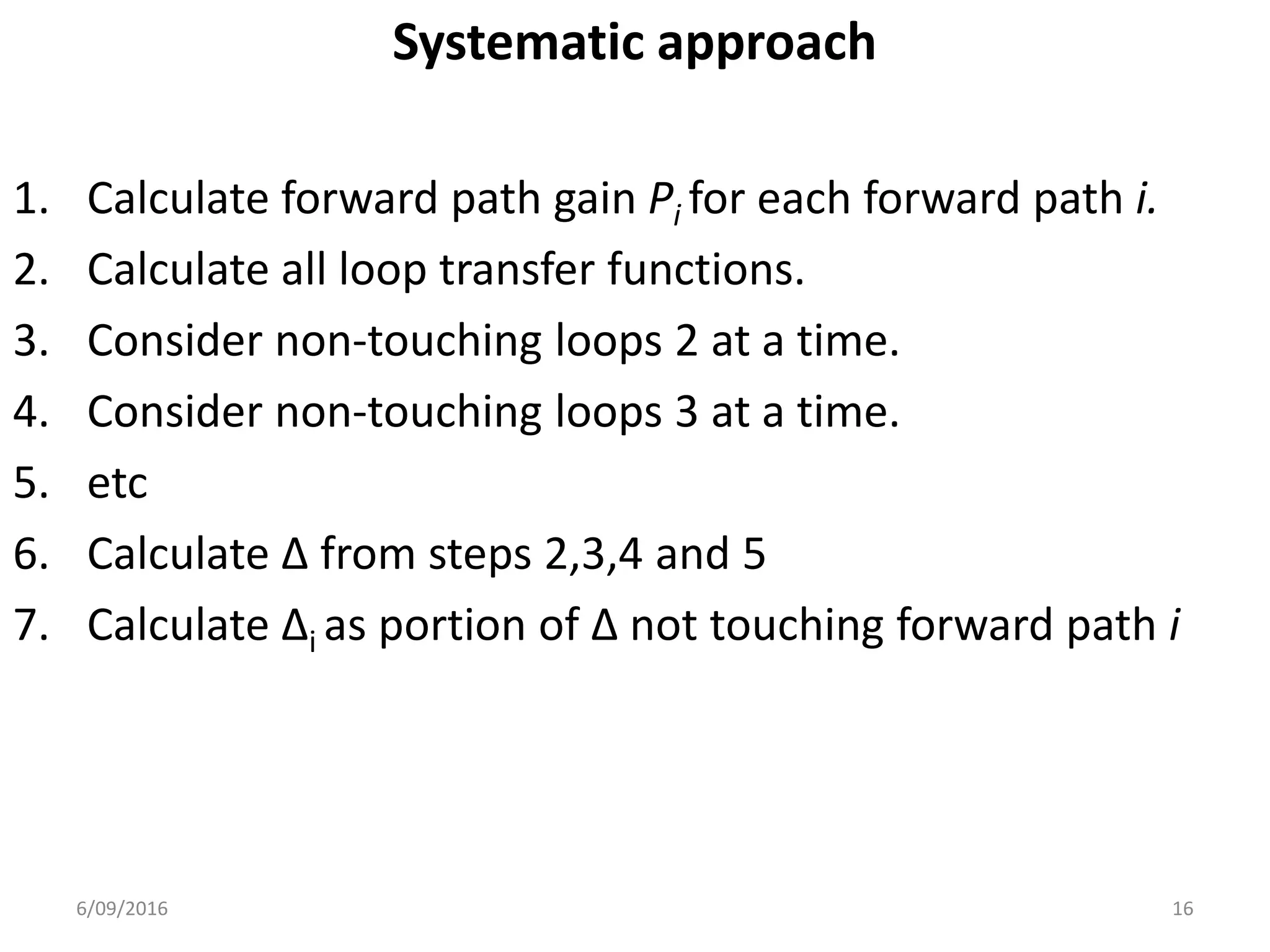
Systematic approach
1. Calculateforward path gain Pi for each forward path i.
2. Calculate all loop transfer functions.
3. Consider non-touching loops 2 at a time.
4. Consider non-touching loops 3 at a time.
5. etc
6. Calculate Δ from steps 2,3,4 and 5
7. Calculate Δi as portion of Δ not touching forward path i
166/09/2016
17.
6/09/2016 17
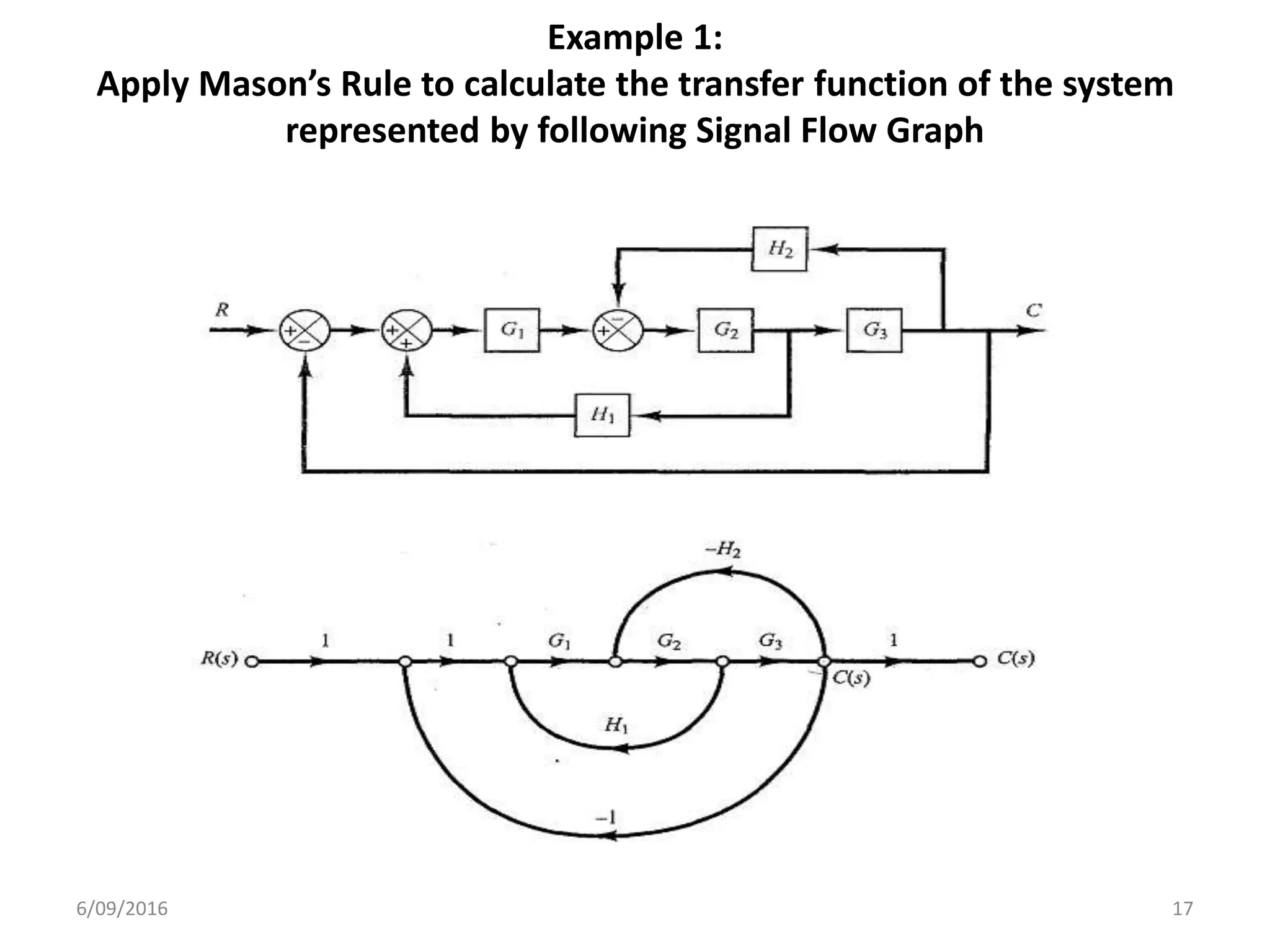
Example 1:
ApplyMason’s Rule to calculate the transfer function of the system
represented by following Signal Flow Graph
18.
Continued…..
• In thissystem there is only one forward path between the input R(s) and the
output C(s). The forward path gain is
• we see that there are three individual loops. The gains of these loops are
𝐿1 = 𝐺1 𝐺2 𝐻1
𝐿2 = −𝐺2 𝐺3 𝐻2
𝐿3 = −𝐺1 𝐺2 𝐺3
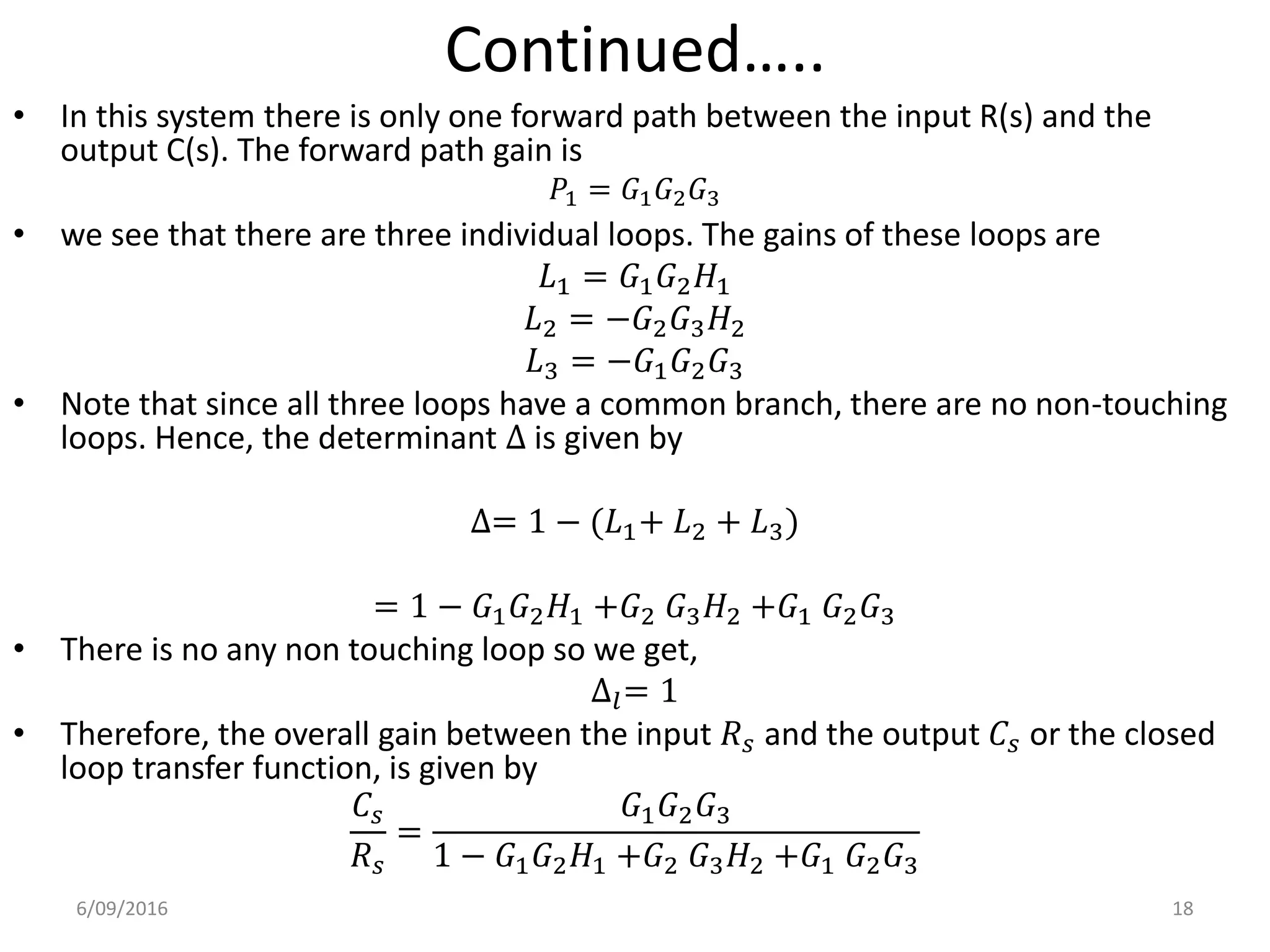
• Note that since all three loops have a common branch, there are no non-touching
loops. Hence, the determinant ∆ is given by
∆= 1 − (𝐿1+ 𝐿2 + 𝐿3)
= 1 − 𝐺1 𝐺2 𝐻1 +𝐺2 𝐺3 𝐻2 +𝐺1 𝐺2 𝐺3
• There is no any non touching loop so we get,
∆𝑙= 1
• Therefore, the overall gain between the input 𝑅 𝑠 and the output 𝐶𝑠 or the closed
loop transfer function, is given by
𝐶𝑠
𝑅 𝑠
=
𝐺1 𝐺2 𝐺3
1 − 𝐺1 𝐺2 𝐻1 +𝐺2 𝐺3 𝐻2 +𝐺1 𝐺2 𝐺3
6/09/2016 18
𝑃1 = 𝐺1 𝐺2 𝐺3
19.
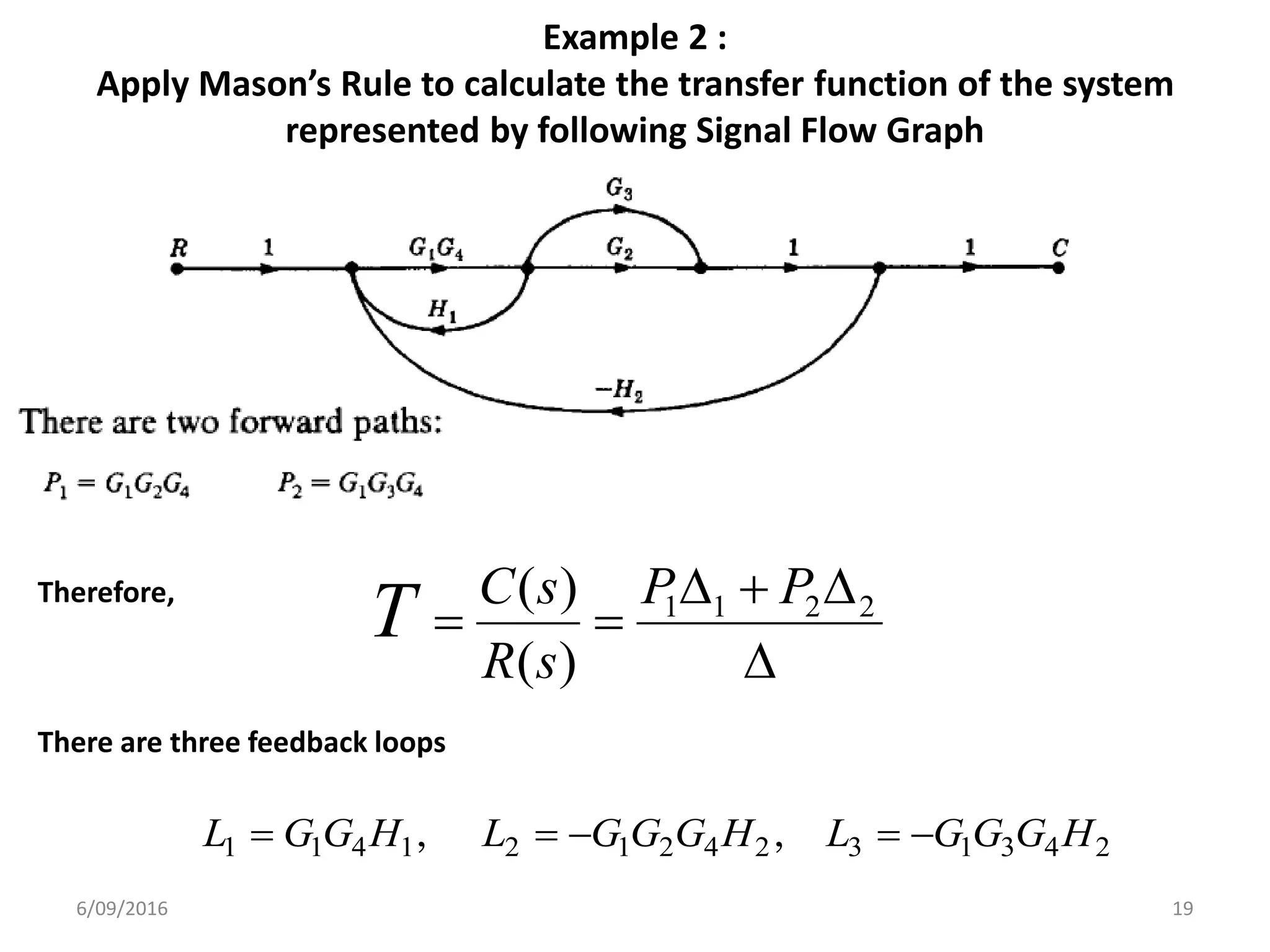
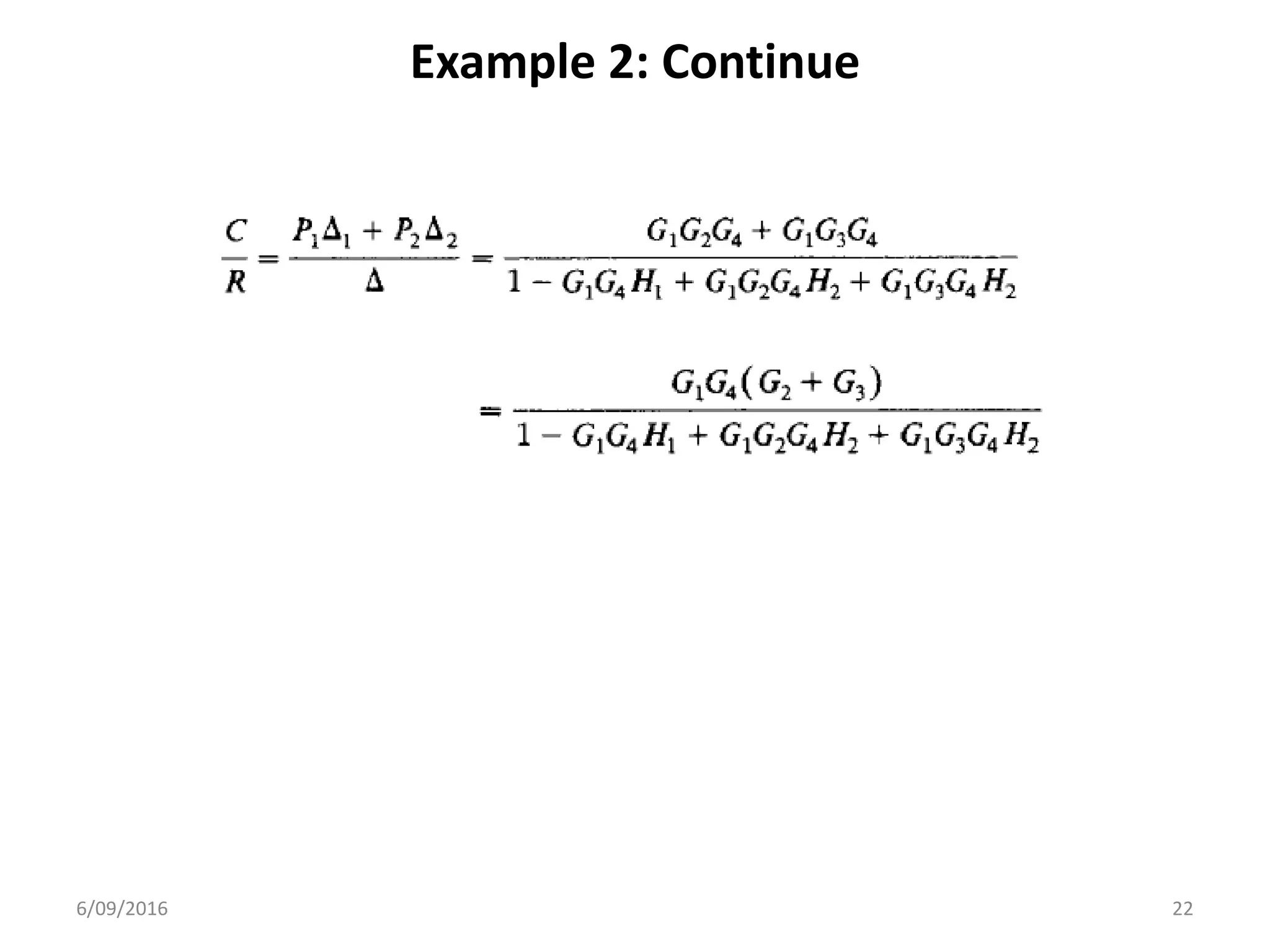
2211
)(
)( PP
sR
sC
TTherefore,
24313242121411HGGGLHGGGLHGGL ,,
There are three feedback loops
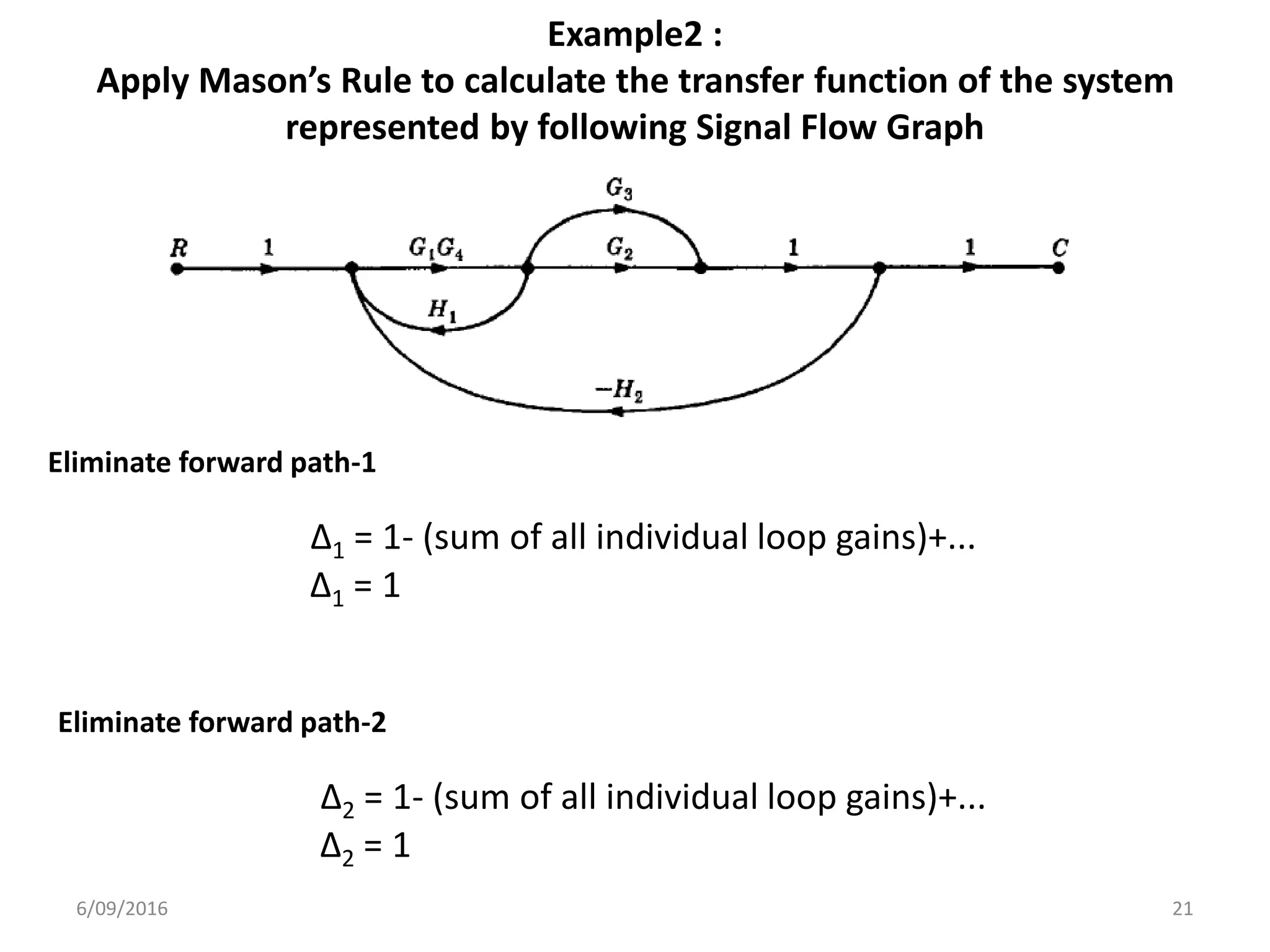
Example 2 :
Apply Mason’s Rule to calculate the transfer function of the system
represented by following Signal Flow Graph
6/09/2016 19
20.
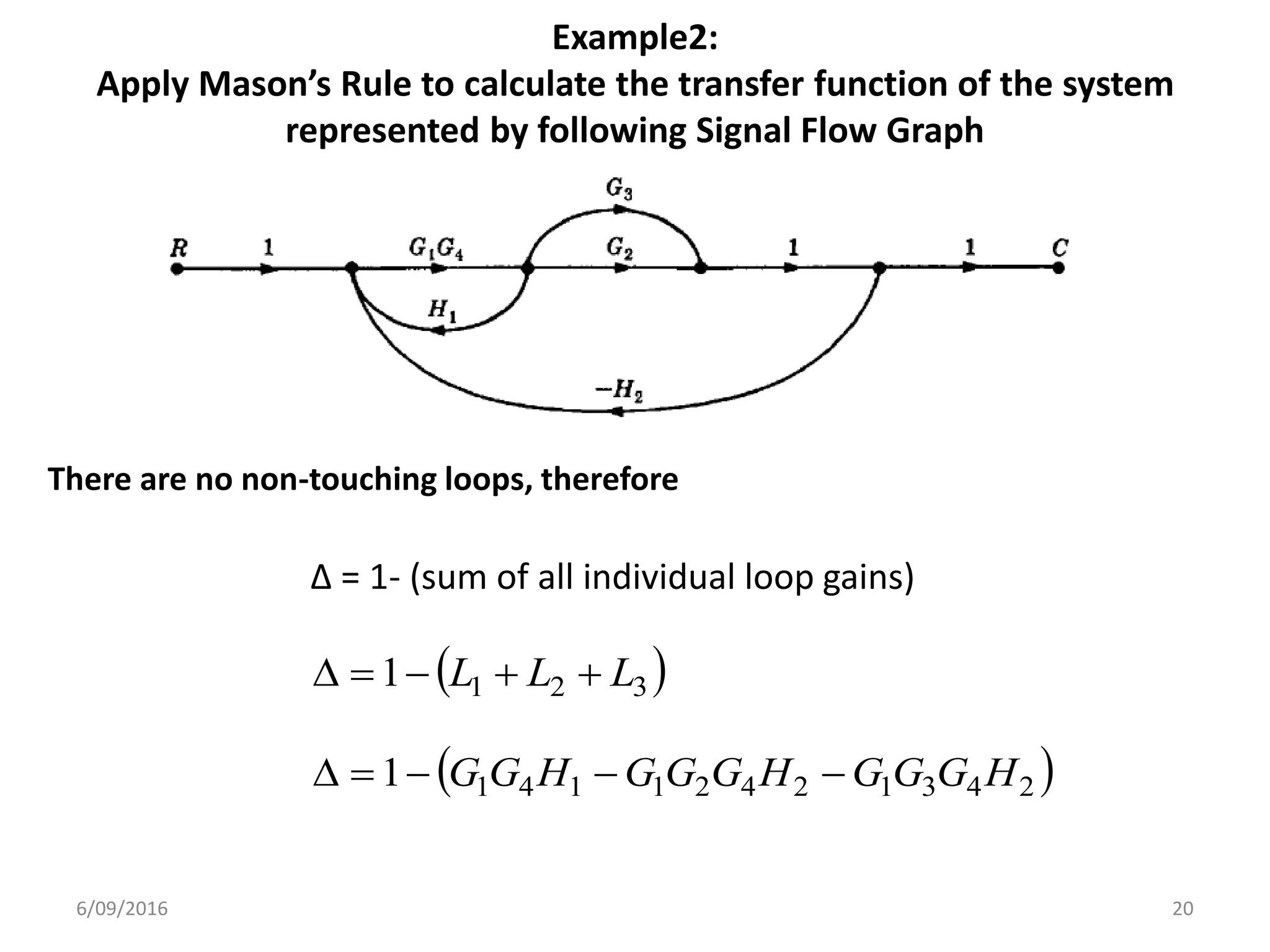
∆ = 1-(sum of all individual loop gains)
There are no non-touching loops, therefore
3211 LLL
243124211411 HGGGHGGGHGG
Example2:
Apply Mason’s Rule to calculate the transfer function of the system
represented by following Signal Flow Graph
6/09/2016 20
21.
∆1 = 1-(sum of all individual loop gains)+...
Eliminate forward path-1
∆1 = 1
∆2 = 1- (sum of all individual loop gains)+...
Eliminate forward path-2
∆2 = 1
Example2 :
Apply Mason’s Rule to calculate the transfer function of the system
represented by following Signal Flow Graph
6/09/2016 21