Control System:
Polar Plot
By
Dr.K.Hussain
Associate Professor & Head
Dept. of EE, SITCOE
Polar Plot
• The Polar plot is a plot, which can be drawn between the
magnitude and the phase angle of G(jω)H(jω) by varying ω from
zero to ∞.
• The polar graph sheet consistsof concentric circles and radial
lines.
• Polar plot is a plot of magnitude versus phase angle in complex
plane .
(i.e., locus of magnitude traced by the phasor by varying frequency from 0 to ∞)
Advantages of Polar plots
• It depicts the frequency response characteristics over the entire
frequency range in a single plot.
• Much easier to determineboth wpc and wgc.
• Here we will have to work with open loop transfer function G(s)H(s)
(and not with closed loop transfer function and unlike Bode plot we
need not requiredto convertG(s)H(s) to the time constantform).
Disadvantageof Polar plots:
• The plot does not clearly indicate the contribution of each
individualfactor of the open loop transfer function.
Polar Plot
Basics of Polar Plot:
• The polar plot of a sinusoidal transfer function G(jω) is a plot
of the magnitude of G(jω) Vs the phase of G(jω) on polar co-
ordinates as ω is varied from 0 to ∞.
i.e., |G(jω)| Vs angle G(jω) as ω → 0 to ∞.
• Polar graph sheet has concentric circles and radial lines.
• Concentric circles represents the magnitude.
• Radial lines represents the phase angles.
• In polar sheet:
• +ve phase angle is measured in ACW from 00
• -ve phase angle is measured in CW from 00.
Polar Plot
• To sketch the polar plot of G(jω) for the entire
range of frequency ω, i.e., from 0 to infinity,
there are four key points that usually need to
be known:
(1) the start of plot where ω = 0,
(2) the end of plot where ω = ∞,
(3) where the plot crosses the real axis, i.e.,
Im(G(jω)) = 0, and
(4) where the plot crosses the imaginary axis, i.e.,
Re(G(jω)) = 0.
Polar Plot
PROCEDURE:
• Expressthe given expression of OLTFin (1+sT) form.
• Substitutes = jω in the expression for G(s)H(s) and get G(jω)H(jω).
• Get the expressionsfor |G(jω)H(jω)|& G(jω)H(jω).
• Tabulatevariousvalues of magnitude and phaseangles for different
valuesof ω ranging from 0 to ∞.
• Usually the choiceof frequencieswill be the corner frequency and
around cornerfrequencies.
• Chooseproperscale for the magnitude circles.
• Fix all the pointsin the polar graph sheet and join the pointsby a
smooth curve.
• Write the frequency correspondingto each of the point of the plot.
Example-1
Q. Sketch the Polar Plot of a 1st Order Pole of 10/(s+2)
Step 2: We now find the magnitude and phase.
The given transfer function is
Step 1: The first step would be convert this transfer
function to the frequencydomain.This can be done by
converting‘s’by ‘jω’.
Sol:
Step 3: Vary ‘ω’ from 0 to ∞.
Now insteadof taking different
values of ω, we simply take two
extreme values of ω. i.e., ω = 0
and ω = ∞
Now these two points are sufficient to draw the polar plot. At ω = 0 since the magnitude is +5 and
angle is 0, we draw it on the right side horizontal axis. At ω = ∞, the magnitude is 0 while angle is -900,
hence we drawit as dot (zero magnitude) on the -900.
Polar Plot
Example-2 (Effect of adding more Simple Poles)
Q. Sketch the Polar Plot for the given transfer function
10/(s+2)(s+4)
Step 2: We now find the magnitude and phase.
The given transfer function is
Step 1: The first step would be convert this transfer
function to the frequencydomain.This can be done by
converting‘s’ by ‘jω’.
Sol:
Step 3: Vary ‘ω’ from 0 to ∞.
Now insteadof taking different values of ω,
we simply take two extreme values of ω
i.e., ω = 0 and ω = ∞
Now these two points are sufficient to draw the
polar plot. At ω = 0 since the magnitude is +5
and angle is 0, we draw it on the right side
horizontal axis. At ω = ∞, the magnitude is 0
while angle is -900, hence we draw it as dot
(zero magnitude) on the -90.
Polar Plot
Polar Plots-Examples
Polar Plot
Polar Plot
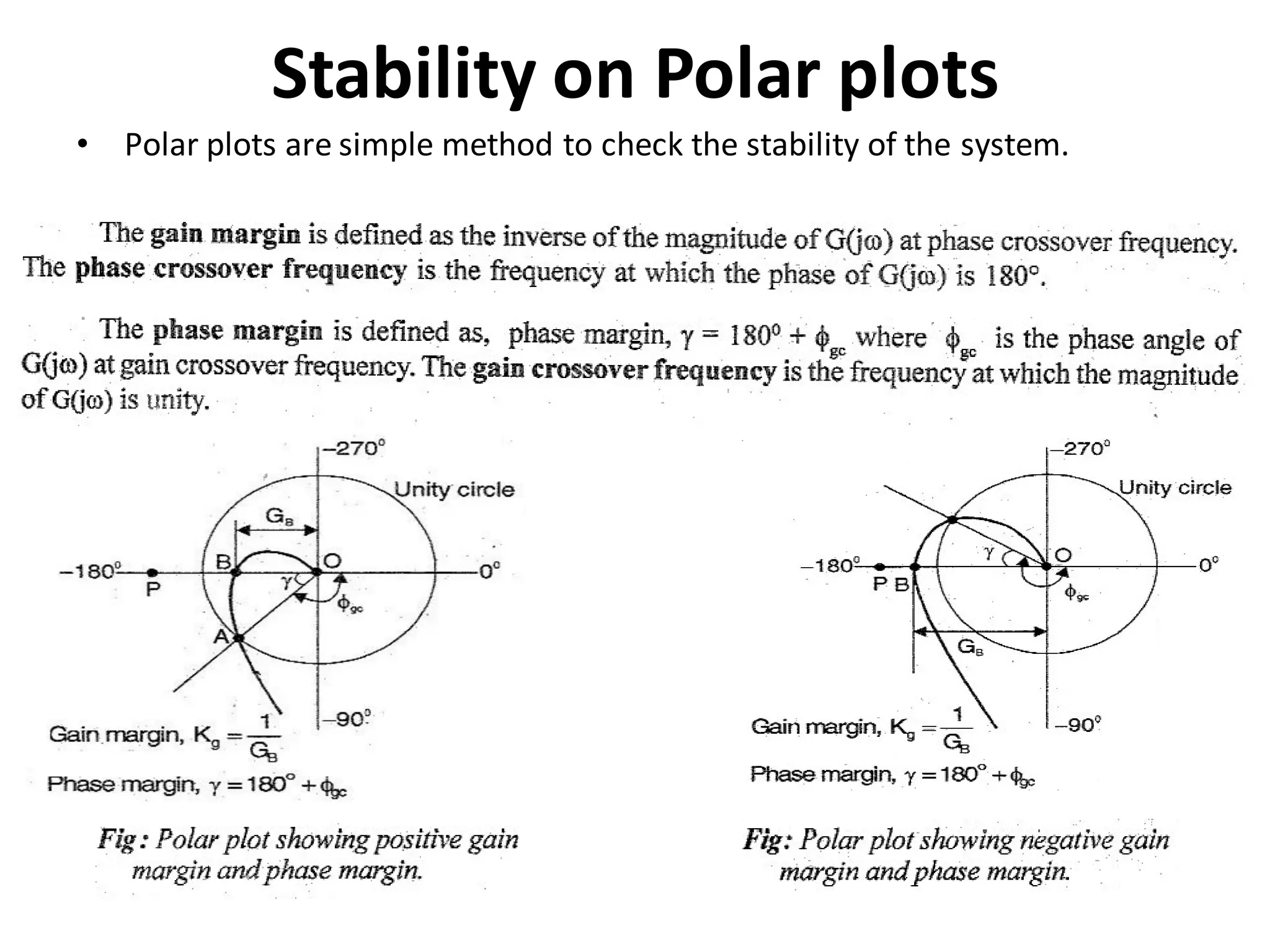
Stability on Polar plots
• Polar plots are simple method to check the stability of the system.
THANK YOU

Polar Plot

  • 1.
    Control System: Polar Plot By Dr.K.Hussain AssociateProfessor & Head Dept. of EE, SITCOE
  • 2.
    Polar Plot • ThePolar plot is a plot, which can be drawn between the magnitude and the phase angle of G(jω)H(jω) by varying ω from zero to ∞. • The polar graph sheet consistsof concentric circles and radial lines. • Polar plot is a plot of magnitude versus phase angle in complex plane . (i.e., locus of magnitude traced by the phasor by varying frequency from 0 to ∞)
  • 3.
    Advantages of Polarplots • It depicts the frequency response characteristics over the entire frequency range in a single plot. • Much easier to determineboth wpc and wgc. • Here we will have to work with open loop transfer function G(s)H(s) (and not with closed loop transfer function and unlike Bode plot we need not requiredto convertG(s)H(s) to the time constantform). Disadvantageof Polar plots: • The plot does not clearly indicate the contribution of each individualfactor of the open loop transfer function.
  • 4.
    Polar Plot Basics ofPolar Plot: • The polar plot of a sinusoidal transfer function G(jω) is a plot of the magnitude of G(jω) Vs the phase of G(jω) on polar co- ordinates as ω is varied from 0 to ∞. i.e., |G(jω)| Vs angle G(jω) as ω → 0 to ∞. • Polar graph sheet has concentric circles and radial lines. • Concentric circles represents the magnitude. • Radial lines represents the phase angles. • In polar sheet: • +ve phase angle is measured in ACW from 00 • -ve phase angle is measured in CW from 00.
  • 5.
    Polar Plot • Tosketch the polar plot of G(jω) for the entire range of frequency ω, i.e., from 0 to infinity, there are four key points that usually need to be known: (1) the start of plot where ω = 0, (2) the end of plot where ω = ∞, (3) where the plot crosses the real axis, i.e., Im(G(jω)) = 0, and (4) where the plot crosses the imaginary axis, i.e., Re(G(jω)) = 0.
  • 6.
    Polar Plot PROCEDURE: • Expressthegiven expression of OLTFin (1+sT) form. • Substitutes = jω in the expression for G(s)H(s) and get G(jω)H(jω). • Get the expressionsfor |G(jω)H(jω)|& G(jω)H(jω). • Tabulatevariousvalues of magnitude and phaseangles for different valuesof ω ranging from 0 to ∞. • Usually the choiceof frequencieswill be the corner frequency and around cornerfrequencies. • Chooseproperscale for the magnitude circles. • Fix all the pointsin the polar graph sheet and join the pointsby a smooth curve. • Write the frequency correspondingto each of the point of the plot.
  • 7.
    Example-1 Q. Sketch thePolar Plot of a 1st Order Pole of 10/(s+2) Step 2: We now find the magnitude and phase. The given transfer function is Step 1: The first step would be convert this transfer function to the frequencydomain.This can be done by converting‘s’by ‘jω’. Sol: Step 3: Vary ‘ω’ from 0 to ∞. Now insteadof taking different values of ω, we simply take two extreme values of ω. i.e., ω = 0 and ω = ∞ Now these two points are sufficient to draw the polar plot. At ω = 0 since the magnitude is +5 and angle is 0, we draw it on the right side horizontal axis. At ω = ∞, the magnitude is 0 while angle is -900, hence we drawit as dot (zero magnitude) on the -900. Polar Plot
  • 8.
    Example-2 (Effect ofadding more Simple Poles) Q. Sketch the Polar Plot for the given transfer function 10/(s+2)(s+4) Step 2: We now find the magnitude and phase. The given transfer function is Step 1: The first step would be convert this transfer function to the frequencydomain.This can be done by converting‘s’ by ‘jω’. Sol: Step 3: Vary ‘ω’ from 0 to ∞. Now insteadof taking different values of ω, we simply take two extreme values of ω i.e., ω = 0 and ω = ∞ Now these two points are sufficient to draw the polar plot. At ω = 0 since the magnitude is +5 and angle is 0, we draw it on the right side horizontal axis. At ω = ∞, the magnitude is 0 while angle is -900, hence we draw it as dot (zero magnitude) on the -90. Polar Plot
  • 9.
  • 10.
  • 11.
  • 12.
    Stability on Polarplots • Polar plots are simple method to check the stability of the system.
  • 13.