3
• Terminologies
• Basic Properties of SFG
• Definitions of SFG Terms
• SFG Algebra
• Relation between SFG and block diagram
• Mason Gain Formula
• Example solved with Masson Gain Formula
• Consider a simple equation below and draw its signal flow graph:
y  ax
• The signal flow graph of the equation is shown below;
x a y
• Every variable in a signal flow graph is designed by a Node.
• Every transmission function in a signal flow graph is designed by a
Branch.
• Branches are always unidirectional.
• The arrow in the branch denotes the direction of the signal flow.
• An input node or source contain only the outgoing branches. i.e., X1
• An output node or sink contain only the incoming branches. i.e., X4
• A path is a continuous, unidirectional succession of branches along which no
node is passed more than ones. i.e.,
• A forward path is a path from the input node to the output node. i.e.,
X1 to X2 to X3 to X4 , and X1 to X2 to X4 , are forwardpaths.
• A feedback path or feedback loop is a path which originates and terminates on
the same node. i.e.; X2 to X3 and back to X2 is a feedback path.
X1 to X2 to X3 to X4 X1 to X2 to X4 X2 to X3 to X4
• A self-loop is a feedback loop consisting of a single branch. i.e.; A33 is a self
loop.
• The gain of a branch is the transmission function of that branch.
• The path gain is the product of branch gains encountered in traversing a path.
i.e. the gain of forwards path X1 to X2 to X3 to X4 is A21A32A43
• The loop gain is the product of the branch gains of the loop. i.e., the loop gain
of the feedback loop from X2 to X3 and back to X2 is A32A23.
• Two loops, paths, or loop and a path are said to be non-touching if they have
no nodes in common.
Draw the SFG for the following system of linear algebraic equations
y2  a12 y1  a32 y3
y3  a23 y2 a43 y4
y4  a24 y2  a34 y3 a44 y4
y5  a25 y2 a45 y4
SFG applies only to linear systems.
The equations for which anSFG is drawn must be algebraic equations in the form of
cause-and-effect.
Nodes areused to represent variables. Normally, the nodes arearrangedfrom left to
right, from the input to the output, following asuccession of cause-and-effect
relations through the system.
Signals travel along branches only in the direction described by the arrows of the
branches.
The branch directing from node yk to yj represents the dependence of yk upon yj but
not the reverse.
A signal yk traveling along abranch between yk to yj is multiplied by the gain of the
branch akj, so asignal akjyk is delivered at yj.
Input Node (Source): An input node is a node that has only outgoing branches
Output Node (Sink): An output node is a node that has only incoming branches
Path: A path is any collection of a continuous succession of branches traversed in
the same direction.
Forward Path: A forward path is a path that starts at an input node and ends at an
output node and along which no node is traversed more than once
Path Gain: The product of the branch gains encountered in traversing a path is
called the path gain
Loop: A loop is a path that originates and terminates on the same node and along
which no other node is encountered more than once.
Forward-Path Gain: The forward-path gain is the path gain of a forward path.
Loop Gain: The loop gain is the path gain of a loop.
Nontouching Loops: Two parts of an SFG are nontouching if they do not share a
common node.
The value of the variable represented by a node is equal to the sum of all the
signals entering the node.
The value of the variable represented by a node is transmitted through all branches
leaving the node
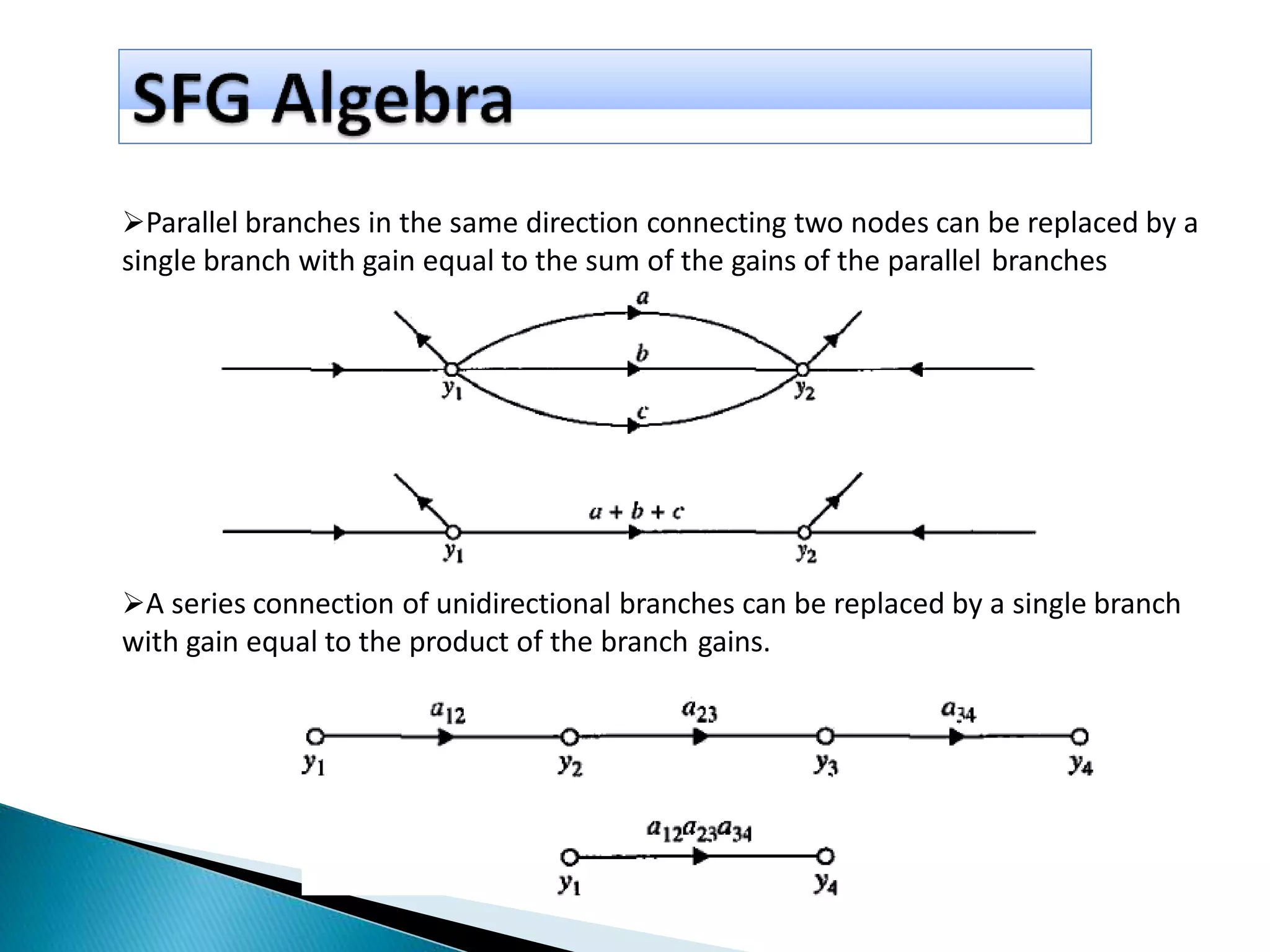
Parallel branches in the same direction connecting two nodes can be replaced by a
single branch with gain equal to the sum of the gains of the parallel branches
A series connection of unidirectional branches can be replaced by a single branch
with gain equal to the product of the branch gains.
Example
Where,
n = number of forward paths.
Pi = the i th forward-path gain.
∆ = Determinant of the system
∆i = Determinant of the ith forwardpath
• ∆ is called the signal flow graph determinant or characteristic function. Since
∆=0 is the system characteristic equation.

• The transfer function T, of a system represented by a signal-flow graph is;
n
Pii
 i1
T  C(s)
R(s)
∆i = Calculate ∆ for ith path
=1- [loop transmittance of single Non Touching loops with forward path]
+ [loop transmittance of pair of Non Touching loops withforward path]
n
Pii
 i1
R(s) 
 ∆ = 1- (sum of all individual loop transmittance) + (sum of the products
of loop transmittance of all possible pairs of Non Touching loops) – (sum
of the products of loop transmittance of Triple of Non Touching loop) +
…
T  C(s)
1. Calculate forward path gain Pi for each forward
path i.
2. Calculate all loop transfer functions
3. Consider non-touching loops 2 at a time
4. Consider non-touching loops 3 at a time
5. etc
6. Calculate Δ from steps 2,3,4 and 5
7. Calculate Δi as portion of Δ not touching forward
path i
10
T 
C(s)

P11 P22
R(s) 
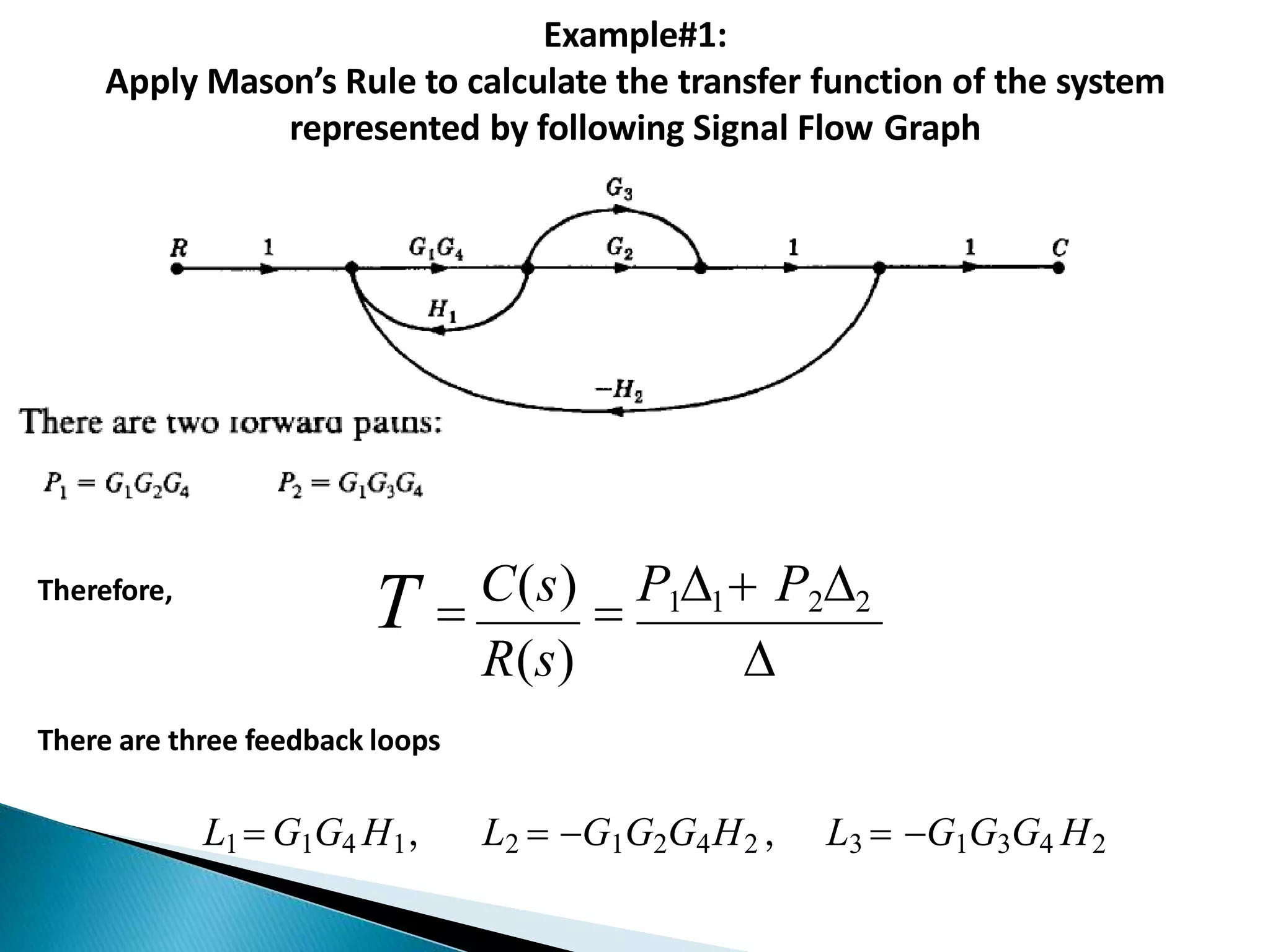
Therefore,
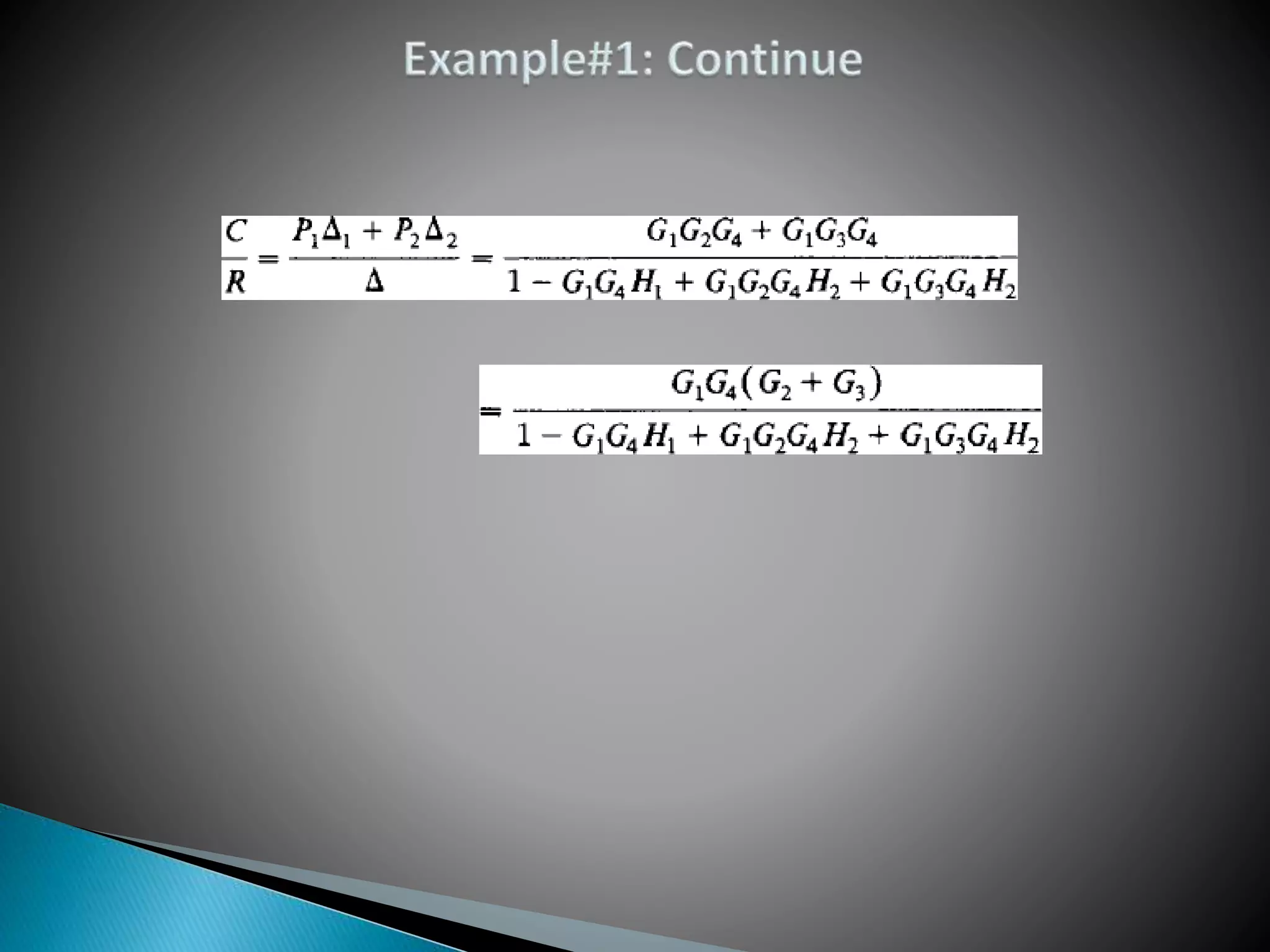
L3  G1G3G4 H2
L2  G1G2G4H2 ,
L1  G1G4 H1,
There are three feedback loops
Example#1:
Apply Mason’s Rule to calculate the transfer function of the system
represented by following Signal Flow Graph
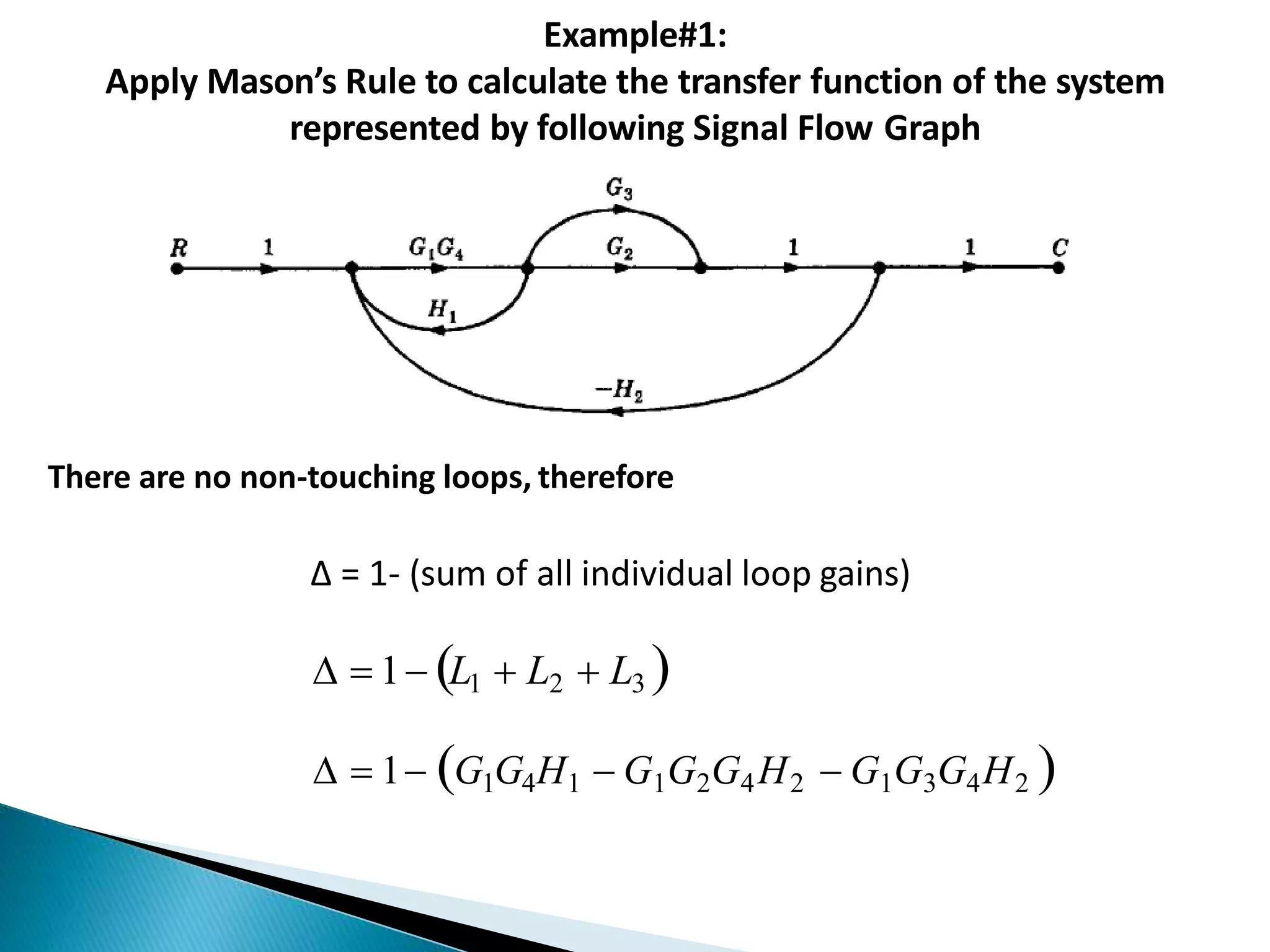
There are no non-touching loops, therefore
∆ = 1- (sum of all individual loop gains)
  1 L1  L2  L3 
  1 G1G4H1  G1G2G4H2  G1G3G4H2 
Example#1:
Apply Mason’s Rule to calculate the transfer function of the system
represented by following Signal Flow Graph
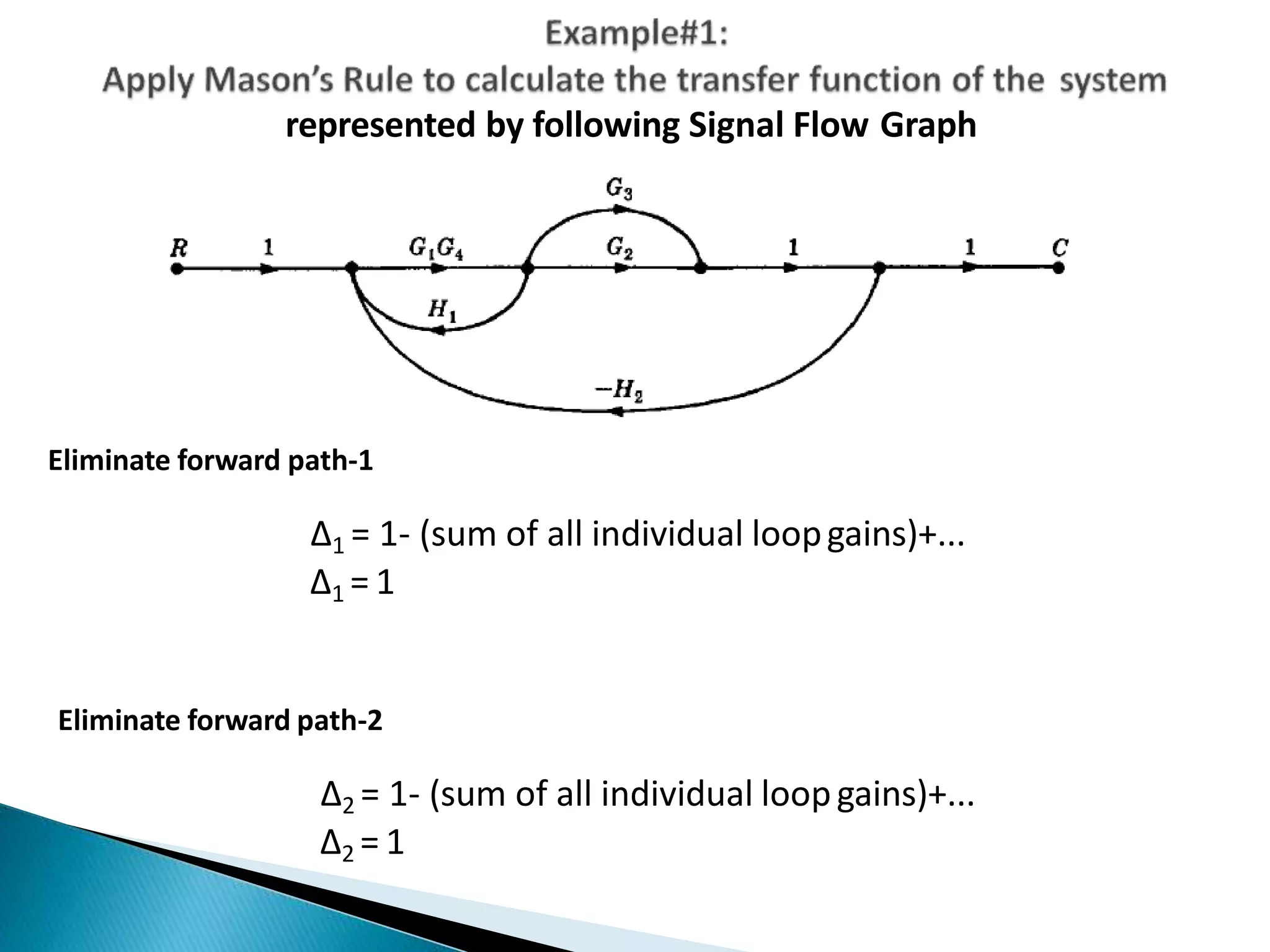
Eliminate forward path-1
∆1 = 1- (sum of all individual loopgains)+...
∆1 = 1
Eliminate forward path-2
∆2 = 1- (sum of all individual loopgains)+...
∆2 = 1
represented by following Signal Flow Graph
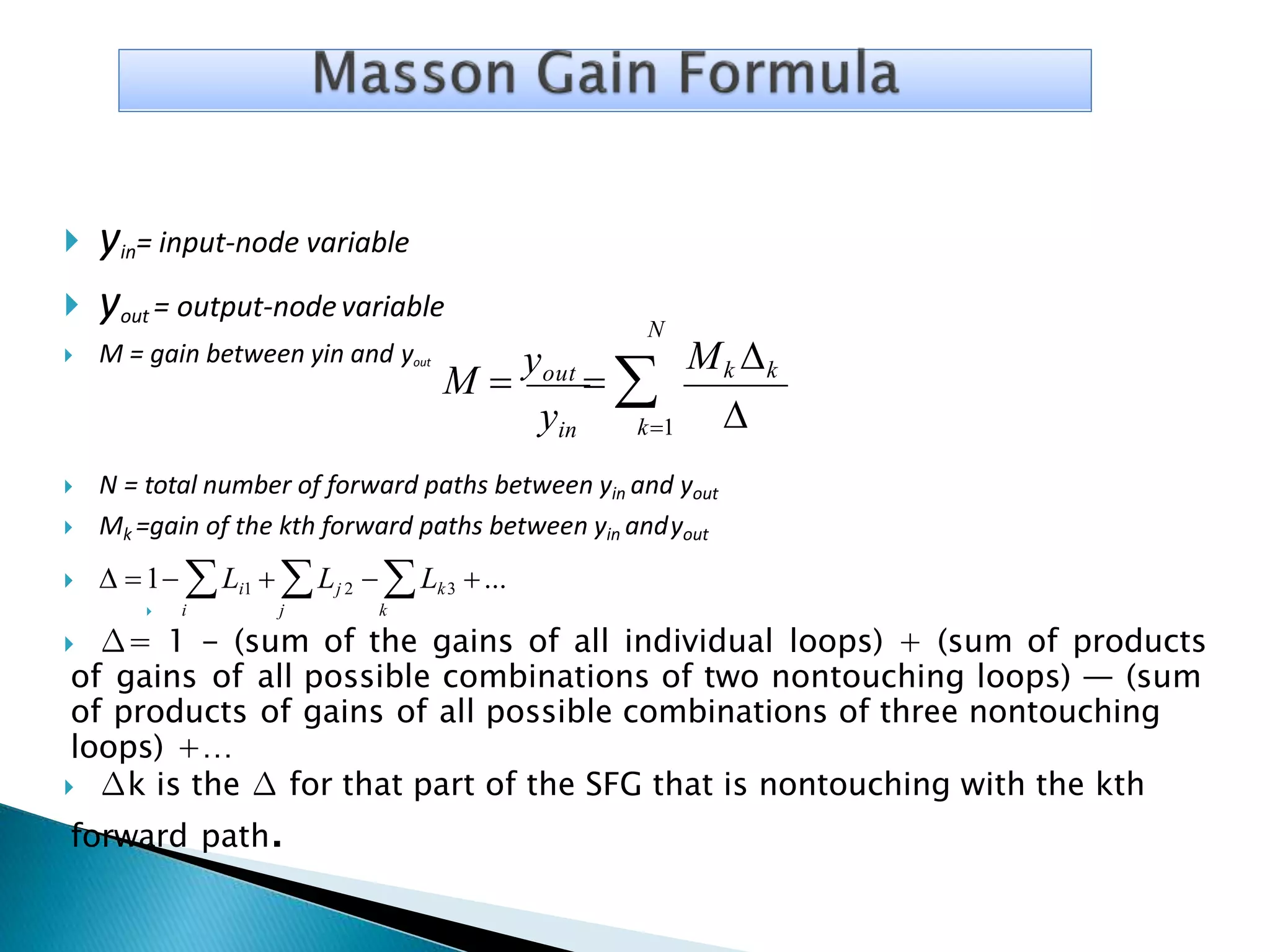
 yin= input-node variable
 yout = output-nodevariable
 M = gain between yin and yout
 N = total number of forward paths between yin and yout
 Mk =gain of the kth forward paths between yin andyout
  1 Li1  Lj 2  Lk3 ...
 i j k
 ∆= 1 - (sum of the gains of all individual loops) + (sum of products
of gains of all possible combinations of two nontouching loops) — (sum
of products of gains of all possible combinations of three nontouching
loops) +…
 ∆k is the ∆ for that part of the SFG that is nontouching with the kth
forward path.

Mk k
N
M 
yout
 
yin k1
Example: 2
Determine the gain between y1 and y5 using the gain formula for the following
SFG.
Solution
The three forward paths between y1 and y5 and the forward-path gainsare
Solution
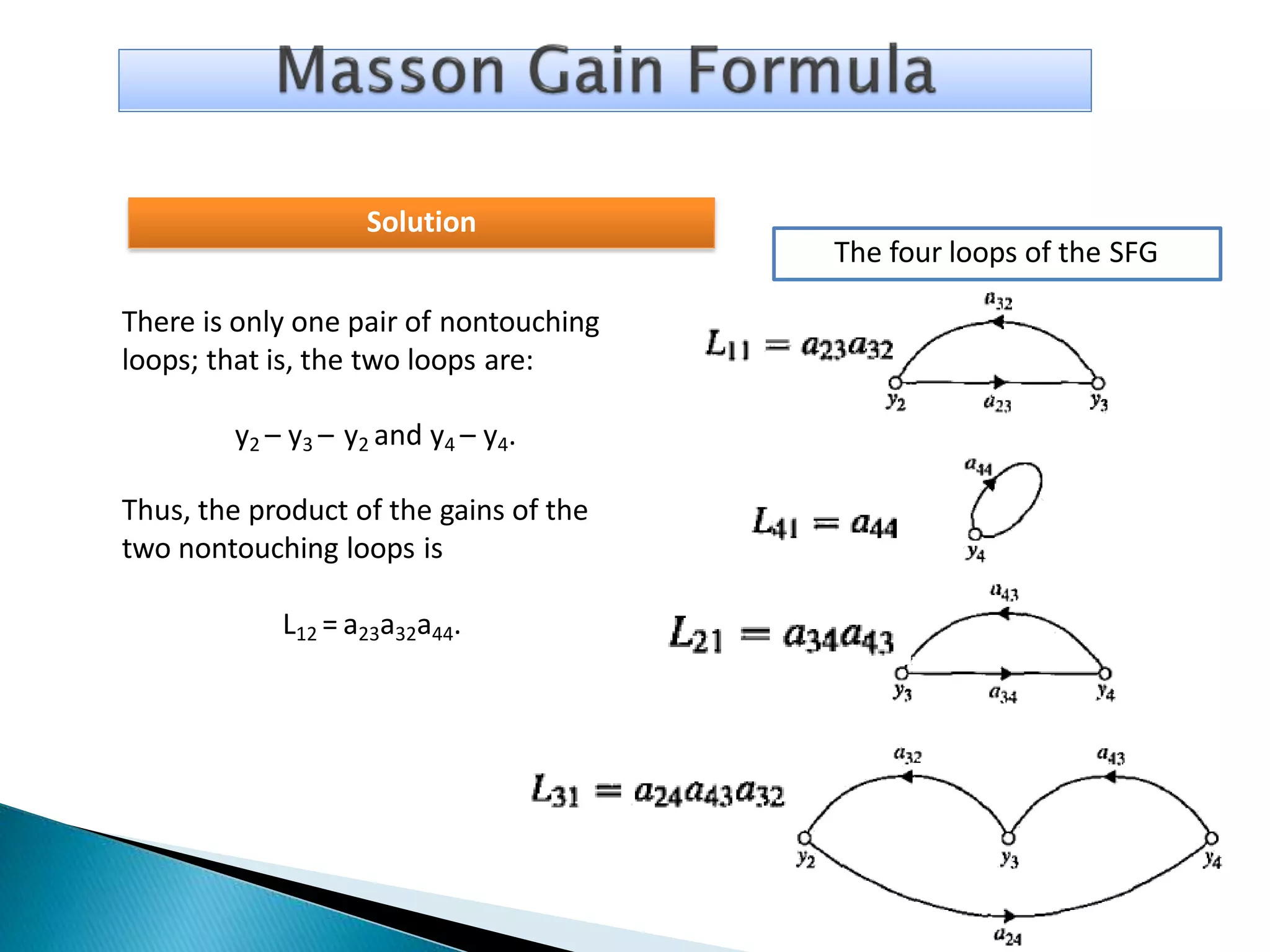
The four loops of the SFG
There is only one pair of nontouching
loops; that is, the two loops are:
y2 – y3 – y2 and y4 – y4.
Thus, the product of the gains of the
two nontouching loops is
L12 = a23a32a44.
Solution
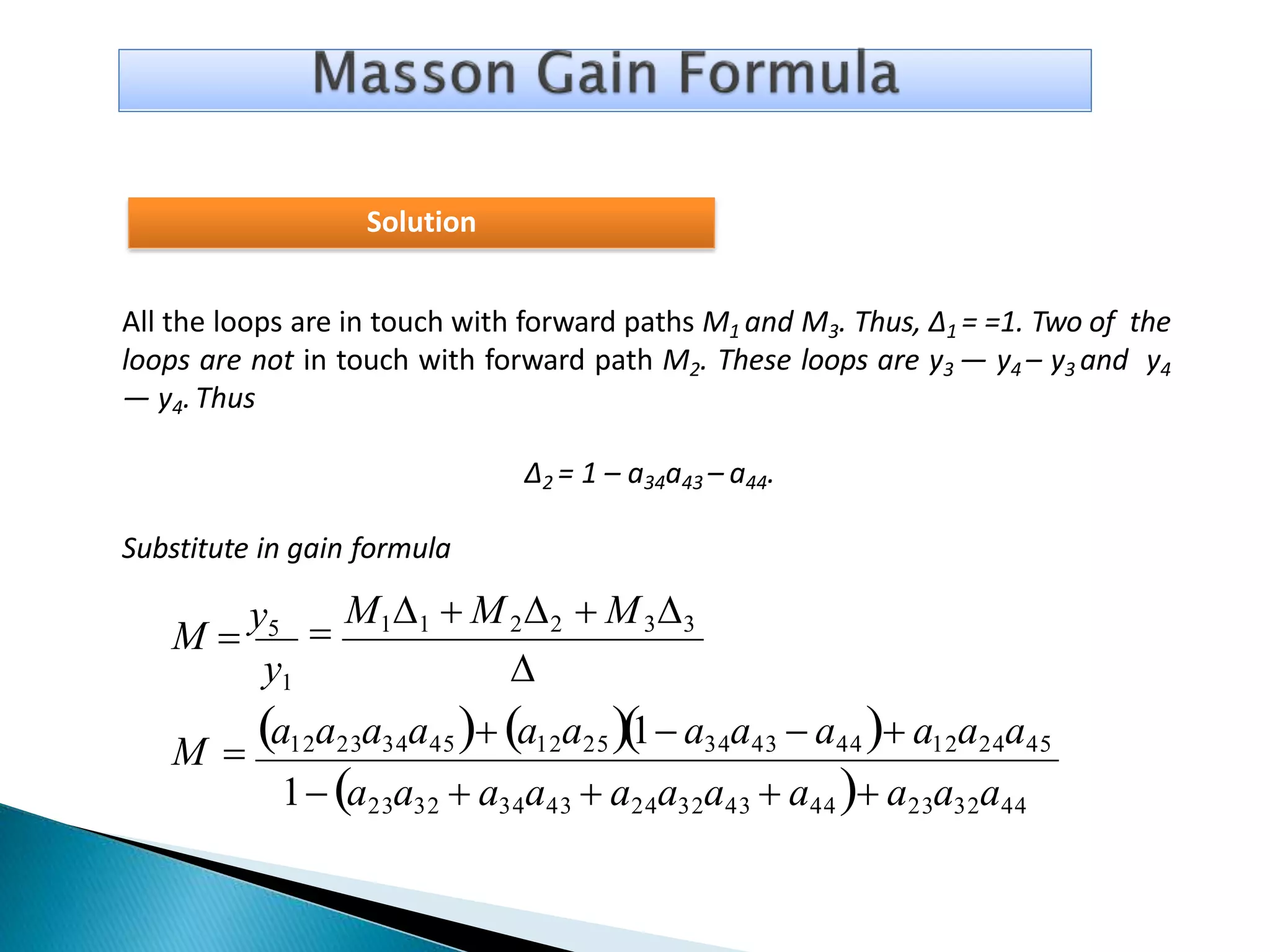
All the loops are in touch with forward paths M1 and M3. Thus, ∆1 = =1. Two of the
loops are not in touch with forward path M2. These loops are y3 — y4 – y3 and y4
— y4.Thus
∆2 = 1 – a34a43 – a44.
Substitute in gain formula
M 
a12a23a34a45 a12a251 a34a43  a44  a12a24a45
1 a23a32  a34a43  a24a32a43  a44  a23a32a44

M11  M22  M33
y1 
M 
y5

Signal Flow Graph, SFG and Mason Gain Formula, Example solved with Masson Gain Formula

  • 1.
    3 • Terminologies • BasicProperties of SFG • Definitions of SFG Terms • SFG Algebra • Relation between SFG and block diagram • Mason Gain Formula • Example solved with Masson Gain Formula
  • 2.
    • Consider asimple equation below and draw its signal flow graph: y  ax • The signal flow graph of the equation is shown below; x a y • Every variable in a signal flow graph is designed by a Node. • Every transmission function in a signal flow graph is designed by a Branch. • Branches are always unidirectional. • The arrow in the branch denotes the direction of the signal flow.
  • 3.
    • An inputnode or source contain only the outgoing branches. i.e., X1 • An output node or sink contain only the incoming branches. i.e., X4 • A path is a continuous, unidirectional succession of branches along which no node is passed more than ones. i.e., • A forward path is a path from the input node to the output node. i.e., X1 to X2 to X3 to X4 , and X1 to X2 to X4 , are forwardpaths. • A feedback path or feedback loop is a path which originates and terminates on the same node. i.e.; X2 to X3 and back to X2 is a feedback path. X1 to X2 to X3 to X4 X1 to X2 to X4 X2 to X3 to X4
  • 4.
    • A self-loopis a feedback loop consisting of a single branch. i.e.; A33 is a self loop. • The gain of a branch is the transmission function of that branch. • The path gain is the product of branch gains encountered in traversing a path. i.e. the gain of forwards path X1 to X2 to X3 to X4 is A21A32A43 • The loop gain is the product of the branch gains of the loop. i.e., the loop gain of the feedback loop from X2 to X3 and back to X2 is A32A23. • Two loops, paths, or loop and a path are said to be non-touching if they have no nodes in common.
  • 5.
    Draw the SFGfor the following system of linear algebraic equations y2  a12 y1  a32 y3 y3  a23 y2 a43 y4 y4  a24 y2  a34 y3 a44 y4 y5  a25 y2 a45 y4
  • 8.
    SFG applies onlyto linear systems. The equations for which anSFG is drawn must be algebraic equations in the form of cause-and-effect. Nodes areused to represent variables. Normally, the nodes arearrangedfrom left to right, from the input to the output, following asuccession of cause-and-effect relations through the system. Signals travel along branches only in the direction described by the arrows of the branches. The branch directing from node yk to yj represents the dependence of yk upon yj but not the reverse. A signal yk traveling along abranch between yk to yj is multiplied by the gain of the branch akj, so asignal akjyk is delivered at yj.
  • 9.
    Input Node (Source):An input node is a node that has only outgoing branches Output Node (Sink): An output node is a node that has only incoming branches Path: A path is any collection of a continuous succession of branches traversed in the same direction. Forward Path: A forward path is a path that starts at an input node and ends at an output node and along which no node is traversed more than once Path Gain: The product of the branch gains encountered in traversing a path is called the path gain Loop: A loop is a path that originates and terminates on the same node and along which no other node is encountered more than once. Forward-Path Gain: The forward-path gain is the path gain of a forward path. Loop Gain: The loop gain is the path gain of a loop. Nontouching Loops: Two parts of an SFG are nontouching if they do not share a common node.
  • 10.
    The value ofthe variable represented by a node is equal to the sum of all the signals entering the node. The value of the variable represented by a node is transmitted through all branches leaving the node
  • 11.
    Parallel branches inthe same direction connecting two nodes can be replaced by a single branch with gain equal to the sum of the gains of the parallel branches A series connection of unidirectional branches can be replaced by a single branch with gain equal to the product of the branch gains.
  • 13.
  • 14.
    Where, n = numberof forward paths. Pi = the i th forward-path gain. ∆ = Determinant of the system ∆i = Determinant of the ith forwardpath • ∆ is called the signal flow graph determinant or characteristic function. Since ∆=0 is the system characteristic equation.  • The transfer function T, of a system represented by a signal-flow graph is; n Pii  i1 T  C(s) R(s)
  • 15.
    ∆i = Calculate∆ for ith path =1- [loop transmittance of single Non Touching loops with forward path] + [loop transmittance of pair of Non Touching loops withforward path] n Pii  i1 R(s)   ∆ = 1- (sum of all individual loop transmittance) + (sum of the products of loop transmittance of all possible pairs of Non Touching loops) – (sum of the products of loop transmittance of Triple of Non Touching loop) + … T  C(s)
  • 16.
    1. Calculate forwardpath gain Pi for each forward path i. 2. Calculate all loop transfer functions 3. Consider non-touching loops 2 at a time 4. Consider non-touching loops 3 at a time 5. etc 6. Calculate Δ from steps 2,3,4 and 5 7. Calculate Δi as portion of Δ not touching forward path i 10
  • 17.
    T  C(s)  P11 P22 R(s) Therefore, L3  G1G3G4 H2 L2  G1G2G4H2 , L1  G1G4 H1, There are three feedback loops Example#1: Apply Mason’s Rule to calculate the transfer function of the system represented by following Signal Flow Graph
  • 18.
    There are nonon-touching loops, therefore ∆ = 1- (sum of all individual loop gains)   1 L1  L2  L3    1 G1G4H1  G1G2G4H2  G1G3G4H2  Example#1: Apply Mason’s Rule to calculate the transfer function of the system represented by following Signal Flow Graph
  • 19.
    Eliminate forward path-1 ∆1= 1- (sum of all individual loopgains)+... ∆1 = 1 Eliminate forward path-2 ∆2 = 1- (sum of all individual loopgains)+... ∆2 = 1 represented by following Signal Flow Graph
  • 21.
     yin= input-nodevariable  yout = output-nodevariable  M = gain between yin and yout  N = total number of forward paths between yin and yout  Mk =gain of the kth forward paths between yin andyout   1 Li1  Lj 2  Lk3 ...  i j k  ∆= 1 - (sum of the gains of all individual loops) + (sum of products of gains of all possible combinations of two nontouching loops) — (sum of products of gains of all possible combinations of three nontouching loops) +…  ∆k is the ∆ for that part of the SFG that is nontouching with the kth forward path.  Mk k N M  yout   yin k1
  • 22.
    Example: 2 Determine thegain between y1 and y5 using the gain formula for the following SFG.
  • 23.
    Solution The three forwardpaths between y1 and y5 and the forward-path gainsare
  • 24.
    Solution The four loopsof the SFG There is only one pair of nontouching loops; that is, the two loops are: y2 – y3 – y2 and y4 – y4. Thus, the product of the gains of the two nontouching loops is L12 = a23a32a44.
  • 25.
    Solution All the loopsare in touch with forward paths M1 and M3. Thus, ∆1 = =1. Two of the loops are not in touch with forward path M2. These loops are y3 — y4 – y3 and y4 — y4.Thus ∆2 = 1 – a34a43 – a44. Substitute in gain formula M  a12a23a34a45 a12a251 a34a43  a44  a12a24a45 1 a23a32  a34a43  a24a32a43  a44  a23a32a44  M11  M22  M33 y1  M  y5