CONTROL SYSTEMS THEORY

Transient response
Chapter 4
Objectives
 To find time response from transfer
function
 To describe quantitatively the
transient response of a 1st and 2nd
order system
 To determine response of a control
system using poles and zeros
Introduction
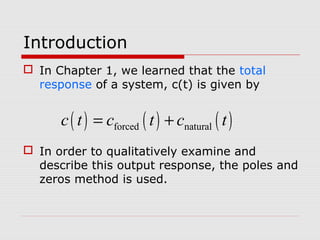
 In Chapter 1, we learned that the total
response of a system, c(t) is given by

c ( t ) = cforced ( t ) + cnatural ( t )
 In order to qualitatively examine and
describe this output response, the poles and
zeros method is used.
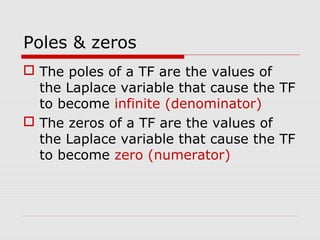
Poles & zeros
 The poles of a TF are the values of
the Laplace variable that cause the TF
to become infinite (denominator)
 The zeros of a TF are the values of
the Laplace variable that cause the TF
to become zero (numerator)
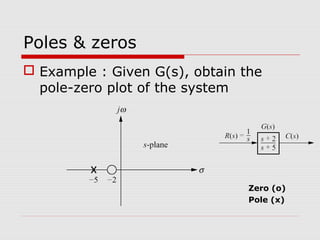
Poles & zeros
 Example : Given the TF of G(s), find
the poles and zeros

 Solution :
 G(s) = zero/pole
 Pole at s=-5
 Zero at s=-2
Poles & zeros
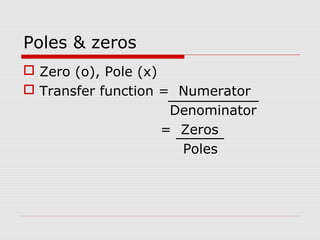
 Zero (o), Pole (x)
 Transfer function = Numerator
Denominator
= Zeros
Poles
Poles & zeros
 Example : Given G(s), obtain the
pole-zero plot of the system

Zero (o)
Pole (x)
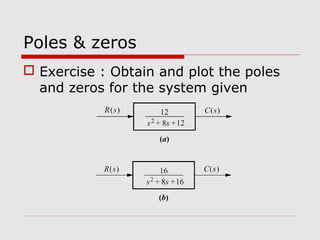
Poles & zeros
 Exercise : Obtain and plot the poles
and zeros for the system given
First order system
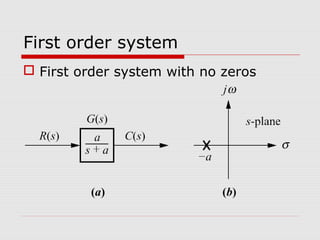
 First order system with no zeros
First order system
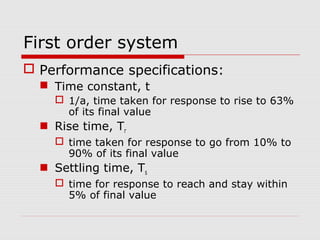
 Performance specifications:
 Time constant, t
 1/a, time taken for response to rise to 63%
of its final value

 Rise time, Tr
 time taken for response to go from 10% to
90% of its final value

 Settling time, Ts
 time for response to reach and stay within
5% of final value
First order system
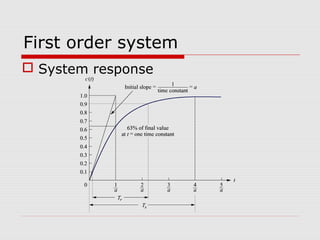
 System response
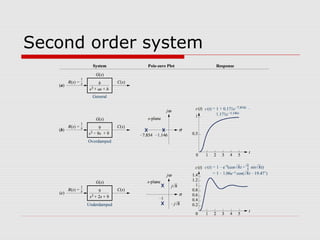
Second order system
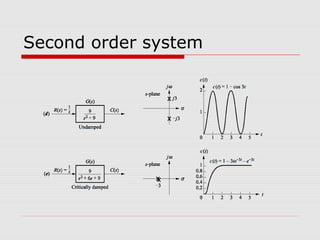
Second order system
Second order system
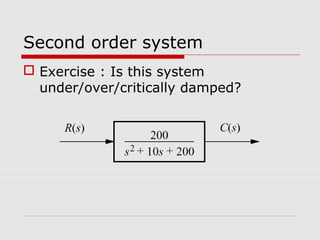
 Exercise : Is this system
under/over/critically damped?
Second order system
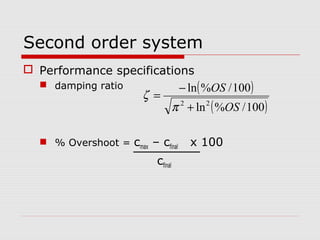
 Performance specifications
 damping ratio
− ln ( %OS / 100 )
ζ =
π 2 + ln 2 ( %OS / 100 )
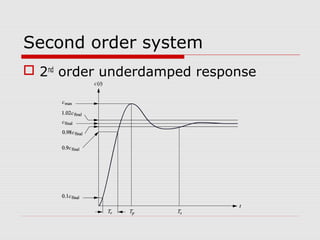
 % Overshoot = cmax – cfinal

cfinal

x 100
Second order system
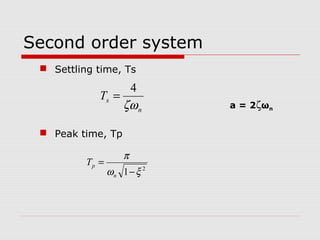
 Settling time, Ts

4
Ts =
ζω n
 Peak time, Tp

Tp =

π
ωn 1 − ξ 2

a = 2ζωn
Second order system
 2nd order underdamped response
Second order system
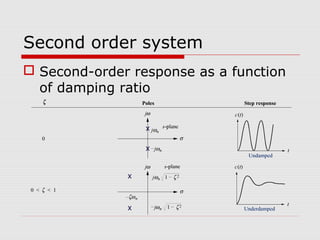
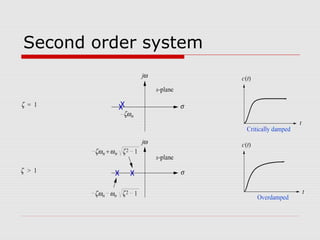
 Second-order response as a function
of damping ratio
Second order system
Second order system
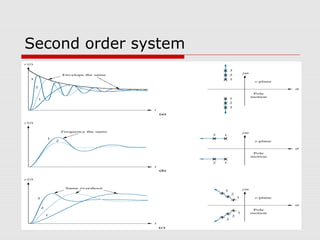
 Step responses of second-order
under-damped systems as poles
move:
a. with constant real part
b. with constant imaginary part
c. with constant damping ratio
(constant on the diagonal)
Second order system
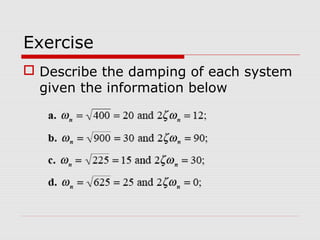
Exercise
 Describe the damping of each system
given the information below
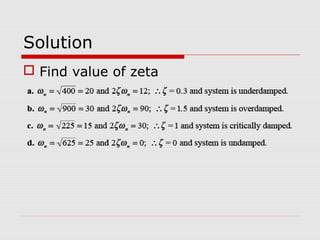
Solution
 Find value of zeta
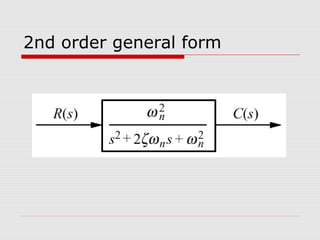
2nd order general form
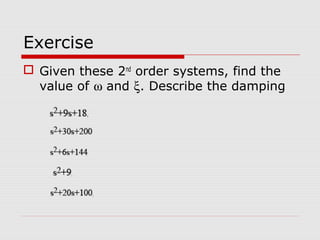
Exercise
 Given these 2nd order systems, find the
value of ω and ξ. Describe the damping
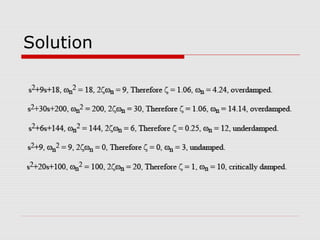
Solution
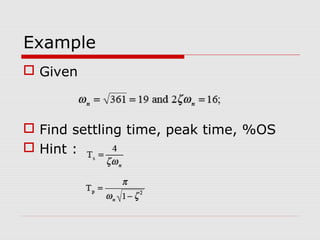
Example
 Given

 Find settling time, peak time, %OS
 Hint :
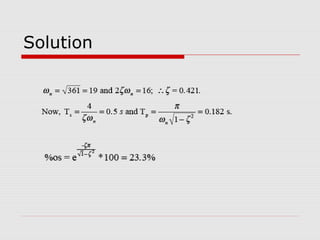
Solution
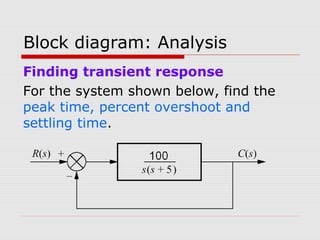
Block diagram: Analysis
Finding transient response
For the system shown below, find the
peak time, percent overshoot and
settling time.
Block diagram: Analysis
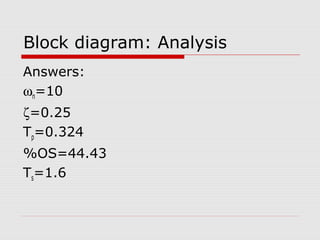
Answers:
ωn=10
ζ=0.25
Tp=0.324
%OS=44.43
Ts=1.6
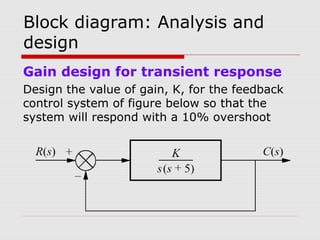
Block diagram: Analysis and
design
Gain design for transient response
Design the value of gain, K, for the feedback
control system of figure below so that the
system will respond with a 10% overshoot
Block diagram: Analysis and
design
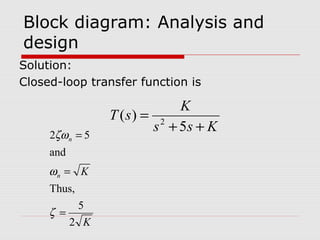
Solution:
Closed-loop transfer function is

2ζω n = 5
and

ωn = K
Thus,
5
ζ =
2 K

K
T (s) = 2
s + 5s + K
Block diagram: Analysis and
design
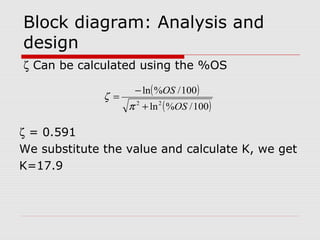
ζ Can be calculated using the %OS
ζ =

− ln ( %OS / 100 )

π 2 + ln 2 ( %OS / 100 )

ζ = 0.591
We substitute the value and calculate K, we get
K=17.9
Higher order systems
 Systems with >2 poles and zeros can
be approximated to 2nd order system
with 2 dominant poles
Higher order systems
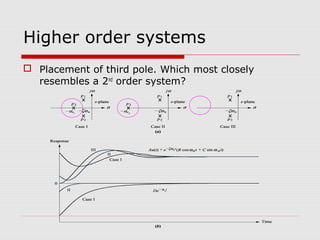
 Placement of third pole. Which most closely
resembles a 2nd order system?
Higher order systems
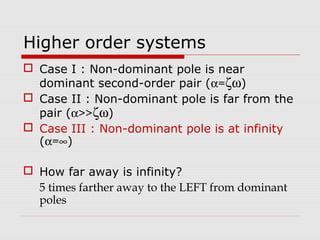
 Case I : Non-dominant pole is near
dominant second-order pair (α=ζω)
 Case II : Non-dominant pole is far from the
pair (α>>ζω)
 Case III : Non-dominant pole is at infinity
(α=∞)
 How far away is infinity?
5 times farther away to the LEFT from dominant
poles
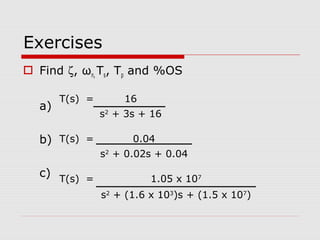
Exercises
 Find ζ, ωn, Ts, Tp and %OS
a)

T(s) =

b) T(s) =

16
s2 + 3s + 16
0.04
s2 + 0.02s + 0.04

c) T(s) =

1.05 x 10⁷
s2 + (1.6 x 10³)s + (1.5 x 10⁷)
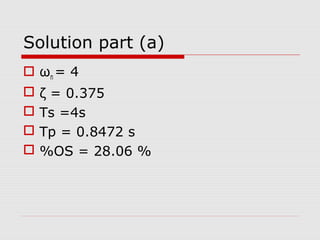
Solution part (a)
 ωn = 4





ζ = 0.375
Ts =4s
Tp = 0.8472 s
%OS = 28.06 %
Solution part (b)
 ωn = 0.2





ζ = 0.05
Ts =400s
Tp = 15.73s
%OS = 85.45 %
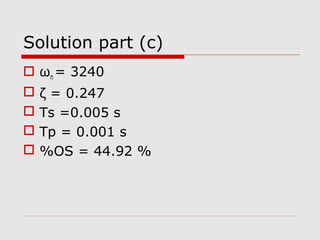
Solution part (c)
 ωn = 3240





ζ = 0.247
Ts =0.005 s
Tp = 0.001 s
%OS = 44.92 %

Control chap4