TIME RESPONSE
OF
FIRST ORDER SYSTEM
Email : hasansaeedcontrol@gmail.com
URL: http://shasansaeed.yolasite.com/
1SYED HASAN SAEED
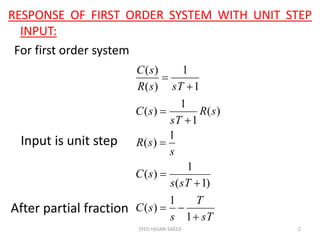
RESPONSE OF FIRST ORDER SYSTEM WITH UNIT STEP
INPUT:
For first order system
SYED HASAN SAEED 2
sT
T
s
sC
sTs
sC
s
sR
sR
sT
sC
sTsR
sC









1
1
)(
)1(
1
)(
1
)(
)(
1
1
)(
1
1
)(
)(
Input is unit step
After partial fraction
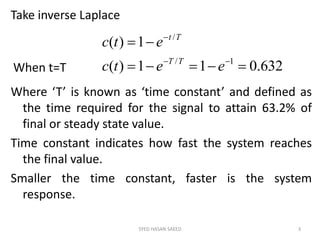
Take inverse Laplace
Where ‘T’ is known as ‘time constant’ and defined as
the time required for the signal to attain 63.2% of
final or steady state value.
Time constant indicates how fast the system reaches
the final value.
Smaller the time constant, faster is the system
response.
SYED HASAN SAEED 3
632.011)(
1)(
1/
/




eetc
etc
TT
Tt
When t=T
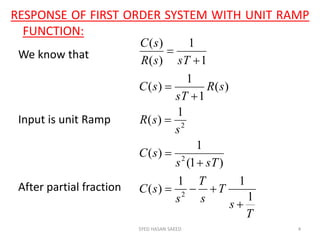
RESPONSE OF FIRST ORDER SYSTEM WITH UNIT RAMP
FUNCTION:
SYED HASAN SAEED 4
T
s
T
s
T
s
sC
sTs
sC
s
sR
sR
sT
sC
sTsR
sC
1
11
)(
)1(
1
)(
1
)(
)(
1
1
)(
1
1
)(
)(
2
2
2









Input is unit Ramp
After partial fraction
We know that
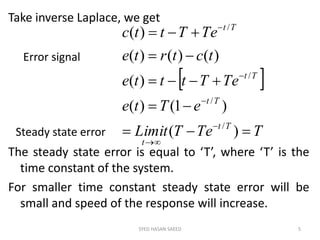
Take inverse Laplace, we get
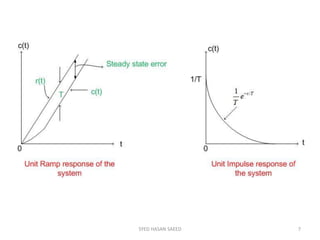
The steady state error is equal to ‘T’, where ‘T’ is the
time constant of the system.
For smaller time constant steady state error will be
small and speed of the response will increase.
SYED HASAN SAEED 5
 
TTeTLimit
eTte
TeTttte
tctrte
TeTttc
Tt
t
Tt
Tt
Tt










)(
)1()(
)(
)()()(
)(
/
/
/
/
Error signal
Steady state error
RESPONSE OF THE FIRST ORDER SYSTEM WITH UNIT
IMPULSE FUNCTION:
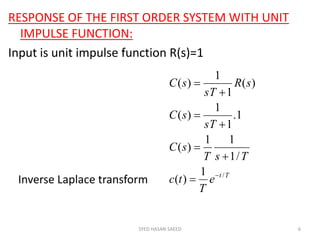
Input is unit impulse function R(s)=1
SYED HASAN SAEED 6
Tt
e
T
tc
TsT
sC
sT
sC
sR
sT
sC
/1
)(
/1
11
)(
1.
1
1
)(
)(
1
1
)(








Inverse Laplace transform
SYED HASAN SAEED 7
SYED HASAN SAEED 8
1)(
1
)(
1
)( 2



sR
s
sR
s
sRFor unit Ramp Input
For Unit Step Input
For Unit Impulse Input
Tt
TeTttc /
)( 

Tt
etc /
1)( 

Tt
e
T
tc /1
)( 

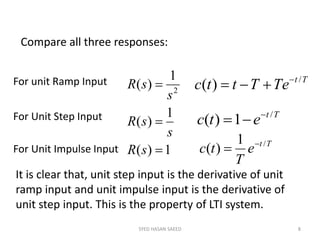
It is clear that, unit step input is the derivative of unit
ramp input and unit impulse input is the derivative of
unit step input. This is the property of LTI system.
Compare all three responses:
THANK YOU
SYED HASAN SAEED 9

Time response first order

  • 1.
    TIME RESPONSE OF FIRST ORDERSYSTEM Email : hasansaeedcontrol@gmail.com URL: http://shasansaeed.yolasite.com/ 1SYED HASAN SAEED
  • 2.
    RESPONSE OF FIRSTORDER SYSTEM WITH UNIT STEP INPUT: For first order system SYED HASAN SAEED 2 sT T s sC sTs sC s sR sR sT sC sTsR sC          1 1 )( )1( 1 )( 1 )( )( 1 1 )( 1 1 )( )( Input is unit step After partial fraction
  • 3.
    Take inverse Laplace Where‘T’ is known as ‘time constant’ and defined as the time required for the signal to attain 63.2% of final or steady state value. Time constant indicates how fast the system reaches the final value. Smaller the time constant, faster is the system response. SYED HASAN SAEED 3 632.011)( 1)( 1/ /     eetc etc TT Tt When t=T
  • 4.
    RESPONSE OF FIRSTORDER SYSTEM WITH UNIT RAMP FUNCTION: SYED HASAN SAEED 4 T s T s T s sC sTs sC s sR sR sT sC sTsR sC 1 11 )( )1( 1 )( 1 )( )( 1 1 )( 1 1 )( )( 2 2 2          Input is unit Ramp After partial fraction We know that
  • 5.
    Take inverse Laplace,we get The steady state error is equal to ‘T’, where ‘T’ is the time constant of the system. For smaller time constant steady state error will be small and speed of the response will increase. SYED HASAN SAEED 5   TTeTLimit eTte TeTttte tctrte TeTttc Tt t Tt Tt Tt           )( )1()( )( )()()( )( / / / / Error signal Steady state error
  • 6.
    RESPONSE OF THEFIRST ORDER SYSTEM WITH UNIT IMPULSE FUNCTION: Input is unit impulse function R(s)=1 SYED HASAN SAEED 6 Tt e T tc TsT sC sT sC sR sT sC /1 )( /1 11 )( 1. 1 1 )( )( 1 1 )(         Inverse Laplace transform
  • 7.
  • 8.
    SYED HASAN SAEED8 1)( 1 )( 1 )( 2    sR s sR s sRFor unit Ramp Input For Unit Step Input For Unit Impulse Input Tt TeTttc / )(   Tt etc / 1)(   Tt e T tc /1 )(   It is clear that, unit step input is the derivative of unit ramp input and unit impulse input is the derivative of unit step input. This is the property of LTI system. Compare all three responses:
  • 9.