BLOCK DIAGRAM
REPRESENTATION
MADE BY - NIRALI MONANI
BRANCH - ELECTRONICS & COMMUNICATION
INTRODUCTION
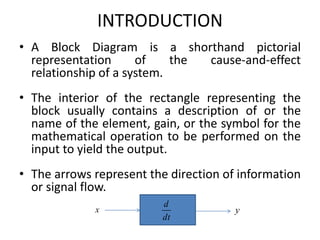
• A Block Diagram is a shorthand pictorial
representation of the cause-and-effect
relationship of a system.
• The interior of the rectangle representing the
block usually contains a description of or the
name of the element, gain, or the symbol for the
mathematical operation to be performed on the
input to yield the output.
• The arrows represent the direction of information
or signal flow.
dt
d
x y
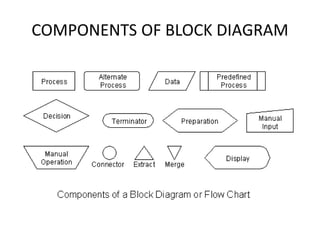
COMPONENTS OF BLOCK DIAGRAM
ADVANTAGES OF BLOCK DIAGRAM
• THE FUNCTIONAL OPERATION OF THE SYSTEM
CAN BE OBSERVED FROM BLOCK DIAGRAM
• BLOCK DIAGRAM GIVES THE INFORMATION
ABOUT PERFORMANCE OF SYSTEM
• BLOCK DIAGRAM IS USED FOR ANALYSIS &
DESIGN OF CONTROL SYSTEM
• IT IS VERY SIMPLE TO CONSTRUST THE BLOCK
DIAGRAM FOR BIG & COMPLICATED SYSTEM
DISADVANTAGES OF BLOCK DIAGRAM
• BLOCK DIAGRAM FOR GIVEN SYSTEM ARE NON
UNIQUE
• SOURCE OF ENERGY IN THE SYSTEM IS NOT
SHOWN IN THE DIAGRAM
• IN THE PROCEDURE OF REDUCTION OF BLOCK
DIAGRAM ALGEBRA SOME IMPORTANT
FUNCTIONSMAY BE OMITTED . THERE IS NO
CHECK FOR IT
• IT DOESN’T GIVE ANY INFORMATION ABOUT
PHYSICAL CONSTRUCTION OF THE SYSTEM
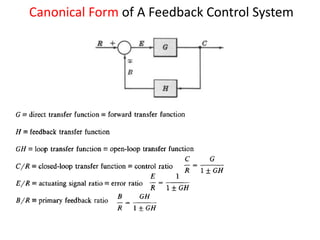
Canonical Form of A Feedback Control System
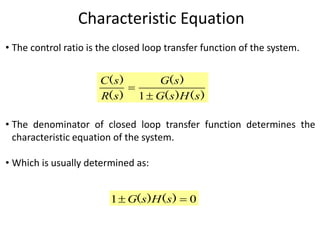
Characteristic Equation
• The control ratio is the closed loop transfer function of the system.
• The denominator of closed loop transfer function determines the
characteristic equation of the system.
• Which is usually determined as:
)()(
)(
)(
)(
sHsG
sG
sR
sC


1
01  )()( sHsG
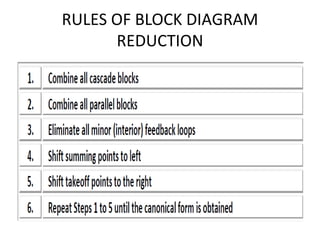
RULES OF BLOCK DIAGRAM
REDUCTION
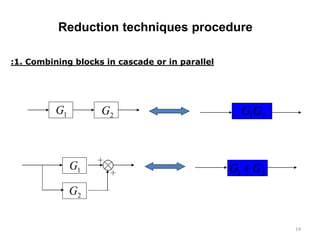
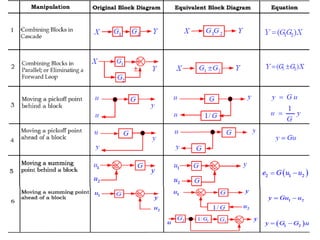
Reduction techniques procedure
:1. Combining blocks in cascade or in parallel
1G 2G 21GG
1G
2G
21 GG 
14
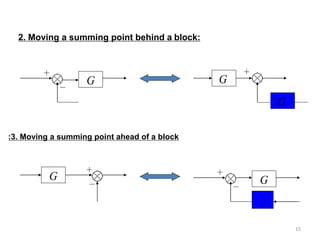
2. Moving a summing point behind a block:
G G
G
:3. Moving a summing point ahead of a block
G G
G
1
15
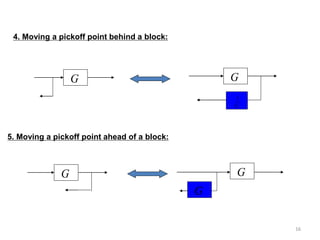
4. Moving a pickoff point behind a block:
G G
G
1
5. Moving a pickoff point ahead of a block:
G G
G
16
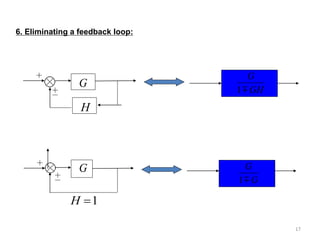
6. Eliminating a feedback loop:
G
H
G
1H
G
G
1
GH
G
1
17
THANK YOU !!!

Block diagram representation

  • 1.
    BLOCK DIAGRAM REPRESENTATION MADE BY- NIRALI MONANI BRANCH - ELECTRONICS & COMMUNICATION
  • 2.
    INTRODUCTION • A BlockDiagram is a shorthand pictorial representation of the cause-and-effect relationship of a system. • The interior of the rectangle representing the block usually contains a description of or the name of the element, gain, or the symbol for the mathematical operation to be performed on the input to yield the output. • The arrows represent the direction of information or signal flow. dt d x y
  • 3.
  • 4.
    ADVANTAGES OF BLOCKDIAGRAM • THE FUNCTIONAL OPERATION OF THE SYSTEM CAN BE OBSERVED FROM BLOCK DIAGRAM • BLOCK DIAGRAM GIVES THE INFORMATION ABOUT PERFORMANCE OF SYSTEM • BLOCK DIAGRAM IS USED FOR ANALYSIS & DESIGN OF CONTROL SYSTEM • IT IS VERY SIMPLE TO CONSTRUST THE BLOCK DIAGRAM FOR BIG & COMPLICATED SYSTEM
  • 5.
    DISADVANTAGES OF BLOCKDIAGRAM • BLOCK DIAGRAM FOR GIVEN SYSTEM ARE NON UNIQUE • SOURCE OF ENERGY IN THE SYSTEM IS NOT SHOWN IN THE DIAGRAM • IN THE PROCEDURE OF REDUCTION OF BLOCK DIAGRAM ALGEBRA SOME IMPORTANT FUNCTIONSMAY BE OMITTED . THERE IS NO CHECK FOR IT • IT DOESN’T GIVE ANY INFORMATION ABOUT PHYSICAL CONSTRUCTION OF THE SYSTEM
  • 6.
    Canonical Form ofA Feedback Control System
  • 7.
    Characteristic Equation • Thecontrol ratio is the closed loop transfer function of the system. • The denominator of closed loop transfer function determines the characteristic equation of the system. • Which is usually determined as: )()( )( )( )( sHsG sG sR sC   1 01  )()( sHsG
  • 8.
    RULES OF BLOCKDIAGRAM REDUCTION
  • 9.
    Reduction techniques procedure :1.Combining blocks in cascade or in parallel 1G 2G 21GG 1G 2G 21 GG  14
  • 10.
    2. Moving asumming point behind a block: G G G :3. Moving a summing point ahead of a block G G G 1 15
  • 11.
    4. Moving apickoff point behind a block: G G G 1 5. Moving a pickoff point ahead of a block: G G G 16
  • 12.
    6. Eliminating afeedback loop: G H G 1H G G 1 GH G 1 17
  • 14.