CONTROL SYSTEMS
(L11)
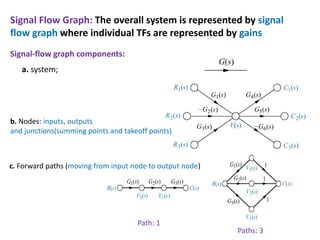
Signal Flow Graph: The overall system is represented by signal
flow graph where individual TFs are represented by gains
a. system;
Signal-flow graph components:
b. Nodes: inputs, outputs
and junctions(summing points and takeoff points)
c. Forward paths (moving from input node to output node)
Path: 1
Paths: 3
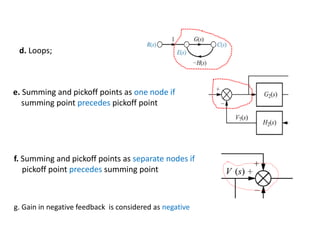
e. Summing and pickoff points as one node if
summing point precedes pickoff point
f. Summing and pickoff points as separate nodes if
pickoff point precedes summing point
d. Loops;
g. Gain in negative feedback is considered as negative
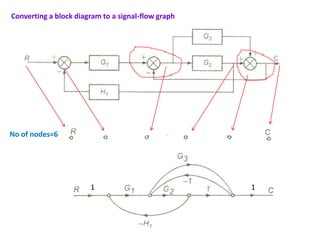
Converting a block diagram to a signal-flow graph
No of nodes=7
Summing
point
Summing
and take off
points
take off
point
Summing
point
take off
point output
input
Converting a block diagram to a signal-flow graph
1 1
No of nodes=6
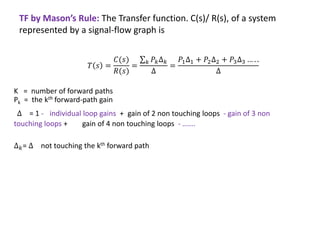
TF by Mason’s Rule: The Transfer function. C(s)/ R(s), of a system
represented by a signal-flow graph is
𝑇 𝑠 =
𝐶(𝑠)
𝑅(𝑠)
=
σ𝑘 𝑃𝑘∆𝑘
∆
=
𝑃1∆1 + 𝑃2∆2 + 𝑃3∆3 … . .
∆
K = number of forward paths
Pk = the kth forward-path gain
∆ = 1 - individual loop gains + gain of 2 non touching loops - gain of 3 non
touching loops + gain of 4 non touching loops - …….
∆𝑘= ∆ not touching the kth forward path
Example1: Transfer function using Mason’s rule
Forward path (1) : P1 = G1(s)G2(s)G3(s)G4(s)G5(s)
Loops(4): L1= G2(s)H1(s), L2=G4(s)H2(s), L3=G7(s)H4(s), L4=G2(s)G3(s)G4(s)G5(s)G6(s)G7(s)G8(s)
Two nontouching loops(3): L12= G2(s)H1(s)G4(s)H2(s), L13=G2(s)H1(s)G7(s)H4(s), L23=G4(s)H2(s)G7(s)H4(s)
Three nontouching loops(1): L123=G2(s)H1(s)G4(s)H2(s)G7(s)H4(s)
= 1-[G2(s)H1(s)+G4(s)H2(s)+G7(s)H4(s)+ G2(s)G3(s)G4(s)G5(s)G6(s)G7(s)G8(s)] + [G2(s)H1(s)G4(s)H2(s)
+ G2(s)H1(s)G7(s)H4(s) + G4(s)H2(s)G7(s)H4(s)] – [G2(s)H1(s)G4(s)H2(s)G7(s)H4(s)]
∆= 1 − (𝐿1 + 𝐿2+𝐿3+𝐿4)+(𝐿12+𝐿13 + 𝐿23) − 𝐿123
∆𝑘= ∆1= 1 − 𝐿3 = 1 − 𝐺7(𝑠)𝐻4(𝑠) 𝑇 𝑠 =
𝑃1∆1
∆
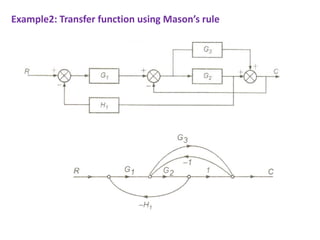
Example2: Transfer function using Mason’s rule
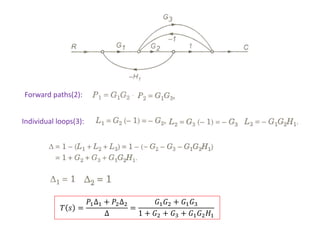
Forward paths(2):
Individual loops(3):
𝑇 𝑠 =
𝑃1∆1 + 𝑃2∆2
∆
=
𝐺1𝐺2 + 𝐺1𝐺3
1 + 𝐺2 + 𝐺3 + 𝐺1𝐺2𝐻1
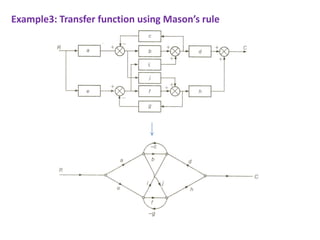
Example3: Transfer function using Mason’s rule
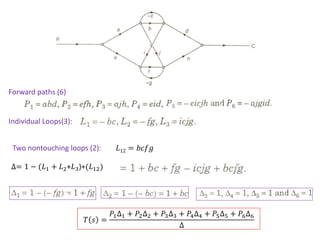
Forward paths (6)
Individual Loops(3):
Two nontouching loops (2): 𝐿12 = 𝑏𝑐𝑓𝑔
∆= 1 − (𝐿1 + 𝐿2+𝐿3)+(𝐿12)
𝑇 𝑠 =
𝑃1∆1 + 𝑃2∆2 + 𝑃3∆3 + 𝑃4∆4 + 𝑃5∆5 + 𝑃6∆6
∆
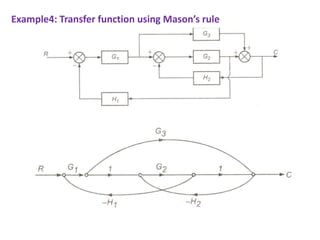
Example4: Transfer function using Mason’s rule
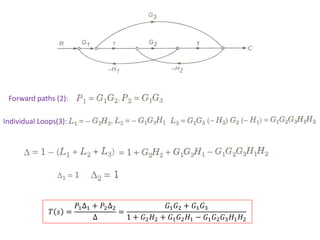
Forward paths (2):
Individual Loops(3):
𝑇 𝑠 =
𝑃1∆1 + 𝑃2∆2
∆
=
𝐺1𝐺2 + 𝐺1𝐺3
1 + 𝐺2𝐻2 + 𝐺1𝐺2𝐻1 − 𝐺1𝐺2𝐺3𝐻1𝐻2

Control_System Signal Flow graph 11_SFG (3).pdf

  • 1.
  • 2.
    Signal Flow Graph:The overall system is represented by signal flow graph where individual TFs are represented by gains a. system; Signal-flow graph components: b. Nodes: inputs, outputs and junctions(summing points and takeoff points) c. Forward paths (moving from input node to output node) Path: 1 Paths: 3
  • 3.
    e. Summing andpickoff points as one node if summing point precedes pickoff point f. Summing and pickoff points as separate nodes if pickoff point precedes summing point d. Loops; g. Gain in negative feedback is considered as negative
  • 4.
    Converting a blockdiagram to a signal-flow graph No of nodes=7 Summing point Summing and take off points take off point Summing point take off point output input
  • 5.
    Converting a blockdiagram to a signal-flow graph 1 1 No of nodes=6
  • 6.
    TF by Mason’sRule: The Transfer function. C(s)/ R(s), of a system represented by a signal-flow graph is 𝑇 𝑠 = 𝐶(𝑠) 𝑅(𝑠) = σ𝑘 𝑃𝑘∆𝑘 ∆ = 𝑃1∆1 + 𝑃2∆2 + 𝑃3∆3 … . . ∆ K = number of forward paths Pk = the kth forward-path gain ∆ = 1 - individual loop gains + gain of 2 non touching loops - gain of 3 non touching loops + gain of 4 non touching loops - ……. ∆𝑘= ∆ not touching the kth forward path
  • 7.
    Example1: Transfer functionusing Mason’s rule Forward path (1) : P1 = G1(s)G2(s)G3(s)G4(s)G5(s) Loops(4): L1= G2(s)H1(s), L2=G4(s)H2(s), L3=G7(s)H4(s), L4=G2(s)G3(s)G4(s)G5(s)G6(s)G7(s)G8(s) Two nontouching loops(3): L12= G2(s)H1(s)G4(s)H2(s), L13=G2(s)H1(s)G7(s)H4(s), L23=G4(s)H2(s)G7(s)H4(s) Three nontouching loops(1): L123=G2(s)H1(s)G4(s)H2(s)G7(s)H4(s) = 1-[G2(s)H1(s)+G4(s)H2(s)+G7(s)H4(s)+ G2(s)G3(s)G4(s)G5(s)G6(s)G7(s)G8(s)] + [G2(s)H1(s)G4(s)H2(s) + G2(s)H1(s)G7(s)H4(s) + G4(s)H2(s)G7(s)H4(s)] – [G2(s)H1(s)G4(s)H2(s)G7(s)H4(s)] ∆= 1 − (𝐿1 + 𝐿2+𝐿3+𝐿4)+(𝐿12+𝐿13 + 𝐿23) − 𝐿123 ∆𝑘= ∆1= 1 − 𝐿3 = 1 − 𝐺7(𝑠)𝐻4(𝑠) 𝑇 𝑠 = 𝑃1∆1 ∆
  • 8.
    Example2: Transfer functionusing Mason’s rule
  • 9.
    Forward paths(2): Individual loops(3): 𝑇𝑠 = 𝑃1∆1 + 𝑃2∆2 ∆ = 𝐺1𝐺2 + 𝐺1𝐺3 1 + 𝐺2 + 𝐺3 + 𝐺1𝐺2𝐻1
  • 10.
    Example3: Transfer functionusing Mason’s rule
  • 11.
    Forward paths (6) IndividualLoops(3): Two nontouching loops (2): 𝐿12 = 𝑏𝑐𝑓𝑔 ∆= 1 − (𝐿1 + 𝐿2+𝐿3)+(𝐿12) 𝑇 𝑠 = 𝑃1∆1 + 𝑃2∆2 + 𝑃3∆3 + 𝑃4∆4 + 𝑃5∆5 + 𝑃6∆6 ∆
  • 12.
    Example4: Transfer functionusing Mason’s rule
  • 13.
    Forward paths (2): IndividualLoops(3): 𝑇 𝑠 = 𝑃1∆1 + 𝑃2∆2 ∆ = 𝐺1𝐺2 + 𝐺1𝐺3 1 + 𝐺2𝐻2 + 𝐺1𝐺2𝐻1 − 𝐺1𝐺2𝐺3𝐻1𝐻2