CONTROL SYSTEMS
THEORY
Transfer Function of Physical
Systems
CHAPTER 2
STB 35103
Objectives
 To

learn about transfer functions.
 To develop mathematical models from
schematics of physical system.
Overview


Review on Laplace transform



Learn about transfer function




Electric network
Translational mechanical system
Rotational mechanical system



You will learn how to develop mathematical model.



Present mathematical representation where the input,
output and system are different and separate.



Solving problems in group and individual
Introduction
A differential equation
 An equation that involves the derivatives
of a function as well as the function itself.
If partial derivatives are involved, the
equation is called a
partial differential equation;
If only ordinary derivatives are present,
the equation is called an
ordinary differential equation.

Introduction


Differential equations. How to obtain?

Physical law of the process

Differential equation

Examples :
Mechanical system (Newton’s laws)
Electrical system (Kirchhoff’s laws)
Introduction
Introduction
Introduction


RLC circuit
~KVL
~Ohm’s law
Introduction
 Control

system can be represented using a
mathematical model.


E.g. LED circuit

 Mathematical

model is based on the
schematic of physical systems.
Introduction

Differential equation
t

di (t )
1
L
+ Ri (t ) +
i (τ )dτ = v (t )
dt
C

∫
0
Introduction
•

Differential equation describes the
relationship between the input and output
of a system.

d nc ( t )
dt

n

+ an −1

d n −1c ( t )
dt

c(t) output
r(t) input

n −1

+ × ×+ a0 c ( t ) = bm
×

d mr ( t )
dt

m

+ bm −1

d m −1r (t )
dt

m −1

+ × ×+ b0 r (t )
×
Introduction
It is easier if we can see the input and the
output clearly such as in the figure below.
Type of input test

Test waveforms used
in control systems
Laplace transform review

Table 2.1
Laplace transform table
Laplace transform review

Table 2.2
Laplace transform
theorems
Transfer function


What is transfer function?


Transfer function is output divided by input.

Output
= Transfer Function
Input
C ( s)
= G (s)
R( s)
Transfer function
Transfer function


Limited to linear system


What is linear system?


A system that has two mathematical properties:
Homogeneity and additivity.

Homogeneity
Transfer function

Additivity
Transfer function
Example:
Find the transfer function represented by

dc(t )
+ 2c(t ) = r (t )
dt
Solution:

sC ( s ) + 2C ( s ) = R( s )
The transfer function G(s) is

C (s)
1
G ( s) =
=
R(s) s + 2
Transfer function
Example:
Find the transfer function represented by
dc(t )
+ 0.5c(t ) = 0.3r (t )
dt

Solution:

sC ( s ) + 0.5C ( s ) = 0.3R( s )
The transfer function G(s) is

C ( s)
0.3
G(s) =
=
R( s ) s + 0.5
Transfer function
Example:
Given the transfer function for a system is
1
G (s) =
( s + 2)
The input for the system, r(t), is a unit step.
r(t)=u(t), assuming zero initial conditions.
What is the output, c(t), of the system?
Transfer function
Solution:
Refer to Table 2.1. Laplace transform for a unit step input is
1/s. We know that

Output
= Transfer Function
Input
so

C ( s)
= G(s)
R( s)
C ( s ) = R ( s )G ( s)
1 1 
= 
s s + 2

1
=
s( s + 2)
Transfer function
Expanding the partial fraction, we get

1/ 2 1/ 2
C (s) =
−
s
s+2
Taking the inverse Laplace transform (use Table
2.2) of each term,

1 1 − 2t
c(t ) = − e
2 2
Transfer function


You are going to apply transfer function in
three types of mathematical modeling.




Electric network
Translational mechanical system
Rotational mechanical system
Electric Network Transfer Functions


We are only going to apply transfer function to
the mathematical modeling of electric circuits for
passive networks (resistor, capacitor and
inductor).



We will look at a circuit and decide the input and
the output.



We will use Kirchhoff’s laws as our guiding
principles.



Mesh analysis
Nodal analysis
Electric Network Transfer Functions
Component

VoltageCurrent

Currentvoltage

Voltagecharge

Impedance
Z(s)=
V(s)/I(s)

Admittance
Y(s)=
I(s)/V(s)
Electric Network Transfer Functions
Simple circuit via mesh analysis
We can obtain transfer function using
Kirchhoff’s voltage law and summing
voltages around loops or meshes. This
method is called loop or mesh analysis.
Electric Network Transfer Functions
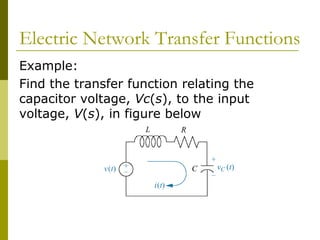
Example:
Find the transfer function relating the
capacitor voltage, Vc(s), to the input
voltage, V(s), in figure below
Electric Network Transfer Functions
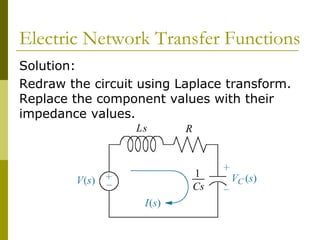
Solution:
Redraw the circuit using Laplace transform.
Replace the component values with their
impedance values.
Electric Network Transfer Functions
Determine the input and the output for the
circuit. For this circuit,
Input is V(s)
Output is VC(s)
Next, we write a mesh equation using the
impedance as we would use resistor values
in a purely resistive circuit.
Electric Network Transfer Functions

We obtain

1 

 Ls + R +  I ( s ) = V ( s )
Cs 


(2.7)
Electric Network Transfer Functions
If we look at Eq.2.7, we can only find the input, V(s).
In order to calculate the transfer function we must
have the output which is VC(s).
From the circuit,

1
VC ( s ) = I ( s )
Cs
Electric Network Transfer Functions
1
VC ( s ) = I ( s )
Cs
I ( s ) = VC ( s )Cs
Substituting Eq.2.8 into Eq.2.7.

1 

 Ls + R + VC ( s )Cs = V ( s )
Cs 

VC ( s )
1
1
=
=
1  CLs 2 + RCs + 1
V (s)

Cs Ls + R + 
Cs 

1 / LC
=
R
1
s2 + s +
L
LC

(2.8)
Electric Network Transfer Functions
We can also present our answer in block
diagram
Electric Network Transfer Functions


Solution summary

L

Using mesh analysis
Electric Network Transfer Functions
Simple circuit via nodal analysis
We obtain the transfer function using
Kirchhoff’s current law and summing current
flowing from nodes. This method is called
nodal analysis.
Electric Network Transfer Functions
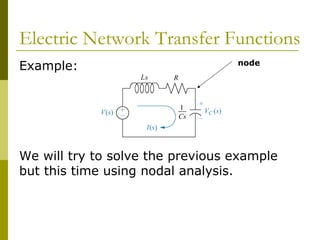
Example:

node

We will try to solve the previous example
but this time using nodal analysis.
Electric Network Transfer Functions
Solution:
We will look at the current flowing in and out of the
node whose voltage is VC(s). We assume the current
leaving the node is positive and current entering the
node is negative.
VC ( s ) V ( s ) − VC ( s )
=
1 / Cs
R + Ls
VC ( s ) V ( s ) − VC ( s )
−
=0
1 / Cs
R + Ls

VC ( s )
1 / LC
=
V ( s) s 2 + R s + 1
L
LC
Electric Network Transfer Functions
Complex circuit via mesh analysis
To solve a complex circuit we will perform the
following steps.
1. Replace passive elements values with their
impedances.
2. Replace all sources and time variables with their
Laplace transform.
3. Assume a transform current and a current
direction in each mesh.
4. Write Kirchhoff’s voltage law around each mesh.
5. Solve the simultaneous equations for the
output.
6. Form the transfer function.
Electric Network Transfer Functions


Find the transfer function, I2(s)/V(s)

Output I2(s)
Input V(s)
Electric Network Transfer Functions
Sum of

Sum of

Sum of applied 
impedances 
impedances  I ( s ) − 
 I 2 ( s ) =  voltages around 

 1


common to the
around Mesh 1
Mesh 1







two meshes 

Sum of

Sum of

Sum of applied 
impedances 

 I1 ( s ) − impedances  I 2 ( s ) =  voltages around 




common to the
around Mesh 2
Mesh 2







two meshes 

Electric Network Transfer Functions
( R1 + Ls ) I1 ( s ) − LsI 2 ( s ) = V ( s )
1 

− LsI1 ( s ) +  Ls + R2 +  I 2 ( s ) = 0
Cs 


(1)
( 2)

We need to solve both equation (1) and (2) to get
the value of I2(s) and V(s).
You can use substitution method or Cramer’s rule
Electric Network Transfer Functions
It is easier if we use Cramer’s rule

( R1 + Ls ) V ( s )
− Ls
0
LsV ( s )
I 2 ( s) =
=
∆
∆
where

∆=

( R1 + Ls )
− Ls

− Ls
1 

 Ls − R2 + 
Cs 

Electric Network Transfer Functions
Forming the transfer function, G(s), yields

I 2 ( s ) Ls
LCs 2
G(s) =
=
=
V ( s ) ∆ ( R1 + R2 ) LCs 2 + ( R1 R2C + L ) s + R1
Example


Solve using mesh analysis and Nodal
analysis
Mesh analysis method


Write the mesh equations :



Solving the equations for I2(s):
Mesh analysis method
Nodal analysis method


Write the nodal equations :
Nodal analysis method
Mechanical Systems


Types of Mechanical Systems
•Translational Systems
•Rotational Systems
Translational Mechanical System
Transfer Function
We are going to model translational
mechanical system by a transfer function.
 In electrical we have three passive
elements, resistor, capacitor and inductor.
In mechanical we have spring, mass and
viscous damper.

Translational Mechanical System
Transfer Function


In electrical we have resistance, capacitance and
inductance but in mechanical we have, spring
constant (K), viscous damper (fv) and mass (M).



We are going to find the transfer function for a
mechanical system in term of force-displacement
(i.e. forces are written in terms of displacement)
Translational Mechanical System


Mass


f(t) represents the applied force, x(t)
represents the displacement, and M represents
the mass. Then, in accordance with Newton’s
second law,

Where v(t) is velocity and a(t) is acceleration. It is
assumed that the mass is rigid at the top connection
point and that cannot move relative to the bottom
connection point.
Translational Mechanical System


Damper




Damper is the damping elements and damping is the
friction existing in physical systems whenever
mechanical system moves on sliding surface. The
friction encountered is of many types, namely stiction,
coulomb friction and viscous friction force
In friction elements, the top connection point can move
relative to the bottom connection point. Hence two
displacement variables are required to describe the
motion of these elements, where B is the damping
coefficient
Translational Mechanical System


Spring


The final translational mechanical element is a
spring. The ideal spring gives the elastic
deformation of a body. The defining equation
from Hooke’s law, is given by
Translational Mechanical System
Transfer Function
Force-velocity,
forcedisplacement,
and impedance
translational
relationships
for springs,
viscous dampers,
and mass
Translational Mechanical System
Transfer Function
Simple system



Assumption




Movement to the left is assumed to be
positive.
positive
+ve
Translational Mechanical System
Transfer Function


Draw a free body diagram, placing on the
body all forces that act on the body either
in the direction of motion or opposite to it.



Use Newton’s law to form a differential
equation of motion by summing the forces
and setting the sum equal to zero.



Assume zero initial conditions, we change
the differential equation into Laplace form.
Translational Mechanical System
Transfer Function
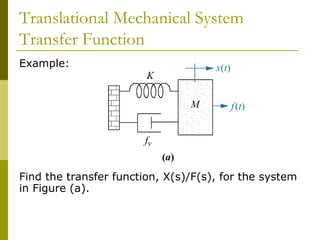
Example:

Find the transfer function, X(s)/F(s), for the system
in Figure (a).
Translational Mechanical System
Transfer Function






Draw the free body diagram
Place on the mass all forces felt by the mass.
Assume the mass is travelling toward the right.
Use Laplace transform.
Translational Mechanical System
Transfer Function

How do we get the equation?
 Answer:





[sum of impedances]X(s) = [sum of applied forces]
Movement to the left is positive
Translational Mechanical System
Transfer Function



The equation in Laplace form is
2

( Ms + f v s + K ) X ( s ) = F ( s )
Translational Mechanical System
Transfer Function

Solving for the transfer function
X (s)
1
G (s) =
=
F ( s ) Ms 2 + f v s + K
Translational Mechanical System
Transfer Function
Complex system
 Find transfer function, X2(s)/F(s)

Translational Mechanical System
Transfer Function
a. Forces on M1 due
only to motion of
M1
b. forces on M1 due
only to motion of
M2(sharing);
c. all forces on M1
Translational Mechanical System
Transfer Function
a. Forces on M2
due only to motion
of M2;
b. forces on M2 due
only to motion
of M1 (sharing);
c. all forces on M2
Example


Solve for G(s) = X2(s)/F(s)
Exercise


Solve for G(s) = X2(s)/F(s)

Friction, fv
(Damper)
Rotational Mechanical System
Transfer Functions


We are going to solve for rotational
mechanical system using the same way as
the translational mechanical systems
except



Torque replaces force
Angular displacement replaces translational
displacement
Rotational Mechanical System
Transfer Functions


In translational mechanical system we
have three elements; spring, damper
and mass. In rotational mechanical
system we have; spring, damper and
inertia.
Rotational Mechanical System
Transfer Functions
Torque-angular
velocity, torqueangular
displacement,
and impedance
rotational
relationships for
springs, viscous
dampers, and
inertia
Rotational Mechanical System
Transfer Functions
Simple system



Assumption


Anti-clockwise movement is assumed to be
positive
Rotational Mechanical System
Transfer Functions
Example:

Find the transfer function, θ(s)/T(s)
Rotational Mechanical System
Transfer Functions



Draw the free body diagram
T(s)
Kθ(s)

Θ(s)

J

Dsθ(s)

Js2θ(s)
Rotational Mechanical System
Transfer Functions


We will use




[sum of impedances]θ(s) = [sum of applied torque]

Based on the free body diagram, the
equation of motion is

( Js

2

)

+ Ds + K θ ( s ) = T ( s )

θ ( s)
we know transfer function, G ( s), is
T ( s)
θ (s)
1
= 2
T ( s ) Js + Ds + K
1
J
=
D
K
2
s + s+
J
J
Rotational Mechanical System
Transfer Functions
Complex system
 Find transfer function θ2(s)/T(s)

Rotational Mechanical System
Transfer Functions
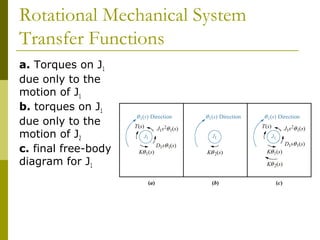
a. Torques on J1
due only to the
motion of J1
b. torques on J1
due only to the
motion of J2
c. final free-body
diagram for J1
Rotational Mechanical System
Transfer Functions
a. Torques on J2
due only to the
motion of J2;
b. torques on J2
due only to the
motion of J1
c. final free-body
diagram for J2
Laplace transform review


The Laplace transform is defined as
∞

ℒ[ f (t )] = F (s) = ∫

f (t )e − st dt

0−

Where s = σ + jω
Inverse Laplace transform, to get f(t) given
F(s), is
σ + j∞
1
−1
st
ℒ [ F ( s)] = 2π j ∫ F ( s)e ds
σ − j∞
Laplace transform review

Table 2.1
Laplace transform table
Laplace transform review

Table 2.2
Laplace transform
theorems
Laplace transform review
Example
Find the inverse Laplace transform of
F(s)=1/s
F(s)=1/s2
F(s)=1/(s+3)
Laplace transform review
Example:
Find the inverse Laplace transform of

1
F (s) =
s+3

Answer
We use frequency shift theorem, item 4 in Table 2.2, and
Laplace transform of f(t)=u(t), item 3 in Table 2.1
If inverse transform of F(s)=1/s2 is tu(t), the inverse
transform of F(s+a)=1/(s+a)2 is e-attu(t).
Hence, f(t)=e-3ttu(t)
Laplace transform review
Example:
Find the inverse Laplace transform of

F ( s) = 1/ ( s + 3) 2

Answer
We use frequency shift theorem, item 4 in Table 2.2, and
Laplace transform of f(t)=tu(t), item 3 in Table 2.1
If inverse transform of F(s)=1/s2 is tu(t), the inverse
transform of F(s+a)=1/(s+a)2 is e-attu(t).
Hence, f(t)=e-3ttu(t)
Laplace transform review
Can you solve this question using Table 2.1
and Table 2.2?

F ( s ) = 1/ ( s + 3)3
Or this question

F (s) =

s3 + 2s 2 + 6s + 7
s2 + s + 5
Laplace transform review
We can find the inverse Laplace transform
for complicated function by changing the
function to a sum of simpler term for which
we know the Laplace transform of each
term.
The result is called partial-fraction expansion
Partial fraction expansion
Let’s take F(s)=N(s)/D(s)
In order for us to do the partial-fraction
expansion we need to make sure the order
of N(s) is smaller than or equal to the order
of D(s).
N(s) <= D(s)
Partial fraction expansion
What will we do if
N(s) >= D(s) ?
Answer.
We will divide N(s) by D(s) successively until
the result has a remainder whose
numerator is of order less that its
denominator (polynomial division).
Partial fraction expansion
Polynomial long division
Example:
Divide x2+9x+14 by x+7
Answer
Partial fraction expansion
Divide 3x3 – 5x2 + 10x – 3 by 3x + 1
Answer:
Partial fraction expansion
Can be divided into 3 cases.
1. Roots

of the denominator of F(s) are real
and distinct
2. Roots of the denominator of F(s) are real
and repeated
3. Roots of the denominator of F(s) are
complex or imaginary
Partial fraction expansion: Case 1
Roots of the denominator of F(s) are real
and distinct
Example of an F(s) with real and distinct
roots in the denominator is

2
F (s) =
( s + 1)( s + 2)
Partial fraction expansion: Case 1
Solution
K1
K2
F ( s) =
=
+
( s + 1) ( s + 2 ) ( s + 1) ( s + 2)
2

(2.1)

To find K1, we multiply Eq. (2.1) by (s+1),
which isolates K1. Thus
2
K1 =
( s + 2)
2
K2 =
( s + 1)

=2
s →−1

= −2
s →−2
Partial fraction expansion: Case 1
Change value K1 and K2 gives
F ( s) =
F ( s) =

2

( s + 1) ( s + 2 )
2

( s + 1) ( s + 2 )

=

K1
K2
+
( s + 1) ( s + 2)

=

2
2
−
( s + 1) ( s + 2)

Using Table 2.1, the inverse Laplace
transform is ??

f ( s) = (2e −t − 2e −2t )u (t )
Partial fraction expansion: Case 1
Problem: Given the following differential
equation, solve for y(t) if all initial condition
are zero. Use Laplace transform.
d2y

dy
+ 12 + 32 y = 32u (t )
2
dt
dt
Partial fraction expansion: Case 2
Roots of the denominator of F(s) are real
and repeated
Example of an F(s) with real and repeated
roots in the denominator is
F (s) =

2
( s + 1)( s + 2) 2

Roots of (s+2)2 in the denominator are
repeated.
Partial fraction expansion: Case 2


We write the partial-fraction expansion as a sum
of terms. Each factor of the denominator forms
the denominator of each term.



Each multiple root generates additional terms
consisting of denominator factors of reduced
multiplicity.
K3
K1
K2
F (s) =
=
+
+
2
2
( s + 1) ( s + 2)
( s + 2)
( s + 1)( s + 2)
2

(2.2)
Partial fraction expansion: Case 2


We can solve for K1 using method in case 1
in Eq.2.2.
K1 =



2
( s + 2)

2

=2
s →−1

Next step is to isolate K2 by multiplying
Eq. 2.2 by (s+2)2
2
2 K1
= ( s + 2)
+ K 2 + ( s + 2 ) K3
s +1
( s + 1)

(2.3)
Partial fraction expansion: Case 2


Solve for K2 using the same method as
Case 1 in Eq.2.3.
K2 =



2
= −2
( s + 1) s →−2

To get the value of K3 we need to
differentiate Eq.2.3 with respect to s,

( s + 2) s
=
K1 + K 3
2
2
( s + 1) ( s + 1)
−2

(2.4)
Partial fraction expansion: Case 2


Using the method in case 1. K3 can be
found if we let s approach -2. (-2 comes
from the denominator of K3)
K3 =



−2
( s + 1)

2

= −2
s →−2

Changing K1, K2 and K3 with their respective
values
K3
K1
K2
F (s) =
=
+
+
2
2
( s + 1) ( s + 2)
( s + 2)
( s + 1)( s + 2)
2
2
2
=
−
−
2
( s + 1) ( s + 2)
( s + 2)
2
Partial fraction expansion: Case 3
Roots of the denominator of F(s) are
complex or imaginary
Example of an F(s) with complex roots in
the denominator is
F ( s) =

(

3

s s 2 + 2s + 5

)

We can expand the function in partial
fractions as
3
3
F ( s) =
=

(

2

s s + 2s + 5

)

=

s ( s + 1 + j2) ( s + 1 − j2)

K3
K1
K2
+
+
s s + 1 + j 2 s + 1 − j1
Partial fraction expansion: Case 3
Solve for K1 using similar method in case 1.
K1 =

(s

3
2

+ 2s + 5

)

=
s →0

3
5

Solve for K2 using similar method in case 1.
3
K2 =
s ( s + 1 − j2)

s →−1− j 2

3
= − ( 2 + j1)
20
Partial fraction expansion: Case 3
K3 is found to be the complex conjugate of
K2
K3 =

3
s ( s + 1 + j2)

=
s →−1+ j 2

3
( 2 + j1)
20

Changing K1, K2 and K3 with their respective
values
F (s) =

3 / 5 3  2 + j1
2 − j1 
− 
+
÷
s
20  s + 1 + j 2 s + 1 − j 2 

(2.5)
Partial fraction expansion: Case 3
Inverse Laplace transform for Eq.2.5 is
3 3 
−
( 2 + j1) e−( 1+ j 2) t + ( 2 − j1) e−( 1− j 2) t 

5 20 
 e j 2t + e − j 2 t
3 3 − t   e j 2 t + e − j 2t 
= − e 4 
÷+ 2 

÷ 
5 20
2
2j
 




f (t ) =

Using equation
e jθ + e − jθ
= cos θ
2

Into Eq.2.6

and

e jθ − e − jθ
= sin θ
2j


÷
÷



(2.6)
Partial fraction expansion: Case 3
The final result is
3 3 −t 
1

f (t ) = − e  cos 2t + sin 2t ÷ = 0.6 − 0.671e −t cos ( 2t − φ )
5 5
2


where φ = arctan 0.5 = 26.57 o

Control chap2

  • 1.
    CONTROL SYSTEMS THEORY Transfer Functionof Physical Systems CHAPTER 2 STB 35103
  • 2.
    Objectives  To learn abouttransfer functions.  To develop mathematical models from schematics of physical system.
  • 3.
    Overview  Review on Laplacetransform  Learn about transfer function    Electric network Translational mechanical system Rotational mechanical system  You will learn how to develop mathematical model.  Present mathematical representation where the input, output and system are different and separate.  Solving problems in group and individual
  • 4.
    Introduction A differential equation An equation that involves the derivatives of a function as well as the function itself. If partial derivatives are involved, the equation is called a partial differential equation; If only ordinary derivatives are present, the equation is called an ordinary differential equation. 
  • 5.
    Introduction  Differential equations. Howto obtain? Physical law of the process Differential equation Examples : Mechanical system (Newton’s laws) Electrical system (Kirchhoff’s laws)
  • 6.
  • 7.
  • 8.
  • 9.
    Introduction  Control system canbe represented using a mathematical model.  E.g. LED circuit  Mathematical model is based on the schematic of physical systems.
  • 10.
    Introduction Differential equation t di (t) 1 L + Ri (t ) + i (τ )dτ = v (t ) dt C ∫ 0
  • 11.
    Introduction • Differential equation describesthe relationship between the input and output of a system. d nc ( t ) dt n + an −1 d n −1c ( t ) dt c(t) output r(t) input n −1 + × ×+ a0 c ( t ) = bm × d mr ( t ) dt m + bm −1 d m −1r (t ) dt m −1 + × ×+ b0 r (t ) ×
  • 12.
    Introduction It is easierif we can see the input and the output clearly such as in the figure below.
  • 13.
    Type of inputtest Test waveforms used in control systems
  • 14.
    Laplace transform review Table2.1 Laplace transform table
  • 15.
    Laplace transform review Table2.2 Laplace transform theorems
  • 16.
    Transfer function  What istransfer function?  Transfer function is output divided by input. Output = Transfer Function Input C ( s) = G (s) R( s)
  • 17.
  • 18.
    Transfer function  Limited tolinear system  What is linear system?  A system that has two mathematical properties: Homogeneity and additivity. Homogeneity
  • 19.
  • 20.
    Transfer function Example: Find thetransfer function represented by dc(t ) + 2c(t ) = r (t ) dt Solution: sC ( s ) + 2C ( s ) = R( s ) The transfer function G(s) is C (s) 1 G ( s) = = R(s) s + 2
  • 21.
    Transfer function Example: Find thetransfer function represented by dc(t ) + 0.5c(t ) = 0.3r (t ) dt Solution: sC ( s ) + 0.5C ( s ) = 0.3R( s ) The transfer function G(s) is C ( s) 0.3 G(s) = = R( s ) s + 0.5
  • 22.
    Transfer function Example: Given thetransfer function for a system is 1 G (s) = ( s + 2) The input for the system, r(t), is a unit step. r(t)=u(t), assuming zero initial conditions. What is the output, c(t), of the system?
  • 23.
    Transfer function Solution: Refer toTable 2.1. Laplace transform for a unit step input is 1/s. We know that Output = Transfer Function Input so C ( s) = G(s) R( s) C ( s ) = R ( s )G ( s) 1 1  =  s s + 2  1 = s( s + 2)
  • 24.
    Transfer function Expanding thepartial fraction, we get 1/ 2 1/ 2 C (s) = − s s+2 Taking the inverse Laplace transform (use Table 2.2) of each term, 1 1 − 2t c(t ) = − e 2 2
  • 25.
    Transfer function  You aregoing to apply transfer function in three types of mathematical modeling.    Electric network Translational mechanical system Rotational mechanical system
  • 26.
    Electric Network TransferFunctions  We are only going to apply transfer function to the mathematical modeling of electric circuits for passive networks (resistor, capacitor and inductor).  We will look at a circuit and decide the input and the output.  We will use Kirchhoff’s laws as our guiding principles.   Mesh analysis Nodal analysis
  • 27.
    Electric Network TransferFunctions Component VoltageCurrent Currentvoltage Voltagecharge Impedance Z(s)= V(s)/I(s) Admittance Y(s)= I(s)/V(s)
  • 28.
    Electric Network TransferFunctions Simple circuit via mesh analysis We can obtain transfer function using Kirchhoff’s voltage law and summing voltages around loops or meshes. This method is called loop or mesh analysis.
  • 29.
    Electric Network TransferFunctions Example: Find the transfer function relating the capacitor voltage, Vc(s), to the input voltage, V(s), in figure below
  • 30.
    Electric Network TransferFunctions Solution: Redraw the circuit using Laplace transform. Replace the component values with their impedance values.
  • 31.
    Electric Network TransferFunctions Determine the input and the output for the circuit. For this circuit, Input is V(s) Output is VC(s) Next, we write a mesh equation using the impedance as we would use resistor values in a purely resistive circuit.
  • 32.
    Electric Network TransferFunctions We obtain 1    Ls + R +  I ( s ) = V ( s ) Cs   (2.7)
  • 33.
    Electric Network TransferFunctions If we look at Eq.2.7, we can only find the input, V(s). In order to calculate the transfer function we must have the output which is VC(s). From the circuit, 1 VC ( s ) = I ( s ) Cs
  • 34.
    Electric Network TransferFunctions 1 VC ( s ) = I ( s ) Cs I ( s ) = VC ( s )Cs Substituting Eq.2.8 into Eq.2.7. 1    Ls + R + VC ( s )Cs = V ( s ) Cs   VC ( s ) 1 1 = = 1  CLs 2 + RCs + 1 V (s)  Cs Ls + R +  Cs   1 / LC = R 1 s2 + s + L LC (2.8)
  • 35.
    Electric Network TransferFunctions We can also present our answer in block diagram
  • 36.
    Electric Network TransferFunctions  Solution summary L Using mesh analysis
  • 37.
    Electric Network TransferFunctions Simple circuit via nodal analysis We obtain the transfer function using Kirchhoff’s current law and summing current flowing from nodes. This method is called nodal analysis.
  • 38.
    Electric Network TransferFunctions Example: node We will try to solve the previous example but this time using nodal analysis.
  • 39.
    Electric Network TransferFunctions Solution: We will look at the current flowing in and out of the node whose voltage is VC(s). We assume the current leaving the node is positive and current entering the node is negative. VC ( s ) V ( s ) − VC ( s ) = 1 / Cs R + Ls VC ( s ) V ( s ) − VC ( s ) − =0 1 / Cs R + Ls  VC ( s ) 1 / LC = V ( s) s 2 + R s + 1 L LC
  • 40.
    Electric Network TransferFunctions Complex circuit via mesh analysis To solve a complex circuit we will perform the following steps. 1. Replace passive elements values with their impedances. 2. Replace all sources and time variables with their Laplace transform. 3. Assume a transform current and a current direction in each mesh. 4. Write Kirchhoff’s voltage law around each mesh. 5. Solve the simultaneous equations for the output. 6. Form the transfer function.
  • 41.
    Electric Network TransferFunctions  Find the transfer function, I2(s)/V(s) Output I2(s) Input V(s)
  • 42.
    Electric Network TransferFunctions Sum of  Sum of  Sum of applied  impedances  impedances  I ( s ) −   I 2 ( s ) =  voltages around    1   common to the around Mesh 1 Mesh 1        two meshes   Sum of  Sum of  Sum of applied  impedances    I1 ( s ) − impedances  I 2 ( s ) =  voltages around      common to the around Mesh 2 Mesh 2        two meshes  
  • 43.
    Electric Network TransferFunctions ( R1 + Ls ) I1 ( s ) − LsI 2 ( s ) = V ( s ) 1   − LsI1 ( s ) +  Ls + R2 +  I 2 ( s ) = 0 Cs   (1) ( 2) We need to solve both equation (1) and (2) to get the value of I2(s) and V(s). You can use substitution method or Cramer’s rule
  • 44.
    Electric Network TransferFunctions It is easier if we use Cramer’s rule ( R1 + Ls ) V ( s ) − Ls 0 LsV ( s ) I 2 ( s) = = ∆ ∆ where ∆= ( R1 + Ls ) − Ls − Ls 1    Ls − R2 +  Cs  
  • 45.
    Electric Network TransferFunctions Forming the transfer function, G(s), yields I 2 ( s ) Ls LCs 2 G(s) = = = V ( s ) ∆ ( R1 + R2 ) LCs 2 + ( R1 R2C + L ) s + R1
  • 46.
    Example  Solve using meshanalysis and Nodal analysis
  • 47.
    Mesh analysis method  Writethe mesh equations :  Solving the equations for I2(s):
  • 48.
  • 49.
    Nodal analysis method  Writethe nodal equations :
  • 50.
  • 51.
    Mechanical Systems  Types ofMechanical Systems •Translational Systems •Rotational Systems
  • 52.
    Translational Mechanical System TransferFunction We are going to model translational mechanical system by a transfer function.  In electrical we have three passive elements, resistor, capacitor and inductor. In mechanical we have spring, mass and viscous damper. 
  • 53.
    Translational Mechanical System TransferFunction  In electrical we have resistance, capacitance and inductance but in mechanical we have, spring constant (K), viscous damper (fv) and mass (M).  We are going to find the transfer function for a mechanical system in term of force-displacement (i.e. forces are written in terms of displacement)
  • 54.
    Translational Mechanical System  Mass  f(t)represents the applied force, x(t) represents the displacement, and M represents the mass. Then, in accordance with Newton’s second law, Where v(t) is velocity and a(t) is acceleration. It is assumed that the mass is rigid at the top connection point and that cannot move relative to the bottom connection point.
  • 55.
    Translational Mechanical System  Damper   Damperis the damping elements and damping is the friction existing in physical systems whenever mechanical system moves on sliding surface. The friction encountered is of many types, namely stiction, coulomb friction and viscous friction force In friction elements, the top connection point can move relative to the bottom connection point. Hence two displacement variables are required to describe the motion of these elements, where B is the damping coefficient
  • 56.
    Translational Mechanical System  Spring  Thefinal translational mechanical element is a spring. The ideal spring gives the elastic deformation of a body. The defining equation from Hooke’s law, is given by
  • 57.
    Translational Mechanical System TransferFunction Force-velocity, forcedisplacement, and impedance translational relationships for springs, viscous dampers, and mass
  • 58.
    Translational Mechanical System TransferFunction Simple system  Assumption   Movement to the left is assumed to be positive. positive +ve
  • 59.
    Translational Mechanical System TransferFunction  Draw a free body diagram, placing on the body all forces that act on the body either in the direction of motion or opposite to it.  Use Newton’s law to form a differential equation of motion by summing the forces and setting the sum equal to zero.  Assume zero initial conditions, we change the differential equation into Laplace form.
  • 60.
    Translational Mechanical System TransferFunction Example: Find the transfer function, X(s)/F(s), for the system in Figure (a).
  • 61.
    Translational Mechanical System TransferFunction     Draw the free body diagram Place on the mass all forces felt by the mass. Assume the mass is travelling toward the right. Use Laplace transform.
  • 62.
    Translational Mechanical System TransferFunction How do we get the equation?  Answer:    [sum of impedances]X(s) = [sum of applied forces] Movement to the left is positive
  • 63.
    Translational Mechanical System TransferFunction  The equation in Laplace form is 2 ( Ms + f v s + K ) X ( s ) = F ( s )
  • 64.
    Translational Mechanical System TransferFunction Solving for the transfer function X (s) 1 G (s) = = F ( s ) Ms 2 + f v s + K
  • 65.
    Translational Mechanical System TransferFunction Complex system  Find transfer function, X2(s)/F(s) 
  • 66.
    Translational Mechanical System TransferFunction a. Forces on M1 due only to motion of M1 b. forces on M1 due only to motion of M2(sharing); c. all forces on M1
  • 67.
    Translational Mechanical System TransferFunction a. Forces on M2 due only to motion of M2; b. forces on M2 due only to motion of M1 (sharing); c. all forces on M2
  • 68.
  • 70.
    Exercise  Solve for G(s)= X2(s)/F(s) Friction, fv (Damper)
  • 71.
  • 72.
    Rotational Mechanical System TransferFunctions  We are going to solve for rotational mechanical system using the same way as the translational mechanical systems except   Torque replaces force Angular displacement replaces translational displacement
  • 73.
    Rotational Mechanical System TransferFunctions  In translational mechanical system we have three elements; spring, damper and mass. In rotational mechanical system we have; spring, damper and inertia.
  • 74.
    Rotational Mechanical System TransferFunctions Torque-angular velocity, torqueangular displacement, and impedance rotational relationships for springs, viscous dampers, and inertia
  • 75.
    Rotational Mechanical System TransferFunctions Simple system  Assumption  Anti-clockwise movement is assumed to be positive
  • 76.
    Rotational Mechanical System TransferFunctions Example: Find the transfer function, θ(s)/T(s)
  • 77.
    Rotational Mechanical System TransferFunctions  Draw the free body diagram T(s) Kθ(s) Θ(s) J Dsθ(s) Js2θ(s)
  • 78.
    Rotational Mechanical System TransferFunctions  We will use   [sum of impedances]θ(s) = [sum of applied torque] Based on the free body diagram, the equation of motion is ( Js 2 ) + Ds + K θ ( s ) = T ( s ) θ ( s) we know transfer function, G ( s), is T ( s) θ (s) 1 = 2 T ( s ) Js + Ds + K 1 J = D K 2 s + s+ J J
  • 79.
    Rotational Mechanical System TransferFunctions Complex system  Find transfer function θ2(s)/T(s) 
  • 80.
    Rotational Mechanical System TransferFunctions a. Torques on J1 due only to the motion of J1 b. torques on J1 due only to the motion of J2 c. final free-body diagram for J1
  • 81.
    Rotational Mechanical System TransferFunctions a. Torques on J2 due only to the motion of J2; b. torques on J2 due only to the motion of J1 c. final free-body diagram for J2
  • 82.
    Laplace transform review  TheLaplace transform is defined as ∞ ℒ[ f (t )] = F (s) = ∫ f (t )e − st dt 0− Where s = σ + jω Inverse Laplace transform, to get f(t) given F(s), is σ + j∞ 1 −1 st ℒ [ F ( s)] = 2π j ∫ F ( s)e ds σ − j∞
  • 83.
    Laplace transform review Table2.1 Laplace transform table
  • 84.
    Laplace transform review Table2.2 Laplace transform theorems
  • 85.
    Laplace transform review Example Findthe inverse Laplace transform of F(s)=1/s F(s)=1/s2 F(s)=1/(s+3)
  • 86.
    Laplace transform review Example: Findthe inverse Laplace transform of 1 F (s) = s+3 Answer We use frequency shift theorem, item 4 in Table 2.2, and Laplace transform of f(t)=u(t), item 3 in Table 2.1 If inverse transform of F(s)=1/s2 is tu(t), the inverse transform of F(s+a)=1/(s+a)2 is e-attu(t). Hence, f(t)=e-3ttu(t)
  • 87.
    Laplace transform review Example: Findthe inverse Laplace transform of F ( s) = 1/ ( s + 3) 2 Answer We use frequency shift theorem, item 4 in Table 2.2, and Laplace transform of f(t)=tu(t), item 3 in Table 2.1 If inverse transform of F(s)=1/s2 is tu(t), the inverse transform of F(s+a)=1/(s+a)2 is e-attu(t). Hence, f(t)=e-3ttu(t)
  • 88.
    Laplace transform review Canyou solve this question using Table 2.1 and Table 2.2? F ( s ) = 1/ ( s + 3)3 Or this question F (s) = s3 + 2s 2 + 6s + 7 s2 + s + 5
  • 89.
    Laplace transform review Wecan find the inverse Laplace transform for complicated function by changing the function to a sum of simpler term for which we know the Laplace transform of each term. The result is called partial-fraction expansion
  • 90.
    Partial fraction expansion Let’stake F(s)=N(s)/D(s) In order for us to do the partial-fraction expansion we need to make sure the order of N(s) is smaller than or equal to the order of D(s). N(s) <= D(s)
  • 91.
    Partial fraction expansion Whatwill we do if N(s) >= D(s) ? Answer. We will divide N(s) by D(s) successively until the result has a remainder whose numerator is of order less that its denominator (polynomial division).
  • 92.
    Partial fraction expansion Polynomiallong division Example: Divide x2+9x+14 by x+7 Answer
  • 93.
    Partial fraction expansion Divide3x3 – 5x2 + 10x – 3 by 3x + 1 Answer:
  • 94.
    Partial fraction expansion Canbe divided into 3 cases. 1. Roots of the denominator of F(s) are real and distinct 2. Roots of the denominator of F(s) are real and repeated 3. Roots of the denominator of F(s) are complex or imaginary
  • 95.
    Partial fraction expansion:Case 1 Roots of the denominator of F(s) are real and distinct Example of an F(s) with real and distinct roots in the denominator is 2 F (s) = ( s + 1)( s + 2)
  • 96.
    Partial fraction expansion:Case 1 Solution K1 K2 F ( s) = = + ( s + 1) ( s + 2 ) ( s + 1) ( s + 2) 2 (2.1) To find K1, we multiply Eq. (2.1) by (s+1), which isolates K1. Thus 2 K1 = ( s + 2) 2 K2 = ( s + 1) =2 s →−1 = −2 s →−2
  • 97.
    Partial fraction expansion:Case 1 Change value K1 and K2 gives F ( s) = F ( s) = 2 ( s + 1) ( s + 2 ) 2 ( s + 1) ( s + 2 ) = K1 K2 + ( s + 1) ( s + 2) = 2 2 − ( s + 1) ( s + 2) Using Table 2.1, the inverse Laplace transform is ?? f ( s) = (2e −t − 2e −2t )u (t )
  • 98.
    Partial fraction expansion:Case 1 Problem: Given the following differential equation, solve for y(t) if all initial condition are zero. Use Laplace transform. d2y dy + 12 + 32 y = 32u (t ) 2 dt dt
  • 99.
    Partial fraction expansion:Case 2 Roots of the denominator of F(s) are real and repeated Example of an F(s) with real and repeated roots in the denominator is F (s) = 2 ( s + 1)( s + 2) 2 Roots of (s+2)2 in the denominator are repeated.
  • 100.
    Partial fraction expansion:Case 2  We write the partial-fraction expansion as a sum of terms. Each factor of the denominator forms the denominator of each term.  Each multiple root generates additional terms consisting of denominator factors of reduced multiplicity. K3 K1 K2 F (s) = = + + 2 2 ( s + 1) ( s + 2) ( s + 2) ( s + 1)( s + 2) 2 (2.2)
  • 101.
    Partial fraction expansion:Case 2  We can solve for K1 using method in case 1 in Eq.2.2. K1 =  2 ( s + 2) 2 =2 s →−1 Next step is to isolate K2 by multiplying Eq. 2.2 by (s+2)2 2 2 K1 = ( s + 2) + K 2 + ( s + 2 ) K3 s +1 ( s + 1) (2.3)
  • 102.
    Partial fraction expansion:Case 2  Solve for K2 using the same method as Case 1 in Eq.2.3. K2 =  2 = −2 ( s + 1) s →−2 To get the value of K3 we need to differentiate Eq.2.3 with respect to s, ( s + 2) s = K1 + K 3 2 2 ( s + 1) ( s + 1) −2 (2.4)
  • 103.
    Partial fraction expansion:Case 2  Using the method in case 1. K3 can be found if we let s approach -2. (-2 comes from the denominator of K3) K3 =  −2 ( s + 1) 2 = −2 s →−2 Changing K1, K2 and K3 with their respective values K3 K1 K2 F (s) = = + + 2 2 ( s + 1) ( s + 2) ( s + 2) ( s + 1)( s + 2) 2 2 2 = − − 2 ( s + 1) ( s + 2) ( s + 2) 2
  • 104.
    Partial fraction expansion:Case 3 Roots of the denominator of F(s) are complex or imaginary Example of an F(s) with complex roots in the denominator is F ( s) = ( 3 s s 2 + 2s + 5 ) We can expand the function in partial fractions as 3 3 F ( s) = = ( 2 s s + 2s + 5 ) = s ( s + 1 + j2) ( s + 1 − j2) K3 K1 K2 + + s s + 1 + j 2 s + 1 − j1
  • 105.
    Partial fraction expansion:Case 3 Solve for K1 using similar method in case 1. K1 = (s 3 2 + 2s + 5 ) = s →0 3 5 Solve for K2 using similar method in case 1. 3 K2 = s ( s + 1 − j2) s →−1− j 2 3 = − ( 2 + j1) 20
  • 106.
    Partial fraction expansion:Case 3 K3 is found to be the complex conjugate of K2 K3 = 3 s ( s + 1 + j2) = s →−1+ j 2 3 ( 2 + j1) 20 Changing K1, K2 and K3 with their respective values F (s) = 3 / 5 3  2 + j1 2 − j1  −  + ÷ s 20  s + 1 + j 2 s + 1 − j 2  (2.5)
  • 107.
    Partial fraction expansion:Case 3 Inverse Laplace transform for Eq.2.5 is 3 3  − ( 2 + j1) e−( 1+ j 2) t + ( 2 − j1) e−( 1− j 2) t   5 20   e j 2t + e − j 2 t 3 3 − t   e j 2 t + e − j 2t  = − e 4  ÷+ 2   ÷  5 20 2 2j      f (t ) = Using equation e jθ + e − jθ = cos θ 2 Into Eq.2.6 and e jθ − e − jθ = sin θ 2j  ÷ ÷   (2.6)
  • 108.
    Partial fraction expansion:Case 3 The final result is 3 3 −t  1  f (t ) = − e  cos 2t + sin 2t ÷ = 0.6 − 0.671e −t cos ( 2t − φ ) 5 5 2   where φ = arctan 0.5 = 26.57 o