Control System:
Bode Plot
By
Dr.K.Hussain
Associate Professor & Head
Dept. of EE, SITCOE
BodePlot
The Bode plot is the frequency response plot of the transfer function of a system.
A Bode plot consists of two graphs.
• One is the plot of magnitude of sinusoidal transfer function versus log ω.
• The other is a plot of the phase angle of a sinusoidal function versus log ω.
Plots of the magnitude and phase characteristics are used to fully describe the frequency
response
The magnitude of the open loop transfer function in dB is
M=20log|G(jω)H(jω)|
The phase angle of the open loop transfer function in degrees is
ϕ=∠G(jω)H(jω)
Advantages of Bode Plot:
• It is based on the asymptotic approximation, which provides a simple method to
plot the logarithmic magnitude curve.
• The multiplication of various magnitude appears in the transfer function can be
treated as an addition, while division can be treated as subtraction as we are using
a logarithmic scale.
• With the help of this plot only we can directly comment on the stability of the
system without doing any calculations.
• Study of relative stability is easier as parameters of analysis of relative stability are
gain & phase margin which are visibly seen on sketch.
• Low & High frequency characteristics can be represented on a single diagram.
• Transfer function can be easily obtained from the bode diagram.
Procedurefordrawing the Bode MagnitudePlot:
•Convert given TF into frequency domain. (Substitutes=jw in the TF)
•Mark the corner frequency on the semi-log graph paper.
•Tabulate these factors moving from top to bottom in the given sequence.
1. Constantterm K
2. Integral factor 1/(jω)n
3. First order factor (1+jωT) 1
4. Second order or quadratic factor: *{1/(1+(2ζ/ωn)}×(jω)+{(1/ωn
2)}×(jω)2)]1
•Now sketch the line with the help of the corresponding slope of the given
factor. Change the slope at every corner frequency by adding the slope of the
next factor. We will get the magnitude plot.
Procedurefordrawing the Bode Phase Plot:
1.Calculate the phase function adding all the phases of factors.
2.Substitutevarious values to the above function in order to find out the phase
at different points and plot a curve. We will get a phase curve.
• Calculate the phase margin.
• Calculate the gain margin.
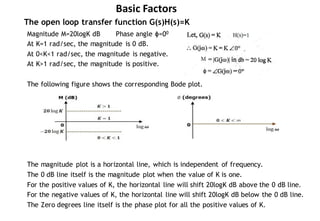
The open loop transfer function G(s)H(s)=K
Magnitude M=20logK dB Phase angle ϕ=00
At K=1 rad/sec, the magnitude is 0 dB.
At 0<K<1 rad/sec, the magnitude is negative.
At K>1 rad/sec, the magnitude is positive.
The following figure shows the corresponding Bode plot.
The magnitude plot is a horizontal line, which is independent of frequency.
The 0 dB line itself is the magnitude plot when the value of K is one.
For the positive values of K, the horizontal line will shift 20logK dB above the 0 dB line.
For the negative values of K, the horizontal line will shift 20logK dB below the 0 dB line.
The Zero degrees line itself is the phase plot for all the positive values of K.
Basic Factors
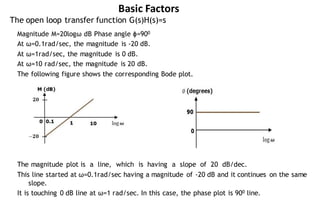
The open loop transfer function G(s)H(s)=s
Magnitude M=20logω dB Phase angle ϕ=900
At ω=0.1rad/sec, the magnitude is -20 dB.
At ω=1rad/sec, the magnitude is 0 dB.
At ω=10 rad/sec, the magnitude is 20 dB.
The following figure shows the corresponding Bode plot.
The magnitude plot is a line, which is having a slope of 20 dB/dec.
This line started at ω=0.1rad/sec having a magnitude of -20 dB and it continues on the same
slope.
It is touching 0 dB line at ω=1 rad/sec. In this case, the phase plot is 900 line.
Basic Factors
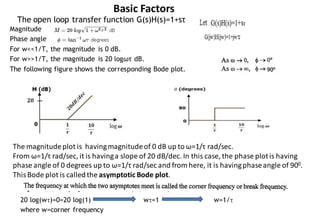
The open loop transfer function G(s)H(s)=1+sτ
Magnitude
Phase angle
For w<<1/T, the magnitude is 0 dB.
For w>>1/T, the magnitude is 20 logωτ dB.
The following figure shows the corresponding Bode plot.
20 log(w)=0=20 log(1) w=1 w=1/
where w=corner frequency
Basic Factors
The magnitudeplot is havingmagnitudeof 0 dB up to ω=1/τ rad/sec.
From ω=1/τ rad/sec, it is havinga slope of 20 dB/dec. In this case, the phase plotis having
phase angle of 0 degrees up to ω=1/τ rad/sec and from here, it is havingphaseangle of 900.
This Bode plot is calledthe asymptotic Bode plot.
Basic Factors-Summary
• Constant Term K: This factor has a slope of zero dB per decade. There is no corner
frequency corresponding to this constant term. The phase angle associated with this
constant term is also zero.
•Derivative factor (jω)n: This factor has a slope of 20 × n (where n is any integer) dB
per decade. There is no corner frequency corresponding to this integral factor. The
phase angle associated with this integral factor is 90 × n. (here n is also an integer).
• Integral factor 1/(jω)n: This factor has a slope of -20 × n (where n is any integer)dB
per decade. There is no corner frequency corresponding to this integral factor. The
phase angle associated with this integral factor is -90 × n. (here n is also an integer).
•First order factor (1+jωT): This factor has a slope of 20 dB per decade. The corner
frequency corresponding to this factor is 1/T radian per second. The phase angle
associated with this first factor is tan– 1(ωT).
• First order factor 1/ (1+jωT): This factor has a slope of -20 dB per decade. The
corner frequency corresponding to this factor is 1/T radian pr second. The phase angle
associated with this first factor is -tan– 1(ωT).
• Second order or quadratic factor: [{1/(1+(2ζ/ωn)}×(jω)+{(1/ωn
2)}×(jω)2)]: This
factor has a slope of -40 dB per decade. The corner frequency corresponding to this
factor is ωn radian per second. The phase angle associated with this first factor is
StabilityAnalysisusingBode Plots
From the Bode plots, we can say whether the control system is stable, marginally stable or
unstable based on the values of these parameters.
Gain Crossover Frequency and Phase Crossover Frequency
Gain Margin and Phase Margin
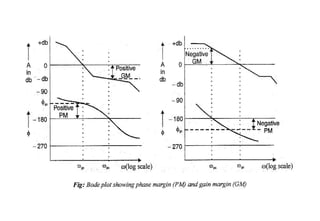
Phase Crossover Frequency: The frequency at which the phase plot is having the phase of -1800
is known as phase cross over frequency. It is denoted by ωpc.
The unit of phase cross over frequency is rad/sec.
Gain Crossover Frequency: The frequency at which the magnitude plot is having the magnitude
of zero dB is known as gain cross over frequency. It is denoted by ωgc.
The unit of gain cross over frequency is rad/sec.
The stability of the control system based on the relation between the phase cross over
frequency and the gain cross over frequency is listed below.
If the phase crossover frequency ωpc is greater than the gain crossover frequency ωgc, then
the control system is stable.
If the phase crossover frequency ωpc is equal to the gain crossover frequency ωgc, then the
control system is marginallystable.
If the phase crossover frequency ωpc is less than the gain crossover frequency ωgc, then the
control system is unstable.
StabilityAnalysisusingBode Plots
Gain Margin: Gain margin GM is equal to negative of the magnitude in dB at phase cross
over frequency.
GM=20log(1/Mpc)= -20logMpc
Where, Mpc is the magnitude at phase cross over frequency. The unit of GM is dB.
Phase Margin: The formula for phase margin PM is PM=1800+ϕgc
Where, ϕgc is the phase angle at gain cross over frequency. The unit of PM is degrees.
NOTE: The stability of the control system based on the relation between gain margin and
phase margin is listed below.
If both the gain margin GM and the phase margin PM are positive, then the control
system is stable.
If both the gain margin GM and the phase margin PM are equal to zero, then the control
system is marginally stable.
If the gain margin GM and / or the phase margin PM are/is negative, then the control
system is unstable.
Bode Plot – Example1
Q. Determine Gain crossover frequency (wgc), Phase crossover frequency(wpc), Gain Margin
and Phase Margin for the following T.F. using Bode plot and also determine the
stability.
G(s) = 20 / [s (1+3s) (1+4s)]
Solution: The sinusoidal T.F. of G(s) is obtained by replacing s by jw in the given T.F
G(jw) = 20/[jw(1+j3w)(1+j4w)]
Corner frequencies:
wc1= 1/4 = 0.25 rad /sec; wc2 = 1/3 = 0.33 rad /sec
Choose a lower frequency and a higher frequency
wl= 0.025 rad/sec (wl < wc1) and
wh = 3.3 rad / sec (wh > wc2)
MAGNITUDE PLOT:
Calculation of Gain (A):
A|wl: A = 20*log [20/0.025] =58.06 dB
A|wc1: A = [(Slope from wl to wc1)* log(wc1/wl)] + Gain (A)|wl
= - 20*log [0.25/0.025]+58.06 = 38.06 dB
A|wc2: A = [(Slope from wc1 to wc2)* log(wc2/wc1)]+Gain(A)|wc1
= - 40*log [0.33/0.25]+38 = 33 dB
A|wh: A = [(Slope from wc2 to wh)* log(wh/wc2)] + Gain (A)|wc2
PHASE PLOT:
Calculation of Phase angle for different values of frequencies :
G(jw) = 20/[jw(1+j3w)(1+j4w)]
= -900-tan-1(3w)–tan-1(4w)
Frequency in rad/sec Phase Angle in Degree
w = 0  = -900
w = 0.025  = -990
w = 0.25  = -1720
w = 0.33  = -1880
w = 3.3  = -2590
w = ∞  = -2700
Bode Plot – Example1
Fig: Bode Plot for the given transfer function G(s) = 20 / [s (1+3s) (1+4s)]
Bode Plot-Example-1
Gain CrossoverFrequency
The frequencyat whichthe dB magnitudeis Zero.
wgc = 1.1 rad/sec
Phase CrossoverFrequency
The frequencyat whichthe Phase of the system is - 1800
wpc = 0.3 rad/sec
Gain Margin:The gain margin in dB is given by the negativeof dB magnitudeof G(jw) at
phase cross over frequency.
GM = - {20*log [G(jwpc)] = -32 dB
Phase Margin:
PM== 1800+ gc=1800 + (- 2400) = -600
Conclusion:
For this system GM and PM are negativein values.Thereforethe system is unstable.
StabilityAnalysis
Refer Text Book:ControlSystem Engineeringby A. Nagoor Kani
Thank You

Bode Plots

  • 1.
    Control System: Bode Plot By Dr.K.Hussain AssociateProfessor & Head Dept. of EE, SITCOE
  • 2.
    BodePlot The Bode plotis the frequency response plot of the transfer function of a system. A Bode plot consists of two graphs. • One is the plot of magnitude of sinusoidal transfer function versus log ω. • The other is a plot of the phase angle of a sinusoidal function versus log ω. Plots of the magnitude and phase characteristics are used to fully describe the frequency response The magnitude of the open loop transfer function in dB is M=20log|G(jω)H(jω)| The phase angle of the open loop transfer function in degrees is ϕ=∠G(jω)H(jω)
  • 3.
    Advantages of BodePlot: • It is based on the asymptotic approximation, which provides a simple method to plot the logarithmic magnitude curve. • The multiplication of various magnitude appears in the transfer function can be treated as an addition, while division can be treated as subtraction as we are using a logarithmic scale. • With the help of this plot only we can directly comment on the stability of the system without doing any calculations. • Study of relative stability is easier as parameters of analysis of relative stability are gain & phase margin which are visibly seen on sketch. • Low & High frequency characteristics can be represented on a single diagram. • Transfer function can be easily obtained from the bode diagram.
  • 4.
    Procedurefordrawing the BodeMagnitudePlot: •Convert given TF into frequency domain. (Substitutes=jw in the TF) •Mark the corner frequency on the semi-log graph paper. •Tabulate these factors moving from top to bottom in the given sequence. 1. Constantterm K 2. Integral factor 1/(jω)n 3. First order factor (1+jωT) 1 4. Second order or quadratic factor: *{1/(1+(2ζ/ωn)}×(jω)+{(1/ωn 2)}×(jω)2)]1 •Now sketch the line with the help of the corresponding slope of the given factor. Change the slope at every corner frequency by adding the slope of the next factor. We will get the magnitude plot. Procedurefordrawing the Bode Phase Plot: 1.Calculate the phase function adding all the phases of factors. 2.Substitutevarious values to the above function in order to find out the phase at different points and plot a curve. We will get a phase curve. • Calculate the phase margin. • Calculate the gain margin.
  • 5.
    The open looptransfer function G(s)H(s)=K Magnitude M=20logK dB Phase angle ϕ=00 At K=1 rad/sec, the magnitude is 0 dB. At 0<K<1 rad/sec, the magnitude is negative. At K>1 rad/sec, the magnitude is positive. The following figure shows the corresponding Bode plot. The magnitude plot is a horizontal line, which is independent of frequency. The 0 dB line itself is the magnitude plot when the value of K is one. For the positive values of K, the horizontal line will shift 20logK dB above the 0 dB line. For the negative values of K, the horizontal line will shift 20logK dB below the 0 dB line. The Zero degrees line itself is the phase plot for all the positive values of K. Basic Factors
  • 6.
    The open looptransfer function G(s)H(s)=s Magnitude M=20logω dB Phase angle ϕ=900 At ω=0.1rad/sec, the magnitude is -20 dB. At ω=1rad/sec, the magnitude is 0 dB. At ω=10 rad/sec, the magnitude is 20 dB. The following figure shows the corresponding Bode plot. The magnitude plot is a line, which is having a slope of 20 dB/dec. This line started at ω=0.1rad/sec having a magnitude of -20 dB and it continues on the same slope. It is touching 0 dB line at ω=1 rad/sec. In this case, the phase plot is 900 line. Basic Factors
  • 7.
    The open looptransfer function G(s)H(s)=1+sτ Magnitude Phase angle For w<<1/T, the magnitude is 0 dB. For w>>1/T, the magnitude is 20 logωτ dB. The following figure shows the corresponding Bode plot. 20 log(w)=0=20 log(1) w=1 w=1/ where w=corner frequency Basic Factors The magnitudeplot is havingmagnitudeof 0 dB up to ω=1/τ rad/sec. From ω=1/τ rad/sec, it is havinga slope of 20 dB/dec. In this case, the phase plotis having phase angle of 0 degrees up to ω=1/τ rad/sec and from here, it is havingphaseangle of 900. This Bode plot is calledthe asymptotic Bode plot.
  • 8.
    Basic Factors-Summary • ConstantTerm K: This factor has a slope of zero dB per decade. There is no corner frequency corresponding to this constant term. The phase angle associated with this constant term is also zero. •Derivative factor (jω)n: This factor has a slope of 20 × n (where n is any integer) dB per decade. There is no corner frequency corresponding to this integral factor. The phase angle associated with this integral factor is 90 × n. (here n is also an integer). • Integral factor 1/(jω)n: This factor has a slope of -20 × n (where n is any integer)dB per decade. There is no corner frequency corresponding to this integral factor. The phase angle associated with this integral factor is -90 × n. (here n is also an integer). •First order factor (1+jωT): This factor has a slope of 20 dB per decade. The corner frequency corresponding to this factor is 1/T radian per second. The phase angle associated with this first factor is tan– 1(ωT). • First order factor 1/ (1+jωT): This factor has a slope of -20 dB per decade. The corner frequency corresponding to this factor is 1/T radian pr second. The phase angle associated with this first factor is -tan– 1(ωT). • Second order or quadratic factor: [{1/(1+(2ζ/ωn)}×(jω)+{(1/ωn 2)}×(jω)2)]: This factor has a slope of -40 dB per decade. The corner frequency corresponding to this factor is ωn radian per second. The phase angle associated with this first factor is
  • 9.
    StabilityAnalysisusingBode Plots From theBode plots, we can say whether the control system is stable, marginally stable or unstable based on the values of these parameters. Gain Crossover Frequency and Phase Crossover Frequency Gain Margin and Phase Margin Phase Crossover Frequency: The frequency at which the phase plot is having the phase of -1800 is known as phase cross over frequency. It is denoted by ωpc. The unit of phase cross over frequency is rad/sec. Gain Crossover Frequency: The frequency at which the magnitude plot is having the magnitude of zero dB is known as gain cross over frequency. It is denoted by ωgc. The unit of gain cross over frequency is rad/sec. The stability of the control system based on the relation between the phase cross over frequency and the gain cross over frequency is listed below. If the phase crossover frequency ωpc is greater than the gain crossover frequency ωgc, then the control system is stable. If the phase crossover frequency ωpc is equal to the gain crossover frequency ωgc, then the control system is marginallystable. If the phase crossover frequency ωpc is less than the gain crossover frequency ωgc, then the control system is unstable.
  • 10.
    StabilityAnalysisusingBode Plots Gain Margin:Gain margin GM is equal to negative of the magnitude in dB at phase cross over frequency. GM=20log(1/Mpc)= -20logMpc Where, Mpc is the magnitude at phase cross over frequency. The unit of GM is dB. Phase Margin: The formula for phase margin PM is PM=1800+ϕgc Where, ϕgc is the phase angle at gain cross over frequency. The unit of PM is degrees. NOTE: The stability of the control system based on the relation between gain margin and phase margin is listed below. If both the gain margin GM and the phase margin PM are positive, then the control system is stable. If both the gain margin GM and the phase margin PM are equal to zero, then the control system is marginally stable. If the gain margin GM and / or the phase margin PM are/is negative, then the control system is unstable.
  • 12.
    Bode Plot –Example1 Q. Determine Gain crossover frequency (wgc), Phase crossover frequency(wpc), Gain Margin and Phase Margin for the following T.F. using Bode plot and also determine the stability. G(s) = 20 / [s (1+3s) (1+4s)] Solution: The sinusoidal T.F. of G(s) is obtained by replacing s by jw in the given T.F G(jw) = 20/[jw(1+j3w)(1+j4w)] Corner frequencies: wc1= 1/4 = 0.25 rad /sec; wc2 = 1/3 = 0.33 rad /sec Choose a lower frequency and a higher frequency wl= 0.025 rad/sec (wl < wc1) and wh = 3.3 rad / sec (wh > wc2) MAGNITUDE PLOT: Calculation of Gain (A): A|wl: A = 20*log [20/0.025] =58.06 dB A|wc1: A = [(Slope from wl to wc1)* log(wc1/wl)] + Gain (A)|wl = - 20*log [0.25/0.025]+58.06 = 38.06 dB A|wc2: A = [(Slope from wc1 to wc2)* log(wc2/wc1)]+Gain(A)|wc1 = - 40*log [0.33/0.25]+38 = 33 dB A|wh: A = [(Slope from wc2 to wh)* log(wh/wc2)] + Gain (A)|wc2
  • 13.
    PHASE PLOT: Calculation ofPhase angle for different values of frequencies : G(jw) = 20/[jw(1+j3w)(1+j4w)] = -900-tan-1(3w)–tan-1(4w) Frequency in rad/sec Phase Angle in Degree w = 0  = -900 w = 0.025  = -990 w = 0.25  = -1720 w = 0.33  = -1880 w = 3.3  = -2590 w = ∞  = -2700 Bode Plot – Example1
  • 14.
    Fig: Bode Plotfor the given transfer function G(s) = 20 / [s (1+3s) (1+4s)]
  • 15.
    Bode Plot-Example-1 Gain CrossoverFrequency Thefrequencyat whichthe dB magnitudeis Zero. wgc = 1.1 rad/sec Phase CrossoverFrequency The frequencyat whichthe Phase of the system is - 1800 wpc = 0.3 rad/sec Gain Margin:The gain margin in dB is given by the negativeof dB magnitudeof G(jw) at phase cross over frequency. GM = - {20*log [G(jwpc)] = -32 dB Phase Margin: PM== 1800+ gc=1800 + (- 2400) = -600 Conclusion: For this system GM and PM are negativein values.Thereforethe system is unstable. StabilityAnalysis Refer Text Book:ControlSystem Engineeringby A. Nagoor Kani
  • 16.