Antibiotic SensitivityAntibiotic Sensitivity
Testing 2017 UpdateTesting 2017 Update
Margie A. Morgan, PhD, MT(ASCP), D(ABMM)Margie A. Morgan, PhD, MT(ASCP), D(ABMM)
Antibiotic Classes
Penicillins
◦ Penicillin
◦ Amoxicillin
◦ Ampicillin
◦ Amp/Clavulanate
◦ Amp/Sulbactam
Anti-Pseudomonal Penicillins
◦ Piperacillin/Tazobactam
◦ Ticarcillin/Clavulanate
Anti- Staph Penicillins
◦ Nafcillin
◦ Oxacillin
◦ Cloxacillin
◦ Dicloxacillin
These antibiotics and those listed
on the next slide have a beta
lactam ring structure – aka beta
lactam antibiotics
Antibiotic Classes (2)
Carbapenems
◦ Imipenem
◦ Meropenem
◦ Ertapenem
◦ Dorapenem
Monobactam
◦ Aztreonam
Cephalosporins
◦ First generation
◦ Cefazolin
◦ Second generation
◦ Cefotetan
◦ Cefoxitin Cefuroxime
◦ Third generation
◦ Cefotaxime Ceftriazone
◦ Ceftazidime Cefpodoxime
◦ Fourth generation
◦ Cefepime Ceftaroline
Antibiotic Classes (3)
Fluoroquinolones
◦ Ciprofloxacin
◦ Levofloxacin
◦ Moxifloxacin
Aminoglycosides
◦ Gentamicin
◦ Tobramycin
◦ Amikacin
Trimethoprim/ sulfamethozaxole
Macrolides
◦ Azithromycin
◦ Clarythromycin
◦ Erthromycin
Tetracyclines
◦ Tetracycline
◦ Minocycline
◦ Doxycycline
Lincosamide
◦ Chloramphenicol
The Four Major mechanismsThe Four Major mechanisms
of antibiotic resistanceof antibiotic resistance
Enzymatic cleavageEnzymatic cleavage leads to inactivation of antibioticleads to inactivation of antibiotic
◦ Active Beta lactamases and amino-glycoside modifying enzymesActive Beta lactamases and amino-glycoside modifying enzymes
Altered receptorsAltered receptors/binding proteins preventing attachment of antibiotics/binding proteins preventing attachment of antibiotics
to the bacterial surfaceto the bacterial surface
◦ Penicillin binding proteins (PBPs)Penicillin binding proteins (PBPs)
◦ Mechanism for Strep pneumoniae resistance to penicillin and MRSAMechanism for Strep pneumoniae resistance to penicillin and MRSA
resistance to methicillinresistance to methicillin
Altered permeabilityAltered permeability/influx and efflux pumps stopping passage through/influx and efflux pumps stopping passage through
porins – gram negative bacilliporins – gram negative bacilli
◦ Pseudomonas aeruginosa resistance to amino-glycosidesPseudomonas aeruginosa resistance to amino-glycosides
Bypass of a metabolic blockBypass of a metabolic block/metabolic block imposed by antibiotic/metabolic block imposed by antibiotic
◦ Enterococcus resistance to TMP/SXTEnterococcus resistance to TMP/SXT
The Rules for SusceptibilityThe Rules for Susceptibility
TestingTesting
CLSICLSI – Clinical Laboratory Standards Institute Approved standards for– Clinical Laboratory Standards Institute Approved standards for
the testing & reporting of susceptibility results/ updated yearlythe testing & reporting of susceptibility results/ updated yearly
1.1. Charts with appropriate antibiotics to testCharts with appropriate antibiotics to test
2.2. How to interpret the laboratory resultsHow to interpret the laboratory results
3.3. QC standards and proper testing proceduresQC standards and proper testing procedures
Methods/Bacteria inMethods/Bacteria in
ReviewReview
Susceptibility testing methodsSusceptibility testing methods
1. Kirby Bauer disk diffusion (KB)1. Kirby Bauer disk diffusion (KB)
2. E Test Strip Minimum inhibitory concentration (MIC )2. E Test Strip Minimum inhibitory concentration (MIC )
3. Broth dilution Minimum inhibitory concentration (MIC)3. Broth dilution Minimum inhibitory concentration (MIC)
4. Beta lactamase enzyme detection4. Beta lactamase enzyme detection
Resistant Bacteria of ImportanceResistant Bacteria of Importance
MRSAMRSA methicillin resistant Staphylococcus aureusmethicillin resistant Staphylococcus aureus
VREVRE vancomycin resistant enterococcusvancomycin resistant enterococcus
ESBLESBL Extended Spectrum Beta Lactamase Gram neg rodsExtended Spectrum Beta Lactamase Gram neg rods
KPCKPC Klebsiella pneumonia Carbapenemase orKlebsiella pneumonia Carbapenemase or
CRECRE Carbapenamase Resistant EntericsCarbapenamase Resistant Enterics
Streptococcus pneumoniaeStreptococcus pneumoniae
Neisseria gonorrhoeaeNeisseria gonorrhoeae
Preparation of Bacteria forPreparation of Bacteria for
all Susceptibility Methodsall Susceptibility Methods
Pure culture of one organismPure culture of one organism
Log phase growth of bacteria - 16-24 hrs oldLog phase growth of bacteria - 16-24 hrs old
Methods test for stasis not killingMethods test for stasis not killing
Standardized suspension of bacteria:Standardized suspension of bacteria:
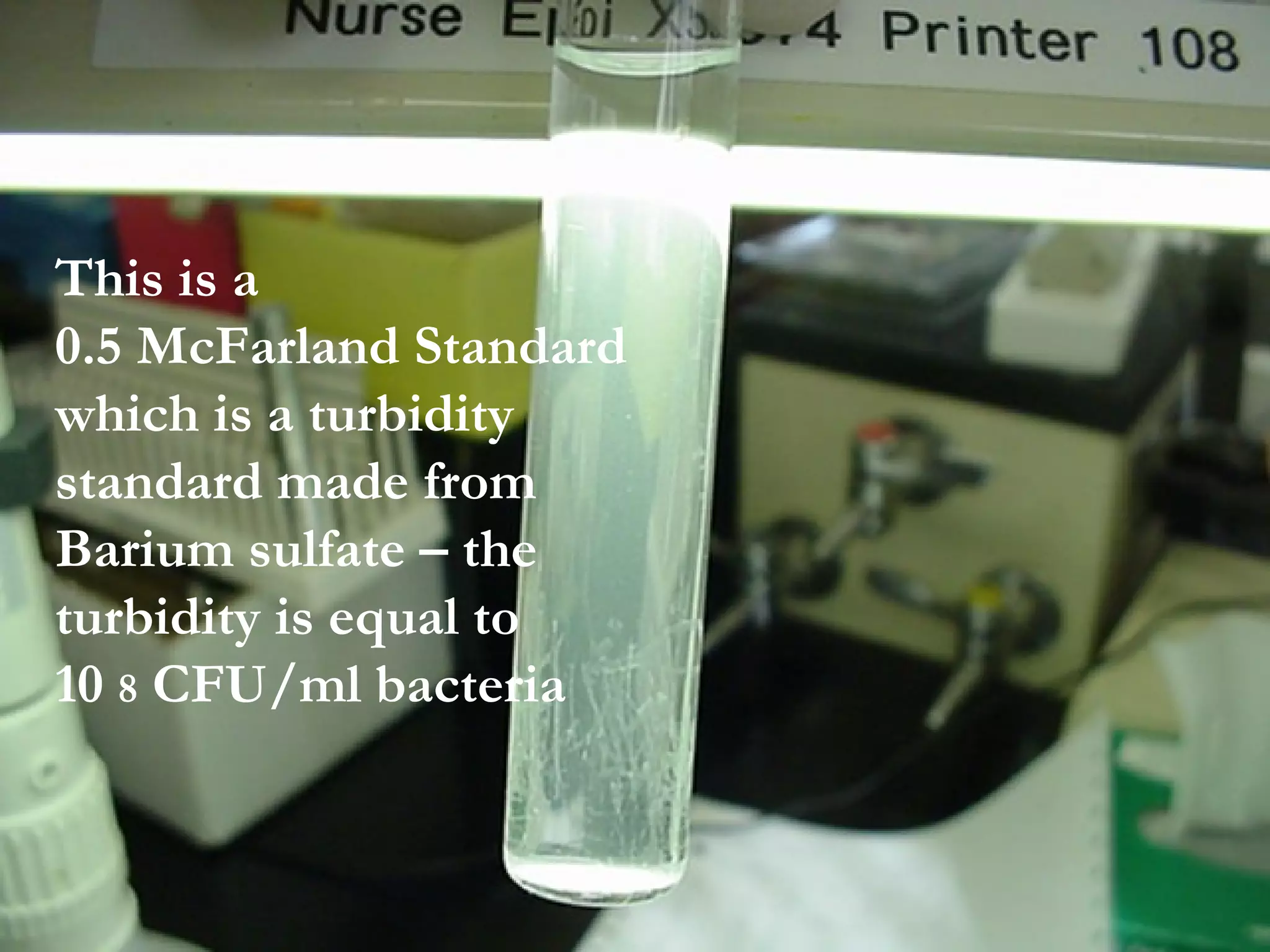
◦O.5 McFarland Standard – Barium sulfate solution thatO.5 McFarland Standard – Barium sulfate solution that
equals the turbidity of 10 8 bacteria/mlequals the turbidity of 10 8 bacteria/ml
◦Alternative method – use spectrophotometerAlternative method – use spectrophotometer
Incubation at 35 °C in room air (or CO²) for 18- 24 hrsIncubation at 35 °C in room air (or CO²) for 18- 24 hrs
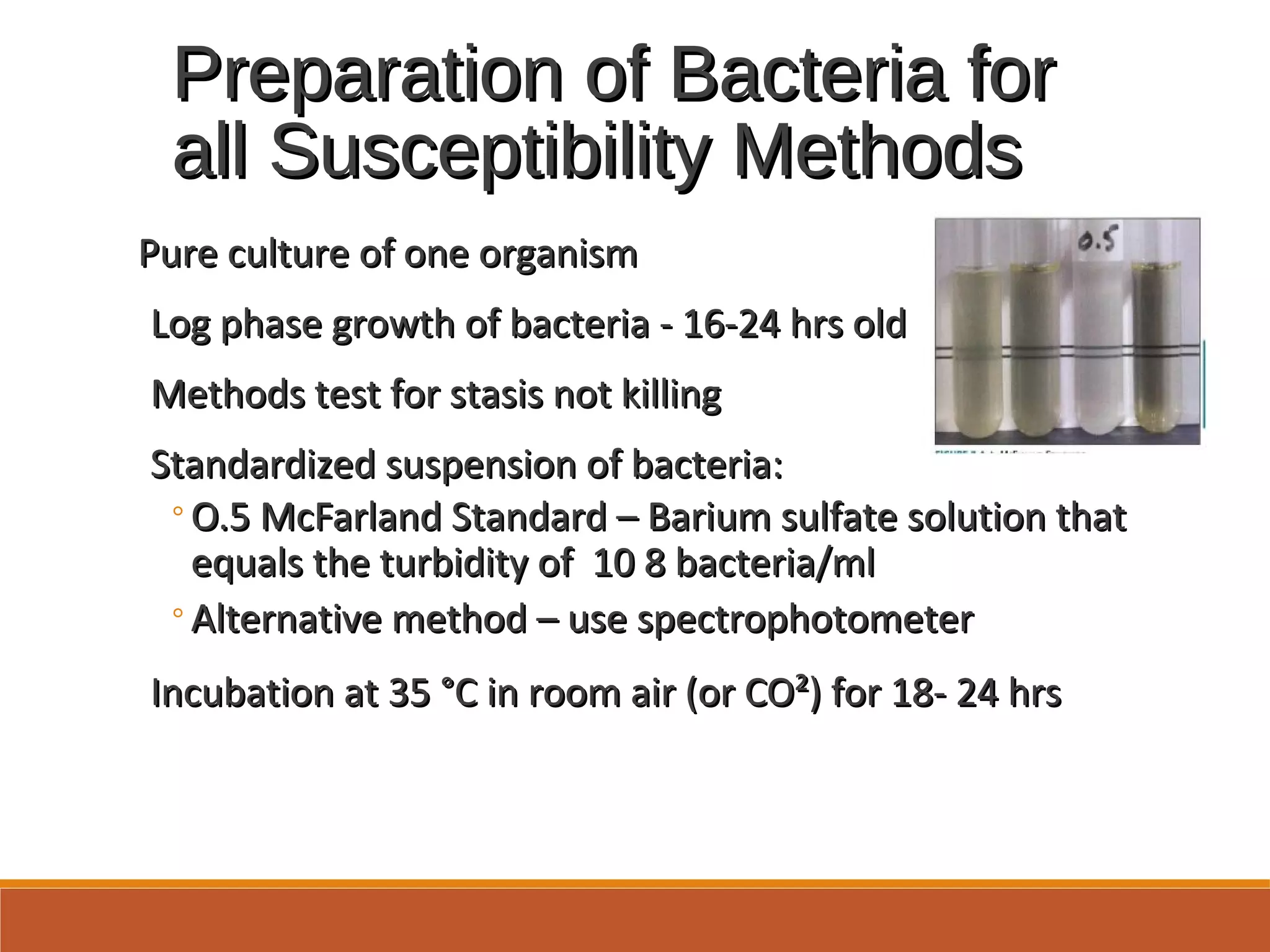
This is a
0.5 McFarland Standard
which is a turbidity
standard made from
Barium sulfate – the
turbidity is equal to
10 8 CFU/ml bacteria
Quality ControlQuality Control
VerificationVerification: Before testing patients: Must correctly test multiple QC: Before testing patients: Must correctly test multiple QC
strains for 20 consecutive days or 3 replicates for 5 days. This is tostrains for 20 consecutive days or 3 replicates for 5 days. This is to
make sure you can perform the tests correctly.make sure you can perform the tests correctly.
ATCCATCC strains of bacteria (American Type Culture Collection) If QCstrains of bacteria (American Type Culture Collection) If QC
strains are within limits - you can then do Weekly quality control on allstrains are within limits - you can then do Weekly quality control on all
lots of cards, disks, plates in uselots of cards, disks, plates in use
◦ Data must be recorded and reviewed monthly by supervisorData must be recorded and reviewed monthly by supervisor
If weekly QC results are out of control:If weekly QC results are out of control:
◦ Immediately repeat/ inform supervisorImmediately repeat/ inform supervisor
◦ If repeat is OK – continue routine testingIf repeat is OK – continue routine testing
◦ If repeat is NOT OK – must investigate/document/ repeat 5 times toIf repeat is NOT OK – must investigate/document/ repeat 5 times to
start routine testing. All repeats must be in controlstart routine testing. All repeats must be in control
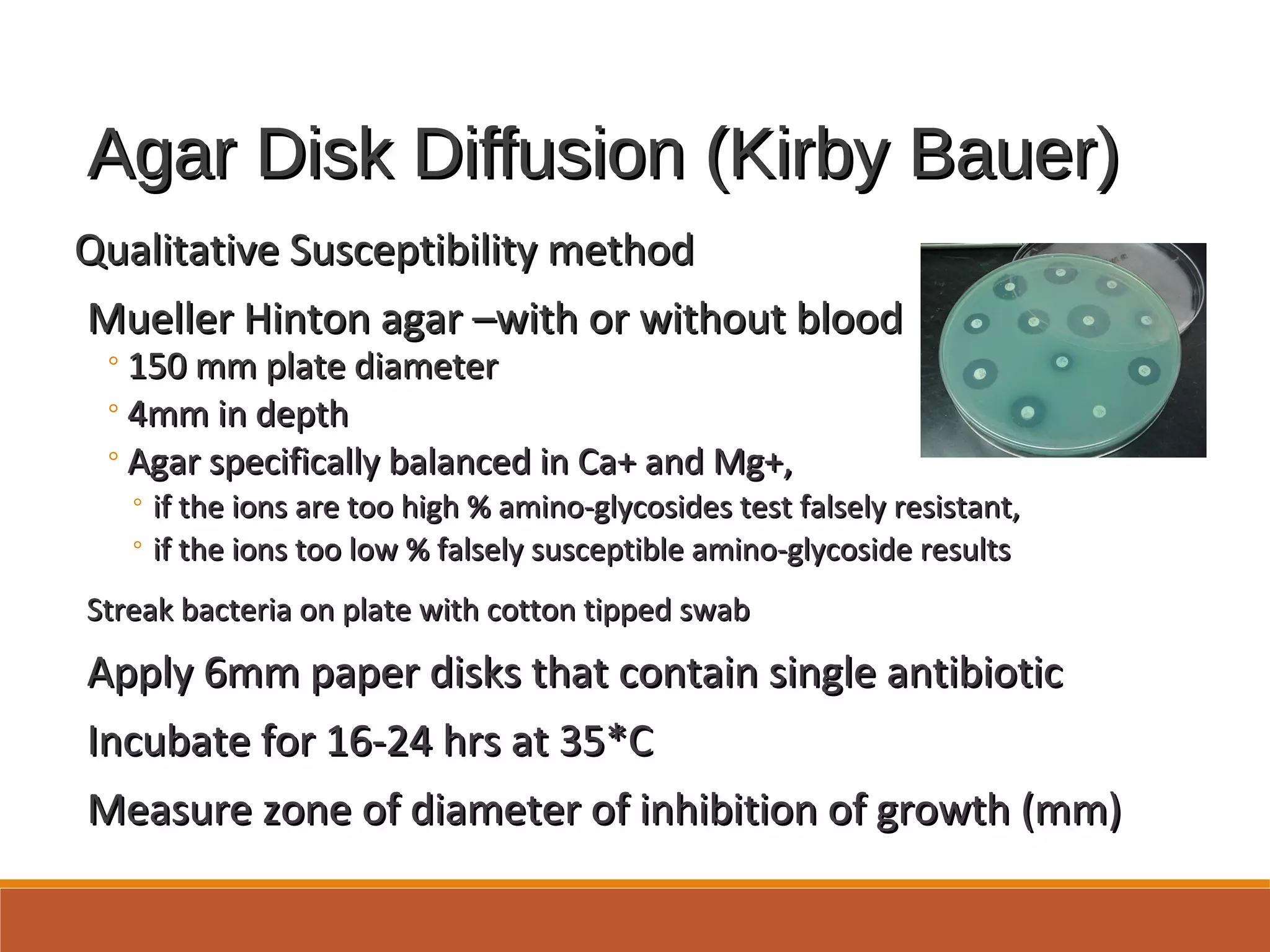
Agar Disk Diffusion (Kirby Bauer)Agar Disk Diffusion (Kirby Bauer)
Qualitative Susceptibility methodQualitative Susceptibility method
Mueller Hinton agar –with or without bloodMueller Hinton agar –with or without blood
◦150 mm plate diameter150 mm plate diameter
◦4mm in depth4mm in depth
◦Agar specifically balanced in Ca+ and Mg+,Agar specifically balanced in Ca+ and Mg+,
◦ if the ions are too high % amino-glycosides test falsely resistant,if the ions are too high % amino-glycosides test falsely resistant,
◦ if the ions too low % falsely susceptible amino-glycoside resultsif the ions too low % falsely susceptible amino-glycoside results
Streak bacteria on plate with cotton tipped swabStreak bacteria on plate with cotton tipped swab
Apply 6mm paper disks that contain single antibioticApply 6mm paper disks that contain single antibiotic
Incubate for 16-24 hrs at 35*CIncubate for 16-24 hrs at 35*C
Measure zone of diameter of inhibition of growth (mm)Measure zone of diameter of inhibition of growth (mm)
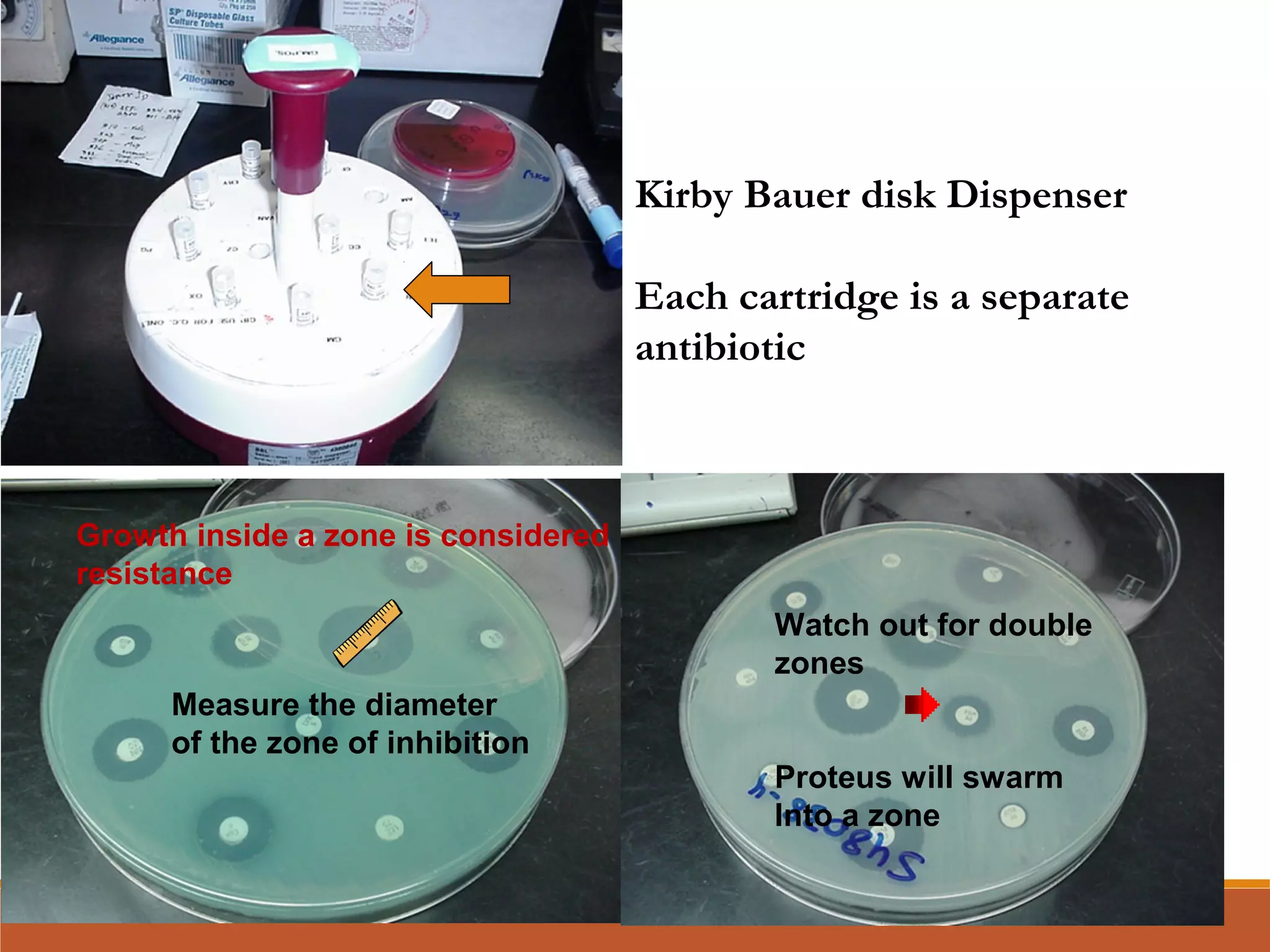
Kirby Bauer disk Dispenser
Each cartridge is a separate
antibiotic
Growth inside a zone is considered
resistance
Measure the diameter
of the zone of inhibition
Watch out for double
zones
Proteus will swarm
Into a zone
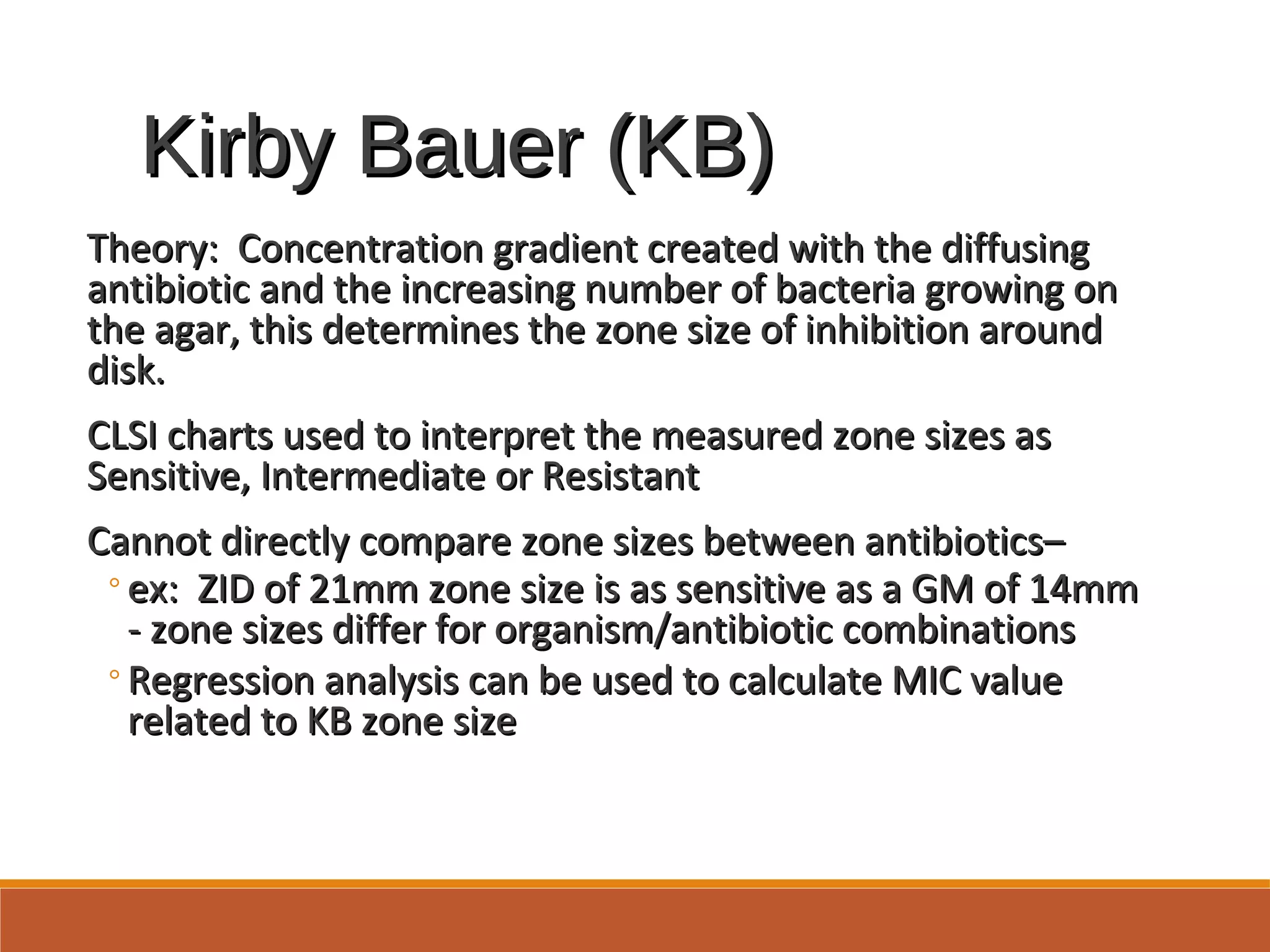
Kirby Bauer (KB)Kirby Bauer (KB)
Theory: Concentration gradient created with the diffusingTheory: Concentration gradient created with the diffusing
antibiotic and the increasing number of bacteria growing onantibiotic and the increasing number of bacteria growing on
the agar, this determines the zone size of inhibition aroundthe agar, this determines the zone size of inhibition around
disk.disk.
CLSI charts used to interpret the measured zone sizes asCLSI charts used to interpret the measured zone sizes as
Sensitive, Intermediate or ResistantSensitive, Intermediate or Resistant
Cannot directly compare zone sizes between antibiotics–Cannot directly compare zone sizes between antibiotics–
◦ex: ZID of 21mm zone size is as sensitive as a GM of 14mmex: ZID of 21mm zone size is as sensitive as a GM of 14mm
- zone sizes differ for organism/antibiotic combinations- zone sizes differ for organism/antibiotic combinations
◦Regression analysis can be used to calculate MIC valueRegression analysis can be used to calculate MIC value
related to KB zone sizerelated to KB zone size
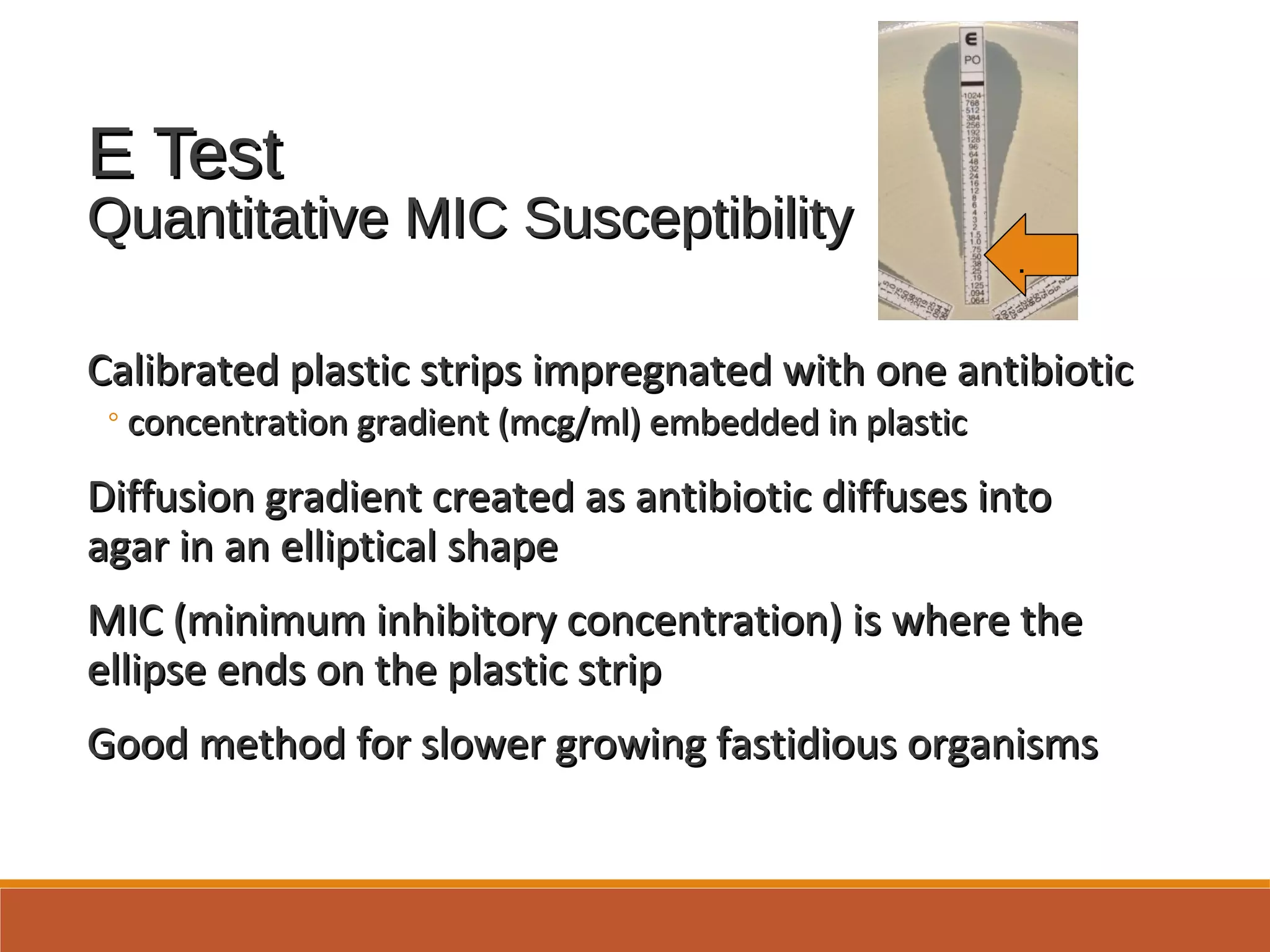
E TestE Test
Quantitative MIC SusceptibilityQuantitative MIC Susceptibility
Calibrated plastic strips impregnated with one antibioticCalibrated plastic strips impregnated with one antibiotic
◦concentration gradient (mcg/ml) embedded in plasticconcentration gradient (mcg/ml) embedded in plastic
Diffusion gradient created as antibiotic diffuses intoDiffusion gradient created as antibiotic diffuses into
agar in an elliptical shapeagar in an elliptical shape
MIC (minimum inhibitory concentration) is where theMIC (minimum inhibitory concentration) is where the
ellipse ends on the plastic stripellipse ends on the plastic strip
Good method for slower growing fastidious organismsGood method for slower growing fastidious organisms
.
E Test method
E test method
Susceptibility result =
Where growth crosses
The plastic strip
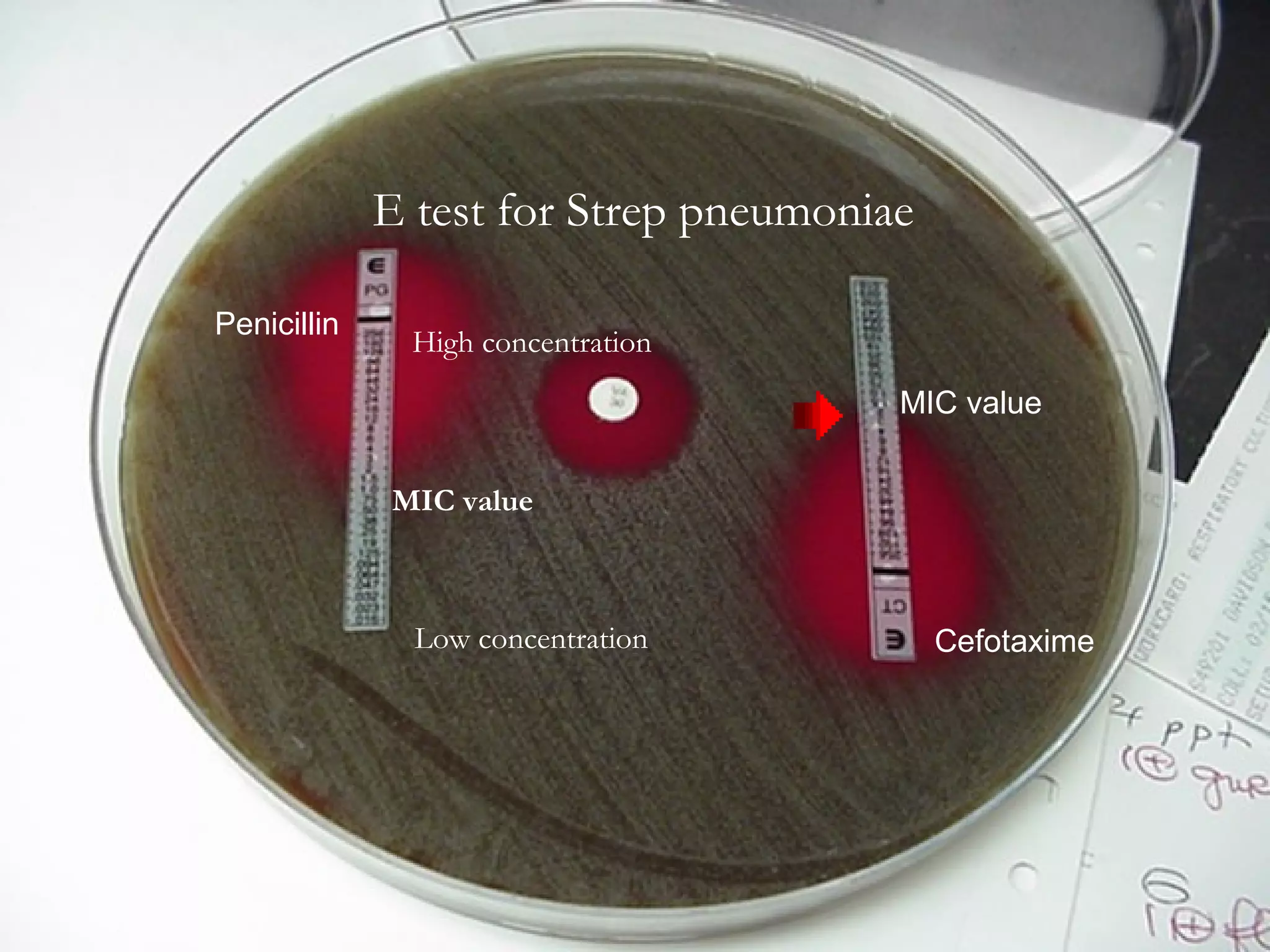
E test for Strep pneumoniae
Low concentration
High concentration
MIC value
MIC value
Penicillin
Cefotaxime
Broth DilutionBroth Dilution
Quantitative Susceptibility MethodQuantitative Susceptibility Method
Bacteria inoculum: 0.5 McFarland standard – further diluted to 5x10Bacteria inoculum: 0.5 McFarland standard – further diluted to 5x1055
organisms/mlorganisms/ml
in brothin broth
Suspension is inoculated into tubes or micro titer trays containingSuspension is inoculated into tubes or micro titer trays containing
growth medium and known 2 fold dilutions (mcg/ml) of antibioticsgrowth medium and known 2 fold dilutions (mcg/ml) of antibiotics
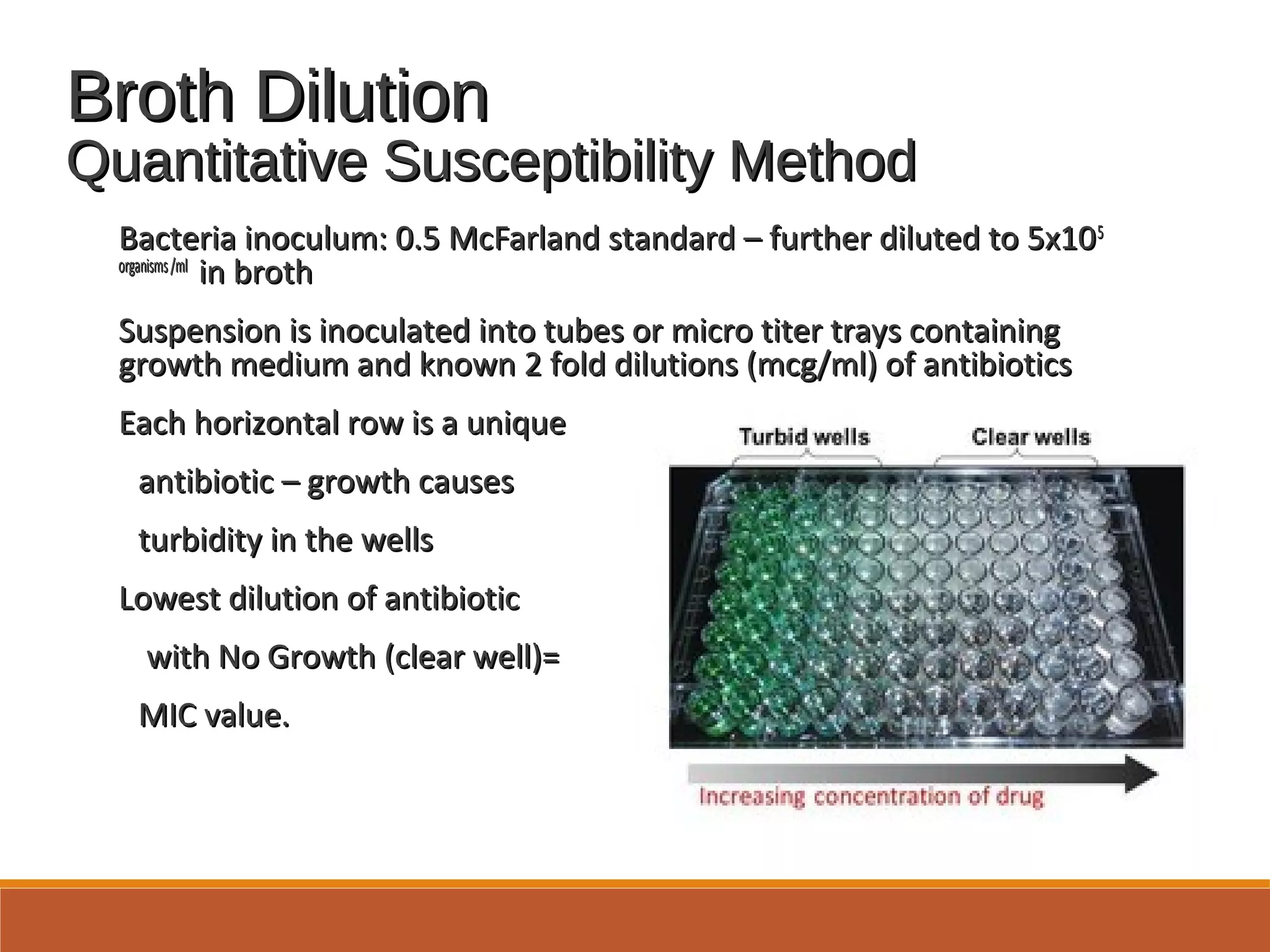
Each horizontal row is a uniqueEach horizontal row is a unique
antibiotic – growth causesantibiotic – growth causes
turbidity in the wellsturbidity in the wells
Lowest dilution of antibioticLowest dilution of antibiotic
with No Growth (clear well)=with No Growth (clear well)=
MIC value.MIC value.
Broth Dilution DefinitionsBroth Dilution Definitions
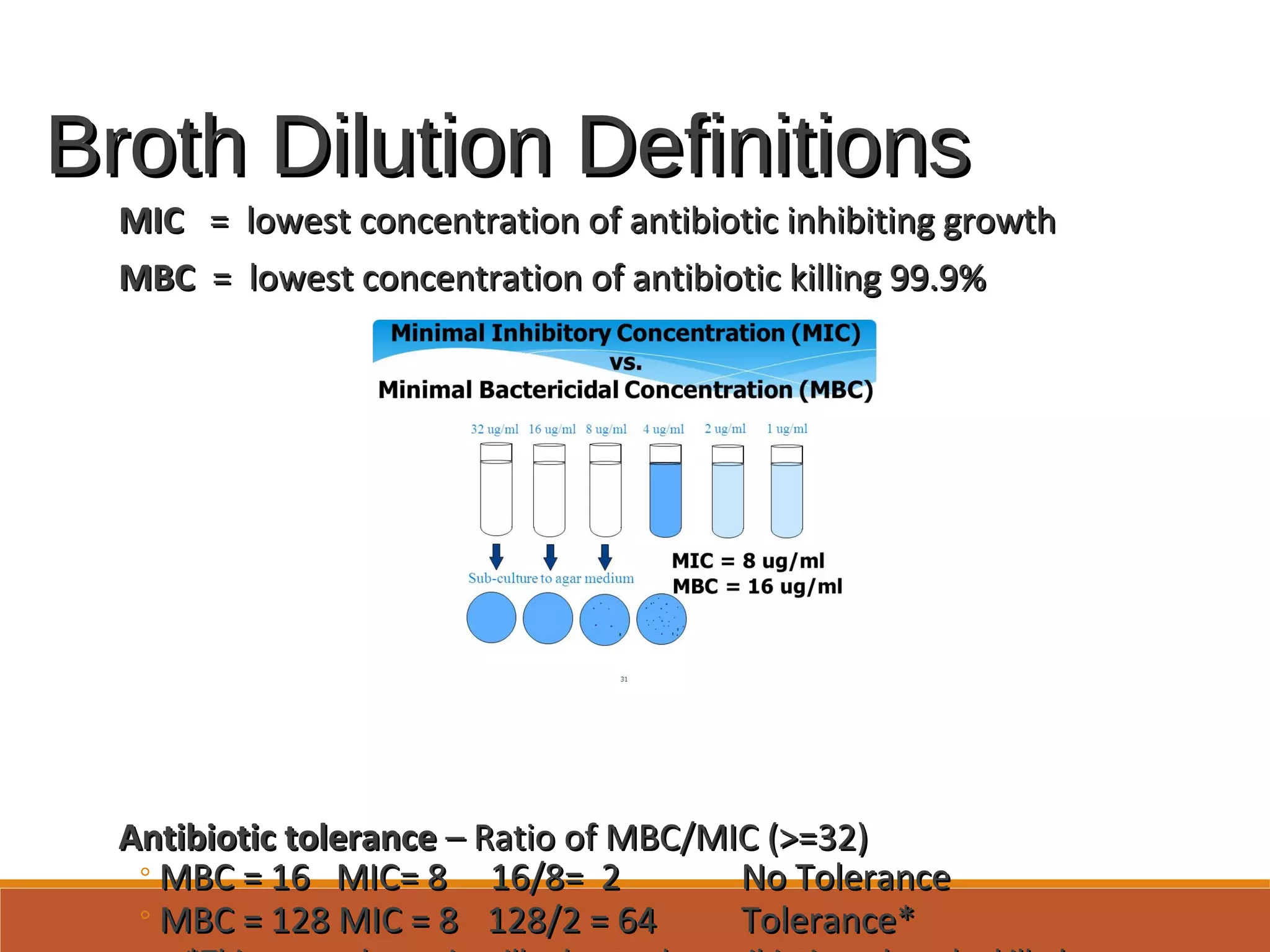
MICMIC = lowest concentration of antibiotic inhibiting growth= lowest concentration of antibiotic inhibiting growth
MBCMBC = lowest concentration of antibiotic killing 99.9%= lowest concentration of antibiotic killing 99.9%
Antibiotic toleranceAntibiotic tolerance – Ratio of MBC/MIC (>=32)– Ratio of MBC/MIC (>=32)
◦MBC = 16 MIC= 8 16/8= 2MBC = 16 MIC= 8 16/8= 2 No ToleranceNo Tolerance
◦MBC = 128 MIC = 8MBC = 128 MIC = 8 128/2 = 64128/2 = 64 Tolerance*Tolerance*
Siemens Microscan walkaway
AST system
BD Phoenix AST system
Biomerieux Vitek2 AST
Automated Identification
Susceptibility Testing
Systems (AST)
Disk test for Beta lactamaseDisk test for Beta lactamase
Detection (Cefinase Test)Detection (Cefinase Test)
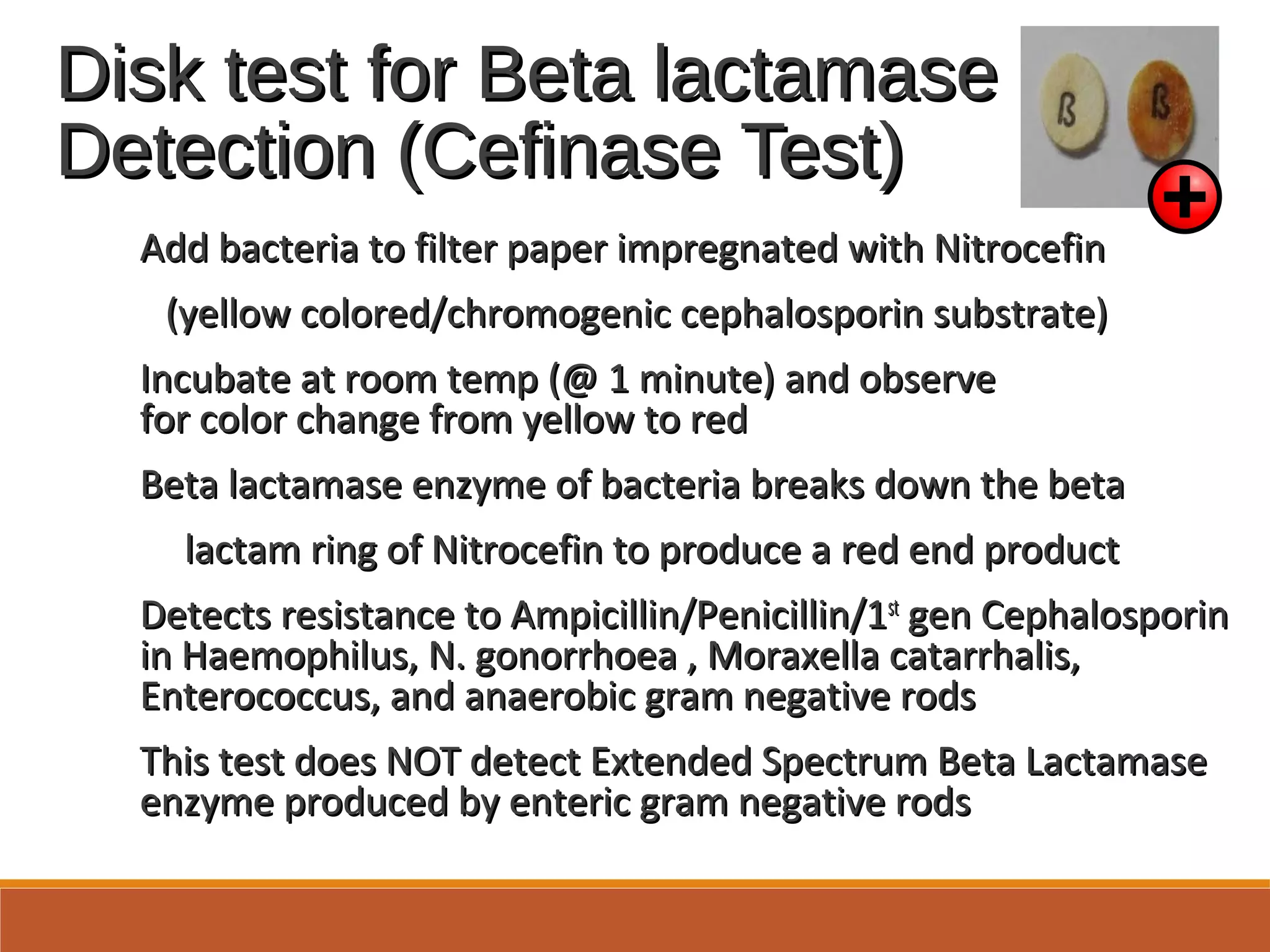
Add bacteria to filter paper impregnated with NitrocefinAdd bacteria to filter paper impregnated with Nitrocefin
(yellow colored/chromogenic cephalosporin substrate)(yellow colored/chromogenic cephalosporin substrate)
Incubate at room temp (@ 1 minute) and observeIncubate at room temp (@ 1 minute) and observe
for color change from yellow to redfor color change from yellow to red
Beta lactamase enzyme of bacteria breaks down the betaBeta lactamase enzyme of bacteria breaks down the beta
lactam ring of Nitrocefin to produce a red end productlactam ring of Nitrocefin to produce a red end product
Detects resistance to Ampicillin/Penicillin/1Detects resistance to Ampicillin/Penicillin/1stst
gen Cephalosporingen Cephalosporin
in Haemophilus, N. gonorrhoea , Moraxella catarrhalis,in Haemophilus, N. gonorrhoea , Moraxella catarrhalis,
Enterococcus, and anaerobic gram negative rodsEnterococcus, and anaerobic gram negative rods
This test does NOT detect Extended Spectrum Beta LactamaseThis test does NOT detect Extended Spectrum Beta Lactamase
enzyme produced by enteric gram negative rodsenzyme produced by enteric gram negative rods
Beta lactamase detectionBeta lactamase detection
tidbitstidbits
Haemophilus influenzaeHaemophilus influenzae
◦In US, approx 28% are beta lactamase producers andIn US, approx 28% are beta lactamase producers and
therefore, resistant to Ampicillintherefore, resistant to Ampicillin
Bacteroides fragilis groupBacteroides fragilis group
◦Primary resistance mechanism is beta lactamase productionPrimary resistance mechanism is beta lactamase production
>95% of strains are resistant to Pencillin>95% of strains are resistant to Pencillin
Moraxella catarrhalisMoraxella catarrhalis
◦>90% beta lactamase positive /Ampicillin resistant>90% beta lactamase positive /Ampicillin resistant
Methicillin Resistant StaphMethicillin Resistant Staph
aureus (MRSA)aureus (MRSA)
Test for oxacillin (OX) resistance - it is more stable for testingTest for oxacillin (OX) resistance - it is more stable for testing
than methicillin in the laboratorythan methicillin in the laboratory
OLDOLD - If- If OX is resistantOX is resistant - S. aureus is reported as a MRSA- S. aureus is reported as a MRSA
NEW - resistanceNEW - resistance testing for Cefoxitin is more reliable and atesting for Cefoxitin is more reliable and a
preferred way to confirm MRSApreferred way to confirm MRSA
All cephalosporin antibiotics are reported resistant for MRSAAll cephalosporin antibiotics are reported resistant for MRSA
and should never be used for therapyand should never be used for therapy
Resistance mechanism byResistance mechanism by penicillin binding proteins (PBPs)penicillin binding proteins (PBPs)
◦ PBPs bind penicillin and related antibioticsPBPs bind penicillin and related antibiotics
◦ The binding prevents disruption of the peptidoglycan synthesis in theThe binding prevents disruption of the peptidoglycan synthesis in the
Staph aureus cell wallStaph aureus cell wall
◦ PBPs are produced by thePBPs are produced by the mecA genemecA gene
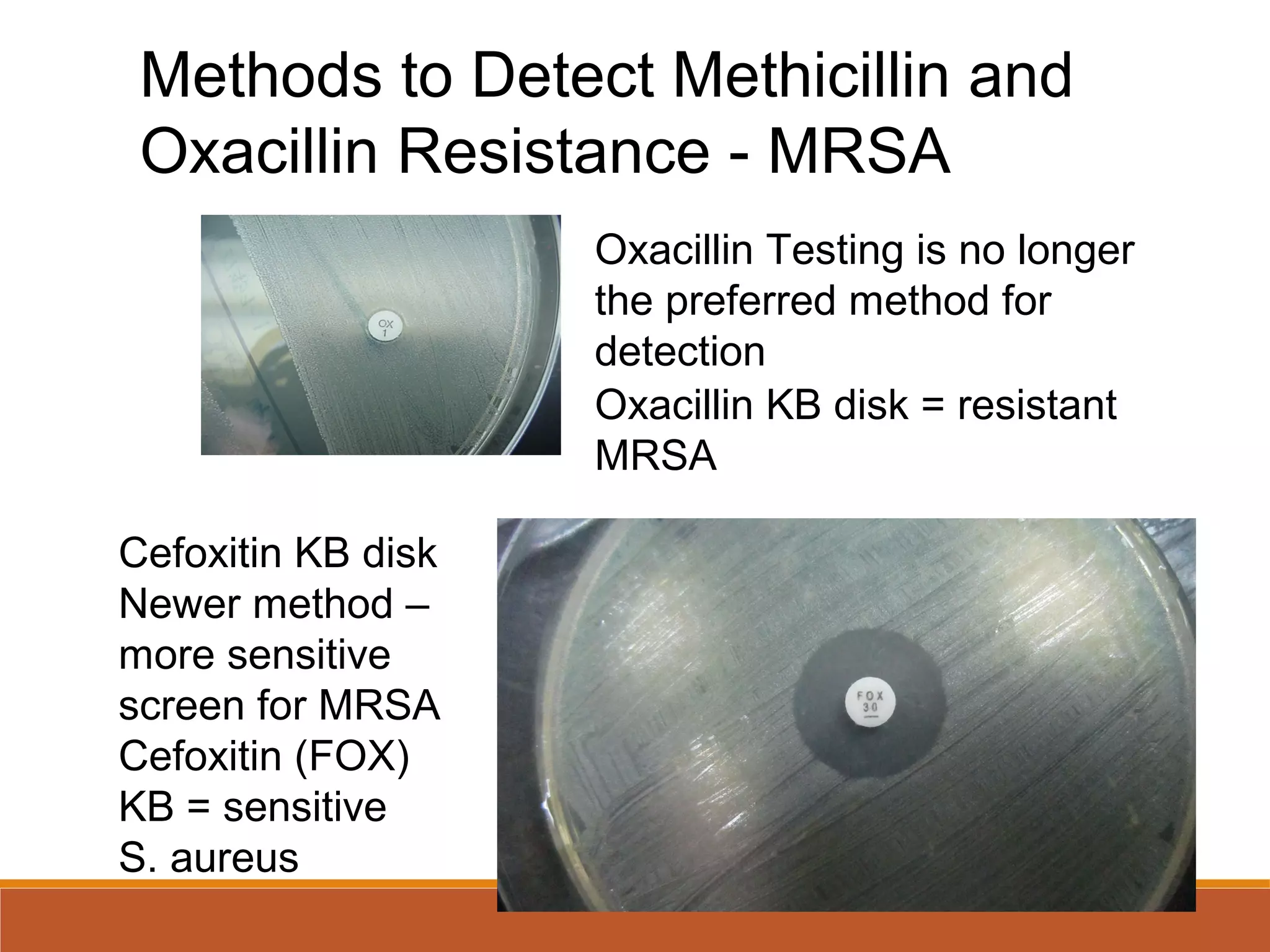
Oxacillin KB disk = resistant
MRSA
Cefoxitin KB disk
Newer method –
more sensitive
screen for MRSA
Cefoxitin (FOX)
KB = sensitive
S. aureus
Methods to Detect Methicillin and
Oxacillin Resistance - MRSA
Oxacillin Testing is no longer
the preferred method for
detection
Clindamycin Induction Test –Clindamycin Induction Test –
The D testThe D test
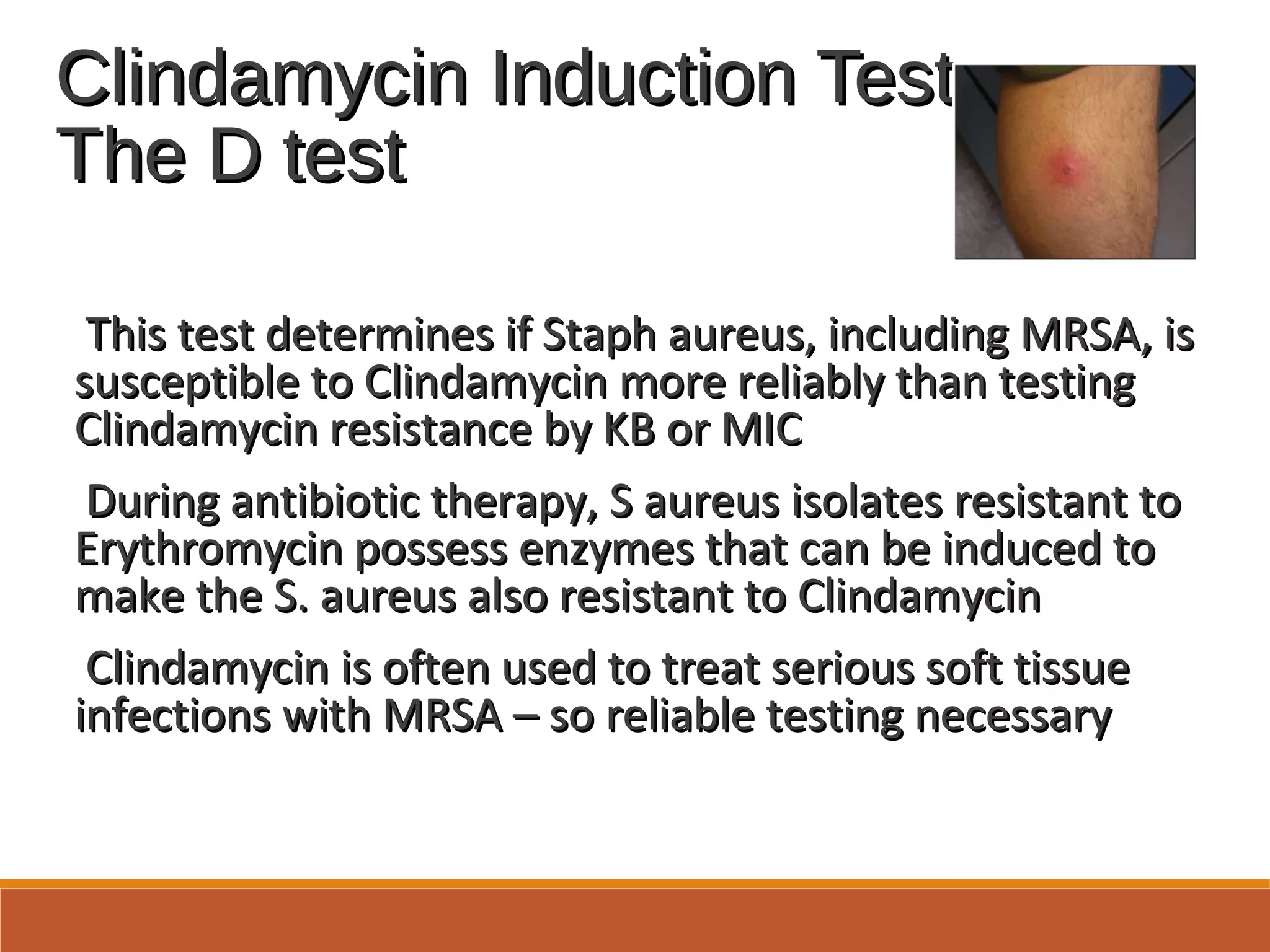
This test determines if Staph aureus, including MRSA, isThis test determines if Staph aureus, including MRSA, is
susceptible to Clindamycin more reliably than testingsusceptible to Clindamycin more reliably than testing
Clindamycin resistance by KB or MICClindamycin resistance by KB or MIC
During antibiotic therapy, S aureus isolates resistant toDuring antibiotic therapy, S aureus isolates resistant to
Erythromycin possess enzymes that can be induced toErythromycin possess enzymes that can be induced to
make the S. aureus also resistant to Clindamycinmake the S. aureus also resistant to Clindamycin
Clindamycin is often used to treat serious soft tissueClindamycin is often used to treat serious soft tissue
infections with MRSA – so reliable testing necessaryinfections with MRSA – so reliable testing necessary
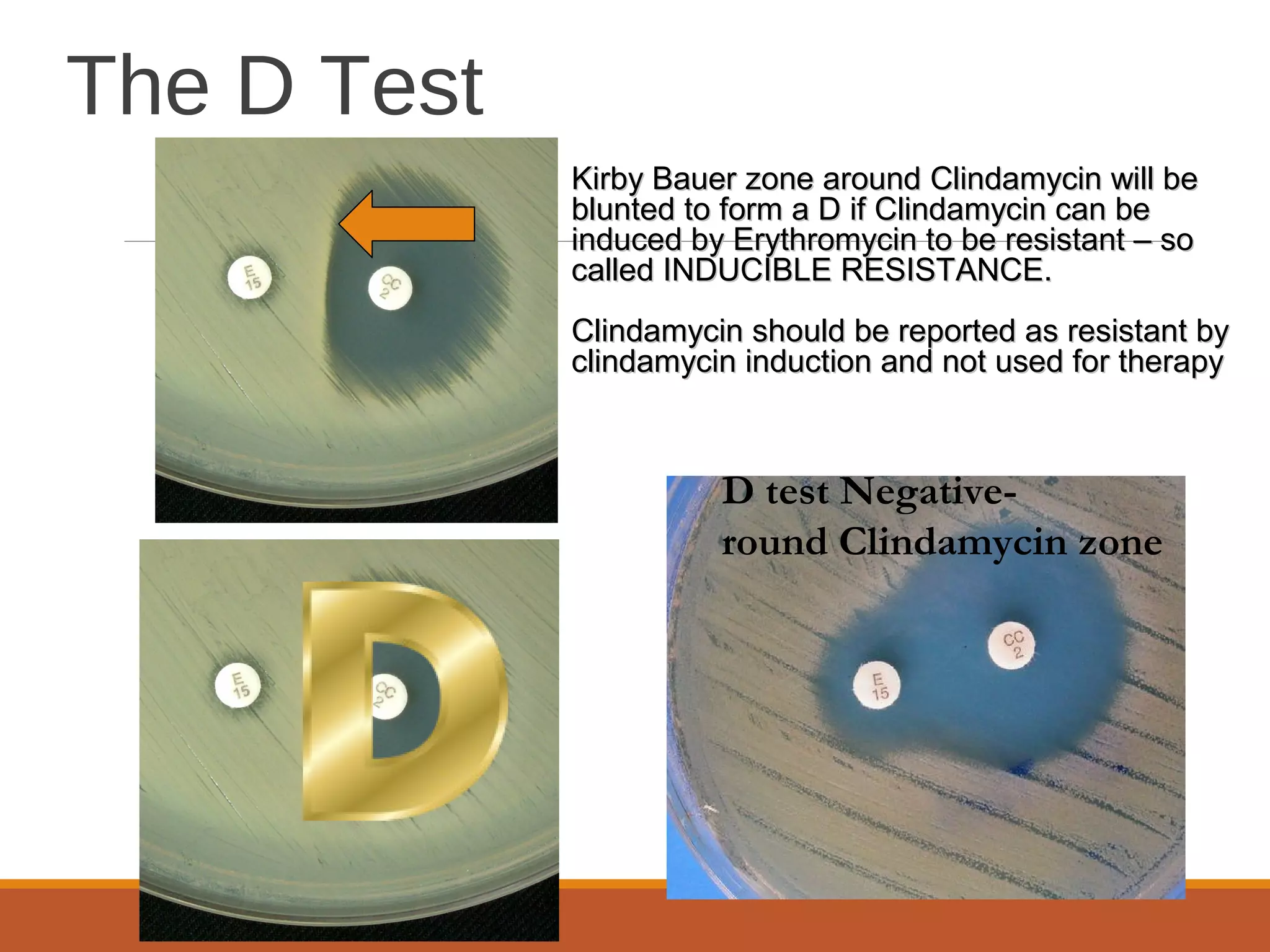
D test Negative-
round Clindamycin zone
Kirby Bauer zone around Clindamycin will beKirby Bauer zone around Clindamycin will be
blunted to form a D if Clindamycin can beblunted to form a D if Clindamycin can be
induced by Erythromycin to be resistant – soinduced by Erythromycin to be resistant – so
called INDUCIBLE RESISTANCE.called INDUCIBLE RESISTANCE.
Clindamycin should be reported as resistant byClindamycin should be reported as resistant by
clindamycin induction and not used for therapyclindamycin induction and not used for therapy
The D Test
EnterococcusEnterococcus
All are intrinsically resistant to:All are intrinsically resistant to:
◦CephalosporinsCephalosporins
◦ClindamycinClindamycin
◦Trimethoprim/sulfamethoxazoleTrimethoprim/sulfamethoxazole
Synergistic antibiotic therapy can be important for theSynergistic antibiotic therapy can be important for the
treatment of Enterococcustreatment of Enterococcus
◦Ampicillin plus Gentamicin is synergistic = increasedAmpicillin plus Gentamicin is synergistic = increased
killing potential in combinationkilling potential in combination
◦Important for endocarditis therapyImportant for endocarditis therapy
Vancomycin Resistant EnterococcusVancomycin Resistant Enterococcus
(VRE)(VRE)
Acquired resistance to vancomycin –Acquired resistance to vancomycin –
◦Plasmid mediated vanA associated with E. faeciumPlasmid mediated vanA associated with E. faecium
◦Plasmic mediated vanB associated with E. faecalisPlasmic mediated vanB associated with E. faecalis
Detected by KB, automated AST systems, and EtestDetected by KB, automated AST systems, and Etest
methodsmethods
Drugs of choice limited if VRE detected –Drugs of choice limited if VRE detected –
◦ LinezolidLinezolid
◦ Synercid for E. faecium onlySynercid for E. faecium only
Major infection control issue!!Major infection control issue!!
◦Rectal colonization can contaminatie the environment andRectal colonization can contaminatie the environment and
lead to transmission to surrounding patientslead to transmission to surrounding patients
◦Most infections related to ICU stays and longMost infections related to ICU stays and long
hospitalizationshospitalizations
◦Not virulent but problematic in immune suppressedNot virulent but problematic in immune suppressed
Extended Spectrum BetaExtended Spectrum Beta
LactamaseLactamase
[ESBL][ESBL]
Enzymes produced by Enteric Gram negative bacilliEnzymes produced by Enteric Gram negative bacilli
◦Confer resistance to Cephalosporins, Penicillins andConfer resistance to Cephalosporins, Penicillins and
Monobactam (Aztreonam) by opening the beta lactam ringMonobactam (Aztreonam) by opening the beta lactam ring
and inactivating the antibioticand inactivating the antibiotic
◦ESBLs do not attack Cephamycin (cefoxitin, cefotetan) or theESBLs do not attack Cephamycin (cefoxitin, cefotetan) or the
Carbapenem antibiotic classesCarbapenem antibiotic classes
Plasmid mediated CTX-M beta lactamases are the mostPlasmid mediated CTX-M beta lactamases are the most
common in the US currently, but many more ESBL typescommon in the US currently, but many more ESBL types
worldwideworldwide
Therapy for ESBL producing gram negative rods:Therapy for ESBL producing gram negative rods:
◦Carbapenems: Imipenem, Meropenem, Doripenem,Carbapenems: Imipenem, Meropenem, Doripenem,
ErtapenemErtapenem
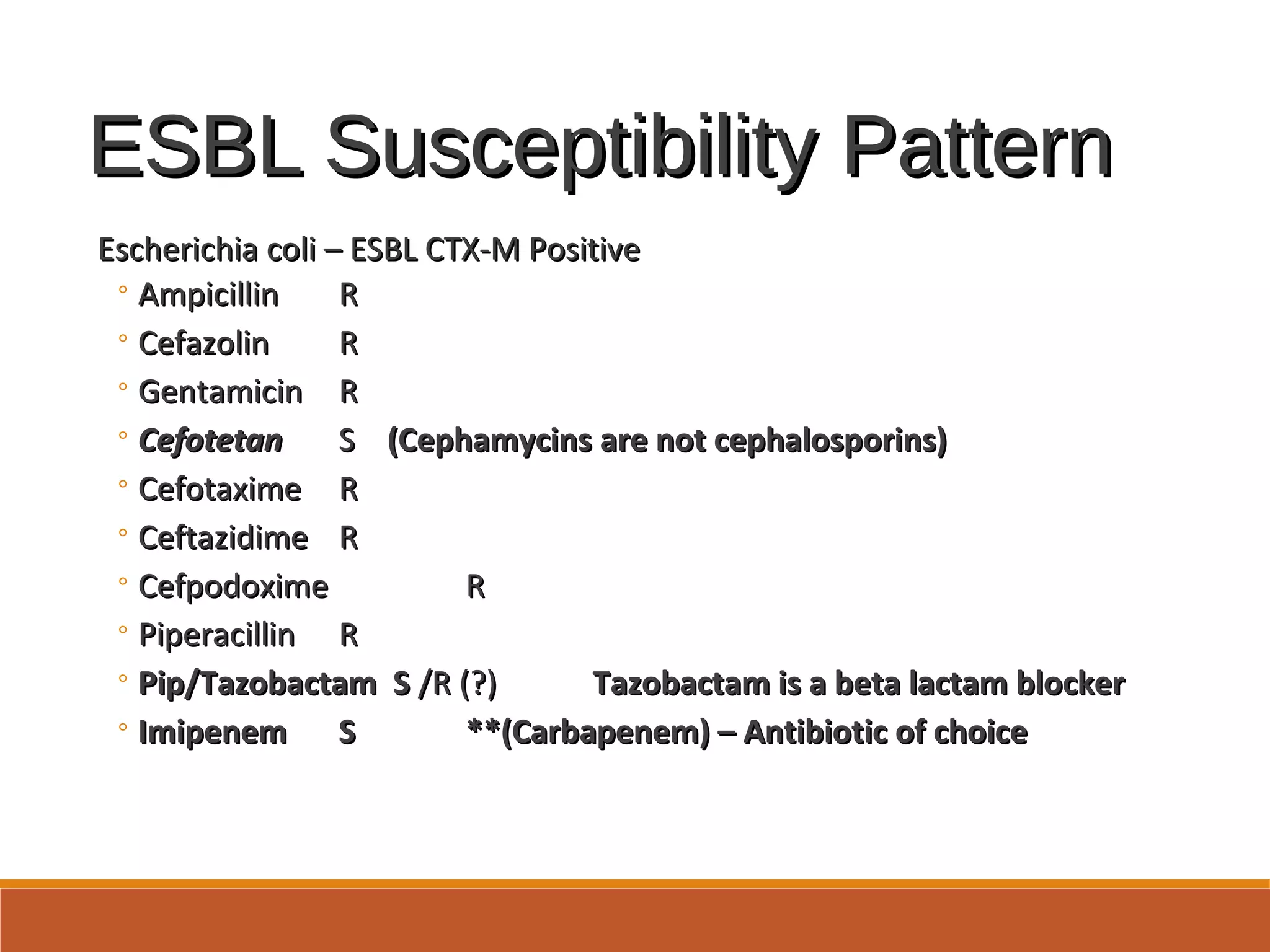
ESBL Susceptibility PatternESBL Susceptibility Pattern
Escherichia coli – ESBL CTX-M PositiveEscherichia coli – ESBL CTX-M Positive
◦ AmpicillinAmpicillin RR
◦ CefazolinCefazolin RR
◦ GentamicinGentamicin RR
◦ CefotetanCefotetan SS (Cephamycins are not cephalosporins)(Cephamycins are not cephalosporins)
◦ CefotaximeCefotaxime RR
◦ CeftazidimeCeftazidime RR
◦ CefpodoximeCefpodoxime RR
◦ PiperacillinPiperacillin RR
◦ Pip/Tazobactam SPip/Tazobactam S /R (?)/R (?) Tazobactam is a beta lactam blockerTazobactam is a beta lactam blocker
◦ ImipenemImipenem SS **(Carbapenem) – Antibiotic of choice**(Carbapenem) – Antibiotic of choice
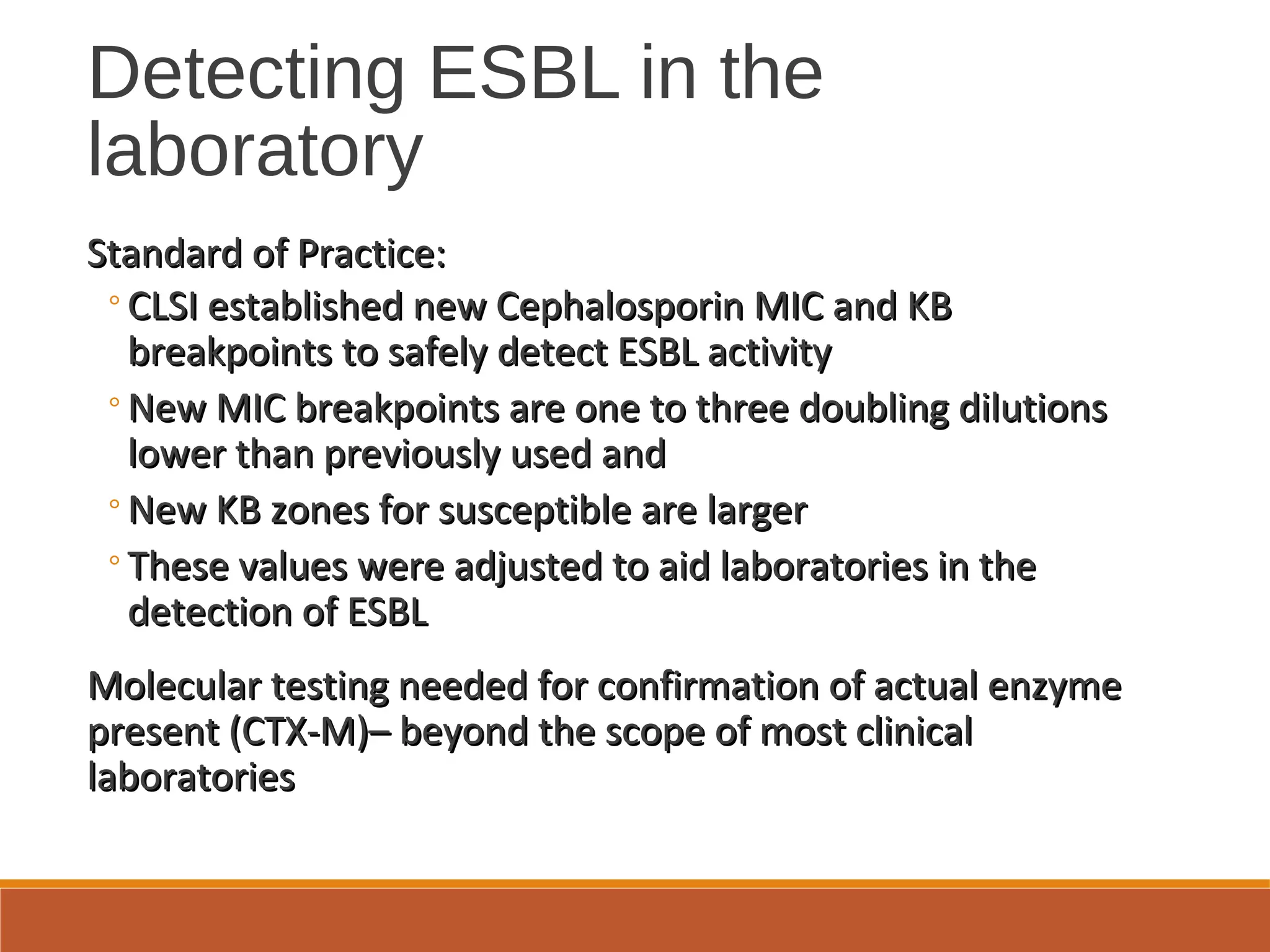
Detecting ESBL in the
laboratory
Standard of Practice:Standard of Practice:
◦CLSI established new Cephalosporin MIC and KBCLSI established new Cephalosporin MIC and KB
breakpoints to safely detect ESBL activitybreakpoints to safely detect ESBL activity
◦New MIC breakpoints are one to three doubling dilutionsNew MIC breakpoints are one to three doubling dilutions
lower than previously used andlower than previously used and
◦New KB zones for susceptible are largerNew KB zones for susceptible are larger
◦These values were adjusted to aid laboratories in theThese values were adjusted to aid laboratories in the
detection of ESBLdetection of ESBL
Molecular testing needed for confirmation of actual enzymeMolecular testing needed for confirmation of actual enzyme
present (CTX-M)– beyond the scope of most clinicalpresent (CTX-M)– beyond the scope of most clinical
laboratorieslaboratories
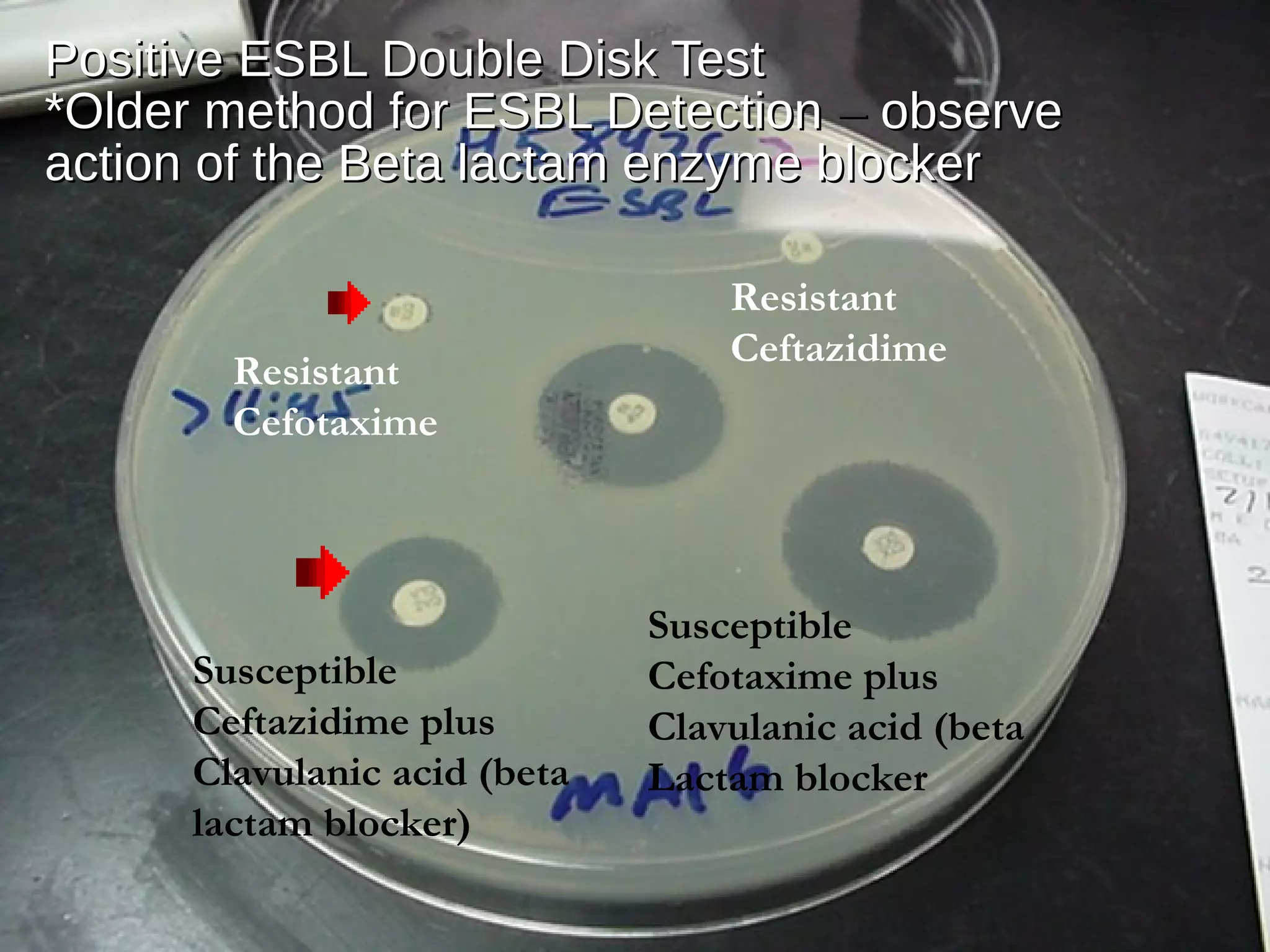
Positive ESBL Double Disk TestPositive ESBL Double Disk Test
*Older method for ESBL Detection*Older method for ESBL Detection –– observeobserve
action of the Beta lactam enzyme blockeraction of the Beta lactam enzyme blocker
Resistant
Cefotaxime
Resistant
Ceftazidime
Susceptible
Ceftazidime plus
Clavulanic acid (beta
lactam blocker)
Susceptible
Cefotaxime plus
Clavulanic acid (beta
Lactam blocker
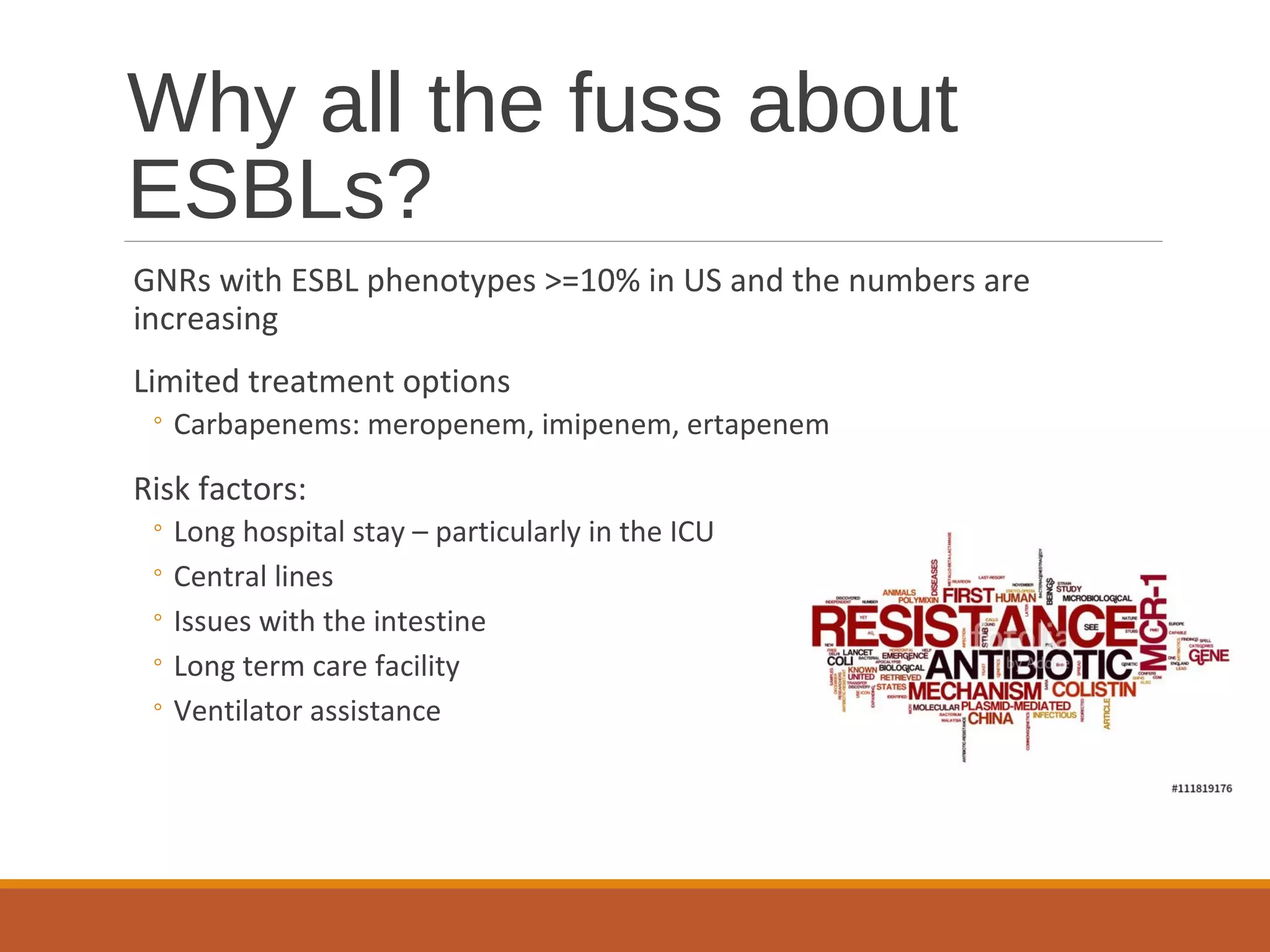
Why all the fuss about
ESBLs?
GNRs with ESBL phenotypes >=10% in US and the numbers are
increasing
Limited treatment options
◦ Carbapenems: meropenem, imipenem, ertapenem
Risk factors:
◦ Long hospital stay – particularly in the ICU
◦ Central lines
◦ Issues with the intestine
◦ Long term care facility
◦ Ventilator assistance
Carbapenemases - CRE
Carbapenem antibiotics currently have the highest spectrum of
activity against multi-drug resistant GNRs
But the worst scenario has come true – Appearance of
Carbapenem-hydrolyzing-beta-lactamases which confer
resistance to a broad spectrum of beta lactam antibiotics –
making GNR pan resistant
CRE – Carbapenemase Resistant Enteriobacteriaceae
Two CREs are getting the most attention:
◦ KPC – “Klebsiella pneumoniae carbapenemas most common in the US
◦ NDM-1 – New Delhi metallo-beta-lactamase has received much press.
Recognized in 2009. Resistance determinants are numerous and great
concern about its spread.
Infections with CRE producing GNRs - 50% fatality rate
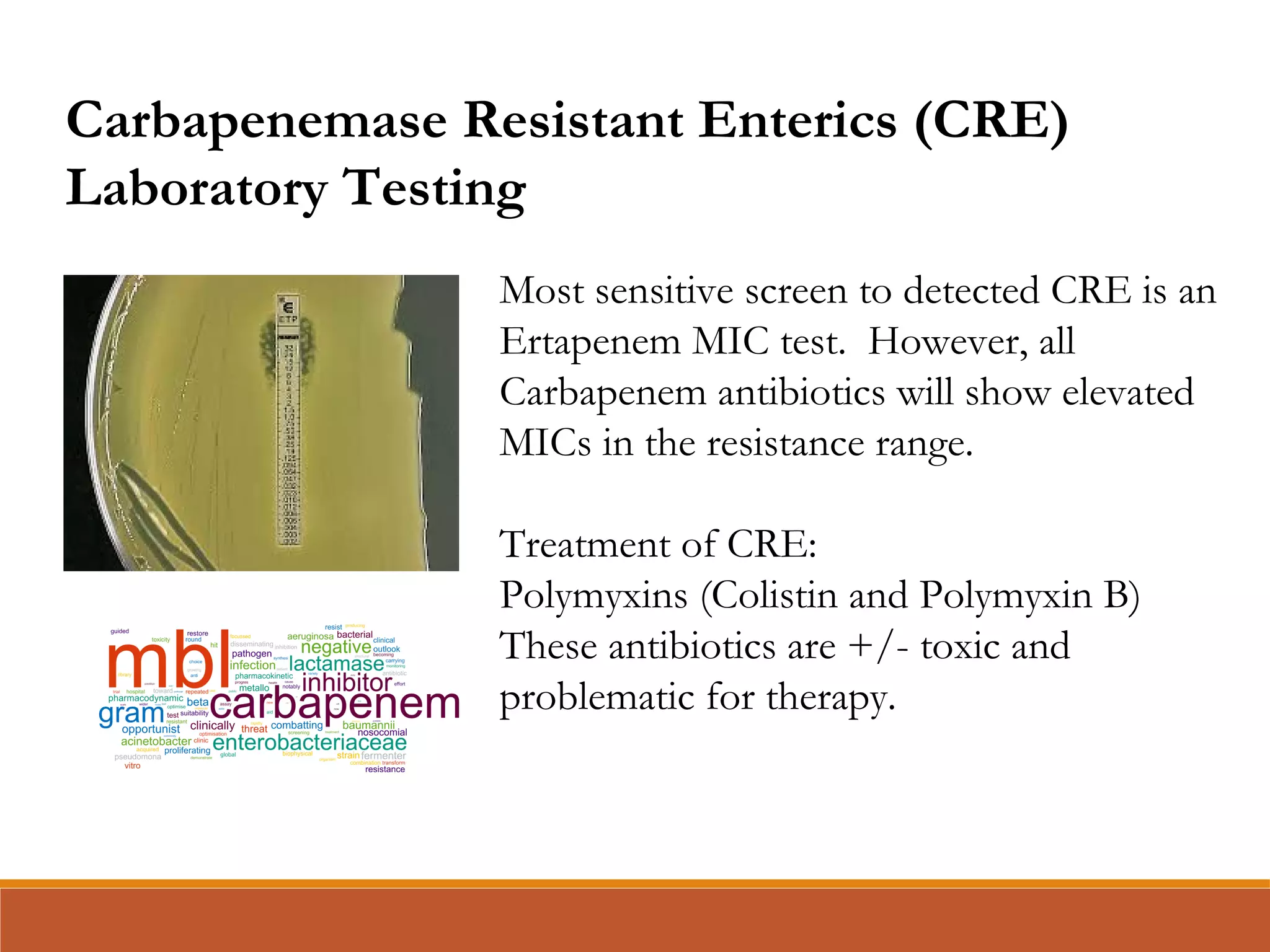
Most sensitive screen to detected CRE is an
Ertapenem MIC test. However, all
Carbapenem antibiotics will show elevated
MICs in the resistance range.
Treatment of CRE:
Polymyxins (Colistin and Polymyxin B)
These antibiotics are +/- toxic and
problematic for therapy.
Carbapenemase Resistant Enterics (CRE)
Laboratory Testing
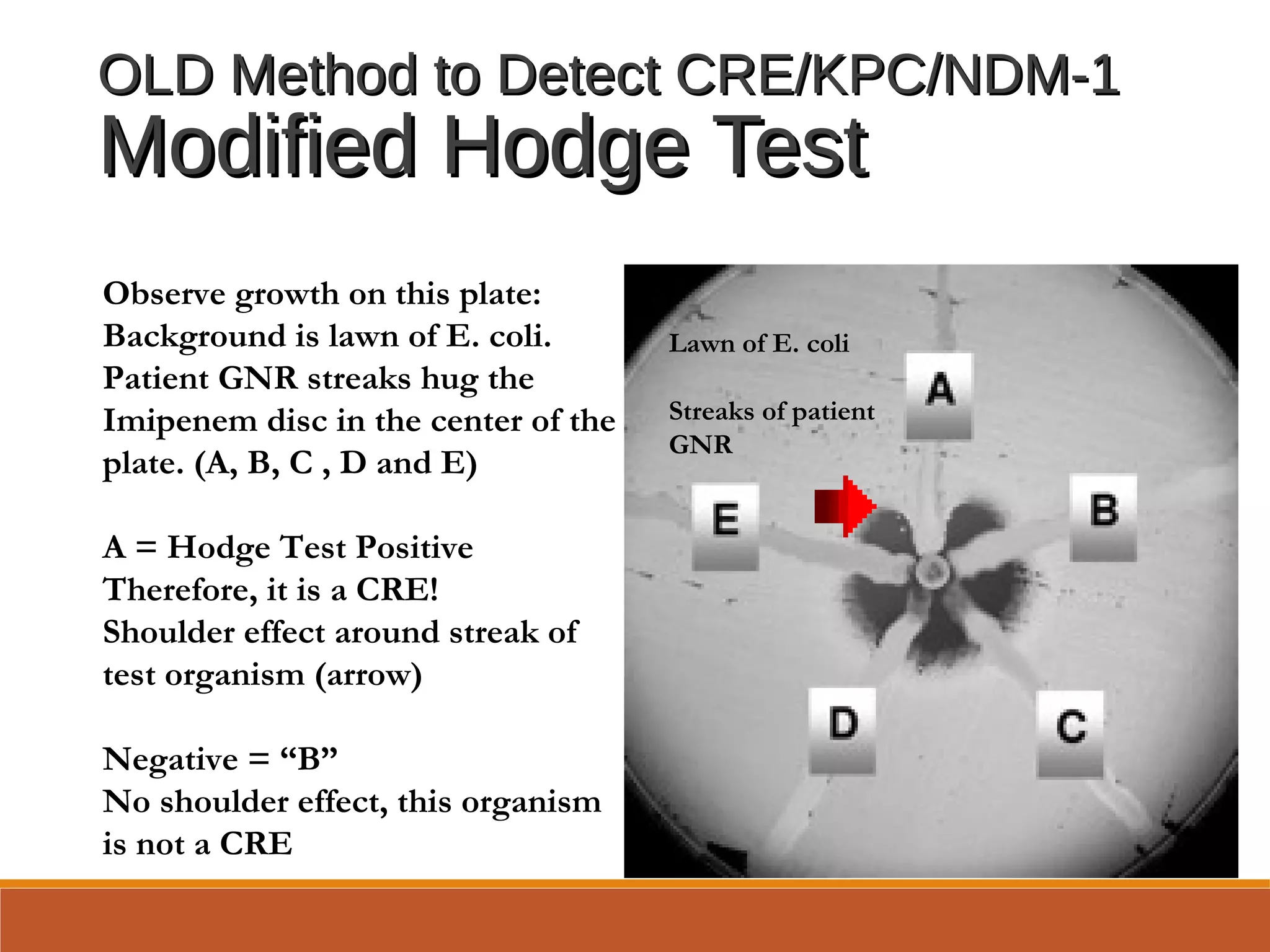
OLD Method to Detect CRE/KPC/NDM-1OLD Method to Detect CRE/KPC/NDM-1
Modified Hodge TestModified Hodge Test
Observe growth on this plate:
Background is lawn of E. coli.
Patient GNR streaks hug the
Imipenem disc in the center of the
plate. (A, B, C , D and E)
A = Hodge Test Positive
Therefore, it is a CRE!
Shoulder effect around streak of
test organism (arrow)
Negative = “B”
No shoulder effect, this organism
is not a CRE
Lawn of E. coli
Streaks of patient
GNR
Streptococcus pneumoniae andStreptococcus pneumoniae and
resistance to Penicillin (PEN)resistance to Penicillin (PEN)
Two step resistance test – old wayTwo step resistance test – old way
◦Step 1Step 1 -- Oxacillin KBOxacillin KB disk testing performeddisk testing performed
◦If resistant to Oxacillin, possible resistance to PENIf resistant to Oxacillin, possible resistance to PEN
◦Step 2Step 2 –Confirm PEN resistance by MIC test–Confirm PEN resistance by MIC test
◦MIC value determines susceptibility or resistanceMIC value determines susceptibility or resistance
Best method – Primary test is to perform a Penicillin MICBest method – Primary test is to perform a Penicillin MIC
test by E Test or broth dilutiontest by E Test or broth dilution
KB method cannot be used to test PEN against StrepKB method cannot be used to test PEN against Strep
pneumoniae, under predicts resistancepneumoniae, under predicts resistance
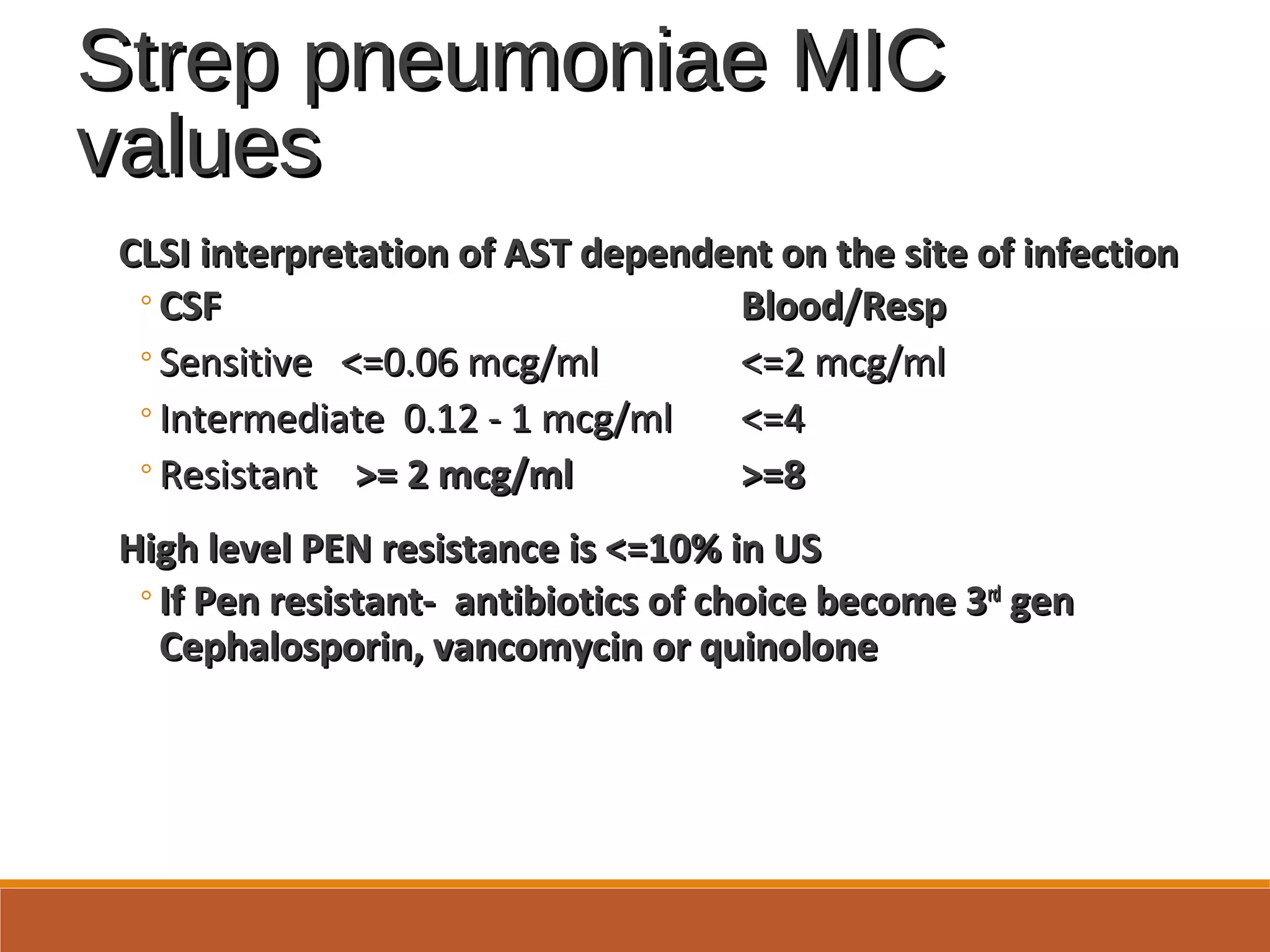
Strep pneumoniae MICStrep pneumoniae MIC
valuesvalues
CLSI interpretation of AST dependent on the site of infectionCLSI interpretation of AST dependent on the site of infection
◦CSFCSF Blood/RespBlood/Resp
◦Sensitive <=0.06 mcg/mlSensitive <=0.06 mcg/ml <=2 mcg/ml<=2 mcg/ml
◦Intermediate 0.12 - 1 mcg/mlIntermediate 0.12 - 1 mcg/ml <=4<=4
◦ResistantResistant >= 2 mcg/ml>= 2 mcg/ml >=8>=8
High level PEN resistance is <=10% in USHigh level PEN resistance is <=10% in US
◦If Pen resistant- antibiotics of choice become 3If Pen resistant- antibiotics of choice become 3rdrd
gengen
Cephalosporin, vancomycin or quinoloneCephalosporin, vancomycin or quinolone
Neisseria gonorrhoeae
(GC)
Increasing resistance of GC over last two decades
◦1980’s beta lactamase producing - Penicillin resistance
◦By 2000, the quinolones were resistant due to the acquisition of
mutations that altered the binding sites
◦Currently Cephalosporins (Ceftriaxone & Cefixime) are the
mainstay for therapy in the US – however resistance to these
antibiotics are becoming common in Asia.
◦Resistance due to Penicillin Binding Proteins (PBPs) and over production of
efflux pump
◦Detection of resistance in the USA could be problematic due to
our reliance on amplification testing for STD diagnosis that only
test for GC and not for resistance markers

Antibiotic Senstivity Testing 2017 Update

  • 1.
    Antibiotic SensitivityAntibiotic Sensitivity Testing2017 UpdateTesting 2017 Update Margie A. Morgan, PhD, MT(ASCP), D(ABMM)Margie A. Morgan, PhD, MT(ASCP), D(ABMM)
  • 2.
    Antibiotic Classes Penicillins ◦ Penicillin ◦Amoxicillin ◦ Ampicillin ◦ Amp/Clavulanate ◦ Amp/Sulbactam Anti-Pseudomonal Penicillins ◦ Piperacillin/Tazobactam ◦ Ticarcillin/Clavulanate Anti- Staph Penicillins ◦ Nafcillin ◦ Oxacillin ◦ Cloxacillin ◦ Dicloxacillin These antibiotics and those listed on the next slide have a beta lactam ring structure – aka beta lactam antibiotics
  • 3.
    Antibiotic Classes (2) Carbapenems ◦Imipenem ◦ Meropenem ◦ Ertapenem ◦ Dorapenem Monobactam ◦ Aztreonam Cephalosporins ◦ First generation ◦ Cefazolin ◦ Second generation ◦ Cefotetan ◦ Cefoxitin Cefuroxime ◦ Third generation ◦ Cefotaxime Ceftriazone ◦ Ceftazidime Cefpodoxime ◦ Fourth generation ◦ Cefepime Ceftaroline
  • 4.
    Antibiotic Classes (3) Fluoroquinolones ◦Ciprofloxacin ◦ Levofloxacin ◦ Moxifloxacin Aminoglycosides ◦ Gentamicin ◦ Tobramycin ◦ Amikacin Trimethoprim/ sulfamethozaxole Macrolides ◦ Azithromycin ◦ Clarythromycin ◦ Erthromycin Tetracyclines ◦ Tetracycline ◦ Minocycline ◦ Doxycycline Lincosamide ◦ Chloramphenicol
  • 5.
    The Four MajormechanismsThe Four Major mechanisms of antibiotic resistanceof antibiotic resistance Enzymatic cleavageEnzymatic cleavage leads to inactivation of antibioticleads to inactivation of antibiotic ◦ Active Beta lactamases and amino-glycoside modifying enzymesActive Beta lactamases and amino-glycoside modifying enzymes Altered receptorsAltered receptors/binding proteins preventing attachment of antibiotics/binding proteins preventing attachment of antibiotics to the bacterial surfaceto the bacterial surface ◦ Penicillin binding proteins (PBPs)Penicillin binding proteins (PBPs) ◦ Mechanism for Strep pneumoniae resistance to penicillin and MRSAMechanism for Strep pneumoniae resistance to penicillin and MRSA resistance to methicillinresistance to methicillin Altered permeabilityAltered permeability/influx and efflux pumps stopping passage through/influx and efflux pumps stopping passage through porins – gram negative bacilliporins – gram negative bacilli ◦ Pseudomonas aeruginosa resistance to amino-glycosidesPseudomonas aeruginosa resistance to amino-glycosides Bypass of a metabolic blockBypass of a metabolic block/metabolic block imposed by antibiotic/metabolic block imposed by antibiotic ◦ Enterococcus resistance to TMP/SXTEnterococcus resistance to TMP/SXT
  • 6.
    The Rules forSusceptibilityThe Rules for Susceptibility TestingTesting CLSICLSI – Clinical Laboratory Standards Institute Approved standards for– Clinical Laboratory Standards Institute Approved standards for the testing & reporting of susceptibility results/ updated yearlythe testing & reporting of susceptibility results/ updated yearly 1.1. Charts with appropriate antibiotics to testCharts with appropriate antibiotics to test 2.2. How to interpret the laboratory resultsHow to interpret the laboratory results 3.3. QC standards and proper testing proceduresQC standards and proper testing procedures
  • 7.
    Methods/Bacteria inMethods/Bacteria in ReviewReview Susceptibilitytesting methodsSusceptibility testing methods 1. Kirby Bauer disk diffusion (KB)1. Kirby Bauer disk diffusion (KB) 2. E Test Strip Minimum inhibitory concentration (MIC )2. E Test Strip Minimum inhibitory concentration (MIC ) 3. Broth dilution Minimum inhibitory concentration (MIC)3. Broth dilution Minimum inhibitory concentration (MIC) 4. Beta lactamase enzyme detection4. Beta lactamase enzyme detection Resistant Bacteria of ImportanceResistant Bacteria of Importance MRSAMRSA methicillin resistant Staphylococcus aureusmethicillin resistant Staphylococcus aureus VREVRE vancomycin resistant enterococcusvancomycin resistant enterococcus ESBLESBL Extended Spectrum Beta Lactamase Gram neg rodsExtended Spectrum Beta Lactamase Gram neg rods KPCKPC Klebsiella pneumonia Carbapenemase orKlebsiella pneumonia Carbapenemase or CRECRE Carbapenamase Resistant EntericsCarbapenamase Resistant Enterics Streptococcus pneumoniaeStreptococcus pneumoniae Neisseria gonorrhoeaeNeisseria gonorrhoeae
  • 8.
    Preparation of BacteriaforPreparation of Bacteria for all Susceptibility Methodsall Susceptibility Methods Pure culture of one organismPure culture of one organism Log phase growth of bacteria - 16-24 hrs oldLog phase growth of bacteria - 16-24 hrs old Methods test for stasis not killingMethods test for stasis not killing Standardized suspension of bacteria:Standardized suspension of bacteria: ◦O.5 McFarland Standard – Barium sulfate solution thatO.5 McFarland Standard – Barium sulfate solution that equals the turbidity of 10 8 bacteria/mlequals the turbidity of 10 8 bacteria/ml ◦Alternative method – use spectrophotometerAlternative method – use spectrophotometer Incubation at 35 °C in room air (or CO²) for 18- 24 hrsIncubation at 35 °C in room air (or CO²) for 18- 24 hrs
  • 9.
    This is a 0.5McFarland Standard which is a turbidity standard made from Barium sulfate – the turbidity is equal to 10 8 CFU/ml bacteria
  • 10.
    Quality ControlQuality Control VerificationVerification:Before testing patients: Must correctly test multiple QC: Before testing patients: Must correctly test multiple QC strains for 20 consecutive days or 3 replicates for 5 days. This is tostrains for 20 consecutive days or 3 replicates for 5 days. This is to make sure you can perform the tests correctly.make sure you can perform the tests correctly. ATCCATCC strains of bacteria (American Type Culture Collection) If QCstrains of bacteria (American Type Culture Collection) If QC strains are within limits - you can then do Weekly quality control on allstrains are within limits - you can then do Weekly quality control on all lots of cards, disks, plates in uselots of cards, disks, plates in use ◦ Data must be recorded and reviewed monthly by supervisorData must be recorded and reviewed monthly by supervisor If weekly QC results are out of control:If weekly QC results are out of control: ◦ Immediately repeat/ inform supervisorImmediately repeat/ inform supervisor ◦ If repeat is OK – continue routine testingIf repeat is OK – continue routine testing ◦ If repeat is NOT OK – must investigate/document/ repeat 5 times toIf repeat is NOT OK – must investigate/document/ repeat 5 times to start routine testing. All repeats must be in controlstart routine testing. All repeats must be in control
  • 11.
    Agar Disk Diffusion(Kirby Bauer)Agar Disk Diffusion (Kirby Bauer) Qualitative Susceptibility methodQualitative Susceptibility method Mueller Hinton agar –with or without bloodMueller Hinton agar –with or without blood ◦150 mm plate diameter150 mm plate diameter ◦4mm in depth4mm in depth ◦Agar specifically balanced in Ca+ and Mg+,Agar specifically balanced in Ca+ and Mg+, ◦ if the ions are too high % amino-glycosides test falsely resistant,if the ions are too high % amino-glycosides test falsely resistant, ◦ if the ions too low % falsely susceptible amino-glycoside resultsif the ions too low % falsely susceptible amino-glycoside results Streak bacteria on plate with cotton tipped swabStreak bacteria on plate with cotton tipped swab Apply 6mm paper disks that contain single antibioticApply 6mm paper disks that contain single antibiotic Incubate for 16-24 hrs at 35*CIncubate for 16-24 hrs at 35*C Measure zone of diameter of inhibition of growth (mm)Measure zone of diameter of inhibition of growth (mm)
  • 12.
    Kirby Bauer diskDispenser Each cartridge is a separate antibiotic Growth inside a zone is considered resistance Measure the diameter of the zone of inhibition Watch out for double zones Proteus will swarm Into a zone
  • 13.
    Kirby Bauer (KB)KirbyBauer (KB) Theory: Concentration gradient created with the diffusingTheory: Concentration gradient created with the diffusing antibiotic and the increasing number of bacteria growing onantibiotic and the increasing number of bacteria growing on the agar, this determines the zone size of inhibition aroundthe agar, this determines the zone size of inhibition around disk.disk. CLSI charts used to interpret the measured zone sizes asCLSI charts used to interpret the measured zone sizes as Sensitive, Intermediate or ResistantSensitive, Intermediate or Resistant Cannot directly compare zone sizes between antibiotics–Cannot directly compare zone sizes between antibiotics– ◦ex: ZID of 21mm zone size is as sensitive as a GM of 14mmex: ZID of 21mm zone size is as sensitive as a GM of 14mm - zone sizes differ for organism/antibiotic combinations- zone sizes differ for organism/antibiotic combinations ◦Regression analysis can be used to calculate MIC valueRegression analysis can be used to calculate MIC value related to KB zone sizerelated to KB zone size
  • 14.
    E TestE Test QuantitativeMIC SusceptibilityQuantitative MIC Susceptibility Calibrated plastic strips impregnated with one antibioticCalibrated plastic strips impregnated with one antibiotic ◦concentration gradient (mcg/ml) embedded in plasticconcentration gradient (mcg/ml) embedded in plastic Diffusion gradient created as antibiotic diffuses intoDiffusion gradient created as antibiotic diffuses into agar in an elliptical shapeagar in an elliptical shape MIC (minimum inhibitory concentration) is where theMIC (minimum inhibitory concentration) is where the ellipse ends on the plastic stripellipse ends on the plastic strip Good method for slower growing fastidious organismsGood method for slower growing fastidious organisms .
  • 15.
    E Test method Etest method Susceptibility result = Where growth crosses The plastic strip E test for Strep pneumoniae Low concentration High concentration MIC value MIC value Penicillin Cefotaxime
  • 16.
    Broth DilutionBroth Dilution QuantitativeSusceptibility MethodQuantitative Susceptibility Method Bacteria inoculum: 0.5 McFarland standard – further diluted to 5x10Bacteria inoculum: 0.5 McFarland standard – further diluted to 5x1055 organisms/mlorganisms/ml in brothin broth Suspension is inoculated into tubes or micro titer trays containingSuspension is inoculated into tubes or micro titer trays containing growth medium and known 2 fold dilutions (mcg/ml) of antibioticsgrowth medium and known 2 fold dilutions (mcg/ml) of antibiotics Each horizontal row is a uniqueEach horizontal row is a unique antibiotic – growth causesantibiotic – growth causes turbidity in the wellsturbidity in the wells Lowest dilution of antibioticLowest dilution of antibiotic with No Growth (clear well)=with No Growth (clear well)= MIC value.MIC value.
  • 17.
    Broth Dilution DefinitionsBrothDilution Definitions MICMIC = lowest concentration of antibiotic inhibiting growth= lowest concentration of antibiotic inhibiting growth MBCMBC = lowest concentration of antibiotic killing 99.9%= lowest concentration of antibiotic killing 99.9% Antibiotic toleranceAntibiotic tolerance – Ratio of MBC/MIC (>=32)– Ratio of MBC/MIC (>=32) ◦MBC = 16 MIC= 8 16/8= 2MBC = 16 MIC= 8 16/8= 2 No ToleranceNo Tolerance ◦MBC = 128 MIC = 8MBC = 128 MIC = 8 128/2 = 64128/2 = 64 Tolerance*Tolerance*
  • 18.
    Siemens Microscan walkaway ASTsystem BD Phoenix AST system Biomerieux Vitek2 AST Automated Identification Susceptibility Testing Systems (AST)
  • 19.
    Disk test forBeta lactamaseDisk test for Beta lactamase Detection (Cefinase Test)Detection (Cefinase Test) Add bacteria to filter paper impregnated with NitrocefinAdd bacteria to filter paper impregnated with Nitrocefin (yellow colored/chromogenic cephalosporin substrate)(yellow colored/chromogenic cephalosporin substrate) Incubate at room temp (@ 1 minute) and observeIncubate at room temp (@ 1 minute) and observe for color change from yellow to redfor color change from yellow to red Beta lactamase enzyme of bacteria breaks down the betaBeta lactamase enzyme of bacteria breaks down the beta lactam ring of Nitrocefin to produce a red end productlactam ring of Nitrocefin to produce a red end product Detects resistance to Ampicillin/Penicillin/1Detects resistance to Ampicillin/Penicillin/1stst gen Cephalosporingen Cephalosporin in Haemophilus, N. gonorrhoea , Moraxella catarrhalis,in Haemophilus, N. gonorrhoea , Moraxella catarrhalis, Enterococcus, and anaerobic gram negative rodsEnterococcus, and anaerobic gram negative rods This test does NOT detect Extended Spectrum Beta LactamaseThis test does NOT detect Extended Spectrum Beta Lactamase enzyme produced by enteric gram negative rodsenzyme produced by enteric gram negative rods
  • 20.
    Beta lactamase detectionBetalactamase detection tidbitstidbits Haemophilus influenzaeHaemophilus influenzae ◦In US, approx 28% are beta lactamase producers andIn US, approx 28% are beta lactamase producers and therefore, resistant to Ampicillintherefore, resistant to Ampicillin Bacteroides fragilis groupBacteroides fragilis group ◦Primary resistance mechanism is beta lactamase productionPrimary resistance mechanism is beta lactamase production >95% of strains are resistant to Pencillin>95% of strains are resistant to Pencillin Moraxella catarrhalisMoraxella catarrhalis ◦>90% beta lactamase positive /Ampicillin resistant>90% beta lactamase positive /Ampicillin resistant
  • 21.
    Methicillin Resistant StaphMethicillinResistant Staph aureus (MRSA)aureus (MRSA) Test for oxacillin (OX) resistance - it is more stable for testingTest for oxacillin (OX) resistance - it is more stable for testing than methicillin in the laboratorythan methicillin in the laboratory OLDOLD - If- If OX is resistantOX is resistant - S. aureus is reported as a MRSA- S. aureus is reported as a MRSA NEW - resistanceNEW - resistance testing for Cefoxitin is more reliable and atesting for Cefoxitin is more reliable and a preferred way to confirm MRSApreferred way to confirm MRSA All cephalosporin antibiotics are reported resistant for MRSAAll cephalosporin antibiotics are reported resistant for MRSA and should never be used for therapyand should never be used for therapy Resistance mechanism byResistance mechanism by penicillin binding proteins (PBPs)penicillin binding proteins (PBPs) ◦ PBPs bind penicillin and related antibioticsPBPs bind penicillin and related antibiotics ◦ The binding prevents disruption of the peptidoglycan synthesis in theThe binding prevents disruption of the peptidoglycan synthesis in the Staph aureus cell wallStaph aureus cell wall ◦ PBPs are produced by thePBPs are produced by the mecA genemecA gene
  • 22.
    Oxacillin KB disk= resistant MRSA Cefoxitin KB disk Newer method – more sensitive screen for MRSA Cefoxitin (FOX) KB = sensitive S. aureus Methods to Detect Methicillin and Oxacillin Resistance - MRSA Oxacillin Testing is no longer the preferred method for detection
  • 23.
    Clindamycin Induction Test–Clindamycin Induction Test – The D testThe D test This test determines if Staph aureus, including MRSA, isThis test determines if Staph aureus, including MRSA, is susceptible to Clindamycin more reliably than testingsusceptible to Clindamycin more reliably than testing Clindamycin resistance by KB or MICClindamycin resistance by KB or MIC During antibiotic therapy, S aureus isolates resistant toDuring antibiotic therapy, S aureus isolates resistant to Erythromycin possess enzymes that can be induced toErythromycin possess enzymes that can be induced to make the S. aureus also resistant to Clindamycinmake the S. aureus also resistant to Clindamycin Clindamycin is often used to treat serious soft tissueClindamycin is often used to treat serious soft tissue infections with MRSA – so reliable testing necessaryinfections with MRSA – so reliable testing necessary
  • 24.
    D test Negative- roundClindamycin zone Kirby Bauer zone around Clindamycin will beKirby Bauer zone around Clindamycin will be blunted to form a D if Clindamycin can beblunted to form a D if Clindamycin can be induced by Erythromycin to be resistant – soinduced by Erythromycin to be resistant – so called INDUCIBLE RESISTANCE.called INDUCIBLE RESISTANCE. Clindamycin should be reported as resistant byClindamycin should be reported as resistant by clindamycin induction and not used for therapyclindamycin induction and not used for therapy The D Test
  • 25.
    EnterococcusEnterococcus All are intrinsicallyresistant to:All are intrinsically resistant to: ◦CephalosporinsCephalosporins ◦ClindamycinClindamycin ◦Trimethoprim/sulfamethoxazoleTrimethoprim/sulfamethoxazole Synergistic antibiotic therapy can be important for theSynergistic antibiotic therapy can be important for the treatment of Enterococcustreatment of Enterococcus ◦Ampicillin plus Gentamicin is synergistic = increasedAmpicillin plus Gentamicin is synergistic = increased killing potential in combinationkilling potential in combination ◦Important for endocarditis therapyImportant for endocarditis therapy
  • 26.
    Vancomycin Resistant EnterococcusVancomycinResistant Enterococcus (VRE)(VRE) Acquired resistance to vancomycin –Acquired resistance to vancomycin – ◦Plasmid mediated vanA associated with E. faeciumPlasmid mediated vanA associated with E. faecium ◦Plasmic mediated vanB associated with E. faecalisPlasmic mediated vanB associated with E. faecalis Detected by KB, automated AST systems, and EtestDetected by KB, automated AST systems, and Etest methodsmethods Drugs of choice limited if VRE detected –Drugs of choice limited if VRE detected – ◦ LinezolidLinezolid ◦ Synercid for E. faecium onlySynercid for E. faecium only Major infection control issue!!Major infection control issue!! ◦Rectal colonization can contaminatie the environment andRectal colonization can contaminatie the environment and lead to transmission to surrounding patientslead to transmission to surrounding patients ◦Most infections related to ICU stays and longMost infections related to ICU stays and long hospitalizationshospitalizations ◦Not virulent but problematic in immune suppressedNot virulent but problematic in immune suppressed
  • 27.
    Extended Spectrum BetaExtendedSpectrum Beta LactamaseLactamase [ESBL][ESBL] Enzymes produced by Enteric Gram negative bacilliEnzymes produced by Enteric Gram negative bacilli ◦Confer resistance to Cephalosporins, Penicillins andConfer resistance to Cephalosporins, Penicillins and Monobactam (Aztreonam) by opening the beta lactam ringMonobactam (Aztreonam) by opening the beta lactam ring and inactivating the antibioticand inactivating the antibiotic ◦ESBLs do not attack Cephamycin (cefoxitin, cefotetan) or theESBLs do not attack Cephamycin (cefoxitin, cefotetan) or the Carbapenem antibiotic classesCarbapenem antibiotic classes Plasmid mediated CTX-M beta lactamases are the mostPlasmid mediated CTX-M beta lactamases are the most common in the US currently, but many more ESBL typescommon in the US currently, but many more ESBL types worldwideworldwide Therapy for ESBL producing gram negative rods:Therapy for ESBL producing gram negative rods: ◦Carbapenems: Imipenem, Meropenem, Doripenem,Carbapenems: Imipenem, Meropenem, Doripenem, ErtapenemErtapenem
  • 28.
    ESBL Susceptibility PatternESBLSusceptibility Pattern Escherichia coli – ESBL CTX-M PositiveEscherichia coli – ESBL CTX-M Positive ◦ AmpicillinAmpicillin RR ◦ CefazolinCefazolin RR ◦ GentamicinGentamicin RR ◦ CefotetanCefotetan SS (Cephamycins are not cephalosporins)(Cephamycins are not cephalosporins) ◦ CefotaximeCefotaxime RR ◦ CeftazidimeCeftazidime RR ◦ CefpodoximeCefpodoxime RR ◦ PiperacillinPiperacillin RR ◦ Pip/Tazobactam SPip/Tazobactam S /R (?)/R (?) Tazobactam is a beta lactam blockerTazobactam is a beta lactam blocker ◦ ImipenemImipenem SS **(Carbapenem) – Antibiotic of choice**(Carbapenem) – Antibiotic of choice
  • 29.
    Detecting ESBL inthe laboratory Standard of Practice:Standard of Practice: ◦CLSI established new Cephalosporin MIC and KBCLSI established new Cephalosporin MIC and KB breakpoints to safely detect ESBL activitybreakpoints to safely detect ESBL activity ◦New MIC breakpoints are one to three doubling dilutionsNew MIC breakpoints are one to three doubling dilutions lower than previously used andlower than previously used and ◦New KB zones for susceptible are largerNew KB zones for susceptible are larger ◦These values were adjusted to aid laboratories in theThese values were adjusted to aid laboratories in the detection of ESBLdetection of ESBL Molecular testing needed for confirmation of actual enzymeMolecular testing needed for confirmation of actual enzyme present (CTX-M)– beyond the scope of most clinicalpresent (CTX-M)– beyond the scope of most clinical laboratorieslaboratories
  • 30.
    Positive ESBL DoubleDisk TestPositive ESBL Double Disk Test *Older method for ESBL Detection*Older method for ESBL Detection –– observeobserve action of the Beta lactam enzyme blockeraction of the Beta lactam enzyme blocker Resistant Cefotaxime Resistant Ceftazidime Susceptible Ceftazidime plus Clavulanic acid (beta lactam blocker) Susceptible Cefotaxime plus Clavulanic acid (beta Lactam blocker
  • 31.
    Why all thefuss about ESBLs? GNRs with ESBL phenotypes >=10% in US and the numbers are increasing Limited treatment options ◦ Carbapenems: meropenem, imipenem, ertapenem Risk factors: ◦ Long hospital stay – particularly in the ICU ◦ Central lines ◦ Issues with the intestine ◦ Long term care facility ◦ Ventilator assistance
  • 32.
    Carbapenemases - CRE Carbapenemantibiotics currently have the highest spectrum of activity against multi-drug resistant GNRs But the worst scenario has come true – Appearance of Carbapenem-hydrolyzing-beta-lactamases which confer resistance to a broad spectrum of beta lactam antibiotics – making GNR pan resistant CRE – Carbapenemase Resistant Enteriobacteriaceae Two CREs are getting the most attention: ◦ KPC – “Klebsiella pneumoniae carbapenemas most common in the US ◦ NDM-1 – New Delhi metallo-beta-lactamase has received much press. Recognized in 2009. Resistance determinants are numerous and great concern about its spread. Infections with CRE producing GNRs - 50% fatality rate
  • 33.
    Most sensitive screento detected CRE is an Ertapenem MIC test. However, all Carbapenem antibiotics will show elevated MICs in the resistance range. Treatment of CRE: Polymyxins (Colistin and Polymyxin B) These antibiotics are +/- toxic and problematic for therapy. Carbapenemase Resistant Enterics (CRE) Laboratory Testing
  • 34.
    OLD Method toDetect CRE/KPC/NDM-1OLD Method to Detect CRE/KPC/NDM-1 Modified Hodge TestModified Hodge Test Observe growth on this plate: Background is lawn of E. coli. Patient GNR streaks hug the Imipenem disc in the center of the plate. (A, B, C , D and E) A = Hodge Test Positive Therefore, it is a CRE! Shoulder effect around streak of test organism (arrow) Negative = “B” No shoulder effect, this organism is not a CRE Lawn of E. coli Streaks of patient GNR
  • 35.
    Streptococcus pneumoniae andStreptococcuspneumoniae and resistance to Penicillin (PEN)resistance to Penicillin (PEN) Two step resistance test – old wayTwo step resistance test – old way ◦Step 1Step 1 -- Oxacillin KBOxacillin KB disk testing performeddisk testing performed ◦If resistant to Oxacillin, possible resistance to PENIf resistant to Oxacillin, possible resistance to PEN ◦Step 2Step 2 –Confirm PEN resistance by MIC test–Confirm PEN resistance by MIC test ◦MIC value determines susceptibility or resistanceMIC value determines susceptibility or resistance Best method – Primary test is to perform a Penicillin MICBest method – Primary test is to perform a Penicillin MIC test by E Test or broth dilutiontest by E Test or broth dilution KB method cannot be used to test PEN against StrepKB method cannot be used to test PEN against Strep pneumoniae, under predicts resistancepneumoniae, under predicts resistance
  • 36.
    Strep pneumoniae MICStreppneumoniae MIC valuesvalues CLSI interpretation of AST dependent on the site of infectionCLSI interpretation of AST dependent on the site of infection ◦CSFCSF Blood/RespBlood/Resp ◦Sensitive <=0.06 mcg/mlSensitive <=0.06 mcg/ml <=2 mcg/ml<=2 mcg/ml ◦Intermediate 0.12 - 1 mcg/mlIntermediate 0.12 - 1 mcg/ml <=4<=4 ◦ResistantResistant >= 2 mcg/ml>= 2 mcg/ml >=8>=8 High level PEN resistance is <=10% in USHigh level PEN resistance is <=10% in US ◦If Pen resistant- antibiotics of choice become 3If Pen resistant- antibiotics of choice become 3rdrd gengen Cephalosporin, vancomycin or quinoloneCephalosporin, vancomycin or quinolone
  • 37.
    Neisseria gonorrhoeae (GC) Increasing resistanceof GC over last two decades ◦1980’s beta lactamase producing - Penicillin resistance ◦By 2000, the quinolones were resistant due to the acquisition of mutations that altered the binding sites ◦Currently Cephalosporins (Ceftriaxone & Cefixime) are the mainstay for therapy in the US – however resistance to these antibiotics are becoming common in Asia. ◦Resistance due to Penicillin Binding Proteins (PBPs) and over production of efflux pump ◦Detection of resistance in the USA could be problematic due to our reliance on amplification testing for STD diagnosis that only test for GC and not for resistance markers