DRUG SUSCEPTIBILITY
TESTING
SUBMITTED BY PRANZLY
INTRODUCTION
 Drug Susceptibility- Susceptibility is a term used when microbe such
as bacteria and fungi are unable to grow in the presence of one or
more antimicrobial drugs.
 Susceptibility testing is performed on bacteria or fungi causing an
individual’s infection after they have been recovered in a culture of
the specimen.
 Bacteria and fungi have the potential to develop resistance to
antibiotics and antifungal drugs at any time.
 This means that antibiotics once used to kill or inhibit their growth
may no longer be effective.
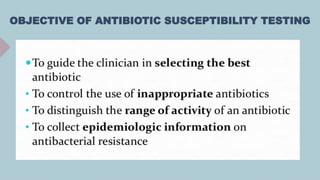
OBJECTIVE OF ANTIBIOTIC SUSCEPTIBILITY TESTING
TYPES
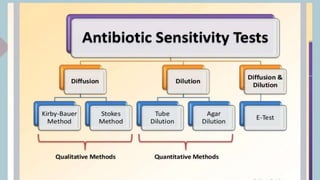
 QUALITATIVE
 For testing of isolates from “healthy” patients with intact immune defences.
 For less serious infections such as uncomplicated urinary tract
infections.
 QUANTITATIVE
 In the treatment of serious infections such as endocarditis or
osteomyelitis.
 For infections in high risk patients groups such as
immunocompromised patients (eg. Transplant patients)
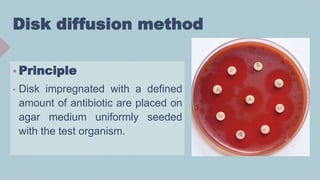
Disk diffusion method
 Principle
• Disk impregnated with a defined
amount of antibiotic are placed on
agar medium uniformly seeded
with the test organism.
KIRBY-BAUER DISC DIFFUSION METHOD
 . Material required
Mueller Hinton agar
Antibiotic disc
Turbidity standard
swabs
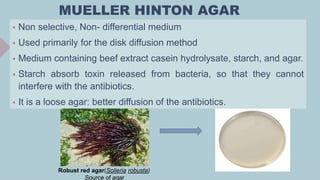
MUELLER HINTON AGAR
 Non selective, Non- differential medium
 Used primarily for the disk diffusion method
 Medium containing beef extract casein hydrolysate, starch, and agar.
 Starch absorb toxin released from bacteria, so that they cannot
interfere with the antibiotics.
 It is a loose agar: better diffusion of the antibiotics.
Robust red agar(Solieria robusta)
Source of agar
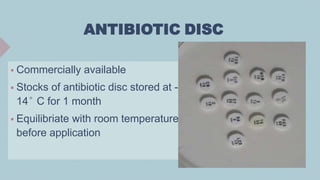
ANTIBIOTIC DISC
 Commercially available
 Stocks of antibiotic disc stored at -
14° C for 1 month
 Equilibriate with room temperature
before application
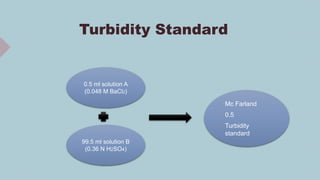
Turbidity Standard
0.5 ml solution A
(0.048 M BaCl2)
99.5 ml solution B
(0.36 N H2SO4)
 Mc Farland
 0.5
 Turbidity
standard
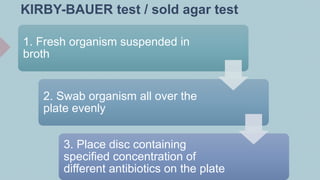
KIRBY-BAUER test / sold agar test
1. Fresh organism suspended in
broth
2. Swab organism all over the
plate evenly
3. Place disc containing
specified concentration of
different antibiotics on the plate
.
4. Incubate at 37°C
5. Measure diameter of Inhibition
zone
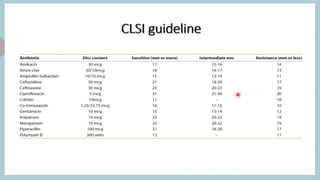
6. Use tables to assess if zone size
indicates resistance or sensitivity
to that antibiotic.
PROCEDURE OF KIRBY-BAUER TEST
1. TO PREPARE THE INOCULUM FROM THE
PRIMARY CULTURE PLATE, TOUCH WITH A LOOP
ON THE TOP OF COLONIES
2. TRANSFER THIS GROWTH TO A TUBE OF
SALINE OR BROTH
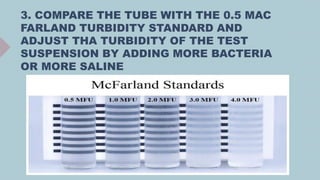
3. COMPARE THE TUBE WITH THE 0.5 MAC
FARLAND TURBIDITY STANDARD AND
ADJUST THA TURBIDITY OF THE TEST
SUSPENSION BY ADDING MORE BACTERIA
OR MORE SALINE
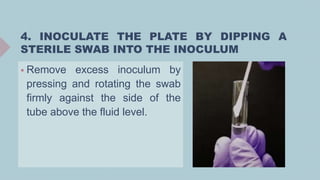
4. INOCULATE THE PLATE BY DIPPING A
STERILE SWAB INTO THE INOCULUM
 Remove excess inoculum by
pressing and rotating the swab
firmly against the side of the
tube above the fluid level.
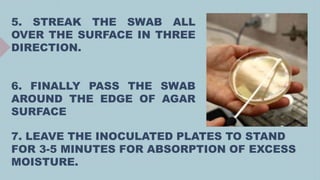
5. STREAK THE SWAB ALL
OVER THE SURFACE IN THREE
DIRECTION.
6. FINALLY PASS THE SWAB
AROUND THE EDGE OF AGAR
SURFACE
7. LEAVE THE INOCULATED PLATES TO STAND
FOR 3-5 MINUTES FOR ABSORPTION OF EXCESS
MOISTURE.
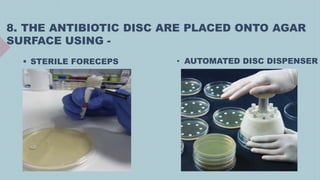
8. THE ANTIBIOTIC DISC ARE PLACED ONTO AGAR
SURFACE USING -
 STERILE FORECEPS • AUTOMATED DISC DISPENSER
• Each disc is gently pressed to ensure complete
contact with the agar surface
• Centre to centre distance between disc 24mm
• 6 disc per standard 90mm petri disc.
9. THE PLATES SHOULD BE PLACED IN AN
INCUBATOR AT 35°C WITHIN 15 MINUTES OF
PREPARATION.
• Incubated aerobically for 16-18 hours
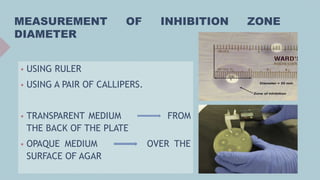
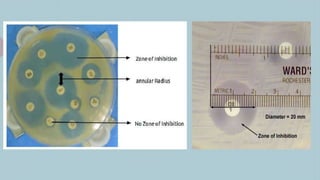
MEASUREMENT OF INHIBITION ZONE
DIAMETER
 USING RULER
 USING A PAIR OF CALLIPERS.
 TRANSPARENT MEDIUM FROM
THE BACK OF THE PLATE
 OPAQUE MEDIUM OVER THE
SURFACE OF AGAR
FACTORS AFFECTING THE ZONE OF
INHIBITION
 Size of the inoculum
o Turbidity of medium -0.5 Mc Farland
opacity standard
 Test medium
o Mueller Hinton agar on its modification
(isosensitest agar, oxoid)
o Its has good batch to batch reproducibility
o Low in sulphonamide, trimethoprim and
tetracycline inhibitors
o Satisfactory growth of pathogen.
 Antimicrobial agent and its
concentration in disc
 Incubation conditions
o 35C for 16-18h under
aerobic conditions
 Test bacterium – resistance or
susceptibility
 Effects of variation in divalent
cations.
Results
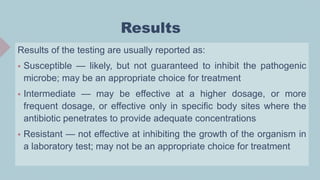
Results of the testing are usually reported as:
 Susceptible — likely, but not guaranteed to inhibit the pathogenic
microbe; may be an appropriate choice for treatment
 Intermediate — may be effective at a higher dosage, or more
frequent dosage, or effective only in specific body sites where the
antibiotic penetrates to provide adequate concentrations
 Resistant — not effective at inhibiting the growth of the organism in
a laboratory test; may not be an appropriate choice for treatment
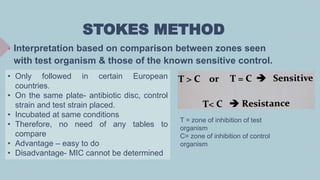
STOKES METHOD
 Interpretation based on comparison between zones seen
with test organism & those of the known sensitive control.
• Only followed in certain European
countries.
• On the same plate- antibiotic disc, control
strain and test strain placed.
• Incubated at same conditions
• Therefore, no need of any tables to
compare
• Advantage – easy to do
• Disadvantage- MIC cannot be determined
T = zone of inhibition of test
organism
C= zone of inhibition of control
organism
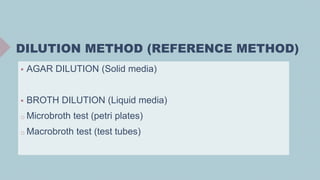
DILUTION METHOD (REFERENCE METHOD)
 AGAR DILUTION (Solid media)
 BROTH DILUTION (Liquid media)
o Microbroth test (petri plates)
o Macrobroth test (test tubes)
BROTH DILUTION METHOD
 MEDIUM- NUTRIENT BROTH
 E.g. UTI Escherichia coli overnight broth
culture in peptone standard inoculum
 In macrobroth dilution method ,we will take
same amount of nutrient broth in series of test
tubes
 Serial dilution of antibiotics prepared in nutrient
broth control with no antibiotics
 Add 1 ml of standard inoculum to all test
tubes Incubate overnight at 37°C
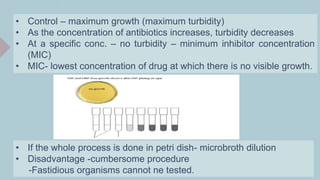
• Control – maximum growth (maximum turbidity)
• As the concentration of antibiotics increases, turbidity decreases
• At a specific conc. – no turbidity – minimum inhibitor concentration
(MIC)
• MIC- lowest concentration of drug at which there is no visible growth.
• If the whole process is done in petri dish- microbroth dilution
• Disadvantage -cumbersome procedure
-Fastidious organisms cannot ne tested.
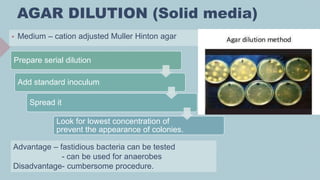
AGAR DILUTION (Solid media)
 Medium – cation adjusted Muller Hinton agar
Prepare serial dilution
Add standard inoculum
Spread it
Look for lowest concentration of
prevent the appearance of colonies.
Advantage – fastidious bacteria can be tested
- can be used for anaerobes
Disadvantage- cumbersome procedure.
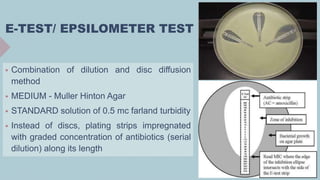
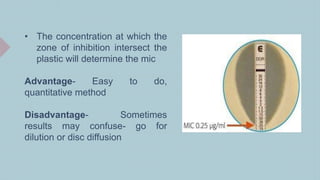
E-TEST/ EPSILOMETER TEST
 Combination of dilution and disc diffusion
method
 MEDIUM - Muller Hinton Agar
 STANDARD solution of 0.5 mc farland turbidity
 Instead of discs, plating strips impregnated
with graded concentration of antibiotics (serial
dilution) along its length
• The concentration at which the
zone of inhibition intersect the
plastic will determine the mic
Advantage- Easy to do,
quantitative method
Disadvantage- Sometimes
results may confuse- go for
dilution or disc diffusion
APPLICATION OF COMPUTERS IN
ANTIBACTERIAL SUSCEPTIBILITY
TESTING
 WHONET – software developed for the management of
routine laboratory results by WHO.
 Useful in supplying current guidelines, protocols to local
laboratories, in identifying the clusters of resistant isolates and
emerging outbreaks, research studies.
BIBLIOGRAPHY
 Street, T. (Updated 2014 March 13). Antimicrobial Susceptibility.
Medscape. Available online at
https://emedicine.medscape.com/article/2103786-overview?
 L.Barth Reller, Melvin Weinstein, James H. Jorgensen, Mary Jane
Ferraro ANTIMICROBIAL SUSCEPTIBILITY TESTING: A review of
general principle and contemporary practices. (Updated 2009
December 01) Issue 11, Volume 49.()PG. 11749-1755
 IMAGES SOURCE
 Reseachgate.net
drug susceptibility testing by Pranzly.pptx

drug susceptibility testing by Pranzly.pptx

  • 1.
  • 2.
    INTRODUCTION  Drug Susceptibility-Susceptibility is a term used when microbe such as bacteria and fungi are unable to grow in the presence of one or more antimicrobial drugs.  Susceptibility testing is performed on bacteria or fungi causing an individual’s infection after they have been recovered in a culture of the specimen.  Bacteria and fungi have the potential to develop resistance to antibiotics and antifungal drugs at any time.  This means that antibiotics once used to kill or inhibit their growth may no longer be effective.
  • 6.
    OBJECTIVE OF ANTIBIOTICSUSCEPTIBILITY TESTING
  • 7.
    TYPES  QUALITATIVE  Fortesting of isolates from “healthy” patients with intact immune defences.  For less serious infections such as uncomplicated urinary tract infections.  QUANTITATIVE  In the treatment of serious infections such as endocarditis or osteomyelitis.  For infections in high risk patients groups such as immunocompromised patients (eg. Transplant patients)
  • 10.
    Disk diffusion method Principle • Disk impregnated with a defined amount of antibiotic are placed on agar medium uniformly seeded with the test organism.
  • 11.
    KIRBY-BAUER DISC DIFFUSIONMETHOD  . Material required Mueller Hinton agar Antibiotic disc Turbidity standard swabs
  • 12.
    MUELLER HINTON AGAR Non selective, Non- differential medium  Used primarily for the disk diffusion method  Medium containing beef extract casein hydrolysate, starch, and agar.  Starch absorb toxin released from bacteria, so that they cannot interfere with the antibiotics.  It is a loose agar: better diffusion of the antibiotics. Robust red agar(Solieria robusta) Source of agar
  • 13.
    ANTIBIOTIC DISC  Commerciallyavailable  Stocks of antibiotic disc stored at - 14° C for 1 month  Equilibriate with room temperature before application
  • 14.
    Turbidity Standard 0.5 mlsolution A (0.048 M BaCl2) 99.5 ml solution B (0.36 N H2SO4)  Mc Farland  0.5  Turbidity standard
  • 15.
    KIRBY-BAUER test /sold agar test 1. Fresh organism suspended in broth 2. Swab organism all over the plate evenly 3. Place disc containing specified concentration of different antibiotics on the plate
  • 16.
    . 4. Incubate at37°C 5. Measure diameter of Inhibition zone 6. Use tables to assess if zone size indicates resistance or sensitivity to that antibiotic.
  • 17.
    PROCEDURE OF KIRBY-BAUERTEST 1. TO PREPARE THE INOCULUM FROM THE PRIMARY CULTURE PLATE, TOUCH WITH A LOOP ON THE TOP OF COLONIES
  • 18.
    2. TRANSFER THISGROWTH TO A TUBE OF SALINE OR BROTH
  • 19.
    3. COMPARE THETUBE WITH THE 0.5 MAC FARLAND TURBIDITY STANDARD AND ADJUST THA TURBIDITY OF THE TEST SUSPENSION BY ADDING MORE BACTERIA OR MORE SALINE
  • 20.
    4. INOCULATE THEPLATE BY DIPPING A STERILE SWAB INTO THE INOCULUM  Remove excess inoculum by pressing and rotating the swab firmly against the side of the tube above the fluid level.
  • 21.
    5. STREAK THESWAB ALL OVER THE SURFACE IN THREE DIRECTION. 6. FINALLY PASS THE SWAB AROUND THE EDGE OF AGAR SURFACE 7. LEAVE THE INOCULATED PLATES TO STAND FOR 3-5 MINUTES FOR ABSORPTION OF EXCESS MOISTURE.
  • 22.
    8. THE ANTIBIOTICDISC ARE PLACED ONTO AGAR SURFACE USING -  STERILE FORECEPS • AUTOMATED DISC DISPENSER
  • 23.
    • Each discis gently pressed to ensure complete contact with the agar surface • Centre to centre distance between disc 24mm • 6 disc per standard 90mm petri disc. 9. THE PLATES SHOULD BE PLACED IN AN INCUBATOR AT 35°C WITHIN 15 MINUTES OF PREPARATION. • Incubated aerobically for 16-18 hours
  • 24.
    MEASUREMENT OF INHIBITIONZONE DIAMETER  USING RULER  USING A PAIR OF CALLIPERS.  TRANSPARENT MEDIUM FROM THE BACK OF THE PLATE  OPAQUE MEDIUM OVER THE SURFACE OF AGAR
  • 26.
    FACTORS AFFECTING THEZONE OF INHIBITION  Size of the inoculum o Turbidity of medium -0.5 Mc Farland opacity standard  Test medium o Mueller Hinton agar on its modification (isosensitest agar, oxoid) o Its has good batch to batch reproducibility o Low in sulphonamide, trimethoprim and tetracycline inhibitors o Satisfactory growth of pathogen.  Antimicrobial agent and its concentration in disc  Incubation conditions o 35C for 16-18h under aerobic conditions  Test bacterium – resistance or susceptibility  Effects of variation in divalent cations.
  • 27.
    Results Results of thetesting are usually reported as:  Susceptible — likely, but not guaranteed to inhibit the pathogenic microbe; may be an appropriate choice for treatment  Intermediate — may be effective at a higher dosage, or more frequent dosage, or effective only in specific body sites where the antibiotic penetrates to provide adequate concentrations  Resistant — not effective at inhibiting the growth of the organism in a laboratory test; may not be an appropriate choice for treatment
  • 29.
    STOKES METHOD  Interpretationbased on comparison between zones seen with test organism & those of the known sensitive control. • Only followed in certain European countries. • On the same plate- antibiotic disc, control strain and test strain placed. • Incubated at same conditions • Therefore, no need of any tables to compare • Advantage – easy to do • Disadvantage- MIC cannot be determined T = zone of inhibition of test organism C= zone of inhibition of control organism
  • 31.
    DILUTION METHOD (REFERENCEMETHOD)  AGAR DILUTION (Solid media)  BROTH DILUTION (Liquid media) o Microbroth test (petri plates) o Macrobroth test (test tubes)
  • 32.
    BROTH DILUTION METHOD MEDIUM- NUTRIENT BROTH  E.g. UTI Escherichia coli overnight broth culture in peptone standard inoculum  In macrobroth dilution method ,we will take same amount of nutrient broth in series of test tubes  Serial dilution of antibiotics prepared in nutrient broth control with no antibiotics  Add 1 ml of standard inoculum to all test tubes Incubate overnight at 37°C
  • 33.
    • Control –maximum growth (maximum turbidity) • As the concentration of antibiotics increases, turbidity decreases • At a specific conc. – no turbidity – minimum inhibitor concentration (MIC) • MIC- lowest concentration of drug at which there is no visible growth. • If the whole process is done in petri dish- microbroth dilution • Disadvantage -cumbersome procedure -Fastidious organisms cannot ne tested.
  • 34.
    AGAR DILUTION (Solidmedia)  Medium – cation adjusted Muller Hinton agar Prepare serial dilution Add standard inoculum Spread it Look for lowest concentration of prevent the appearance of colonies. Advantage – fastidious bacteria can be tested - can be used for anaerobes Disadvantage- cumbersome procedure.
  • 35.
    E-TEST/ EPSILOMETER TEST Combination of dilution and disc diffusion method  MEDIUM - Muller Hinton Agar  STANDARD solution of 0.5 mc farland turbidity  Instead of discs, plating strips impregnated with graded concentration of antibiotics (serial dilution) along its length
  • 36.
    • The concentrationat which the zone of inhibition intersect the plastic will determine the mic Advantage- Easy to do, quantitative method Disadvantage- Sometimes results may confuse- go for dilution or disc diffusion
  • 37.
    APPLICATION OF COMPUTERSIN ANTIBACTERIAL SUSCEPTIBILITY TESTING  WHONET – software developed for the management of routine laboratory results by WHO.  Useful in supplying current guidelines, protocols to local laboratories, in identifying the clusters of resistant isolates and emerging outbreaks, research studies.
  • 38.
    BIBLIOGRAPHY  Street, T.(Updated 2014 March 13). Antimicrobial Susceptibility. Medscape. Available online at https://emedicine.medscape.com/article/2103786-overview?  L.Barth Reller, Melvin Weinstein, James H. Jorgensen, Mary Jane Ferraro ANTIMICROBIAL SUSCEPTIBILITY TESTING: A review of general principle and contemporary practices. (Updated 2009 December 01) Issue 11, Volume 49.()PG. 11749-1755  IMAGES SOURCE  Reseachgate.net