Presented By
EKTA RANI
ASSISTANT PROFESSOR
P.C.P.S
Members of the family Enterobacteriaceae should have !he following
properties:
 They are gram-negative bacilli
 Aerobes and facultative anaerobes
 Non-fastidious, can grow in ordinary media like nutrient agar
 Ferment glucose to produce acid with or without gas.
 Reduce nitrate to nitrite.
 They produce catalase .
 They do not produce oxidase.
 They are generally motile with peritrichous flagella.
 Natural habita1: Most of them are commensals in human intestine,
called coliform bacilli, e.g. Escherichia, Klebsiella.
 It was described first by Escherich in 1885.
 E. coli is the most important species
encountered as human pathogen.
 It is also the most common aerobe to
be harbored in the gut of humans
and animals.
 After excreted in feces, it remains viable
only for some days in die environment.
 Other species are less important as human pathogens. These
include E. hermannii and E. vulneris which are rarely
isolated from clinical specimens.
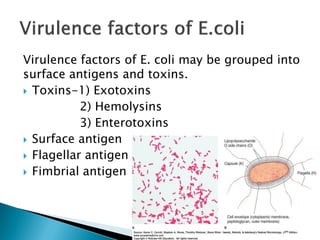
Virulence factors of E. coli may be grouped into
surface antigens and toxins.
 Toxins-1) Exotoxins
2) Hemolysins
3) Enterotoxins
 Surface antigen
 Flagellar antigen
 Fimbrial antigen
 Urinary tract infection (UTI)
 Diarrhea:- It is caused by six types of diarrheagenic
E.coli
1. Enteropathogenic E.coli (EPEC)
2. Enterotoxigenic E.coli (ETEC)
3. Enteroinvasive E. coll (EIEC)
4. Enterohemorrhagic E.coli (EHEC)
5. En1eroaggrega1ive E. coli (EAEC)
6. Diffusely adherent E. coli (DAEC)
 Abdominal infections
 Hepatic abscess
 Pneumonia
 Neonatal meningitis
 Wound and soft tissue infection such as cellulitis and
infection of ulcers and wounds
 Bacteremia
 Osteomyelitis
 Endovascular infection
1. Sample collection- Depends on the site of infection-
urine, stool, pus, wound swab etc.
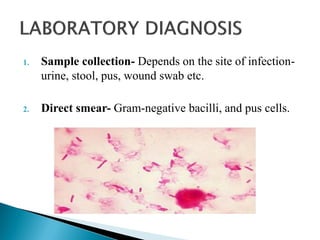
2. Direct smear- Gram-negative bacilli, and pus cells.
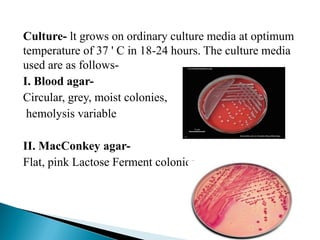
Culture- lt grows on ordinary culture media at optimum
temperature of 37 ' C in 18-24 hours. The culture media
used are as follows-
I. Blood agar-
Circular, grey, moist colonies,
hemolysis variable
II. MacConkey agar-
Flat, pink Lactose Ferment colonies
4. Culture gram staining- Culture smear of the
colonies shows gram-negative bacilli arranged singly.
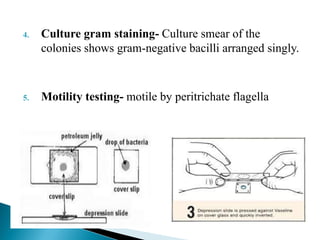
5. Motility testing- motile by peritrichate flagella
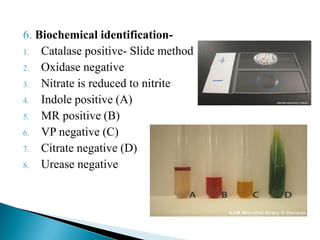
6. Biochemical identification-
1. Catalase positive- Slide method
2. Oxidase negative
3. Nitrate is reduced to nitrite
4. Indole positive (A)
5. MR positive (B)
6. VP negative (C)
7. Citrate negative (D)
8. Urease negative
7. Sugar fermentation test- Ferments most sugars
(glucose, lactose, mannitol, maltose.
8. Molecular test- PCR
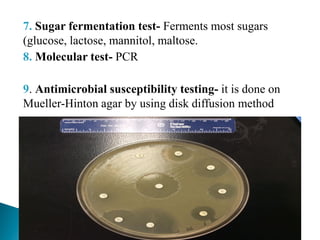
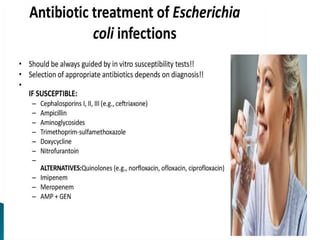
9. Antimicrobial susceptibility testing- it is done on
Mueller-Hinton agar by using disk diffusion method
THANK YOU

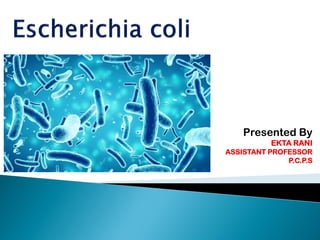
Escherichia coli

  • 1.
  • 2.
    Members of thefamily Enterobacteriaceae should have !he following properties:  They are gram-negative bacilli  Aerobes and facultative anaerobes  Non-fastidious, can grow in ordinary media like nutrient agar  Ferment glucose to produce acid with or without gas.  Reduce nitrate to nitrite.  They produce catalase .  They do not produce oxidase.  They are generally motile with peritrichous flagella.  Natural habita1: Most of them are commensals in human intestine, called coliform bacilli, e.g. Escherichia, Klebsiella.
  • 3.
     It wasdescribed first by Escherich in 1885.  E. coli is the most important species encountered as human pathogen.  It is also the most common aerobe to be harbored in the gut of humans and animals.  After excreted in feces, it remains viable only for some days in die environment.  Other species are less important as human pathogens. These include E. hermannii and E. vulneris which are rarely isolated from clinical specimens.
  • 4.
    Virulence factors ofE. coli may be grouped into surface antigens and toxins.  Toxins-1) Exotoxins 2) Hemolysins 3) Enterotoxins  Surface antigen  Flagellar antigen  Fimbrial antigen
  • 5.
     Urinary tractinfection (UTI)  Diarrhea:- It is caused by six types of diarrheagenic E.coli 1. Enteropathogenic E.coli (EPEC) 2. Enterotoxigenic E.coli (ETEC) 3. Enteroinvasive E. coll (EIEC) 4. Enterohemorrhagic E.coli (EHEC) 5. En1eroaggrega1ive E. coli (EAEC) 6. Diffusely adherent E. coli (DAEC)
  • 6.
     Abdominal infections Hepatic abscess  Pneumonia  Neonatal meningitis  Wound and soft tissue infection such as cellulitis and infection of ulcers and wounds  Bacteremia  Osteomyelitis  Endovascular infection
  • 7.
    1. Sample collection-Depends on the site of infection- urine, stool, pus, wound swab etc. 2. Direct smear- Gram-negative bacilli, and pus cells.
  • 8.
    Culture- lt growson ordinary culture media at optimum temperature of 37 ' C in 18-24 hours. The culture media used are as follows- I. Blood agar- Circular, grey, moist colonies, hemolysis variable II. MacConkey agar- Flat, pink Lactose Ferment colonies
  • 9.
    4. Culture gramstaining- Culture smear of the colonies shows gram-negative bacilli arranged singly. 5. Motility testing- motile by peritrichate flagella
  • 10.
    6. Biochemical identification- 1.Catalase positive- Slide method 2. Oxidase negative 3. Nitrate is reduced to nitrite 4. Indole positive (A) 5. MR positive (B) 6. VP negative (C) 7. Citrate negative (D) 8. Urease negative
  • 11.
    7. Sugar fermentationtest- Ferments most sugars (glucose, lactose, mannitol, maltose. 8. Molecular test- PCR 9. Antimicrobial susceptibility testing- it is done on Mueller-Hinton agar by using disk diffusion method
  • 13.