Pediatric Case Study Jessica Schroeder Texas A & M University – Kingsville Dietetic Intern
Background Information
Pt:Baby CG 4-month-old male Born 10/8/08 40-week gestation Shortly after delivery, patient appeared cyanotic which instigated further examination Cardiac catheterization performed on 10/9/08 revealed Dx: Tetralogy of Fallot (TOF) Near pulmonary atresia, multiple aortopulmonary collaterals, ventricular septal defect, aorta lying over septal defect
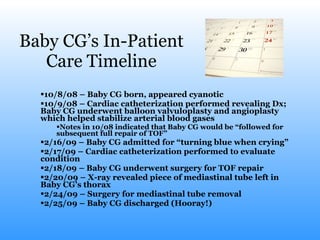
Baby CG’s In-Patient Care Timeline 10/8/08 – Baby CG born, appeared cyanotic  10/9/08 – Cardiac catheterization performed revealing Dx; Baby CG underwent balloon valvuloplasty and angioplasty which helped stabilize arterial blood gases Notes in 10/08 indicated that Baby CG would be “followed for subsequent full repair of TOF” 2/16/09 – Baby CG admitted for “turning blue when crying” 2/17/09 – Cardiac catheterization performed to evaluate condition 2/18/09 – Baby CG underwent surgery for TOF repair 2/20/09 – X-ray revealed piece of mediastinal tube left in Baby CG’s thorax 2/24/09 – Surgery for mediastinal tube removal  2/25/09 – Baby CG discharged (Hooray!)
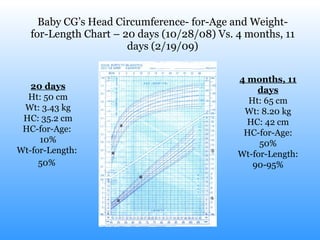
Baby CG’s Head Circumference- for-Age and Weight-for-Length Chart – 20 days (10/28/08) Vs. 4 months, 11 days (2/19/09) 20 days Ht: 50 cm Wt: 3.43 kg HC: 35.2 cm HC-for-Age:  10% Wt-for-Length:  50%   4 months, 11 days Ht: 65 cm Wt: 8.20 kg HC: 42 cm HC-for-Age: 50% Wt-for-Length: 90-95%
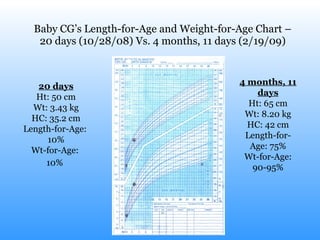
Baby CG’s Length-for-Age and Weight-for-Age Chart – 20 days (10/28/08) Vs. 4 months, 11 days (2/19/09) 20 days Ht: 50 cm Wt: 3.43 kg HC: 35.2 cm Length-for-Age:  10% Wt-for-Age:  10%   4 months, 11 days Ht: 65 cm Wt: 8.20 kg HC: 42 cm Length-for-Age: 75% Wt-for-Age: 90-95%
Social Background 24-year-old mother and 29-year-old father are Corpus Christi, TX residents Parents married and play active roles in Baby CG’s care Mom reports appropriate prenatal care and tested negative for transferrable diseases Parents report access to electricity, plumbing/city water, air conditioning, and a cooking facility Participate in WIC
Baby CG’s Dx: Tetralogy of  Fallot (TOF)
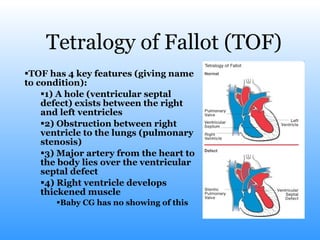
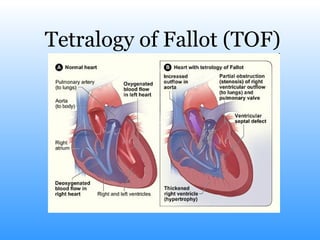
Tetralogy of Fallot (TOF) TOF has 4 key features (giving name to condition): 1) A hole (ventricular septal defect) exists between the right and left ventricles 2) Obstruction between right ventricle to the lungs (pulmonary stenosis) 3) Major artery from the heart to the body lies over the ventricular septal defect 4) Right ventricle develops thickened muscle Baby CG has no showing of this
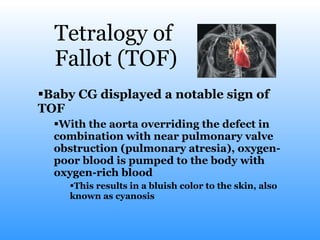
Tetralogy of  Fallot (TOF) Baby CG displayed a notable sign of TOF With the aorta overriding the defect in combination with near pulmonary valve obstruction (pulmonary atresia), oxygen-poor blood is pumped to the body with oxygen-rich blood This results in a bluish color to the skin, also known as cyanosis
Tetralogy of Fallot (TOF)
Baby CG’s Abnormal Labs
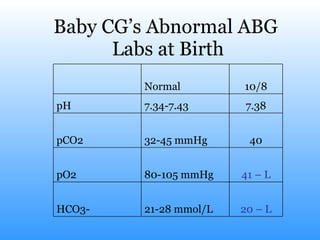
Baby CG’s Abnormal ABG  Labs at Birth 20 – L 21-28 mmol/L HCO3- 41 – L 80-105 mmHg pO2 40 32-45 mmHg pCO2 7.38 7.34-7.43 pH 10/8 Normal  
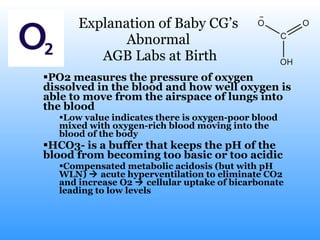
Explanation of Baby CG’s  Abnormal  AGB Labs at Birth PO2 measures the pressure of oxygen dissolved in the blood and how well oxygen is able to move from the airspace of lungs into the blood Low value indicates there is oxygen-poor blood mixed with oxygen-rich blood moving into the blood of the body HCO3- is a buffer that keeps the pH of the blood from becoming too basic or too acidic Compensated metabolic acidosis (but with pH WLN)    acute hyperventilation to eliminate CO2 and increase O2    cellular uptake of bicarbonate leading to low levels
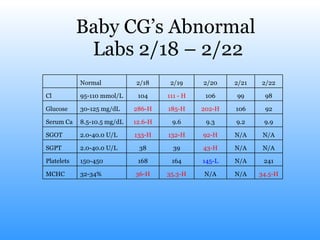
Baby CG’s Abnormal  Labs 2/18 – 2/22 34.5-H N/A N/A 35.3-H 36-H 32-34% MCHC  241 N/A 145-L 164 168 150-450 Platelets N/A N/A 43-H 39 38 2.0-40.0 U/L SGPT N/A N/A 92-H 132-H 133-H 2.0-40.0 U/L SGOT 9.9 9.2 9.3 9.6 12.6-H 8.5-10.5 mg/dL Serum Ca 92 106 202-H 185-H 286-H 30-125 mg/dL Glucose 98 99 106 111 - H 104 95-110 mmol/L Cl 2/22 2/21 2/20 2/19 2/18 Normal  
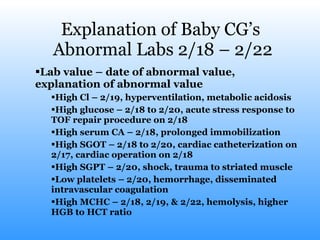
Explanation of Baby CG’s  Abnormal Labs 2/18 – 2/22 Lab value – date of abnormal value, explanation of abnormal value High Cl – 2/19, hyperventilation, metabolic acidosis High glucose – 2/18 to 2/20, acute stress response to TOF repair procedure on 2/18 High serum CA – 2/18, prolonged immobilization High SGOT – 2/18 to 2/20, cardiac catheterization on 2/17, cardiac operation on 2/18 High SGPT – 2/20, shock, trauma to striated muscle Low platelets – 2/20, hemorrhage, disseminated intravascular coagulation High MCHC – 2/18, 2/19, & 2/22, hemolysis, higher HGB to HCT ratio
Explanation of Baby CG’s High Glucose Levels 2/18 – 2/22 Glucose levels rose on 2/18 and eventually subsided to normal limits by 2/21 Explanation: when in stress, the sympathetic nervous system (SNS) is activated and turns on the fight or flight response As a result, adrenal glands release adrenaline (a.k.a. epinephrine) which causes rapid release of glucose and fatty acids to the bloodstream This is to provide readily available energy to the cells of the body for immediate action
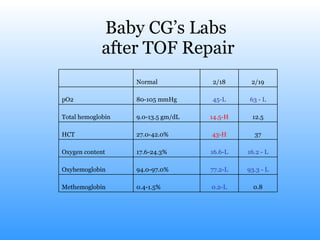
Baby CG’s Labs  after TOF Repair 0.8 0.2-L 0.4-1.5% Methemoglobin 93.3 - L 77.2-L 94.0-97.0% Oxyhemoglobin 16.2 - L 16.6-L 17.6-24.3% Oxygen content 37 43-H 27.0-42.0% HCT 12.5 14.5-H 9.0-13.5 gm/dL Total hemoglobin 63 - L 45-L 80-105 mmHg pO2 2/19 2/18 Normal  
Explanation of Baby CG’s  Labs after TOF Repair Lab value – date of abnormal value, explanation of abnormal value Low p02 – atrial or ventricular cardiac septal defects; improving, increased from 2/18    2/19  High HGB – congenital heart disease causes this; improving, WNL by 2/19 High HCT – congenital heart disease causes this; WNL by 2/19 Low O2 content – decreased 2/18    2/19; adjusting?; O2 levels being utilized more?  Low oxyhemoglobin – 2/18 & 2/19, O2 was not available to bind to hemoglobin, now more O2 available; improving, increased from 2/18    2/19  Low methemoglobin – not enough O2 was available, ferrous ion (Fe2+) of the heme group of hemoglobin does not become oxidized to the ferric state (Fe3+), meaning hemoglobin isn’t    methemoglobin (just like hemoglobin, but iron in heme group binds to H2O instead of O2); WNL by 2/19
Baby CG’s Medications
Baby CG’s Medications Acetaminophen (Tylenol) – pain reliever and fever reducer Adenosine – regulates normal heart rate and rhythm during episodes of supraventricular tachycardia Aminocaproic acid – enhances hemostasis Amiodarone – antiarrhythmic agent Atropine sulfate – reduces secretions of respiratory tract, temporarily increases heart rate Bacitracin zinc – antibiotic for cuts and wounds Calcium chloride – treats hypocalcemic tetany Ceftazidime – for treatment of skin infections and intra-abdominal infections Clindamycin (Cleocin) – antibiotic Dobutamine Hydrochloride – increases cardiac output through regulating contractions of the heart Epinephrine HCL – for local or regional anesthesia  Fentanyl citrate (Sublimaze) – depresses central nervous system function and respiratory function, anesthetic Furosemide (Lasix) - diuretic Glycopyrrolate (Robinul) – reduces salivary, tracheobronchial, and pharyngeal secretions  Heparin (Porcine) - anticoagulant
Baby CG’s Medications Ioversol (Opitray 320) – for angiocardiography Lidocaine HCL – anesthetic and antiarrhythmic agent Magnesium sulfate – replacement therapy for Mg deficiency, prevents tetany Mannitol – diuretic Methylprednisolone sodium (Solu-Medrol) – for adrenocortical insufficiency as a result of shock Midazolam HCL (Versed) – for sedation, anxyiolysis, and amnesia Milrinone lactate (Primacor) – for short-term management for low output states of cardiac surgery  Morphine sulfate – for pain relief  Mupirocin calcium (Bactroban Nasal) – antibiotic for infected cuts or wounds  Naloxone – for complete or partial reversal of narcotic depression including respiratory depression Neostigmine methylsulfate (Prostigmin) – for acute myasthenic crisis Nitroglycerin – prevents angina pectoris Ondansetron HCL (Zofran) – prevents nausea and vomiting after surgery, blocks serotonin
Baby CG’s Medications Pancuronim bromide (Pavulon) – muscle relaxant Phenylephrine HCL (Neo-Synephrine) – for relief of upper   respiratory symptoms such as allergy or cold Potassium chloride – treats hypokalemia, replacement therapy for K defiency Procainamide – antiarrhythmic agent  Propranolol HCL (Inderal) – for management of hypertension Protamine sulfate – treats/prevents heparin overdosage Ranitindine (Zantac) – helps treat GERD Rocuronium bromide (Zemuron) - anesthetic to aid intubation, muscle relaxant Sodium bicarbonate – for metabolic acidosis Sodium chloride – for electrolyte replacement Thrombin (Thrombin-JMI) – aids homeostasis with oozing blood and minor bleeding from capillaries and small venules Vecuronium bromide (Norcuron) – anesthetic to aid intubation, muscle relaxant
Baby CG’s Pre-Op Medical Nutrition Therapy
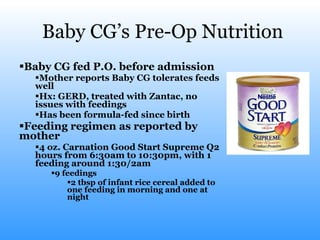
Baby CG’s Pre-Op Nutrition Baby CG fed P.O. before admission Mother reports Baby CG tolerates feeds well Hx: GERD, treated with Zantac, no issues with feedings Has been formula-fed since birth Feeding regimen as reported by mother 4 oz. Carnation Good Start Supreme Q2 hours from 6:30am to 10:30pm, with 1 feeding around 1:30/2am 9 feedings 2 tbsp of infant rice cereal added to one feeding in morning and one at night
Baby CG’s Pre-Op  Nutrition Calories 9 4 oz. feedings = 36 oz./day 2 scoops of Carnation Good Start Supreme with 4 oz. water 2 scoops * 8.7 g/scoop * 5.12 kcal/g * 9 feeds = 802 kcal Total 4 tbsp infant rice cereal = 60 kcal 802 kcal + 60 kcal = 862 kcal/day 862 kcal/8.2 kg = 105 kcal/kg Protein 2 scoops * 8.7 gm/scoop * 0.11 g protein/g powder * 9 feeds = 17.2 g protein Total 4 tbsp infant rice cereal = 1 g protein 17.2 g + 1 g = 18.2 g protein/day 18.2 g protein/8.2 kg = 2.2 g protein/kg  Fluid  36 oz./day * 30 mL/oz. = 1080 mL/day 1080 mL/8.2 kg = 132 mL/kg
Baby CG’s Pre-Op  Nutrition Assessment Because Baby CG plots on the 95 th % for weight-for-age, 50 th % weight-for-age, 7.1 kg, should be used for nutritional needs 7.1 kg * 82 kcal/kg/day (DRI) = 582 kcal/day (582 kcal/day)/8.2 kg = 71 kcal/kg/day Current regimen provides 105 kcal/kg/day 7.1 kg * 1.52 g protein/kg/day = 10.8 g protein/day (10.8 g/day)/8.2 kg = 1.32 g protein/kg/day Current regimen provides 2.2 g protein/kg/day 8.2 kg * 100 mL/kg = 820 mL/day Current regimen provides 1080 mL/day
Baby CG’s Pre-Op Nutrition Recommendations Reduce calories, protein, and fluid to meet appropriate requirements Reducing intake appropriately over time may help Baby CG reach 50 – 75% for weight-for-age Reduce number of 4 oz. feeds to 6 with Carnation Good Start Supreme formula, continue with 2X rice cereal addition Calories 582 – 60 (rice cereal) kcal/6 feeds = 87 kcal/4 oz. feed = 22 kcal/oz. (Carnation Good Start Supreme caloric density) 22 kcal/oz. * 24 oz. = 528 kcal/day Protein 2 scoops * 8.7 gm/scoop * 0.11 g protein/g powder * 6 feeds = 11.5 g protein/day Fluid 6 feedings * 4 oz. * 30 mL/oz. = 720 mL/day Provide 100 mL or ~3.5 oz. water separately All are close to/meet appropriate requirements
Baby CG’s Surgeries and Procedures
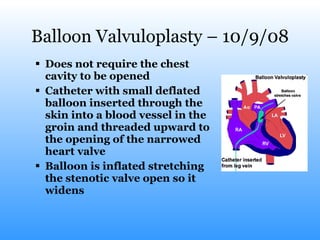
Balloon Valvuloplasty – 10/9/08 Does not require the chest cavity to be opened Catheter with small deflated balloon inserted through the skin into a blood vessel in the groin and threaded upward to the opening of the narrowed heart valve Balloon is inflated stretching the stenotic valve open so it widens
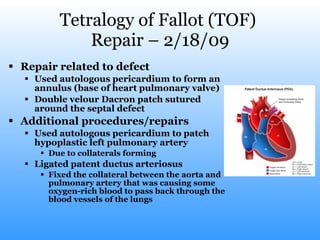
Tetralogy of Fallot (TOF)  Repair – 2/18/09 Repair related to defect Used autologous pericardium to form an annulus (base of heart pulmonary valve) Double velour Dacron patch sutured around the septal defect  Additional procedures/repairs Used autologous pericardium to patch hypoplastic left pulmonary artery Due to collaterals forming Ligated patent ductus arteriosus Fixed the collateral between the aorta and pulmonary artery that was causing some oxygen-rich blood to pass back through the blood vessels of the lungs
Baby CG’s Pre-Op Medical Nutrition Therapy
Baby CG’s Post-Op Nutrition Feeding pattern 2/20 - Baby CG was N.P.O. until successfully extubated  Fed P.O. after successful extubation 2/23 - Went N.P.O. for chest tube removal 2/24 - Resumed P.O. after surgery (2/24) Nutrition plan Must increase intake to adjust for surgery, bed rest, and cardiac failure Research shows that 2.5 years after surgery, energy needs are roughly comparable to that of a healthy child of the same age without CHD May be necessary to factor in energy needs post-surgery for next 2.5 years Monitor progress and adjust after this time period
Baby CG’s Post-Op Nutrition New nutritional goals Must include AF’s for energy needs Major surgery 1.2 Bed rest 1.2 Cardiac 1.1 Recommend 82 kcal/kg IBW (DRI) with AF’s 82 kcal/kg * 1.2 * 1.2 * 1.1 = 130 kcal/kg 130 kcal/kg * 7.1 kg = 923 kcal/day (923 kcal/day)/8.2 kg = 113 kcal/kg  Recommend 1.52 g protein/kg IBW with AF’s 1.52 g protein/kg * 1.2 * 1.2 *1.1 = 2.4 g protein/kg 2.4 gram protein/kg * 7.1 kg = 17 g protein/day (17 g protein/day)/8.2 kg = 2.1 g protein/day Fluid recommendation per MD
Baby CG’s Post-Op Nutrition  Assessment and Recommendations Assessment Baby CG is slow to feed *Energy expenditures drop within 1 week of surgery to meet pre-op levels, so less intake is required* Can result in refusal to feed P.O. Regular appetite is expected to return after week Speech pathology may be needed if issues arise with chewing, swallowing, and manipulating food Recommendations Increase feedings (923 kcal/day)/(1 oz./22 kcal) = 42 oz. of Carnation Good Start Supreme Could mean about 10 – 11 4 oz. feedings/day Or switch to higher caloric density formula A 27 kcal/oz. would mean 8- 9 feedings/day A 30 kcal/oz. would mean 7 – 8 feedings/day Make sure to monitor tolerance, higher caloric density    diarrhea, vomiting, etc. Start introducing baby foods and decrease formula intake  Monitor progress and adjust intake as necessary
Relevant Research:  Operations in Infants  Alter Energy Needs Energy needs in infants decrease after surgery Due to growth inhibition from catabolic stress metabolism, decreased insensible losses, and inactivity Infants are often fed 200% excess Overfeeding    increased CO2 production from lipogenesis Seven infants observed, measured CRP, O2 consumption, measured energy expenditure, and total urinary nitrogen during first 3 days following surgery  Even 50% caloric excess produces substantial CO2 production and lipogenesis Caloric needs during stress are equal to or only a little bit more than measured energy expenditure Should use basal metabolic rate for estimated calorie needs until CRP values are </= 2.0 mg/dL
THANK YOU!
References Bunting, Dawn, Suzanne D'Souza, Jia Nguyen, Sarah Phillips, Sundae Rich,  and Susanne Trout.  Texas Children's Hospital Pediatric Nutrition Reference Guide 2008 . 8th ed. Houston: Texas Children's Hospital, 2008.  &quot;Cardiovascular Disorders: Patent Ductus Arteriosus (PDA).&quot;  University of Virginia Health System . 24 Aug. 2006. University of Virginia. 24 Feb. 2009.  Ekvall, Shirely W., and Valli K. Ekvall, eds.  Pediatric Nutrition in Chronic Diseases and Developmental Disorders: Prevention, Assessment, and Treatment . 2 nd  ed. New York: University P, 2005.  Kleinman, Ronald E., ed.  Pediatric Nutrition Handbook . 5th ed. Elk Grove Village, IL: American Academy of Pediatrics, 2004.  Letton, Robert W., Walter J. Chwals, Angela Jamie, and Barbara Charles. &quot;Early postoperative alterations in infant energy use increase the risk of overfeeding.“ Journal of Pediatric Surgery  30 (1995): 988-93.  RxList: The Internet Drug Index . 2009. RxList Inc. 22 Feb. 2009.  &quot;Tetralogy of Fallot.&quot;  American Heart Association . 22 Feb. 2009.

Pediatric Case Study

  • 1.
    Pediatric Case StudyJessica Schroeder Texas A & M University – Kingsville Dietetic Intern
  • 2.
  • 3.
    Pt:Baby CG 4-month-oldmale Born 10/8/08 40-week gestation Shortly after delivery, patient appeared cyanotic which instigated further examination Cardiac catheterization performed on 10/9/08 revealed Dx: Tetralogy of Fallot (TOF) Near pulmonary atresia, multiple aortopulmonary collaterals, ventricular septal defect, aorta lying over septal defect
  • 4.
    Baby CG’s In-PatientCare Timeline 10/8/08 – Baby CG born, appeared cyanotic 10/9/08 – Cardiac catheterization performed revealing Dx; Baby CG underwent balloon valvuloplasty and angioplasty which helped stabilize arterial blood gases Notes in 10/08 indicated that Baby CG would be “followed for subsequent full repair of TOF” 2/16/09 – Baby CG admitted for “turning blue when crying” 2/17/09 – Cardiac catheterization performed to evaluate condition 2/18/09 – Baby CG underwent surgery for TOF repair 2/20/09 – X-ray revealed piece of mediastinal tube left in Baby CG’s thorax 2/24/09 – Surgery for mediastinal tube removal 2/25/09 – Baby CG discharged (Hooray!)
  • 5.
    Baby CG’s HeadCircumference- for-Age and Weight-for-Length Chart – 20 days (10/28/08) Vs. 4 months, 11 days (2/19/09) 20 days Ht: 50 cm Wt: 3.43 kg HC: 35.2 cm HC-for-Age: 10% Wt-for-Length: 50% 4 months, 11 days Ht: 65 cm Wt: 8.20 kg HC: 42 cm HC-for-Age: 50% Wt-for-Length: 90-95%
  • 6.
    Baby CG’s Length-for-Ageand Weight-for-Age Chart – 20 days (10/28/08) Vs. 4 months, 11 days (2/19/09) 20 days Ht: 50 cm Wt: 3.43 kg HC: 35.2 cm Length-for-Age: 10% Wt-for-Age: 10% 4 months, 11 days Ht: 65 cm Wt: 8.20 kg HC: 42 cm Length-for-Age: 75% Wt-for-Age: 90-95%
  • 7.
    Social Background 24-year-oldmother and 29-year-old father are Corpus Christi, TX residents Parents married and play active roles in Baby CG’s care Mom reports appropriate prenatal care and tested negative for transferrable diseases Parents report access to electricity, plumbing/city water, air conditioning, and a cooking facility Participate in WIC
  • 8.
    Baby CG’s Dx:Tetralogy of Fallot (TOF)
  • 9.
    Tetralogy of Fallot(TOF) TOF has 4 key features (giving name to condition): 1) A hole (ventricular septal defect) exists between the right and left ventricles 2) Obstruction between right ventricle to the lungs (pulmonary stenosis) 3) Major artery from the heart to the body lies over the ventricular septal defect 4) Right ventricle develops thickened muscle Baby CG has no showing of this
  • 10.
    Tetralogy of Fallot (TOF) Baby CG displayed a notable sign of TOF With the aorta overriding the defect in combination with near pulmonary valve obstruction (pulmonary atresia), oxygen-poor blood is pumped to the body with oxygen-rich blood This results in a bluish color to the skin, also known as cyanosis
  • 11.
  • 12.
  • 13.
    Baby CG’s AbnormalABG Labs at Birth 20 – L 21-28 mmol/L HCO3- 41 – L 80-105 mmHg pO2 40 32-45 mmHg pCO2 7.38 7.34-7.43 pH 10/8 Normal  
  • 14.
    Explanation of BabyCG’s Abnormal AGB Labs at Birth PO2 measures the pressure of oxygen dissolved in the blood and how well oxygen is able to move from the airspace of lungs into the blood Low value indicates there is oxygen-poor blood mixed with oxygen-rich blood moving into the blood of the body HCO3- is a buffer that keeps the pH of the blood from becoming too basic or too acidic Compensated metabolic acidosis (but with pH WLN)  acute hyperventilation to eliminate CO2 and increase O2  cellular uptake of bicarbonate leading to low levels
  • 15.
    Baby CG’s Abnormal Labs 2/18 – 2/22 34.5-H N/A N/A 35.3-H 36-H 32-34% MCHC 241 N/A 145-L 164 168 150-450 Platelets N/A N/A 43-H 39 38 2.0-40.0 U/L SGPT N/A N/A 92-H 132-H 133-H 2.0-40.0 U/L SGOT 9.9 9.2 9.3 9.6 12.6-H 8.5-10.5 mg/dL Serum Ca 92 106 202-H 185-H 286-H 30-125 mg/dL Glucose 98 99 106 111 - H 104 95-110 mmol/L Cl 2/22 2/21 2/20 2/19 2/18 Normal  
  • 16.
    Explanation of BabyCG’s Abnormal Labs 2/18 – 2/22 Lab value – date of abnormal value, explanation of abnormal value High Cl – 2/19, hyperventilation, metabolic acidosis High glucose – 2/18 to 2/20, acute stress response to TOF repair procedure on 2/18 High serum CA – 2/18, prolonged immobilization High SGOT – 2/18 to 2/20, cardiac catheterization on 2/17, cardiac operation on 2/18 High SGPT – 2/20, shock, trauma to striated muscle Low platelets – 2/20, hemorrhage, disseminated intravascular coagulation High MCHC – 2/18, 2/19, & 2/22, hemolysis, higher HGB to HCT ratio
  • 17.
    Explanation of BabyCG’s High Glucose Levels 2/18 – 2/22 Glucose levels rose on 2/18 and eventually subsided to normal limits by 2/21 Explanation: when in stress, the sympathetic nervous system (SNS) is activated and turns on the fight or flight response As a result, adrenal glands release adrenaline (a.k.a. epinephrine) which causes rapid release of glucose and fatty acids to the bloodstream This is to provide readily available energy to the cells of the body for immediate action
  • 18.
    Baby CG’s Labs after TOF Repair 0.8 0.2-L 0.4-1.5% Methemoglobin 93.3 - L 77.2-L 94.0-97.0% Oxyhemoglobin 16.2 - L 16.6-L 17.6-24.3% Oxygen content 37 43-H 27.0-42.0% HCT 12.5 14.5-H 9.0-13.5 gm/dL Total hemoglobin 63 - L 45-L 80-105 mmHg pO2 2/19 2/18 Normal  
  • 19.
    Explanation of BabyCG’s Labs after TOF Repair Lab value – date of abnormal value, explanation of abnormal value Low p02 – atrial or ventricular cardiac septal defects; improving, increased from 2/18  2/19 High HGB – congenital heart disease causes this; improving, WNL by 2/19 High HCT – congenital heart disease causes this; WNL by 2/19 Low O2 content – decreased 2/18  2/19; adjusting?; O2 levels being utilized more? Low oxyhemoglobin – 2/18 & 2/19, O2 was not available to bind to hemoglobin, now more O2 available; improving, increased from 2/18  2/19 Low methemoglobin – not enough O2 was available, ferrous ion (Fe2+) of the heme group of hemoglobin does not become oxidized to the ferric state (Fe3+), meaning hemoglobin isn’t  methemoglobin (just like hemoglobin, but iron in heme group binds to H2O instead of O2); WNL by 2/19
  • 20.
  • 21.
    Baby CG’s MedicationsAcetaminophen (Tylenol) – pain reliever and fever reducer Adenosine – regulates normal heart rate and rhythm during episodes of supraventricular tachycardia Aminocaproic acid – enhances hemostasis Amiodarone – antiarrhythmic agent Atropine sulfate – reduces secretions of respiratory tract, temporarily increases heart rate Bacitracin zinc – antibiotic for cuts and wounds Calcium chloride – treats hypocalcemic tetany Ceftazidime – for treatment of skin infections and intra-abdominal infections Clindamycin (Cleocin) – antibiotic Dobutamine Hydrochloride – increases cardiac output through regulating contractions of the heart Epinephrine HCL – for local or regional anesthesia Fentanyl citrate (Sublimaze) – depresses central nervous system function and respiratory function, anesthetic Furosemide (Lasix) - diuretic Glycopyrrolate (Robinul) – reduces salivary, tracheobronchial, and pharyngeal secretions Heparin (Porcine) - anticoagulant
  • 22.
    Baby CG’s MedicationsIoversol (Opitray 320) – for angiocardiography Lidocaine HCL – anesthetic and antiarrhythmic agent Magnesium sulfate – replacement therapy for Mg deficiency, prevents tetany Mannitol – diuretic Methylprednisolone sodium (Solu-Medrol) – for adrenocortical insufficiency as a result of shock Midazolam HCL (Versed) – for sedation, anxyiolysis, and amnesia Milrinone lactate (Primacor) – for short-term management for low output states of cardiac surgery Morphine sulfate – for pain relief Mupirocin calcium (Bactroban Nasal) – antibiotic for infected cuts or wounds Naloxone – for complete or partial reversal of narcotic depression including respiratory depression Neostigmine methylsulfate (Prostigmin) – for acute myasthenic crisis Nitroglycerin – prevents angina pectoris Ondansetron HCL (Zofran) – prevents nausea and vomiting after surgery, blocks serotonin
  • 23.
    Baby CG’s MedicationsPancuronim bromide (Pavulon) – muscle relaxant Phenylephrine HCL (Neo-Synephrine) – for relief of upper respiratory symptoms such as allergy or cold Potassium chloride – treats hypokalemia, replacement therapy for K defiency Procainamide – antiarrhythmic agent Propranolol HCL (Inderal) – for management of hypertension Protamine sulfate – treats/prevents heparin overdosage Ranitindine (Zantac) – helps treat GERD Rocuronium bromide (Zemuron) - anesthetic to aid intubation, muscle relaxant Sodium bicarbonate – for metabolic acidosis Sodium chloride – for electrolyte replacement Thrombin (Thrombin-JMI) – aids homeostasis with oozing blood and minor bleeding from capillaries and small venules Vecuronium bromide (Norcuron) – anesthetic to aid intubation, muscle relaxant
  • 24.
    Baby CG’s Pre-OpMedical Nutrition Therapy
  • 25.
    Baby CG’s Pre-OpNutrition Baby CG fed P.O. before admission Mother reports Baby CG tolerates feeds well Hx: GERD, treated with Zantac, no issues with feedings Has been formula-fed since birth Feeding regimen as reported by mother 4 oz. Carnation Good Start Supreme Q2 hours from 6:30am to 10:30pm, with 1 feeding around 1:30/2am 9 feedings 2 tbsp of infant rice cereal added to one feeding in morning and one at night
  • 26.
    Baby CG’s Pre-Op Nutrition Calories 9 4 oz. feedings = 36 oz./day 2 scoops of Carnation Good Start Supreme with 4 oz. water 2 scoops * 8.7 g/scoop * 5.12 kcal/g * 9 feeds = 802 kcal Total 4 tbsp infant rice cereal = 60 kcal 802 kcal + 60 kcal = 862 kcal/day 862 kcal/8.2 kg = 105 kcal/kg Protein 2 scoops * 8.7 gm/scoop * 0.11 g protein/g powder * 9 feeds = 17.2 g protein Total 4 tbsp infant rice cereal = 1 g protein 17.2 g + 1 g = 18.2 g protein/day 18.2 g protein/8.2 kg = 2.2 g protein/kg Fluid 36 oz./day * 30 mL/oz. = 1080 mL/day 1080 mL/8.2 kg = 132 mL/kg
  • 27.
    Baby CG’s Pre-Op Nutrition Assessment Because Baby CG plots on the 95 th % for weight-for-age, 50 th % weight-for-age, 7.1 kg, should be used for nutritional needs 7.1 kg * 82 kcal/kg/day (DRI) = 582 kcal/day (582 kcal/day)/8.2 kg = 71 kcal/kg/day Current regimen provides 105 kcal/kg/day 7.1 kg * 1.52 g protein/kg/day = 10.8 g protein/day (10.8 g/day)/8.2 kg = 1.32 g protein/kg/day Current regimen provides 2.2 g protein/kg/day 8.2 kg * 100 mL/kg = 820 mL/day Current regimen provides 1080 mL/day
  • 28.
    Baby CG’s Pre-OpNutrition Recommendations Reduce calories, protein, and fluid to meet appropriate requirements Reducing intake appropriately over time may help Baby CG reach 50 – 75% for weight-for-age Reduce number of 4 oz. feeds to 6 with Carnation Good Start Supreme formula, continue with 2X rice cereal addition Calories 582 – 60 (rice cereal) kcal/6 feeds = 87 kcal/4 oz. feed = 22 kcal/oz. (Carnation Good Start Supreme caloric density) 22 kcal/oz. * 24 oz. = 528 kcal/day Protein 2 scoops * 8.7 gm/scoop * 0.11 g protein/g powder * 6 feeds = 11.5 g protein/day Fluid 6 feedings * 4 oz. * 30 mL/oz. = 720 mL/day Provide 100 mL or ~3.5 oz. water separately All are close to/meet appropriate requirements
  • 29.
    Baby CG’s Surgeriesand Procedures
  • 30.
    Balloon Valvuloplasty –10/9/08 Does not require the chest cavity to be opened Catheter with small deflated balloon inserted through the skin into a blood vessel in the groin and threaded upward to the opening of the narrowed heart valve Balloon is inflated stretching the stenotic valve open so it widens
  • 31.
    Tetralogy of Fallot(TOF) Repair – 2/18/09 Repair related to defect Used autologous pericardium to form an annulus (base of heart pulmonary valve) Double velour Dacron patch sutured around the septal defect Additional procedures/repairs Used autologous pericardium to patch hypoplastic left pulmonary artery Due to collaterals forming Ligated patent ductus arteriosus Fixed the collateral between the aorta and pulmonary artery that was causing some oxygen-rich blood to pass back through the blood vessels of the lungs
  • 32.
    Baby CG’s Pre-OpMedical Nutrition Therapy
  • 33.
    Baby CG’s Post-OpNutrition Feeding pattern 2/20 - Baby CG was N.P.O. until successfully extubated Fed P.O. after successful extubation 2/23 - Went N.P.O. for chest tube removal 2/24 - Resumed P.O. after surgery (2/24) Nutrition plan Must increase intake to adjust for surgery, bed rest, and cardiac failure Research shows that 2.5 years after surgery, energy needs are roughly comparable to that of a healthy child of the same age without CHD May be necessary to factor in energy needs post-surgery for next 2.5 years Monitor progress and adjust after this time period
  • 34.
    Baby CG’s Post-OpNutrition New nutritional goals Must include AF’s for energy needs Major surgery 1.2 Bed rest 1.2 Cardiac 1.1 Recommend 82 kcal/kg IBW (DRI) with AF’s 82 kcal/kg * 1.2 * 1.2 * 1.1 = 130 kcal/kg 130 kcal/kg * 7.1 kg = 923 kcal/day (923 kcal/day)/8.2 kg = 113 kcal/kg Recommend 1.52 g protein/kg IBW with AF’s 1.52 g protein/kg * 1.2 * 1.2 *1.1 = 2.4 g protein/kg 2.4 gram protein/kg * 7.1 kg = 17 g protein/day (17 g protein/day)/8.2 kg = 2.1 g protein/day Fluid recommendation per MD
  • 35.
    Baby CG’s Post-OpNutrition Assessment and Recommendations Assessment Baby CG is slow to feed *Energy expenditures drop within 1 week of surgery to meet pre-op levels, so less intake is required* Can result in refusal to feed P.O. Regular appetite is expected to return after week Speech pathology may be needed if issues arise with chewing, swallowing, and manipulating food Recommendations Increase feedings (923 kcal/day)/(1 oz./22 kcal) = 42 oz. of Carnation Good Start Supreme Could mean about 10 – 11 4 oz. feedings/day Or switch to higher caloric density formula A 27 kcal/oz. would mean 8- 9 feedings/day A 30 kcal/oz. would mean 7 – 8 feedings/day Make sure to monitor tolerance, higher caloric density  diarrhea, vomiting, etc. Start introducing baby foods and decrease formula intake Monitor progress and adjust intake as necessary
  • 36.
    Relevant Research: Operations in Infants Alter Energy Needs Energy needs in infants decrease after surgery Due to growth inhibition from catabolic stress metabolism, decreased insensible losses, and inactivity Infants are often fed 200% excess Overfeeding  increased CO2 production from lipogenesis Seven infants observed, measured CRP, O2 consumption, measured energy expenditure, and total urinary nitrogen during first 3 days following surgery Even 50% caloric excess produces substantial CO2 production and lipogenesis Caloric needs during stress are equal to or only a little bit more than measured energy expenditure Should use basal metabolic rate for estimated calorie needs until CRP values are </= 2.0 mg/dL
  • 37.
  • 38.
    References Bunting, Dawn,Suzanne D'Souza, Jia Nguyen, Sarah Phillips, Sundae Rich, and Susanne Trout. Texas Children's Hospital Pediatric Nutrition Reference Guide 2008 . 8th ed. Houston: Texas Children's Hospital, 2008. &quot;Cardiovascular Disorders: Patent Ductus Arteriosus (PDA).&quot; University of Virginia Health System . 24 Aug. 2006. University of Virginia. 24 Feb. 2009. Ekvall, Shirely W., and Valli K. Ekvall, eds. Pediatric Nutrition in Chronic Diseases and Developmental Disorders: Prevention, Assessment, and Treatment . 2 nd ed. New York: University P, 2005. Kleinman, Ronald E., ed. Pediatric Nutrition Handbook . 5th ed. Elk Grove Village, IL: American Academy of Pediatrics, 2004. Letton, Robert W., Walter J. Chwals, Angela Jamie, and Barbara Charles. &quot;Early postoperative alterations in infant energy use increase the risk of overfeeding.“ Journal of Pediatric Surgery 30 (1995): 988-93. RxList: The Internet Drug Index . 2009. RxList Inc. 22 Feb. 2009. &quot;Tetralogy of Fallot.&quot; American Heart Association . 22 Feb. 2009.