Antimicrobial Assay
1
USES OF ANTIBIOTIC SENSITIVITY
TESTING
2
• Antibiotic sensitivity test: A laboratory
test which determines how effective
antibiotic therapy is against a bacterial
infections.
• Antibiotic sensitivity testing will control
the use of Antibiotics in clinical practice
• Testing will assist the clinicians in the
choice of drugs for the treatment of
infections.
• Susceptibility tests should never
be performed on contaminants or
commensals belonging to the
normal flora, or on other
organisms that have no causal
relationship to the infectious
process. These should be
carried out only on pure
cultures of organisms
considered to be causing the
infectious process. The
organisms should also be
identified since not every
microorganism isolated from a
patient with an infection requires
an Antibiograms.
SUSCEPTIBILITY TEST AS A GUIDE FOR
TREATMENT
3
GENERAL PRINCIPLES OF
ANTIMICROBIAL SUSCEPTIBILITY
TESTING
4
• Antimicrobial
susceptibility tests
measure the ability of
an antibiotic or other
antimicrobial agent to
inhibit bacterial growth
in vitro. This ability may
be estimated by either
the dilution method or
the diffusion method.
ANTIMICROBIAL
SUSCEPTIBILITY TESTS
5
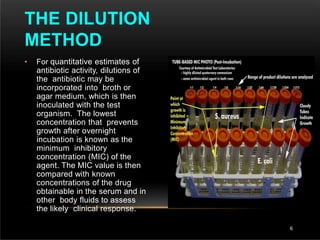
• For quantitative estimates of
antibiotic activity, dilutions of
the antibiotic may be
incorporated into broth or
agar medium, which is then
inoculated with the test
organism. The lowest
concentration that prevents
growth after overnight
incubation is known as the
minimum inhibitory
concentration (MIC) of the
agent. The MIC value is then
compared with known
concentrations of the drug
obtainable in the serum and in
other body fluids to assess
the likely clinical response.
THE DILUTION
METHOD
6
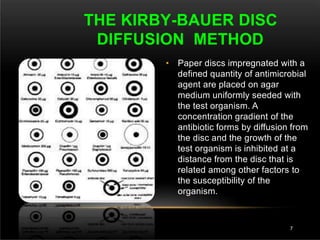
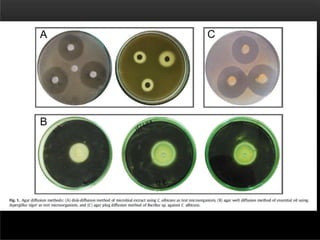
• Paper discs impregnated with a
defined quantity of antimicrobial
agent are placed on agar
medium uniformly seeded with
the test organism. A
concentration gradient of the
antibiotic forms by diffusion from
the disc and the growth of the
test organism is inhibited at a
distance from the disc that is
related among other factors to
the susceptibility of the
organism.
THE KIRBY-BAUER DISC
DIFFUSION METHOD
7
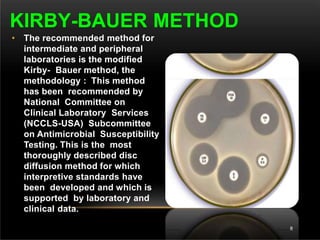
• The recommended method for
intermediate and peripheral
laboratories is the modified
Kirby- Bauer method, the
methodology : This method
has been recommended by
National Committee on
Clinical Laboratory Services
(NCCLS-USA) Subcommittee
on Antimicrobial Susceptibility
Testing. This is the most
thoroughly described disc
diffusion method for which
interpretive standards have
been developed and which is
supported by laboratory and
clinical data.
KIRBY-BAUER METHOD
8
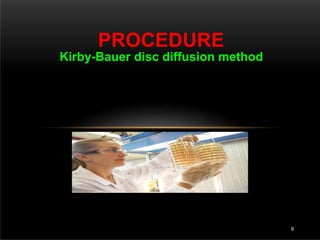
PROCEDURE
Kirby-Bauer disc diffusion method
9
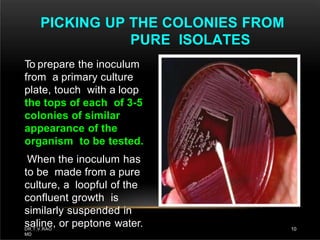
To prepare the inoculum
from a primary culture
plate, touch with a loop
the tops of each of 3-5
colonies of similar
appearance of the
organism to be tested.
When the inoculum has
to be made from a pure
culture, a loopful of the
confluent growth is
similarly suspended in
saline, or peptone water.
PICKING UP THE COLONIES FROM
PURE ISOLATES
DR.T.V.RAO
MD
10
• Compare the tube with the
turbidity standard and adjust
the density of the test
suspension to that of the
standard by adding more
bacteria or more sterile saline.
Proper adjustment to the
turbidity of the inoculum is
essential to ensure that the
resulting lawn of growth is
confluent or almost confluent.
Inoculate the plates by dipping a
sterile swab into the inoculum.
Remove excess inoculum by
pressing and rotating the swabs
firmly against the side of the
tube above the level of the liquid.
PREPARE THE OPTIMAL
INOCULUM
DR.T.V.RAO
MD
11
•
• Streak the swab all over the
surface of the medium three
times, rotating the plate
through an angle of 60o after
each application. Finally, pass
the swab round the edge of the
agar surface. Leave the
inoculum to dry for a few
minutes at room temperature
with the lid closed. The
antibiotic discs may be placed
on the inoculated plates using
a pair of sterile forceps.
A sterile needle tip may
also be used to place the
antibiotic discs on the plate.
Alternatively, an antibiotic
disc dispenser can be used to
apply the discs to the
inoculated plate.
PREPARE THE LAWN CULTURE OF
THE ISOLATE
DR.T.V.RAO
MD
12
•
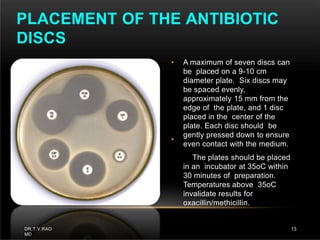
• A maximum of seven discs can
be placed on a 9-10 cm
diameter plate. Six discs may
be spaced evenly,
approximately 15 mm from the
edge of the plate, and 1 disc
placed in the center of the
plate. Each disc should be
gently pressed down to ensure
even contact with the medium.
The plates should be placed
in an incubator at 35oC within
30 minutes of preparation.
Temperatures above 35oC
invalidate results for
oxacillin/methicillin.
PLACEMENT OF THE ANTIBIOTIC
DISCS
DR.T.V.RAO
MD
13
STACKING OF PLATES
NO MORE THAN 5 PLATES
HIGH
DR.T.V.RAO
MD
14
INCUBATION
• Knowledge of
requirements for
incubation
• Ambient air at 350C for non
fastidious aerobic and
facultative anaerobic
bacteria
• Timing – generally 16-18
hours
• 24 hours for S.aureus
and enterococci
• 5% CO2 for Haemophilus
• 15
•
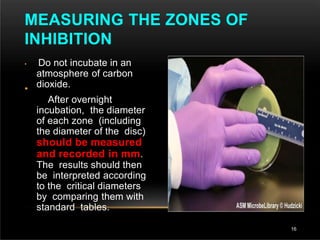
• Do not incubate in an
atmosphere of carbon
dioxide.
After overnight
incubation, the diameter
of each zone (including
the diameter of the disc)
should be measured
and recorded in mm.
The results should then
be interpreted according
to the critical diameters
by comparing them with
standard tables.
MEASURING THE ZONES OF
INHIBITION
16
•
•
• The measurements can be
made with a ruler on the
under surface of the plate
without opening the lid.
The endpoint of
inhibition is judged by
the naked eye at the
edge where the growth
starts, but there are
three exceptions.
With sulfonamides and
co- trimoxazole, slight
growth occurs within the
inhibition zone; such
growth should be ignored.
MEASURE ZONE WITH RULER FOR
OPTIMAL REPORTING
DR.T.V.RAO
MD
17
CLINICAL DEFINITIONS OF TERMS
RESISTANT AND SUSCEPTIBLE: THE
THREE- CATEGORY SYSTEM
DR.T.V.RAO
MD
18
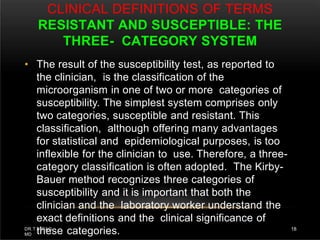
• The result of the susceptibility test, as reported to
the clinician, is the classification of the
microorganism in one of two or more categories of
susceptibility. The simplest system comprises only
two categories, susceptible and resistant. This

classification, although offering many advantages
for statistical and epidemiological purposes, is too
inflexible for the clinician to use. Therefore, a three-
category classification is often adopted. The Kirby-
Bauer method recognizes three categories of
susceptibility and it is important that both the
clinician and the laboratory worker understand the
exact definitions and the clinical significance of
these categories.
• An organism is
called
"susceptible" to
a drug when the
infection caused
by it is likely to
respond to
treatment with
this drug at the
recommended
dosage.
SUSCEPTIBLE:
DR.T.V.RAO
MD
19
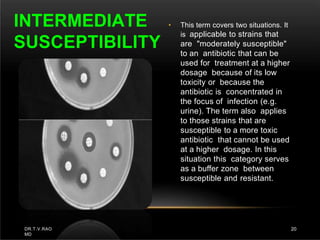
• This term covers two situations. It
is applicable to strains that
are "moderately susceptible"
to an antibiotic that can be
used for treatment at a higher
dosage because of its low
toxicity or because the
antibiotic is concentrated in
the focus of infection (e.g.
urine). The term also applies
to those strains that are
susceptible to a more toxic
antibiotic that cannot be used
at a higher dosage. In this
situation this category serves
as a buffer zone between
susceptible and resistant.
INTERMEDIATE
SUSCEPTIBILITY
DR.T.V.RAO
MD
20
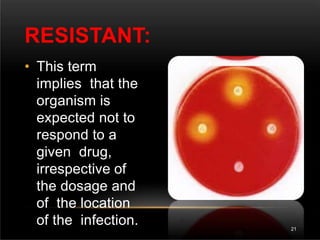
• This term
implies that the
organism is
expected not to
respond to a
given drug,
irrespective of
the dosage and
of the location
of the infection.
RESISTANT:
21
READ THE RESULTS WITH
PRECISION
Transmitted
Light
DR.T.V.RAO
MD
POSSIBLE ERRORS
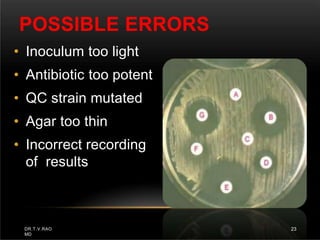
• Inoculum too light
• Antibiotic too potent
• QC strain mutated
• Agar too thin
• Incorrect recording
of results
DR.T.V.RAO
MD
23
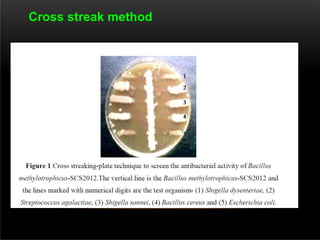
Cross streak method
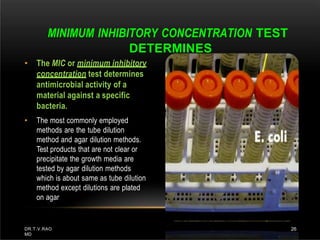
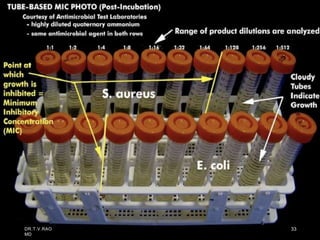
• The MIC or minimum inhibitory
concentration test determines
antimicrobial activity of a
material against a specific
bacteria.
• The most commonly employed
methods are the tube dilution
method and agar dilution methods.
Test products that are not clear or
precipitate the growth media are
tested by agar dilution methods
which is about same as tube dilution
method except dilutions are plated
on agar
MINIMUM INHIBITORY CONCENTRATION TEST
DETERMINES
DR.T.V.RAO
MD
26
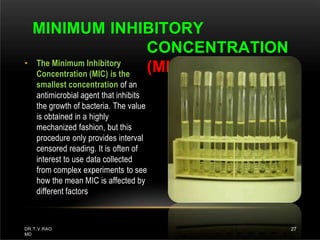
• The Minimum Inhibitory
Concentration (MIC) is the
smallest concentration of an
antimicrobial agent that inhibits
the growth of bacteria. The value
is obtained in a highly
mechanized fashion, but this
procedure only provides interval
censored reading. It is often of
interest to use data collected
from complex experiments to see
how the mean MIC is affected by
different factors
MINIMUM INHIBITORY
CONCENTRATION
(MIC)
DR.T.V.RAO
MD
27
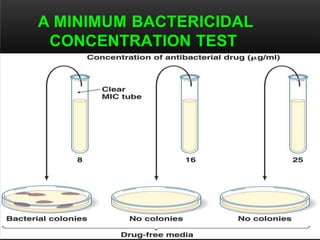
• The minimal bactericidal
concentration (MBC) or the
minimum lethal concentration
(MLC) of an antibacterial which is
defined as the maximum dilution
of the product that will kill a test
organism can be determined by
sub culturing last clear MIC tube
onto growth medium and
examining for bacterial growth.
Serial dilutions are made of the
products in bacterial growth
media.
THE MINIMAL BACTERICIDAL
CONCENTRATION
DR.T.V.RAO
MD
28
A MINIMUM BACTERICIDAL
CONCENTRATION TEST
Figure 10.12
MINIMUM INHIBITORY CONCENTRATION (MIC)
30
PRACTICE THE EXERCISE FOR SKILLS
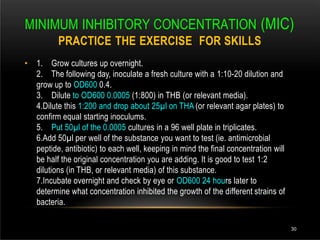
• 1. Grow cultures up overnight.
2. The following day, inoculate a fresh culture with a 1:10-20 dilution and
grow up to OD600 0.4.
3. Dilute to OD600 0.0005 (1:800) in THB (or relevant media).
4.Dilute this 1:200 and drop about 25µl on THA (or relevant agar plates) to
confirm equal starting inoculums.
5. Put 50µl of the 0.0005 cultures in a 96 well plate in triplicates.
6.Add 50µl per well of the substance you want to test (ie. antimicrobial
peptide, antibiotic) to each well, keeping in mind the final concentration will
be half the original concentration you are adding. It is good to test 1:2
dilutions (in THB, or relevant media) of this substance.
7.Incubate overnight and check by eye or OD600 24 hours later to
determine what concentration inhibited the growth of the different strains of
bacteria.
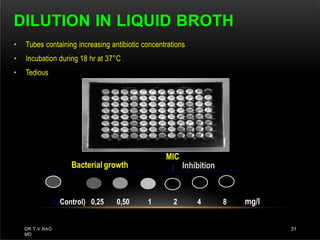
DILUTION IN LIQUID BROTH
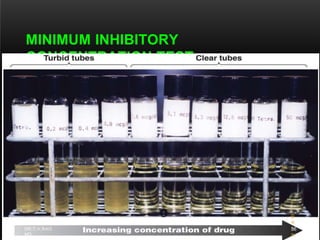
• Tubes containing increasing antibiotic concentrations
• Incubation during 18 hr at 37°C
• Tedious
0 (Control) 0,25 0,50 1 2 4 8 mg/l
Bacterial growth
MIC
Inhibition
DR.T.V.RAO
MD
31
DR.T.V.RAO
MD
32
DR.T.V.RAO
MD
33
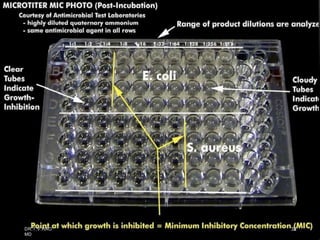
Minimum Inhibitory Concentration
(MIC) :
Principle:
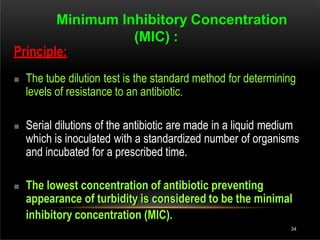
 The tube dilution test is the standard method for determining
levels of resistance to an antibiotic.
 Serial dilutions of the antibiotic are made in a liquid medium
which is inoculated with a standardized number of organisms
and incubated for a prescribed time.
 The lowest concentration of antibiotic preventing
appearance of turbidity is considered to be the minimal
inhibitory concentration (MIC).
34
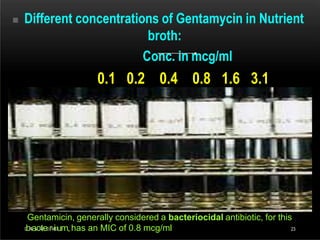
 Different concentrations of Gentamycin in Nutrient
broth:
Conc. in mcg/ml
0.1 0.2 0.4 0.8 1.6 3.1
Gentamicin, generally considered a bacteriocidal antibiotic, for this
D
bR
.
T
a.
V
c.
R
tA
eOrMiDum,has an MIC of 0.8 mcg/ml 23
MINIMUM INHIBITORY
CONCENTRATION TEST
F
i
g
u
r
e
DR.T.V.RAO
MD
36
• E-test is based on arraying a
concentration gradient of each
antibiotic on a polymer strip.
Concentration values are marked
on the other side of the strip so
that one can easily locate
corresponding concentrations. E-
strips, also known as
“epsilometers”, are commercially
prepared by micro dispersing
robotic machines that can deliver
Nano liter volumes of antibiotic
concentration along the strip.
WHAT IS E-
TEST
DR.T.V.RAO
MD
37

Antimicrobial assay.pptx

  • 1.
  • 2.
    USES OF ANTIBIOTICSENSITIVITY TESTING 2 • Antibiotic sensitivity test: A laboratory test which determines how effective antibiotic therapy is against a bacterial infections. • Antibiotic sensitivity testing will control the use of Antibiotics in clinical practice • Testing will assist the clinicians in the choice of drugs for the treatment of infections.
  • 3.
    • Susceptibility testsshould never be performed on contaminants or commensals belonging to the normal flora, or on other organisms that have no causal relationship to the infectious process. These should be carried out only on pure cultures of organisms considered to be causing the infectious process. The organisms should also be identified since not every microorganism isolated from a patient with an infection requires an Antibiograms. SUSCEPTIBILITY TEST AS A GUIDE FOR TREATMENT 3
  • 4.
    GENERAL PRINCIPLES OF ANTIMICROBIALSUSCEPTIBILITY TESTING 4
  • 5.
    • Antimicrobial susceptibility tests measurethe ability of an antibiotic or other antimicrobial agent to inhibit bacterial growth in vitro. This ability may be estimated by either the dilution method or the diffusion method. ANTIMICROBIAL SUSCEPTIBILITY TESTS 5
  • 6.
    • For quantitativeestimates of antibiotic activity, dilutions of the antibiotic may be incorporated into broth or agar medium, which is then inoculated with the test organism. The lowest concentration that prevents growth after overnight incubation is known as the minimum inhibitory concentration (MIC) of the agent. The MIC value is then compared with known concentrations of the drug obtainable in the serum and in other body fluids to assess the likely clinical response. THE DILUTION METHOD 6
  • 7.
    • Paper discsimpregnated with a defined quantity of antimicrobial agent are placed on agar medium uniformly seeded with the test organism. A concentration gradient of the antibiotic forms by diffusion from the disc and the growth of the test organism is inhibited at a distance from the disc that is related among other factors to the susceptibility of the organism. THE KIRBY-BAUER DISC DIFFUSION METHOD 7
  • 8.
    • The recommendedmethod for intermediate and peripheral laboratories is the modified Kirby- Bauer method, the methodology : This method has been recommended by National Committee on Clinical Laboratory Services (NCCLS-USA) Subcommittee on Antimicrobial Susceptibility Testing. This is the most thoroughly described disc diffusion method for which interpretive standards have been developed and which is supported by laboratory and clinical data. KIRBY-BAUER METHOD 8
  • 9.
  • 10.
    To prepare theinoculum from a primary culture plate, touch with a loop the tops of each of 3-5 colonies of similar appearance of the organism to be tested. When the inoculum has to be made from a pure culture, a loopful of the confluent growth is similarly suspended in saline, or peptone water. PICKING UP THE COLONIES FROM PURE ISOLATES DR.T.V.RAO MD 10
  • 11.
    • Compare thetube with the turbidity standard and adjust the density of the test suspension to that of the standard by adding more bacteria or more sterile saline. Proper adjustment to the turbidity of the inoculum is essential to ensure that the resulting lawn of growth is confluent or almost confluent. Inoculate the plates by dipping a sterile swab into the inoculum. Remove excess inoculum by pressing and rotating the swabs firmly against the side of the tube above the level of the liquid. PREPARE THE OPTIMAL INOCULUM DR.T.V.RAO MD 11
  • 12.
    • • Streak theswab all over the surface of the medium three times, rotating the plate through an angle of 60o after each application. Finally, pass the swab round the edge of the agar surface. Leave the inoculum to dry for a few minutes at room temperature with the lid closed. The antibiotic discs may be placed on the inoculated plates using a pair of sterile forceps. A sterile needle tip may also be used to place the antibiotic discs on the plate. Alternatively, an antibiotic disc dispenser can be used to apply the discs to the inoculated plate. PREPARE THE LAWN CULTURE OF THE ISOLATE DR.T.V.RAO MD 12
  • 13.
    • • A maximumof seven discs can be placed on a 9-10 cm diameter plate. Six discs may be spaced evenly, approximately 15 mm from the edge of the plate, and 1 disc placed in the center of the plate. Each disc should be gently pressed down to ensure even contact with the medium. The plates should be placed in an incubator at 35oC within 30 minutes of preparation. Temperatures above 35oC invalidate results for oxacillin/methicillin. PLACEMENT OF THE ANTIBIOTIC DISCS DR.T.V.RAO MD 13
  • 14.
    STACKING OF PLATES NOMORE THAN 5 PLATES HIGH DR.T.V.RAO MD 14
  • 15.
    INCUBATION • Knowledge of requirementsfor incubation • Ambient air at 350C for non fastidious aerobic and facultative anaerobic bacteria • Timing – generally 16-18 hours • 24 hours for S.aureus and enterococci • 5% CO2 for Haemophilus • 15
  • 16.
    • • Do notincubate in an atmosphere of carbon dioxide. After overnight incubation, the diameter of each zone (including the diameter of the disc) should be measured and recorded in mm. The results should then be interpreted according to the critical diameters by comparing them with standard tables. MEASURING THE ZONES OF INHIBITION 16
  • 17.
    • • • The measurementscan be made with a ruler on the under surface of the plate without opening the lid. The endpoint of inhibition is judged by the naked eye at the edge where the growth starts, but there are three exceptions. With sulfonamides and co- trimoxazole, slight growth occurs within the inhibition zone; such growth should be ignored. MEASURE ZONE WITH RULER FOR OPTIMAL REPORTING DR.T.V.RAO MD 17
  • 18.
    CLINICAL DEFINITIONS OFTERMS RESISTANT AND SUSCEPTIBLE: THE THREE- CATEGORY SYSTEM DR.T.V.RAO MD 18 • The result of the susceptibility test, as reported to the clinician, is the classification of the microorganism in one of two or more categories of susceptibility. The simplest system comprises only two categories, susceptible and resistant. This classification, although offering many advantages for statistical and epidemiological purposes, is too inflexible for the clinician to use. Therefore, a three- category classification is often adopted. The Kirby- Bauer method recognizes three categories of susceptibility and it is important that both the clinician and the laboratory worker understand the exact definitions and the clinical significance of these categories.
  • 19.
    • An organismis called "susceptible" to a drug when the infection caused by it is likely to respond to treatment with this drug at the recommended dosage. SUSCEPTIBLE: DR.T.V.RAO MD 19
  • 20.
    • This termcovers two situations. It is applicable to strains that are "moderately susceptible" to an antibiotic that can be used for treatment at a higher dosage because of its low toxicity or because the antibiotic is concentrated in the focus of infection (e.g. urine). The term also applies to those strains that are susceptible to a more toxic antibiotic that cannot be used at a higher dosage. In this situation this category serves as a buffer zone between susceptible and resistant. INTERMEDIATE SUSCEPTIBILITY DR.T.V.RAO MD 20
  • 21.
    • This term impliesthat the organism is expected not to respond to a given drug, irrespective of the dosage and of the location of the infection. RESISTANT: 21
  • 22.
    READ THE RESULTSWITH PRECISION Transmitted Light DR.T.V.RAO MD
  • 23.
    POSSIBLE ERRORS • Inoculumtoo light • Antibiotic too potent • QC strain mutated • Agar too thin • Incorrect recording of results DR.T.V.RAO MD 23
  • 25.
  • 26.
    • The MICor minimum inhibitory concentration test determines antimicrobial activity of a material against a specific bacteria. • The most commonly employed methods are the tube dilution method and agar dilution methods. Test products that are not clear or precipitate the growth media are tested by agar dilution methods which is about same as tube dilution method except dilutions are plated on agar MINIMUM INHIBITORY CONCENTRATION TEST DETERMINES DR.T.V.RAO MD 26
  • 27.
    • The MinimumInhibitory Concentration (MIC) is the smallest concentration of an antimicrobial agent that inhibits the growth of bacteria. The value is obtained in a highly mechanized fashion, but this procedure only provides interval censored reading. It is often of interest to use data collected from complex experiments to see how the mean MIC is affected by different factors MINIMUM INHIBITORY CONCENTRATION (MIC) DR.T.V.RAO MD 27
  • 28.
    • The minimalbactericidal concentration (MBC) or the minimum lethal concentration (MLC) of an antibacterial which is defined as the maximum dilution of the product that will kill a test organism can be determined by sub culturing last clear MIC tube onto growth medium and examining for bacterial growth. Serial dilutions are made of the products in bacterial growth media. THE MINIMAL BACTERICIDAL CONCENTRATION DR.T.V.RAO MD 28
  • 29.
  • 30.
    MINIMUM INHIBITORY CONCENTRATION(MIC) 30 PRACTICE THE EXERCISE FOR SKILLS • 1. Grow cultures up overnight. 2. The following day, inoculate a fresh culture with a 1:10-20 dilution and grow up to OD600 0.4. 3. Dilute to OD600 0.0005 (1:800) in THB (or relevant media). 4.Dilute this 1:200 and drop about 25µl on THA (or relevant agar plates) to confirm equal starting inoculums. 5. Put 50µl of the 0.0005 cultures in a 96 well plate in triplicates. 6.Add 50µl per well of the substance you want to test (ie. antimicrobial peptide, antibiotic) to each well, keeping in mind the final concentration will be half the original concentration you are adding. It is good to test 1:2 dilutions (in THB, or relevant media) of this substance. 7.Incubate overnight and check by eye or OD600 24 hours later to determine what concentration inhibited the growth of the different strains of bacteria.
  • 31.
    DILUTION IN LIQUIDBROTH • Tubes containing increasing antibiotic concentrations • Incubation during 18 hr at 37°C • Tedious 0 (Control) 0,25 0,50 1 2 4 8 mg/l Bacterial growth MIC Inhibition DR.T.V.RAO MD 31
  • 32.
  • 33.
  • 34.
    Minimum Inhibitory Concentration (MIC): Principle:  The tube dilution test is the standard method for determining levels of resistance to an antibiotic.  Serial dilutions of the antibiotic are made in a liquid medium which is inoculated with a standardized number of organisms and incubated for a prescribed time.  The lowest concentration of antibiotic preventing appearance of turbidity is considered to be the minimal inhibitory concentration (MIC). 34
  • 35.
     Different concentrationsof Gentamycin in Nutrient broth: Conc. in mcg/ml 0.1 0.2 0.4 0.8 1.6 3.1 Gentamicin, generally considered a bacteriocidal antibiotic, for this D bR . T a. V c. R tA eOrMiDum,has an MIC of 0.8 mcg/ml 23
  • 36.
  • 37.
    • E-test isbased on arraying a concentration gradient of each antibiotic on a polymer strip. Concentration values are marked on the other side of the strip so that one can easily locate corresponding concentrations. E- strips, also known as “epsilometers”, are commercially prepared by micro dispersing robotic machines that can deliver Nano liter volumes of antibiotic concentration along the strip. WHAT IS E- TEST DR.T.V.RAO MD 37