
SUSCEPTIBILITY TESTING
BY:ANJALI SHARMA (M.Sc.)
DEPARTMENT OF MICROBIOLOGY
CONTENTS:
• INTRODUCTION
• ANTIBACTERIAL SUSCEPTIBILITY TESTING
1. Diffusion method
• Strokes disc diffusion
• Kirby bauer disc diffusion
2. Dilution method
• Agar dilution
• Broth dilution
3. Diffusion and dilution
• E- test
• ANTIVIRAL SUSCEPTIBILITY TESTING
1. Phenotypic susceptibility assay
2. Genotypic susceptibility assay
3. Plaque reduction assay
4. Dye uptake assay
5. DNA hybridization assay
6. Pyrosequencing
• ANTIFUNGAL SUSCEPTIBILITY TESTING
INTRODUCTION
• AST ( ANTIMICROBIAL SUSCEPTIBILITY TESTING) is used to determine how
effective antibiotic therapy is against a bacterial infection.
• AST will control the use of antibiotics in clinical practice.
• For e.g. : BACITRACIN DISC TEST – For identification of S.pyrogenes (as this spp.
Is sensitive to minute concentration (0.02 micro gm) of BACITRACIN -gives positive
test.
IMPORTANCE/GOALS OF AST :
• The identification of relevant antibiotics to specific pathogens in exudates and
body fluids collected from patients.
• Sensitivity tests down to determine the degree of sensitivity or resistance of
pathogens isolated from patient to an appropriate range of antimicrobial drugs .
• Assay of concentration of an administered drug in blood or body fluid of patient
required to control the schedule of dosage.
• The RESULTS of AST should be combined with clinical information and experience
when selecting the most appropriate antibiotic for patient .
• The raw data are either in form of a [INHIBITORY ZONE ] OR [MIC] . Typically , raw
data are interpreted and reported out as;
• SUSCEPTIBLE /SENSITIVE ORGANISMS :
• This category implies that the organisms is inhibited by the serum concentration of
antimicrobial agent i.e. achieved by using the usual dosage recommended for the
type of infection present .
• INTERMEDIATE ORGANISMS :
• Implies that the organisms are inhibited only by the maximum recommended
dosage .
• Strains that show “intermediate susceptibility” to a more toxic antibiotic .
• E.G.: aminoglycoside that can not be used at a higher dosage .
• RESISTANT ORGANISMS :
• Implies that the organisms are resistant to usually achieveable serum drug
concentration of antimicrobial agent.
• THESE TESTS ARE PERFORED IN-VIVO AND UNDER STANDARDIZED
CONDITIONS:
1. STANDARD MEDIA : Muller-Hinton agar or broth.
2. STANDARD INOCULUM : Isolation and standardizing the bacteria suspend by
Macfarland standards [ Mcf =1.5microMF ].
• Macfarland standard : standard unit to measure turnbidity of bacterial suspension .
3. INCUBATION TIME AND TEMPERATURE : (35-37) ,16-18 hrs .
4. VOLUME OF MEDIA USED : 0.5 Mcf std.
TYPES OF ANTI-BACTERIAL
SUSCEPTIBILITY TESTING :
DILUTIO
N
DIFFUSION
AST
[DIFFUSION
AND
DILUTION]
AGAR DIUTION
BROTH DILUTION
STROKES DISC
DIFFUSION
KIRBY BAUER DISC
DIFFUSION
E-TEST
DILUTION METHODS :
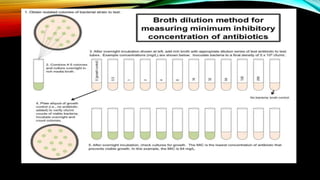
1. BROTH DILUTION METHODS :
• First performed in test tubes , now in – shallow wells of std . Plates .
• MEDIA: muller – hinton broth , nutrient broth .
• ANTIBIOTIC CONCENTRATION : 0.1-0.2 micro gm / m litre
• INCUBATION TIME : 16-20 hrs.
• E.G. : UTI – E.coli –overnight broth culture in peptone - std. inoculum.
• In MICROBROTH DILUTION METHOD , We will take some amount o fnutrient broth
in series of test tubes .
i. Serial dilution of concentration of antibiotic prepared in nutrient broth .
ii. And a NEGATIVE CONTROL with no antibiotic .
iii. Add 1 ml of std. inoculum to all test tubes .
iv. Incubate overnight at 37 Celsius.
• CONTROL : max growth (max. turbidity).
• As the concentration of antibiotics increases , the turbidity decreases .
• At a spwcific concentration – no turbidity -( MIC ).
• If the whole process sis done in petridish , it is called as MICROBROTH DILUTION
METHOD .
• ADVANTAGE : Quantitative method [MIC can be done ].
• DISADVANTAGE : 1) fastidious organisms can not be done .
2) Cumbersome procedure.
• AGAR DILUTION METHOD :
• MEDIUM : cation adjusted muller-hinton agar
• ANTIBIOTIC CONCENTRATION : 0.1-0.2 micro gm / ml
• INCUBATION TIME : 16-20 hrs ,(35-37 )celcius.
• PROCEDURE :
i. Pour the media in sterile petri plates .
ii. Prepare serial dilution of antibiotic concentration .
iii. Spread it through sterile glass spreader .
iv. Look for lowest concentration of antibiotic prevent the appearance of colonies
[MIC].
• ADVANTAGES: 1) fastidious bacteria can be tested
2) Can be used for anaerobes
3)MIC can be determined .
• DISADVANTAGES : 1) Cumbersome procedure .
DISK DIFFUSION METHOD :
• KIRBY-BAUER DIFFUSION METHOD :
• Simple and quick agar diffusion test.
• Developed by – William M. Kirby and A.W. Bauer .
• Most common method in use .
• MEDIUM : Muller-hinton agar (5% blood added if required ).
• STANDARD INOCULUM : 0.5 McF turbidity.
• PROCEDURE :
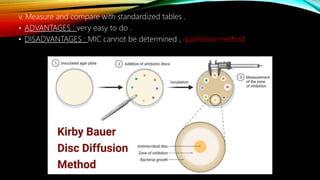
i. Using a sterile cotton swab , the inoculum is spread onto MH agar medium (lawn culture of
bacteria )
ii. Discs (impregnated with single standardized concentration of antibiotics )are placed on the
swab inoculated petri dish .
iii. Overnight incubation (16-20)hrs at 25 celcius .
iv. ZONE OF INHIBITON SEEN AROUND EACH DISC .
v. Measure and compare with standardized tables .
• ADVANTAGES : very easy to do .
• DISADVANTAGES : MIC cannot be determined , qualitative method .
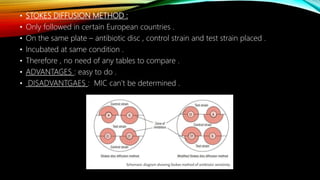
• STOKES DIFFUSION METHOD :
• Only followed in certain European countries .
• On the same plate – antibiotic disc , control strain and test strain placed .
• Incubated at same condition .
• Therefore , no need of any tables to compare .
• ADVANTAGES : easy to do .
• DISADVANTGAES : MIC can’t be determined .
DILUTION –DIFFUSION METHOD:
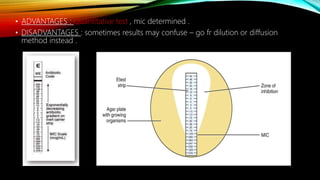
• EPSILOMETER TEST /E-TEST :
• Combination of both diffusion and dilution test.
• MEDIUM : muller –hinton agar.
• STANDARD INOCULUM : 0.5 McF turbidity .
i. Instead of discs , PLASTIC STRIPS impregnated with graded concentration of
antibiotics (serial dilution) along its length .
ii. INCUBATION : 24-48 hrs
iii. ELLIPTICAL ZONE of INHIBITION can be seen .
iv. The concentration at which zone of inhibition intersect the plastic strip will
determine the MIC .
• ADVANTAGES : Quantitative test , mic determined .
• DISADVANTAGES : sometimes results may confuse – go fr dilution or diffusion
method instead .
SERUM KILLING POWER :
• SERUM =blood plasma – clotting proteins .
• Used to determine effectiveness of chemotherapeutic agent .
• From patient’s blood sample (serum ) – when on antibiotic therapy.
i. suspension of bacterial pathogens .
ii. Known quantity of patient’s serum (from freshly collected tubes ) .
iii. Incubated at 35 Celsius .
iv. NO GROWTH : antibiotics are working (effective ).
v. TURBIDITY : not working ( ineffective ).
AUTOMATED METHODS :
• Modern , efficient and less expensive method for AST .
i. Sample (suspension of measured quantity of microbe )
ii. Wells on plastic tray containing chemical reagent .
iii. Tests carried out in incubation chamber .
iv. Incubated overnight (1-20) hrs , 37 celsius .
v. Growth and results are taken by computer .
vi. RESULTS : 1) AFTER OVERNIGHT INCUBATION.
2) FOR SLOW GROWING ORGANISMS – 48 HRS .
• ADVANTAGES : 1) plastic trays are available for wide variety of microorganisms – gm (+) ,
gm (-) , anaerobic , yeasts .
2)Many organisms from different patients can be inoculated at the same time .
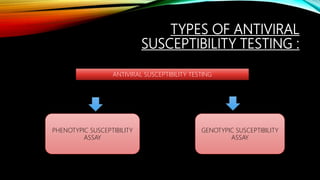
TYPES OF ANTIVIRAL
SUSCEPTIBILITY TESTING :
ANTIVIRAL SUSCEPTIBILITY TESTING
PHENOTYPIC SUSCEPTIBILITY
ASSAY
GENOTYPIC SUSCEPTIBILITY
ASSAY
AVST INTRODUCTION :
• Very few standards have been established for AVST BY CLINICAL and LABORATORY STANDARDS
INSTITUTE .
• The final results of AVST is determined b various variables .
• These variables includes :
1. Cell line used to grow virus .
2. Viral inoculum litre .
3. Incubation time of culture .
4. Concentration range of antiviral drug tested .
5. Reference strains
6. Assay methods .
7. End point criteria .
8. Calculation of end point .
9. Interpretation of end point .
METHODS OF ANTIVIRAL
SUSCEPTIBILITY TESTING :
• PURPOSE :
1. To evaluate new antiviral chemoprophylaxis .
2. To test for cross-resistance .
3. To determine how frequently drug – resistance viral mutation occur.
PHENOTYPIC SUSCEPTIBITLITY
ASSAY :
• Uses variety of end points measurements .
• Used to determine , whether a virus is inhibited by an antivirak drug or
demonstrates drug resistance .
• END POINTS : 1) reduction in number of plaques .
2) Inhibition of viral DNA synthesis .
3) Reduction of viral protein synthesis .
4) Reduction in enzymatic activity.
• Measure inhibitory effect (zone of inhibition ) on entire viral population in clinical
isolate .
• ADVANTAGES : 1) used to assess combined effect of multiple resistance mutation on
drug susceptibility .
2) Useful for assaying viruses [such as ; hepaitis B virus , HIV -1 , HCMV ]
• DISADVANTAGES : 1) labor intensive .
2) Expensive .
3) long exposure time / long turn around time .
GENOTYPIC SUSCEPTIBILITY ASSAY:
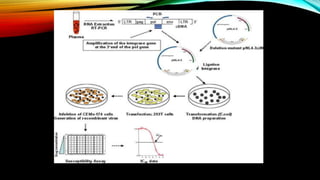
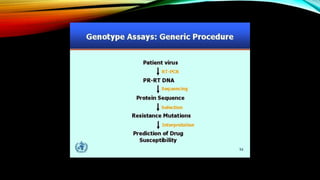
• Uses RTPCR to detect genes , which can mutate , coupled with genetic sequence or
molecular sequence .
• To determine genetic mutation with resistance occurred .
• USES : 1)DNA sequence by automated sequence method .
2)PCR amplification .
3) Restriction enzyme digestion of products .
4)DNA probes .
• RAPID TECHNIQUE : because isolation of culture is not necessary .
• Response to antiviral agent also measured by QUANTITATIVE METHOD of viral load in
patients serum .
• E.G.: hepatitis c virus , CMV .
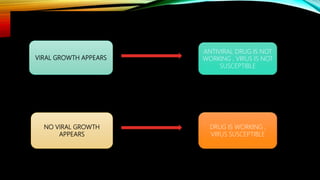
VIRAL GROWTH APPEARS
ANTIVIRAL DRUG IS NOT
WORKING , VIRUS IS NOT
SUSCEPTIBLE
NO VIRAL GROWTH
APPEARS
DRUG IS WORKING ,
VIRUS SUSCEPTIBLE
• ADVANTAGES : 1) less exposure time .
2) Less expensive .
• DISADVANTAGES : 1) only detect defined viral mutation .
• After G.S.A.
• The viral load should significantly diminish following the addition of antiviral agent
to which virus is susceptible .
• Using molecular testing , such as quantitative PCR , to measure the amount of
virus present in serum is a surrogate test for resistance to antiviral agent .
• The viral load rises quickly when resistance appears .
PLAQUE REDUCTION ASSAY :
• Standard method of antiviral susceptibility assay .
• PRINCIPLE : determine of viral plaque formation in presence of antiviral agent .
• CONCENTRATION OF ANTIVIRAL DRUG :
• Inhibit plaque formation by 50% is [ IC 50].
• [50% inhibitory concentration +50% effective concentration ].
DYE UPTAKE ASSAY :
• Used for years .
• Determine viral cell lytic activity .
• Virus- in prescence of antiviral drug .
• Alive and viable cell.
• Takes vital cell [neutral red ] + HSV infection .
• RESULTS : dye bound to in comparison to dye bound to uninfected cell .
• This determines the extent of viral lytic activity .
• Drug concentration that inhibits viral lytic activity by 50% is IC50
DNA HYBRIDISATION ASSAY :
• Measure effect of antiviral reagents on synthesis of viral DNA .
• Measures how much viral DNA is produced in absence of antiviral agent .
• IC50 is calculated from these comparisons .
• USED FOR : HSV , VZV , HCMV .
PYROSEQUENCING :
• Most important method .
• Sequence based detection method .
• Allow rapid , accurate quantification of sequence variation .
• Allow rapid acquisition of short reads [100-200 bp ] of genomic sequence to
identify known mutation .
• Based on – technique of detection of released [Ppi] pyrpphosphate during DNA
synthesis .
• Visible light produced during reactions .
• Visible light strength generated directly proportional to number of nucleotide
incorporated into final product .
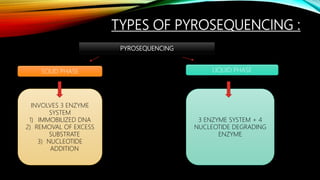
TYPES OF PYROSEQUENCING :
PYROSEQUENCING
SOLID PHASE LIQUID PHASE
INVOLVES 3 ENZYME
SYSTEM
1) IMMOBILIZED DNA
2) REMOVAL OF EXCESS
SUBSTRATE
3) NUCLEOTIDE
ADDITION
3 ENZYME SYSTEM + 4
NUCLEOTIDE DEGRADING
ENZYME
• The availability of specific antiviral agent has added importance and urgency to the
need for laboratory diagnosis of viral infection .
• Resistance of virus establish an exact etiologic diagnosis is usually needed to justify
use of these expensive and sometimes toxic agents.
ANTIFUNGAL SUSCEPTIBILITY
TESTING:
• Antifungal susceptibility testing are designed to provide information that will allow
the physician to select the appropriate Anti- fungal agent useful for treating a
specific infection.
• But A.F.S.T. are not progressed as compared to A.B.S.T.
• An effort is going into standardization for a method that is reproducible between
the laboratories.
• All the techniques variables and end-point are standardized and efforts are
underway to develop interpretative guidelines for different antifungal agents.
• CLSI (CLINICAL LABORATORY STANDARD INSTITUTE) and NCCLS (NATIONAL
COMMITTEE FOR CLINICAL LABORATORY STANDARD) , provides documents and
set standard for A.F.S.T on their website at www.nccls.org.
• GUIDELINES FOR A.F S.T. :
1. M27-A2 document - reference method for (broth dilution A.F.S.T of yeast )
appropriate standard.
2. M38-A - reference method for A F.S.T. Of filamentous fungi.
3. M44-A – reference method for antifungal disk diffusion susceptibility testing of
yeast .
• A.F ST. METHODS are still evolving .
• A.F.ST. are costly and time consuming.
REFERENCES :
• cle/49/11/1749/344384
• https://en.m.wikipedia.org/wiki/Antibiotic_sensitivity_testing
• https://www.synbiosis.com/application-notes/antibiotic-susceptibility-test-ast/
• https://clinicalgate.com/antiviral-therapy-susceptibility-testing-and-
prevention/#:~:text=The%20purpose%20of%20antiviral%20susceptibility,drug-
resistance%20viral%20mutations%20occur.
• https://www.uptodate.com/contents/antifungal-susceptibility-
testing#:~:text=The%20need%20for%20reproducible%2C%20clinically,problem%2
0%5B1-4%5D.

Antimicrobial susceptibility testing

  • 1.
    SUSCEPTIBILITY TESTING BY:ANJALI SHARMA(M.Sc.) DEPARTMENT OF MICROBIOLOGY
  • 2.
    CONTENTS: • INTRODUCTION • ANTIBACTERIALSUSCEPTIBILITY TESTING 1. Diffusion method • Strokes disc diffusion • Kirby bauer disc diffusion 2. Dilution method • Agar dilution • Broth dilution 3. Diffusion and dilution • E- test
  • 3.
    • ANTIVIRAL SUSCEPTIBILITYTESTING 1. Phenotypic susceptibility assay 2. Genotypic susceptibility assay 3. Plaque reduction assay 4. Dye uptake assay 5. DNA hybridization assay 6. Pyrosequencing • ANTIFUNGAL SUSCEPTIBILITY TESTING
  • 4.
    INTRODUCTION • AST (ANTIMICROBIAL SUSCEPTIBILITY TESTING) is used to determine how effective antibiotic therapy is against a bacterial infection. • AST will control the use of antibiotics in clinical practice. • For e.g. : BACITRACIN DISC TEST – For identification of S.pyrogenes (as this spp. Is sensitive to minute concentration (0.02 micro gm) of BACITRACIN -gives positive test.
  • 5.
    IMPORTANCE/GOALS OF AST: • The identification of relevant antibiotics to specific pathogens in exudates and body fluids collected from patients. • Sensitivity tests down to determine the degree of sensitivity or resistance of pathogens isolated from patient to an appropriate range of antimicrobial drugs . • Assay of concentration of an administered drug in blood or body fluid of patient required to control the schedule of dosage. • The RESULTS of AST should be combined with clinical information and experience when selecting the most appropriate antibiotic for patient . • The raw data are either in form of a [INHIBITORY ZONE ] OR [MIC] . Typically , raw data are interpreted and reported out as;
  • 6.
    • SUSCEPTIBLE /SENSITIVEORGANISMS : • This category implies that the organisms is inhibited by the serum concentration of antimicrobial agent i.e. achieved by using the usual dosage recommended for the type of infection present . • INTERMEDIATE ORGANISMS : • Implies that the organisms are inhibited only by the maximum recommended dosage . • Strains that show “intermediate susceptibility” to a more toxic antibiotic . • E.G.: aminoglycoside that can not be used at a higher dosage . • RESISTANT ORGANISMS : • Implies that the organisms are resistant to usually achieveable serum drug concentration of antimicrobial agent.
  • 7.
    • THESE TESTSARE PERFORED IN-VIVO AND UNDER STANDARDIZED CONDITIONS: 1. STANDARD MEDIA : Muller-Hinton agar or broth. 2. STANDARD INOCULUM : Isolation and standardizing the bacteria suspend by Macfarland standards [ Mcf =1.5microMF ]. • Macfarland standard : standard unit to measure turnbidity of bacterial suspension . 3. INCUBATION TIME AND TEMPERATURE : (35-37) ,16-18 hrs . 4. VOLUME OF MEDIA USED : 0.5 Mcf std.
  • 8.
    TYPES OF ANTI-BACTERIAL SUSCEPTIBILITYTESTING : DILUTIO N DIFFUSION AST [DIFFUSION AND DILUTION] AGAR DIUTION BROTH DILUTION STROKES DISC DIFFUSION KIRBY BAUER DISC DIFFUSION E-TEST
  • 9.
    DILUTION METHODS : 1.BROTH DILUTION METHODS : • First performed in test tubes , now in – shallow wells of std . Plates . • MEDIA: muller – hinton broth , nutrient broth . • ANTIBIOTIC CONCENTRATION : 0.1-0.2 micro gm / m litre • INCUBATION TIME : 16-20 hrs. • E.G. : UTI – E.coli –overnight broth culture in peptone - std. inoculum. • In MICROBROTH DILUTION METHOD , We will take some amount o fnutrient broth in series of test tubes . i. Serial dilution of concentration of antibiotic prepared in nutrient broth . ii. And a NEGATIVE CONTROL with no antibiotic . iii. Add 1 ml of std. inoculum to all test tubes . iv. Incubate overnight at 37 Celsius.
  • 11.
    • CONTROL :max growth (max. turbidity). • As the concentration of antibiotics increases , the turbidity decreases . • At a spwcific concentration – no turbidity -( MIC ). • If the whole process sis done in petridish , it is called as MICROBROTH DILUTION METHOD . • ADVANTAGE : Quantitative method [MIC can be done ]. • DISADVANTAGE : 1) fastidious organisms can not be done . 2) Cumbersome procedure.
  • 12.
    • AGAR DILUTIONMETHOD : • MEDIUM : cation adjusted muller-hinton agar • ANTIBIOTIC CONCENTRATION : 0.1-0.2 micro gm / ml • INCUBATION TIME : 16-20 hrs ,(35-37 )celcius. • PROCEDURE : i. Pour the media in sterile petri plates . ii. Prepare serial dilution of antibiotic concentration . iii. Spread it through sterile glass spreader . iv. Look for lowest concentration of antibiotic prevent the appearance of colonies [MIC]. • ADVANTAGES: 1) fastidious bacteria can be tested 2) Can be used for anaerobes 3)MIC can be determined . • DISADVANTAGES : 1) Cumbersome procedure .
  • 14.
    DISK DIFFUSION METHOD: • KIRBY-BAUER DIFFUSION METHOD : • Simple and quick agar diffusion test. • Developed by – William M. Kirby and A.W. Bauer . • Most common method in use . • MEDIUM : Muller-hinton agar (5% blood added if required ). • STANDARD INOCULUM : 0.5 McF turbidity. • PROCEDURE : i. Using a sterile cotton swab , the inoculum is spread onto MH agar medium (lawn culture of bacteria ) ii. Discs (impregnated with single standardized concentration of antibiotics )are placed on the swab inoculated petri dish . iii. Overnight incubation (16-20)hrs at 25 celcius . iv. ZONE OF INHIBITON SEEN AROUND EACH DISC .
  • 15.
    v. Measure andcompare with standardized tables . • ADVANTAGES : very easy to do . • DISADVANTAGES : MIC cannot be determined , qualitative method .
  • 16.
    • STOKES DIFFUSIONMETHOD : • Only followed in certain European countries . • On the same plate – antibiotic disc , control strain and test strain placed . • Incubated at same condition . • Therefore , no need of any tables to compare . • ADVANTAGES : easy to do . • DISADVANTGAES : MIC can’t be determined .
  • 17.
    DILUTION –DIFFUSION METHOD: •EPSILOMETER TEST /E-TEST : • Combination of both diffusion and dilution test. • MEDIUM : muller –hinton agar. • STANDARD INOCULUM : 0.5 McF turbidity . i. Instead of discs , PLASTIC STRIPS impregnated with graded concentration of antibiotics (serial dilution) along its length . ii. INCUBATION : 24-48 hrs iii. ELLIPTICAL ZONE of INHIBITION can be seen . iv. The concentration at which zone of inhibition intersect the plastic strip will determine the MIC .
  • 18.
    • ADVANTAGES :Quantitative test , mic determined . • DISADVANTAGES : sometimes results may confuse – go fr dilution or diffusion method instead .
  • 19.
    SERUM KILLING POWER: • SERUM =blood plasma – clotting proteins . • Used to determine effectiveness of chemotherapeutic agent . • From patient’s blood sample (serum ) – when on antibiotic therapy. i. suspension of bacterial pathogens . ii. Known quantity of patient’s serum (from freshly collected tubes ) . iii. Incubated at 35 Celsius . iv. NO GROWTH : antibiotics are working (effective ). v. TURBIDITY : not working ( ineffective ).
  • 20.
    AUTOMATED METHODS : •Modern , efficient and less expensive method for AST . i. Sample (suspension of measured quantity of microbe ) ii. Wells on plastic tray containing chemical reagent . iii. Tests carried out in incubation chamber . iv. Incubated overnight (1-20) hrs , 37 celsius . v. Growth and results are taken by computer . vi. RESULTS : 1) AFTER OVERNIGHT INCUBATION. 2) FOR SLOW GROWING ORGANISMS – 48 HRS . • ADVANTAGES : 1) plastic trays are available for wide variety of microorganisms – gm (+) , gm (-) , anaerobic , yeasts . 2)Many organisms from different patients can be inoculated at the same time .
  • 21.
    TYPES OF ANTIVIRAL SUSCEPTIBILITYTESTING : ANTIVIRAL SUSCEPTIBILITY TESTING PHENOTYPIC SUSCEPTIBILITY ASSAY GENOTYPIC SUSCEPTIBILITY ASSAY
  • 22.
    AVST INTRODUCTION : •Very few standards have been established for AVST BY CLINICAL and LABORATORY STANDARDS INSTITUTE . • The final results of AVST is determined b various variables . • These variables includes : 1. Cell line used to grow virus . 2. Viral inoculum litre . 3. Incubation time of culture . 4. Concentration range of antiviral drug tested . 5. Reference strains 6. Assay methods . 7. End point criteria . 8. Calculation of end point . 9. Interpretation of end point .
  • 23.
    METHODS OF ANTIVIRAL SUSCEPTIBILITYTESTING : • PURPOSE : 1. To evaluate new antiviral chemoprophylaxis . 2. To test for cross-resistance . 3. To determine how frequently drug – resistance viral mutation occur.
  • 24.
    PHENOTYPIC SUSCEPTIBITLITY ASSAY : •Uses variety of end points measurements . • Used to determine , whether a virus is inhibited by an antivirak drug or demonstrates drug resistance . • END POINTS : 1) reduction in number of plaques . 2) Inhibition of viral DNA synthesis . 3) Reduction of viral protein synthesis . 4) Reduction in enzymatic activity. • Measure inhibitory effect (zone of inhibition ) on entire viral population in clinical isolate .
  • 25.
    • ADVANTAGES :1) used to assess combined effect of multiple resistance mutation on drug susceptibility . 2) Useful for assaying viruses [such as ; hepaitis B virus , HIV -1 , HCMV ] • DISADVANTAGES : 1) labor intensive . 2) Expensive . 3) long exposure time / long turn around time .
  • 27.
    GENOTYPIC SUSCEPTIBILITY ASSAY: •Uses RTPCR to detect genes , which can mutate , coupled with genetic sequence or molecular sequence . • To determine genetic mutation with resistance occurred . • USES : 1)DNA sequence by automated sequence method . 2)PCR amplification . 3) Restriction enzyme digestion of products . 4)DNA probes . • RAPID TECHNIQUE : because isolation of culture is not necessary . • Response to antiviral agent also measured by QUANTITATIVE METHOD of viral load in patients serum . • E.G.: hepatitis c virus , CMV .
  • 28.
    VIRAL GROWTH APPEARS ANTIVIRALDRUG IS NOT WORKING , VIRUS IS NOT SUSCEPTIBLE NO VIRAL GROWTH APPEARS DRUG IS WORKING , VIRUS SUSCEPTIBLE
  • 29.
    • ADVANTAGES :1) less exposure time . 2) Less expensive . • DISADVANTAGES : 1) only detect defined viral mutation . • After G.S.A. • The viral load should significantly diminish following the addition of antiviral agent to which virus is susceptible . • Using molecular testing , such as quantitative PCR , to measure the amount of virus present in serum is a surrogate test for resistance to antiviral agent . • The viral load rises quickly when resistance appears .
  • 31.
    PLAQUE REDUCTION ASSAY: • Standard method of antiviral susceptibility assay . • PRINCIPLE : determine of viral plaque formation in presence of antiviral agent . • CONCENTRATION OF ANTIVIRAL DRUG : • Inhibit plaque formation by 50% is [ IC 50]. • [50% inhibitory concentration +50% effective concentration ].
  • 32.
    DYE UPTAKE ASSAY: • Used for years . • Determine viral cell lytic activity . • Virus- in prescence of antiviral drug . • Alive and viable cell. • Takes vital cell [neutral red ] + HSV infection . • RESULTS : dye bound to in comparison to dye bound to uninfected cell . • This determines the extent of viral lytic activity . • Drug concentration that inhibits viral lytic activity by 50% is IC50
  • 33.
    DNA HYBRIDISATION ASSAY: • Measure effect of antiviral reagents on synthesis of viral DNA . • Measures how much viral DNA is produced in absence of antiviral agent . • IC50 is calculated from these comparisons . • USED FOR : HSV , VZV , HCMV .
  • 34.
    PYROSEQUENCING : • Mostimportant method . • Sequence based detection method . • Allow rapid , accurate quantification of sequence variation . • Allow rapid acquisition of short reads [100-200 bp ] of genomic sequence to identify known mutation . • Based on – technique of detection of released [Ppi] pyrpphosphate during DNA synthesis . • Visible light produced during reactions . • Visible light strength generated directly proportional to number of nucleotide incorporated into final product .
  • 35.
    TYPES OF PYROSEQUENCING: PYROSEQUENCING SOLID PHASE LIQUID PHASE INVOLVES 3 ENZYME SYSTEM 1) IMMOBILIZED DNA 2) REMOVAL OF EXCESS SUBSTRATE 3) NUCLEOTIDE ADDITION 3 ENZYME SYSTEM + 4 NUCLEOTIDE DEGRADING ENZYME
  • 36.
    • The availabilityof specific antiviral agent has added importance and urgency to the need for laboratory diagnosis of viral infection . • Resistance of virus establish an exact etiologic diagnosis is usually needed to justify use of these expensive and sometimes toxic agents.
  • 37.
    ANTIFUNGAL SUSCEPTIBILITY TESTING: • Antifungalsusceptibility testing are designed to provide information that will allow the physician to select the appropriate Anti- fungal agent useful for treating a specific infection. • But A.F.S.T. are not progressed as compared to A.B.S.T. • An effort is going into standardization for a method that is reproducible between the laboratories. • All the techniques variables and end-point are standardized and efforts are underway to develop interpretative guidelines for different antifungal agents. • CLSI (CLINICAL LABORATORY STANDARD INSTITUTE) and NCCLS (NATIONAL COMMITTEE FOR CLINICAL LABORATORY STANDARD) , provides documents and set standard for A.F.S.T on their website at www.nccls.org.
  • 38.
    • GUIDELINES FORA.F S.T. : 1. M27-A2 document - reference method for (broth dilution A.F.S.T of yeast ) appropriate standard. 2. M38-A - reference method for A F.S.T. Of filamentous fungi. 3. M44-A – reference method for antifungal disk diffusion susceptibility testing of yeast . • A.F ST. METHODS are still evolving . • A.F.ST. are costly and time consuming.
  • 39.
    REFERENCES : • cle/49/11/1749/344384 •https://en.m.wikipedia.org/wiki/Antibiotic_sensitivity_testing • https://www.synbiosis.com/application-notes/antibiotic-susceptibility-test-ast/ • https://clinicalgate.com/antiviral-therapy-susceptibility-testing-and- prevention/#:~:text=The%20purpose%20of%20antiviral%20susceptibility,drug- resistance%20viral%20mutations%20occur. • https://www.uptodate.com/contents/antifungal-susceptibility- testing#:~:text=The%20need%20for%20reproducible%2C%20clinically,problem%2 0%5B1-4%5D.