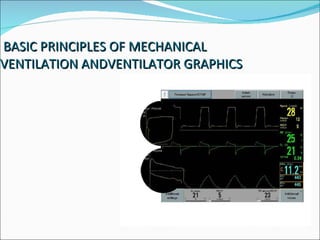
BASIC PRINCIPLES OF MECHANICAL VENTILATION ANDVENTILATOR GRAPHICS
BASIC PRINCIPLES OF MECHANICAL VENTILATION Regardless of the disease states when a patient fails to ventilate or oxygenate adequately the problem lies in 1 of 6 pathophysiological factors Increased airway resistance  Change in lung compliance Hypoventilation V/Q mismatch Intrapulmonary shunting  Diffusion defects
AIRWAY RESISTANCE Normal airway resistance   in term newborn is 20-40cm  H 2 O/l/sec Normal airway resistance   in adults is 0.6-cm of H2O /l/sec Resistance increases  by following Inside the airway retained secretions In the wall swelling or neoplasm Outside the wall eg. tumor  Simplified Poiseuille’s Law  P=V/ r4 P= driving force V=airflow , r=radius of airway
CONDITIONS LEADING TO AIRWAY RESISTANCE   Emphysema Asthma Bronchiectasis Postintubation obstruction Foreign body Endotracheal tube (small size and long) Condensation in vent circuit ALTB Bronchiolitis  Epiglottitis
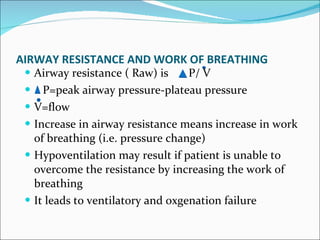
AIRWAY RESISTANCE AND WORK OF BREATHING Airway resistance ( Raw) is  P/ V P=peak airway pressure-plateau pressure V=flow Increase in airway resistance means increase in work of breathing (i.e. pressure change) Hypoventilation may result if patient is unable to overcome the resistance by increasing the work of breathing  It leads to ventilatory and oxgenation failure
VENTILATORY FAILURE is failure of lungs to eliminate CO2 OXGENATION FAILURE is failure of lung and heart to provide adequate oxygen for metabolic needs
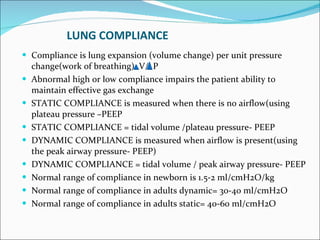
LUNG COMPLIANCE Compliance is lung expansion (volume change) per unit pressure change(work of breathing)  V/  P Abnormal high or low compliance impairs the patient ability to maintain effective gas exchange STATIC COMPLIANCE is measured when there is no airflow(using plateau pressure –PEEP STATIC COMPLIANCE = tidal volume /plateau pressure- PEEP DYNAMIC COMPLIANCE is measured when airflow is present(using the peak airway pressure- PEEP) DYNAMIC COMPLIANCE = tidal volume / peak airway pressure- PEEP Normal range of compliance in newborn is 1.5-2 ml/cmH2O/kg Normal range of compliance in adults dynamic= 30-40 ml/cmH2O Normal range of compliance in adults static= 40-60 ml/cmH2O
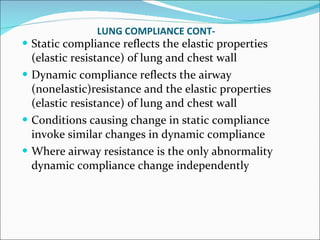
LUNG COMPLIANCE CONT- Static compliance reflects the elastic properties (elastic resistance) of lung and chest wall Dynamic compliance reflects the airway (nonelastic)resistance and the elastic properties (elastic resistance) of lung and chest wall Conditions causing change in static compliance invoke similar changes in dynamic compliance Where airway resistance is the only abnormality dynamic compliance change independently
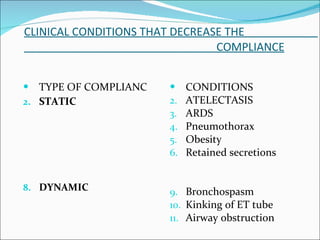
CLINICAL CONDITIONS THAT DECREASE THE  COMPLIANCE   TYPE OF COMPLIANC STATIC DYNAMIC CONDITIONS ATELECTASIS ARDS Pneumothorax Obesity Retained secretions Bronchospasm Kinking of ET tube Airway obstruction
HIGH COMPLIANCE Emphysema Surfactant therapy
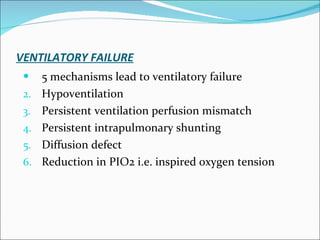
VENTILATORY FAILURE 5 mechanisms lead to ventilatory failure Hypoventilation Persistent ventilation perfusion mismatch Persistent intrapulmonary shunting Diffusion defect Reduction in PIO2 i.e. inspired oxygen tension
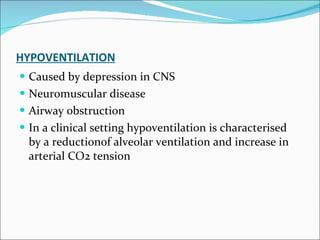
HYPOVENTILATION Caused by depression in CNS Neuromuscular disease Airway obstruction In a clinical setting hypoventilation is characterised by a reductionof alveolar ventilation and increase in arterial CO2 tension
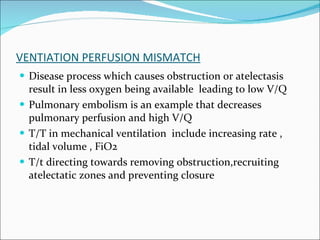
VENTIATION PERFUSION MISMATCH Disease process which causes obstruction or atelectasis result in less oxygen being available  leading to low V/Q  Pulmonary embolism is an example that decreases pulmonary perfusion and high V/Q T/T in mechanical ventilation  include increasing rate , tidal volume , FiO2 T/t directing towards removing obstruction,recruiting atelectatic zones and preventing closure
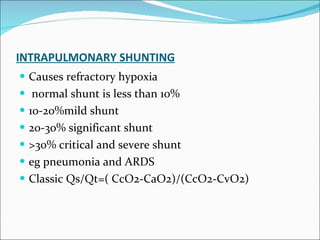
INTRAPULMONARY SHUNTING Causes refractory hypoxia normal shunt is less than 10% 10-20%mild shunt 20-30% significant shunt >30% critical and severe shunt  eg pneumonia and ARDS Classic Qs/Qt=( CcO2-CaO2)/(CcO2-CvO2)
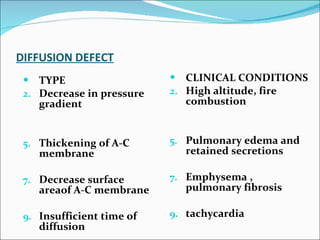
DIFFUSION DEFECT TYPE Decrease in pressure gradient Thickening of A-C membrane Decrease surface areaof A-C membrane Insufficient time of diffusion CLINICAL CONDITIONS High altitude, fire combustion Pulmonary edema and retained secretions Emphysema , pulmonary fibrosis tachycardia
Purpose of Graphics Graphics are waveforms that reflect the patient-ventilator system and their interaction. Purpose of monitoring graphics includes: Allows user to interpret, evaluate, and troubleshoot  the ventilator and the patient’s response to ventilator. Monitors the patient’s disease status (C and Raw). Assesses patient’s response to therapy. Monitors ventilator function Allows fine tuning of ventilator to decrease WOB, optimize ventilation, and maximize patient comfort.
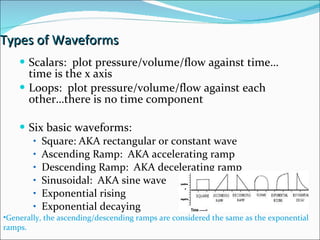
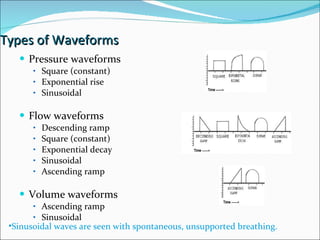
Types of Waveforms Scalars:  plot pressure/volume/flow against time…time is the x axis Loops:  plot pressure/volume/flow against each other…there is no time component Six basic waveforms: Square: AKA rectangular or constant wave Ascending Ramp:  AKA accelerating ramp Descending Ramp:  AKA decelerating ramp Sinusoidal:  AKA sine wave Exponential rising Exponential decaying Generally, the ascending/descending ramps are considered the same as the exponential ramps.
Types of Waveforms  Pressure waveforms Square (constant) Exponential rise Sinusoidal  Flow waveforms Descending ramp Square (constant) Exponential decay Sinusoidal Ascending ramp Volume waveforms Ascending ramp Sinusoidal Sinusoidal waves are seen with spontaneous, unsupported breathing.
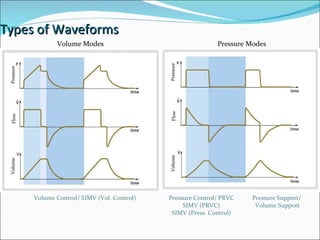
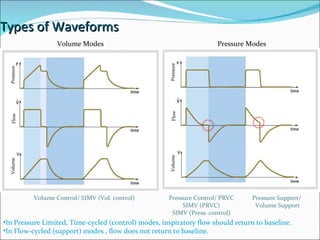
Types of Waveforms  Volume Modes Pressure Modes Volume Control/ SIMV (Vol. Control) Pressure Control/ PRVC SIMV (PRVC) SIMV (Press. Control) Pressure Support/ Volume Support Pressure Flow Volume Pressure Flow Volume
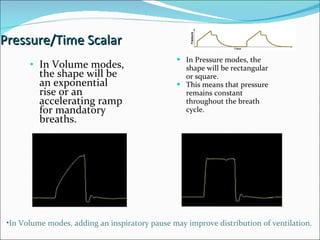
Pressure/Time Scalar In Volume modes, the shape will be an exponential rise or an accelerating ramp for mandatory breaths. In Pressure modes, the shape will be rectangular or square.  This means that pressure remains constant throughout the breath cycle. In Volume modes, adding an inspiratory pause may improve distribution of ventilation.
Pressure/Time Scalar Air trapping (auto-PEEP) Airway Obstruction Bronchodilator Response Respiratory Mechanics (C/Raw) Active Exhalation Breath Type  (Pressure vs. Volume) PIP, Pplat CPAP, PEEP Asynchrony Triggering Effort Can be used to assess:
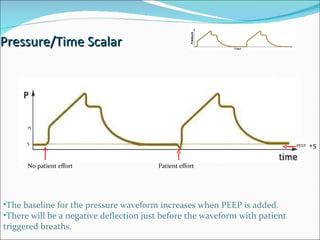
Pressure/Time Scalar The baseline for the pressure waveform increases when PEEP is added. There will be a negative deflection just before the waveform with patient triggered breaths.  5 15 No patient effort Patient effort PEEP  +5
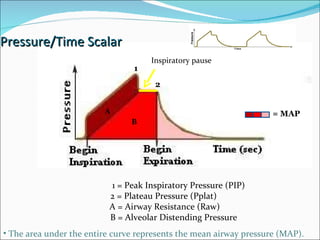
Pressure/Time Scalar A B 1 2 Inspiratory pause = MAP  1 = Peak Inspiratory Pressure (PIP) 2 = Plateau Pressure (Pplat) A = Airway Resistance (Raw) B = Alveolar Distending Pressure The area under the entire curve represents the mean airway pressure (MAP).
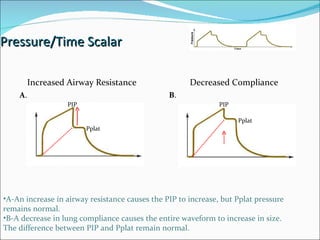
Pressure/Time Scalar Increased Airway Resistance Decreased Compliance PIP Pplat PIP Pplat A . B . A-An increase in airway resistance causes the PIP to increase, but Pplat pressure remains normal. B-A decrease in lung compliance causes the entire waveform to increase in size.  The difference between PIP and Pplat remain normal.
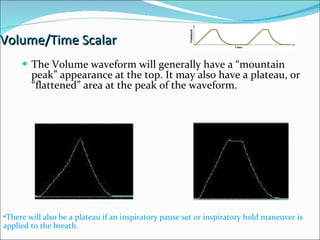
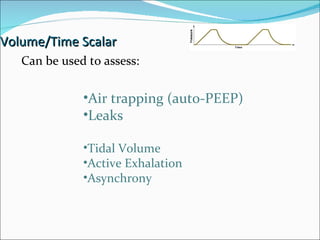
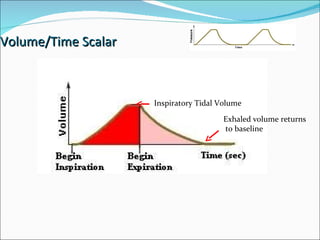
Volume/Time Scalar The Volume waveform will generally have a “mountain peak” appearance at the top. It may also have a plateau, or “flattened” area at the peak of the waveform. There will also be a plateau if an inspiratory pause set or inspiratory hold maneuver is applied to the breath.
Volume/Time Scalar Air trapping (auto-PEEP)  Leaks Tidal Volume Active Exhalation Asynchrony Can be used to assess:
Volume/Time Scalar Inspiratory Tidal Volume Exhaled volume returns to baseline
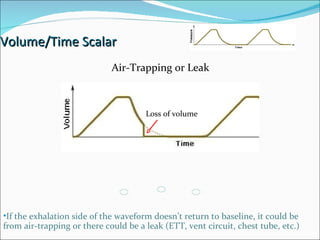
Volume/Time Scalar Air-Trapping or Leak If the exhalation side of the waveform doesn’t return to baseline, it could be from air-trapping or there could be a leak (ETT, vent circuit, chest tube, etc.) Loss of volume
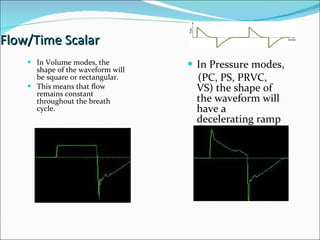
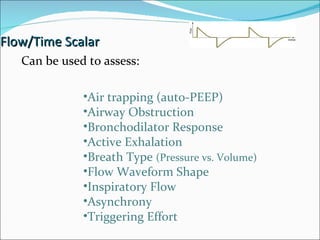
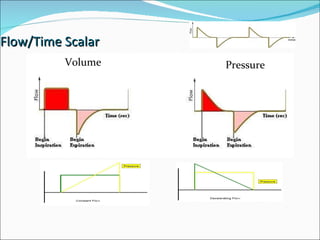
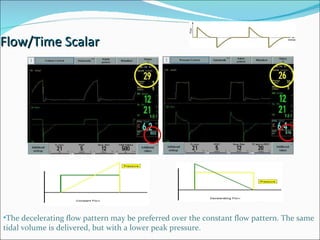
Flow/Time Scalar In Volume modes, the shape of the waveform will be square or rectangular.  This means that flow remains constant throughout the breath cycle. In Pressure modes, (PC, PS, PRVC, VS) the shape of the waveform will have a decelerating ramp flow pattern.
Flow/Time Scalar Air trapping (auto-PEEP) Airway Obstruction Bronchodilator Response Active Exhalation Breath Type  (Pressure vs. Volume) Flow Waveform Shape Inspiratory Flow Asynchrony Triggering Effort Can be used to assess:
Flow/Time Scalar Volume Pressure
Flow/Time Scalar The decelerating flow pattern may be preferred over the constant flow pattern. The same tidal volume is delivered, but with a lower peak pressure.
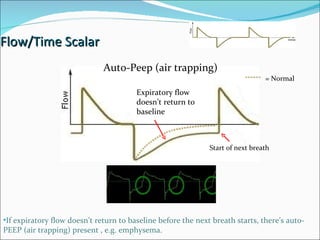
Flow/Time Scalar Auto-Peep (air trapping) If expiratory flow doesn’t return to baseline before the next breath starts, there’s auto-PEEP (air trapping) present , e.g. emphysema. Start of next breath Expiratory flow doesn’t return to baseline = Normal
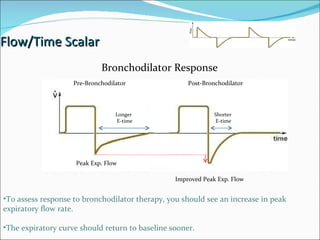
Flow/Time Scalar Bronchodilator Response To assess response to bronchodilator therapy, you should see an increase in peak expiratory flow rate. The expiratory curve should return to baseline sooner. Peak Exp. Flow Improved Peak Exp. Flow Shorter  E-time Longer  E-time Pre-Bronchodilator Post-Bronchodilator
Types of Waveforms  Volume Modes Pressure Modes In Pressure Limited, Time-cycled (control) modes, inspiratory flow should return to baseline.  In Flow-cycled (support) modes , flow does not return to baseline.  Volume Control/ SIMV (Vol. control) Pressure Control/ PRVC SIMV (PRVC) SIMV (Press. control) Pressure Support/ Volume Support Pressure Flow Volume Pressure Flow Volume
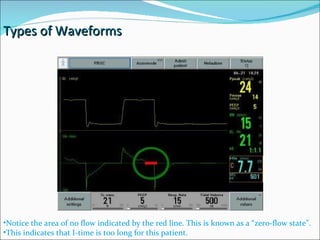
Notice the area of no flow indicated by the red line. This is known as a “zero-flow state”.  This indicates that I-time is too long for this patient. Types of Waveforms
Pressure/Volume Loops 15 30 5 250 500
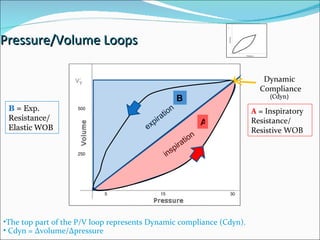
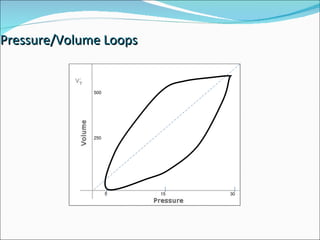
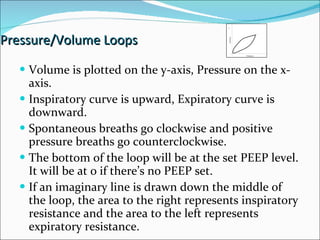
Pressure/Volume Loops Volume is plotted on the y-axis, Pressure on the x-axis. Inspiratory curve is upward, Expiratory curve is downward. Spontaneous breaths go clockwise and positive pressure breaths go counterclockwise. The bottom of the loop will be at the set PEEP level. It will be at 0 if there’s no PEEP set. If an imaginary line is drawn down the middle of the loop, the area to the right represents inspiratory resistance and the area to the left represents expiratory resistance.
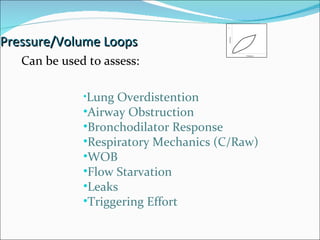
Pressure/Volume Loops Lung Overdistention Airway Obstruction Bronchodilator Response Respiratory Mechanics (C/Raw) WOB Flow Starvation Leaks Triggering Effort Can be used to assess:
Pressure/Volume Loops inspiration expiration 15 30 5 Dynamic  Compliance A A  = Inspiratory Resistance/ Resistive WOB B ( Cdyn ) The top part of the P/V loop represents Dynamic compliance (Cdyn). Cdyn =  Δ volume/ Δ pressure  500 250 B  = Exp. Resistance/ Elastic WOB
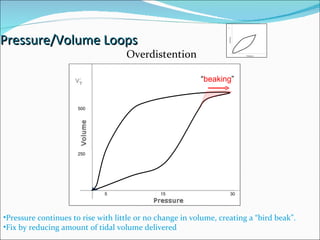
Pressure/Volume Loops 15 30 5 Overdistention “ beaking ” Pressure continues to rise with little or no change in volume, creating a “bird beak”. Fix by reducing amount of tidal volume delivered 500 250
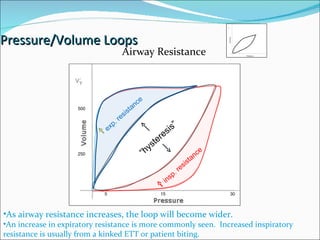
Pressure/Volume Loops 15 30 5 Airway Resistance As airway resistance increases, the loop will become wider. An increase in expiratory resistance is more commonly seen.  Increased inspiratory resistance is usually from a kinked ETT or patient biting. “ hysteresis” exp. resistance insp. resistance 500 250
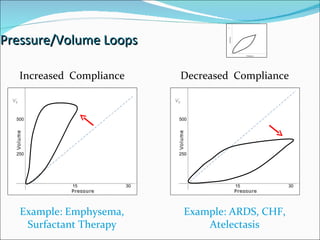
Pressure/Volume Loops 15 30 5 250 500 15 30 5 Increased  Compliance Decreased  Compliance Example: Emphysema, Surfactant Therapy Example: ARDS, CHF, Atelectasis 500 250
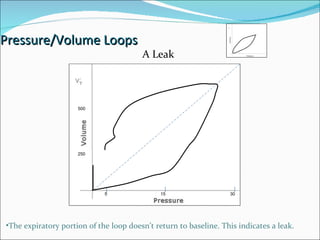
Pressure/Volume Loops 15 30 5 A Leak The expiratory portion of the loop doesn’t return to baseline. This indicates a leak. 500 250
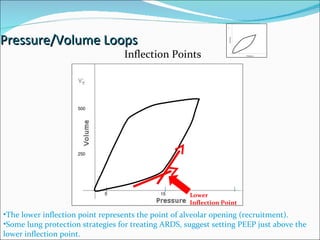
Pressure/Volume Loops 15 30 5 Lower  Inflection Point The lower inflection point represents the point of alveolar opening (recruitment).  Some lung protection strategies for treating ARDS, suggest setting PEEP just above the lower inflection point. Inflection Points 250 500
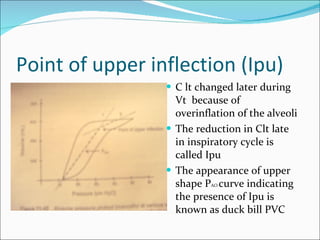
Point of upper inflection (Ipu) C lt changed later during Vt  because of overinflation of the alveoli The reduction in Clt late in inspiratory cycle is called Ipu The appearance of upper shape P AO  curve indicating the presence of Ipu is known as duck bill PVC
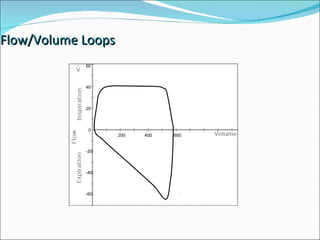
Flow/Volume Loops 0 200 400 600 20 40 60 -20 -40 -60
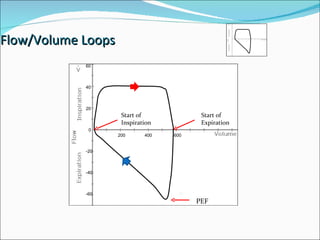
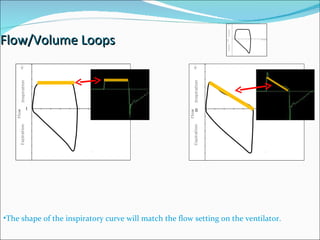
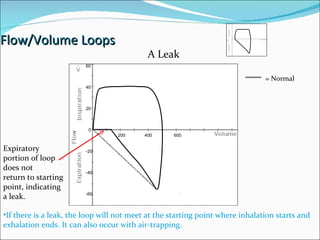
Flow/Volume Loops Flow is plotted on the y axis and volume on the x axis Flow  volume loops used for ventilator graphics are the same as ones used for Pulmonary Function Testing, (usually upside down). Inspiration is above the horizontal line and expiration is below. The shape of the inspiratory curve will match what’s set on the ventilator. The shape of the exp flow curve represents passive exhalation…it’s long and more drawn out in patients with less recoil. Can be used to determine the PIF, PEF, and Vt Looks circular with spontaneous breaths
Flow/Volume Loops Air trapping Airway Obstruction Airway Resistance Bronchodilator Response Insp/Exp Flow Flow Starvation Leaks Water or Secretion accumulation Asynchrony Can be used to assess:
Flow/Volume Loops 0 200 400 600 20 40 60 -20 -40 -60 PEF Start of  Inspiration Start of  Expiration
Flow/Volume Loops 0 0 The shape of the inspiratory curve will match the flow setting on the ventilator.
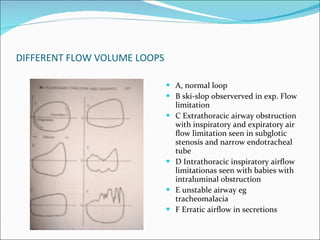
DIFFERENT FLOW VOLUME LOOPS A, normal loop B ski-slop observerved in exp. Flow limitation C Extrathoracic airway obstruction with inspiratory and expiratory air flow limitation seen in subglotic stenosis and narrow endotracheal tube D Intrathoracic inspiratory airflow limitationas seen with babies with intraluminal obstruction E unstable airway eg tracheomalacia F Erratic airflow in secretions
Flow/Volume Loops 0 200 400 600 20 40 60 -20 -40 -60 Expiratory portion of loop does not return to starting point, indicating a leak. A Leak If there is a leak, the loop will not meet at the starting point where inhalation starts and exhalation ends. It can also occur with air-trapping. = Normal
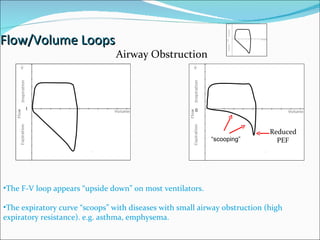
Flow/Volume Loops 0 0 Reduced  PEF “ scooping” The F-V loop appears “upside down” on most ventilators. The expiratory curve “scoops” with diseases with small airway obstruction (high expiratory resistance). e.g. asthma, emphysema. Airway Obstruction
Air Trapping (auto-PEEP) Causes:  Insufficient expiratory time Early collapse of unstable alveoli/airways during exhalation How to Identify it on the graphics Pressure wave:  while performing an expiratory hold, the waveform rises above baseline. Flow wave:  the expiratory flow doesn’t return to baseline before the next breath begins. Volume wave:  the expiratory portion doesn’t return to baseline. Flow/Volume Loop:  the loop doesn’t meet at the baseline Pressure/Volume Loop:  the loop doesn’t meet at the baseline
Airway Resistance Changes Causes:  Bronchospasm ETT problems (too small, kinked, obstructed, patient biting) High flow rate Secretion build-up Damp or blocked expiratory valve/filter Water in the HME How to Identify it on the graphics Pressure wave: PIP increases, but the plateau stays the same Flow wave:  it takes longer for the exp side to reach baseline/exp flow rate is reduced Volume wave:  it takes longer for the exp curve to reach the baseline Pressure/Volume loop:  the loop will be wider. Increase Insp. Resistance will cause it to bulge to the right. Exp resistance, bulges to the left. Flow/Volume loop:  decreased exp flow with a scoop in the exp curve How to fix Give a treatment, suction patient, drain water, change HME, change ETT, add a bite block, reduce PF rate, change exp filter .
Compliance Changes Decreased compliance Causes ARDS Atelectasis Abdominal distension CHF Consolidation Fibrosis Hyperinflation Pneumothorax Pleural effusion How to Identify it on the graphics Pressure wave: PIP and plateau both increase Pressure/Volume loop:  lays more horizontal Increased compliance Causes Emphysema Surfactant Therapy How to Identify it on the graphics Pressure wave: PIP and plateau both decrease Pressure/Volume loop:  Stands more vertical (upright)
Leaks  Causes Expiratory leak: ETT cuff leak , chest tube leak, BP fistula, NG tube in trachea Inspiratory leak:  loose connections, ventilator malfunction, faulty flow sensor How to ID it Pressure wave:  Decreased PIP Volume wave:  Expiratory side of wave doesn’t return to baseline Flow wave:  PEF decreased Pressure/Volume loop:  exp side doesn’t return to the baseline Flow/Volume loop:  exp side doesn’t return to baseline How to fix it Check possible causes listed above Do a leak test and make sure all connections are tight
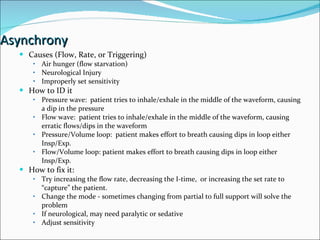
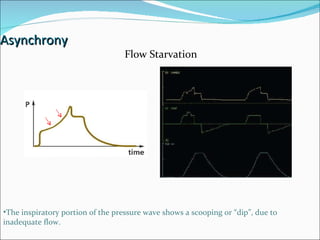
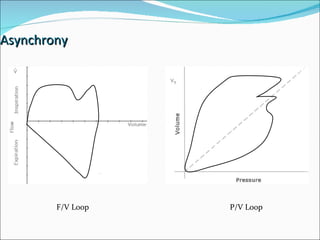
Asynchrony Causes (Flow, Rate, or Triggering) Air hunger (flow starvation) Neurological Injury Improperly set sensitivity How to ID it Pressure wave:  patient tries to inhale/exhale in the middle of the waveform, causing a dip in the pressure Flow wave:  patient tries to inhale/exhale in the middle of the waveform, causing erratic flows/dips in the waveform  Pressure/Volume loop:  patient makes effort to breath causing dips in loop either Insp/Exp. Flow/Volume loop: patient makes effort to breath causing dips in loop either Insp/Exp. How to fix it:  Try increasing the flow rate, decreasing the I-time,  or increasing the set rate to “capture” the patient.  Change the mode - sometimes changing from partial to full support will solve the problem If neurological, may need paralytic or sedative  Adjust sensitivity
Asynchrony Flow Starvation The inspiratory portion of the pressure wave shows a scooping or “dip”, due to inadequate flow.
Asynchrony F/V Loop P/V Loop
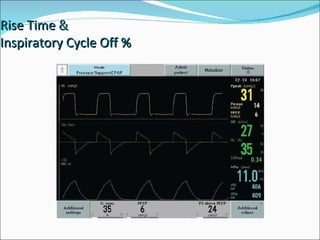
Rise Time  &   Inspiratory Cycle Off %
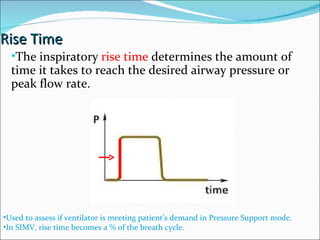
Rise Time The inspiratory  rise time  determines the amount of time it takes to reach the desired airway pressure or peak flow rate. Used to assess if ventilator is meeting patient’s demand in Pressure Support mode. In SIMV, rise time becomes a % of the breath cycle.
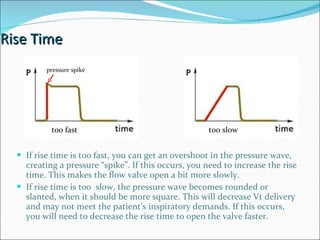
Rise Time If rise time is too fast, you can get an overshoot in the pressure wave, creating a pressure “spike”. If this occurs, you need to increase the rise time. This makes the flow valve open a bit more slowly.  If rise time is too  slow, the pressure wave becomes rounded or slanted, when it should be more square. This will decrease Vt delivery and may not meet the patient’s inspiratory demands. If this occurs, you will need to decrease the rise time to open the valve faster. too slow too fast pressure spike
Inspiratory Cycle Off The  inspiratory cycle off  determines when the ventilator flow cycles from inspiration to expiration, in Pressure Support mode. The flow-cycling variable is given different names depending on the type of ventilator. Also know as–  Inspiratory flow termination,  Expiratory flow sensitivity,  Inspiratory flow cycle %,  E-cycle etc…
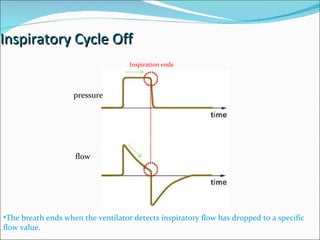
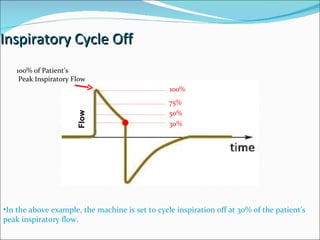
Inspiratory Cycle Off The breath ends when the ventilator detects inspiratory flow has dropped to a specific flow value. Inspiration ends pressure flow
Inspiratory Cycle Off In the above example, the machine is set to cycle inspiration off at 30% of the patient’s peak inspiratory flow. 100% of Patient’s Peak Inspiratory Flow Flow 100% 50% 30% 75%
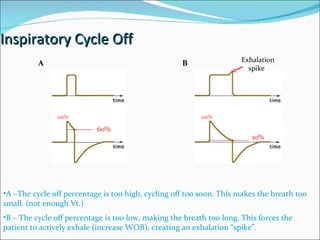
Inspiratory Cycle Off A –The cycle off percentage is too high, cycling off too soon. This makes the breath too small. (not enough Vt.) 60% 10% B – The cycle off percentage is too low, making the breath too long. This forces the patient to actively exhale (increase WOB), creating an exhalation “spike”. Exhalation  spike A B 100% 100%
Sources: Rapid Interpretation of Ventilator Waveforms  Ventilator Waveform Analysis –  Susan Pearson Golden Moments in Mechanical Ventilation – Maquet, inc. Servo-I Graphics – Maquet, inc. text book of physiology- Ganong  David W Chang –clinical application of mechanical ventilation Pulmonary function and graphics -Goldsmith
Thank You!

Ventilator Graphics

  • 1.
    BASIC PRINCIPLES OFMECHANICAL VENTILATION ANDVENTILATOR GRAPHICS
  • 2.
    BASIC PRINCIPLES OFMECHANICAL VENTILATION Regardless of the disease states when a patient fails to ventilate or oxygenate adequately the problem lies in 1 of 6 pathophysiological factors Increased airway resistance Change in lung compliance Hypoventilation V/Q mismatch Intrapulmonary shunting Diffusion defects
  • 3.
    AIRWAY RESISTANCE Normalairway resistance in term newborn is 20-40cm H 2 O/l/sec Normal airway resistance in adults is 0.6-cm of H2O /l/sec Resistance increases by following Inside the airway retained secretions In the wall swelling or neoplasm Outside the wall eg. tumor Simplified Poiseuille’s Law P=V/ r4 P= driving force V=airflow , r=radius of airway
  • 4.
    CONDITIONS LEADING TOAIRWAY RESISTANCE Emphysema Asthma Bronchiectasis Postintubation obstruction Foreign body Endotracheal tube (small size and long) Condensation in vent circuit ALTB Bronchiolitis Epiglottitis
  • 5.
    AIRWAY RESISTANCE ANDWORK OF BREATHING Airway resistance ( Raw) is P/ V P=peak airway pressure-plateau pressure V=flow Increase in airway resistance means increase in work of breathing (i.e. pressure change) Hypoventilation may result if patient is unable to overcome the resistance by increasing the work of breathing It leads to ventilatory and oxgenation failure
  • 6.
    VENTILATORY FAILURE isfailure of lungs to eliminate CO2 OXGENATION FAILURE is failure of lung and heart to provide adequate oxygen for metabolic needs
  • 7.
    LUNG COMPLIANCE Complianceis lung expansion (volume change) per unit pressure change(work of breathing) V/ P Abnormal high or low compliance impairs the patient ability to maintain effective gas exchange STATIC COMPLIANCE is measured when there is no airflow(using plateau pressure –PEEP STATIC COMPLIANCE = tidal volume /plateau pressure- PEEP DYNAMIC COMPLIANCE is measured when airflow is present(using the peak airway pressure- PEEP) DYNAMIC COMPLIANCE = tidal volume / peak airway pressure- PEEP Normal range of compliance in newborn is 1.5-2 ml/cmH2O/kg Normal range of compliance in adults dynamic= 30-40 ml/cmH2O Normal range of compliance in adults static= 40-60 ml/cmH2O
  • 8.
    LUNG COMPLIANCE CONT-Static compliance reflects the elastic properties (elastic resistance) of lung and chest wall Dynamic compliance reflects the airway (nonelastic)resistance and the elastic properties (elastic resistance) of lung and chest wall Conditions causing change in static compliance invoke similar changes in dynamic compliance Where airway resistance is the only abnormality dynamic compliance change independently
  • 9.
    CLINICAL CONDITIONS THATDECREASE THE COMPLIANCE TYPE OF COMPLIANC STATIC DYNAMIC CONDITIONS ATELECTASIS ARDS Pneumothorax Obesity Retained secretions Bronchospasm Kinking of ET tube Airway obstruction
  • 10.
    HIGH COMPLIANCE EmphysemaSurfactant therapy
  • 11.
    VENTILATORY FAILURE 5mechanisms lead to ventilatory failure Hypoventilation Persistent ventilation perfusion mismatch Persistent intrapulmonary shunting Diffusion defect Reduction in PIO2 i.e. inspired oxygen tension
  • 12.
    HYPOVENTILATION Caused bydepression in CNS Neuromuscular disease Airway obstruction In a clinical setting hypoventilation is characterised by a reductionof alveolar ventilation and increase in arterial CO2 tension
  • 13.
    VENTIATION PERFUSION MISMATCHDisease process which causes obstruction or atelectasis result in less oxygen being available leading to low V/Q Pulmonary embolism is an example that decreases pulmonary perfusion and high V/Q T/T in mechanical ventilation include increasing rate , tidal volume , FiO2 T/t directing towards removing obstruction,recruiting atelectatic zones and preventing closure
  • 14.
    INTRAPULMONARY SHUNTING Causesrefractory hypoxia normal shunt is less than 10% 10-20%mild shunt 20-30% significant shunt >30% critical and severe shunt eg pneumonia and ARDS Classic Qs/Qt=( CcO2-CaO2)/(CcO2-CvO2)
  • 15.
    DIFFUSION DEFECT TYPEDecrease in pressure gradient Thickening of A-C membrane Decrease surface areaof A-C membrane Insufficient time of diffusion CLINICAL CONDITIONS High altitude, fire combustion Pulmonary edema and retained secretions Emphysema , pulmonary fibrosis tachycardia
  • 16.
    Purpose of GraphicsGraphics are waveforms that reflect the patient-ventilator system and their interaction. Purpose of monitoring graphics includes: Allows user to interpret, evaluate, and troubleshoot the ventilator and the patient’s response to ventilator. Monitors the patient’s disease status (C and Raw). Assesses patient’s response to therapy. Monitors ventilator function Allows fine tuning of ventilator to decrease WOB, optimize ventilation, and maximize patient comfort.
  • 17.
    Types of WaveformsScalars: plot pressure/volume/flow against time…time is the x axis Loops: plot pressure/volume/flow against each other…there is no time component Six basic waveforms: Square: AKA rectangular or constant wave Ascending Ramp: AKA accelerating ramp Descending Ramp: AKA decelerating ramp Sinusoidal: AKA sine wave Exponential rising Exponential decaying Generally, the ascending/descending ramps are considered the same as the exponential ramps.
  • 18.
    Types of Waveforms Pressure waveforms Square (constant) Exponential rise Sinusoidal Flow waveforms Descending ramp Square (constant) Exponential decay Sinusoidal Ascending ramp Volume waveforms Ascending ramp Sinusoidal Sinusoidal waves are seen with spontaneous, unsupported breathing.
  • 19.
    Types of Waveforms Volume Modes Pressure Modes Volume Control/ SIMV (Vol. Control) Pressure Control/ PRVC SIMV (PRVC) SIMV (Press. Control) Pressure Support/ Volume Support Pressure Flow Volume Pressure Flow Volume
  • 20.
    Pressure/Time Scalar InVolume modes, the shape will be an exponential rise or an accelerating ramp for mandatory breaths. In Pressure modes, the shape will be rectangular or square. This means that pressure remains constant throughout the breath cycle. In Volume modes, adding an inspiratory pause may improve distribution of ventilation.
  • 21.
    Pressure/Time Scalar Airtrapping (auto-PEEP) Airway Obstruction Bronchodilator Response Respiratory Mechanics (C/Raw) Active Exhalation Breath Type (Pressure vs. Volume) PIP, Pplat CPAP, PEEP Asynchrony Triggering Effort Can be used to assess:
  • 22.
    Pressure/Time Scalar Thebaseline for the pressure waveform increases when PEEP is added. There will be a negative deflection just before the waveform with patient triggered breaths. 5 15 No patient effort Patient effort PEEP +5
  • 23.
    Pressure/Time Scalar AB 1 2 Inspiratory pause = MAP 1 = Peak Inspiratory Pressure (PIP) 2 = Plateau Pressure (Pplat) A = Airway Resistance (Raw) B = Alveolar Distending Pressure The area under the entire curve represents the mean airway pressure (MAP).
  • 24.
    Pressure/Time Scalar IncreasedAirway Resistance Decreased Compliance PIP Pplat PIP Pplat A . B . A-An increase in airway resistance causes the PIP to increase, but Pplat pressure remains normal. B-A decrease in lung compliance causes the entire waveform to increase in size. The difference between PIP and Pplat remain normal.
  • 25.
    Volume/Time Scalar TheVolume waveform will generally have a “mountain peak” appearance at the top. It may also have a plateau, or “flattened” area at the peak of the waveform. There will also be a plateau if an inspiratory pause set or inspiratory hold maneuver is applied to the breath.
  • 26.
    Volume/Time Scalar Airtrapping (auto-PEEP) Leaks Tidal Volume Active Exhalation Asynchrony Can be used to assess:
  • 27.
    Volume/Time Scalar InspiratoryTidal Volume Exhaled volume returns to baseline
  • 28.
    Volume/Time Scalar Air-Trappingor Leak If the exhalation side of the waveform doesn’t return to baseline, it could be from air-trapping or there could be a leak (ETT, vent circuit, chest tube, etc.) Loss of volume
  • 29.
    Flow/Time Scalar InVolume modes, the shape of the waveform will be square or rectangular. This means that flow remains constant throughout the breath cycle. In Pressure modes, (PC, PS, PRVC, VS) the shape of the waveform will have a decelerating ramp flow pattern.
  • 30.
    Flow/Time Scalar Airtrapping (auto-PEEP) Airway Obstruction Bronchodilator Response Active Exhalation Breath Type (Pressure vs. Volume) Flow Waveform Shape Inspiratory Flow Asynchrony Triggering Effort Can be used to assess:
  • 31.
  • 32.
    Flow/Time Scalar Thedecelerating flow pattern may be preferred over the constant flow pattern. The same tidal volume is delivered, but with a lower peak pressure.
  • 33.
    Flow/Time Scalar Auto-Peep(air trapping) If expiratory flow doesn’t return to baseline before the next breath starts, there’s auto-PEEP (air trapping) present , e.g. emphysema. Start of next breath Expiratory flow doesn’t return to baseline = Normal
  • 34.
    Flow/Time Scalar BronchodilatorResponse To assess response to bronchodilator therapy, you should see an increase in peak expiratory flow rate. The expiratory curve should return to baseline sooner. Peak Exp. Flow Improved Peak Exp. Flow Shorter E-time Longer E-time Pre-Bronchodilator Post-Bronchodilator
  • 35.
    Types of Waveforms Volume Modes Pressure Modes In Pressure Limited, Time-cycled (control) modes, inspiratory flow should return to baseline. In Flow-cycled (support) modes , flow does not return to baseline. Volume Control/ SIMV (Vol. control) Pressure Control/ PRVC SIMV (PRVC) SIMV (Press. control) Pressure Support/ Volume Support Pressure Flow Volume Pressure Flow Volume
  • 36.
    Notice the areaof no flow indicated by the red line. This is known as a “zero-flow state”. This indicates that I-time is too long for this patient. Types of Waveforms
  • 37.
  • 38.
    Pressure/Volume Loops Volumeis plotted on the y-axis, Pressure on the x-axis. Inspiratory curve is upward, Expiratory curve is downward. Spontaneous breaths go clockwise and positive pressure breaths go counterclockwise. The bottom of the loop will be at the set PEEP level. It will be at 0 if there’s no PEEP set. If an imaginary line is drawn down the middle of the loop, the area to the right represents inspiratory resistance and the area to the left represents expiratory resistance.
  • 39.
    Pressure/Volume Loops LungOverdistention Airway Obstruction Bronchodilator Response Respiratory Mechanics (C/Raw) WOB Flow Starvation Leaks Triggering Effort Can be used to assess:
  • 40.
    Pressure/Volume Loops inspirationexpiration 15 30 5 Dynamic Compliance A A = Inspiratory Resistance/ Resistive WOB B ( Cdyn ) The top part of the P/V loop represents Dynamic compliance (Cdyn). Cdyn = Δ volume/ Δ pressure 500 250 B = Exp. Resistance/ Elastic WOB
  • 41.
    Pressure/Volume Loops 1530 5 Overdistention “ beaking ” Pressure continues to rise with little or no change in volume, creating a “bird beak”. Fix by reducing amount of tidal volume delivered 500 250
  • 42.
    Pressure/Volume Loops 1530 5 Airway Resistance As airway resistance increases, the loop will become wider. An increase in expiratory resistance is more commonly seen. Increased inspiratory resistance is usually from a kinked ETT or patient biting. “ hysteresis” exp. resistance insp. resistance 500 250
  • 43.
    Pressure/Volume Loops 1530 5 250 500 15 30 5 Increased Compliance Decreased Compliance Example: Emphysema, Surfactant Therapy Example: ARDS, CHF, Atelectasis 500 250
  • 44.
    Pressure/Volume Loops 1530 5 A Leak The expiratory portion of the loop doesn’t return to baseline. This indicates a leak. 500 250
  • 45.
    Pressure/Volume Loops 1530 5 Lower Inflection Point The lower inflection point represents the point of alveolar opening (recruitment). Some lung protection strategies for treating ARDS, suggest setting PEEP just above the lower inflection point. Inflection Points 250 500
  • 46.
    Point of upperinflection (Ipu) C lt changed later during Vt because of overinflation of the alveoli The reduction in Clt late in inspiratory cycle is called Ipu The appearance of upper shape P AO curve indicating the presence of Ipu is known as duck bill PVC
  • 47.
    Flow/Volume Loops 0200 400 600 20 40 60 -20 -40 -60
  • 48.
    Flow/Volume Loops Flowis plotted on the y axis and volume on the x axis Flow volume loops used for ventilator graphics are the same as ones used for Pulmonary Function Testing, (usually upside down). Inspiration is above the horizontal line and expiration is below. The shape of the inspiratory curve will match what’s set on the ventilator. The shape of the exp flow curve represents passive exhalation…it’s long and more drawn out in patients with less recoil. Can be used to determine the PIF, PEF, and Vt Looks circular with spontaneous breaths
  • 49.
    Flow/Volume Loops Airtrapping Airway Obstruction Airway Resistance Bronchodilator Response Insp/Exp Flow Flow Starvation Leaks Water or Secretion accumulation Asynchrony Can be used to assess:
  • 50.
    Flow/Volume Loops 0200 400 600 20 40 60 -20 -40 -60 PEF Start of Inspiration Start of Expiration
  • 51.
    Flow/Volume Loops 00 The shape of the inspiratory curve will match the flow setting on the ventilator.
  • 52.
    DIFFERENT FLOW VOLUMELOOPS A, normal loop B ski-slop observerved in exp. Flow limitation C Extrathoracic airway obstruction with inspiratory and expiratory air flow limitation seen in subglotic stenosis and narrow endotracheal tube D Intrathoracic inspiratory airflow limitationas seen with babies with intraluminal obstruction E unstable airway eg tracheomalacia F Erratic airflow in secretions
  • 53.
    Flow/Volume Loops 0200 400 600 20 40 60 -20 -40 -60 Expiratory portion of loop does not return to starting point, indicating a leak. A Leak If there is a leak, the loop will not meet at the starting point where inhalation starts and exhalation ends. It can also occur with air-trapping. = Normal
  • 54.
    Flow/Volume Loops 00 Reduced PEF “ scooping” The F-V loop appears “upside down” on most ventilators. The expiratory curve “scoops” with diseases with small airway obstruction (high expiratory resistance). e.g. asthma, emphysema. Airway Obstruction
  • 55.
    Air Trapping (auto-PEEP)Causes: Insufficient expiratory time Early collapse of unstable alveoli/airways during exhalation How to Identify it on the graphics Pressure wave: while performing an expiratory hold, the waveform rises above baseline. Flow wave: the expiratory flow doesn’t return to baseline before the next breath begins. Volume wave: the expiratory portion doesn’t return to baseline. Flow/Volume Loop: the loop doesn’t meet at the baseline Pressure/Volume Loop: the loop doesn’t meet at the baseline
  • 56.
    Airway Resistance ChangesCauses: Bronchospasm ETT problems (too small, kinked, obstructed, patient biting) High flow rate Secretion build-up Damp or blocked expiratory valve/filter Water in the HME How to Identify it on the graphics Pressure wave: PIP increases, but the plateau stays the same Flow wave: it takes longer for the exp side to reach baseline/exp flow rate is reduced Volume wave: it takes longer for the exp curve to reach the baseline Pressure/Volume loop: the loop will be wider. Increase Insp. Resistance will cause it to bulge to the right. Exp resistance, bulges to the left. Flow/Volume loop: decreased exp flow with a scoop in the exp curve How to fix Give a treatment, suction patient, drain water, change HME, change ETT, add a bite block, reduce PF rate, change exp filter .
  • 57.
    Compliance Changes Decreasedcompliance Causes ARDS Atelectasis Abdominal distension CHF Consolidation Fibrosis Hyperinflation Pneumothorax Pleural effusion How to Identify it on the graphics Pressure wave: PIP and plateau both increase Pressure/Volume loop: lays more horizontal Increased compliance Causes Emphysema Surfactant Therapy How to Identify it on the graphics Pressure wave: PIP and plateau both decrease Pressure/Volume loop: Stands more vertical (upright)
  • 58.
    Leaks CausesExpiratory leak: ETT cuff leak , chest tube leak, BP fistula, NG tube in trachea Inspiratory leak: loose connections, ventilator malfunction, faulty flow sensor How to ID it Pressure wave: Decreased PIP Volume wave: Expiratory side of wave doesn’t return to baseline Flow wave: PEF decreased Pressure/Volume loop: exp side doesn’t return to the baseline Flow/Volume loop: exp side doesn’t return to baseline How to fix it Check possible causes listed above Do a leak test and make sure all connections are tight
  • 59.
    Asynchrony Causes (Flow,Rate, or Triggering) Air hunger (flow starvation) Neurological Injury Improperly set sensitivity How to ID it Pressure wave: patient tries to inhale/exhale in the middle of the waveform, causing a dip in the pressure Flow wave: patient tries to inhale/exhale in the middle of the waveform, causing erratic flows/dips in the waveform Pressure/Volume loop: patient makes effort to breath causing dips in loop either Insp/Exp. Flow/Volume loop: patient makes effort to breath causing dips in loop either Insp/Exp. How to fix it: Try increasing the flow rate, decreasing the I-time, or increasing the set rate to “capture” the patient. Change the mode - sometimes changing from partial to full support will solve the problem If neurological, may need paralytic or sedative Adjust sensitivity
  • 60.
    Asynchrony Flow StarvationThe inspiratory portion of the pressure wave shows a scooping or “dip”, due to inadequate flow.
  • 61.
  • 62.
    Rise Time & Inspiratory Cycle Off %
  • 63.
    Rise Time Theinspiratory rise time determines the amount of time it takes to reach the desired airway pressure or peak flow rate. Used to assess if ventilator is meeting patient’s demand in Pressure Support mode. In SIMV, rise time becomes a % of the breath cycle.
  • 64.
    Rise Time Ifrise time is too fast, you can get an overshoot in the pressure wave, creating a pressure “spike”. If this occurs, you need to increase the rise time. This makes the flow valve open a bit more slowly. If rise time is too slow, the pressure wave becomes rounded or slanted, when it should be more square. This will decrease Vt delivery and may not meet the patient’s inspiratory demands. If this occurs, you will need to decrease the rise time to open the valve faster. too slow too fast pressure spike
  • 65.
    Inspiratory Cycle OffThe inspiratory cycle off determines when the ventilator flow cycles from inspiration to expiration, in Pressure Support mode. The flow-cycling variable is given different names depending on the type of ventilator. Also know as– Inspiratory flow termination, Expiratory flow sensitivity, Inspiratory flow cycle %, E-cycle etc…
  • 66.
    Inspiratory Cycle OffThe breath ends when the ventilator detects inspiratory flow has dropped to a specific flow value. Inspiration ends pressure flow
  • 67.
    Inspiratory Cycle OffIn the above example, the machine is set to cycle inspiration off at 30% of the patient’s peak inspiratory flow. 100% of Patient’s Peak Inspiratory Flow Flow 100% 50% 30% 75%
  • 68.
    Inspiratory Cycle OffA –The cycle off percentage is too high, cycling off too soon. This makes the breath too small. (not enough Vt.) 60% 10% B – The cycle off percentage is too low, making the breath too long. This forces the patient to actively exhale (increase WOB), creating an exhalation “spike”. Exhalation spike A B 100% 100%
  • 69.
    Sources: Rapid Interpretationof Ventilator Waveforms Ventilator Waveform Analysis – Susan Pearson Golden Moments in Mechanical Ventilation – Maquet, inc. Servo-I Graphics – Maquet, inc. text book of physiology- Ganong David W Chang –clinical application of mechanical ventilation Pulmonary function and graphics -Goldsmith
  • 70.