NUR AINA BINTI AB KADIR
MECHANCAL VENTILATION
CONTENTS
Introduction Types Components
Indications Modes
Dual mode
ventilation
Complications Weaning
INTRODUCTION
 The fundamental operation of positive pressure
ventilation is to create a pressure that moves a
volume of gas into the lungs.
 1. Volume-controlled ventilation , where the inflation
volume (tidal volume) is preselected, and the
ventilator automatically adjusts the inflation pressure
to deliver the desired volume. The rate of lung
inflation can be constant or decelerating.
 2. Pressure-controlled ventilation, where the inflation
pressure is preselected, and the duration of inflation
is adjusted (by the operator) to deliver the desired
tidal volume. The rate of lung inflation is high at the
onset of lung inflation (to achieve the desired inflation
pressure), then rapidly decelerates (to maintain a
TYPES
INVASIVE
NON
INVASIVE
NON INVASIVE
 Have respiratory failure but no urgent need of
intubation
 Conscious and cooperative
 No risk of aspiration
 Tightly fitted mask
CONTRAINDICATION
 Contraindication :
 Cardiac and respiratory arrest
 Severe hypoxemia
 High risk of aspiration
 Facial trauma
 Inability to protect airways
 Upper GI bleed
COMPLICATIONS
 Leakage Hypoventilation
 Inconvenience and claustrophobia
 Increase chance of aspiration
 Skin breakdown, facial edema on prolonged use
INITIAL SETTING OF
VENTILATOR
 Tidal volume : 6-8 ml
 I:E ratio : 1:2
 Frequency : 10-12 breaths/min
 Inspiratory flow rate : 60-80 liters/min
 PEEP : 3-5 cmH2O
 Trigger sensitivity : -1 to -2 cmH2O
 FIO2 : 0.5 (50%)
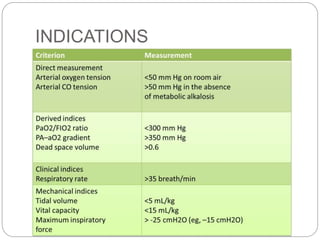
INDICATIONS
OTHERS
 Excessive fatigue of respiratory muscle
 Loss of protective airway reflexes
 Inability to cough adequately
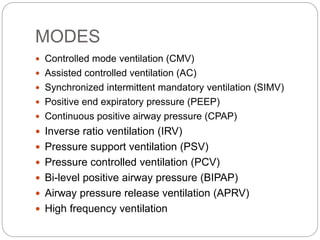
MODES
 Controlled mode ventilation (CMV)
 Assisted controlled ventilation (AC)
 Synchronized intermittent mandatory ventilation (SIMV)
 Positive end expiratory pressure (PEEP)
 Continuous positive airway pressure (CPAP)
 Inverse ratio ventilation (IRV)
 Pressure support ventilation (PSV)
 Pressure controlled ventilation (PCV)
 Bi-level positive airway pressure (BIPAP)
 Airway pressure release ventilation (APRV)
 High frequency ventilation
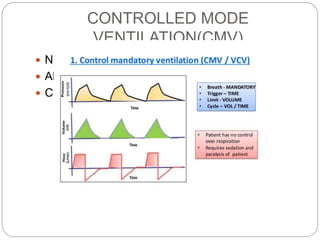
CONTROLLED MODE
VENTILATION(CMV)
 No spontaneous effort from patient.
 All breath are fully provided by ventilator.
 Control both pressure and volume
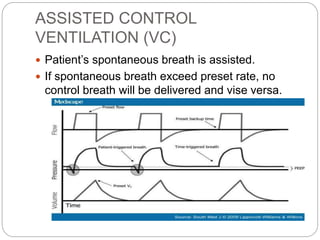
ASSISTED CONTROL
VENTILATION (VC)
 Patient’s spontaneous breath is assisted.
 If spontaneous breath exceed preset rate, no
control breath will be delivered and vise versa.
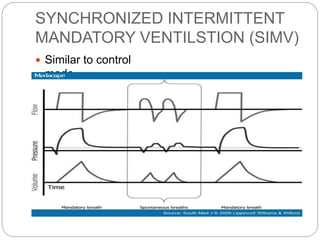
SYNCHRONIZED INTERMITTENT
MANDATORY VENTILSTION (SIMV)
 Similar to control
mode.
 Whatever the preset
mode, it is consider
mandatory.
 ventilator synchronize
its breath with
patient’s breath.
SYNCHRONIZED INTERMITTENT
MANDATORY VENTILSTION (SIMV)
 Advantages over
CMV :
 Less hemodynamic
depression (less
cardiac output)
 Less need of heavy
sedation or muscle
relaxants
 Less V/Q mismatch
 More rapid weaning
 Disadvantages :
 Use lots work of
breathing (leads to
muscle fatiggue)
 Increase chance of
hypocapnia (due
hyperventilation)
POSITIVE END EXPIRATORY
PRESSURE (PEEP)
 Positive pressure is
given at end of
expiratory :
 Prevent alveolar
collapse
 Lead to gas exchange
during expiration
 Used in :
 Pulmonary edema
 ARDS
 In thoracic surgery to
minimise bleeding
 Physiological PEEP
SIDE EFFECTS OF PEEP
 hypotension and
decrease cardiac
output
 Increase pulmonary
artery pressure and
right ventricular strain
 Increase dead space
 Increase pleural
pressure
 Increase mediastinal
pressure
 Increase intracranial
pressure
CONTINUOUS POSTIVE AIRWAY
PRESSURE (CPAP)
 Continuously the positive pressure is given.
 Help prevent alveolar collapse.
 Used for spontaneously breathing patient
INVERSE RATIO VENTILATION
 Inverse the inspiration and expiration ratio from
1:2 to 2:1.
 It prolonged the gas exchange time as inspiration
time is more
PRESSURE SUPPORT
VENTILATION
 Preset pressure is given to achieve desired tidal
volume.
 The PEEP preset are 8 cmH2O and then titrated
to achieve desired tidal volume.
 Can be used alone or combine with SIMV.
 Help in decrease work of breathing and overcome
resistance offered by endotracheal tube and
ventilator tubing.
PRESSSURE CONTROLLED
VENTILATION(PCV)
 Similar to pressure support ventilation.
 Difference is :
 Ventilator will cycle to expiration once a
predetermined time is elapse in the inspiration (time
cycle).
 Advantages :
 Less chance of barotrauma
 Have choice to extending the inspiratory time
 Disadvantages :
 Tidal volume can vary with airway pressure
BI-LEVEL POSITIVE AIRWAY
PRESSURE (BIPAP)
 Similar to continuous positive airway pressure.
 But it have typical setting :
 8-20 cmH2O on inspiration(IPAP)
 5 cmH2O on expiration(EPAP)
 Combination of PEEP and CPAP.
AIRWAY PRESSURE RELEASE
VENTILATION (APRV)
 Combine with PEEP and CPAP.
 Make a periodic release of pressure to decrease
incidence of barotrauma and hypotension.
HIGH FREQUENCY
VENTILATION
 Used in condition
where exact tidal
volume cannot be
delivered.
 Thus minute volume
is compensated by
high frequency.
 Indication :
 Bronchopleural fistula
 Bronchoscopies
 Microlaryngeal
surgery
 Emergency ventilation
through cricothyroid
membrane
HIGH FREQUENCY
VENTILATION
 High frequency ventilation may be :
 High frequency of positive pressure : 60-120
cycles/min
 High frequency jet ventilation : 100-300 cycles/min
with gases at high pressure
 High frequency oscillations : 600-3000 cycles/min
DUAL MODE VENTILATION
 Combine both pressure and volume ventilation.
 Modes used :
 Pressure controlled ventilation – volume guaranteed
 Bi-level volume guaranteed
COMPLICATIONS
 Pulmonary barotrauma
 Infection
 Due to prolonged intubation
 Due inadequate ventilation
 GIT
 Cardiovascular
 CNS
 Liver and kidney dysfunction
 Neuromuscular weakness
 Oxygen toxicity
 Physiological
 Due to prolonged bed rest
WEANING
 Discontinuing of ventilator support.
 Method :
 Shift from control/assist mode to SIMV.
 Decrease the rate of breathing till 1 to 2 breath/min.
 If tidal volume not sufficient give pressure support.
 Once tidal volume and frequency achieved,
disconnected it.
 If normal cardiac and pulmonary functions
maintained, extubation can be done.
WHEN??
 Initial setting in normal range
 Rapid shallow breathing index (RSBI)
 Normal arterial pH
 Normal hemoglobin
 Normal cardiac status
 Normal electrolyte
 Adequate nutritional status
REFERENCES
 Short textbook of Anaesthesia,Ajay Yaday,5th
edition
 The ICU Book, Paul L. Marino, 3rd Edition.

Mechanical ventilation

  • 1.
    NUR AINA BINTIAB KADIR MECHANCAL VENTILATION
  • 2.
    CONTENTS Introduction Types Components IndicationsModes Dual mode ventilation Complications Weaning
  • 3.
    INTRODUCTION  The fundamentaloperation of positive pressure ventilation is to create a pressure that moves a volume of gas into the lungs.  1. Volume-controlled ventilation , where the inflation volume (tidal volume) is preselected, and the ventilator automatically adjusts the inflation pressure to deliver the desired volume. The rate of lung inflation can be constant or decelerating.  2. Pressure-controlled ventilation, where the inflation pressure is preselected, and the duration of inflation is adjusted (by the operator) to deliver the desired tidal volume. The rate of lung inflation is high at the onset of lung inflation (to achieve the desired inflation pressure), then rapidly decelerates (to maintain a
  • 4.
  • 5.
    NON INVASIVE  Haverespiratory failure but no urgent need of intubation  Conscious and cooperative  No risk of aspiration  Tightly fitted mask
  • 6.
    CONTRAINDICATION  Contraindication : Cardiac and respiratory arrest  Severe hypoxemia  High risk of aspiration  Facial trauma  Inability to protect airways  Upper GI bleed
  • 7.
    COMPLICATIONS  Leakage Hypoventilation Inconvenience and claustrophobia  Increase chance of aspiration  Skin breakdown, facial edema on prolonged use
  • 8.
    INITIAL SETTING OF VENTILATOR Tidal volume : 6-8 ml  I:E ratio : 1:2  Frequency : 10-12 breaths/min  Inspiratory flow rate : 60-80 liters/min  PEEP : 3-5 cmH2O  Trigger sensitivity : -1 to -2 cmH2O  FIO2 : 0.5 (50%)
  • 9.
  • 10.
    OTHERS  Excessive fatigueof respiratory muscle  Loss of protective airway reflexes  Inability to cough adequately
  • 11.
    MODES  Controlled modeventilation (CMV)  Assisted controlled ventilation (AC)  Synchronized intermittent mandatory ventilation (SIMV)  Positive end expiratory pressure (PEEP)  Continuous positive airway pressure (CPAP)  Inverse ratio ventilation (IRV)  Pressure support ventilation (PSV)  Pressure controlled ventilation (PCV)  Bi-level positive airway pressure (BIPAP)  Airway pressure release ventilation (APRV)  High frequency ventilation
  • 12.
    CONTROLLED MODE VENTILATION(CMV)  Nospontaneous effort from patient.  All breath are fully provided by ventilator.  Control both pressure and volume
  • 13.
    ASSISTED CONTROL VENTILATION (VC) Patient’s spontaneous breath is assisted.  If spontaneous breath exceed preset rate, no control breath will be delivered and vise versa.
  • 14.
    SYNCHRONIZED INTERMITTENT MANDATORY VENTILSTION(SIMV)  Similar to control mode.  Whatever the preset mode, it is consider mandatory.  ventilator synchronize its breath with patient’s breath.
  • 15.
    SYNCHRONIZED INTERMITTENT MANDATORY VENTILSTION(SIMV)  Advantages over CMV :  Less hemodynamic depression (less cardiac output)  Less need of heavy sedation or muscle relaxants  Less V/Q mismatch  More rapid weaning  Disadvantages :  Use lots work of breathing (leads to muscle fatiggue)  Increase chance of hypocapnia (due hyperventilation)
  • 16.
    POSITIVE END EXPIRATORY PRESSURE(PEEP)  Positive pressure is given at end of expiratory :  Prevent alveolar collapse  Lead to gas exchange during expiration  Used in :  Pulmonary edema  ARDS  In thoracic surgery to minimise bleeding  Physiological PEEP
  • 17.
    SIDE EFFECTS OFPEEP  hypotension and decrease cardiac output  Increase pulmonary artery pressure and right ventricular strain  Increase dead space  Increase pleural pressure  Increase mediastinal pressure  Increase intracranial pressure
  • 18.
    CONTINUOUS POSTIVE AIRWAY PRESSURE(CPAP)  Continuously the positive pressure is given.  Help prevent alveolar collapse.  Used for spontaneously breathing patient
  • 19.
    INVERSE RATIO VENTILATION Inverse the inspiration and expiration ratio from 1:2 to 2:1.  It prolonged the gas exchange time as inspiration time is more
  • 20.
    PRESSURE SUPPORT VENTILATION  Presetpressure is given to achieve desired tidal volume.  The PEEP preset are 8 cmH2O and then titrated to achieve desired tidal volume.  Can be used alone or combine with SIMV.  Help in decrease work of breathing and overcome resistance offered by endotracheal tube and ventilator tubing.
  • 21.
    PRESSSURE CONTROLLED VENTILATION(PCV)  Similarto pressure support ventilation.  Difference is :  Ventilator will cycle to expiration once a predetermined time is elapse in the inspiration (time cycle).  Advantages :  Less chance of barotrauma  Have choice to extending the inspiratory time  Disadvantages :  Tidal volume can vary with airway pressure
  • 22.
    BI-LEVEL POSITIVE AIRWAY PRESSURE(BIPAP)  Similar to continuous positive airway pressure.  But it have typical setting :  8-20 cmH2O on inspiration(IPAP)  5 cmH2O on expiration(EPAP)  Combination of PEEP and CPAP.
  • 23.
    AIRWAY PRESSURE RELEASE VENTILATION(APRV)  Combine with PEEP and CPAP.  Make a periodic release of pressure to decrease incidence of barotrauma and hypotension.
  • 24.
    HIGH FREQUENCY VENTILATION  Usedin condition where exact tidal volume cannot be delivered.  Thus minute volume is compensated by high frequency.  Indication :  Bronchopleural fistula  Bronchoscopies  Microlaryngeal surgery  Emergency ventilation through cricothyroid membrane
  • 25.
    HIGH FREQUENCY VENTILATION  Highfrequency ventilation may be :  High frequency of positive pressure : 60-120 cycles/min  High frequency jet ventilation : 100-300 cycles/min with gases at high pressure  High frequency oscillations : 600-3000 cycles/min
  • 26.
    DUAL MODE VENTILATION Combine both pressure and volume ventilation.  Modes used :  Pressure controlled ventilation – volume guaranteed  Bi-level volume guaranteed
  • 27.
    COMPLICATIONS  Pulmonary barotrauma Infection  Due to prolonged intubation  Due inadequate ventilation  GIT  Cardiovascular  CNS  Liver and kidney dysfunction  Neuromuscular weakness  Oxygen toxicity  Physiological  Due to prolonged bed rest
  • 28.
    WEANING  Discontinuing ofventilator support.  Method :  Shift from control/assist mode to SIMV.  Decrease the rate of breathing till 1 to 2 breath/min.  If tidal volume not sufficient give pressure support.  Once tidal volume and frequency achieved, disconnected it.  If normal cardiac and pulmonary functions maintained, extubation can be done.
  • 29.
    WHEN??  Initial settingin normal range  Rapid shallow breathing index (RSBI)  Normal arterial pH  Normal hemoglobin  Normal cardiac status  Normal electrolyte  Adequate nutritional status
  • 30.
    REFERENCES  Short textbookof Anaesthesia,Ajay Yaday,5th edition  The ICU Book, Paul L. Marino, 3rd Edition.