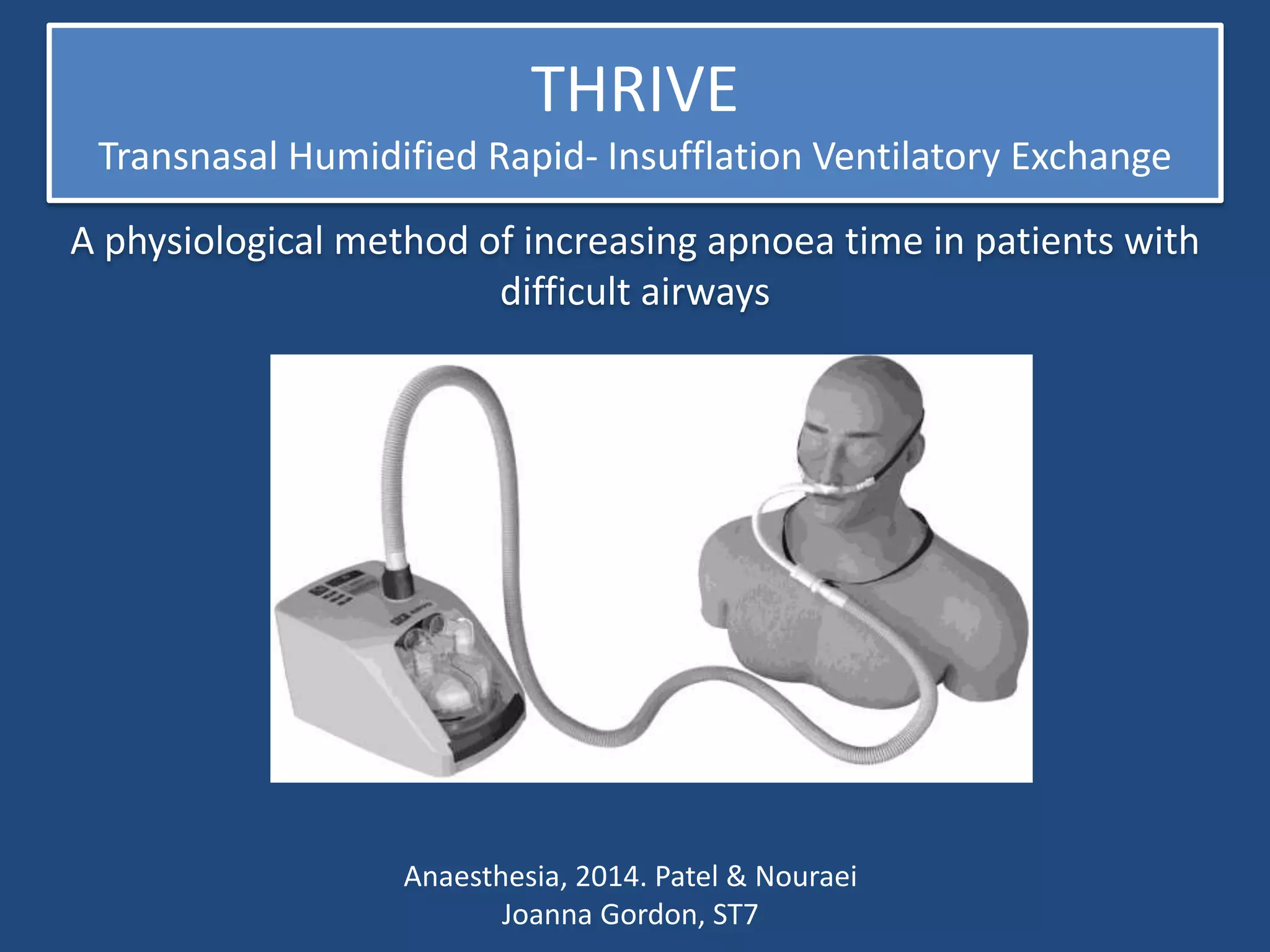
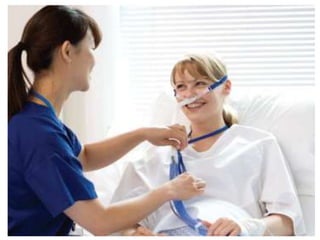
THRIVE
Transnasal Humidified Rapid- Insufflation Ventilatory Exchange
A physiological method of increasing apnoea time in patients with
difficult airways
Anaesthesia, 2014. Patel & Nouraei
Joanna Gordon, ST7
Mechanisms of action
• Warmth & humidification allows higher flows
• Flush dead space in nasopharynx  CO2
• Mechanical splinting  supraglottic resistance
• Warmed, humidified – less constriction, more compliance
• Distending pressure – up to 6cm H2O pharyngeal pressure
• Apnoeic oxygenation
• Reducing rates of intubation in resp failure
• Reducing rates of re-intubation on ITU and PACU
• Home device as alternative to CPAP/BiPAP for OSA &
CLD
• Areas of increasing interest:
– Pre-oxygenation in high risk pts (adults)
– Oxygenation during difficult airway management
Uses
Sample
• Case series
• 25 adult patients
• Difficult airways - anatomical or rapid
SpO2 likely
• Stenosis, vocal fold pathology, OSA,
hypopharyngeal obstruction
Methods
• 40 degrees head up tilt
• Optiflow at 70L/min, 10 minutes
• Prop 2-3mg/kg, Fent 1-2μg/kg, Roc 0.5mg/kg
• TIVA maintenance, propofol 0.2-0.3mg/kg/min
• Jaw thrust on LOC
• BMV confirmed then discontinued
1. MAC laryngoscopy
2. VL
3. VL difficult blade
• Apnoea time = NMB to PPV or jet vent or SV
Results
• 15M, 10F
• Mean age 49 (25-81)
• Median BMI 30 (18-52)
• 10 benign larynx, 2 OSA, 4 head & neck masses
• 9 had stridor
• Median MP = 3
• Median C&L = 3
• Mean apnoea time = 17mins (5 – 65)
Results
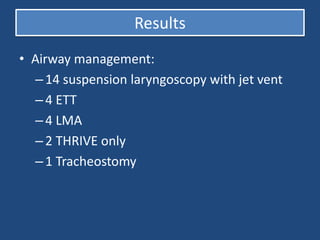
• Airway management:
–14 suspension laryngoscopy with jet vent
–4 ETT
–4 LMA
–2 THRIVE only
–1 Tracheostomy
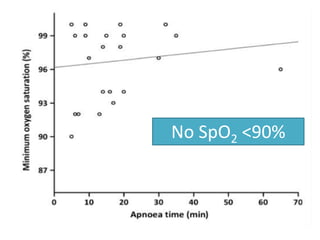
No SpO2 <90%
THRIVE
Limitations
• Observational & cross sectional
– routine clinical care
• Optiflow only until definitive airway secured
• Airway expert management ? generalisable
• Techniques not far from our practice
• Conclusion – can extend safe apnoeic window
THRIVE
To change difficult airway management?

Thrive journal club crh

  • 1.
    THRIVE Transnasal Humidified Rapid-Insufflation Ventilatory Exchange A physiological method of increasing apnoea time in patients with difficult airways Anaesthesia, 2014. Patel & Nouraei Joanna Gordon, ST7
  • 2.
    Mechanisms of action •Warmth & humidification allows higher flows • Flush dead space in nasopharynx  CO2 • Mechanical splinting  supraglottic resistance • Warmed, humidified – less constriction, more compliance • Distending pressure – up to 6cm H2O pharyngeal pressure • Apnoeic oxygenation
  • 3.
    • Reducing ratesof intubation in resp failure • Reducing rates of re-intubation on ITU and PACU • Home device as alternative to CPAP/BiPAP for OSA & CLD • Areas of increasing interest: – Pre-oxygenation in high risk pts (adults) – Oxygenation during difficult airway management Uses
  • 5.
    Sample • Case series •25 adult patients • Difficult airways - anatomical or rapid SpO2 likely • Stenosis, vocal fold pathology, OSA, hypopharyngeal obstruction
  • 6.
    Methods • 40 degreeshead up tilt • Optiflow at 70L/min, 10 minutes • Prop 2-3mg/kg, Fent 1-2μg/kg, Roc 0.5mg/kg • TIVA maintenance, propofol 0.2-0.3mg/kg/min • Jaw thrust on LOC • BMV confirmed then discontinued 1. MAC laryngoscopy 2. VL 3. VL difficult blade • Apnoea time = NMB to PPV or jet vent or SV
  • 7.
    Results • 15M, 10F •Mean age 49 (25-81) • Median BMI 30 (18-52) • 10 benign larynx, 2 OSA, 4 head & neck masses • 9 had stridor • Median MP = 3 • Median C&L = 3 • Mean apnoea time = 17mins (5 – 65)
  • 8.
    Results • Airway management: –14suspension laryngoscopy with jet vent –4 ETT –4 LMA –2 THRIVE only –1 Tracheostomy
  • 9.
  • 11.
  • 12.
    Limitations • Observational &cross sectional – routine clinical care • Optiflow only until definitive airway secured • Airway expert management ? generalisable • Techniques not far from our practice • Conclusion – can extend safe apnoeic window
  • 13.
    THRIVE To change difficultairway management?

Editor's Notes

  • #3 Flush dead space – alveolar ventilation is larger fraction of minute ventilation Inspiration normally causes retraction of nasopharyngeal boundaries causing increased resistance – high flow causes splinting which reduces resistance along that airway pathway Studies have shown just 5mins cold dry gas causes bronchoconstriction and less compliance of lung ? Muscarinic receptors Apnoeic oxygenation – as oxygen is removed and CO2 is excreted in alveoli, that pressure gradient as long as a patent airway exists between the lungs and the oxygen delivery device, drives oxygen into the lungs
  • #10 BMI 52 – spasmodic dysphonia , SpO2 of 90% after 5mins BMI 34 – severe tracheobronchomalacia, SpO2 of 92% after 7mins, acute airway compromise 2 patients with longest apnoea times had THRIVE throughout their pharyngolaryngeal surgery – 32 & 65 mins Correlation coefficient R is 0.13 – not much correlation P value is 0.5
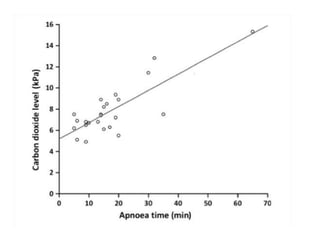
  • #11 4 patients had Arterial CO2 measured – 2x long apnoea times, 2 where art line inserted for other indications EtCo2 via definitive airway device Correlation coefficient is R = 0.82 – good correlation P<0.0001
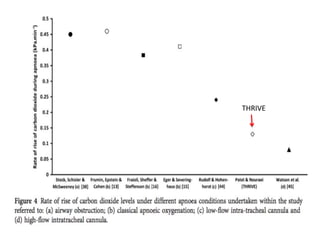
  • #12 b) Classical apnoeic oxygenation rate of CO2 rise is 0.35 to 0.45 kPa/minute – similar to if airway obstructed THRIVE is just > 0.1kPa/ minute
  • #14 Airway management can be quite high stress time anaesthetists feel quite pressured, stop-start process because of the constant time limitation to each attempt at securing the airway and that in itself can lead to more trauma and a cycle of the airway becoming increasingly difficult to manage. High flow nasal oxygen does show real promise as a technique to reduce that pressure & help move airway management towards a much smoother, continuous process which is unhurried and less stressful.