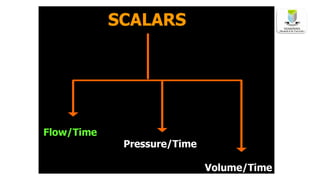
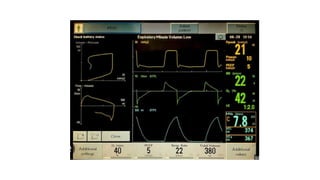
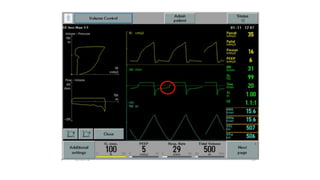
PURPOSE OF VENTILATORGRAPHICS
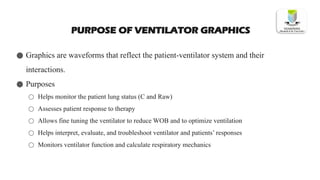
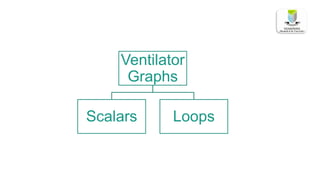
● Graphics are waveforms that reflect the patient-ventilator system and their
interactions.
● Purposes
○ Helps monitor the patient lung status (C and Raw)
○ Assesses patient response to therapy
○ Allows fine tuning the ventilator to reduce WOB and to optimize ventilation
○ Helps interpret, evaluate, and troubleshoot ventilator and patients’ responses
○ Monitors ventilator function and calculate respiratory mechanics
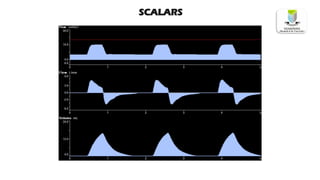
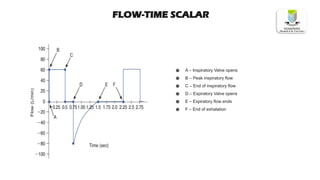
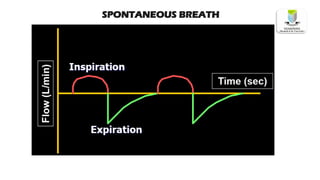
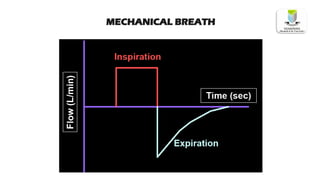
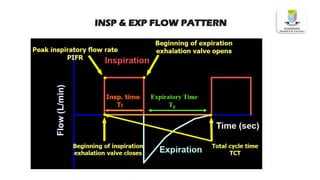
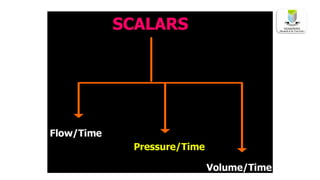
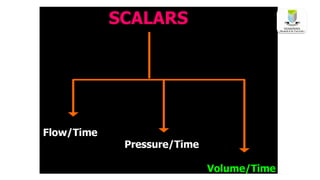
FLOW-TIME SCALAR
● A– Inspiratory Valve opens
● B – Peak inspiratory flow
● C – End of inspiratory flow
● D – Expiratory Valve opens
● E – Expiratory flow ends
● F – End of exhalation
10.
FLOW-TIME SCALARS
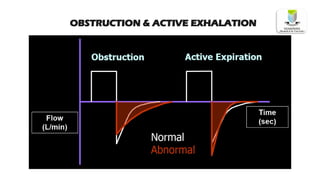
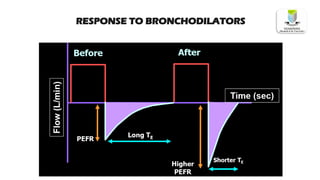
● Usefulto detect certain abnormalities.
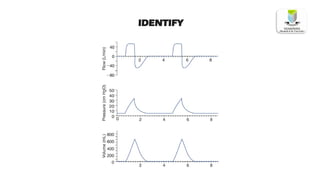
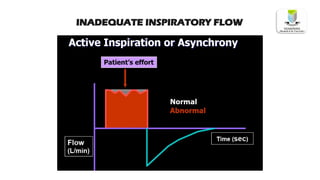
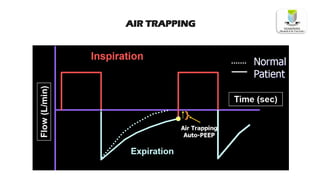
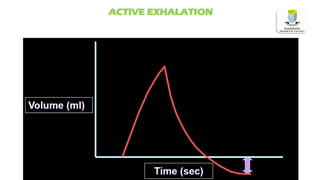
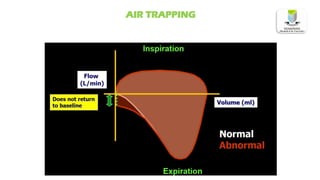
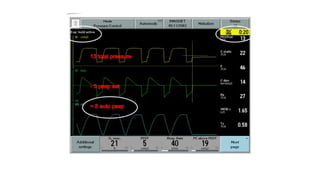
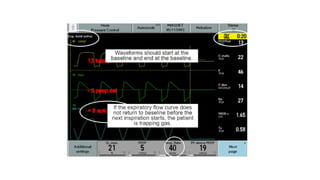
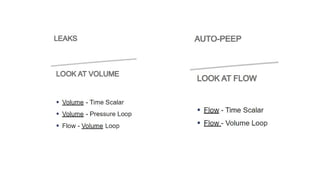
● If expiratory flow doesn’t return to baseline before the next breath, there is auto-PEEP present.
● CPAP has a sinusoidal flow pattern unless PS has been added.
11.
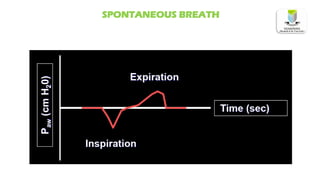
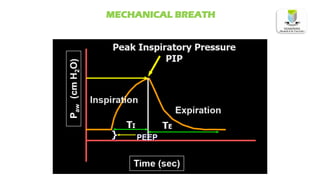
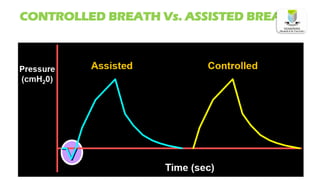
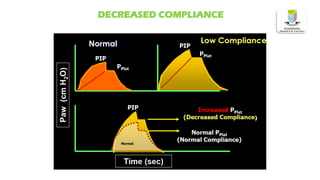
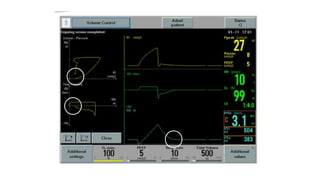
PRESSURE-TIME SCALAR
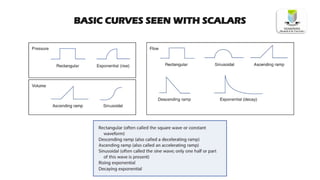
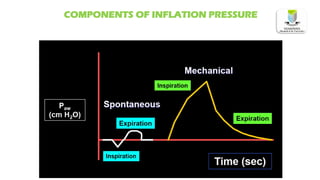
● Patienttriggered breaths will have a negative deflection at the start of the
breath if pressure triggering is used.
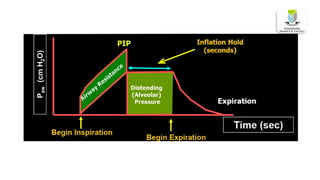
● In volume modes, the shape of PT curve will be exponential rise for
mandatory breaths and sinusoidal for spontaneous breaths.
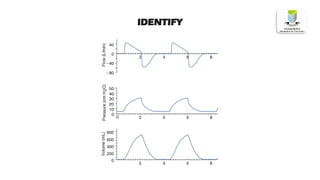
● In pressure modes, the shape of PT curve will be rectangular for mandatory
breaths and sinusoidal for spontaneous breaths.
● Addition of PEEP raises the baseline in the PT curve.
● The area under the entire curve equals the mean airway pressure.
12.
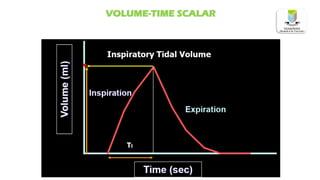
VOLUME-TIME SCALAR
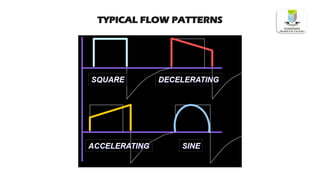
● Dependson the type of flow pattern used.
○ Ascending ramp pattern with square wave flow pattern
○ Exponential rise if the decelerating flow pattern is used
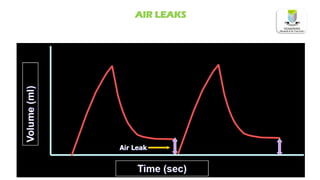
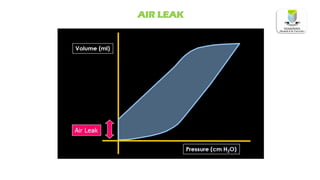
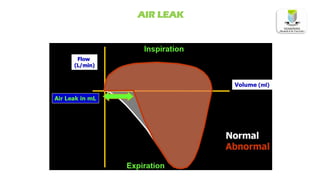
● Helpful to detect abnormalities (auto-PEEP or air leak) – Exhalation side of the curve
does not return to the baseline.
#11 In volume modes, the shape of PT curve will be exponential rise for mandatory breaths and sinusoidal for spontaneous breaths.
In pressure modes, the shape of PT curve will be rectangular for mandatory breaths and sinusoidal for spontaneous breaths.