Management of Snake Bite Victims


Dr. Smrutiranjan Patanaik
Hopes everyone finds it helpful ….. Just a quick review
Epidemiology
• India estimates in the region of 200,000 bites and 15-
  20,000 snake bite deaths per year
• Originally made in the last century, are still quoted. No
  reliable national statistics are available.
• Males are bitten almost twice as often as females
• Majority of the bites being on the lower extremities.
• 50% of bites by venomous snakes are dry bites. that
  result in negligible envenomation.
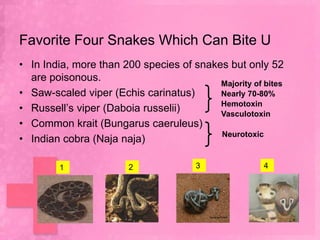
Favorite Four Snakes Which Can Bite U
• In India, more than 200 species of snakes but only 52
  are poisonous.
                                          Majority of bites
• Saw-scaled viper (Echis carinatus)      Nearly 70-80%
                                          Hemotoxin
• Russell’s viper (Daboia russelii)       Vasculotoxin
• Common krait (Bungarus caeruleus)
                                          Neurotoxic
• Indian cobra (Naja naja)

        1               2              3              4
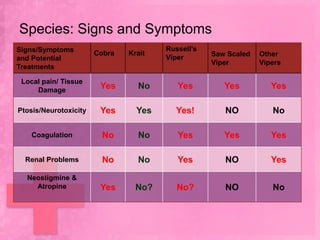
Species: Signs and Symptoms
Signs/Symptoms                         Russell’s
                       Cobra   Krait               Saw Scaled   Other
and Potential                          Viper
                                                   Viper        Vipers
Treatments

 Local pain/ Tissue
     Damage
                        Yes      No       Yes         Yes          Yes

Ptosis/Neurotoxicity    Yes      Yes     Yes!         NO           No

    Coagulation         No       No       Yes         Yes          Yes

  Renal Problems        No       No       Yes         NO           Yes
  Neostigmine &
    Atropine            Yes      No?      No?         NO           No
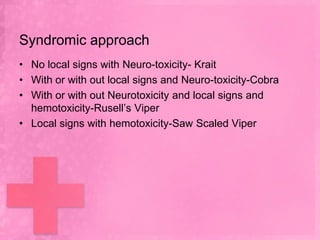
Syndromic approach
• No local signs with Neuro-toxicity- Krait
• With or with out local signs and Neuro-toxicity-Cobra
• With or with out Neurotoxicity and local signs and
  hemotoxicity-Rusell’s Viper
• Local signs with hemotoxicity-Saw Scaled Viper
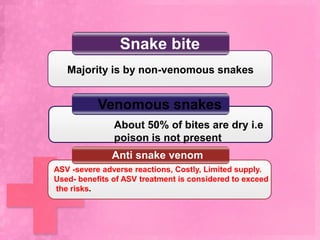
Snake bite
   Majority is by non-venomous snakes


           Venomous snakes
               About 50% of bites are dry i.e
               poison is not present
              Anti snake venom
ASV -severe adverse reactions, Costly, Limited supply.
Used- benefits of ASV treatment is considered to exceed
the risks.
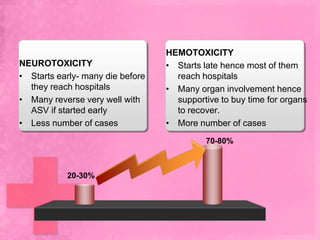
HEMOTOXICITY
NEUROTOXICITY                     • Starts late hence most of them
• Starts early- many die before     reach hospitals
  they reach hospitals            • Many organ involvement hence
• Many reverse very well with       supportive to buy time for organs
  ASV if started early              to recover.
• Less number of cases            • More number of cases
                                           70-80%


           20-30%
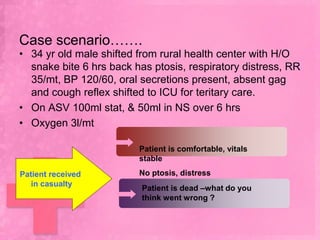
Case scenario…….
• 34 yr old male shifted from rural health center with H/O
  snake bite 6 hrs back has ptosis, respiratory distress, RR
  35/mt, BP 120/60, oral secretions present, absent gag
  and cough reflex shifted to ICU for teritary care.
• On ASV 100ml stat, & 50ml in NS over 6 hrs
• Oxygen 3l/mt

                         Patient is comfortable, vitals
                         stable
Patient received         No ptosis, distress
   in casualty
                          Patient is dead –what do you
                          think went wrong ?
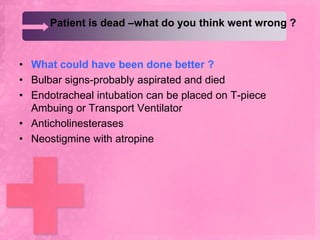
Patient is dead –what do you think went wrong ?


• What could have been done better ?
• Bulbar signs-probably aspirated and died
• Endotracheal intubation can be placed on T-piece
  Ambuing or Transport Ventilator
• Anticholinesterases
• Neostigmine with atropine
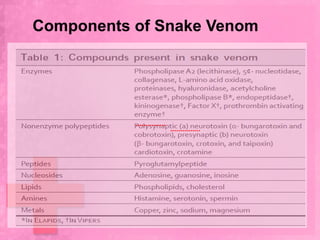
Components of Snake Venom
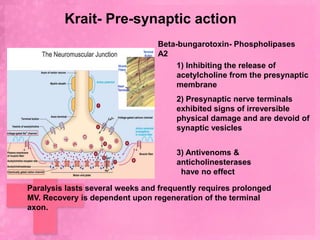
Krait- Pre-synaptic action
                                 Beta-bungarotoxin- Phospholipases
                                 A2
                                      1) Inhibiting the release of
                                      acetylcholine from the presynaptic
                                      membrane
                                      2) Presynaptic nerve terminals
                                      exhibited signs of irreversible
                                      physical damage and are devoid of
                                      synaptic vesicles


                                      3) Antivenoms &
                                      anticholinesterases
                                       have no effect

Paralysis lasts several weeks and frequently requires prolonged
MV. Recovery is dependent upon regeneration of the terminal
axon.
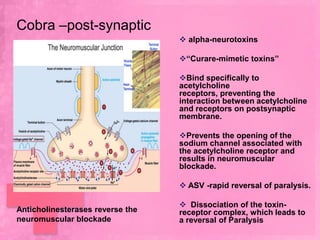
Cobra –post-synaptic
                                   alpha-neurotoxins

                                  “Curare-mimetic toxins’’

                                  Bind specifically to
                                  acetylcholine
                                  receptors, preventing the
                                  interaction between acetylcholine
                                  and receptors on postsynaptic
                                  membrane.

                                  Prevents the opening of the
                                  sodium channel associated with
                                  the acetylcholine receptor and
                                  results in neuromuscular
                                  blockade.

                                   ASV -rapid reversal of paralysis.

                                   Dissociation of the toxin-
Anticholinesterases reverse the   receptor complex, which leads to
neuromuscular blockade            a reversal of Paralysis
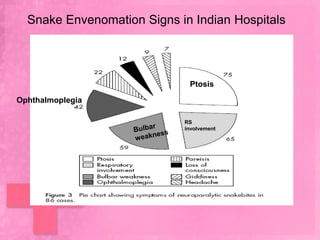
Snake Envenomation Signs in Indian Hospitals


                             Ptosis
Ophthalmoplegia

                            RS
                            involvement
Neurotoxic Venom - Examination
•Ask the patient to look up and observe whether the
upper lids retract fully.
•Test eye movements for evidence of early external
ophthalmoplegia .
•Check the size and reaction of the pupils.
•Krait can cause fixed, dilated non reactive pupils
simulating brain stem death – however, it can recover
fully
•Ask the patient to open their mouth wide and
protrude their tongue; early restriction often paralysis
of pterygoid muscles.
• The muscles flexing the neck may be
paralysed, giving the “broken neck sign
Bulbar paralysis
• Can the patient swallow or are secretions accumulating
  in the pharynx- an early sign of bulbar paralysis?
• Ask the patient to take deep breaths in and out.
  ―Paradoxical respiration‖.
• Objective measurement of ventilatory capacity is very
  useful. Use a peak flow metre, spirometer (FEV1 and
  FVC)
• Ask the patient to blow into the tube of a
  sphygmomanometer to record the maximum expiratory
  pressure (mmHg).
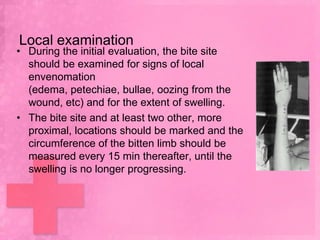
Local examination
• During the initial evaluation, the bite site
  should be examined for signs of local
  envenomation
  (edema, petechiae, bullae, oozing from the
  wound, etc) and for the extent of swelling.
• The bite site and at least two other, more
  proximal, locations should be marked and the
  circumference of the bitten limb should be
  measured every 15 min thereafter, until the
  swelling is no longer progressing.
Treatment
•   Anti Snake Venom
•   Polyvalent /Monovalent
•   Dose-large vs small
•   Timing
•   Repeat dose
•   Hypersensitivity
•   Anticholinesterases- Tensilon test
•   Mechanical ventilation
Anti Snake Venom (ASV)
• The decision to treat a snake bite with antivenin is
  largely based on clinical parameters.
• Trying to capture, kill, or transport a snake for
  identification purposes seems of little value and
  possibly dangerous

    ASV is polyvalent
    Syndromic approach helps in
    examination and investigations and
    outcome predictions
Skin testing for ASV
• Skin/conjunctival hypersensitivity testing does not
  reliably predict early or late antivenom reactions
  and is not recommended.
What is ASV?
• Antivenom is immunoglobulin (usually the enzyme
  refined F(ab)2 fragment of IgG) purified from the serum
  or plasma of a horse or sheep that has been immunised
  with the venoms of one or more species of snake.
• Monovalent or monospecific antivenom neutralises the
  venom
• of only one species of snake
• Polyvalent or polyspecific antivenom neutralises the
  venoms of several different species of snakes
• The ASV that is available in India is a polyvalent type
  which is active against the commonly found snakes in
  India including the Favourite Four.
Indications for ASV
•   Neurotoxicity
•   ARF
•   Bleeding/coagulopathy
•   Myoglobinuria/haemoglobinuria
•   Cardiac toxicity
•   Local swelling involving more than half of the bitten limb
•   Rapid extension of swelling
•    Development of an enlarged tender lymph node draining
    the bitten limb
Timing of ASV
• There is no consensus as to the outer limit of time of
  administration of antivenom. Best effects are observed
  within four hours of bite .
• It has been noted to be effective in symptomatic patients
  even when administered up to 48 hours after bite.
• Reports suggest that antivenom is efficacious even 6-7
  days after the bite from vipers
• When there are signs of local envenoming, without
  systemic envenoming, antivenom will be effective only if
  it can be given within the first few hours after the bite
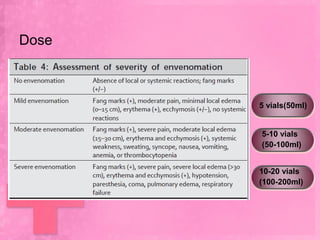
Dose


       5 vials(50ml)


       5-10 vials
       (50-100ml)


       10-20 vials
       (100-200ml)
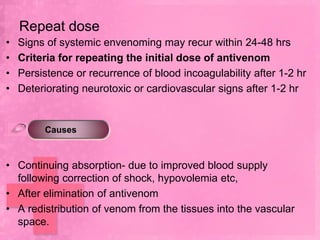
Repeat dose
•   Signs of systemic envenoming may recur within 24-48 hrs
•   Criteria for repeating the initial dose of antivenom
•   Persistence or recurrence of blood incoagulability after 1-2 hr
•   Deteriorating neurotoxic or cardiovascular signs after 1-2 hr


         Causes


• Continuing absorption- due to improved blood supply
  following correction of shock, hypovolemia etc,
• After elimination of antivenom
• A redistribution of venom from the tissues into the vascular
  space.
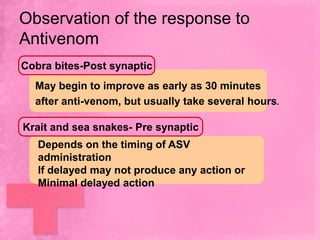
Observation of the response to
Antivenom
Cobra bites-Post synaptic
  May begin to improve as early as 30 minutes
  after anti-venom, but usually take several hours.

Krait and sea snakes- Pre synaptic
   Depends on the timing of ASV
   administration
   If delayed may not produce any action or
   Minimal delayed action
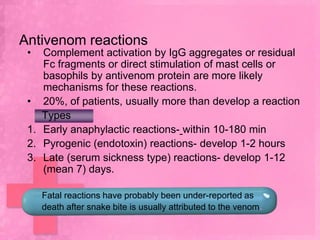
Antivenom reactions
 •  Complement activation by IgG aggregates or residual
    Fc fragments or direct stimulation of mast cells or
    basophils by antivenom protein are more likely
    mechanisms for these reactions.
 • 20%, of patients, usually more than develop a reaction
    Types
 1. Early anaphylactic reactions- within 10-180 min
 2. Pyrogenic (endotoxin) reactions- develop 1-2 hours
 3. Late (serum sickness type) reactions- develop 1-12
    (mean 7) days.

     Fatal reactions have probably been under-reported as
     death after snake bite is usually attributed to the venom.
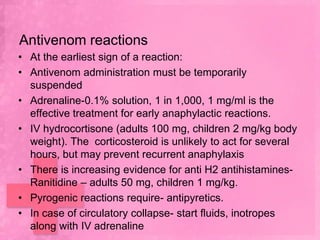
Antivenom reactions
• At the earliest sign of a reaction:
• Antivenom administration must be temporarily
  suspended
• Adrenaline-0.1% solution, 1 in 1,000, 1 mg/ml is the
  effective treatment for early anaphylactic reactions.
• IV hydrocortisone (adults 100 mg, children 2 mg/kg body
  weight). The corticosteroid is unlikely to act for several
  hours, but may prevent recurrent anaphylaxis
• There is increasing evidence for anti H2 antihistamines-
  Ranitidine – adults 50 mg, children 1 mg/kg.
• Pyrogenic reactions require- antipyretics.
• In case of circulatory collapse- start fluids, inotropes
  along with IV adrenaline
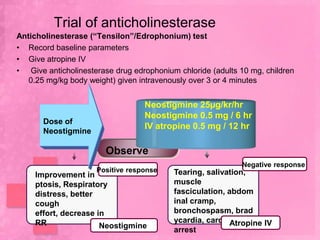
Trial of anticholinesterase
Anticholinesterase (“Tensilon”/Edrophonium) test
• Record baseline parameters
• Give atropine IV
• Give anticholinesterase drug edrophonium chloride (adults 10 mg, children
   0.25 mg/kg body weight) given intravenously over 3 or 4 minutes


                                  Neostigmine 25µg/kr/hr
                                  Neostigmine 0.5 mg / 6 hr
       Dose of
                                  IV atropine 0.5 mg / 12 hr
       Neostigmine

                        Observe
                                                            Negative response
                     Positive response    Tearing, salivation,
     Improvement in
     ptosis, Respiratory                  muscle
     distress, better                     fasciculation, abdom
     cough                                inal cramp,
     effort, decrease in                  bronchospasm, brad
     RR                                   ycardia, cardiac
                                                         Atropine IV
                       Neostigmine        arrest
Mechanical ventilation
• If patient has respiratory distress or bulbar paralysis-
  intubate and ventilate.
• If delayed can cause aspiration or hypoxia and cardiac
  arrest.
• Even if the facility for MV is not available
  Ambuing can save the day.
• This helps even during transport.
• MV is not complicated is like ventilating a patient with
  curare over-dosage
ASV and children (Biggest Myth among
doctors)
 • Dose of antivenom
 • Snakes inject the same dose of venom into children and
   adults.
 • Children must therefore be given exactly the same dose
   of antivenom as adults.
Pregnancy and snake bite
 • Pregnant patient is treated the same manner as the
   nonpregnant patient. Spontaneous
   abortion, bleeding, fetal death & malformations are
   common.
 • Lactating mothers can continue lactating
 • Fetal demise is difficult to predict because of associated
   symptoms, such as coagulopathy or hypotension, and
   complications of treatment including anaphylaxis.
 • Generally speaking, the severity of the mother's clinical
   course seems to be the best indicator of the fetal
   survival.
Treatment issues in non Neurotoxic
respiratory paralysis
• Aspiration can complicate Mechanical Ventilation.
• Respiratory paralysis due to Shock, ARF, Sepsis, etc..
   MV is instituted to buy time till the organs recover
  Treatment is directed towards the cause
  ASV
  Antibiotics
  Source control-Fasciotomies ?
  Dialysis
  Inotropes
  Blood and blood products
• A 25 yr old male with snake bite has signs of
  compartment syndrome and the pressure is 60 mmHg is
  undergoing surgery has a Hb of 6 gm%, is hypotensive
  100/60, on noradrenalin, acidotic,coagulation profile is
  normal
• Blood is started
• After 15 mts of surgical time patient develops
• Dark colored urine                        Treatment
• Bp drops to 80/60                         Fluids, Mannitol,
                                            Alkalinize the urine,
• What are the possibilities ?              Manage electrolytes
                                               Fasciotomy
                                               RRT
 Rhabdomyolysis
 Mismatched Blood transfusion
Krait
• Bites by krait, coral snake, and some cobras are
  associated with minimal local changes;
• However, bite by the Indian cobra (Naja naja)
  results in tender local swelling, blistering, and
  necrosis. Local necrosis causes a picture of wet
  gangrene with a characteristic putrid smell due to
  the direct cytolytic action of the venom.
• Skip lesions are typical findings
Viper
• Viper bite is primarily vasculotoxic. It causes
  rapidly developing swelling of the bitten part.
• Local necrosis is mainly ischemic as thrombosis
  blocks the local blood vessels and causes a dry
  gangrene
Clinical features of a compartmental syndrome
• Disproportionately severe pain
• Weakness of intracompartmental muscles
• Pain on passive stretching of intracompartmental muscles
• Hypoaesthesia of areas of skin supplied by nerves running through the
compartment
• Obvious tenseness of the compartment on palpation

             Early treatment with antivenom remains the best
              way of preventing irreversible muscle damage


    Criteria for fasciotomy in snake-bitten limbs

 Haemostatic abnormalities have been corrected (antivenom, with or
 without clotting factors)
 • Clinical evidence of an intracompartmental syndrome
 • Intracompartmental pressure >40 mmHg (in adults)
Fasciotomy
• Fasciotomy should not be carried out in snake
  bite patients unless or until haemostatic
  abnormalities have been corrected.
• Clinical features of an intracompartmental
  syndrome are present and a high
  intracompartmental pressure has been confirmed
  by direct measurement
High-Dose Anti-Snake Venom Versus Low-Dose Anti-
Snake Venom in The Treatment of Poisonous Snake
Bites — A Critical Study

• Results :
• In the low-dose group
• Mortality rate of 10%, 18% required dialysis and 6%
  required ventilatory support. LOS 8.42 days
• In the high-dose group
• Mortality rate of 14%, 26% required dialysis 6% required
  ventilatory support.LOS 9.02 days
• Conclusion : While there was no additional advantage in
  following a high-dose regime for snake bite cases, there
  was considerable financial gain by following the low-
  dose regime,
• Most of the parameters showed a beneficial trend for
  the low-dose group though the differences were not
  statistically significant
High vs low ASV
• Repeated high doses of ASV to restore the clotting time
  to normal within the shortest time, do not seem to be
  necessary to reduce the ultimate morbidity and
  mortality.
• A smaller dose sufficient to make the clotting time graph
  take a downward trend is sufficient.
• The body’s detoxifying system will bring down the clotting
  time eventually though it may take a slightly longer time.
• This delay does not seem to affect the morbidity and
  mortality as shown by the results of some trial.
Summary
• Snake bites may be by an non venomous snake or a dry
  bite
• Not all snake bites require ASV
• ASV is the main stay in the treatment of snake bites
• ASV must be initiated if indicated at the earliest
• Respiratory paralysis can be because of different
  reasons-Neurotoxicity, shock, sepsis, ARF…
• MV may be main stay of treatment or just supportive
  depending on the cause of failure.
Management of snake bite victims

Management of snake bite victims

  • 1.
    Management of SnakeBite Victims Dr. Smrutiranjan Patanaik Hopes everyone finds it helpful ….. Just a quick review
  • 2.
    Epidemiology • India estimatesin the region of 200,000 bites and 15- 20,000 snake bite deaths per year • Originally made in the last century, are still quoted. No reliable national statistics are available. • Males are bitten almost twice as often as females • Majority of the bites being on the lower extremities. • 50% of bites by venomous snakes are dry bites. that result in negligible envenomation.
  • 3.
    Favorite Four SnakesWhich Can Bite U • In India, more than 200 species of snakes but only 52 are poisonous. Majority of bites • Saw-scaled viper (Echis carinatus) Nearly 70-80% Hemotoxin • Russell’s viper (Daboia russelii) Vasculotoxin • Common krait (Bungarus caeruleus) Neurotoxic • Indian cobra (Naja naja) 1 2 3 4
  • 4.
    Species: Signs andSymptoms Signs/Symptoms Russell’s Cobra Krait Saw Scaled Other and Potential Viper Viper Vipers Treatments Local pain/ Tissue Damage Yes No Yes Yes Yes Ptosis/Neurotoxicity Yes Yes Yes! NO No Coagulation No No Yes Yes Yes Renal Problems No No Yes NO Yes Neostigmine & Atropine Yes No? No? NO No
  • 5.
    Syndromic approach • Nolocal signs with Neuro-toxicity- Krait • With or with out local signs and Neuro-toxicity-Cobra • With or with out Neurotoxicity and local signs and hemotoxicity-Rusell’s Viper • Local signs with hemotoxicity-Saw Scaled Viper
  • 6.
    Snake bite Majority is by non-venomous snakes Venomous snakes About 50% of bites are dry i.e poison is not present Anti snake venom ASV -severe adverse reactions, Costly, Limited supply. Used- benefits of ASV treatment is considered to exceed the risks.
  • 7.
    HEMOTOXICITY NEUROTOXICITY • Starts late hence most of them • Starts early- many die before reach hospitals they reach hospitals • Many organ involvement hence • Many reverse very well with supportive to buy time for organs ASV if started early to recover. • Less number of cases • More number of cases 70-80% 20-30%
  • 8.
    Case scenario……. • 34yr old male shifted from rural health center with H/O snake bite 6 hrs back has ptosis, respiratory distress, RR 35/mt, BP 120/60, oral secretions present, absent gag and cough reflex shifted to ICU for teritary care. • On ASV 100ml stat, & 50ml in NS over 6 hrs • Oxygen 3l/mt Patient is comfortable, vitals stable Patient received No ptosis, distress in casualty Patient is dead –what do you think went wrong ?
  • 9.
    Patient is dead–what do you think went wrong ? • What could have been done better ? • Bulbar signs-probably aspirated and died • Endotracheal intubation can be placed on T-piece Ambuing or Transport Ventilator • Anticholinesterases • Neostigmine with atropine
  • 10.
  • 11.
    Krait- Pre-synaptic action Beta-bungarotoxin- Phospholipases A2 1) Inhibiting the release of acetylcholine from the presynaptic membrane 2) Presynaptic nerve terminals exhibited signs of irreversible physical damage and are devoid of synaptic vesicles 3) Antivenoms & anticholinesterases have no effect Paralysis lasts several weeks and frequently requires prolonged MV. Recovery is dependent upon regeneration of the terminal axon.
  • 12.
    Cobra –post-synaptic  alpha-neurotoxins “Curare-mimetic toxins’’ Bind specifically to acetylcholine receptors, preventing the interaction between acetylcholine and receptors on postsynaptic membrane. Prevents the opening of the sodium channel associated with the acetylcholine receptor and results in neuromuscular blockade.  ASV -rapid reversal of paralysis.  Dissociation of the toxin- Anticholinesterases reverse the receptor complex, which leads to neuromuscular blockade a reversal of Paralysis
  • 13.
    Snake Envenomation Signsin Indian Hospitals Ptosis Ophthalmoplegia RS involvement
  • 14.
    Neurotoxic Venom -Examination •Ask the patient to look up and observe whether the upper lids retract fully. •Test eye movements for evidence of early external ophthalmoplegia . •Check the size and reaction of the pupils. •Krait can cause fixed, dilated non reactive pupils simulating brain stem death – however, it can recover fully •Ask the patient to open their mouth wide and protrude their tongue; early restriction often paralysis of pterygoid muscles. • The muscles flexing the neck may be paralysed, giving the “broken neck sign
  • 15.
    Bulbar paralysis • Canthe patient swallow or are secretions accumulating in the pharynx- an early sign of bulbar paralysis? • Ask the patient to take deep breaths in and out. ―Paradoxical respiration‖. • Objective measurement of ventilatory capacity is very useful. Use a peak flow metre, spirometer (FEV1 and FVC) • Ask the patient to blow into the tube of a sphygmomanometer to record the maximum expiratory pressure (mmHg).
  • 16.
    Local examination • Duringthe initial evaluation, the bite site should be examined for signs of local envenomation (edema, petechiae, bullae, oozing from the wound, etc) and for the extent of swelling. • The bite site and at least two other, more proximal, locations should be marked and the circumference of the bitten limb should be measured every 15 min thereafter, until the swelling is no longer progressing.
  • 17.
    Treatment • Anti Snake Venom • Polyvalent /Monovalent • Dose-large vs small • Timing • Repeat dose • Hypersensitivity • Anticholinesterases- Tensilon test • Mechanical ventilation
  • 18.
    Anti Snake Venom(ASV) • The decision to treat a snake bite with antivenin is largely based on clinical parameters. • Trying to capture, kill, or transport a snake for identification purposes seems of little value and possibly dangerous ASV is polyvalent Syndromic approach helps in examination and investigations and outcome predictions
  • 19.
    Skin testing forASV • Skin/conjunctival hypersensitivity testing does not reliably predict early or late antivenom reactions and is not recommended.
  • 20.
    What is ASV? •Antivenom is immunoglobulin (usually the enzyme refined F(ab)2 fragment of IgG) purified from the serum or plasma of a horse or sheep that has been immunised with the venoms of one or more species of snake. • Monovalent or monospecific antivenom neutralises the venom • of only one species of snake • Polyvalent or polyspecific antivenom neutralises the venoms of several different species of snakes • The ASV that is available in India is a polyvalent type which is active against the commonly found snakes in India including the Favourite Four.
  • 21.
    Indications for ASV • Neurotoxicity • ARF • Bleeding/coagulopathy • Myoglobinuria/haemoglobinuria • Cardiac toxicity • Local swelling involving more than half of the bitten limb • Rapid extension of swelling • Development of an enlarged tender lymph node draining the bitten limb
  • 22.
    Timing of ASV •There is no consensus as to the outer limit of time of administration of antivenom. Best effects are observed within four hours of bite . • It has been noted to be effective in symptomatic patients even when administered up to 48 hours after bite. • Reports suggest that antivenom is efficacious even 6-7 days after the bite from vipers • When there are signs of local envenoming, without systemic envenoming, antivenom will be effective only if it can be given within the first few hours after the bite
  • 23.
    Dose 5 vials(50ml) 5-10 vials (50-100ml) 10-20 vials (100-200ml)
  • 24.
    Repeat dose • Signs of systemic envenoming may recur within 24-48 hrs • Criteria for repeating the initial dose of antivenom • Persistence or recurrence of blood incoagulability after 1-2 hr • Deteriorating neurotoxic or cardiovascular signs after 1-2 hr Causes • Continuing absorption- due to improved blood supply following correction of shock, hypovolemia etc, • After elimination of antivenom • A redistribution of venom from the tissues into the vascular space.
  • 25.
    Observation of theresponse to Antivenom Cobra bites-Post synaptic May begin to improve as early as 30 minutes after anti-venom, but usually take several hours. Krait and sea snakes- Pre synaptic Depends on the timing of ASV administration If delayed may not produce any action or Minimal delayed action
  • 26.
    Antivenom reactions • Complement activation by IgG aggregates or residual Fc fragments or direct stimulation of mast cells or basophils by antivenom protein are more likely mechanisms for these reactions. • 20%, of patients, usually more than develop a reaction Types 1. Early anaphylactic reactions- within 10-180 min 2. Pyrogenic (endotoxin) reactions- develop 1-2 hours 3. Late (serum sickness type) reactions- develop 1-12 (mean 7) days. Fatal reactions have probably been under-reported as death after snake bite is usually attributed to the venom.
  • 27.
    Antivenom reactions • Atthe earliest sign of a reaction: • Antivenom administration must be temporarily suspended • Adrenaline-0.1% solution, 1 in 1,000, 1 mg/ml is the effective treatment for early anaphylactic reactions. • IV hydrocortisone (adults 100 mg, children 2 mg/kg body weight). The corticosteroid is unlikely to act for several hours, but may prevent recurrent anaphylaxis • There is increasing evidence for anti H2 antihistamines- Ranitidine – adults 50 mg, children 1 mg/kg. • Pyrogenic reactions require- antipyretics. • In case of circulatory collapse- start fluids, inotropes along with IV adrenaline
  • 28.
    Trial of anticholinesterase Anticholinesterase(“Tensilon”/Edrophonium) test • Record baseline parameters • Give atropine IV • Give anticholinesterase drug edrophonium chloride (adults 10 mg, children 0.25 mg/kg body weight) given intravenously over 3 or 4 minutes Neostigmine 25µg/kr/hr Neostigmine 0.5 mg / 6 hr Dose of IV atropine 0.5 mg / 12 hr Neostigmine Observe Negative response Positive response Tearing, salivation, Improvement in ptosis, Respiratory muscle distress, better fasciculation, abdom cough inal cramp, effort, decrease in bronchospasm, brad RR ycardia, cardiac Atropine IV Neostigmine arrest
  • 29.
    Mechanical ventilation • Ifpatient has respiratory distress or bulbar paralysis- intubate and ventilate. • If delayed can cause aspiration or hypoxia and cardiac arrest. • Even if the facility for MV is not available Ambuing can save the day. • This helps even during transport. • MV is not complicated is like ventilating a patient with curare over-dosage
  • 30.
    ASV and children(Biggest Myth among doctors) • Dose of antivenom • Snakes inject the same dose of venom into children and adults. • Children must therefore be given exactly the same dose of antivenom as adults.
  • 31.
    Pregnancy and snakebite • Pregnant patient is treated the same manner as the nonpregnant patient. Spontaneous abortion, bleeding, fetal death & malformations are common. • Lactating mothers can continue lactating • Fetal demise is difficult to predict because of associated symptoms, such as coagulopathy or hypotension, and complications of treatment including anaphylaxis. • Generally speaking, the severity of the mother's clinical course seems to be the best indicator of the fetal survival.
  • 32.
    Treatment issues innon Neurotoxic respiratory paralysis • Aspiration can complicate Mechanical Ventilation. • Respiratory paralysis due to Shock, ARF, Sepsis, etc.. MV is instituted to buy time till the organs recover Treatment is directed towards the cause ASV Antibiotics Source control-Fasciotomies ? Dialysis Inotropes Blood and blood products
  • 33.
    • A 25yr old male with snake bite has signs of compartment syndrome and the pressure is 60 mmHg is undergoing surgery has a Hb of 6 gm%, is hypotensive 100/60, on noradrenalin, acidotic,coagulation profile is normal • Blood is started • After 15 mts of surgical time patient develops • Dark colored urine Treatment • Bp drops to 80/60 Fluids, Mannitol, Alkalinize the urine, • What are the possibilities ? Manage electrolytes Fasciotomy RRT Rhabdomyolysis Mismatched Blood transfusion
  • 34.
    Krait • Bites bykrait, coral snake, and some cobras are associated with minimal local changes; • However, bite by the Indian cobra (Naja naja) results in tender local swelling, blistering, and necrosis. Local necrosis causes a picture of wet gangrene with a characteristic putrid smell due to the direct cytolytic action of the venom. • Skip lesions are typical findings
  • 35.
    Viper • Viper biteis primarily vasculotoxic. It causes rapidly developing swelling of the bitten part. • Local necrosis is mainly ischemic as thrombosis blocks the local blood vessels and causes a dry gangrene
  • 36.
    Clinical features ofa compartmental syndrome • Disproportionately severe pain • Weakness of intracompartmental muscles • Pain on passive stretching of intracompartmental muscles • Hypoaesthesia of areas of skin supplied by nerves running through the compartment • Obvious tenseness of the compartment on palpation Early treatment with antivenom remains the best way of preventing irreversible muscle damage Criteria for fasciotomy in snake-bitten limbs Haemostatic abnormalities have been corrected (antivenom, with or without clotting factors) • Clinical evidence of an intracompartmental syndrome • Intracompartmental pressure >40 mmHg (in adults)
  • 37.
    Fasciotomy • Fasciotomy shouldnot be carried out in snake bite patients unless or until haemostatic abnormalities have been corrected. • Clinical features of an intracompartmental syndrome are present and a high intracompartmental pressure has been confirmed by direct measurement
  • 38.
    High-Dose Anti-Snake VenomVersus Low-Dose Anti- Snake Venom in The Treatment of Poisonous Snake Bites — A Critical Study • Results : • In the low-dose group • Mortality rate of 10%, 18% required dialysis and 6% required ventilatory support. LOS 8.42 days • In the high-dose group • Mortality rate of 14%, 26% required dialysis 6% required ventilatory support.LOS 9.02 days • Conclusion : While there was no additional advantage in following a high-dose regime for snake bite cases, there was considerable financial gain by following the low- dose regime, • Most of the parameters showed a beneficial trend for the low-dose group though the differences were not statistically significant
  • 39.
    High vs lowASV • Repeated high doses of ASV to restore the clotting time to normal within the shortest time, do not seem to be necessary to reduce the ultimate morbidity and mortality. • A smaller dose sufficient to make the clotting time graph take a downward trend is sufficient. • The body’s detoxifying system will bring down the clotting time eventually though it may take a slightly longer time. • This delay does not seem to affect the morbidity and mortality as shown by the results of some trial.
  • 40.
    Summary • Snake bitesmay be by an non venomous snake or a dry bite • Not all snake bites require ASV • ASV is the main stay in the treatment of snake bites • ASV must be initiated if indicated at the earliest • Respiratory paralysis can be because of different reasons-Neurotoxicity, shock, sepsis, ARF… • MV may be main stay of treatment or just supportive depending on the cause of failure.