TRANSGENIC ANIMALS
Dr. M. Sonia Angeline
• Transgenic animals are the animals with the modified genome. A foreign gene is inserted into the genome of the
animal to alter its DNA.
• This method is done to improve the genetic traits of the target animal.
• Initially, the improvement of genetic traits was done by selective breeding methods.
• The animals with desired genetic characteristics were mated to produce an individual with improved genetic
characteristics.
• Since this technique was time-consuming and expensive, it was later replaced by recombinant DNA technology.
• Transgenesis is the phenomenon in which a foreign gene with desired characteristics is introduced into the
genome of the target animal.
• The foreign gene that is introduced is known as the transgene, and the animal whose genome is altered is known
as transgenic.
• These genes are passed on to the successive generations.
• The transgenic animals are genetically engineered and are also known as genetically modified organisms. The
first genetically modified organism was engineered in the year 1980.
What are Transgenic Animals?
METHODS OF CREATION OF TRANSGENIC
ANIMALS
DNA microinjection:
Introducing the transgene DNA directly into the zygote at an early stage of
development.
 No vector required.
Retrovirus-mediated gene transfer:
 Infecting mouse embryo with a retrovirus which carry the new gene.
 Using virus as a vector .
Embryonic stem cell-mediated gene transfer:
 The blastocyst (inner layer of a fertilized egg) is harvested and mixed with
recombinant DNA and inserted back in the blastocyst.
METHODS OF CREATION OF TRANSGENIC ANIMALS
Somatic-Cell Nuclear Transfer
Sperm-mediated transfer:
 Use of “Linker protein" to attach DNA to sperm which transfer the new
DNA during fertilization.
Gene gun
DNA MICROINJECTION
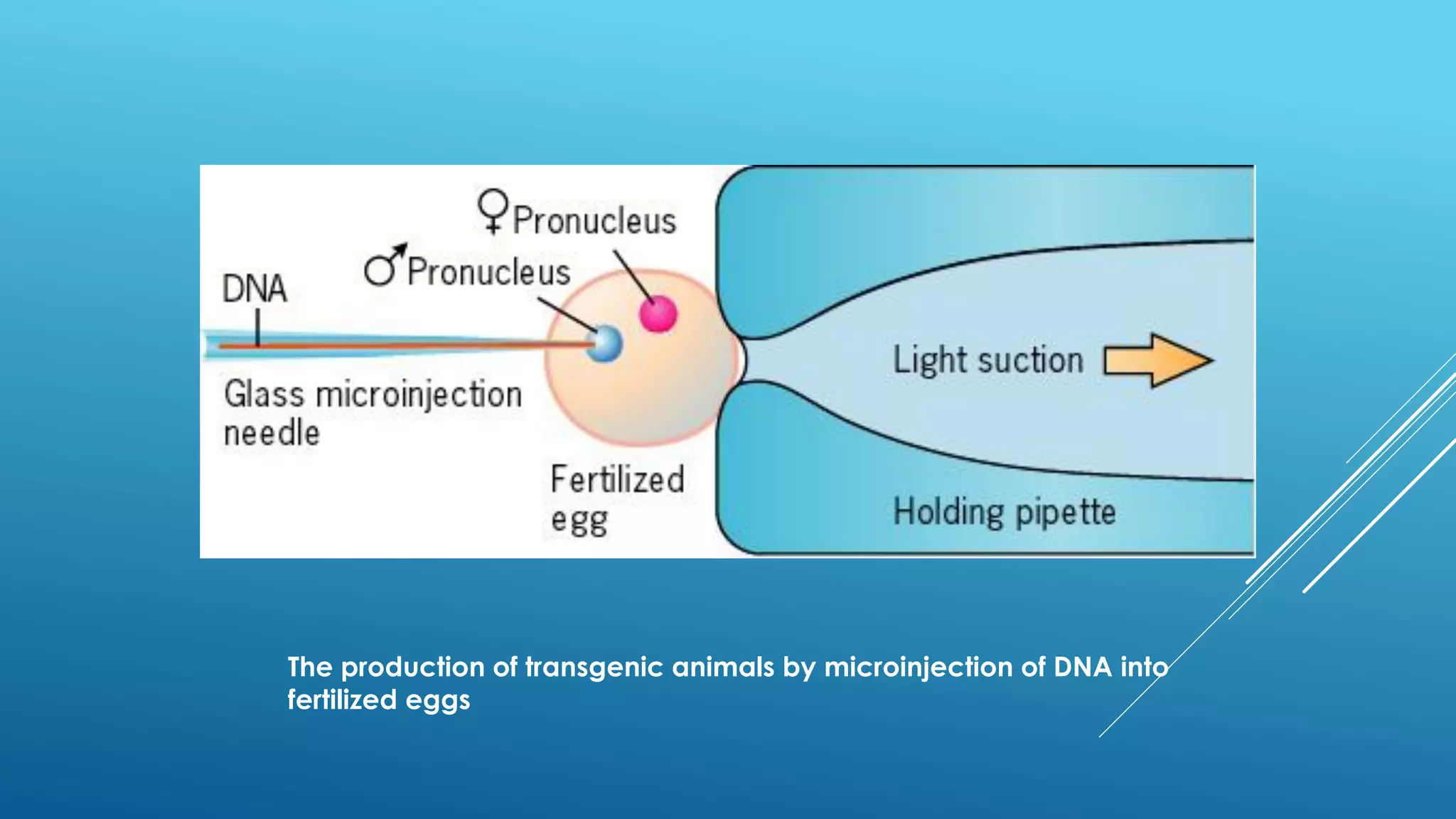
 This method involves the direct microinjection of a chosen gene construct (a single gene or a combination of genes) from
another member of the same species or from a different species, into the pronucleus of a fertilized ovum.
 It is one of the first methods that proved to be effective in mammals (Gordon and Ruddle, 1981).
 The introduced DNA may lead to the over- or under-expression of certain genes or to the expression of genes entirely new
to the animal species.
 The insertion of DNA is, however, a random process, and there is a high probability that the introduced gene will not
insert itself into a site on the host DNA that will permit its expression.
 The manipulated fertilized ovum is transferred into the oviduct of a recipient female, or foster mother that has been
induced to act as a recipient by mating with a vasectomized male.
 A major advantage of this method is its applicability to a wide variety of species.
The production of transgenic animals by microinjection of DNA into
fertilized eggs
EMBRYONIC STEM CELL-MEDIATED GENE TRANSFER
 This method involves prior insertion of the desired DNA sequence by homologous recombination into an in vitro culture of
embryonic stem (ES) cells.
 Stem cells are undifferentiated cells that have the potential to differentiate into any type of cell (somatic and germ cells) and
therefore to give rise to a complete organism.
 These cells are then incorporated into an embryo at the blastocyst stage of development.
 The result is a chimeric animal.
 ES cell-mediated gene transfer is the method of choice for gene inactivation, the so-called knock-out method.
 This technique is of particular importance for the study of the genetic control of developmental processes.
 This technique works particularly well in mice.
 It has the advantage of allowing precise targeting of defined mutations in the gene via homologous recombination.
RETROVIRUS-MEDIATED GENE TRANSFER.
 To increase the probability of expression, gene transfer is mediated by means of a carrier or vector,
generally a virus or a plasmid.
 Retroviruses are commonly used as vectors to transfer genetic material into the cell, taking advantage of
their ability to infect host cells in this way.
 Offspring derived from this method are chimeric, i.e., not all cells carry the retrovirus. Transmission of the
transgene is possible only if the retrovirus integrates into some of the germ cells.
 For any of these techniques the success rate in terms of live birth of animals containing the transgene is
extremely low.
RETROVIRUS-MEDIATED GENE TRANSFER.
 Providing that the genetic manipulation does not lead to abortion, the result is a first generation (F1) of
animals that need to be tested for the expression of the transgene.
 Depending on the technique used, the F1 generation may result in chimeras. When the transgene has
integrated into the germ cells, the so-called germ line chimeras are then inbred for 10 to 20 generations until
homozygous transgenic animals are obtained and the transgene is present in every cell.
 At this stage embryos carrying the transgene can be frozen and stored for subsequent implantation.
APPLICATIONS
 in medical research, transgenic animals are used to identify the functions of specific factors in complex homeostatic systems through
over- or under-expression of a modified gene (the inserted transgene);
 in toxicology: as responsive test animals (detection of toxicants); in mammalian developmental genetics;
 in molecular biology, the analysis of the regulation of gene expression makes use of the evaluation of a specific genetic change at the
level of the whole animal;
 in the pharmaceutical industry, targeted production of pharmaceutical proteins, drug production and product efficacy testing;
 in biotechnology: as producers of specific proteins;
 genetically engineered hormones to increase milk yield, meat production; genetic engineering of livestock and in aquaculture
affecting modification of animal physiology and/or anatomy; cloning procedures to reproduce specific blood lines; and
 developing animals specially created for use in xenografting.
TRANSGENIC MICE AND SHEEP- APPLICATIONS
 As disease model:
 Historically, mice have been used to model human disease because of their physiological, anatomical and genomic similarities to
humans.
 Transgenic animals are produced as disease models (animals genetically manipulated to exhibit disease symptoms so that effective
treatment can be studied) such as Alzheimers, cancer, AIDS.
 Transgenic animals enable scientists to understand the role of genes in specific diseases. The benefits of using transgenic animals
include the possibility of the replacement of higher species by lower species- through development of disease models in mice rather
than in dogs or non-human primates, the extent of discomfort experienced by parent animals during the experimental procedures.
 Transgenic animals such as mice have been found to be valuable in investigations into gene function and for analysis of different
hereditary diseases
APPLICATIONS
 Xenotransplantation
 Nutritional Supplements
 Pharmaceuticals
 Human Gene Therapy
http://bunseiserver.pharm.hokudai.ac.jp/gihou/knockout.html
Chimeric mouse
The brown fur comes from ES cells injected
into the blastocyst of an albino mouse
p27 knockout mouse is bigger than the control
This is not due to obesity, but the skeletal structure is
increased in size (everything about the mouse is larger)
http://www.bioreg.kyushu-u.ac.jp/saibouE.html
p27 knockout mouse
http://www.bbc.co.uk/science/genes/gene_safari/wild_west/bigger_and_better02.shtml
GDF8 (Myostatin) knockout mouse
Over twice the muscle mass of a wildtype mouse
normal knockout
SHEEP
 Increase wool production
 keratin promoter
 growth factor
 Breeding
 Quality
 Disease Resistance

Transgenic Animals.pdf

  • 1.
  • 2.
    • Transgenic animalsare the animals with the modified genome. A foreign gene is inserted into the genome of the animal to alter its DNA. • This method is done to improve the genetic traits of the target animal. • Initially, the improvement of genetic traits was done by selective breeding methods. • The animals with desired genetic characteristics were mated to produce an individual with improved genetic characteristics. • Since this technique was time-consuming and expensive, it was later replaced by recombinant DNA technology. • Transgenesis is the phenomenon in which a foreign gene with desired characteristics is introduced into the genome of the target animal. • The foreign gene that is introduced is known as the transgene, and the animal whose genome is altered is known as transgenic. • These genes are passed on to the successive generations. • The transgenic animals are genetically engineered and are also known as genetically modified organisms. The first genetically modified organism was engineered in the year 1980. What are Transgenic Animals?
  • 3.
    METHODS OF CREATIONOF TRANSGENIC ANIMALS DNA microinjection: Introducing the transgene DNA directly into the zygote at an early stage of development.  No vector required. Retrovirus-mediated gene transfer:  Infecting mouse embryo with a retrovirus which carry the new gene.  Using virus as a vector . Embryonic stem cell-mediated gene transfer:  The blastocyst (inner layer of a fertilized egg) is harvested and mixed with recombinant DNA and inserted back in the blastocyst.
  • 4.
    METHODS OF CREATIONOF TRANSGENIC ANIMALS Somatic-Cell Nuclear Transfer Sperm-mediated transfer:  Use of “Linker protein" to attach DNA to sperm which transfer the new DNA during fertilization. Gene gun
  • 5.
    DNA MICROINJECTION  Thismethod involves the direct microinjection of a chosen gene construct (a single gene or a combination of genes) from another member of the same species or from a different species, into the pronucleus of a fertilized ovum.  It is one of the first methods that proved to be effective in mammals (Gordon and Ruddle, 1981).  The introduced DNA may lead to the over- or under-expression of certain genes or to the expression of genes entirely new to the animal species.  The insertion of DNA is, however, a random process, and there is a high probability that the introduced gene will not insert itself into a site on the host DNA that will permit its expression.  The manipulated fertilized ovum is transferred into the oviduct of a recipient female, or foster mother that has been induced to act as a recipient by mating with a vasectomized male.  A major advantage of this method is its applicability to a wide variety of species.
  • 6.
    The production oftransgenic animals by microinjection of DNA into fertilized eggs
  • 8.
    EMBRYONIC STEM CELL-MEDIATEDGENE TRANSFER  This method involves prior insertion of the desired DNA sequence by homologous recombination into an in vitro culture of embryonic stem (ES) cells.  Stem cells are undifferentiated cells that have the potential to differentiate into any type of cell (somatic and germ cells) and therefore to give rise to a complete organism.  These cells are then incorporated into an embryo at the blastocyst stage of development.  The result is a chimeric animal.  ES cell-mediated gene transfer is the method of choice for gene inactivation, the so-called knock-out method.  This technique is of particular importance for the study of the genetic control of developmental processes.  This technique works particularly well in mice.  It has the advantage of allowing precise targeting of defined mutations in the gene via homologous recombination.
  • 10.
    RETROVIRUS-MEDIATED GENE TRANSFER. To increase the probability of expression, gene transfer is mediated by means of a carrier or vector, generally a virus or a plasmid.  Retroviruses are commonly used as vectors to transfer genetic material into the cell, taking advantage of their ability to infect host cells in this way.  Offspring derived from this method are chimeric, i.e., not all cells carry the retrovirus. Transmission of the transgene is possible only if the retrovirus integrates into some of the germ cells.  For any of these techniques the success rate in terms of live birth of animals containing the transgene is extremely low.
  • 11.
    RETROVIRUS-MEDIATED GENE TRANSFER. Providing that the genetic manipulation does not lead to abortion, the result is a first generation (F1) of animals that need to be tested for the expression of the transgene.  Depending on the technique used, the F1 generation may result in chimeras. When the transgene has integrated into the germ cells, the so-called germ line chimeras are then inbred for 10 to 20 generations until homozygous transgenic animals are obtained and the transgene is present in every cell.  At this stage embryos carrying the transgene can be frozen and stored for subsequent implantation.
  • 13.
    APPLICATIONS  in medicalresearch, transgenic animals are used to identify the functions of specific factors in complex homeostatic systems through over- or under-expression of a modified gene (the inserted transgene);  in toxicology: as responsive test animals (detection of toxicants); in mammalian developmental genetics;  in molecular biology, the analysis of the regulation of gene expression makes use of the evaluation of a specific genetic change at the level of the whole animal;  in the pharmaceutical industry, targeted production of pharmaceutical proteins, drug production and product efficacy testing;  in biotechnology: as producers of specific proteins;  genetically engineered hormones to increase milk yield, meat production; genetic engineering of livestock and in aquaculture affecting modification of animal physiology and/or anatomy; cloning procedures to reproduce specific blood lines; and  developing animals specially created for use in xenografting.
  • 14.
    TRANSGENIC MICE ANDSHEEP- APPLICATIONS  As disease model:  Historically, mice have been used to model human disease because of their physiological, anatomical and genomic similarities to humans.  Transgenic animals are produced as disease models (animals genetically manipulated to exhibit disease symptoms so that effective treatment can be studied) such as Alzheimers, cancer, AIDS.  Transgenic animals enable scientists to understand the role of genes in specific diseases. The benefits of using transgenic animals include the possibility of the replacement of higher species by lower species- through development of disease models in mice rather than in dogs or non-human primates, the extent of discomfort experienced by parent animals during the experimental procedures.  Transgenic animals such as mice have been found to be valuable in investigations into gene function and for analysis of different hereditary diseases
  • 15.
    APPLICATIONS  Xenotransplantation  NutritionalSupplements  Pharmaceuticals  Human Gene Therapy
  • 16.
    http://bunseiserver.pharm.hokudai.ac.jp/gihou/knockout.html Chimeric mouse The brownfur comes from ES cells injected into the blastocyst of an albino mouse
  • 17.
    p27 knockout mouseis bigger than the control This is not due to obesity, but the skeletal structure is increased in size (everything about the mouse is larger) http://www.bioreg.kyushu-u.ac.jp/saibouE.html p27 knockout mouse
  • 18.
  • 19.
    SHEEP  Increase woolproduction  keratin promoter  growth factor  Breeding  Quality  Disease Resistance