X-ray Crystallography
Index
-History
-x-ray
-Introduction
-Instrumentation
x-ray source
monochromatic
calorimeter
Goniometry
photographic plat film
detector
-Principal
-Working
-Application
-Reference
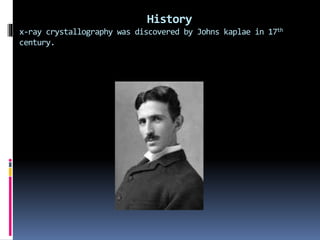
History
x-ray crystallography was discovered by Johns kaplae in 17th
century.
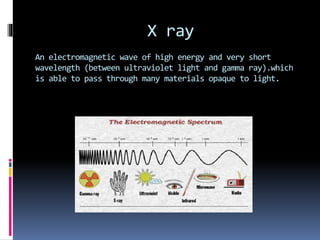
X ray
An electromagnetic wave of high energy and very short
wavelength (between ultraviolet light and gamma ray).which
is able to pass through many materials opaque to light.
Introduction
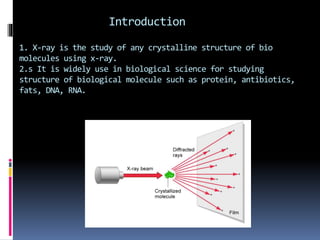
1. X-ray is the study of any crystalline structure of bio
molecules using x-ray.
2.s It is widely use in biological science for studying
structure of biological molecule such as protein, antibiotics,
fats, DNA, RNA.
Properties
1.X-ray travel in straight lines.
2.x-ray are electrically neutral.
3.x-ray are polynergetic and heterogonous.
4.x-ray are invisible ray.
Instruments
The instrument used in x-ray crystallography is know as x-
ray diffractometer and content following part:
1. X-ray source
2. Monochromater
3. Calorimeter
4. Goneometer
5. Photographic plate film
6. Detector
X-ray source
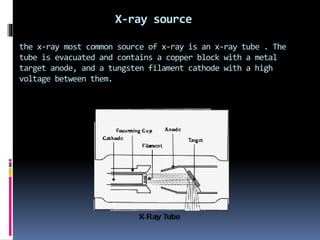
the x-ray most common source of x-ray is an x-ray tube . The
tube is evacuated and contains a copper block with a metal
target anode, and a tungsten filament cathode with a high
voltage between them.
Monochromater
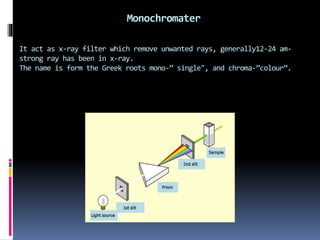
It act as x-ray filter which remove unwanted rays, generally12-24 am-
strong ray has been in x-ray.
The name is form the Greek roots mono-” single", and chroma-”colour”.
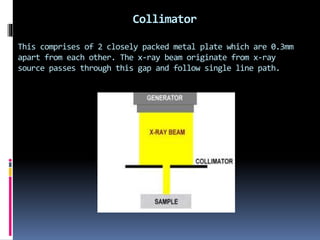
Collimator
This comprises of 2 closely packed metal plate which are 0.3mm
apart from each other. The x-ray beam originate from x-ray
source passes through this gap and follow single line path.
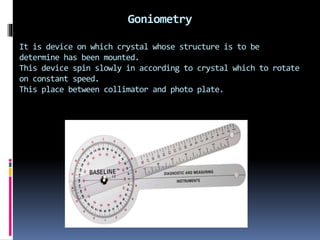
Goniometry
It is device on which crystal whose structure is to be
determine has been mounted.
This device spin slowly in according to crystal which to rotate
on constant speed.
This place between collimator and photo plate.
Photo plate film
As the name suggest this plate capture the diffraction rays of
crystal.
The light-sensitive emulsion of silver salts was coated on a
glass plate ,typically thinner than common window glass
,instead of a clear plastic film .
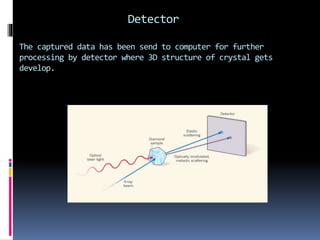
Detector
The captured data has been send to computer for further
processing by detector where 3D structure of crystal gets
develop.
Principle
The principle is based on principle of diffraction
1. The crystal is made to strike against x-ray beam.
2. Due to striking the atoms present in crystal diffracts the x-ray
beam into different direction.
3. The angel and intensity of this diffraction rays is analog to
spatial arrangement of atom in crystal.
4. By studying these angle, the 3D structure of any crystal can be
determine.
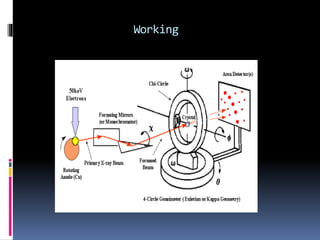
5.X-rays are generated by bombarding electrons on an metallic anode.
Working
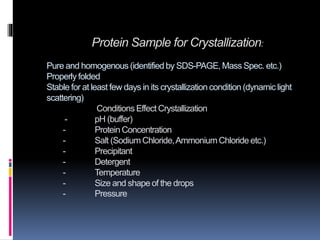
Protein Sample for Crystallization:
Pure and homogenous (identified by SDS-PAGE, Mass Spec. etc.)
Properly folded
Stable for at least few days in its crystallization condition (dynamic light
scattering)
Conditions Effect Crystallization
- pH (buffer)
- Protein Concentration
- Salt (Sodium Chloride,AmmoniumChloride etc.)
- Precipitant
- Detergent
- Temperature
- Size and shape of the drops
- Pressure
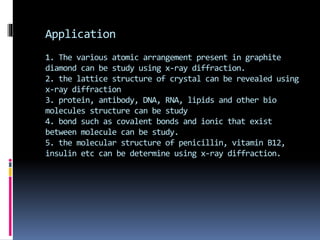
Application
1. The various atomic arrangement present in graphite
diamond can be study using x-ray diffraction.
2. the lattice structure of crystal can be revealed using
x-ray diffraction
3. protein, antibody, DNA, RNA, lipids and other bio
molecules structure can be study
4. bond such as covalent bonds and ionic that exist
between molecule can be study.
5. the molecular structure of penicillin, vitamin B12,
insulin etc can be determine using x-ray diffraction.
Reference
 Avinash Upadhyay, Himalaya publishing house, Biophysical
Chemistry, Fourth edition, chapter 11, , pg no. 523-535.
 http://www.google.com
 http://www.wikipedia.com
Thank you

X ray crystallography

  • 1.
  • 2.
  • 3.
    History x-ray crystallography wasdiscovered by Johns kaplae in 17th century.
  • 4.
    X ray An electromagneticwave of high energy and very short wavelength (between ultraviolet light and gamma ray).which is able to pass through many materials opaque to light.
  • 5.
    Introduction 1. X-ray isthe study of any crystalline structure of bio molecules using x-ray. 2.s It is widely use in biological science for studying structure of biological molecule such as protein, antibiotics, fats, DNA, RNA.
  • 6.
    Properties 1.X-ray travel instraight lines. 2.x-ray are electrically neutral. 3.x-ray are polynergetic and heterogonous. 4.x-ray are invisible ray.
  • 7.
    Instruments The instrument usedin x-ray crystallography is know as x- ray diffractometer and content following part: 1. X-ray source 2. Monochromater 3. Calorimeter 4. Goneometer 5. Photographic plate film 6. Detector
  • 8.
    X-ray source the x-raymost common source of x-ray is an x-ray tube . The tube is evacuated and contains a copper block with a metal target anode, and a tungsten filament cathode with a high voltage between them.
  • 9.
    Monochromater It act asx-ray filter which remove unwanted rays, generally12-24 am- strong ray has been in x-ray. The name is form the Greek roots mono-” single", and chroma-”colour”.
  • 10.
    Collimator This comprises of2 closely packed metal plate which are 0.3mm apart from each other. The x-ray beam originate from x-ray source passes through this gap and follow single line path.
  • 11.
    Goniometry It is deviceon which crystal whose structure is to be determine has been mounted. This device spin slowly in according to crystal which to rotate on constant speed. This place between collimator and photo plate.
  • 12.
    Photo plate film Asthe name suggest this plate capture the diffraction rays of crystal. The light-sensitive emulsion of silver salts was coated on a glass plate ,typically thinner than common window glass ,instead of a clear plastic film .
  • 13.
    Detector The captured datahas been send to computer for further processing by detector where 3D structure of crystal gets develop.
  • 14.
    Principle The principle isbased on principle of diffraction 1. The crystal is made to strike against x-ray beam. 2. Due to striking the atoms present in crystal diffracts the x-ray beam into different direction. 3. The angel and intensity of this diffraction rays is analog to spatial arrangement of atom in crystal. 4. By studying these angle, the 3D structure of any crystal can be determine. 5.X-rays are generated by bombarding electrons on an metallic anode.
  • 15.
  • 16.
    Protein Sample forCrystallization: Pure and homogenous (identified by SDS-PAGE, Mass Spec. etc.) Properly folded Stable for at least few days in its crystallization condition (dynamic light scattering) Conditions Effect Crystallization - pH (buffer) - Protein Concentration - Salt (Sodium Chloride,AmmoniumChloride etc.) - Precipitant - Detergent - Temperature - Size and shape of the drops - Pressure
  • 17.
    Application 1. The variousatomic arrangement present in graphite diamond can be study using x-ray diffraction. 2. the lattice structure of crystal can be revealed using x-ray diffraction 3. protein, antibody, DNA, RNA, lipids and other bio molecules structure can be study 4. bond such as covalent bonds and ionic that exist between molecule can be study. 5. the molecular structure of penicillin, vitamin B12, insulin etc can be determine using x-ray diffraction.
  • 18.
    Reference  Avinash Upadhyay,Himalaya publishing house, Biophysical Chemistry, Fourth edition, chapter 11, , pg no. 523-535.  http://www.google.com  http://www.wikipedia.com
  • 19.