Introduction to Spectroscopy
M. Faisal Shahid
Department of Biosciences
Mohammad Ali Jinnah University
Karachi
Light
Light is electromagnetic radiation within a certain portion of the
electromagnetic spectrum.
The Electromagnetic Spectrum
The electromagnetic spectrum is the ENTIRE RANGE and of
FREQUENCIES of ELECTROMAGNETIC RADIATION* as per their
WAVELENGTHS AND PHOTON ENERGIES.
* LIGHT CAN EXIST AS BOTH PARTICLE AND WAVE (de’ Broglie hypothesis)
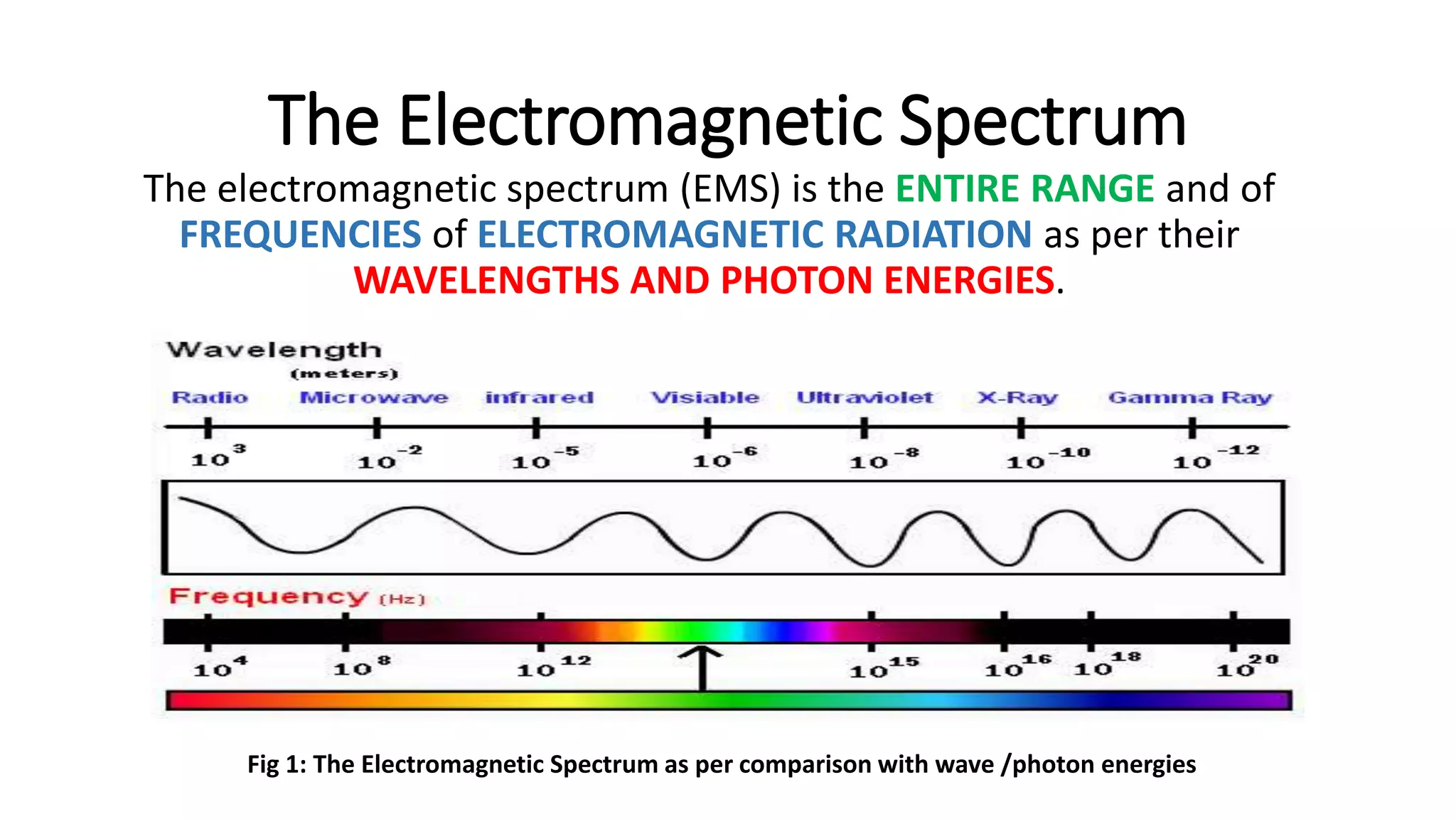
The Electromagnetic Spectrum
The electromagnetic spectrum (EMS) is the ENTIRE RANGE and of
FREQUENCIES of ELECTROMAGNETIC RADIATION as per their
WAVELENGTHS AND PHOTON ENERGIES.
Fig 1: The Electromagnetic Spectrum as per comparison with wave /photon energies
The EMS-Continued
Fig 2: The Electromagnetic Spectrum as per comparison with daily life examples
Spectroscopy
• Spectroscopy is a series of technique(s) that uses the interaction of
energy with a SAMPLE to perform analysis.
OR
• It is the study of matter and the changes it undergo(es) when it
interacts/subjected to a particular electromagnetic radiation (light).
Ionizing and Non Ionizing Radiations
Ionizing radiation refers to types of radiation that has ENOUGH
ENERGY TO REMOVE ATLEAST “ONE” ELECTRON from an atom.
Ionizing radiation is always HIGH ENERGY CARRIER WAVES/PHOTONS
The EMS-Continued
Fig 2: The Electromagnetic Spectrum as per comparison with daily life examples
Boundaries of EMS
Fig 3: The Electromagnetic Spectrum Regional Boundaries as per Wavelengths (ƛ) and Frequency
The Wave Energy Equation (Plank’s Equation)
E=h.ʋ
Here:
E: Energy
h: Plank’s Constant (6.63x10⁻³⁴ J.s)
ʋ: Frequency of a wave [f= 1/(c/ƛ)] or [ f= 1/t(sec))
The UV Spectrum
• 150-380 nm (UV)
Fig 4: The UV Spectrum Regional Boundaries as per Wavelengths (ƛ) and Frequency
Here:
UV-A: Long wave UV (315-400 nm)
UV-B: Medium wave UV (280-315 nm)
UV-C: Short wave (100-280 nm)
Near UV: 300- 380, 400 nm
The Visible Spectrum
Fig 5: The Visible Spectrum Boundaries as per Wavelengths (ƛ) and Frequency
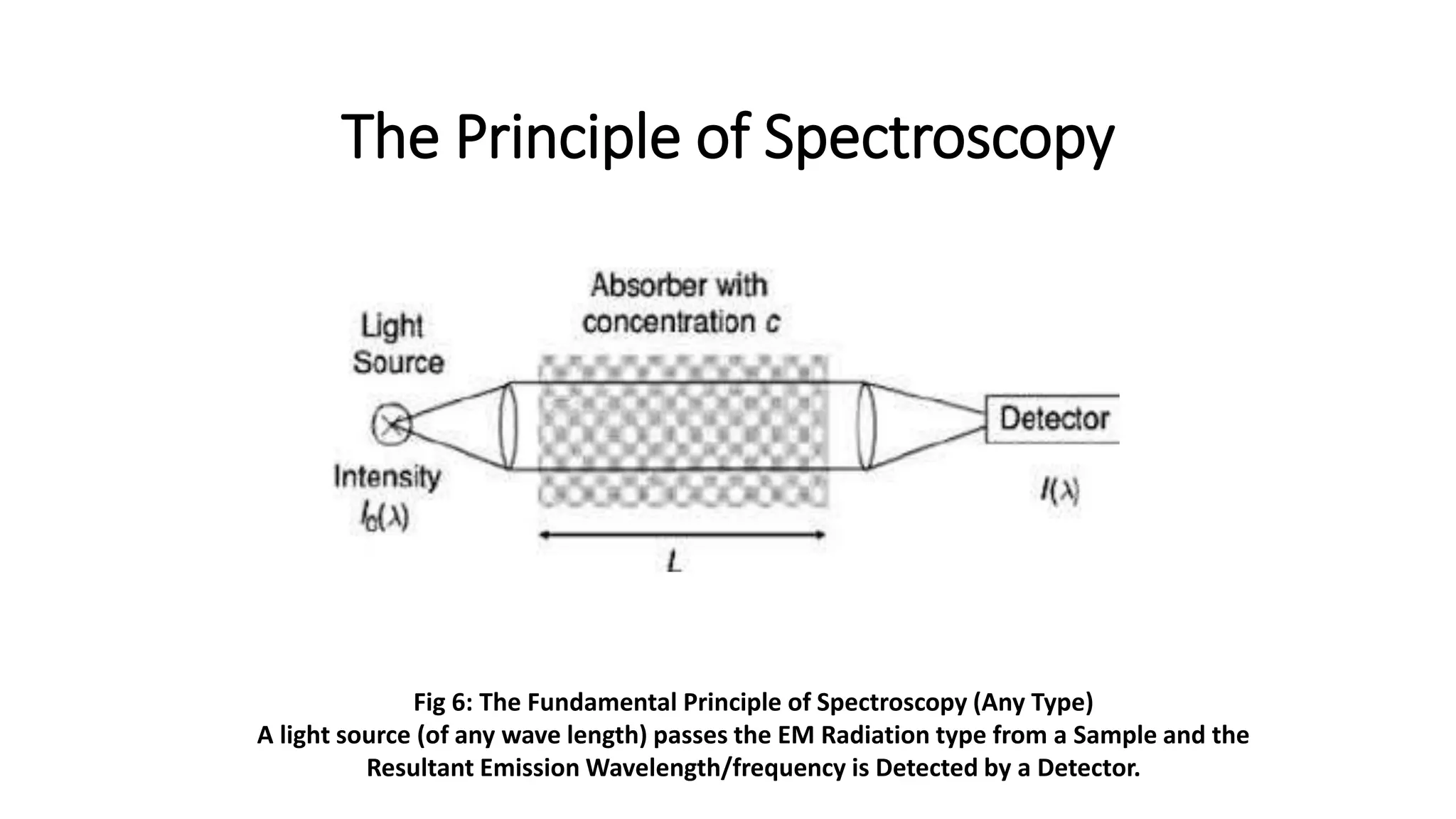
The Principle of Spectroscopy
Fig 6: The Fundamental Principle of Spectroscopy (Any Type)
A light source (of any wave length) passes the EM Radiation type from a Sample and the
Resultant Emission Wavelength/frequency is Detected by a Detector.
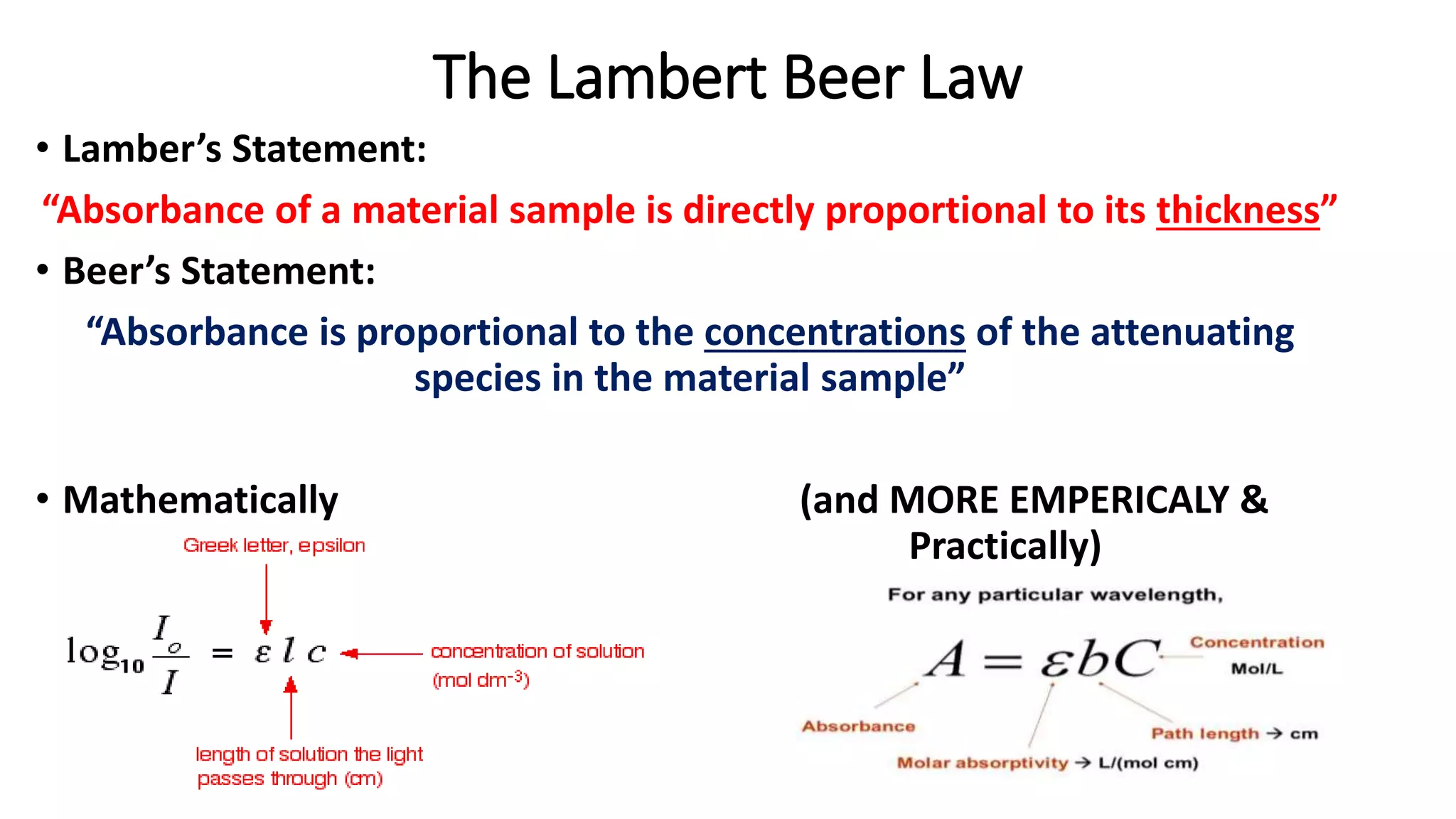
The Lambert Beer Law
• Lamber’s Statement:
“Absorbance of a material sample is directly proportional to its thickness”
• Beer’s Statement:
“Absorbance is proportional to the concentrations of the attenuating
species in the material sample”
• Mathematically (and MORE EMPERICALY &
Practically)
Some Basic Types of Spectroscopy in Research
and Applied Use
• UV-Visible Spectroscopy
• IR-Spectroscopy
• X-Ray Diffraction
• Fluorescent Spectrometery
• Mass Spectrometery
• NMR Spectroscopy
The Founders Behind This Science
Joseph Ritter von Fraunhofer
(Straubing, Germany)
Anders Jonas Ångström
(Uppsala, Sweden)
Heisenberg’s Uncertainty Principle
• “It is simultaneously impossible to PRECISELY MEASURE the POSITION
and ANGULAR MOMENTUM of a moving object at the same time.”
Werner Heisenberg
Nobel Prize in Physics-1932
Spectroscopy Stretched to It’s Limit
at Visualization of 4 states of a Hydrogen Atom
Fig 7: The Electromagnetic Spectrum Regional Boundaries as per Wavelengths (ƛ) and Frequency
Questions??

Introduction to spectroscopy

  • 1.
    Introduction to Spectroscopy M.Faisal Shahid Department of Biosciences Mohammad Ali Jinnah University Karachi
  • 2.
    Light Light is electromagneticradiation within a certain portion of the electromagnetic spectrum.
  • 3.
    The Electromagnetic Spectrum Theelectromagnetic spectrum is the ENTIRE RANGE and of FREQUENCIES of ELECTROMAGNETIC RADIATION* as per their WAVELENGTHS AND PHOTON ENERGIES. * LIGHT CAN EXIST AS BOTH PARTICLE AND WAVE (de’ Broglie hypothesis)
  • 4.
    The Electromagnetic Spectrum Theelectromagnetic spectrum (EMS) is the ENTIRE RANGE and of FREQUENCIES of ELECTROMAGNETIC RADIATION as per their WAVELENGTHS AND PHOTON ENERGIES. Fig 1: The Electromagnetic Spectrum as per comparison with wave /photon energies
  • 5.
    The EMS-Continued Fig 2:The Electromagnetic Spectrum as per comparison with daily life examples
  • 6.
    Spectroscopy • Spectroscopy isa series of technique(s) that uses the interaction of energy with a SAMPLE to perform analysis. OR • It is the study of matter and the changes it undergo(es) when it interacts/subjected to a particular electromagnetic radiation (light).
  • 7.
    Ionizing and NonIonizing Radiations Ionizing radiation refers to types of radiation that has ENOUGH ENERGY TO REMOVE ATLEAST “ONE” ELECTRON from an atom. Ionizing radiation is always HIGH ENERGY CARRIER WAVES/PHOTONS
  • 8.
    The EMS-Continued Fig 2:The Electromagnetic Spectrum as per comparison with daily life examples
  • 9.
    Boundaries of EMS Fig3: The Electromagnetic Spectrum Regional Boundaries as per Wavelengths (ƛ) and Frequency
  • 10.
    The Wave EnergyEquation (Plank’s Equation) E=h.ʋ Here: E: Energy h: Plank’s Constant (6.63x10⁻³⁴ J.s) ʋ: Frequency of a wave [f= 1/(c/ƛ)] or [ f= 1/t(sec))
  • 11.
    The UV Spectrum •150-380 nm (UV) Fig 4: The UV Spectrum Regional Boundaries as per Wavelengths (ƛ) and Frequency Here: UV-A: Long wave UV (315-400 nm) UV-B: Medium wave UV (280-315 nm) UV-C: Short wave (100-280 nm) Near UV: 300- 380, 400 nm
  • 12.
    The Visible Spectrum Fig5: The Visible Spectrum Boundaries as per Wavelengths (ƛ) and Frequency
  • 13.
    The Principle ofSpectroscopy Fig 6: The Fundamental Principle of Spectroscopy (Any Type) A light source (of any wave length) passes the EM Radiation type from a Sample and the Resultant Emission Wavelength/frequency is Detected by a Detector.
  • 14.
    The Lambert BeerLaw • Lamber’s Statement: “Absorbance of a material sample is directly proportional to its thickness” • Beer’s Statement: “Absorbance is proportional to the concentrations of the attenuating species in the material sample” • Mathematically (and MORE EMPERICALY & Practically)
  • 15.
    Some Basic Typesof Spectroscopy in Research and Applied Use • UV-Visible Spectroscopy • IR-Spectroscopy • X-Ray Diffraction • Fluorescent Spectrometery • Mass Spectrometery • NMR Spectroscopy
  • 16.
    The Founders BehindThis Science Joseph Ritter von Fraunhofer (Straubing, Germany) Anders Jonas Ångström (Uppsala, Sweden)
  • 17.
    Heisenberg’s Uncertainty Principle •“It is simultaneously impossible to PRECISELY MEASURE the POSITION and ANGULAR MOMENTUM of a moving object at the same time.” Werner Heisenberg Nobel Prize in Physics-1932
  • 18.
    Spectroscopy Stretched toIt’s Limit at Visualization of 4 states of a Hydrogen Atom Fig 7: The Electromagnetic Spectrum Regional Boundaries as per Wavelengths (ƛ) and Frequency
  • 19.