DARWIN’S THEORY OF NATURAL SELECTIONDARWIN’S THEORY OF NATURAL SELECTION
Presented By
Swati Kumari
Roll no: 22
M.Sc. Bioinformatics
3rd
semester
11th July, 2015
CENTER FOR BIOLOGICAL SCIENCES
(BIOINFORMATICS)
CENTRAL UNIVERSITY OF SOUTH BIHAR, PATNA
1
ContentsContents

Introduction

Factor of Darwinism
 Rapid multiplication
 Limited environmental resources
 Struggle for existence
 Variation
 Survival of the fittest
 Inheritance of the useful variation
 Formation of new species

Darwinism V/S Lamarckism

References
11th July, 2015 2
IntroductionIntroduction

Darwinism : Darwin's Theory of Natural Selection.

The theory of the evolution of species by natural selection
advanced by Charles Darwin announced on July 1, 1858.

Darwin travelled round the world in the 19th century on the ship
H.M.S. Beagle with a surveying expedition for 5 years (1831-1836).

“On the origin of species by Means of Natural Selection “,
November,1859.
311th July, 2015
Natural SelectionNatural Selection

Darwin’s most famous and most important theory of evolution.

Only process that promotes adaptation.

The machenism for adaptation and evolution is called “natural
selection”

This theory states that
“ Those organisms best adapted to their environment
have a better chance of surviving and reproducing.”
411th July, 2015
Factor of DarwinismFactor of Darwinism
• Rapid multiplication
• Limited environmental resources
• Struggle for existence
• Variation
• Survival of the fittest
• Inheritance of the useful variation
• Formation of new species
511th July, 2015
1. Rapid multiplication (over production)1. Rapid multiplication (over production)
Organism reproduce more offspring than can survive. There is high death rate.
e.g. -
 Paramecium divide 3 times in 48 hours with this rate, a single paramecium will
produce in 5 year a mass of paramecium equal to ten thousand times the size of
earth.
 Plant produce thousands of seed each year.
 cod fish may produce over a million egg in a year. If all the egg developed into fishes,
the whole Atlantic Ocean will be full of cods in Five years.
611th July, 2015
Source: http://www.mosaictraining.ca/fishing/images/stories/whatson%2013.jpg
2. Limited environmental resources (space & food)2. Limited environmental resources (space & food)
• Increase of population in animal & plants requires more space
and food but the universe remains constant.
• Individuals compete for limited resources
• food,
• water,
• spaces,
• mates.
11th July, 2015
7
3. Struggle for existence (competition)3. Struggle for existence (competition)
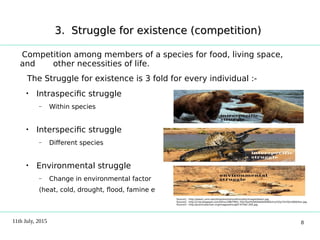
Competition among members of a species for food, living space,
and other necessities of life.
The Struggle for existence is 3 fold for every individual :-
• Intraspecific struggle
 Within species
• Interspecific struggle
 Different species
• Environmental struggle
 Change in environmental factor
(heat, cold, drought, flood, famine etc..)
811th July, 2015
Source1 : http://www1.umn.edu/ships/evolutionofmorality/images/bears.jpg
Source2 : http://2.bp.blogspot.com/HInvu1MbTf8/U_YQz7wziHI/AAAAAAAAAOk/myTjOyY2LY0/s1600/lion.jpg
Source3 : http://practicalaction.org/images/drought-41562-200.jpg
4. Variation & Adaptation4. Variation & Adaptation
• Understanding how individuals of the same species vary was key to Darwin
developing his theory.
• Because the environment changes, the more variation within a species, the
more likely it will survive.
• Each individual has a unique combination of inherited traits.
• An inherited traits that increase an organism's change of survival is called
“Adaptation”.
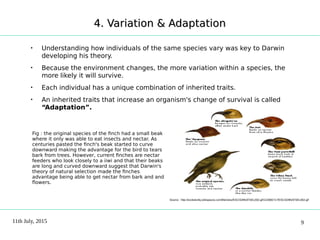
Fig : the original species of the finch had a small beak
where it only was able to eat insects and nectar. As
centuries pasted the finch's beak started to curve
downward making the advantage for the bird to tears
bark from trees. However, current finches are nectar
feeders who look closely to a iiwi and that their beaks
are long and curved downward suggest that Darwin's
theory of natural selection made the finches
advantage being able to get nectar from bark and and
flowers.
911th July, 2015
Source : http://evolutionkj.wikispaces.com/file/view/ESCI329NATSEL002.gif/122865717/ESCI329NATSEL002.gif
5. Survival of fittest (natural selection)5. Survival of fittest (natural selection)
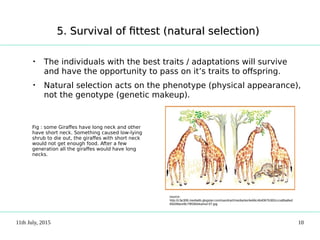
• The individuals with the best traits / adaptations will survive
and have the opportunity to pass on it’s traits to offspring.
• Natural selection acts on the phenotype (physical appearance),
not the genotype (genetic makeup).
Fig : some Giraffes have long neck and other
have short neck. Something caused low-lying
shrub to die out, the giraffes with short neck
would not get enough food. After a few
generation all the giraffes would have long
necks.
11th July, 2015 10
source:
http://c3e308.medialib.glogster.com/sandrart/media/4e/4e66c4b4067b382ccca8ba8ed
65d39ace9c79f28/tekamul-07.jpg
6. Inheritance of the useful variation6. Inheritance of the useful variation
• The individual, selected by nature, pass on their useful variation to
the next generation.
• Thus, offspring of fit individual also be fit.
11th July, 2015 11
6. Inheritance of the useful variation6. Inheritance of the useful variation
Source http://image.slidesharecdn.com/evolution-naturalselection2011-111120023730-phpapp01/95/evolution-natural-selection2011-17-728.jpg?cb=1321757091
7.7. Formation of new speciesFormation of new species
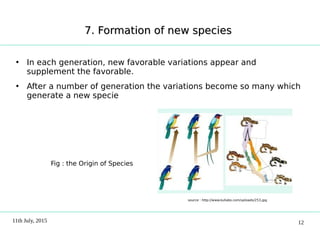
• In each generation, new favorable variations appear and
supplement the favorable.
• After a number of generation the variations become so many which
generate a new specie
11th July, 2015 12
Fig : the Origin of Species
source : http://www.kullabs.com/uploads/253.jpg
Darwinism v/s LamarckismDarwinism v/s Lamarckism
1. It doesn’t believe in the internal
vital force.
2. These vital force do not form part
of Darwin’s natural selection.
3. An organ can develop further or
degeneration only due to
continuous variation
4. Struggle for existence is vary
important.
5. Only useful variation are
transferred to next generation.
6. Darwin’s natural selection theory
is based on survival of the fittest.
1. There is an internal vital force in
all organism.
2. It consider new need or desire or
produce new structure & change
habits of the organism.
3. According to this theory if organ is
contently used it would be better
developed where as disuse of
organ results in its degeneration.
4. No concept of struggle for
existence
5. All the acquired characters are
inherited to the next generation .
6. Lamarckism does not believe in
survival of the fittest.
11th July, 2015 13
ReferencesReferences

http://darwin200.christs.cam.ac.uk/pages/index.php?page_id=d3

Biology, Textbook class XII (NCERT)

Pradeep's A Text Book Of Biology class 12th ; G. Chopra, H.N. Srivastava,
P.S. Dhami.

http://www.apsnet.org/edcenter/advanced/topics/PopGenetics/Pages/Natural
Selection.aspx

http://bivalves.teacherfriendlyguide.org/index.php?
option=com_content&view=article&id=36&Itemid=123

http://nectunt.bifi.es/to-learn-more-overview/mechanisms-of-evolutionary-
change/

http://www.slideshare.net/paprescott/evolution-natural-selection2011-
10239059
11th July, 2015 14
11th July, 2015 15

Natural selection

  • 1.
    DARWIN’S THEORY OFNATURAL SELECTIONDARWIN’S THEORY OF NATURAL SELECTION Presented By Swati Kumari Roll no: 22 M.Sc. Bioinformatics 3rd semester 11th July, 2015 CENTER FOR BIOLOGICAL SCIENCES (BIOINFORMATICS) CENTRAL UNIVERSITY OF SOUTH BIHAR, PATNA 1
  • 2.
    ContentsContents  Introduction  Factor of Darwinism Rapid multiplication  Limited environmental resources  Struggle for existence  Variation  Survival of the fittest  Inheritance of the useful variation  Formation of new species  Darwinism V/S Lamarckism  References 11th July, 2015 2
  • 3.
    IntroductionIntroduction  Darwinism : Darwin'sTheory of Natural Selection.  The theory of the evolution of species by natural selection advanced by Charles Darwin announced on July 1, 1858.  Darwin travelled round the world in the 19th century on the ship H.M.S. Beagle with a surveying expedition for 5 years (1831-1836).  “On the origin of species by Means of Natural Selection “, November,1859. 311th July, 2015
  • 4.
    Natural SelectionNatural Selection  Darwin’smost famous and most important theory of evolution.  Only process that promotes adaptation.  The machenism for adaptation and evolution is called “natural selection”  This theory states that “ Those organisms best adapted to their environment have a better chance of surviving and reproducing.” 411th July, 2015
  • 5.
    Factor of DarwinismFactorof Darwinism • Rapid multiplication • Limited environmental resources • Struggle for existence • Variation • Survival of the fittest • Inheritance of the useful variation • Formation of new species 511th July, 2015
  • 6.
    1. Rapid multiplication(over production)1. Rapid multiplication (over production) Organism reproduce more offspring than can survive. There is high death rate. e.g. -  Paramecium divide 3 times in 48 hours with this rate, a single paramecium will produce in 5 year a mass of paramecium equal to ten thousand times the size of earth.  Plant produce thousands of seed each year.  cod fish may produce over a million egg in a year. If all the egg developed into fishes, the whole Atlantic Ocean will be full of cods in Five years. 611th July, 2015 Source: http://www.mosaictraining.ca/fishing/images/stories/whatson%2013.jpg
  • 7.
    2. Limited environmentalresources (space & food)2. Limited environmental resources (space & food) • Increase of population in animal & plants requires more space and food but the universe remains constant. • Individuals compete for limited resources • food, • water, • spaces, • mates. 11th July, 2015 7
  • 8.
    3. Struggle forexistence (competition)3. Struggle for existence (competition) Competition among members of a species for food, living space, and other necessities of life. The Struggle for existence is 3 fold for every individual :- • Intraspecific struggle  Within species • Interspecific struggle  Different species • Environmental struggle  Change in environmental factor (heat, cold, drought, flood, famine etc..) 811th July, 2015 Source1 : http://www1.umn.edu/ships/evolutionofmorality/images/bears.jpg Source2 : http://2.bp.blogspot.com/HInvu1MbTf8/U_YQz7wziHI/AAAAAAAAAOk/myTjOyY2LY0/s1600/lion.jpg Source3 : http://practicalaction.org/images/drought-41562-200.jpg
  • 9.
    4. Variation &Adaptation4. Variation & Adaptation • Understanding how individuals of the same species vary was key to Darwin developing his theory. • Because the environment changes, the more variation within a species, the more likely it will survive. • Each individual has a unique combination of inherited traits. • An inherited traits that increase an organism's change of survival is called “Adaptation”. Fig : the original species of the finch had a small beak where it only was able to eat insects and nectar. As centuries pasted the finch's beak started to curve downward making the advantage for the bird to tears bark from trees. However, current finches are nectar feeders who look closely to a iiwi and that their beaks are long and curved downward suggest that Darwin's theory of natural selection made the finches advantage being able to get nectar from bark and and flowers. 911th July, 2015 Source : http://evolutionkj.wikispaces.com/file/view/ESCI329NATSEL002.gif/122865717/ESCI329NATSEL002.gif
  • 10.
    5. Survival offittest (natural selection)5. Survival of fittest (natural selection) • The individuals with the best traits / adaptations will survive and have the opportunity to pass on it’s traits to offspring. • Natural selection acts on the phenotype (physical appearance), not the genotype (genetic makeup). Fig : some Giraffes have long neck and other have short neck. Something caused low-lying shrub to die out, the giraffes with short neck would not get enough food. After a few generation all the giraffes would have long necks. 11th July, 2015 10 source: http://c3e308.medialib.glogster.com/sandrart/media/4e/4e66c4b4067b382ccca8ba8ed 65d39ace9c79f28/tekamul-07.jpg
  • 11.
    6. Inheritance ofthe useful variation6. Inheritance of the useful variation • The individual, selected by nature, pass on their useful variation to the next generation. • Thus, offspring of fit individual also be fit. 11th July, 2015 11 6. Inheritance of the useful variation6. Inheritance of the useful variation Source http://image.slidesharecdn.com/evolution-naturalselection2011-111120023730-phpapp01/95/evolution-natural-selection2011-17-728.jpg?cb=1321757091
  • 12.
    7.7. Formation ofnew speciesFormation of new species • In each generation, new favorable variations appear and supplement the favorable. • After a number of generation the variations become so many which generate a new specie 11th July, 2015 12 Fig : the Origin of Species source : http://www.kullabs.com/uploads/253.jpg
  • 13.
    Darwinism v/s LamarckismDarwinismv/s Lamarckism 1. It doesn’t believe in the internal vital force. 2. These vital force do not form part of Darwin’s natural selection. 3. An organ can develop further or degeneration only due to continuous variation 4. Struggle for existence is vary important. 5. Only useful variation are transferred to next generation. 6. Darwin’s natural selection theory is based on survival of the fittest. 1. There is an internal vital force in all organism. 2. It consider new need or desire or produce new structure & change habits of the organism. 3. According to this theory if organ is contently used it would be better developed where as disuse of organ results in its degeneration. 4. No concept of struggle for existence 5. All the acquired characters are inherited to the next generation . 6. Lamarckism does not believe in survival of the fittest. 11th July, 2015 13
  • 14.
    ReferencesReferences  http://darwin200.christs.cam.ac.uk/pages/index.php?page_id=d3  Biology, Textbook classXII (NCERT)  Pradeep's A Text Book Of Biology class 12th ; G. Chopra, H.N. Srivastava, P.S. Dhami.  http://www.apsnet.org/edcenter/advanced/topics/PopGenetics/Pages/Natural Selection.aspx  http://bivalves.teacherfriendlyguide.org/index.php? option=com_content&view=article&id=36&Itemid=123  http://nectunt.bifi.es/to-learn-more-overview/mechanisms-of-evolutionary- change/  http://www.slideshare.net/paprescott/evolution-natural-selection2011- 10239059 11th July, 2015 14
  • 15.